Analyzing: JONATHAN TURLEY: Dem socialist rips ‘institutionalists’ as far left turns up heat on defenders of Constitution — Jonathan Turley · 2026-08-29
What the Editorial Argues
Jonathan Turley, the Shapiro Professor of Public Interest Law at George Washington University, converts a single state rep’s Friday tweet into the leading edge of a coordinated Jacobin-style assault on the U.S. Constitution by the radical left, on the theory that “institutionalist” is a fresh pejorative the radicals have just minted to mark defenders of the Madisonian system for elimination. To make the case the column assembles a curated list of academic critics of specific constitutional arrangements from UC Berkeley, Harvard, Yale, Brown, and George Washington — plus DSA Steering Committee member Cliff Connolly’s podcast declaration and former Obama speechwriter Sarada Peri’s Atlantic essay — then deploys the French Revolution’s Terror and KGB defector Yuri Bezmenov’s four-stage subversion model as predictive templates for what comes next, and closes with an ultimatum drawn from Abdul El-Sayed’s campaign rhetoric aimed at Sen. John Fetterman: institutionalists must surrender their “constitutional ‘nostalgia’” — or face the pike.
Receipts
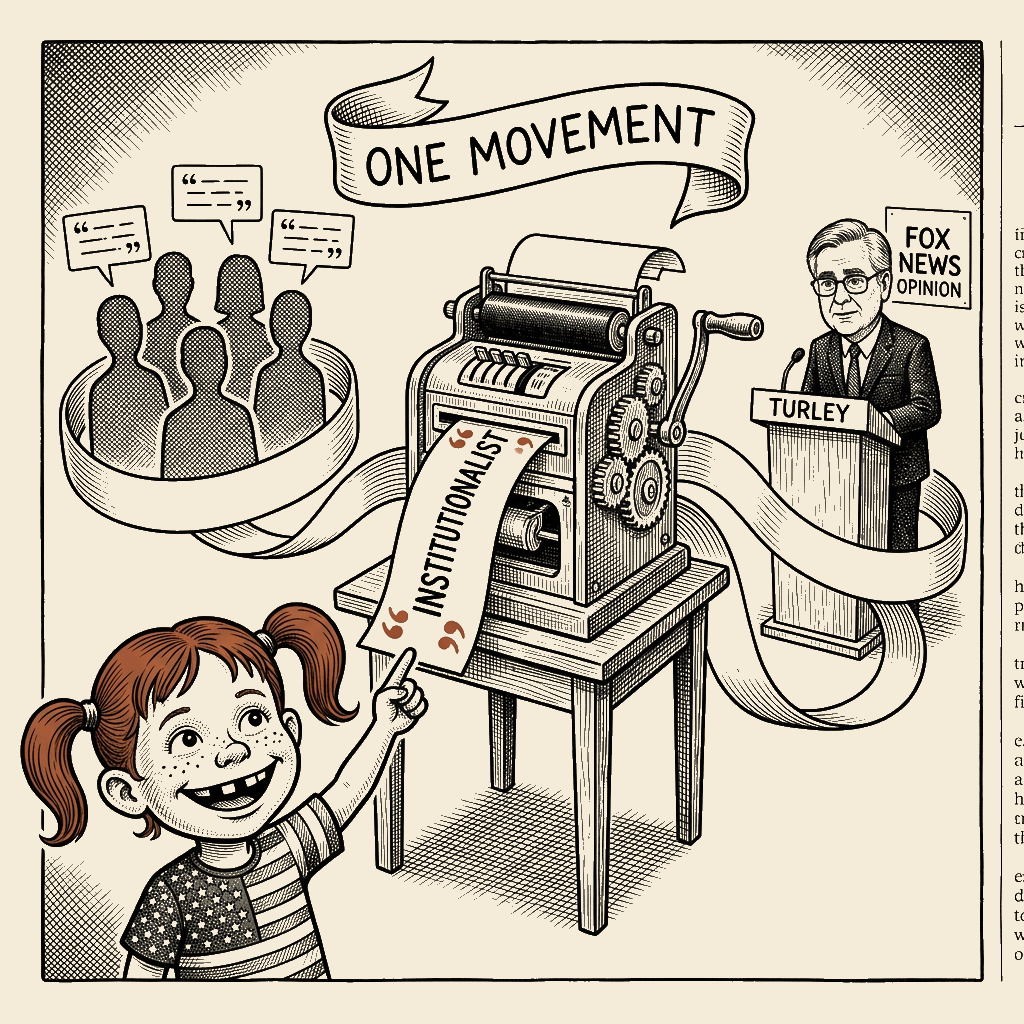
The move: a single state rep’s tweet about Hasan Piker is converted, over fifteen hundred words, into evidence of a coordinated Jacobin-Soviet assault on the founding document, with eleven curated quotes strung together as the voice of one movement.
What the framing wants you to believe
- The radical left — spanning Twitch streamers, state reps, Ivy historians, and law school deans — has declared coordinated war on the U.S. Constitution, and “institutionalist” is the brand they now use to mark defenders for elimination.
- Their playbook follows the French Terror’s template: educated elites radicalize, the radicalized mob consumes the moderates, then turns on itself. Bezmenov’s “four stages” map the same arc onto the present.
- 2026 is the deadline. Institutionalists must surrender their “constitutional ‘nostalgia’” now or join Fetterman on the pike.
What’s really going on
- A curated mosaic of independent critics of specific constitutional arrangements — Doerfler and Moyn’s NYT essay “The Constitution Is Broken and Should Not Be Reclaimed,” Chemerinsky’s No Democracy Lasts Forever, Brettschneider’s “dangerous document,” Franks’s “cult of the Constitution” defending “White male supremacy,” Connolly’s “hatred of the United States Constitution” podcast line, Peri’s “peculiar creatures” Atlantic essay — is presented as evidence of one movement. No shared text, no joint statement, no organizing body is shown linking them, because none exists. The aggregation is itself the proof.
- The Bezmenov and Jacobin references do the work the assembled quotes cannot: they retag ordinary domestic disagreement about constitutional arrangements as foreign-intelligence subversion and as the precursor to the Terror, which exempts the column from any obligation to engage the substantive merits of those arrangements.
- The closing “pikes” image is borrowed from El-Sayed’s campaign rhetoric about Fetterman and redeployed at Turley’s own coalition in identical metaphor — the threat-mirror that lets the writer disclaim the violence while deploying it. The author’s bio block — credentialed defender and named casualty in a single body — does the same move at the level of voice.
The Operation
This is a textbook layering of the Bad-Faith Techniques Catalog and the National Review Editorial Technique Catalogue, run on a Turley-byline Fox News opinion column. The piece does not argue that the Constitution should be defended; it argues that defending the Constitution should be the only permissible posture, and that anyone who deviates from it is, by lexical fiat, a Jacobin, a Soviet, or a pikeman’s customer. The argument is the labeling. The labeling is the operation.
**Scare-quote currency recode — [bf_catalog: frame_engineered_relabeling](/propaganda/docs/bad-faith-techniques-catalogue#frame-engineered-relabeling)** (cf. [WSJ Editorial Technique Catalogue](/propaganda/docs/wsj-technique-catalogue) §4.1, the substitution table); bf_catalog: equivocation runs in parallel. The piece pivots on a single lexeme: “institutionalist,” placed in scare quotes on first use and held in scare quotes throughout. The article’s stated thesis — that “institutionalist” is a fresh pejorative “invented” by the radical left — frames a word that has been a neutral descriptor in American political science for decades as if it were radical coinage. The same machinery is run on “cultists,” “nostalgia,” and “Big Tent party.” The column then equivocates between “institutionalist” as descriptive political-science term and “institutionalist” as alleged in-group slur, and reroutes the slur back to the writer’s coalition as a badge of honor. The article puts the move in its own mouth: “Those of us who continue to celebrate the Madisonian democracy … are now ‘cultists’ and ‘institutionalists’ who are trapped in ‘nostalgia.’” The writer who complains about being labelled is now labelling himself, in identical vocabulary, on identical terrain. This is the reclaimed-pejorative inversion, the most distinctive single move in the column. The scare-quote machinery substitutes for the column’s missing argument for why the constitutional arrangements under defense should be defended.
Mosaic aggregation — [bf_catalog: hasty_generalization`](/propaganda/docs/bad-faith-techniques-catalogue#hasty-generalization) (NR Editorial Technique Catalogue lineage). Eleven distinct voices — Piker, Rabb, Connolly, Peri, Chemerinsky, Doerfler, Moyn, Brettschneider, Franks, Harris, Newsom, Buttigieg, El-Sayed, Bezmenov — are presented as evidence of one movement. The aggregation has no organizing document, no shared text, no joint statement, no coordinating body. The technique converts a curated list of independent critics into a single coordinated actor and uses the volume as the proof. The absence of a connecting thread is never acknowledged, because acknowledging it would collapse the column’s spine.
Category smuggle — [bf_catalog: equivocation](/propaganda/docs/bad-faith-techniques-catalogue#equivocation); cf. bf_catalog: strawman selectional. The piece gathers critiques voiced under titles and headlines about whether the Constitution is “broken” or “dangerous” or a vehicle for “White male supremacy,” and treats them as evidence of wholesale constitutional rejection. The equivocation does the load-bearing work: critiques voiced inside academic and journalistic registers about specific institutional arrangements are presented as identical to rejection of “the Constitution” as a textual and structural document. The column does not engage the actual proposed reforms under any critic’s signature; it engages the maximalist version.
Guilt by contamination chain — [bf_catalog: ad_hominem](/propaganda/docs/bad-faith-techniques-catalogue#ad-hominem) circumstantial; cf. bf_catalog: genetic_fallacy. Hasan Piker is introduced first and characterized in Turley’s voice as a “virulent antisemite” whose record includes “claims that America deserved 9/11, American Jews are asking to be attacked by supporting Israel and mocking the murder of figures like Charlie Kirk.” Rabb’s refusal to disavow Piker is then presented as evidence of Rabb’s radicalism — and, by extension, of every other democratic socialist the column assembles. The chain does not require Rabb to share Piker’s views; it requires only that the reader keep both names in the same frame. The named target is contaminated by the un-named-but-present associate.
Historical-analogy smuggling (NR Editorial Technique Catalogue §4.5, the civilizational frame). The French Revolution’s Terror and Bezmenov’s four-stage model are not offered as comparisons. They are offered as templates — predictive models in which the next stage is the next stage. Turley supplies the assimilation in his own language: “‘The Terror’ began not with the working class, but with educated lawyers, journalists and even aristocrats as part of the Jacobin movement.” Hasan Piker, Chris Rabb, the DSA, Kamala Harris, Gavin Newsom, Pete Buttigieg, Chemerinsky, Doerfler, Moyn, Brettschneider, and Franks are silently recruited into the role of “Jacobin lawyers and aristocrats.” The Framers — and Turley’s coalition — become the would-be victims. The analogy functions as forecast, which exempts it from disconfirmation. The foreign-intelligence frame — Bezmenov as KGB defector — does the same work at higher pitch: a domestic policy disagreement is retagged as something resembling a foreign operation, which converts ordinary political opposition into something close to an act of war. The piece’s own words: “It began with undermining our institutions and values, with the help of journalists and academics.”
Threat-mirror projection (NR Editorial Technique Catalogue §4.5; WSJ Editorial Technique Catalogue §4.13 threat-inflation closer). El-Sayed’s “heads cut off and put on pikes like ogres” line, aimed at moderates, is converted by Turley’s closing line into a literal decapitation image aimed at his own coalition: “So much for the ‘Big Tent party.’ For institutionalists, the message is clear. Lose your constitutional ‘nostalgia’ or your political heads.” The writer borrows the violent register of the named enemy and aims it back, blurring who threatened whom. The violent register is preserved; the original speaker is laundered out.
Selective one-sided panel (cluster; cf. WSJ Editorial Technique Catalogue §4.5 the “study shows” ledger in reverse). Every cited academic is a critic of the Constitution or its institutional arrangements. No constitutional originalist, no institutionalist legal historian, no defender of the existing structure is cited as a counter-voice, and no contrary scholarship is engaged. The panel is curated to one side, and the curation is invisible — the column presents the curated panel as the field.
Self-positioned authority (NR Editorial Technique Catalogue §4.2 erudition-as-cudgel, the credential variant; cf. [bf_catalog: expert_consensus](/propaganda/docs/bad-faith-techniques-catalogue#expert-consensus) / expert_deference framings). Turley’s bio block — “Shapiro Professor of Public Interest Law” at GWU; counsel in “some of the most notable cases in the last two decades”; “testified more than 50 times before the House and Senate,” including the Gorsuch confirmation; expert witness in both the Clinton and Trump impeachment proceedings; author of Rage and the Republic: The Unfinished Story of the American Revolution (Simon & Schuster, 3 February 2026) — positions the author as both credentialed defender and named casualty of the assault he is describing. The author is inside the cohort he is defending, which gives the column its self-positioning authority and its threat-receiver credibility at the same time. The victim and the authority are the same body.
NR Editorial Technique Catalogue §4.1, “Stands Athwart History” is the tonal spine of the column: the first-person plural (“those of us who continue to celebrate the Madisonian democracy”), the past-tense nostalgia, the besieged posture — the standard-issue moves of the embattled-establishment-defender genre the catalogue has tracked across three decades of right-of-center editorial writing. The embattled posture is itself the consolation: the writer gets to inhabit the felt-experience of dissent without paying the cost of actual marginality, in a column whose coalition holds the Supreme Court, the Senate, the House, and the executive branch.
Manufactured urgency — [bf_catalog: manufactured_controversy`](/propaganda/docs/bad-faith-techniques-catalogue#manufactured-controversy) adj. The column opens on a Friday tweet, files for the Saturday cycle, and names the 2026 midterms as the operational deadline. The compression of time is itself the argument.
Slippery-slope catastrophe — [bf_catalog: slippery_slope`](/propaganda/docs/bad-faith-techniques-catalogue#slippery-slope) closes the column: after they come for the institutionalists, they will come for the incrementalists. The sequence is asserted, not argued.
The integration is the move. None of these techniques would land alone. Sequenced — recode → aggregate → smuggle → contaminate → analogize as prophecy → threaten-by-mirror → credential as casualty — they convert a single state rep’s snarky Friday tweet into the leading edge of the Jacobin mob. The lexical update from older scare-words to “institutionalist” is the surface change; the sequencing is not new. I have built versions of this column. The vocabulary is the tell. The vocabulary is always the tell.
The Record
The artifact: a Fox News opinion column, “Dem socialist rips ‘institutionalists’ as far left turns up heat on defenders of Constitution,” published under Jonathan Turley’s byline on the Fox News foxnews.com/opinion path on 29 August 2026. Turley’s bio block — Shapiro Professor of Public Interest Law at GWU; B.A. University of Chicago, J.D. Northwestern, honorary Doctorate of Law from John Marshall Law School (2008); author of Rage and the Republic: The Unfinished Story of the American Revolution (Simon & Schuster, 3 February 2026), described in the bio as released “on the 250th anniversary of the American Revolution”; counsel in “some of the most notable cases in the last two decades,” including whistleblowers, members of Congress, and former cabinet members; expert witness in both the Clinton and Trump impeachment hearings — is presented in the column’s own footer as the author’s standing.
The curated mosaic the column assembles is independently identifiable. Doerfler and Moyn’s NYT essay “The Constitution Is Broken and Should Not Be Reclaimed” is on the public record; Chemerinsky’s No Democracy Lasts Forever: How the Constitution Threatens the United States is in print; Brettschneider’s “dangerous document” formulation, Franks’s “cult of the Constitution” / “White male supremacy” line, Connolly’s DSA Steering Committee status and his “hatred of the United States Constitution” podcast line, Peri’s Atlantic essay and her “peculiar creatures” formulation, Rabb’s tweet, and the El-Sayed / Fetterman “pikes” remark all appear, as cited, in the column. Bezmenov’s four-stage model is a well-circulated interview artifact from his defector-era appearances; the column’s invocation tracks the public-record formulation. None of the preserved facts is fabricated; the propaganda work lives entirely in the assembly, in the lexical recoding, and in the closing threat-mirror.
What the column does not surface: the substantive content of the constitutional critique any of the cited critics actually makes; any contrary scholarship under any originalist or institutionalist signature; any text, joint statement, manifesto, conference, or organizing body linking the eleven named figures into one movement; the actual evidentiary status of the antisemitism allegations against Piker beyond Turley’s summary; any account of where the El-Sayed “pikes” remark originated or how subsequent campaigns qualified it; the documented policy substance of any individual named as “institutionalist.” The omissions are the spine.
The piece’s structural lineage is identifiable: named-enemy construction, imported cautionary tale, foreign-intelligence gloss, threat-mirror close, and self-positioned besieged-coalition posture are the same five moves that have anchored right-of-center constitutional-defense editorials from the Bork era forward. The lexical update (“institutionalist” replacing the previous generation’s scare-words) is real; the operating sequence is continuous. Turley’s column is not an innovation. It is a maintenance run.
How to Recognize This
When a “mainstream-versus-radical” column on the constitutional question lands in your feed, the diagnostic is the cluster:
- A new pejorative is invented or recoded. A previously descriptive term — “institutionalist,” “moderate,” “centrist,” “normie,” “establishment Dem,” “incrementalist” — is held in scare quotes throughout, treating the alleged pejorative use as the writer’s own diagnostic lens and as the writer’s own badge of honor by column’s end. The vocabulary is the tell.
- A single recent rhetorical artifact is elevated to the lead. A tweet, a podcast line, a campaign metaphor, an interview aside — the column treats its existence as the news. The rest of the column is built around it.
- Five or more critics of specific institutional practices are assembled into an unnamed collective. No shared text, meeting, manifesto, or organizing body is shown. The aggregation is itself the proof. Where would a connecting thread come from? It cannot, because none exists.
- Critique voiced under headlines or titles about whether the Constitution is “broken,” “dangerous,” or a vehicle for “White male supremacy” is recast as wholesale rejection of the founding document. The equivocation does the load-bearing work. The actual proposed reforms under any critic’s signature are not engaged.
- A historical catastrophe — the French Terror, the Bolshevik seizure, the Long March, the Cultural Revolution — is imported as predictive template rather than as comparison. No disconfirmation condition is offered. The analogy is not an argument; it is a forecast that exempts itself from falsification.
- A foreign-intelligence gloss is imported. Bezmenov, KGB, Soviet subversion, color revolution, the equivalent on the other side — a domestic policy disagreement is retagged as something resembling a foreign operation. Once the retag is in place, ordinary political opposition can be treated as something close to an act of war.
- The closing lines issue an explicit ultimatum tied to an upcoming election cycle. The threat-mirror returns an opponent’s violent metaphor at the writer’s own coalition. The original speaker is laundered out; the violent register is preserved.
- The author’s own institutional standing is staged as both credential and exposure to danger. The bio block at the bottom of the column performs the same dual function the column is performing at the level of policy: defender and casualty in the same body.
- The piece runs under the byline of an establishment credential holder in a right-of-center outlet. The author is inside the cohort defending. The left-coded target is the entire opposition coalition, not a specific faction or a specific statement.
When seven or eight of these markers co-occur in a single column, the piece is running the manufactured-enemy constitutional-defense operation catalogued at [bf_catalog: frame_engineered_relabeling](/propaganda/docs/bad-faith-techniques-catalogue#frame-engineered-relabeling), bf_catalog: hasty_generalization, [bf_catalog: equivocation](/propaganda/docs/bad-faith-techniques-catalogue#equivocation), bf_catalog: ad_hominem circumstantial, [bf_catalog: genetic_fallacy](/propaganda/docs/bad-faith-techniques-catalogue#genetic-fallacy), bf_catalog: strawman, [bf_catalog: slippery_slope](/propaganda/docs/bad-faith-techniques-catalogue#slippery-slope), bf_catalog: manufactured_controversy, layered with National Review Editorial Technique Catalogue §4.1 “Stands Athwart History” and §4.5 the civilizational frame, and the WSJ Editorial Technique Catalogue §4.1 frame-engineered relabeling spine and §4.13 threat-inflation closer. The Turley column of 29 August 2026 is the case in textbook form.
The piece does not argue that the Constitution should be defended. It argues that defending the Constitution should be the only permissible posture, and that anyone who deviates from it is, by lexical fiat, a Jacobin, a Soviet, a pikeman’s customer. The argument is the labeling. The labeling is the operation. Recognize the recode on first encounter, and refuse the scare-quote currency before the column has finished its first paragraph — because by the closing line, the writer has already worn the brand he came in claiming was being used against him, and the threat he came in attributing to the other side has already been returned at his own. I have built versions of this column. The structure is recognizable on first read by anyone who has built it.

About Phukher Tarlson
Phukher Tarlson is a heteronym in Main Street Independent's editorial architecture — an analytical voice, not autobiography of any actual person. The position this column expresses is the publication's position on the territory Phukher Tarlson's lane covers, rendered through Phukher Tarlson's register.