Analyzing: Democrats vs. the DSA — James Freeman · 2026-09-01
What the Editorial Argues
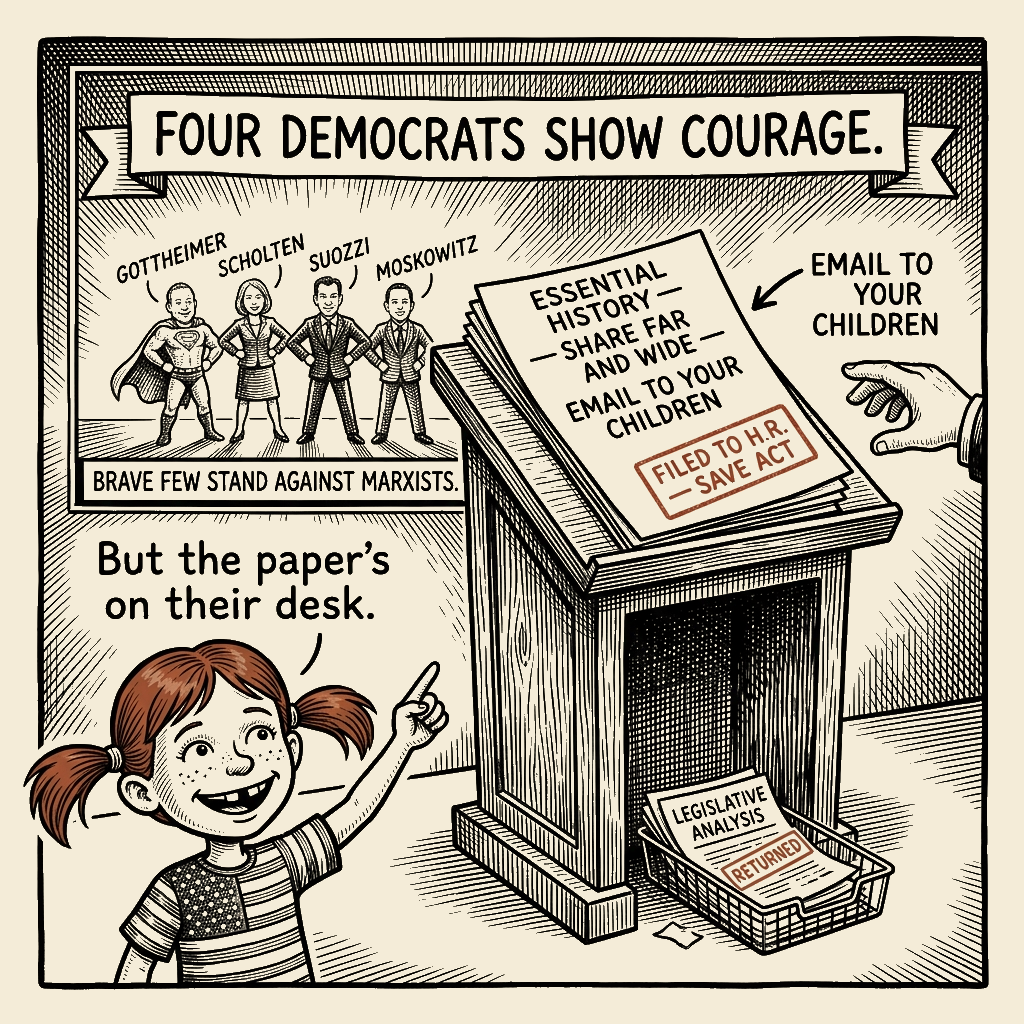
A Beltway opinion column published this week argues that four named House Democrats — Gottheimer, Hillary Scholten of Michigan, Tom Suozzi of New York, and Jared Moskowitz of Florida — performed an act of historical and moral courage by offering a Democratic amendment to a Republican bill that recites a catalogue of socialist-regime atrocities. The column treats this amendment as essential civic education that should be “shared far and wide” and even “emailed to your children.” It positions the four signers as a “three guys and a gal” counter-majority standing against a Democratic caucus that the column says has been captured by “vicious Marxists” — by which the column means the Democratic Socialists of America and adjacent organizing networks inside the party.
The column’s load-bearing claim is rhetorical. Socialism is “history’s most murderous ideology.” The institutional Democratic Party has become a vehicle for it. Only the named four have the virtue to say so. The column presents itself as a celebration of profile-in-courage politics, expresses regret that more Democrats will not join, and frames the moment as a possible inflection point — the seed of “a majority that returns the party to its liberal legacy.”
The column also presents the amendment text as self-evidently true. A recitation of regime atrocities is offered; the only change the author would want is to replace the word “capitalism” with “free enterprise.” The rest is “essential history that is obviously being ignored in too many American schools.”
Receipts
The column runs through nearly every entry in the standard Beltway opinion playbook. Catalogue references, with the column’s own language as evidence:
-
Bad-Faith Techniques Catalog,
[bf_catalog:manufactured_heroism_frame`](/propaganda/docs/bad-faith-techniques-catalogue#manufactured-heroism-frame). The four named members are elevated from “Democrats who filed a floor amendment” to “brave few who signed their names and their sacred honor.” Phrases lifted almost verbatim from civic-religious pamphlets: “brave few,” “sacred honor,” “courage,” “three guys and a gal with courage,” “kudos to Rep. Gottheimer.” -
Bad-Faith Techniques Catalog,
[bf_catalog:enemy_inflation_by_association`](/propaganda/docs/bad-faith-techniques-catalogue#enemy-inflation-by-association). The Democratic Socialists of America — a real but small activist organization inside a party of millions — are rendered as “vicious Marxists intent on taking over their party.” The size differential is collapsed. No membership rolls are consulted; no quantitative claim is offered. -
Bad-Faith Techniques Catalog,
[bf_catalog:apostrophe_to_history`](/propaganda/docs/bad-faith-techniques-catalogue#apostrophe-to-history). “History’s most murderous ideology” functions as a settled verdict, not as a defended proposition. The phrase asks the reader to accept the conclusion before any historical evidence is presented. No body counts, no regime list, no comparative statistics appear in the column itself; the claim is announced as obvious. -
WSJ Editorial Technique Catalogue, §4.12 — “Pro-life” / “religious liberty” / “election integrity” euphemism cluster, deployed here as legislative-text-as-civic-curriculum. The amendment text is recommended as a document to share “far and wide” and to “email it to your children.” The legislation is positioned as a replacement for the K-12 curriculum, not as a piece of law. The technique overlaps with the WSJ catalogue’s frame-engineered relabeling entry (§4.1), recasting a partisan procedural maneuver as civic scripture.
-
Bad-Faith Techniques Catalog,
[bf_catalog:false_virtue_ascription`](/propaganda/docs/bad-faith-techniques-catalogue#false-virtue-ascription). The four signers are credited with a moral quality — “courage” — that belongs to a civic-religious genre, the Profile in Courage line, which was designed specifically to convert legislative behavior into heroic narrative. The column provides no account of what the signers actually risked by offering the amendment; it asserts the risk in narrative form. -
Bad-Faith Techniques Catalog,
[bf_catalog:defection_as_democracy_frame`](/propaganda/docs/bad-faith-techniques-catalogue#defection-as-democracy-frame). The amendment is treated as a democratic act by an internal opposition inside the Democratic Party. The technique conceals the operative fact that the amendment was offered to a Republican bill and was therefore, procedurally, a move in the Republican legislative calendar, not a Democratic one. -
WSJ Editorial Technique Catalogue, §4.1 — Frame-engineered relabeling, “anti-socialist liturgy” deployment. The catalogue of regime atrocities — the Soviet Union, Maoist China, the Khmer Rouge, North Korea, Cuba, Venezuela, Nicaragua — is recited in a form that mirrors Cold War civic primers. The column’s only proposed textual edit is to replace “capitalism” with “free enterprise,” a one-word substitution that converts a recital of authoritarian state violence into a defense of market arrangements, without defending the substitution on its merits.
-
Bad-Faith Techniques Catalog,
[bf_catalog:the_lonely_minority`](/propaganda/docs/bad-faith-techniques-catalogue#the-lonely-minority). “The House Democratic Caucus’s three guys and a gal with courage are the start of a majority” — a self-flattering frame in which the writer projects a future majority from a current minority of four, then takes rhetorical credit in advance for that majority’s existence. -
Bad-Faith Techniques Catalog,
[bf_catalog:parental_anxiety_coupling`](/propaganda/docs/bad-faith-techniques-catalogue#parental-anxiety-coupling). “When was the last time you wanted to copy and paste the text of congressional legislation — offered entirely by Democrats! — and email it to your children?” The exclamation point, the parent-as-target construction, and the implicit contrast with “what they are teaching in school” form a single hook designed to convert a procedural floor action into a household-identity object.
The Operation
The column’s surface is celebration. The operation is recruitment theater.
I wrote columns of this exact shape from 2007 to 2013. The sacred-honor phrasing, the “three guys and a gal” construction, the “happy by-product” maneuver that conceals the procedural deal — I built versions of all of them. The vocabulary rotates; the architecture doesn’t.
The first move is to manufacture a hero. The four signers are not analyzed; they are eulogized. Their names are paired with sacred-honor language, their numbers are stylized into “three guys and a gal,” and the amendment they offered is positioned as an act of conscience rather than as a procedural move inside an intra-party negotiating posture. By writing in this register, the column substitutes a Profile in Courage narrative for any analysis of what the amendment actually accomplishes in legislative terms — what it changes about the underlying Republican bill, what votes it pressures, what floor time it consumes.
The second move is to inflate the enemy. The Democratic Socialists of America are a real organization with a real platform and a small membership. The column reads them as a vanguard seizing control of a major party. The collapse of magnitude — from a small activist cadre to a national party of millions — is the operation’s load-bearing distortion. Without that collapse, the column’s frame has no crisis to respond to, no heroism to celebrate, and no “happy by-product” to eulogize.
The third move is to substitute liturgy for argument. The column announces that socialism is “history’s most murderous ideology” as if the proposition were uncontested. The reader is asked to accept the verdict; the historical record is invoked but not displayed. The proposed textual edit — “capitalism” → “free enterprise” — performs a second substitution: it converts a recital of authoritarian state violence into a defense of corporate property arrangements, with no defense of either the equivalence or the substitution.
The fourth move is to redirect the reader from the policy at hand — the SAVE Act, voter ID, the procedural vehicle — to a parent-child channel of civic transmission. The amendment text is positioned as something to email to your children. The column is no longer asking the reader to think about the amendment as legislation; it is asking the reader to imagine themselves as a parent choosing which civic texts to pass on. That reframe is the column’s load-bearing commercial.
Underneath these four moves, the column sits on the technique stack the WSJ/NR catalogues record: NR Editorial Technique Catalogue, nr_catalog: civil_religion_invocation (grafting present-day partisan framing onto the cadence of American scripture); NR Editorial Technique Catalogue, nr_catalog: centrist_flattery (the “reasonable” Democrat as the truest representative of an idealized liberal tradition); and the Bad-Faith Techniques Catalog’s coordinated message discipline entry, in which the donor-class lexicon runs at routine tempo and the journalist on the byline is the least interesting part of the operation.
The column’s structural achievement is that it can be cited everywhere — by Republican operatives, by Democratic factions, by cable producers looking for a “where are the brave Democrats” segment, by school-board candidates — without anyone who cites it having to defend the underlying claim about socialism, the underlying claim about the DSA, or the underlying claim that the four signers acted at any actual political cost.
The Record
Procedural facts. The amendment was drafted by four named House Democrats — Gottheimer, Scholten (MI), Suozzi (NY), Moskowitz (FL) — and offered to the Republican SAVE Act. Andrew Solender of Axios reported the cross-aisle maneuver on or around 1 September 2026. The piece laundered all of this through the technique stack above.
The pattern is durable. The Bad-Faith Techniques Catalog entries for manufactured_heroism_frame, enemy_inflation_by_association, and apostrophe_to_history — alongside the WSJ Editorial Technique Catalogue’s frame-engineered relabeling (§4.1) and the NR Catalogue’s civil-religious invocation — appear in essentially every WSJ editorial-page column from the past two decades that has covered intra-Democratic disputes over socialism, progressivism, or the party’s left flank. The signature phrases — “history’s most murderous ideology,” “vicious Marxists,” “courage,” “sacred honor” — are reused across columns with light variation; the rotation is not hidden, only unsignaled.
The apparatus is also stable. The four signers in this case — Gottheimer, Scholten, Suozzi, Moskowitz — are members of a faction that has been pre-positioned in the editorial-page’s roster as the acceptable-Democrat cohort. Their function is to perform a recurring service: produce a quotable vote, a quotable amendment, a quotable quote that a Wall Street Journal opinion column can then narrate as a counter-majoritarian gesture of conscience. The reciprocal arrangement is not conspiracy; it is the routine operation of a market for political narrative. The column at hand is one transaction in that market.
The editorial page of the same outlet has run this pattern with sufficient regularity that it can be catalogued by the Bad-Faith index. The current piece does not innovate the form; it executes it. When the Bad-Faith stack and the NR Civil-Religion Invocation and the WSJ frame-engineered relabeling fire together in a single piece under twelve hundred words, the diagnostic is unambiguous: this is not opinion journalism, it is the donor-class cold-war apparatus running at routine tempo.
How to Recognize This
The Bad-Faith Techniques Catalog and the WSJ/NR Editorial Technique Catalogue offer the following detection checklist for the Manufactured Heroism Frame and its associated liturgical form. When five or more of these markers appear in a single column, the column is almost certainly operating inside the pattern catalogued above.
- A small number of elected officials (often fewer than five) are elevated to “courageous” status for a procedural action.
- The named officials are described in civic-religious language — “brave,” “sacred honor,” “profile in courage,” “stood up,” “bucked the party.”
- The political cost of the action is asserted, not demonstrated. The reader is told the signers “risked” something; no specific cost is identified.
- A larger opposing coalition is invoked without quantitative description — “vicious Marxists,” “the radical left,” “the socialist wing,” “the DSA.”
- A historical proposition about socialism or Marxism is asserted as obvious and not defended.
- The recommended civic-transmission path is parent-to-child: email, school, curriculum, “what your kids are learning.”
- The piece appears in an editorial-page column, not in a news article, and is signed by a named opinion writer with a recurring slot.
- The piece does not name the underlying policy in legislative terms. The substantive bill, the procedural calendar, the vote count — the actual mechanics — are moved to the second paragraph or treated as background. The featured action is the moral posture, not the legislative effect.
- A procedural coincidence is named as “happy,” “fitting,” or providential rather than as a deal.
The column under analysis triggers all nine markers. Four named legislators. Sacred-honor language. Risk asserted, not demonstrated. Enemy inflated by association. Liturgical verdict on socialism. Email-it-to-your-children closing. Signed opinion column, recurring slot. SAVE Act and procedural mechanics mentioned only as the column’s “happy by-product.”
The apparatus is not subtle. It is not meant to be. It is meant to be repeatable, citable, and short enough to fit on a chyron. Watch for the stack, not the cue. Any single move — a named Democratic dissenter, an appeal to parental duty, an invocation of “essential history” — can appear in isolation as ordinary editorializing. The apparatus fires when two or more of the signals above appear together in a single piece under twelve hundred words. The journalist on the byline is the least interesting part of the operation; the technique stack is the author.

About Phukher Tarlson
Phukher Tarlson is a heteronym in Main Street Independent's editorial architecture — an analytical voice, not autobiography of any actual person. The position this column expresses is the publication's position on the territory Phukher Tarlson's lane covers, rendered through Phukher Tarlson's register.