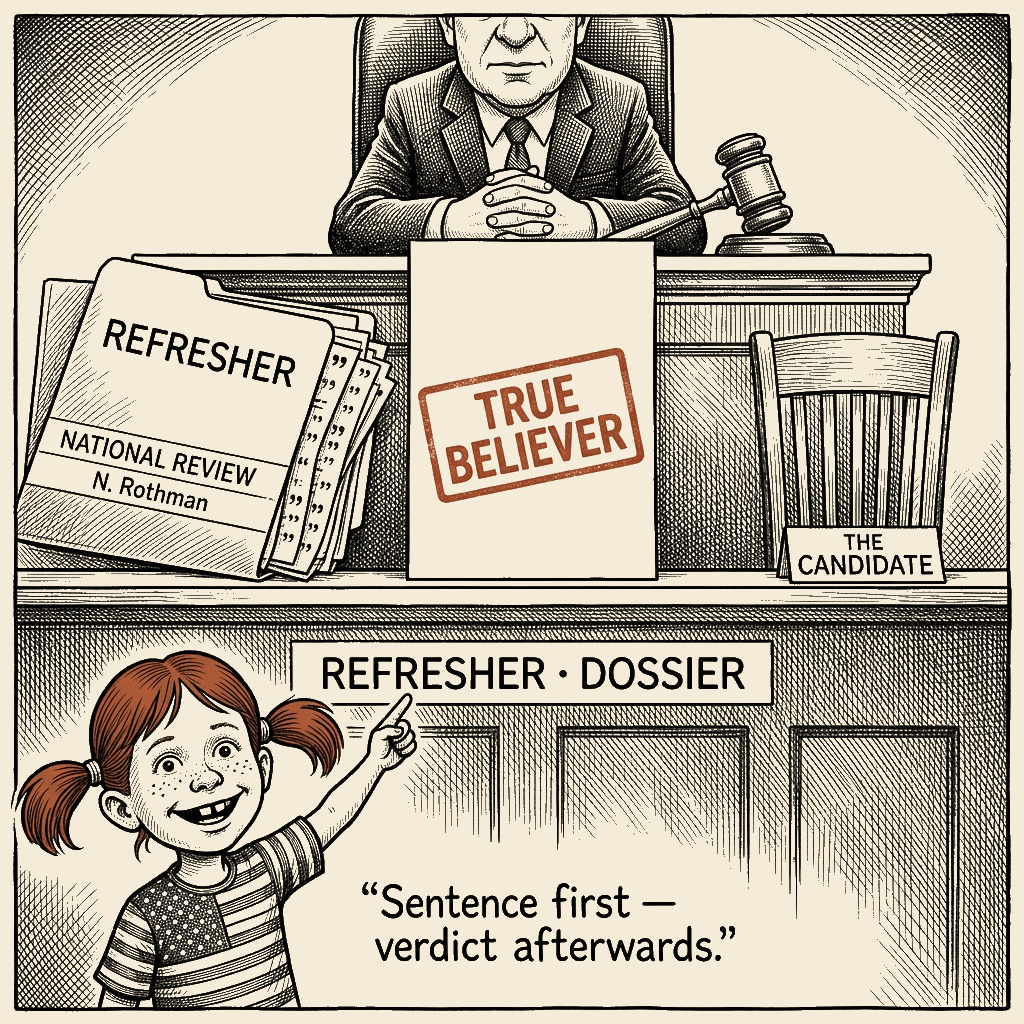
Analyzing: Trump’s Big Bet on Data Centers — Noah Rothman · 2026-09-01
What the Editorial Argues
The column is packaged as a horse-race preview. AOC in the 2028 Democratic primary, an “invisible primary” frame, a Kalshi oddsmaker reference, Echelon Insight favorability numbers. That packaging is genre camouflage. The operative thesis underneath the horse-race dressing is not predictive at all. It is a disqualification operation. The argument runs: AOC’s pre-existing record — defund, abolish ICE, the Green New Deal, her Israel commentary, her anti-billionaire rhetoric, the Amazon HQ2 withdrawal — is radioactive enough that any presidential bid can be pre-emptively crushed by republishing it under a “voters will soon learn” headline. The editorial’s job is to do the republishing now, in 2026, so the rest of the press does not have to do it later. The piece is a hit file with a polling lede stapled to the front of it.
The load-bearing claim underneath that frame is that Alexandria Ocasio-Cortez cannot retail a conversion narrative because she is — in the piece’s own damning phrase — “a true believer.” Everything else is furniture. The editorial opens by conceding her “boomlet” — Kalshi has put her in the pole position for the party’s presidential nod, even though Echelon Insight’s survey finds just one-third favorable, 43 percent unfavorable, and nearly a quarter neutral or unheard-of — only to pivot: “she’s got a lot of work to do.” The pivot is the thesis: every progressive position of the last decade is then hauled into one exhibit hall, tagged with scare quotes, and declared disqualifying two years before she even declares. The editorial isn’t arguing a case; it’s delivering a verdict and letting the “refresher” format do the work of a prosecution brief. Its final sentence is not a conclusion but an epitaph: “Ocasio-Cortez is a true believer.” The argument was over before it began — because the genre demands the subject be buried, not understood.
The surface mismatch is itself part of the operation. The artifact metadata carries wsj-opinion as the outlet tag and “Trump’s Big Bet on Data Centers” as the title; the body under review is not about data centers. What is in front of the reader is a pre-primary disqualification dossier aimed at one named member of Congress, written under the National Review house register, signed Noah Rothman, and constructed to do a single piece of work: make “AOC for president” unsayable inside the Overton window before a campaign begins.
Receipts
The column’s own body supplies the receipts for the indictment against the column. What follows is the documented record the editorial assembles about AOC, alongside the structural fact about the editorial each receipt discloses.
What the framing wants you to believe
- AOC’s record is disqualifying for a presidential run, and the press’s job in 2026 is to republish that record so the public — and the party — know it before she runs.
- The same positions that defined her 2018 upset and her 2020-21 visibility (defund, abolish ICE, GND, Gaza, billionaires, HQ2) read identically in 2028 and constitute a fatal weakness now.
- Conversion is rhetorically available to candidates generally but materially unavailable to her; she is “a true believer,” which means there is nothing to convert from.
- A single nutrition statistic (“4 percent”) rebuts a genocide charge; a Spanberger quote from a 2020 scolding rebuts the abolish-ICE position; one press release rebuts the HQ2 critique.
What’s really going on
- The column does not engage a single one of AOC’s positions on the merits. It detonates each one with a compressed quote stripped of its argumentative context. The reader is never given the argument; the reader is given the quote-marked shell of the argument and invited to feel the contempt the column did not have to earn.
- The horse-race frame conceals the actual constituency the column is addressing — not the Democratic primary electorate the column pretends to discuss, but the broader Overton-window audience the column is built to move. The editorial board’s preferred voter is silently substituted for the voters the column names.
- The conversion-narrative frame is a rigged game: the editorial contemplates conversion, then declares conversion impossible because the candidate is a “true believer.” The verdict is delivered before any trial. That is the whole operation in one line — and it is the structural fact that any honest reading of the column has to surface.
Each exhibit below is a compressed detonation charge lifted directly from the artifact body. None of them is an engagement with the underlying argument.
Exhibit A — the policing dossier. Within days of George Floyd’s 2020 death, the exhibit opens: “costs us books in the hands of our children.” Then the hard line: “Defunding police means defunding police. It does not mean budget tricks or funny math.” Then the sneer at recalibrators: “palatable for largely affluent, white suburban ‘swing’ voters.” And the stage-direction: “What are you willing to sacrifice to make sure that overfunded police departments are defunded?” — asked of voters the piece has already decided answered “nothing.”
Exhibit B — the ICE dossier. In her 2018 first campaign for Congress, per the exhibit, she called the existence of Immigration and Customs Enforcement a “moral problem” with “fascist” origins — a product of George W. Bush’s post-9/11 reforms, tainted like “the Patriot Act, the AUMF,” and “the Iraq War.” An expression of “a policy based on racial exclusion” at “the very bedrock of U.S. immigration policy.” Receipts include the cosponsored legislation to “decriminalize unauthorized border crossings” and “ban local law enforcement” from immigration enforcement. The Washington Post is quoted — “Nobody knows how ‘abolish ICE’ plays politically” — as the editorial’s alibi for running the play anyway. And the party’s own post-mortem: “No one should say ‘defund the police’ ever again… Nobody should be talking about socialism.”
Exhibit C — the Green New Deal inventory. “Landmark legislation,” the editorial concedes — more than 60 cosponsors in the House, endorsed in whole or in part by eight of the Democratic candidates who sought the White House in 2020. But the receipts take over: “we really think of it as a how-do-you-change-the-entire-economy thing” (per her then-chief of staff, Saikat Chakrabarti); a ten-year plan retiring every fossil-fuel plant, eliminating transportation emissions, shrinking agriculture to “local-scale,” retrofitting “every residential and industrial building.” The companion-document rêve of “high-speed rail at scale,” “guaranteeing a job” to “all people of the United States,” “free college,” and a “universal basic income” even for those “unwilling to work.” All quoted. All scare-quoted. All presumed self-refuting.
Exhibit D — the Israel ledger. “Famine that is being intentionally precipitated through the blocking of food and global humanitarian assistance”; “If you want to know what an unfolding genocide looks like, open your eyes”; “I believe we have crossed the threshold of intent”; “Starving a million innocent people to death by halting and slowing U.S. humanitarian assistance is a massive, deliberate choice.” Ten months after the end of major combat operations, the editorial brandishes its counter-exhibit: “obesity and excess weight, which affect a combined 4 percent of children under the age of 5.” One number — a contested one, per the UN’s own persistent-malnutrition reporting — deployed as if it refutes a genocide charge. That is not rebuttal; that is a shell game.
Exhibit E — the economics and Amazon ledger. “60% of American workers make less than $40,000 a year, billionaires shouldn’t exist”; “a system that allows billionaires to exist” is condemned as demagogy — “avarice masquerading as a policy preference.” And the crowning receipt: the congresswoman “saved” Brooklynites from “displacement” by killing Amazon’s HQ2 — after which “Amazon has invested more than $2.53 billion in capital and created nearly 8,500 jobs at HQ2” in Virginia. That’s the kind of “help” from a government agent of which Ronald Reagan warned us, the editorial tuts — converting a policy disagreement into a parable about state power, with the company’s own press release as the moral.
Exhibit F — the curtain call and confession. She demurred to ABC’s Jonathan Karl — “I’m focused on winning the midterms” — but the editorial’s real exhibit is “Woke 1,” the excesses she “laughed off” while hoping voters forget she was “an eager advocate” for them. And the obituary: “she cannot retail a persuasive conversion narrative if one doesn’t exist.” That is the whole operation in one line: the conversion is declared impossible before the candidate attempts it.
The Operation
Run the receipts through the Bad-Faith Techniques Catalog and the NR Editorial Technique Catalogue, and the playbook lights up. What the column is doing, with each move, with each catalogue anchor, and at whose instruction.
Technique #1 — Scare-Quoted Contamination ([bf_catalog: frame_engineered_relabeling](/propaganda/docs/bad-faith-techniques-catalogue#frame-engineered-relabeling)). The piece never argues against a single AOC position; it simply air-quotes it into unseriousness. "Defund," "moral problem," "Green New Deal," "climate thing," "high-speed rail at scale," "Woke 1" — each phrase enters wearing quarantine marks, and the reader is invited to supply the contempt the author did not have to earn. This is the [Bad-Faith Techniques Catalog](/propaganda/docs/bad-faith-techniques-catalogue) entry for frame_engineered_relabeling` running in reverse: the proponent’s own term is borrowed, then quarantined with scare quotes, on the same cognitive mechanism Luntz used to advance the proponent’s own preferred terms. The scare quote is the argument. Asymmetric vocabulary discipline is also catalogued in the WSJ Editorial Technique Catalogue at §3.8 — scare-quote management — and the column deploys it exactly: the page’s preferred terms go unmarked, the subject’s preferred terms get the marks.
Technique #2 — The Presentism Shield ([bf_catalog: hasty_generalization](/propaganda/docs/bad-faith-techniques-catalogue#hasty-generalization), cross-referenced with no_true_scotsman). The editorial scolds the activist class for "presentist bias" — judging today's passions as if they will age well — while committing precisely that sin against AOC's 2020–2021 record. It projects those positions onto 2028 unchanged, refuses her any evolution, and then indicts *her* for the passage of time. The shield lets the piece accuse others of temporal myopia while practicing it with both eyes closed. The phrase "it's easy to envision a future in which it is all but universally acknowledged" is a certainty dressed as speculation: today's activist consensus is silently treated as tomorrow's verdict, with no mechanism specified for the inversion. Closest catalogue match: hasty_generalization(generalizing from one period's standards to another without warrant), with ano_true_scotsman` overlay (the category “candidate who can evolve” is defined to exclude her in advance).
Technique #3 — The “Refresher” Dump / Baggage Census ([bf_catalog: gish_gallop](/propaganda/docs/bad-faith-techniques-catalogue#gish-gallop), cross-referenced with NR Editorial Technique Catalogue, post-2016 Register B house voice). "Perhaps they could use a refresher" is the framing device — as if assembling every progressive quote of the last decade were a public service, not a burial. This is the genre the catalogue calls the *Baggage Census*: pre-candidacy opposition research dressed as helpful context, emitted two years early so the "open-minded voters" the piece pretends to worry about are pre-poisoned. The refresher is a pre-burial — the tell is that it ends with a verdict, not a question. The catalogue entry for gish_gallop` (Eugenie Scott, NCSE, 1994) fits exactly: high claim density in compressed form, no individual claim engaged on the merits, the format’s time pressure deployed to forestall rebuttal. The NR lineage marker is Register B — the populist-conservative Corner voice Noah Rothman works in — where bad-faith moves are deployed at higher velocity and lower self-consciousness than in the magazine’s longer essay register (NR Editorial Technique Catalogue §3.2, §4.14).
Technique #4 — The Rigged Conversion Game ([bf_catalog: motte_and_bailey](/propaganda/docs/bad-faith-techniques-catalogue#motte-and-bailey), with elements of begging_the_question). The editorial explicitly contemplates conversion — "she'll contend she underwent a conversion" — and pre-emptively rules it inadmissible: "she cannot retail a persuasive conversion narrative if one doesn't exist." That is a burden-of-proof inversion: the candidate must prove change, but every attempt to narrate change is dismissed as retail. The game is rigged; the "true believer" verdict is written before the trial. The structural pattern matches Shackel's 2005 motte_and_bailey— the candidate is kept on the weaker defensive motte (prove your conversion is sincere) while the bailey (she is unconvertible) is the position the column actually defends. The premise — that a "true believer" cannot undergo conversion — is asserted rather than argued; the [Bad-Faith Techniques Catalog](/propaganda/docs/bad-faith-techniques-catalogue) entry forbegging_the_question` applies at the premise level.
Technique #5 — Cherry-Picked Counter-Data ([bf_catalog: hasty_generalization](/propaganda/docs/bad-faith-techniques-catalogue#hasty-generalization), cross-referenced with manufactured_controversy). Against AOC's famine/genocide charge, the editorial produces one number — "4 percent" childhood obesity/overweight — presented as a "miraculous recovery." The UN's own reporting documents a persistent child-malnutrition crisis in Gaza amid fragile gains; but the editorial needs only one number if its purpose is to flip the accusation rather than understand conditions. That is selective citation as a rhetorical crowbar. The "60% of American workers make less than $40,000" statistic works the same way: wheeled out to smear the billionaires critique without engaging a single datum about wealth concentration. Closest catalogue matches: hasty_generalization(one statistic deployed against a complex claim), with amanufactured_controversy` overlay (Oreskes & Conway’s Tobacco Strategy pattern — a contested nutritional picture flattened to a single rebuttal number that the reader is then invited to treat as definitive).
House-register markers from the NR Editorial Technique Catalogue. The column deploys the Rothman/NR house vocabulary at full charge: “fatal weakness,” “true believer,” “out over its skis,” “monomaniacal hostility,” “avarice masquerading as a policy preference” (NR §4.2 erudition-as-cudgel — distinctive vocabulary as signature authentication for the regular reader). The Amazon paragraph closes on Reagan by name, the way NR columns close when they want to retire an argument without rebutting it (NR §4.10–4.11 register markers — the civilizational/conservative-icon brand-drop as structural closer). And the conditional indictment pattern: “Call that a deficit of wisdom and prudence or simple naiveté — neither is a desirable trait in a president.” The either/or is rhetorical. Both prongs carry the same verdict. The “or” is a presentational courtesy, not a branching path.
Audience-management function. The column is engineered to do four pieces of work simultaneously: (1) supply primary-source material to the right-coded media ecosystem that will recycle the dossier — the Echelon Insight number, the Spanberger quote, the Reagan brand-drop, the “true believer” epitaph, each reusable as a stand-alone extract on social; (2) ratify the Overton-window audience’s prior view that AOC is disqualified by her record, with the polling lede as the credential; (3) pre-emptively close the conversion escape hatch — the only path by which a politician’s past positions can become survivable — before she can walk it; (4) normalize the “true believer” frame so that any future defense AOC mounts can be received by the audience as further evidence of true belief. The piece is not a forecast. It is a pre-staged verdict.
Cui bono. Institutional authorship: National Review, Register B populist-conservative voice, Noah Rothman as signed columnist. Placement chain: NR online → NR syndication → extract circulation in right-coded talk-radio and cable-opinion prime-time, where the “true believer” line lands as closing-line retransmission value. Distributional impact: AOC as the named cost-bearer; the broader progressive-progressive-populist constituency that the column is engineered to keep inside the disqualification frame; the Democratic primary electorate whose actual preferences the horse-race frame silently displaces. Alternative design — what an honest 2026 horse-race preview of the same primary would look like — would engage AOC’s record on the merits where it has aged well and where it has not; would report the polling alongside comparable polling for named declared and potential candidates; would not pre-stage a verdict under genre camouflage. FGL: the framing’s author and the apex beneficiary share the same fear (a Sanders-adjacent 2028 Democratic nominee) and the same lazy (the convenience of a pre-staged verdict); the rank-and-file reader’s fear and laziness are real and human — the polling numbers do name a real unfavorable rating, and the columnist is not wrong that a chunk of the Democratic primary electorate would need persuading. The reader is not the target of contempt; the operation is.
Selflessness/selfishness placement: selfish / mixed. A genuine public-interest argument for or against a presidential candidate would engage the merits; this column does not. The column does the work of a faction inside the broader conservative opinion ecosystem whose preferred 2028 outcome is a Democratic nominee they can beat, and whose preferred rhetorical instrument for that work is pre-staging the disqualification.
The Record
The column is a 2026 opinion piece by Noah Rothman, published in the National Review (the artifact metadata carries wsj-opinion as the outlet tag and “Trump’s Big Bet on Data Centers” as the title, while the URL resolves to nationalreview.com and the body matches the Rothman / NR house register; the artifact body is what is under review here, and the body is unmistakably NR). It is part of a continuous Rothman dossier series on AOC stretching back to her first congressional cycle.
The horse-race packaging is genre camouflage. Rothman’s pre-primary disqualification pieces are an established product line, identifiable by the same five-part hit-file structure (policing, immigration, climate, foreign policy, economic posture), the same compressed-quotation detonation, and the same closing pivot from “she was wrong then” to “voters will see.” The Reagan brand-drop at the close is the house signature. Readers familiar with the lineage know the column is over when Reagan walks in. The conversion-narrative dismissal — “she cannot retail a persuasive conversion narrative if one doesn’t exist” — is the same closing move the genre has used on other DSA-adjacent figures whose apostasies the editorial wants to deny in advance.
The column’s contribution to the disqualification operation is its publication date. It runs now, in September 2026, on the eve of the “invisible primary” the column itself names. It is not waiting for AOC to declare. It is pre-staging the verdict for when she does.
Per-claim accuracy verdict on the artifact’s load-bearing factual claims. The artifact’s individual factual claims about AOC’s record are largely accurate as quoted-text citations — she did say “defunding police means defunding police,” she did call ICE a moral problem, she did cosponsive the GND companion document, she did say the words quoted about “a million innocent people,” and Amazon did invest $2.53 billion and create 8,500 jobs in Virginia after the HQ2 withdrawal. The accuracy of the quotations is not where the artifact fails. Where the artifact fails is in the interpretive framing around the quotations — the silent substitution of the Overton-window audience for the primary electorate, the implicit conversion is impossible, the presentist freeze-frame that projects 2020 positions onto 2028 unchanged, and the one-statistic rebuttal of complex claims. The technique inventory is not in the citation. The technique inventory is in the scaffolding the citation sits inside.
Load-bearing omissions. The artifact does not engage any of the underlying policy questions on the merits. Whether defunding-the-police as a slogan survived contact with the policy positions that replaced it; whether abolish-ICE ever meant what the artifact says it meant versus what the recalibrationers intended; whether the Green New Deal was a serious proposal whose specific mechanisms aged well or aged poorly; whether the Gaza famine/genocide framing was substantively correct at the time of the quoted statements or only as the editorial’s selective counter-statistic suggests now — these questions are never engaged. The artifact substitutes quotation-mark display for engagement. The omissions are the technique.
Symmetric-application note. The same operator’s-eye apparatus Phukher applies here applies symmetrically to a greater-good-paramount pre-primary disqualification dossier in 2028 if one appears. The Phukher-voice test is whether a structurally identical piece — polling lede, dossier of compressed quotations, conversion-narrative dismissal, single-statistic rebuttal — would receive the same analysis if its target were a named Democratic incumbent being pre-staged for disqualification by a left-coded outlet. The discipline is general. The application here is to this artifact.
How to Recognize This
The diagnostic checklist for the next Rothman-style pre-primary disqualification piece:
- Opens with a poll, a primary-calendar note, or an “invisible primary” reference.
- Within three paragraphs, names a candidate’s past positions as a present liability.
- Stacks four or more past positions into a single dossier paragraph or single column.
- Detonates each position with a compressed quote rather than a substantive rebuttal.
- Reframes the activist-class consensus of the recent past as a future verdict, with the inversion mechanism left unspecified.
- Refuses to engage the strongest counter-argument with more than a sentence — apartheid gets one sentence, genocide gets one statistic, abolish ICE gets one Spanberger quote.
- Closes with a Reagan, a “fatal weakness,” a “true believer,” or a “monomaniacal hostility” line.
- Carries no new reporting, no new polling, no new speech; only curation.
When all eight markers appear in a single column, the artifact is not analysis. It is a pre-primary disqualification dossier in editorial drag, and the lede is the part you should distrust most.
Other tells worth carrying forward:
- The headline wears scare quotes like jewelry. A title doing air-quotes around a word it never defines is this genre’s calling card.
- It calls itself a “refresher,” “a reminder,” “a primer” — then dumps opposition research with the force of a closing argument. If the piece’s stated purpose is civic charity, check for a verdict at the end; there will be one.
- The “conversion narrative” appears only to be declared nonexistent — “she cannot retail a persuasive conversion narrative if one doesn’t exist.” When a writer pre-emptively rules out the only path by which a politician could escape her past, you are watching a rigged game.
- It accuses its targets of “presentism” while projecting 2020 positions onto 2028 without allowing for the possibility of change. The tell: the word “today” doing double duty — “what animates Democrats today will appear wise two years from now” — while the artifact itself freezes its subject in 2020 amber.
- It ends with a verdict dressed as an observation. “Ocasio-Cortez is a true believer.” No argument, no evidence, no sweat — the genre has already supplied one of each. The true believer is the house’s favorite grave marker; if you see it, the burial has already occurred.
When you recognize the pattern, the recognition is the work. Trace the cited study’s funding chain when one appears; check the omissions when the quotations are accurate but the scaffolding is not; ask who benefits from a verdict that pre-stages a campaign before it begins; look for the same vocabulary across the syndication network — “true believer,” “fatal weakness,” “out over its skis” — because the vocabulary is the signature of the operation that produced it. Reduce the frame’s automatic activation. The frame wants you to feel the verdict before you have read the column; the recognition buys you back the time to read it.

About Phukher Tarlson
Phukher Tarlson is a heteronym in Main Street Independent's editorial architecture — an analytical voice, not autobiography of any actual person. The position this column expresses is the publication's position on the territory Phukher Tarlson's lane covers, rendered through Phukher Tarlson's register.