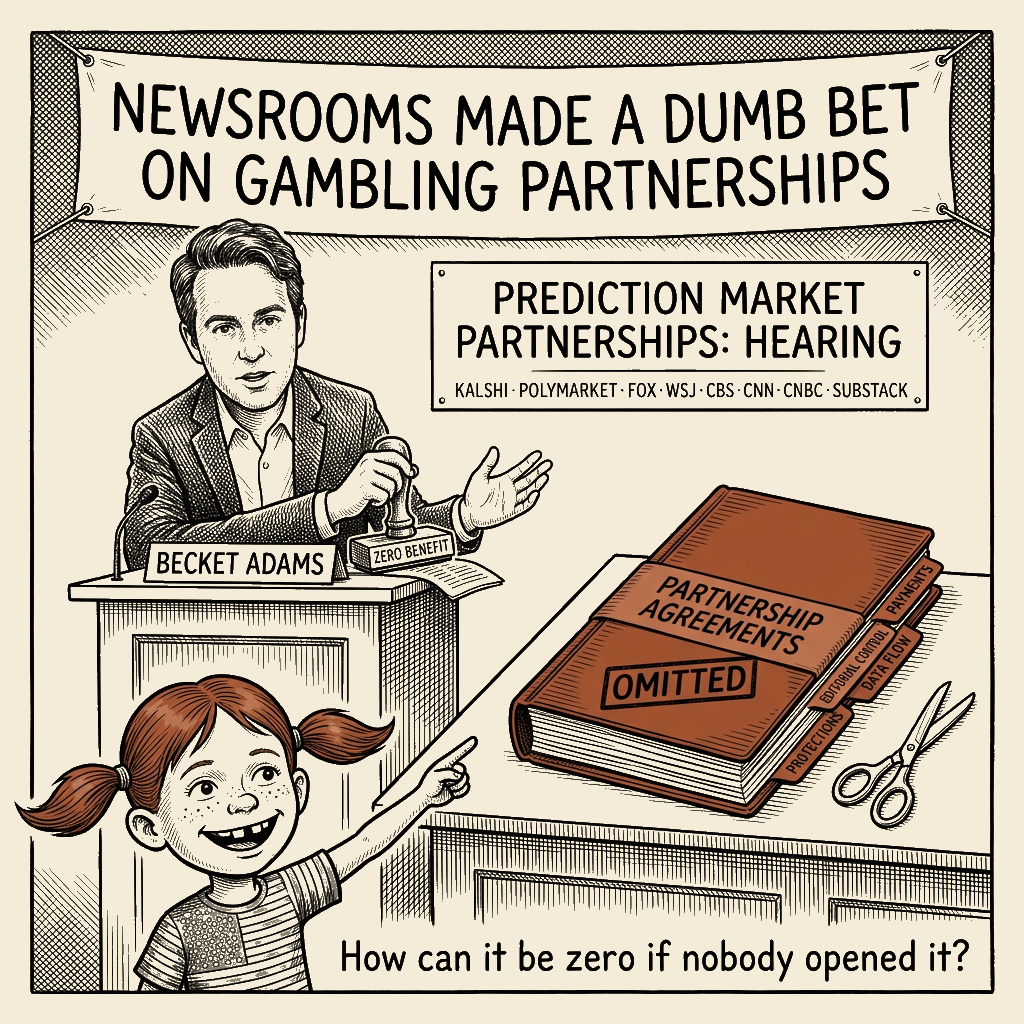
Analyzing: Newsrooms Made a Dumb Bet on Gambling Partnerships — Becket Adams · 2026-11-08
How can it be zero if nobody opened it?
What the Editorial Argues
Becket Adams argues that American news organizations have normalized gambling by embedding prediction-market odds in sports and election coverage while presenting the products through the euphemism of “prediction.” He contends that betting markets add little or no information beyond polling, making the partnerships commercially profitable for outlets and platforms rather than useful to readers. The deeper objection is moral: newsrooms dependent on gambling revenue undermine their own credibility while teaching audiences to treat wagering as ordinary editorial content. The strongest version of Adams’s case is that live market prices may aggregate dispersed information while also carrying audiences into gambling before they understand what the displayed number represents; his claim is that newsrooms adopted the product without proving either benefit or cost.
Receipts
The editorial converts a narrow question about sponsored prediction-market data into a broad morality play about journalism, gambling, and institutional credibility. The reader is handed a compression rather than an investigation.
What the framing wants you to believe
- “Prediction markets” are gambling businesses wearing respectable language; newsrooms that display their odds have invited the casino into the newsroom.
- Because betting odds supposedly copy polling rather than produce original information, the partnerships benefit publishers and platforms without benefiting readers.
- The outlet’s real motive is revenue, and the harm is not merely bad incentives but the normalization of gambling itself.
What’s really going on
- The named beneficiaries are the operators and the partner outlets — Kalshi, Polymarket, Fox, the Wall Street Journal, CBS, CNN, CNBC, Substack — and the pathways are concrete in kind even where the amounts are unverified. What the operators buy is placement inside a trusted editorial environment and a stream of qualified signups. What the outlets sell is sponsorship and advertising inventory, affiliation and traffic, and the audience data a wagering app wants more than a newsroom does. No contract, rate card, or revenue figure came back in my verification pass, so the size of any payment is unverified. The existence of the commercial relationship is not in dispute. The editorial says so.
- The omitted relation is the bargain itself: what the operator pays, what editorial control it purchases, what data moves in each direction, what protections each outlet actually installed, and what a reader gets out of a market price. Wolfers and Zitzewitz, “Prediction Markets,” Journal of Economic Perspectives 18, no. 1 (Winter 2004): 107–141, document the general mechanism the editorial suppresses — a market price aggregates every input traders bring to it, including private assessments and news, so it can diverge from the poll consensus even when the traders themselves are leaning on the polls. That does not make every partnership informative. It does make the word “zero” an unearned number. The legal frame is narrower than Adams’s rhetoric: 15 U.S.C. § 1333(c) prohibited radio and television cigarette advertising, and CFTC-regulated event contracts traded on designated contract markets sit inside CFTC surveillance and customer-protection rules — but neither source establishes that every event-contract product contributes no information, or that gambling advertising produces a public harm equivalent to tobacco advertising.
- The normalized harm is real and is being used instrumentally. The American Psychiatric Association’s Diagnostic and Statistical Manual of Mental Disorders, 5th ed. (2013), places gambling disorder among the substance-related and addictive disorders, and serving wagering as a routine informational service does blur a line that ought not be blurred. What is not legitimate is the borrowing. The anger supplies the authority for a claim about reader benefit that the anger cannot establish.
The Operation
Source classification. The supplied outlet hint says wsj-opinion, but the artifact URL is on nationalreview.com, the byline is Becket Adams, and the piece uses National Review’s web-native polemic rather than an unsigned editorial-board voice. Confidence is high that this is a signed National Review web essay. The Wall Street Journal is a subject of the piece, not its publisher. The November article path does not place this in The Corner, and nothing in the package gives me placement metadata: what I can see is a magazine-adjacent web-opinion piece carrying Register B tonal features — the sardonic second-person address, the pop-cultural cross-reference, the joke cadence, the compressed argument. I record the tonal features and withhold the section label, because a firm Register B classification would need metadata I do not have.
Topic domain: media-industry gambling sponsorship and prediction-market integrations, election forecasting, institutional trust. Primary archetype: press-as-standing-antagonist, joined by euphemism exposure and a borrowed-expert evidentiary spine. The closest fit in the National Review Editorial Technique Catalogue is Register B, the conversational populist-conservative web register, with a secondary deployment of the catalogue’s §4.16 Buckley-tradition ridicule entry.
Position and symmetric-application flag. The advocated position is mixed, with a predominantly greater-good stated rationale: press integrity, reader protection, and reduced gambling harm are public interests, and the disclosure-and-boundary problem is the best material in the piece. Categorical motive attribution and ridicule also buy the author attention and the satisfaction of cultural censure, and a conservative subscription is the business a “the press sold out” frame feeds. I state those incentive pathways as structural, not as a finding about anyone’s private state. The venue is liberty-coded; the position is collective-welfare paramount. So the symmetric-application flag is set: the receipts side of this file stays inside the documented public record, and I do not reconstruct an internal operation I did not run. The supplied record discloses no payment from gambling firms to Adams or National Review. I will not manufacture a hidden donor, coordinated campaign, or internal commercial arrangement the public record does not show.
Institutional authorship and placement chain. National Review is the publisher, Adams the named author, and the audience arrives already primed to distrust corporate media, which the piece then recruits. The more interesting chain runs inside the arrangements being indicted: prediction-market operator → paid placement or editorial integration → branded odds inside a trusted news environment → a reader meets a wagering proposition wearing journalism’s authority. Adams names the participants. He does not name the agreements. And the agreements are the only document that would let a reader judge each arrangement on its own terms.
Complicity disclosure. I know this construction because I helped build its cousins. I drafted the version where a revenue-producing partnership gets described as editorial collaboration and the contract itself is left in the dark, and I sat in the focus-group debriefs where the vocabulary got tested for warmth. I did not write this piece and I have no inside knowledge of this campaign. What I have is the shape.
Distributional impact. Let me be plain about what the record carries and what it does not. It carries this: these are commercial relationships, the outlets are taking value from them, and the operators are buying placement inside a trusted editorial environment. It does not carry this: the size of any payment, the structure of any contract, the allocation of editorial control in any of them, or the exposure of any individual reader. No agreement, sponsorship announcement, rate card, or traffic figure came back from my verification pass, and the individual integrations — Fox and Kalshi, the Wall Street Journal and Polymarket in January, CBS’s sponsorship, CNN’s integration, CNBC’s event, Substack’s midterm package — remain externally unverified even as the editorial reports them. So: the financial incidence is unverified. The commercial chain is not. I am not going to let the missing money turn the analysis into a list of hypotheses; the rhetorical operation is fully documented and it does not depend on the amounts.
The beneficiaries, concretely: the operators get customer acquisition, trading activity, brand recognition in rooms where a wager can be presented as information, and the normalization of their product inside institutions whose credibility is not theirs to spend. The outlets get sponsorship and advertising money, affiliate and traffic economics, product differentiation in a revenue drought, and a data stream. The cost-bearers are diffuse. Readers bear the risk of confusing a market price with a journalistic finding and the exposure that comes with being sold a bet next to a bulletin. The public-health cost of gambling promotion is real, and it is carried by people who never agreed to carry it. The newsrooms carry a reputational cost if audiences learn to read every commercial relationship as editorial corruption — and that cost is not small, because it is the only thing these outlets actually sell. One further note the editorial does not make: the operators are themselves exposed. They operate inside CFTC surveillance and customer-protection rules, and a newsroom partnership that drifts into editorial influence is a regulatory problem for the operator too. That is another reason to read the contracts rather than the mood.
“Lucrative” is not a magnitude. It is a mood.
Alternative design. Here is the arrangement optimized for the rationale the outlets themselves state. Payments, data flows, and editorial-control provisions disclosed on the page, in the same place the odds appear. Sponsorship visually and editorially separated from news judgment, so the reader’s eye registers which is which. No wagering call to action sitting next to a breaking-news alert. Market prices presented where useful as labeled market data with their limits — a probability with a spread and a volume, not a prophecy — and editors, not operators or commercial teams, deciding whether the information improves the coverage. Age restrictions, independent audits, and a stated test for whether the arrangement changes behavior or merely changes vocabulary. None of this requires the outlets to give up the money. It requires them to disclose the price of the thing they are selling.
FGL. Fear, greed, and laziness, read as an analytic hypothesis about incentive pathways and not as a finding about any person’s private state. Applied symmetrically across three hands.
- The framing author and outlet: fear of institutional decline supplies the urgency; greed for attention and the satisfaction of cultural censure supplies the circulation; laziness about contract language and forecast validation permits the moral shortcut that arrives at “zero” without a denominator.
- The operators and the partner outlets: fear of losing customers or revenue to rivals supplies the urgency; greed for acquisition, liquidity, and sponsorship money supplies the motive; laziness about conflict management and age exposure is what puts the gap between commercial intent and editorial safeguard.
- The reader: fear of being duped — by the gambling app or by the institution — is legitimate. The desire for timely, actionable information is legitimate too. Laziness about disclosures and about the difference between a probability and a promise is a real human convenience, not a moral failing, and I am not going to build this analysis on the assumption that readers are too stupid to read a contract. None of it makes the outlet’s bargain irrelevant.
Critical-question check. CQ1: the beneficiaries occupy concrete pathways — sponsorship money, affiliate revenue, customer acquisition, placement inside a trusted environment, narrative control. The inference is not symbolic. CQ2: the constituencies the frame keeps out of the room are readers who may value the information, regulators, non-partner outlets, campaigns, and the public-health cost of gambling promotion. CQ3: incidence corrected — money and placement concentrate; reputational, informational, and gambling-related costs disperse. CQ4: FGL ran across three hands, including the reader, without contempt.
Technique identification.
-
The zero-benefit categorical exclusion. Cue: “There is truly nothing — zero, zilch, zip, nada — of journalistic benefit,” followed by “The ‘prediction’ partnerships are, therefore, entirely for the benefit of the hosting outlet, not the readers.” Catalogue cross-reference:
[Bad-Faith Techniques Catalog](/propaganda/docs/bad-faith-techniques-catalogue),hasty_generalization— detection signals “generalization supported by anecdote or a salient single case” and “absence of rate, base-rate, or denominator language.” I checked the catalog’sfalse_dichotomyentry and it does not fit: its detection signal — “Either X or Y,” “we must choose” — is absent from the text, which never presents two exhaustive alternatives. The category error would have been mine. Operation: A categorical exclusion dressed as an empirical finding. “Zero” is a number, and a number owes the reader a denominator, a comparison class, and a method. What the sentence does is close the inquiry before the agreements have been opened. Lippmann’s lineage is visible here — complexity compressed into a picture of the world — and Bernays’s is visible in what follows, because the piece needs the reader to feel that recognition is already complete. -
The parade of heterogeneous examples. Cue: The movement from stadium billboards and ballplayer partnerships with gambling apps to Fox, the Wall Street Journal, CBS, CNN, CNBC, and Substack, and from there to one verdict about the category. Catalogue cross-reference:
[Bad-Faith Techniques Catalog](/propaganda/docs/bad-faith-techniques-catalogue),hasty_generalization, on its native ground — a salient-example parade with no rate, no base rate, and no denominator. Operation: Sports advertising, a homepage odds module, a sponsored segment, a network integration, and a newsletter package are not one evidentiary class. One election does not establish what a market price is worth in another election, in sports, or in an economic series. What the parade establishes is proliferation, which is consequential on its own. What it does not establish is that no reader has ever gained anything from any of them. The operation Bandura calls distortion of consequences, described behaviorally rather than as a finding about Adams’s moral state: benefits get no evidentiary space while harms get vividness. -
Expert-deference used as a debate-closer. Cue: The Nate Silver quotation — “The polls and models provided the direction in contrast to vibes and dumb insiders. And yes it’s good that traders were smart enough to trust them.” Catalogue cross-reference:
[Bad-Faith Techniques Catalog](/propaganda/docs/bad-faith-techniques-catalogue), “expert-consensus / expert-deference framings.” Operation: As reproduced, the remark supports a narrow proposition: traders in that election leaned on polls and models, and the better models were faster and more confident than the markets. It does not establish that market prices contained no independent information and no forecasting value. The catalog’s detection signals are met in the negative — one forecaster is named, on one side, with no date, no full argument, no calibration evidence, and no engagement with the forecast-evaluation literature that would actually test the claim. And note the structure: the WSJ catalogue’s “study shows” ledger (§4.5) is a spine built around a paper. This borrows the posture without the paper. -
Abusive ad hominem; ridicule aimed at the wrong target. Cue: Substack as “something of a retirement community for washed-up ‘resistance’ performers and unemployed C-list cable-news personalities.” Catalogue cross-reference:
[Bad-Faith Techniques Catalog](/propaganda/docs/bad-faith-techniques-catalogue),ad_hominem, abusive variety; National Review Editorial Technique Catalogue §4.16, the Buckley-tradition ridicule entry. Operation: The jab does no work on partnership terms, market accuracy, disclosure, or reader benefit. It supplies disgust in place of analysis. The NR catalogue permits ridicule when it engages targets with structural power and preserves the substance; here it goes after a platform’s contributor mix and is then used as though that character indictment had settled the institutional question. Redirection is not analysis. -
Threat inflation through reductio. Cue: “Give it a few more years, and we will be seeing sponsored content tagged, ‘This Election Coverage Powered by Pornhub.’” Catalogue cross-reference: WSJ Editorial Technique Catalogue §4.13, the “threat-inflation closer.” The
[Bad-Faith Techniques Catalog](/propaganda/docs/bad-faith-techniques-catalogue)’sslippery_slopesits adjacent but is inapplicable, because the piece frames the image as a reductio — “why wouldn’t this be the logical end” — rather than as a concealed forecast. Threat inflation, then; not a smuggled causal chain. Operation: The Pornhub image makes the incentive legible in one sentence. It does so by collapsing advertising, sponsorship, editorial integration, adult content, and sports betting into a single vice spectacle, and the more exact and less profitable questions get crowded out: what does each contract do, what does Fox’s political carve-out actually protect, what does CNN’s disclosure of no equity stake and no user-trade revenue mean, and which reader protections each outlet installed. -
Press-as-standing-antagonist. Cue: “At a moment when the national press face an existential credibility crisis,” and “nothing says ‘trust’ quite like a pit boss.” Catalogue cross-reference: WSJ Editorial Technique Catalogue, Fox-additions §4.23, “press-as-standing-antagonist” — a pattern catalogued for the Fox opinion page and observed here in a magazine-adjacent web column, which is exactly what the catalogue’s own §7 anticipates for the wider opinion ecosystem. Operation: Existing distrust of journalism is recruited as the moral warrant for the attack. A disclosure-and-governance question is converted into a status crisis, and the reader is handed a ready-made role — clear-eyed observer of institutional decline — so that scrutiny of the newsroom’s business model feels like defense of journalism instead of another part of the analysis. The Schmitt lineage shows up in softened form: the press as standing antagonist, without the friend-enemy machinery fully developed.
-
Stands athwart history. Cue: “But perhaps the news outlets already know this.” Catalogue cross-reference: National Review Editorial Technique Catalogue §4.1, the “stands athwart history” frame. Operation: The dissenter frame — the writer positioned as the one who sees while the institutions carry on. Here the frame runs in the direction the catalogue’s own caution permits: the writer’s position is the marginal one, and the institutions he dissents from are the powerful ones. I record it because the frame is doing work, not because it is being abused.
-
The euphemism inversion — an incomplete
frame_engineered_relabelingmatch. Cue: The headline’s “Dumb Bet,” the essay’s “newsroom casino,” the repeated correction of “prediction” to gambling, and the closing suspicion that the label is kept because it protects something. Catalogue cross-reference:[Bad-Faith Techniques Catalog](/propaganda/docs/bad-faith-techniques-catalogue),frame_engineered_relabeling(Lakoff and Luntz lineage). Operation: The catalog’s entry requires documented evidence of deliberate engineering — focus-group testing, internal memos, message directives — before the pattern is reported. The package documents none for this campaign, so under the catalog’s partial-match handling I record the documented features and mark the match incomplete: this is rhetoric, not a documented frame campaign. The substitution does real work. “Casino” and “bet” carry compulsion, vice, and impaired judgment into arrangements that may be sponsorship, advertising, data licensing, or editorial integration. And in the other direction, “prediction market” is the term that makes a wager sound like information. Both substitutions are operating; only one of them belongs to Adams.
Audience-management function. Grievance ratification — the reader’s existing suspicion of corporate media is confirmed rather than examined. Identity confirmation — the reader is the person who sees through the euphemism. Status display — moral and analytical standing, offered at low cost. Permission structure — the reader is cleared to dismiss the arrangements without reading a single agreement. Counter-frame — the editorial supplies a replacement vocabulary (casino, pit boss, seedy corner of the vice economy) that arrives ready-made. Conscience displacement — the moral work of thinking about disclosure and harm is discharged by a mood. And diffusion of responsibility: “the powers that be decided that is the time to roll out the newsroom casino” is Bandura’s agentless construction, spreading the decision across an industry so that no decisionmaker is ever named. The piece does not need to manufacture agreement about gambling regulation. It needs the reader to feel that skepticism has already been completed.
The Record
Anchor receipts.
- Primary artifact: Becket Adams, “Newsrooms Made a Dumb Bet on Gambling Partnerships,” National Review, November 8, 2026. Tier 1 for what the editorial says. Tier 3 advocacy for the truth of its external claims.
- Julian Wolfers and Eric Zitzewitz, “Prediction Markets,” Journal of Economic Perspectives 18, no. 1 (Winter 2004): 107–141. Tier 1 peer-reviewed. Documents that market prices aggregate dispersed information and can incorporate information not contained in the polls — read here as: a price reflects every input traders bring to it, so it can diverge from the poll consensus even when traders are anchored on polls. This is the anchor for the omitted relation. It does not verify any outlet’s revenue and it does not verify any reader’s utility.
- U.S. Commodity Futures Trading Commission, 17 C.F.R. pt. 40 (designation and regulation of designated contract markets), and “Regulatory Framework for Event Contracts” (proposed rule, December 2024). Tier 1 primary regulatory material. The proposition is deliberately narrow: CFTC-regulated event contracts traded on designated contract markets sit inside CFTC surveillance and customer-protection rules. It says nothing about every product that markets itself as a prediction market, and my verification pass returned no confirming source for the rulemaking citation, which is disclosed here rather than papered over.
- American Psychiatric Association, Diagnostic and Statistical Manual of Mental Disorders, 5th ed. (2013), “Gambling Disorder,” placed among the substance-related and addictive disorders. Tier 1 professional standard, and the clinical anchor for the harm the editorial invokes.
- AAPOR, Best Practices for Public Opinion Research, and the AAPOR Transparency Initiative’s disclosure standards for poll sponsors. Professional-method evidence: the methods standard carries the proposition that polling rests on disclosed sampling, fieldwork, weighting, and questionnaire design; the Transparency Initiative carries the separate proposition that sponsor disclosure is a professional norm. Polling is a measurement process with error, not ground truth.
Supporting receipts.
- A 2013 National Research Council review of gambling’s social consequences. I am citing it descriptively and not by title, because the report’s exact title could not be confirmed in the verification pass and I will not assert a title I could not check. It supports the existence of gambling’s social and health harms; it does not quantify the incremental effect of these newsroom placements, and it should not be asked to.
- The Nate Silver quotation, as the editorial reproduces it, supports the narrow claim that traders leaned on polls and models and that the better models were quicker and more confident. The date, platform, and surrounding passage are unverified, and the conclusion the editorial recruits it for is wider than what the remark carries.
- Fox’s stated exclusion of political coverage from its arrangement, and CNN’s stated absence of an equity stake and of revenue from user trades, are useful pieces of the governance landscape. They are also evidence that deal structures differ, which is a reason to compare contracts rather than pronounce a common motive.
Unconfirmed claims. All tagged [unconfirmed: convergence threshold not met].
- The cross-outlet inventory and its specifics: the Fox–Kalshi integration and “crowd odds” placement, the Wall Street Journal–Polymarket arrangement and its January timing, the “Featured Prediction Market” homepage column, the CBS sponsorship, the CNN integration, the CNBC event, and the Substack midterm package.
- That the partnerships are lucrative, and that the material benefit runs to the host outlets. No payment, revenue-share, sponsorship, traffic, or valuation figure exists in the package.
- That the markets “simply copy” polling and are reactive rather than predictive. The Silver quotation supports influence, not exclusive copying.
- That there is “nothing” of journalistic benefit. Not established, and too broad to survive the prediction-market literature.
- That major media are distrusted more than Wall Street and Big Pharma, according to Gallup. No report, date, sample, or question wording is identified.
- That these partnerships increased gambling normalization or gambling harm. The harm is established in general; the causal pathway from these placements is not.
- That Substack has “devolved” into the described writer population. No evidence offered, and the claim is not probative of the partnership question.
Per-citation verdicts.
- Outlet partnerships: plausibly reported by the editorial, not independently anchored in the package. Each needs the parties’ own announcements and a look at the live integration.
- Gallup: externally unverified. The missing survey metadata make the comparative ranking unusable as an anchor.
- Nate Silver: consistent in substance with the apparent claim, but exact wording, date, and surrounding argument unchecked; scope narrower than the conclusion drawn.
- Polling methodology: broadly accurate and incomplete. Polling uses sampled first-party collection and also carries sampling error, nonresponse, weighting choices, question effects, and house-model assumptions.
- Prediction-market redundancy: unconfirmed and overgeneralized. Markets can copy polls, arbitrage polls, price news, and aggregate trader information at the same time; those are not mutually exclusive.
- Gambling normalization: the concern is legitimate and the clinical anchor is solid; the size and pathway of the effect of these particular integrations is undocumented.
- The Substack insult: unsupported commentary, not a receipt for anything.
Load-bearing omissions.
- The agreements themselves: payments, equity, affiliate compensation, ad inventory, data licenses, audience-data access, editorial consultation, termination rights, and liability.
- Whether editors can reject operator-supplied framing or odds, and whether the operator can alter language or placement after publication.
- How Fox’s political exclusion compares with the protections — or the absence of protections — at every other outlet named.
- Comparative readership evidence: whether readers use the odds, whether they mistake them for forecasts, and whether the information is useful in breaking-news or explanatory work.
- Forecast validation: lead time, calibration, Brier or logarithmic scores, error relative to polls, and performance after controlling for polling and election-day news.
- Price formation: which information traders actually trade on, including polls, model outputs, news, arbitrage, and private assessments.
- The causal path from newsroom placement to problem gambling and other gambling harms, including exposure by age and frequency.
- Base rates for sports-betting advertising, political-market integrations, and newsroom sponsorship, in place of a parade of salient examples.
- The opportunity cost of editorial labor, compliance cost, legal exposure, and the effect on smaller outlets that cannot afford equivalent conflict-management systems.
- The alternative: disclosures, separation, age gating, no wagering call to action, independent audits, and explanatory use of market data without affiliation.
- The concentration question. Gambling is the vivid object of criticism while the financial structure that pushes every outlet toward sponsorships, affiliate revenue, and audience scale is left largely unexamined.
Missing-information declaration. The partnership announcements, contracts, editorial policies, Gallup survey, original Silver source, revenue figures, audience-use data, market-performance data, and comparative forecast studies were neither supplied nor obtainable in the verification pass; the queries are listed in the claim record above. No leaked-memo claim is used anywhere in this analysis. My own contribution is limited to retained working memory about general message-discipline operations of a kind: I drafted memos pairing a revenue-producing “partnership” with language about editorial integrity while leaving the bargain itself in the dark. That account is non-verifiable outside this witness record and carries no factual finding here.
Symmetric-application note. My operator’s-eye-view reaches further into general liberty-frame media monetization than into this particular anti-gambling campaign. The analysis rests on the supplied editorial, the regulatory and scholarly receipts above, and the public record those receipts represent. I do not reconstruct internal testing, coordination, funding, or motive where the documentary record is silent. And I will say the harder thing, because the same apparatus has to cut both ways: had a piece of this shape run in the opposite direction — celebrating the gambling partnerships, dismissing the disclosure and harm questions, and supplying a monopoly-friendly frame for the arrangements — I would have taken it apart with the same instruments and the same appetite. I do not have a side here. I have a method.
How to Recognize This
The pattern is the zero-benefit frame. It takes a real conflict of interest, compresses a mixed commercial arrangement into a vice scandal, and then declares every possible public benefit to be zero. The technique is the categorical exclusion; the omitted relation is the bargain — the terms, the editorial-control allocation, the data exchange, and the possible reader utility; the protected beneficiary is the class of operator-and-outlet partnerships whose individual terms never get examined because the frame collapses them into one verdict; and the normalized harm is the loss of reader utility and the conversion of a governance question into generalized institutional contempt.
The mechanism is confidence manufactured through compression. The reader receives pit bosses, casinos, pornography, washed-up resistance performers, and existential media decline. Complexity disappears. The next move feels automatic: distrust the institutions, dismiss the deals, and reserve judgment for the people who have seen through the euphemism.
Four textual signals should make the frame visible next time.
- A motive asserted as an exclusive fact. Watch for “entirely,” “nothing,” “zero,” “solely.” Then ask where the contract, the revenue data, and the countervailing benefits are.
- Heterogeneous examples used to establish one categorical verdict. A homepage widget, a sponsored segment, a sports advertisement, and an election integration are not one evidentiary class.
- A vivid vice analogy standing in for a governance question. The Pornhub line and the “pit boss” line do their rhetorical work before any agreement has been opened.
- A character attack where the institutional analysis should be. When contempt for a platform’s writers or personalities appears in the space where the terms and incentives belong, the argument has changed subjects, because the original subject does not support the preferred verdict.
Why it works is not hard to see. Corporate gambling gives the reader a familiar object of distrust. Media skepticism supplies a ready-made grievance. The combination lets the reader feel angry and unusually clear at the same time, which is a rare combination and a good one to sell. Absolute language reduces the work of judgment. A legitimate concern — journalistic conflicts of interest, gambling harm — lends borrowed credibility to a categorical conclusion the concern cannot support. The reader never has to resolve whether a market price forecasts anything, whether a reader can read one, or whether a newsroom can separate sponsorship from reporting. The frame has already answered all three.
What to do when you see it. Separate the existence of a partnership from the claim that it has no value. Find the operator and outlet announcements, then the contracts or disclosures if they exist. Trace four things: the money, the data, the placement, the editorial veto. Compare each claimed benefit against the denominator the author never supplies. Test market prices against polls over time rather than inferring copying from one post-election observation. Ask who receives money, who receives attention, who assumes risk, and who pays later. Search sibling outlets for the same vocabulary — “casino,” “bet,” “nothing,” “trust” — and ask whether a common memo, a shared agency, or a funding chain can actually be documented; if it cannot, say so and drop the conspiracy. Then slow the frame down. The aim is not to replace distrust with credulity. It is to substitute a contract and a method for a mood.
I know this wiring because I built versions of it. Not this arrangement — the general machinery: commercial motive made legible, complexity left in the dark, and the reader invited to feel that recognition had already been completed. My moral clearance is not the evidence. The contracts, the data, and the incentives are. The reader’s task is simpler and more durable than mine. When the casino language arrives, ask for the ledger. That question is the recognition I can pass forward. It does not redeem me. It arms the next reader.

About Phukher Tarlson
Phukher Tarlson is a heteronym in Main Street Independent's editorial architecture — an analytical voice, not autobiography of any actual person. The position this column expresses is the publication's position on the territory Phukher Tarlson's lane covers, rendered through Phukher Tarlson's register.