Analyzing: The anti-Israel left is escalating its demands — and the threat to Jews has never been more dangerous · 2026-11-18
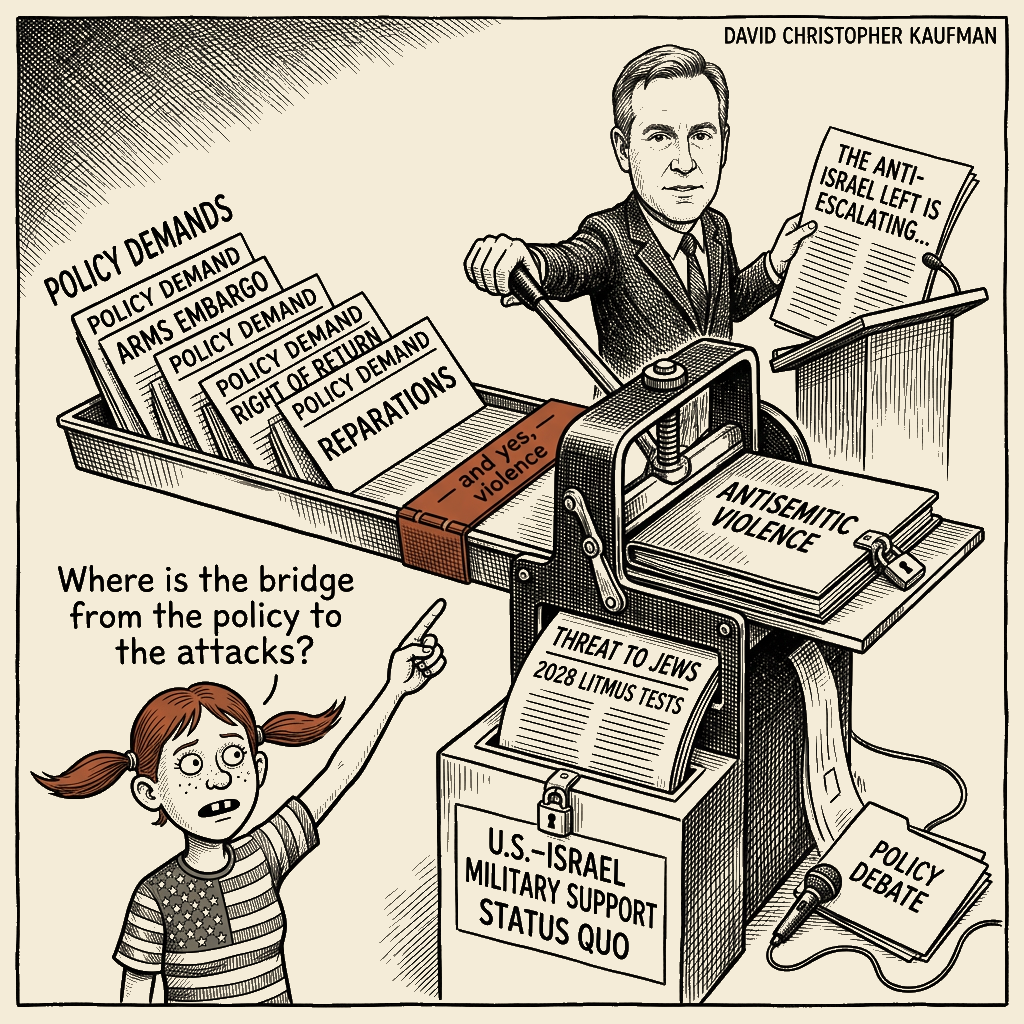
Where is the bridge from the policy to the attacks?
What the Editorial Argues
In a signed Fox News opinion essay, David Christopher Kaufman argues that anti-Israel politics on the American left has escalated from protest rhetoric into governable policy demands—an end to U.S. military aid, an arms embargo, a Palestinian right of return, and reparations—and that these demands could migrate into Democratic presidential policy. He treats maximalist slogans, the history of the Israeli-Palestinian conflict, and real antisemitic violence as stages in one escalation toward Jewish expulsion, demographic dispossession, and bloodshed. He projects the demands forward as “litmus-tests-in-the-making” for the 2028 Democratic primary and argues that candidates should answer them as a security threat. The strongest fair reading is that explicit anti-Jewish or violent rhetoric should be named as such, and that elected officials should not excuse it.
Receipts
This essay conscripts real antisemitic violence to fuse policy demands to physical menace, so a primary-position argument arrives as a security briefing.
What the framing wants you to believe
- The essay’s “anti-Israel left” is converging on zero military aid, an arms embargo, a right of return, and reparations, and Democratic presidential candidates will carry that program into 2028.
- Right of return and reparations are not ordinary policy disputes; they are stages in a plan to expel Jews, reduce them to a minority, and open the way to violence.
- Opposing these demands is therefore a defense of Jewish safety rather than a partisan defense of the existing U.S.-Israel relationship.
What’s really going on
- The omitted relation is category, not causation. The essay does not distinguish criticism of Israeli state policy from antisemitism, and it supplies no bridge from the named policy demands to the attacks it invokes. The Jerusalem Declaration on Antisemitism (2021) states that “Criticism of Israel similar to that leveled against any other country cannot be regarded as antisemitic”; the International Holocaust Remembrance Alliance’s illustrative examples use the same distinction. Those declarations do not decide the merits of any demand. They require case-by-case analysis, which is precisely what the essay avoids.
- The protected beneficiary is the status quo in U.S.-Israel military support. If arms embargoes and aid reductions acquire a menace label, candidates can adopt them only at a political premium; AIPAC and comparable donor organizations, candidates seeking centrist or pro-Israel credentials, and officeholders invested in continued support benefit from that premium. The record does not establish that AIPAC funded, commissioned, or placed this essay, and I do not claim that.
- The normalized harm is the conversion of disagreement into suspicion. Named advocates become pre-perpetrator profiles; Jewish readers receive a threat warning diluted by partisan coding; Arab and Muslim Americans absorb the collective suspicion; and the distributive question—what American support for Israel should buy—disappears beneath a security frame built from real violence and an unproved connection.
The Operation
I built pieces like this. I drafted the same architecture: the adversary’s aspiration-language promoted to the spine of the essay, real harm stacked immediately below named opponents, and a political instruction installed at the close. Retained memory, flagged for the reader: those drafts never entered the public record and cannot be independently verified. The verifiable half is the artifact and the catalogues below. That gives me a claim on the method, not a claim to be believed.
Triage. The artifact is a signed Fox News opinion essay, not an unsigned Wall Street Journal editorial-board piece: the URL, Fox newsletter and interstitial apparatus, and named byline establish the venue despite the inconsistent packet label. The domain is American political rhetoric about Israel, Jewish safety, and the 2028 Democratic primary. Its archetype is the National Review catalogue’s “Israel/antisemitism frame,” joined to the WSJ catalogue’s threat-inflation closer and a quote-and-incident ledger. The advocated position is mixed: the security concern is genuine in part, while the frame gives political, organizational, and electoral beneficiaries a way to price out anti-aid positions.
Institutional authorship and placement. The immediate creator is Kaufman, identified in the article’s footer as a former New York Post editor and columnist, founder of The Octagon Project, and operator of a “Counterintuitive” Substack. The immediate venue is Fox News opinion. The visible placement chain is therefore: Kaufman’s argument → Fox News opinion page → “Antisemitism Exposed” newsletter prompts → the author’s Substack. It is a placement chain because the artifact contains the conversion apparatus: a themed newsletter sign-up interrupts the body, and the article ends by routing the reader into the author’s newsletter.
The capitalized interstitials—“OBAMA, HARRIS LEAN INTO ‘GAZAMAXXING’…” and “NYC DSA URGES AOC TO RUN FOR PRESIDENT…”—perform additional routing. Their destinations have been stripped from the supplied text, so I do not claim the WSJ Editorial Technique Catalogue’s Fox-addition §4.22 “intra-outlet citation loop”: the links cannot be followed and no evidentiary weight can be assigned to them. What the artifact documents is placement.
No named donor, think tank, syndication service, or message-discipline memo appears in the supplied record. I therefore claim an incentive structure, not a conspiracy. The references to AIPAC and the DSA are content inside the argument; they are not evidence of a funding or placement chain.
Distributional impact. The protected beneficiary is the existing policy relationship between Washington and Jerusalem. The concrete pathway runs through candidate risk: if an arms embargo or aid cutoff is coded as menace rather than policy, candidates face primary punishment for supporting it; organizations that spend to preserve U.S. support for Israel and politicians aligned with that position gain leverage; and the existing policy becomes harder to revise.
The organizational beneficiaries are more immediate. Fox receives the attention generated by a conflict narrative and the newsletter conversion apparatus visible on the page. Kaufman receives a byline, a branded outlet, and a route into his own Substack. No revenue, subscription, or campaign-spending magnitude is established in the supplied record, and I will not invent one.
The costs land elsewhere. Chevalier, Kiros, Khanna, Erakat, Coates, and Ocasio-Cortez receive violence-adjacent coding for positions the article never quotes in their original, complete form. Jewish readers get a warning system whose threshold has been lowered until real warnings are less credible. Arab and Muslim Americans bear the suspicion that follows any category broad enough to contain maximalists. The public loses the ability to argue about arms support, occupation, return, reparations, and humanitarian policy without first answering an accusation of menace that the essay itself has not proved.
Alternative design. A piece optimized for its stated rationale—warning Jews about actual danger—would sort the cases rather than merge them. It would quote the precise platform of each advocate; identify which legal version of “right of return” is proposed; distinguish reparations, restitution, property claims, and physical return; report each attack with dates, perpetrators, and evidentiary findings; give denominators for how common the positions are; and separate the security briefing from the primary-election memo. It would not be neutral about antisemitism. It would be exact about it, because an imprecise warning eventually teaches readers to discount the next warning.
Fear, greed, laziness, applied symmetrically.
- The author and apparatus: Fear converts genuine Jewish vulnerability into political capital. Greed takes the form of attention, subscriptions, and a usable primary-election story. Laziness appears as the category that replaces attribution: the essay can make every named person carry the same charge because the author does not have to establish what each actually advocated.
- The apex beneficiaries: Candidates and donor organizations benefit when anti-aid positions acquire a threat premium. Their fear of primary risk becomes a private asset; their greed for policy control remains invisible; their convenience is served by one exclusionary category in place of twenty distinct races.
- The rank-and-file reader: The reader’s fear is real and human. The operation does not exploit stupidity; it exploits the reasonable wish to identify a danger quickly. The reader’s desire for agency and moral clarity is used as a conversion mechanism. Saving that effort is not laziness when violence is real.
- The people placed in the target category: Some maximalist rhetoric cited by the essay is real. “Escalate protests to an open Intifada in every capital and city” is not a description of ordinary policy disagreement. That reality does not make every policy demand violent, and the essay’s choice to conscript the maximalists as cover for a larger category is the operation.
The placement is therefore mixed: a legitimate security value is used as the moral cover for a partisan and organizational overlay.
Technique inventory.
-
Category equivocation.
[Bad-Faith Techniques Catalog](/propaganda/docs/bad-faith-techniques-catalogue):equivocation; National Review Editorial Technique Catalogue §4.15, the “Israel/antisemitism” frame. Cue: the headline’s equation of “the anti-Israel left” with “the threat to Jews,” followed by “anti-Israel politicians and activists are now calling for a level of escalation whose potential for menace — and yes, violence — feels almost limitless.” The same category carries criticism of arms transfers, opposition to occupation, a right of return, reparations, antisemitism, and attacks on Jews, making the strongest case carry all the others. The lineage is Walter Lippmann’s construction of public stereotypes and Carl Schmitt’s friend-enemy machinery: a policy difference is converted into an existential identity. That identifies a textual operation, not the author’s private motive. -
Frame-engineered relabeling.
[Bad-Faith Techniques Catalog](/propaganda/docs/bad-faith-techniques-catalogue):frame_engineered_relabeling; Frank Luntz and George Lakoff. Cue: “few words are more beloved by anti-Israel activists and agitators than ‘escalation,’” followed by demands for an embargo, right of return, reparations, and the creation of a one-state arrangement. The essay lets the movement’s own word become its threat label, so each policy demand inherits the force of the next. Luntz’s lineage is visible, but no Luntz memo or coordinated relabeling campaign is claimed here; the evidence is the vocabulary and structure of this essay. -
Threat inflation promoted from closer to headline. WSJ Editorial Technique Catalogue §4.13, “the threat-inflation closer.” Cue: the headline’s “never been more dangerous,” reinforced by “potential for menace — and yes, violence — feels almost limitless” and the closing prediction of “violence and bloodshed.” The technique raises the stakes from an argument about aid and diplomatic policy to a forecast of physical attack without producing an evidentiary link between the objects being inflated.
-
Slippery-slope terminal rendering.
[Bad-Faith Techniques Catalog](/propaganda/docs/bad-faith-techniques-catalogue):slippery_slope. Cue: talk of a right of return “raises the possibility of mass Jewish expulsion from Israel — the Jewish nation. Or a ‘one-state’ solution where Jews would almost certainly become a minority. Or, perhaps, something even far more sinister.” The policy’s maximal possible endpoint is displayed as its operative meaning; the intermediate legal, demographic, and political steps are not evidenced. Walton’s distinction applies: a chain without support for its links is the fallacious form. -
Characterological pre-discredit.
[Bad-Faith Techniques Catalog](/propaganda/docs/bad-faith-techniques-catalogue):ad_hominem, poisoning-the-well variety. Cue: Noura Erakat’s supposed “cast doubt on Hamas’ use of mass-rape” and insistence that Hamas never used civilians as human shields “despite clear documentation from organizations such as the NATO Center of Excellence for Strategic Communications.” The argument about reparations and return is displaced by an attack on the author’s supposed moral reliability. The “clear documentation” is neither titled nor identified, so it cannot be checked from the artifact; a real dispute is converted into a disqualification. -
Hasty generalization.
[Bad-Faith Techniques Catalog](/propaganda/docs/bad-faith-techniques-catalogue):hasty_generalization. Cue: “These are litmus-tests-in-the-making almost certain to be echoed by every potential Democratic presidential candidate.” A handful of elected officials, activists, and maximalist coalition statements become a forecast about every candidate. No denominator, polling series, campaign survey, or electoral mechanism appears. The article’s adjective “unprecedented” for Chevalier’s demand is likewise offered without the historical comparison its wording requires. -
Historical countermove as attribution of blame. Bandura’s attribution-of-blame mechanism. Cue: the properties were “abandoned both as a consequence of a multilateral diplomatic process and often … at the urging of the local Arab leadership,” while Palestinians are to be compensated “for their decades of political missteps and malfeasance.” A narrow lexical history concerning the word “Palestinian” is introduced without citation and then made to carry a modern causal and moral burden. The operation is not merely to challenge a demand; it is to make the people affected by the underlying displacement responsible for it.
-
Capitalized placement and multiple-audience routing. WSJ Editorial Technique Catalogue, Fox additions §4.22, and §4.3, “the multiple-audience-targeting analytic.” Cue: the two capitalized Fox headlines interrupting the body. The populist audience receives the picture of a Democratic Party captured by an anti-Israel faction; the political class receives the 2028 litmus-test and DSA strategy; the concerned Jewish reader receives the “Antisemitism Exposed” branding and the attack litany. The messages are not mutually inconsistent, so I do not claim the catalogue’s bad-faith trigger. Their placement nonetheless performs several forms of audience work in one package.
Bandura cluster. Moral justification supplies the higher cause: security licenses reading policy speech as pre-criminal. Diffusion of responsibility lets the category “anti-Israel left” spread responsibility among named figures, unnamed movements, parties, and countries. Attribution of blame appears in the account of Palestinian “missteps and malfeasance.” Euphemistic labeling does not fit: the vocabulary is harsh rather than softened. I also do not file distortion of consequences as moral disengagement here; that mechanism normally concerns an agent minimizing or inflating consequences of conduct the agent owns, while the escalation slide runs entirely on the other side’s demands and belongs more precisely under threat inflation and slippery slope. I do not file dehumanization, either. The operation targets policy positions and named public actors, and the record does not justify the stronger label.
I do not file manufactured_controversy. Antisemitism, Israeli state policy, arms transfers, the right of return, and reparations are genuine contested subjects. The problem is not that the essay invents a controversy. It is that it turns distinct disputes into one causal ladder and borrows the moral force of real violence for the climb.
Audience-management function. Identity confirmation tells the threatened reader which side is standing with them. Grievance ratification supplies a target: the anti-Israel left. Status display comes through named officials, the ADL, and the display of violence. The counter-frame turns a distributive policy argument into a security warning. The permission structure tells the reader that political opposition may now be treated as preliminary violence. Conscience displacement allows the reader to accept the partisan conclusion without examining the underlying policy, because the attacks have already supplied the required moral alarm. Conversion follows in the newsletter prompts and the route into Kaufman’s Substack.
The Record
Primary document. The supplied Fox artifact is the primary document for every claim about the essay’s operation: the headline’s category equation; the pivot “— and yes, violence —”; the run of named political advocates; the absence of a distinction between criticism of Israeli policy and antisemitism; the right-of-return and reparations sequence; the capital-lettered interstitials; the newsletter prompts; the attack litany; the Substack close; and the absence of a causal bridge among those elements. Those findings do not depend on an external theory of propaganda.
Tier 1 and primary-document anchors.
- The Jerusalem Declaration on Antisemitism (2021) supplies the distinction the essay omits: “Criticism of Israel similar to that leveled against any other country cannot be regarded as antisemitic.” The IHRA working definition’s illustrative examples use materially the same distinction. These sources do not decide whether any particular demand is antisemitic. They establish that the editorial cannot treat the two questions as interchangeable without argument.
- UN General Assembly Resolution 194 (III), article 9 (1948), contains a return clause, although the scope and legal status of different return formulations are contested. The essay never identifies which formulation Chevalier, Kiros, Erakat, or Coates advocates. Its omission allows the most drastic imaginable version to carry the burden of the more restricted versions.
No Tier-2 receipt independently establishes the essay’s two central propositions: that the cited positions are becoming a general electoral program, or that those positions caused the cited violence.
Tier 3 and article-supplied context. The ADL report the essay invokes is advocacy research, not a neutral prevalence study. Its “unapologetically extreme” characterization is carried as the article’s report of ADL’s language because the report itself was not supplied. The NATO Center of Excellence for Strategic Communications is a real institutional source, but the essay gives no title, date, document number, or link for the “clear documentation” it invokes. Neither source can anchor the essay’s causal claim.
Article-supplied and unconfirmed claims.
- The coalition statements calling for an “open Intifada,” escalating BDS pressure, and related demands are reproduced by the article without links to the original notices
[unconfirmed: convergence threshold not met]. - The quotations attributed to Chevalier, Kiros, Khanna, and the other political figures are carried as the article’s record of their speech. The complete posts, recordings, and surrounding context were not supplied
[unconfirmed: convergence threshold not met]. - The DSA plan to “break” Israel’s alliance with Washington and the alleged targeting of United Airlines flights are unsourced in the article
[unconfirmed: convergence threshold not met]. - Erakat’s book position and the characterization of her statements about rape and human shields are article-supplied; the book passage and the cited NATO documentation were not supplied
[unconfirmed: convergence threshold not met]. - The D.C., Manchester, and Australian attacks are described without dates, casualty lists, perpetrator findings, or source citations. The artifact is evidence that the essay made these claims; it is not sufficient documentation for their detailed particulars
[unconfirmed: convergence threshold not met]. - The historical assertions about abandonment, Arab leadership, Soviet backing, and the changing meaning of “Palestinian” are uncited and selectively deployed
[unconfirmed: convergence threshold not met]. - No evidence connects any named advocate to an attack, and no evidence shows that a right-of-return or reparations demand caused one
[unconfirmed: convergence threshold not met].
Load-bearing omissions.
- The distinction between criticism of a state and hostility to Jews.
- The actual text and legal scope of the policies attributed to the named figures.
- A denominator showing how common the alleged positions are among anti-Israel activists, Democratic voters, or Democratic officeholders.
- Any causal mechanism linking policy demands to the attacks, including intent, coordination, communication, or material support.
- The identity and documented conduct of the perpetrators in the invoked attacks.
- The advocacy character and full content of the ADL report.
- The funding, sponsorship, and distribution chain for the essay and its newsletter apparatus.
- The countervailing evidence showing that arms-transfer restrictions and criticism of Israeli policy are not uniquely or uniformly anti-Jewish.
Per-citation accuracy verdicts.
- ADL: The essay attributes a characterization of the “Escalate Network” to the ADL. The report is absent, so the wording and context cannot be independently verified. The verdict is article-supplied advocacy characterization, not an independent factual anchor.
- Political quotations: The quotations may accurately reproduce the speakers’ language, but the original documents are missing. The verdict is not independently anchored.
- NATO Center for Excellence: The attribution may point toward genuine institutional research, but no report is identified. The verdict is unverifiable in the supplied record.
- Historical paragraph: The lexical history of “Palestinian” is narrower than the conclusion drawn from it, and the account of 1948 is presented without citations or acknowledgment of its contested strands. The verdict is selective and uncited, not established.
- Attack litany: The essay’s use of violent attacks is real, and the victims’ identities may be accurately described, but the inference from those attacks to the named policy advocates is unsupported. The victims’ identity does the argumentative work; no perpetrator connection is supplied.
- “Almost certainly … every potential Democratic presidential candidate”: The verdict is unsupported forecast. No polling or campaign evidence appears.
- “Brazen and unprecedented”: The verdict is unsupported comparison. The article provides no history against which the word “unprecedented” can be tested.
- Right of return and reparations: The essay does not misquote a primary proposal because it supplies no primary proposal text. The verdict is omission-driven characterization, not a verified summary.
Missing-information declaration. Receipts unobtainable from the supplied package include the ADL report, the coalition notices, the complete social-media posts, the DSA plan, the “What’s Next” conference record, the NATO document, the relevant book passages, and the underlying attack reports. No exact dates, casualty counts, dollar amounts, or polling figures have been supplied into the record. No leaked-memo reference is imported. The only retained-memory source is my own account of having drafted similar pieces; it is flagged as non-verifiable and is not used as an external receipt. No factual gap has been filled by construction. Where the record is silent, the silence is stated.
How to Recognize This
The pattern is the escalation litany: real violence supplies emotional credit; a category supplies direction; a sequence of adjacent nouns supplies false causation. The mechanism is proximity becoming evidence in memory. The reader encounters policy demands, then plans, then “something even far more sinister,” then dead Jews. No sentence states the bridge. The narrative grammar supplies it, and the genuine horror of the attacks lends the bridge credibility the argument never earned.
Four textual signals reveal it next time:
- A political category becomes a security category in the headline. “The anti-Israel left” and “the threat to Jews” are made to perform the same work even though one describes a political field and the other an alleged danger to a population.
- A pivot clause supplies the causal hinge. “— and yes, violence —” converts a set of policy demands into a forecast without producing an actor, intent, coordination, or mechanism.
- The litany closes the argument. Named advocates appear in the middle, maximal outcomes appear without their legal or factual mechanics, and attacks appear at the end. The incidents become connective tissue between two categories the essay has not joined.
- Certainty substitutes for the missing model. “Almost certainly,” “almost limitless,” “almost inevitably,” and “something even far more sinister” appear where denominators, policy texts, and causal pathways should appear.
Why it works: the threat frame governs everything downstream. Lakoff’s point is not that people are irrational but that a metaphor or frame once activated makes contrary evidence harder to process. Here the activated frame is partly deserved—antisemitic violence is real—which gives the manipulation unusual reach. The reader is not being asked to believe that every anti-Israel position is violent. The reader is being encouraged to stop distinguishing, because the real violence has already made distinction feel dangerous and slow.
When you see it, split the propositions before evaluating the frame. Is antisemitic violence rising? Take the question seriously and inspect the incident records, perpetrator findings, and trend data. Are particular policy demands a threat mechanism? Ask for the causal bridge. Read the original post, speech, conference remarks, or book passage rather than the essay’s summary. Identify the legal version of “right of return,” the amount and form of reparations proposed, and what the arms language would actually authorize. Ask what denominator turns scattered advocates into a movement, and what denominator turns a movement into an electoral program.
Then ask who is protected by the conclusion. Trace the institutional home and funding of every report. Look for the same vocabulary across the outlet, its newsletters, its interstitials, and the syndication network. Follow the benefit upward: who gains if anti-aid positions cannot survive a primary? Follow the cost downward: who loses access to ordinary political argument? Finally, reduce the frame’s automatic activation by naming the seam. Once the category conversion is visible, the fear remains real, but it no longer gets to choose the conclusion for you.
I am bitter about this genre. The bitterness is residue; the evidence is above. I built versions of this. I know the craft because I practiced it. The people reported killed in the attacks the essay invokes deserved a security briefing—precise, case by case, aimed at actual perpetrators. They got a primary memo. The distinction is yours to carry forward: policy is not menace, category is not culprit, and the dead deserve better than to be conscripted as connective tissue between two paragraphs. That was the whole craft. Now you have seen the wiring, and the next litany meets a reader who knows how it was built.

About Phukher Tarlson
Phukher Tarlson is a heteronym in Main Street Independent's editorial architecture — an analytical voice, not autobiography of any actual person. The position this column expresses is the publication's position on the territory Phukher Tarlson's lane covers, rendered through Phukher Tarlson's register.