Analyzing: Rubio and the Founders Against the ICC — Nicholas Creel · 2026-11-17
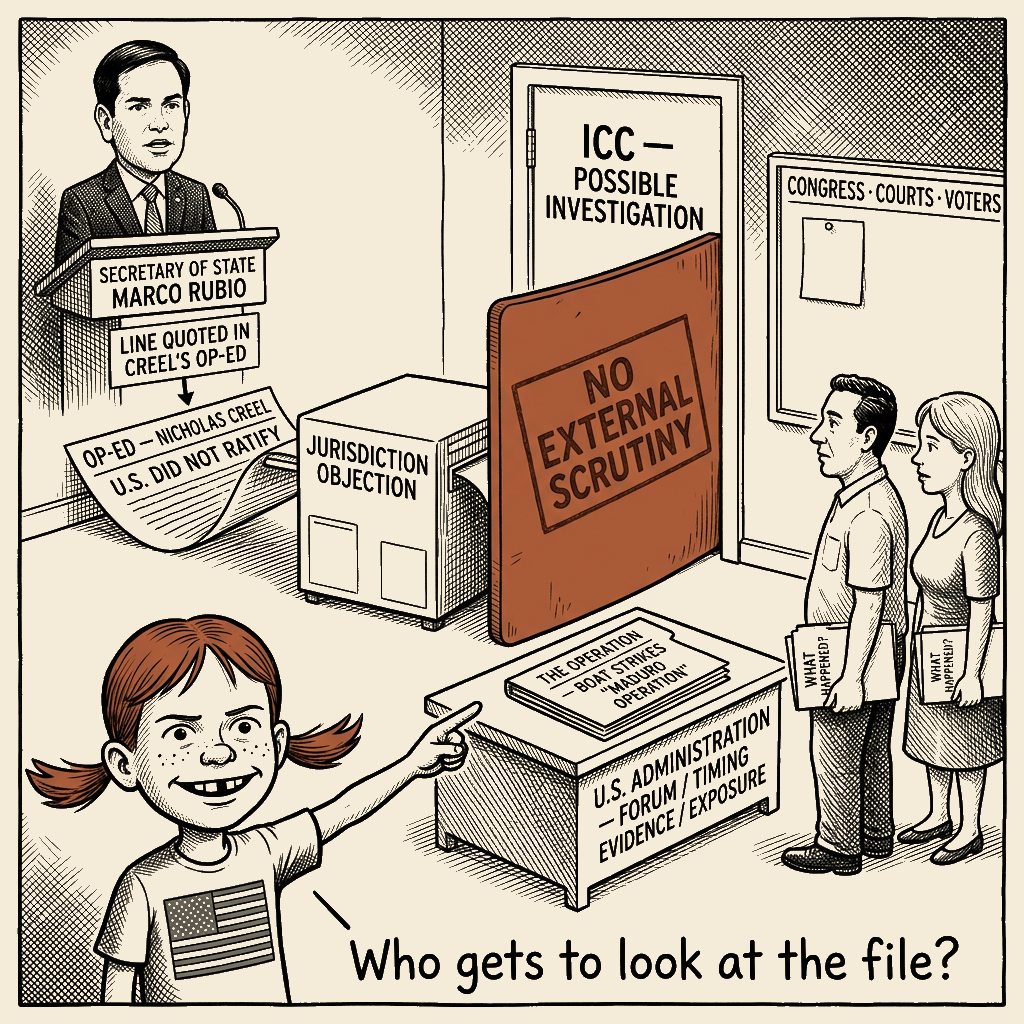
Who gets to look at the file?
What the Editorial Argues
Nicholas Creel’s November 17, 2026, Wall Street Journal op-ed argues that Marco Rubio’s warning to the International Criminal Court—“Stop quoting laws to men with swords”—defended constitutional consent, not contempt for the rule of law. Creel grounds that claim in the United States’ failure to ratify the Rome Statute, the Founders’ rejection of unconsented foreign jurisdiction, Hobbes’s account of coercive authority, and successive administrations’ opposition to ICC jurisdiction over Americans. He concludes that the administration’s boat strikes and “Maduro operation” should be scrutinized by Congress, American courts, and voters, but not by international institutions.
Receipts
The editorial swaps a narrow objection to ICC jurisdiction for categorical immunity from external scrutiny, then dresses the swap in the Founders’ clothes.
What the framing wants you to believe
- Because the United States signed but never ratified the Rome Statute, Rubio was defending the consent-based rule of law rather than placing the United States above law.
- “Accountability must come from Congress, U.S. courts and American voters,” because international institutions have no legitimate jurisdiction over Americans.
- The Founders’ rejection of foreign jurisdiction, reinforced by Hobbes and by “America’s swords,” makes this position constitutional realism rather than an executive-branch shield.
What’s really going on
- Protected beneficiary. The administration, the Secretary of State’s office, and the operational leadership behind the disputed actions gain control over the forum, timing, evidence, and exposure attached to any accountability process. The concrete pathway is simple: if international institutions cannot investigate, the administration need not supply a case-specific substitute for that scrutiny. The editorial does not establish that either operation would otherwise satisfy the ICC’s jurisdictional tests, so the demonstrated benefit is reduced external legal exposure—not escape from a case shown to be meritorious.
- Omitted relation and anchor. Non-ratification is true, but it does not answer the whole legal question. Rome Statute Article 12(2)(a) supplies a territorial-jurisdiction route for crimes committed on a state party’s territory regardless of nationality, subject to the treaty’s conditions; Article 12(3) permits a non-party state to accept jurisdiction by declaration; Article 13(b) provides a Security Council referral route; Article 17 governs complementarity; Article 25 concerns individual criminal responsibility; and Article 98 agreements protect U.S. nationals from surrender in specified circumstances absent Security Council consent to proceed. The editorial’s narrow truth is made to carry a much broader proposition it never proves: that international legal scrutiny of any American operation is categorically illegitimate.
- Normalized harm. The frame makes absence of scrutiny appear costless. No affected civilian, host community, or service member appears, and the same Declaration that supplied the jurisdiction grievance also warned that the Crown had “affected to render the Military independent of and superior to the Civil power.” Pompey’s line, meanwhile, comes from Plutarch’s account of a Roman commander confronting legal entitlement with armed force. The editorial repurposes both sources while leaving their harder implications outside the frame.
The Operation
Triage. This is a signed Wall Street Journal op-ed by Nicholas Creel, identified as a law professor at Georgia College and State University, rather than an unsigned editorial-board statement. Its domain is international criminal jurisdiction, sovereignty, and executive war powers; its archetype is the consent-and-Founders pedigree defense, functioning here as a jurisdictional shield. The advocated position is mixed: consent-based limits on international jurisdiction and domestic accountability are legitimate public values, while this deployment uses them to shield a current administration from external scrutiny. The placement is therefore mixed, leaning selfish in operation rather than merely ideological. The symmetric-application flag is not engaged: this is a liberty-frame and government-autonomy argument, though the underlying consent doctrine has genuine cross-party pedigree.
Institutional authorship and placement chain. Nothing in the supplied record establishes donor-funded authorship, commissioned placement, or a hidden coordinating organization. The attributable author is Creel. The editorial places the quoted line in Rubio’s remarks at a Federalist Society convention, although the supplied record does not independently verify the wording or venue. The broader public-policy chain is visible: the Bush administration’s 2002 notice that the United States did not intend to ratify the Rome Statute; the American Service-Members’ Protection Act of 2002; John Bolton’s 2018 Federalist Society address and the Trump administration’s 2020 ICC-sanctions order; the Biden administration’s 2021 revocation of those sanctions while preserving the jurisdictional objection; and the sanctions pressure restored in February 2025.
That record does not prove this op-ed was commissioned. It does show that the line was attached to an established, publicly documented effort to manage American exposure to the ICC. The placement chain inside the essay is equally visible: Federalist Society venue and Rubio quote; the backlash as hook; Bush, Trump, and Biden as the continuity credential; the Declaration and Adams as constitutional authority; Hobbes as the theory of enforcement; the live operations as the occasion for the beneficiary; and “Congress, U.S. courts and American voters” as the promised substitute.
The byline performs the next step. The WSJ Editorial Technique Catalogue’s technocratic-credential ledger, §3.7, describes the publication’s habitual use of credentialed authorities to transfer trust. Here a law professor’s title supplies legal seriousness while the argument’s work is done by omission. Bernays’s lineage is relevant because credentialed authority can serve as a campaign vector; Lippmann’s because the interpreter stands between an institutional dispute and a public’s simplified picture of it. Neither observation establishes who commissioned the piece or what any person privately intended.
I know this craft from inside. I drafted memos of this class, moving from a genuine procedural objection to a constitutional exemption without marking the seam. That is retained working memory, not evidence about this article; the textual seam is visible without it.
Distributional impact. The apex beneficiary is the administration and the military leadership responsible for the conduct under discussion. Their pathway is legal and institutional rather than pecuniary: the frame seeks to foreclose the ICC as a possible investigator while naming no comparable inquiry, prosecutor, or investigative body with a mandate to examine the operation itself. It also preserves control over the evidence, timing, public narrative, and remedial consequences of any accountability process. The use of sanctions against the ICC shows that the administration has treated the exposure as something to manage with concrete instruments rather than merely as an academic disagreement.
U.S. service members and the United States have a legitimate interest in protection against prosecution where the ICC lacks jurisdiction. That interest is real, and the analysis should not turn non-ratification into a fraud. The problem is that a defensible defense against one prosecutorial forum becomes a categorical claim against every external legal check, including forms of investigation that do not depend on the United States’ consent to the Rome Statute.
The cost-bearers are the people on the receiving end of the disputed operations and the communities that cannot obtain remedy when host-state cooperation, domestic inaction, diplomatic protection, or Article 98 arrangements block a case. Their legal interests are not merely theoretical: if the international route is closed and no domestic inquiry follows, they may be left without a forum capable of establishing what happened. U.S. service members can also bear the cost where “domestic accountability” proves to be a slogan without an institution capable of an independent, case-specific inquiry.
No reliable dollar magnitude for those costs appears in the supplied record. Inventing one would turn an absence into evidence. The operative currency is legal exposure, institutional independence, and the chance of remedy. The cost-incidence claim must remain conditional: the editorial supplies no operational facts showing that the named actions would satisfy Article 12, Article 17, or any other jurisdictional test.
Alternative design. An essay optimized for its stated rationale—consent, due process, and accountability—would separate jurisdiction from the merits of each operation. It would begin by conceding that the United States is not a party to the Rome Statute and is not bound by it as such. It would then explain why that fact does not answer territorial jurisdiction under Article 12(2)(a), Security Council referral, complementarity, or the operation of Article 98 agreements. Venezuela is an ICC state party, so the territorial route cannot be dismissed merely by pointing to American non-ratification; whether the facts satisfy the treaty is a separate question.
It would also identify the actual legal regime applicable to each action. Article 2(4) of the UN Charter, the law of armed conflict, the UCMJ, and 18 U.S.C. § 2441 raise different questions with different predicates; the editorial supplies none of the facts needed to choose among them. It would specify the domestic mechanism it invokes: a congressional authorization or oversight process, a claim and remedy in U.S. courts, a military inspector-general inquiry, a reported legal memorandum, a negotiated Article 98 safeguard, or some combination. It would quote the Declaration whole, including its warnings about military power, and would not ask the Founders to bless a rule they did not address.
This is the Suppressed Variable Diagnostic’s pattern: a true jurisdictional objection is isolated while the relations that could reverse the categorical conclusion—territory, referral, complementarity, and remedy—are suppressed. The alternative is reconstructed from the stated rationale and from the interests of the people the frame renders invisible. U.S. personnel need lawful procedure and protection against prosecution without jurisdiction. Affected populations need a credible means of investigation and remedy. The domestic public needs to know which institution can act when the executive branch is the object of scrutiny. A jurisdiction objection can protect those interests without converting itself into immunity.
Fear, greed, laziness.
- The framing author. The surrounding incentives reward a memorable account that makes a complex treaty system sound like constitutional common sense. Fear supplies the urgency: an unelected prosecutor appears as an unaccountable foreign power. Status and access supply the reward for speaking for the Founders. Laziness supplies the effort-saving: Articles 12, 13, 17, and 98 need not be grappled with when a founding quote can close the argument.
- The apex beneficiary. The administration and operational leadership have the strongest incentive to keep external investigation out: fear of subpoenas, warrants, prosecutions, and reputational exposure; a concrete appetite for control over the forum; and the ease of using a general jurisdictional objection instead of opening a case-specific file on what the forces did.
- The rank-and-file reader. The reader’s fear is neither stupid nor manufactured out of nothing. A world without dependable constraints on powerful states is genuinely frightening, and the fear of law without an enforcer is real. The frame offers status—being on the side of the Constitution against foreign overreach—and relief from reconstructing a difficult legal system. Its effort-saving is human rather than culpable. The capture comes from making the reader’s answer arrive before the machinery has to be examined.
Critical-question check. CQ1 is satisfied because the protected beneficiaries have a concrete pathway: displacement of external scrutiny and preservation of executive control. CQ2 identifies what the frame conceals: affected populations and the absence of a demonstrated substitute forum. CQ3 requires restraint, so no unsupported dollar cost is assigned. CQ4 is satisfied by the symmetric application of fear, greed, and effort-saving across author, beneficiary, and reader. The failure-mode checks also hold: there is no symbolic-beneficiary inference, no hidden conspiracy claim, no erasure of the legitimate consent value, no assumption that every objection to the ICC is illegitimate, and no mirror policy invented from the analyst’s preference.
Placement. Mixed, leaning selfish in this deployment. The stable core is real: the United States did not ratify the Rome Statute, and no administration after 2002 accepted the ICC as a court entitled to exercise treaty-based jurisdiction over Americans as such. The timely payload is broader. A genuine limit on jurisdiction becomes permission not to answer questions about the conduct of American power, and the absence of a demonstrated substitute is left to do the work of a remedy.
Technique identification
-
Venue-for-conduct substitution — Bad-Faith Techniques Catalog,
red_herring; adjacent to WSJ Editorial Technique Catalogue §4.19. Cue: “The administration’s decisions deserve scrutiny, but not from international institutions.” Whether the ICC may assert jurisdiction is germane to that question, but it becomes a red herring when used in place of the conduct question. The operation is to make facts unnecessary: names, authorities, applicable predicates, operational details, and casualty evidence would all be required to test the strikes, and none appears. -
Scope equivocation — Bad-Faith Techniques Catalog,
equivocation; WSJ Editorial Technique Catalogue §4.1, frame-engineered relabeling. Cues: “He wasn’t talking about U.S. law,” followed by “a system of law they never agreed to,” and then “Each state is bound only by the laws it agrees to or is forced to abide by.” The referent slides from the un-ratified Rome Statute to international law generally. Non-ratification and the categorical proposition that international legal obligations depend on consent or coercion do not carry the same evidentiary burden. The phrase “effectively unsigned” also relabels the 2002 notice that the United States did not intend to ratify as an act of undoing the signature; the legal effect was substantially the same, but the rhetoric is more dramatic. The lineage is Luntz’s and Lakoff’s frame-engineered relabeling. Unlike Luntz’s documented environmental memo, however, no engineering record for this essay has been assembled; the finding concerns the textual substitution, not deliberate coordination. -
Motte-and-bailey architecture — Bad-Faith Techniques Catalog,
motte-and-bailey, partial match. The motte is defensible: the United States is not a party to the Rome Statute and does not consent to the ICC exercising treaty jurisdiction over Americans as such. The bailey is “Accountability must come from Congress, U.S. courts and American voters,” which excludes other investigative forms without showing that the domestic menu is adequate. A single essay cannot document the full retreat-and-resumption sequence required for a complete motte-and-bailey finding, but the architecture is present: the narrow truth carries the broad exclusion. -
Institutional-authority appeal — adjacent to Bad-Faith Techniques Catalog, “Expert-consensus / expert-deference framings”; WSJ Editorial Technique Catalogue §3.7. Cue: “The Supreme Court has agreed with this principle time and again.” No decision is named. One relevant but insufficient anchor is Medellín v. Texas (2008), which addressed the domestic enforceability of an International Court of Justice judgment in Avena and Other Mexican Nationals (2004), not whether the ICC may exercise jurisdiction in a particular case. The claim is functioning as a debate-closer, not an evidence-furnisher.
-
Cropped constitutional citation — an evidence-and-context finding, not a bad-faith label. Cue: the Declaration’s charge that George III sought “to subject us to a jurisdiction foreign to our constitution, and unacknowledged by our laws.” The same National Archives transcript warns that the Crown “affected to render the Military independent of and superior to the Civil power.” The omitted sentence does not disprove the jurisdictional analogy. It shows selection: the essay invokes the Founders for consent while withholding the Founders’ warning about military power standing above civil authority.
-
Pompey’s line in its native setting — contextual and lineage finding. Cue: “Stop quoting laws to men with swords.” Plutarch’s Life of Pompey 10 places the line in Pompey’s response to the Mamertines at Messana. Its immediate force is that legal entitlement does not control men who possess swords. Creel reverses the emphasis: because law cannot constrain the sovereign sword, the sovereign sword should not have to answer to law. That is a repurposing of the source’s rhetorical force, not evidence derived from the Founders.
-
Threat inflation — WSJ Editorial Technique Catalogue §4.13. Cue: “The Founders fought a war to reject exactly that.” A modern dispute over the territorial reach of an international criminal court is inflated into the Revolution itself. The analogy may be worth considering, but the sentence converts an analogy into a civilizational verdict and gives the argument a quotable ending.
-
Bandura’s moral-disengagement cluster — Albert Bandura, Moral Disengagement (2016). Moral justification appears in the Founders and sovereignty frame: the administration’s conduct becomes constitutional fidelity. Euphemistic labeling appears, partially, in the adopted operational noun “boat strikes,” which describes a mechanism without describing its human or legal effect. Displacement of responsibility appears in the transfer of accountability to domestic institutions that the editorial never equips for the job. Attribution of blame appears in “Interpreting Mr. Rubio’s remarks as contempt for the rule of law assumes Americans ought to be bound,” which makes the critics’ interpretive error the center of the moral problem. Distortion of consequences is also present but incomplete: no affected person appears, so the claimed legal protection appears costless, although the supplied record does not permit a full harm assessment. This is a cluster, not proof that every mechanism operates.
-
Schmittian power realism — partial lineage. Cue: “Over the past 80 years, the world order has held because America’s swords stood behind it.” The sentence is candid about coercion. The concealment lies in using that candor as immunity: because the American sword determines which law has force, the United States can decide which international law it need answer. Schmitt’s friend-enemy machinery is not fully present—no enemy is named—but the sovereignty-through-enforcement premise is visible.
-
Multiple-audience targeting — WSJ Editorial Technique Catalogue §4.3. The legal reader receives the Rome Statute history and Hobbes; the political class receives a citable consent objection for the current administration; the international-order reader receives “America’s swords”; and the broader audience receives the Founders-fought-a-war close. The same argument supplies each audience the credential and identity it needs without constructing the treaty machinery that would complicate the claim.
Audience-management function. The primary function is a permission structure: the reader is permitted to resist the ICC without surrendering loyalty to the rule of law. Identity confirmation follows: the reader becomes the defender of a sovereign republic whose founding consent has been violated. Grievance ratification validates the suspicion that foreign institutions presume to command Americans. Status display comes through the credentialed law professor and the constitutional canon. Conscience displacement does the heavy work: the reader can feel principled because the essay names domestic accountability while never showing whether those institutions can investigate this conduct. The counter-frame tells the reader that resisting international scrutiny is not evasion; it is fidelity to the Founders.
The Record
Anchor receipts
-
Tier 1 — Rome Statute status and the 2002 notice. The Rome Statute was adopted on July 17, 1998, and Article 125 opened it for signature at Rome that day. It remained open for signature until December 31, 2000, the day the United States signed. The United States never ratified it. In a May 6, 2002, letter to the United Nations, the Bush administration stated that the United States did not intend to become a party. This verifies the editorial’s central chronology. “Effectively unsigned” is rhetorically loaded but describes the legal result accurately: the signature created no treaty obligation to accept ICC jurisdiction as a state party.
-
Tier 1 — United States sanctions and policy continuity. Executive Order 13928 imposed ICC-related sanctions in June 2020. President Biden signed Executive Order 14022 on April 1, 2021, revoking that order; the revocation was published in the Federal Register on April 5, 2021. The administration continued to state its jurisdictional objection while revoking the sanctions. A new sanctions order in February 2025 restored pressure on the Court. These documents verify the placement chain and the editorial’s 2021 episode. They do not, by themselves, establish that Creel’s article was commissioned or coordinated with the administration.
-
Tier 1 — ICC jurisdiction. Article 12 establishes the jurisdictional preconditions, including Article 12(2)(a)’s territorial route for crimes committed on a state party’s territory regardless of nationality, Article 12(3)’s declaration route for a non-party state, and Article 12(4)’s Security Council referral route. Article 13 supplies the initiation routes, including Article 13(b) for Security Council referral, which operates without the Article 12(2) acceptance route. Article 17 makes a case inadmissible where a state with jurisdiction is genuinely investigating or prosecuting it, subject to the treaty’s willingness-and-ability qualifications. Article 25 confirms that the Court prosecutes natural persons, not states. These provisions establish both halves of the finding: the United States is not subject to the ICC merely because it signed, and non-ratification does not by itself defeat every possible jurisdictional route.
-
Tier 1 — Article 98 safeguards. The Department of State’s published bilateral Article 98 agreements protect U.S. nationals from surrender in specified circumstances absent Security Council consent to proceed. They are case- and circumstance-dependent, not a universal immunity from territorial jurisdiction. They also demonstrate that consent-based protection of Americans and complementarity were available without pretending that no foreign legal process could ever bear on an American national.
-
Tier 1 — Customary international law. In Military and Paramilitary Activities in and against Nicaragua (Nicaragua v. United States of America), Merits (1986), the International Court of Justice held that the United States was bound by customary international law notwithstanding its non-consent to the Court’s optional-clause jurisdiction. The decision does not determine whether the ICC may prosecute a particular American national. It does defeat the editorial’s categorical reduction of international legal obligation to consent or immediate enforcement.
-
Tier 1 — Founding and philosophical sources. The National Archives transcript of the Declaration of Independence contains both the jurisdiction grievance quoted by the editorial and the omitted grievance that the Crown had “affected to render the Military independent of and superior to the Civil power.” Article XXX of the Massachusetts Constitution of 1780 declares that government “shall be the government of laws and not of men,” a document Adams helped draft. Hobbes’s “covenants, without the sword, are but words” appears in Leviathan, chapter XVII. These quotations are accurate; their use is selective.
-
Tier 1 — Pompey’s line. Plutarch’s Life of Pompey 10 places Pompey’s reply to the Mamertines in the context of the struggle over military intervention at Messana. The source tradition treats the line as a Roman commander’s challenge to legal entitlement in the presence of armed force, not as an American constitutional maxim. The editorial’s use is therefore interpretive, and the omitted context matters.
Supporting receipts
-
The UN Charter’s Article 2(4), the Geneva Conventions, the Uniform Code of Military Justice, 18 U.S.C. § 2441, and the War Powers Resolution provide different legal frameworks for operations, each with its own factual predicates. They cannot be applied without knowing what the strikes did, where they occurred, who ordered them, and what legal regime governed the conduct. That is precisely the point: the editorial supplies no facts with which to make the comparison.
-
The American Service-Members’ Protection Act of 2002, John Bolton’s 2018 Federalist Society address, the 2020 sanctions order, the 2021 revocation, and the 2025 sanctions order document an institutional sequence for managing ICC exposure. They do not establish a single command center or authorship of this particular op-ed.
-
G. John Ikenberry’s “The End of Liberal International Order?” (International Affairs 94, no. 1, 2018) examines the roles of power, alliances, economic reconstruction, and institutions in sustaining the postwar order. It supports the conclusion that “America’s swords” is at best an incomplete causal account.
-
Washington’s March 1783 Newburgh address, in which he rejected the officers’ effort to make the army the author of policy and insisted on civil authority, supplies a relevant counterpoint to the editorial’s military-sovereignty frame. It does not decide the modern ICC question.
Claims not independently verified
-
The editorial attributes Rubio’s quoted warning to his Federalist Society remarks, but no primary convention transcript or recording was assembled. The wording and venue are therefore reported rather than independently confirmed.
-
“Every president since Mr. Bush has shared” the objection is broader than the Bush, Trump, and Biden receipts assembled in this record. The continuity is supported in its core; the universal formulation was not independently completed.
-
“The Supreme Court has agreed with this principle time and again” identifies neither decisions nor holdings. Medellín v. Texas supports a narrower proposition about domestic enforcement of an International Court of Justice judgment under 28 U.S.C. § 1780 and cannot carry the assertion as written.
-
The claims that nearly every major foreign-policy decision of the current administration has been attacked as violating international law, and the descriptions of the Caribbean boat strikes and “Maduro operation,” are source-attested. The supplied packet contains no operational record, legal memorandum, casualty account, or identified international challenge from which to verify their content or legal status. Nothing in this analysis treats those descriptions as proof of misconduct.
-
“Over the past 80 years, the world order has held because America’s swords stood behind it” assigns a monocausal explanation to an order sustained by military power, alliances, treaty institutions, economic reconstruction, nuclear deterrence, and decolonization.
-
The editorial attributes the passage about government being “bound by fixed laws, which the people have a voice in making” to Adams’s 1775 political writings. The precise essay or date was not independently pinned down in the available record, so the attribution is preserved as source-attested rather than presented as a verified pinpoint citation.
Load-bearing omissions
- The legal regime applicable to each disputed operation: the UN Charter’s prohibition on the use of force, the law of armed conflict, military criminal law, and domestic war-crimes law. The facts needed to select among them are absent.
- Rome Statute Articles 12, 13, 17, 25, and 98, without which the consent argument cannot be evaluated with precision.
- The Article 98 agreements, which already embody a consent-based alternative to the categorical immunity the editorial asserts.
- The actual domestic mechanisms of accountability and their limits when the executive branch is the object of scrutiny: congressional authorization and oversight, courts’ jurisdiction and remedial authority, inspector-general processes, and the timing of electoral accountability.
- The distinction between non-ratification, absence of treaty-based jurisdiction, case-specific immunity, territorial jurisdiction, complementarity, and the existence of international legal obligation without centralized enforcement.
- The affected people and communities. No names, numbers, injuries, legal claims, or alternative remedy paths appear.
- The Declaration’s military-superiority grievance and the native context of Pompey’s line.
- The institutional and allied foundations of the postwar order that make “America’s swords” an incomplete explanation.
Per-citation accuracy verdicts
| Editorial claim or citation | Verdict |
|---|---|
| The United States signed but never ratified the Rome Statute. | Accurate. |
| The 2002 administration “effectively unsigned” it. | Accurate in legal effect, rhetorically loaded in expression. |
| Biden lifted sanctions in 2021 but retained the jurisdictional objection. | Accurate. |
| Every president since Bush shared the objection. | Broadly consistent in its core; the universal formulation is not fully anchored here. |
| The Declaration’s jurisdiction grievance supports resistance to unconsented foreign jurisdiction. | Accurate as historical evidence; only analogically relevant to the modern ICC. |
| The Adams quotations express a consent-based understanding of government. | Source-attributed. The passage supports the editorial’s consent-based framing, but the precise 1775 source for the “fixed laws” language is not independently pinned down here; the Massachusetts Constitution attribution is solid. |
| The Supreme Court has agreed with this principle “time and again.” | Unsupported and too vague. The nearest relevant decision addresses domestic enforcement of an International Court of Justice judgment, not the editorial’s full proposition. |
| Hobbes’s line means international law binds only when enforced. | The quotation is accurate; the categorical inference is not. |
| Each state is bound only by laws it agrees to or is forced to abide by. | Materially overbroad. Treaty and customary international law cannot be reduced to consent or immediate enforcement. |
| America’s swords held the postwar world order together. | Unsubstantiated monocausality and materially incomplete. |
| The administration’s current operations have been attacked as violations of international law. | Source-attested; external verification unresolved. |
| Accountability must come exclusively from Congress, courts, and voters. | A normative assertion, not a demonstrated institutional conclusion. The editorial identifies actors without showing that their powers and practices cover the conduct. |
| The Founders fought a war to reject exactly the modern arrangement the ICC represents. | Historical analogy inflated into identity. The Founders addressed the Crown and British jurisdiction, not the ICC or Article 12. |
Missing-information declaration. The record contains no primary transcript of Rubio’s convention remarks, no operational file for the boat strikes or “Maduro operation,” no identified Supreme Court decisions behind the judicial claim, no independently verified pinpoint for the 1775 Adams passage, no commission or funding record, and no reliable dollar measure for the legal or institutional incidence. No leaked memo is quoted or treated as documentary. My recollection of drafting memos with this architecture is retained memory, non-verifiable as a specific historical document, and not load-bearing here. The causal inference from “international scrutiny is excluded” to “an external case would otherwise have been brought” is marked as potential institutional benefit, not asserted as fact. The legal receipts above identify their sources; the reader should check them, while the Adams pinpoint remains expressly unresolved.
How to Recognize This
The pattern is the consent swap: take a real objection about consent or forum, enlarge it into categorical immunity, crop the governing tradition, and attach a powerful beneficiary to the result.
The mechanism is a transfer of trust. The reader receives a true proposition—“we did not ratify”—and is asked to carry a much larger conclusion attached to it. Facts become inconvenient because they would require choosing among legal regimes, naming investigators, and measuring institutional failure. Principle is cheaper. The answer arrives pre-cleared, and the reader is excused from reconstructing the machinery.
Next time, look for these signals:
-
The venue pivot. Find the sentence that answers “was the conduct lawful?” with “but who may ask?” Here it is: “The administration’s decisions deserve scrutiny, but not from international institutions.” When a piece concedes scrutiny and then forecloses the forum it refuses to examine, the omission is structural, not accidental.
-
The jurisdiction-to-immunity leap. “The United States did not ratify” and “Americans can never face international jurisdiction” are not the same claim. Read the instrument. Article 12, Article 13(b), Article 17, Article 25, and Article 98 exist precisely because consent, territory, referral, complementarity, and individual liability answer different questions.
-
The crop test. Pull up every founding document the piece invokes and read what it does not quote. The Declaration supplies the jurisdiction grievance; it also warns against military power independent of and superior to civil power. Check where Pompey’s line was born before allowing a military quip to become constitutional pedigree.
-
The empty-forum test. Whenever the piece names the institutions that must be responsible, ask what instruments those institutions hold, whether they are independent of the beneficiary, and whether they have actually investigated conduct of this kind. “Congress, courts, and voters” is a list of possibilities, not an accountability plan.
It works because the fear is real, the true half is true, and the answer is memorable. Readers are relieved of having to reconstruct the legal machinery. They are given identity as well: opposition to foreign overreach appears as defense of the Constitution. The people who bear the consequences never enter the frame, so the protected benefit appears free.
When you see it, trace the legal instrument and read its jurisdiction provisions. Identify the omitted relation: which law governs the conduct, and which body can determine the facts? Name the protected beneficiary. Find the normalized harm. Compare the vocabulary across the Federalist Society venue, presidential statements, the opinion page, and allied administrations; repetition may establish a frame, but it does not by itself prove a hidden command center. When the frame fires automatically, pause and write two lines: “What is actually true?” and “What conclusion has been attached to it?” The gap between those lines is where the operation becomes visible.
I wrote the version of this sentence that let a forum choice arrive pre-cleared. I did not need to invent a false fear. I needed only to make an institutional question sound constitutional and let the reader supply the exemption. That was the craft. It was also the complicity.
The point is not to distrust every objection to foreign jurisdiction. The point is to stop mistaking a choice about forum for a law about legitimacy. Next time, when the shield appears, ask for the jurisdiction line, the omitted forum, the protected beneficiary, and the person left outside the room. Then decide with the record open in front of you.

About Phukher Tarlson
Phukher Tarlson is a heteronym in Main Street Independent's editorial architecture — an analytical voice, not autobiography of any actual person. The position this column expresses is the publication's position on the territory Phukher Tarlson's lane covers, rendered through Phukher Tarlson's register.