Analyzing: Rubio and the Founders Against the ICC — Nicholas Creel · 2026-11-17
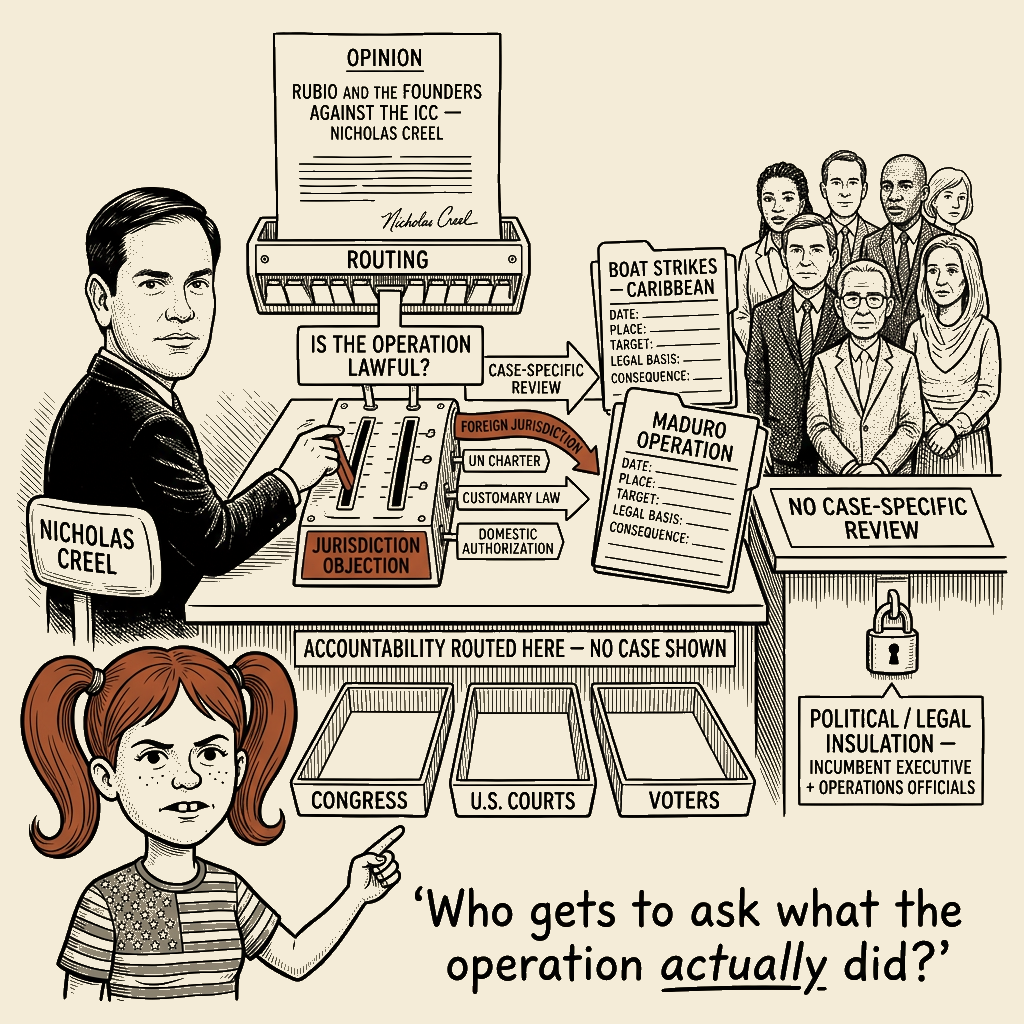
Who gets to ask what the operation actually did?
What the Editorial Argues
Nicholas Creel argues that Marco Rubio’s warning against the International Criminal Court trying to enforce its decrees against Americans defended domestic constitutional self-government rather than repudiating the rule of law. He rests that defense on the United States’ decision to sign but never ratify the Rome Statute, the George W. Bush administration’s 2002 rejection of the treaty, and the persistence of that objection under subsequent presidents, including Joe Biden. Creel then invokes the Declaration of Independence, John Adams, and the Supreme Court to argue that American officials answer to domestic constitutional institutions, while Hobbes and Pompey supply the claim that international order ultimately rests on power. He concludes that the administration’s named military operations deserve scrutiny, but not from international institutions, because the Founders opposed submission to foreign jurisdiction the United States never accepted.
Receipts
The editorial turns a valid objection to ICC jurisdiction into a general license to reject external legal scrutiny of American conduct.
What the framing wants you to believe
- Rubio’s “Stop quoting laws to men with swords” was a Founder-faithful defense of constitutional self-government, not contempt for law.
- The United States has consistently rejected the ICC’s jurisdiction over Americans, so ICC objections should be treated as attacks on the American project rather than as legitimate external criticism.
- Accountability has not been evaded; it has been routed to Congress, American courts, and voters, while international institutions have no legitimate role.
What’s really going on
- The narrow legal premise is sound: the United States is not an ICC state party, and under ordinary Rome Statute Article 12 jurisdiction over a non-party national requires a jurisdictional basis that does not exist here; Article 98 agreements separately protect covered American officials. But neither treaty non-ratification nor Article 98 answers whether a particular use of force is lawful under the UN Charter, customary international law, domestic authorization, or the law of armed conflict.
- The protected beneficiary is the incumbent executive and the officials responsible for the operations the editorial names. The normalized harm is substituted accountability: because external scrutiny is treated as illegitimate in advance, the operations can remain labels rather than becoming subjects of a case-specific legal inquiry.
- The editorial omits Rome Statute Article 17, the complementarity provision designed to address precisely the concern that domestic accountability is inadequate, and never tests whether the institutions it names are actually investigating the conduct it wants shielded.
The Operation
This is a signed Wall Street Journal Opinion contribution by Nicholas Creel, a law professor at Georgia College and State University, not an unsigned editorial-board voice. Its domain is national security and international criminal jurisdiction; its archetype is the forum-switch sovereignty editorial. The advocated position is mixed, tending self-protective: the objection to the ICC’s jurisdiction over Americans without the United States’s consent is legitimate, but the piece stretches that objection until it performs work no jurisdictional premise can bear.
Institutional authorship and placement chain. The oldest layer is supplied by the Declaration of Independence, John Adams, and the Founders’ language about unacknowledged foreign jurisdiction. The modern layer is the documented American anti-ICC tradition built around Article 98 agreements and the American Service-Members’ Protection Act of 2002. The immediate chain supplied by the source is narrower: Rubio’s remarks at a Federalist Society convention, followed by Creel’s jurisprudential gloss on the Journal’s Opinion page. That establishes a venue and a line of amplification. It does not establish that the Federalist Society, the ICC, a donor, or another institution commissioned or paid for the piece, and no coordination claim can rest on adjacency alone.
I drafted memos of this family for the Journal page from 1999 to 2007, including anti-ICC framing built around Article 98 and Americans being placed “in the dock of a foreign court.” That account is retained memory, not a documentary link to Creel, and it cannot show that he used a coordinated brief or brief writer. What it gives me is recognition of the architecture: a genuine jurisdictional fact in front, a constitutional wrapper around it, and the reader’s question changed before the underlying conduct can be seen.
The operation in one line
- Omitted relation: Treaty membership, consent to a legal obligation, customary international law, domestic authorization, jurisdiction over an individual, and the legality of force are separate questions; the editorial allows the first distinction to swallow the rest.
- Protected beneficiary: The incumbent executive and the officials responsible for the operations under discussion, who gain an authoritative permission structure for resisting external criticism.
- Normalized harm: Scrutiny is displaced in advance. Legal questions about particular operations are converted into questions about the legitimacy of foreign jurisdiction, and the operations themselves never acquire enough factual specificity to be tested.
Distributional impact. The administration’s concrete pathway to benefit is political and legal insulation, not immunity from all domestic review. The editorial supplies a reusable line that makes criticism of an American operation vulnerable to the charge that it subverts constitutional self-government. That lowers the reputational and political cost of external criticism and makes a defense of the operation’s factual and legal basis less necessary. It does not show that Congress or an American court lacks jurisdiction, that any named operation is actually outside ICC scrutiny, or that the administration would escape domestic accountability.
The wider anti-ICC legal movement gains something less tangible but still valuable: a citable constitutional vocabulary with which to characterize objections to international adjudication as hostility to the Founders. Legal professionals and political actors gain standing; no payment, commission, or directing role is documented for Creel.
The costs fall on institutions and people the frame makes less visible. The people subjected to the operations bear the consequences if the conduct is unlawful and the legal inquiry is delayed. Congress, the courts, and voters are assigned the entire burden of review without being told what authority each has, what proceeding is available, or what “accountability” would require. International law loses the incentive to test particular conduct whenever an American objection to one institution’s jurisdiction is allowed to disqualify every form of scrutiny. No dollar, casualty, or operational-cost figure appears in the editorial or the supplied record, so none can responsibly be attached to this finding.
Alternative design. A design faithful to the stated rationale—consent plus domestic accountability—would preserve the ICC objection without making it universal. The United States could maintain that the ICC has no jurisdiction over Americans merely because the United States signed the Rome Statute; the administration could then identify what each operation did, disclose its domestic statutory and constitutional basis, answer the international-law arguments actually advanced against it, and accept review by every lawful forum with jurisdiction. The ICC’s absence would not be used as a reason to dismiss the law of armed conflict, the UN Charter, international humanitarian law, the law of affected states, or domestic oversight.
That is the design the people subjected to force would have reason to prefer: no prosecution without jurisdiction, but no jurisdictional objection used as a permanent substitute for a factual and legal defense. If the concern is specifically the ICC, the narrow argument is sufficient. If the concern is international institutions generally, each institution’s mandate must be addressed rather than collectively dismissed. A lawful operation has nothing to fear from that column.
Fear, greed, and laziness. Here “greed” means an institutional incentive to accumulate authority, power, status, or reputational capital, not a finding about anyone’s private character.
- The framing’s author: Fear of making a constitutional argument that cannot withstand scrutiny; greed for professional credit as a defender of the Founders; and the economy of avoiding the difficult distinctions among jurisdiction, authorization, and legality. These are incentives visible in the genre, not a claim about Creel’s motives.
- The apex beneficiary: Fear of external legal and diplomatic exposure; appetite for operational latitude and control of the presidential record; and the cheapness of changing the subject from what the operations did to who may ask about them.
- The rank-and-file reader: Fear of appearing to surrender American sovereignty or betray the Founders; the status of being seen as a clear-eyed defender of constitutional self-government; and the relief of a memorable answer that permits further inquiry to stop. That fear is real, and the reader is not being treated as gullible. The frame offers a legitimate distinction and then uses it to close a much larger question.
The same forum-switch test would apply if a sympathetic administration used an inapplicable jurisdictional objection to bar review of its conduct. The defect is not the party. It is the substitution of institutional identity for the merits.
Technique identification
-
Concession that empties itself — partial match to Motte-and-bailey in the Bad-Faith Techniques Catalog. The cue is: “The administration’s decisions deserve scrutiny, but not from international institutions.” The editorial acknowledges the value of scrutiny, then removes every international forum capable of conducting it. The full motte-and-bailey pattern requires a strong claim to be advanced, abandoned under challenge, and resumed; Creel never abandons the Founders claim, so the formal label would exceed the evidence. Operationally, however, this is the same essential maneuver: the concession is staged so that scrutiny can be affirmed in the abstract and denied in practice. The administration receives a permission structure without having to produce a defense.
-
Pre-emptive legitimacy-withdrawal — Bad-Faith Techniques Catalog. The cue is: “a system of law they never agreed to—one that would supersede our own constitutional order.” The ICC’s legitimacy is withdrawn on identity and consent grounds before the editorial examines any specific case, allegation, or legal theory advanced against the named operations. The move makes external scrutiny categorically suspect, not merely jurisdictionally unavailable. It is a Schmittian friend/enemy recoding: the tribunal becomes a rival to constitutional self-government, and criticism of American conduct is recast as opposition to the American order.
-
Expert-consensus and expert-deference framing — Bad-Faith Techniques Catalog; WSJ Editorial Technique Catalogue §3.7, the technocratic-credential ledger. The cue is: “The Supreme Court has agreed with this principle time and again.” No decision is named. The nearest actual holdings—Reid v. Covert, Medellín v. Texas, and Sale v. Haitian Centers Council—support narrower propositions about the application and enforcement of international obligations in American courts; they do not establish that no international body may scrutinize American conduct abroad. The sentence borrows the authority of settled doctrine without identifying what it settled. “Manufactured” describes the rhetorical effect, not a finding about Creel’s intent.
-
Bandura’s moral-disengagement cluster — moral justification, displacement of responsibility, and distortion of consequences. Moral justification is supplied by: “The Founders fought a war to reject exactly that.” Founding sacrifice consecrates a refusal to answer the present legal question. Displacement of responsibility occurs in: “Accountability must come from Congress, U.S. courts and American voters.” Responsibility is deposited into three institutions whose jurisdiction, independence, procedures, and actual willingness to review the operations are never examined. Distortion of consequences operates through omission: the “boat strikes in the Caribbean” and “Maduro operation” appear as administrative labels, without a date, place, target, casualty, legal allegation, or theory of force. The editorial does not need to minimize a consequence it never allows into the text. That omission is the mechanism.
-
The suppressed-variable half-truth — Suppressed Variable Diagnostic. The blanket claim is: “Each state is bound only by the laws it agrees to or is forced to abide by.” The true half is that consent is foundational to many treaty obligations and that a state cannot be bound by a treaty it has not accepted. The suppressed variables are customary international law, the legality of force under the UN Charter, domestic authorization, and the fact that the ICC’s jurisdictional rules do not answer every legal theory that might be raised against an operation. The editorial isolates a real jurisdictional distinction, suppresses the relations that would make its categorical conclusion too broad, and stops precisely where continuing would require the administration to defend particular conduct.
-
Threat-inflation closer — WSJ Editorial Technique Catalogue §4.13. The final sentence—“The Founders fought a war to reject exactly that”—inflates the forum question into 1776. A dispute over the legal basis for contemporary force becomes a test of fidelity to the Revolution. The concrete issue disappears inside a memorable civilizational cadence. I built sentences of this kind to be lifted out of context and repeated as if they had resolved the question they decorated.
-
Multiple-audience execution — WSJ Editorial Technique Catalogue §4.3. The political class receives the domestic-versus-international accountability distinction. The legal technocrat receives treaty dates, Hobbes, and constitutional quotations. The populist reader receives “The Founders fought a war.” The security-minded reader receives reassurance that no foreign institution can reach an American. The credentialed law-professor byline and one-sided authority stack make the movement position legible as legal analysis. This is Bernays’s credentialed-authority-as-campaign-vector: the authority does not settle the disputed proposition, but it makes the frame easier to carry.
The machinery is old. Bernays supplied the credential as vector; Lippmann supplied the interpreter who translates technical material for a public; Lakoff supplied the frame that makes “constitutional sovereignty” the default lens; Schmitt supplied the friend/enemy recoding. That lineage explains why the form feels familiar. It does not prove coordination behind this particular piece.
Audience-management function. The editorial performs permission structure, identity confirmation, grievance ratification, status display, and conscience displacement. It divides the reader’s moral ledger at the water’s edge: Adams governs the reader at home, where the reader is law’s citizen; Pompey and Hobbes govern abroad, where the reader is power’s citizen. The reader can feel principled about law while never being required to inspect what the administration did. The administrative labels are useful because they permit the reader to deposit unease in the constitutionally proper place while the frame quietly decides that the place need not function.
Placement. The position is mixed. Non-ratification, consent, and the distinction between domestic and international authority are legitimate values. The self-protective overlay begins where one institutional objection is stretched into immunity from legal inquiry. That is the dangerous grade of this piece: not a crude fabrication, but a polished argument that can make the absence of scrutiny look like the triumph of self-government.
The Record
The editorial is the primary source for what Creel says and quotes. The following anchor receipts test the load-bearing legal propositions against primary documents. Claims that cannot be tested from the materials available for this analysis are identified as unverified rather than completed from memory.
R1 — Signature, non-ratification, and ordinary ICC jurisdiction — Tier 1, anchor. The United States signed the Rome Statute on December 31, 2000, and never ratified it. The UN Treaty Collection status record and Rome Statute Articles 12, 15, 17, and 126 establish the distinction between signature, ratification, and state-party status. Article 12 generally bars ICC jurisdiction over a national of a non-party state unless that state has accepted jurisdiction for the particular case; Article 98 provides a separate basis for immunity agreements covering officials. Verdict: accurate as used. These provisions support the narrow claim that the United States did not accept the ICC’s jurisdiction over Americans merely by signing the treaty. They do not establish immunity for American conduct or the lawfulness of force.
R2 — Bush, Biden, and the continuity of the objection — Tier 1, anchor. John R. Bolton, then Under Secretary of State for Arms Control and International Security Affairs, sent UN Secretary-General Kofi Annan the May 6, 2002 letter titled “United States Views of the International Criminal Court,” stating that the United States did not intend to become a party to the Rome Statute and had no legal obligations arising from its signature. Executive Order 13928, “Blocking Property of Certain Persons Associated With the International Criminal Court” (June 11, 2020), authorized broad asset blocking against non-U.S. persons involved in ICC efforts to investigate or prosecute American personnel. Executive Order 14015, “Revoking Executive Order 13928 and Blocking Property of Certain Individuals Contributing to the Activities of the International Criminal Court” (April 1, 2021), revoked that blanket sanctions order and imposed targeted blocking; Secretary of State Antony Blinken’s accompanying April 1 statement reiterated the administration’s objection to ICC jurisdiction over American personnel. Verdict: the underlying continuity claim is accurate. “Effectively unsigned” is journalistic shorthand, not the legal character of the 2002 act: the signature was not erased, but the United States disclaimed any intention of becoming a party. The continuity also elides the materially different intensity of the Clinton, Bush, Obama, Trump, and Biden administrations’ attitudes toward the Court.
R3 — The Founders’ quoted language — Tier 1, anchor. The Declaration of Independence charged George III with conspiring “to subject us to a jurisdiction foreign to our constitution, and unacknowledged by our laws.” The Massachusetts Constitution of 1780, Part I, Article XXX, declares Massachusetts “a government of laws and not of men.” John Adams’s 1774–1775 Novanglus essays state that government is “bound by fixed laws, which the people have a voice in making.” Verdict: the quotations and attributions are accurate. The further claim that the Founders fought a war to reject the particular international legal order Creel has constructed is argumentative, not something the quoted language resolves.
R4 — Complementarity and domestic scrutiny — Tier 1, anchor. Rome Statute Article 17 makes a case inadmissible where a state with jurisdiction is genuinely investigating or prosecuting the same conduct, subject to the qualifications in Articles 17(1)–(3); Article 16 separately addresses Security Council deferral. Verdict: the editorial omits the provision directly designed to answer its stated concern. Article 17 does not prove that the United States is investigating these operations, willing, or unable. It does defeat the categorical claim that external legal scrutiny is illegitimate merely because the United States is not an ICC state party.
R5 — International obligation and the legality of force — Tier 1, anchor. Hobbes’s sentence—“Covenants, without the Sword, are but Words”—appears in Leviathan (1651), Chapter XIV. The editorial’s attribution is accurate. Its leap from that proposition to “International law binds only when someone powerful enough enforces it” is not. The UN Charter, which the United States accepted, prohibits the threat or use of force in Article 2(4) and preserves the inherent right of self-defense in Article 51. Article 38(1)(b) of the International Court of Justice’s Statute, annexed to the Charter, identifies international custom as a source of law. The International Court of Justice recognized customary international law and peremptory norms in Military and Paramilitary Activities in and against Nicaragua (Nicaragua v. United States of America), merits, 1986 I.C.J. Reports 14. Verdict: the quotation is accurate; the categorical legal proposition is overbroad and unsupported. Non-ratification of the Rome Statute does not erase those separate obligations.
R6 — “The Supreme Court has agreed with this principle time and again” — Tier 1 case law, anchor. The editorial names no case. Reid v. Covert, 354 U.S. 1 (1957), addressed the application of domestic constitutional protections to government conduct abroad. Sale v. Haitian Centers Council, 509 U.S. 155 (1993), addressed whether Article 33 of the Refugee Convention applies to the interdiction of Haitian migrants on the high seas. Medellín v. Texas, 548 U.S. 478 (2006), addressed the domestic enforcement of a non-self-executing international judgment. None establishes that no international body may scrutinize American conduct abroad. Verdict: unsupported and overbroad. Settled doctrine is used as a cover for a proposition the cited doctrine does not decide.
R7 — Nuremberg and the absolute consent proposition — Tier 1, anchor. The London Charter of the International Military Tribunal, August 8, 1945, established jurisdiction over individual defendants for international crimes without deriving that jurisdiction from the consent of the defeated states; the United States was among the charter’s principal drafters and participants. The context differed materially from peacetime military operations, and Nuremberg does not establish ICC jurisdiction over an American. Verdict: its omission matters because the editorial’s flat claim that a state is bound only by law it accepts cannot survive the American legal tradition’s own most celebrated war-crimes tribunal without qualification.
Source-limited and unverified claims. The editorial says Rubio spoke at a Federalist Society convention “last week” and quotes him as saying, “Stop quoting laws to men with swords.” The convention program, video, or transcript was not supplied, so the immediate context of the remark remains unverified on the available record; the quotation can be verified only as the wording reproduced in Creel’s column. The “boat strikes in the Caribbean” and “Maduro operation” are likewise identified only by the editorial, which supplies no date, location, target, legal basis, casualty figure, legal allegation, or docket reference. Their identities, particulars, and asserted legal violations cannot be independently verified from the available record. The causal claim that the postwar world order “held because America’s swords stood behind it” has no citation and is an unfalsifiable counterfactual as presented; the available record provides no basis for testing it.
Supporting receipts. Plutarch’s Life of Pompey is the classical source for the Mamertine anecdote. The American Service-Members’ Protection Act of 2002 and the Article 98 agreements document the modern American legal architecture for the anti-ICC position. The Federalist Society venue is established by the editorial itself; it is not evidence of sponsorship, commissioning, or a common funding chain.
Load-bearing omissions
- Rome Statute Article 17 and the question of whether American institutions are genuinely reviewing the conduct.
- The distinction between the ICC’s jurisdiction and legal regimes the editorial never identifies, including the UN Charter, customary international law, humanitarian law, and the law of affected states.
- Any factual description of the operations whose legality is supposedly at stake.
- The constitutional and statutory basis claimed for the operations, including the respective roles of presidential authority, Congress, and the War Powers Resolution.
- What courts, Congress, and voters are supposed to do, under what procedures, and whether they are doing it.
- The London Charter and the contradiction between Nuremberg’s jurisdictional structure and the editorial’s absolute consent rule.
- The difference between congressional oversight, judicial review, electoral accountability, and criminal adjudication.
- The possibility that critics of a particular operation are invoking a legal regime other than the ICC.
Missing-information declaration. The materials available for this analysis contain no Rubio transcript, Federalist Society program, operation legal file, congressional record, court docket, ICC communication, author communication, funding document, or commissioning record. The congressional posture and any pending inquiries concerning the two operations remain unresolved. No source in the available record permits an independent account of what either operation did or why it was challenged as unlawful.
No leaked memo is cited in the editorial, and none has been supplied or invented here. The only retained-memory material used in the analysis is Phukher’s own account of drafting comparable opinion-page frames; it is flagged as non-verifiable and is not used to establish any fact about Creel or the operations. The analysis assumes the supplied text is complete and does not infer that an omitted fact is absent from the world merely because it is absent from the column.
How to Recognize This
The pattern is the sovereignty switch: take a contested act, replace the question “is this lawful?” with “who may ask?”, answer the second question with authorities the actor can weather, and close the inquiry before anyone reaches the act.
Watch for four signals.
First, the concede-then-route sentence: “deserves scrutiny, but not from.” A concession that empties itself. Find out whether any named forum is actually examining the matter, whether it has jurisdiction, and whether it has done anything. Congress, courts, and voters are not interchangeable parts of one machine. One legislates, one adjudicates, one selects officeholders. None is made operational by being named in a sentence.
Second, consent of the wrong political body. When “never agreed” appears, ask who did not agree and who bears the power in question. The government’s consent to an international court’s jurisdiction is not the consent of the people the court’s jurisdiction concerns, and neither fact answers the legality of force. The valid half of the argument is that treaty consent matters. The suppressed relation is that many legal obligations and every use of force have sources beyond the consent of the actor to the forum.
Third, conduct that never appears. The operations are called “boat strikes” and a “Maduro operation”; no death, injury, target, legal theory, or factual allegation enters the text. A piece confident on the merits normally describes the conduct with enough precision to permit a merits dispute. Here the labels allow the reader to react to a category without learning what happened.
Fourth, absent authorities that cut against the frame. Article 17 is not mentioned. The distinction between jurisdiction and legality is not made. The London Charter is not mentioned, even though the editorial’s absolute rule would indict the tribunal the American legal tradition most prizes. A selective citation stack can supply an authority; the missing authorities show where the frame requires the record to go silent.
It works because the legal premise is genuine. The fear of an unaccountable foreign tribunal reaching across a constitutional order is not foolish, and the reader who feels it is not gullible. The frame rewards that fear with a noble-sounding answer. It splits the moral ledger at the water’s edge: Adams governs the reader at home, where the reader is law’s citizen; Pompey governs abroad, where the reader is power’s citizen. The reader is never required to choose between justice and sovereignty.
When the frame fires, name the feeling and check whether a single fact about the actual operation entered the sentence. Then separate the questions: Who has jurisdiction? Who consented to what obligation? What domestic authorization exists? Is the conduct lawful? Which forum can answer? Who benefits? Who bears the consequences? Pull the treaty, the constitutional texts, the decisions, the operational record, and the legal theories advanced by the critics. Do not let the source’s citation stack substitute for the sources it omits. Follow the vocabulary across adjacent opinion pieces, conventions, and advocacy networks, but do not turn adjacency into conspiracy. For a study-led cousin, trace the funding chain; here, trace the treaty, the legal authorities, the missing facts, and the institutional placement.
I drafted memos of this family. I know why the sentence is shaped that way: it gives the reader a respectable place to stop. The people who accept the frame are not stupid; they have been handed an answer engineered to make further thought unnecessary. I know that because I helped engineer versions of it.
What I can give the reader now is the wiring diagram. The point is not to replace one slogan with another or to pretend the legitimate concern about ICC jurisdiction is fraudulent. The point is to keep jurisdiction, obligation, authorization, and legality separate long enough for the conduct to become visible.
Not my redemption. The recognition.

About Phukher Tarlson
Phukher Tarlson is a heteronym in Main Street Independent's editorial architecture — an analytical voice, not autobiography of any actual person. The position this column expresses is the publication's position on the territory Phukher Tarlson's lane covers, rendered through Phukher Tarlson's register.