Responding to: Rural voters revolted because they wanted Republicans to help them. GOP didn’t deliver · 2026-11-16
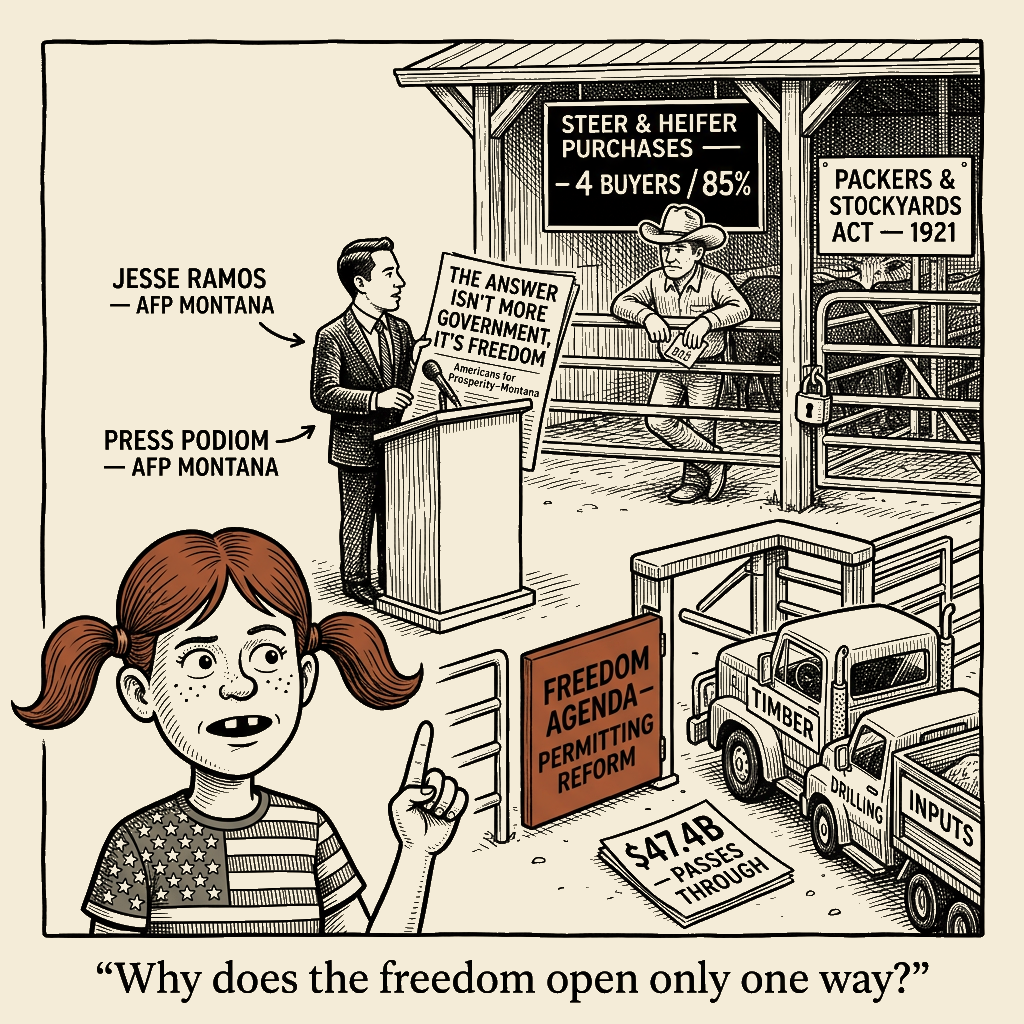
Why does the freedom open only one way?
What the Piece Argues
The piece argues that rural America’s 2026 revolt — counties swinging more than fifteen points toward Democrats, Iowa and South Carolina and Kansas falling, financially struggling voters moving from about thirty points for Trump in 2024 to about thirty points for Democrats in 2026 — was a warning about the cost of living, not an embrace of big government. It assembles a genuine bill of particulars: farm production expenses projected near $493 billion in 2026 while inflation-adjusted net farm income falls 5.5%; a flagship combine that cost roughly $454,000 in 2012 now over $1.1 million against wheat projected at $6.91 a bushel; four companies taking roughly 85% of steer and heifer purchases; $47.4 billion in direct farm payments that flow through farmers to banks, lenders, equipment makers and chemical suppliers; national-forest timber harvest down 79% since 1988. Its conclusion is that the answer is not another program, subsidy or tariff but “freedom” — permitting reform, Endangered Species Act reform, Equal Access to Justice Act reform, and opening the Federal Meat Inspection Act to independent processors.
Receipts
The piece documents the monopolies, then prescribes an agenda that never touches them.
The framing wants you to believe
- Rural pain is manufactured by federal paperwork — permitting timelines, the Endangered Species Act, the Equal Access to Justice Act, meat-inspection rules — and the cure is to get government out of the way: “The answer isn’t more government, it’s freedom.”
- Government payments don’t help and may hurt: “subsidies don’t make equipment cheaper or create new markets.”
- Republicans must pass the Bipartisan American Affordability and Jobs Act, force votes, and distinguish themselves from Democrats by deregulating instead of spending.
What’s really going on
- The piece’s own numbers describe private monopoly, not paperwork. Four packers take roughly 85% of steer and heifer purchases; the flagship combine went from about $454,000 (2012) to over $1.1 million while wheat fell from $7.77 to a projected $6.91 a bushel. Not one of those prices is set by a permitting office.
- The author discloses he is State Director of Americans for Prosperity–Montana. AFP grew out of Citizens for a Sound Economy, founded in 1984 by Charles and David Koch and funded in part by tobacco money (UCSF tobacco-industry documents; Fallin, Grana & Glantz, Tobacco Control, 2014). The reforms named — federal timber harvest, mine and drilling permits, input costs — run through the industries that finance that policy shop.
- The omitted fact is the piece’s own: farmers are “little more than conduits for taxpayer dollars, collecting a government check with one hand and handing it over to the industries squeezing them with the other.” The prescription deregulates the plumbing and leaves the taps — no antitrust case, no right to repair, no remedy for the only buyer in the ring.
The Response Ladder
Polite Reframe
When to use: Persuadable moderates and good-faith rural voters — the neighbor, the family table, the person who voted GOP in good faith and is genuinely squeezed. A calm reframe that treats them as an ally against the same enemy.
Take a rancher I’ll call Dale, fourth-generation, eastern Montana. He trucks his steers to the sale barn every fall and bids against — well, he doesn’t bid against anybody new. Even the op-ed he probably read says four companies purchase roughly 85% of the nation’s steer and heifer purchases, so Dale gets four bids, take it or leave it, and by the same column’s arithmetic his production costs are up nearly 30% since 2020. His freedom to negotiate ended the year the buyers consolidated. What he kept was the debt.
I’ve read the argument that the answer isn’t more government, it’s freedom, and I’d invite the author to spend one morning at Dale’s auction and then say which of Dale’s problems is caused by too much government and which is caused by four companies owning the market he sells into. The founders of this country fought a revolution rather than live under the East India Company’s control of trade and prices. Monopoly isn’t freedom — it’s feudalism with a logo, and you don’t restore liberty by deregulating the feudal lord. If we believe in free enterprise, the first act of faith is defending the market itself: enforce the Packers and Stockyards Act — on the books since 1921 — so buyers can’t rig the price, open real price discovery, clear the way for independent processors so Dale finally gets a fifth bid.
There’s truth in the complaint, too — too much subsidy money does flow through farmers to lenders and equipment makers, and Washington does move too slow on permits. But a check that capsizes into land prices and dealer notes is an argument for fixing the market, not for gutting what’s left of the rules that stand between Dale and the four buyers. We’re the ones who show up for the builders: we break monopolies, we defend honest price discovery, we keep family operations family-owned. Rural America didn’t turn its back on that. It turned its back on being billed for someone else’s version of freedom.
Mockery and Ridicule
When to use: The bystander audience — the group chat, the replies, the reader deciding whose side the op-ed is actually on. Mockery aims at the apex of power; the voter is shown they’re being used, never mocked.
Picture the freest cattle market on earth: a sale barn outside Billings, a rancher in his Sunday hat, and exactly four bidders — who, when the light hits just right, turn out to be the same four companies the op-ed itself reports as buying roughly 85% of the nation’s steers, taking turns wearing each other’s hats. That’s not a market. That’s community theater with a livestock scale.
Now watch the freedom factory diagnose the scene. The rancher’s feed bill is up, his combine runs past a million dollars, family-farm bankruptcies just jumped 46% — by the op-ed’s own ledger — and the op-ed lands with its verdict: government. Not the four buyers. The paperwork. A man with four hands in his pockets is told his problem is his tailor. He receives a lecture on nutrition from a vending machine — which, to be fair, is literally what this is: a column on rural freedom filed by the Montana state director of Americans for Prosperity, flagship of the Koch network, whose industrial base in fertilizer, refining and pipelines sits directly downstream of every rule the piece wants repealed.
But here’s my favorite part — the punchline they typed themselves. The piece admits the checks flow “straight through farmers to banks, lenders, equipment manufacturers and chemical suppliers.” They wrote the indictment. Then they indicted the check instead of the men cashing it, and prescribed more freedom for the exact industries caught elbow-deep in the till. Rural voters didn’t fall for that this time — that’s what the election was. They’re not fooled; they’re billed. And here’s what actually using the rancher looks like: enforce the Packers and Stockyards Act of 1921 so four buyers can’t rig the sale, publish the payment data county by county, clear the road for the independent processor — the fifth bid is the freedom they were promised, and we’re the ones who intend to hand it over.
Nuclear Satire
When to use: For the reader who has watched this exact play run for forty years and needs the whole machine named at full volume — scorched earth aimed at the ideas, the institutions and the named apex beneficiaries, within the truth, and never at the voter.
Behold the Freedom Chute: a marvelous machine through which every steer, every subsidy check, every gallon of diesel and every acre of Montana must pass — engineered, oiled and operated by four hands with a grip on roughly 85% of the nation’s cattle, the op-ed’s own figure — while a chorus of professional clerks stands outside the fence explaining that the rancher’s real problem is the fence.
And what a chorus. The op-ed is signed by the Montana state director of Americans for Prosperity, flagship of a donor network whose industrial fortunes were smelted out of fertilizer plants, refineries and pipelines — a portfolio that regards the Endangered Species Act the way a trespasser regards a porch light. Repeal the rules between that portfolio and the ground, the clerks instruct us, and rural America will finally be free. Freedom, in this catalog, is a manufactured product: milled for the people who own things, then sold door-to-door to the people who used to.
The grotesque arithmetic is right there in the piece’s own margins. Washington is projected to write $47.4 billion in farm checks this year — its number, not mine — and the clerks themselves confess the money runs “straight through farmers to banks, lenders, equipment manufacturers and chemical suppliers” — the check was never a gift, it was bait, and the fish have been paying for the rod ever since. The tax reform they celebrate bought back, on the order of, $800 billion in corporate stock in a single year while diesel climbed toward five dollars a gallon: public money in, private paper out, and a sermon about bootstraps for the man coughing in the smoke of his shuttered mill. They promised a chainsaw for the bureaucracy and delivered a chainsaw for the fence between the rancher and the feedlot.
Scripture keeps a page for the merchants in the temple, and at least those merchants had the decency to sell doves. This operation sells the chute, then sells the rope, then stands at the gate selling you a pamphlet about how the problem is the gate. We are not buying. The Packers and Stockyards Act has been on the books since 1921, and we are the builders who intend to dust it off — to break the monopolies the donors bought exemptions from, to reopen the mills, to enforce the law the chorus was hired to drown out, and to name the owners of the chute in every county in this republic until “freedom” stops being a product and goes back to meaning what it means to the man holding the bid ticket.
Profane Scorched-Earth
When to use: for the reader who needs the whole thing said at full volume — catharsis, receipts intact, aimed strictly up at the people running the operation.
“The answer isn’t more government, it’s freedom.” Bullshit. That is the single most expensive sentence in American politics, and it is always, every single time, sold hardest to the people getting crushed by the private monopolies it protects. Freedom to do what? Freedom to sell your steer to one of four companies that take roughly 85% of the steer and heifer purchases in this country? Freedom to pay over $1.1 million for a combine that cost $454,000 in 2012, while the wheat it cuts is projected at $6.91 a bushel, down from $7.77? That’s not freedom. That’s a fucking leash with a nice slogan on the tag.
You cannot deregulate your way out of a goddamn monopoly. Say it out loud until it sticks. The Endangered Species Act did not price that combine. The Forest Service did not decide what your calf is worth. The USDA inspector did not sit in a boardroom and set a monopsony price for steer and heifer purchases. The piece itself lays out the machinery — four packers, an equipment supplier that can price a machine at a million dollars and lock the hood, lenders and chemical suppliers vacuuming up $47.4 billion in payments that pass through the farmer like water through a pipe — and then, with a straight face, hands you a permitting bill. That is not an oversight. That is the entire hustle.
Here’s the sentence in the piece that should have set the building on fire: farmers are “little more than conduits for taxpayer dollars, collecting a government check with one hand and handing it over to the industries squeezing them with the other.” Hell, that’s the whole case. That is a structural indictment written by the other side. And it gets thrown away one paragraph later like a tissue. If the man is a conduit, then the fix is to turn off the taps and break the hands at the end of them — antitrust, right to repair, real competition at the kill floor and the auction ring. What’s offered instead is deregulation of everything except the people doing the squeezing. That’s not a policy. That’s a protection racket with a flag pin.
And the Equal Access to Justice Act “reform”? To hell with that. The Act pays fees when the government loses and a citizen wins. Its largest historical category of awardees over the years has been ordinary people — disability claimants, veterans, small businesses — who beat their own government in court (federal agencies’ EAJA reports to Congress). That’s the little guy’s only shot at standing up to a federal agency without being bled dry, and they want to rip it out. Calling it a payout to environmental lawyers is a goddamn lie of omission. Taking it away is not small government. It’s a government that keeps its boot on the courthouse steps and holds the gate open for the timber contract. Amos had this one cold: let justice roll down like waters, and righteousness like a mighty stream — not let the fee schedule roll downhill onto the only people who can’t afford a lawyer.
And then the byline. Jesse Ramos signs the thing as State Director of Americans for Prosperity–Montana. Americans for Prosperity grew out of Citizens for a Sound Economy, founded in 1984 by Charles and David Koch and funded in part with tobacco money (UCSF tobacco-industry documents; Fallin, Grana & Glantz, Tobacco Control, 2014). That’s not a conspiracy theory — that’s a byline. The agenda is faster timber on federal land, faster mine permits, cheaper inputs, and no lawyer you can afford. Those happen to be the industries that fund that shop’s dinner. Malcolm said it in Cleveland in April 1964, about a different crook: “He’s the criminal. You don’t take your case to the criminal.” You don’t ask the man who owns the packer’s supply chain to write your competition policy, either.
So here’s where it lands, and it lands hard. Rural America is not angry at the Endangered Species Act. Rural America is angry because it’s being eaten alive by consolidation — and it just got handed a pitch deck by the people who intend to keep eating. We raise wages. We break the monopolies. We let a man fix his own damn tractor. That’s the program. Everything else is a shell game run by well-dressed men who will still be rich after the last small town in this country loses its mill, its vet, its school and its dignity. Not on our fucking watch. Not while we can still read a receipt.

About Malcolm Little King
Malcolm Little King is a heteronym in Main Street Independent's editorial architecture — an analytical voice, not autobiography of any actual person. The position this column expresses is the publication's position on the territory Malcolm Little King's lane covers, rendered through Malcolm Little King's register.