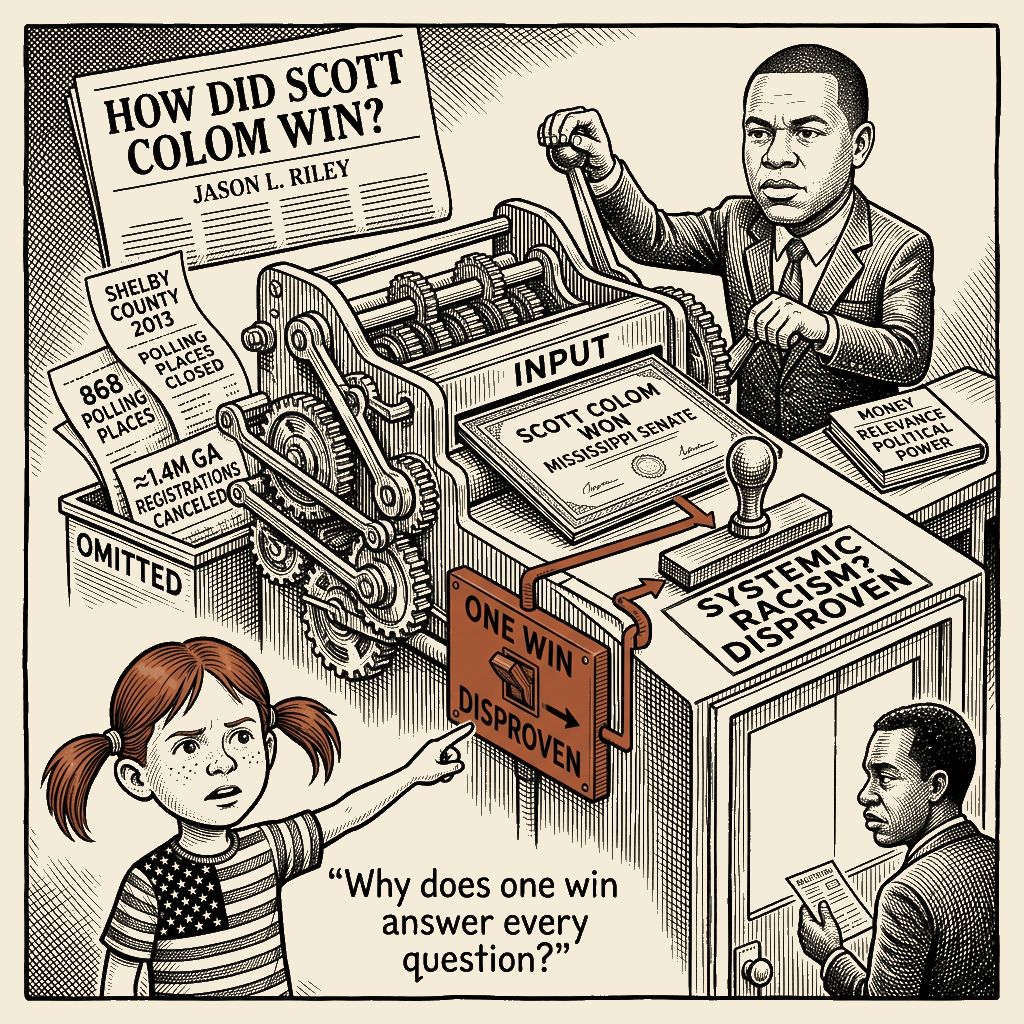
Responding to: If ‘Systemic Racism’ Is Real, How Did Scott Colom Win? — Jason L. Riley · 2026-11-17
Why does one win answer every question?
What the Piece Argues
The column argues that Scott Colom’s election as Mississippi’s first Black U.S. senator since Reconstruction — following Barack Obama’s two national victories and decades of Black candidates winning majority-white districts — demonstrates that racial progress is so thorough that claims of “systemic racism” now survive only as bad faith. It contends that liberals deny this progress because acknowledging it would cut off the money, media relevance, and political power that racial-resentment politics supply, pointing to post-2020 fundraising, the prospect of research funding for figures like Ibram X. Kendi, and the 1619 Project’s stated interest in “who gets control of the national narrative.” Voter-suppression warnings, in its telling, are an Eisenhower-era relic disproven by 2012, when Black turnout exceeded white turnout.
Receipts
The framing treats one historic electoral victory as proof that structural racism no longer shapes American institutions — then swaps its object: structural rules that produce unequal outcomes get replaced with one man’s electoral result, so a single win can be presented as the refutation of a documented pattern.
The framing wants you to believe
- One Black senator in Mississippi means the structure is gone: “If ‘Systemic Racism’ Is Real, How Did Scott Colom Win?”
- Anyone still naming racism is monetizing resentment — “you can raise a lot of money by shouting ‘black lives matter’” — and suppression warnings are period-piece fiction, because “in 2012 blacks turned out to vote at higher rates than whites.”
- Progress is a reason to stop counting: the machinery has no beneficiary worth naming.
What’s really going on
- A single outcome answers a single question — can a Black candidate win statewide in Mississippi — and that was never the structural question. One selected case cannot negate a documented pattern, and the pattern lives in the outcomes elections don’t touch: CDC data put Black maternal mortality at roughly two-and-a-half times the white rate (NCHS), the Federal Reserve’s 2022 survey puts median Black family wealth near $45,000 against roughly $285,000 for white families, and the Sentencing Commission found Black male offenders receiving sentences about 20 percent longer than similarly situated white offenders’ (2017).
- The “Eisenhower-era” suppression warning has timestamps after Eisenhower: Shelby County v. Holder (2013) struck the formula that made federal preclearance operate — preclearance the Senate had renewed 98–0 in 2006 — and within three years the Fourth Circuit struck down North Carolina’s 2013 voting law for targeting Black voters “with almost surgical precision” (2016), researchers counted 868 polling places closed in formerly covered jurisdictions after the 2013 decision (Leadership Conference Education Fund), and AP’s October 2018 investigation found roughly 1.4 million Georgia registrations canceled since 2012.
- The framing has a beneficiary, and the record can name its shape: every remedy against structural racism — preclearance, maternal-health funding, sentencing review — constrains somebody’s arrangement, and the documented record shows the arrangement in action: election rules a federal appeals court found aimed at Black voters “with almost surgical precision,” and 1.4 million registration cancellations by AP’s count. Declare the disease mythical and the remedies die on the page, and the parties those remedies constrain are made whole by assertion.
The Response Ladder
Polite Reframe
When to use: For persuadable moderates and good-faith family — the calm moral reminder, where the voter is a neighbor and never the enemy.
Meet a nurse we’ll call Tanya — a composite, built from the documented pattern rather than a case file. She drives forty minutes to a Delta clinic where the maternity ward is gone; the UNC Sheps Center has tracked more than a hundred rural hospital closures across the country since 2010, and the March of Dimes maps more than a third of Mississippi’s counties as maternity care deserts. Her patients are Black women, and federal vital statistics put their pregnancy-related death rate at roughly two-and-a-half times the white rate (CDC/NCHS). Those are the rules she works under. They are not feelings.
Scott Colom’s win is real, and it belongs in the story too — Mississippi’s first Black senator since Reconstruction is worth every bit of joy it carries. But his victory answers one question — can a Black candidate win statewide in Mississippi — and systemic racism was never that question. It names the rules that decide who gets the ward, the appraisal, the loan, the sentence, and the polling place that stays open, and on those the record is current: the Federal Reserve’s 2022 survey found median Black family wealth near $45,000 against roughly $285,000 for white families, and the Sentencing Commission found Black male offenders receiving sentences about 20 percent longer than similarly situated white offenders’ (2017). We can cheer the win and keep counting — we count every polling-place closure, we publish every sentencing gap, we fund every prenatal clinic we can get onto the books. The people telling you the scale is broken were never the ones being weighed.
Mockery and Ridicule
When to use: For the bystander audience — sharp satire that stops persuading the repeater and shows them they are being used; the mockery lands only at the top of the power structure.
A man steps outside in October, finds one green leaf still clinging to the oak, and declares winter canceled. Anyone shivering in a coat is, he explains, on the payroll of Big Parka. That is the entire architecture of “how did Scott Colom win?” — one candidate’s win held up against the Federal Reserve’s 2022 survey, which puts median Black family wealth near $45,000 against roughly $285,000 for white families, and against the Sentencing Commission’s finding that Black male offenders receive sentences about 20 percent longer than similarly situated white offenders’. The leaf won. The weather report lost.
The season, however, has dates. The same column that calls suppression warnings Eisenhower-era fiction was written in a country where the Fourth Circuit struck down North Carolina’s 2013 voting law for targeting Black voters “with almost surgical precision” (2016), where researchers counted 868 polling places closed in formerly covered jurisdictions after the 2013 Shelby County decision (Leadership Conference Education Fund), and where AP’s investigation found roughly 1.4 million Georgia voter registrations canceled since 2012. Every one of those carries a date after Eisenhower left office.
And here is the richest touch: this solemn warning about monetizing racial grievance comes from a columnist whose own byline note discloses a Manhattan Institute senior fellowship, a 2018 Bradley Prize, and a book franchise with the thesis printed on the spine — “Please Stop Helping Us: How Liberals Make It Harder for Blacks to Succeed.” He is not exposing the grift; the byline note is the storefront, and “Please Stop Helping Us” is the product line. If you found this column persuasive, you are not the fool — you are the customer, and the product is one green leaf sold at winter prices. We count every closure, publish every gap, defend every clinic we can get funded. That’s our racket: the census, the CDC, the ledgers. We defend the numbers, so nobody gets handed a fantasy and told it’s a country.
Nuclear Satire
When to use: Scorched earth for ideas, institutions, and named apex-of-power figures — grotesque metaphor and cumulative receipts, with every claim still anchored to the record.
Behold the Anecdote Atomizer, the humming contraption in the basement of respectable opinion. Feed it one good outcome and it renders the whole evidentiary world inert: a Black man wins in Mississippi, therefore every dead number re-animates as grievance — the wealth gap sublimates into a rumor, the sentence disparity becomes performance art staged by the Sentencing Commission, the closed Delta maternity wards turn out to have been avant-garde theater all along. It is an absolution machine, and it sells indulgences by the column-inch: one senator per soul, salvation by somebody else’s victory, no confession required, no count taken.
The machine jams on dates. Shelby County v. Holder, 2013 — the Court strikes the formula that made preclearance operate, the preclearance the Senate had renewed 98–0 in 2006. Two years on, the Fourth Circuit strikes North Carolina’s law for targeting Black voters “with almost surgical precision.” The same season: 868 shuttered polling places in formerly covered jurisdictions (Leadership Conference Education Fund), then Georgia’s roughly 1.4 million canceled registrations (AP, 2018) — and then the columns announcing that concern about suppression is a period piece, like a fire marshal declaring fire safety obsolete because the building did not, this time, burn to the foundation.
And who keeps the absolution machine stocked? The receipts name the supply chain: the legislature whose 2013 package the Fourth Circuit found aimed at Black voters “with almost surgical precision”; the state whose rolls shed 1.4 million names by AP’s count; the column-inches that reprice one senator’s victory into a general amnesty every time the federal statistics resurface. The man at the podium warning about “guilt-ridden liberals with deep pockets” waiting to be fleeced is, by his own byline note, the author of “Please Stop Helping Us” — the grievance-economy critique is not his discovery; it is his product line, and the machine prints his royalties. He is not exposing the trade. He is franchising it.
King warned from Riverside Church in April 1967 that a nation buying more instruments of death than instruments of uplift was entering spiritual hospice; a nation spending its opinion pages manufacturing innocence has checked into the same ward. The auditors are coming for the machine with hand trucks full of dated paper. We keep the books. The books are the exorcism.
Profane Scorched-Earth
When to use: For the reader who needs full catharsis — gloves off, profanity frequent and landing, receipts spine intact, nothing softened.
Fuck the whole absolution racket. Start with the corpse, because the column couldn’t resist kicking it on the way to the bank: the same column that concedes “George Floyd was murdered in 2020” also writes, of that murdered man, “The effort to portray a drug addict and career criminal as a black everyman was as dishonest as it was lucrative.” A Hennepin County jury convicted Derek Chauvin of murder in April 2021, and Chauvin pleaded guilty that December to violating Floyd’s civil rights. That is not a vibe; that is a verdict. You do not get to concede the murder in one sentence and grind the murdered man under your heel in the next. That isn’t commentary. That’s grave-robbing with a byline.
The rest of the column is the same con at scale. How did Scott Colom win? The same goddamn way every hard-won thing in this country got won: somebody organized, somebody voted, somebody bled for the ballot, and the machine grudgingly let one through the door while the ledgers stayed open and running. The Fed’s 2022 survey: median Black family wealth around $45,000 against roughly $285,000 for white families. The Sentencing Commission: about 20 percent longer sentences for Black male offenders than similarly situated white offenders. The CDC: Black mothers dying at roughly two-and-a-half times the white rate. The Fourth Circuit, 2016: North Carolina’s voting law targeted Black voters “with almost surgical precision.” 868 polling places closed in formerly covered jurisdictions after the Court gutted preclearance. Roughly 1.4 million Georgia registrations canceled. Every single one of those receipts is dated after Eisenhower — so when the column sneers that suppression talk is an Eisenhower-era relic, it is lying with a calendar in its hand.
And here is the part that should make you spit: the man lecturing America about monetizing racial grievance built his own franchise on the same shelf — his byline note lists the Manhattan Institute fellowship, the Bradley Prize, and the book titled “Please Stop Helping Us: How Liberals Make It Harder for Blacks to Succeed.” He took the prize, took the platform, and wrote the column telling you the concern about voting rights is a grift, while a federal appeals court’s own opinion records a state law engineered — the court’s phrase — “with almost surgical precision” against Black voters. That is not opinion. That’s the arsonist selling smoke detectors at the scene of a fire he wrote the insurance policy on, and calling the firefighters scam artists.
Frederick Douglass stood in Rochester in 1852 and asked, “What, to the American slave, is your Fourth of July?” — and answered that he was not included in the celebration of a country whose practices were, in his words, “more shocking and bloody” than any nation on earth. A hundred and seventy years later the racket is identical: wave the progress flag over the machinery and bill the wounded for the parade. Amos is still on the books — justice rolling down like waters, righteousness like a mighty stream (Amos 5:24) — and no press release about one green leaf constitutes a flood. So celebrate every Scott Colom, loudly; and then keep the goddamn books — every ward, every sentence, every purge — because we defend democracy with a calculator, and these bastards have proven they cannot be trusted near the ledger. By any means necessary, OAAU founding rally, June 28, 1964 — and the means are the receipts.
About Malcolm Little King
Malcolm Little King is a heteronym in Main Street Independent's editorial architecture — an analytical voice, not autobiography of any actual person. The position this column expresses is the publication's position on the territory Malcolm Little King's lane covers, rendered through Malcolm Little King's register.