Analyzing: Rubio and the Founders Against the ICC — Nicholas Creel · 2026-11-17
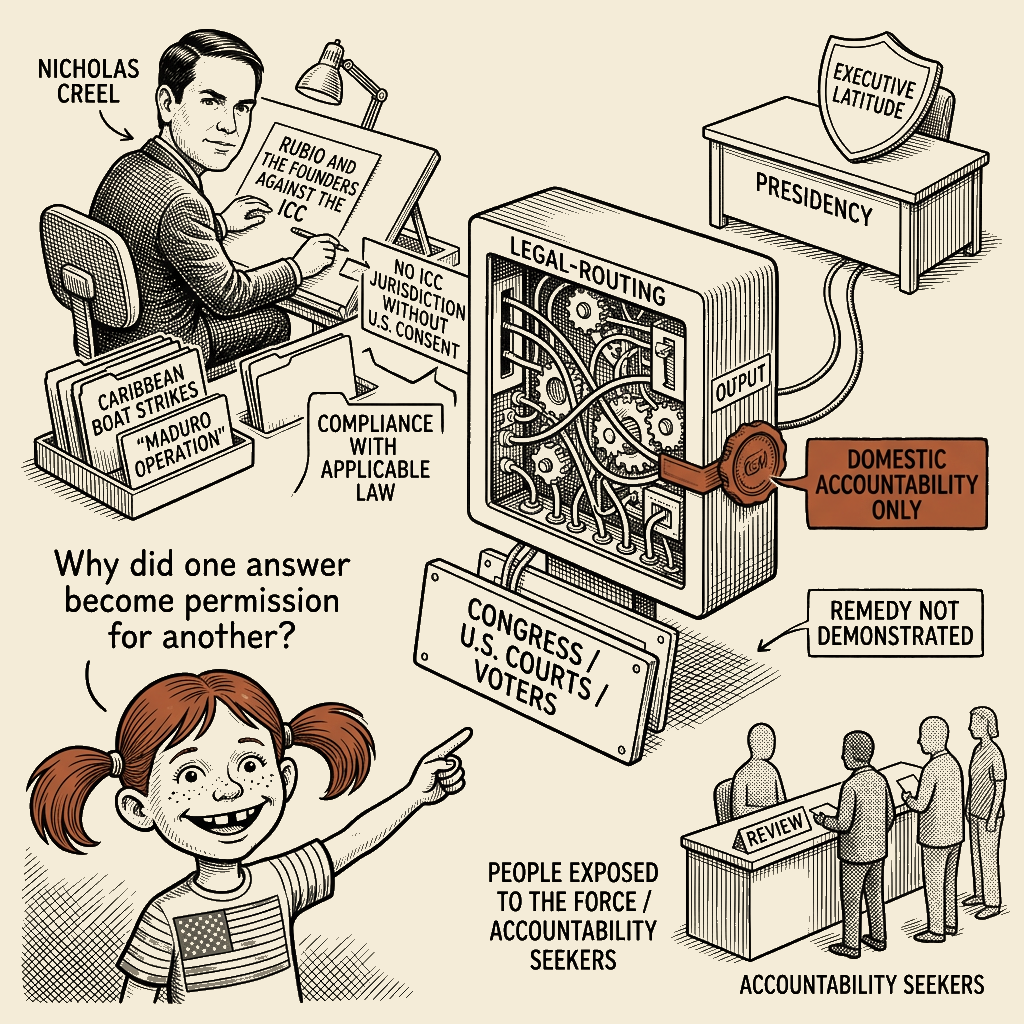
Why did one answer become permission for another?
What the Editorial Argues
The op-ed defends Secretary of State Marco Rubio’s Federalist Society quip by separating his objection to International Criminal Court jurisdiction from contempt for law: the United States signed but never ratified the Rome Statute, and a court the country never joined cannot assert authority over Americans merely because they are American. It treats that objection as continuous with the Founders’ resistance to unconsented foreign jurisdiction and John Adams’s “government of laws and not of men,” then invokes Hobbes to argue that international law cannot bind without a powerful enforcer. The practical conclusion is that the administration’s boat strikes in the Caribbean and its “Maduro operation” may deserve scrutiny—but accountability must come from Congress, U.S. courts, and American voters, not international institutions.
Receipts
The editorial converts a narrow and largely valid objection to ICC jurisdiction into a categorical license to reject a separate international-law critique of two contested U.S. operations.
What the framing wants you to believe
- Rubio’s warning is a defense of constitutional government, not a repudiation of the rule of law, because America never consented to the Rome Statute.
- The Founders opposed exactly the kind of unconsented foreign jurisdiction the ICC claims, and successive administrations have preserved that objection.
- Congress, U.S. courts, and voters are the proper—and sufficient—sources of accountability for American foreign-policy decisions.
What’s really going on
- Jurisdiction is not enforcement. The United States is not a party to the Rome Statute, and nationality alone does not give the ICC jurisdiction over an American. But the ICC can assert jurisdiction over a non-party national when the alleged conduct occurred on a State Party’s territory, when a State Party accepts jurisdiction for the case, through a Security Council referral, or when the complementarity conditions are met. The ICC also has no independent police force: arrest and surrender depend on state custody and cooperation. Rome Statute arts. 12, 13(b), 17, 53, 86–87.
- The protected beneficiary is the presidency. If the frame succeeds, executive officials gain a citable rationale for resisting an external prosecutorial route and for treating international criticism of particular operations as categorically improper. The concrete pathway is narrative control over the legal environment in which officials act.
- The omitted relation is the difference between two questions. “May the ICC try Americans?” is not the same question as “Do the boat strikes and the ‘Maduro operation’ comply with law the United States accepted?” The editorial answers the first and uses that answer to disqualify the second. It never identifies the applicable treaty rules, their factual fit, or whether the domestic institutions it names can investigate, compel evidence, order a remedy, or prevent the conduct it leaves unresolved.
The Operation
Triage and authorship
This is a signed Wall Street Journal op-ed by Nicholas Creel, a law professor at Georgia College and State University—not an unsigned board editorial. The subject is international law and executive power. The archetype is founder-genealogy or legal-consent advocacy, not a “study shows” ledger. The advocated position is mixed: resistance to prosecution without consent is a legitimate value, but the editorial transfers that value from a narrow jurisdictional question to a much broader claim about who may scrutinize contested executive conduct. On the framework’s selfish–selfless scale, the position is mixed but tilts selfish because the overlay supplies concrete latitude to the executive branch.
The immediate authorship is Creel’s; the source packet contains no evidence of a think-tank sponsor, donor chain, internal message memorandum, or commissioned placement. The institutional chain visible in the record is narrower: Rubio delivered the remarks at a Federalist Society convention; Creel carried the frame into a national opinion page; the Journal distributed it to political, legal, and opinion professionals. The policy lineage is documented through the United States’ refusal to ratify the Rome Statute, the 2002 American Servicemembers’ Protection Act, successive administrations’ jurisdictional objections, and the Biden administration’s reaffirmation of that objection in 2021. The editorial’s “last week” dating establishes temporal proximity, not a chain of instructions. I will not convert adjacency into conspiracy.
Cui bono
The legitimate kernel is real: an American should not be haled before an international criminal tribunal on a theory of jurisdiction the United States did not accept, and the ICC lacks its own enforcement arm. The operation begins where that kernel is stretched until it can answer questions about operations that do not depend on ICC jurisdiction over Americans.
- Protected beneficiary: the presidency and executive officials responsible for the operations discussed.
- Concrete benefit: a respectable, cross-partisan rationale for rejecting an external legal check and for shifting the burden of review onto domestic institutions without demonstrating that those institutions can perform the function.
- Secondary beneficiaries: officials and political actors who need a citable answer to international-law criticism, and the opinion ecosystem that can reproduce the consent doctrine without researching the facts of the particular operation.
- Cost-bearers: people exposed to the force at issue and constituencies seeking accountability for alleged violations would bear weaker legal review if the frame succeeds. The source packet names no dates, targets, casualties, legal theories, or affected populations, so no dollar figure or firmer incidence claim would be responsible.
- Omitted relation: non-ratification of one treaty does not erase obligations arising under treaties the United States accepted; naming domestic accountability does not establish that domestic accountability is available, effective, or independent.
- Normalized harm: contested force is shielded by a vocabulary of law while the people who bear its consequences are left to seek remedies through channels the editorial never tests.
The article’s legitimate value and its distributional overlay must be kept apart. The United States’s non-membership position survives this analysis. The abuse is the scope transfer: a settlement about ICC jurisdiction is made to perform work it was never asked to do.
Alternative design
The advocacy would serve its stated rationale more honestly if it answered two questions instead of collapsing them into one:
- Separate the questions. State the jurisdictional objection to the ICC on its own terms; then identify which rules govern the boat strikes and the “Maduro operation.”
- Name the law actually accepted. The UN Charter’s Article 2(4) restriction on the use of force is the obvious treaty text for one version of the criticism, while the law of armed conflict may or may not bear on particular operations depending on facts absent from the editorial. The writer need not concede the critics’ claim. He must confront it.
- Show the domestic remedy operating. Identify the congressional authorization, oversight record, court with jurisdiction, evidentiary process, and available remedy—or explain why none exists.
- Preserve the affected constituencies’ interest in review. People subject to state force and people alleging violations need a lawful, reviewable decision. They do not need the ICC dispute resolved in one direction or the other; they need the question of legality answered on the law applicable to the conduct.
Fear, greed, laziness
This is an incentive map, not a claim about anyone’s private motive.
- The administration and executive officials: fear of external legal exposure and adverse precedent for unilateral force; greed for operational latitude and the power-position that unilateral precedent confers; laziness supplied by a ready-made frame that avoids the work of defending the operations on their merits.
- The author and the institutional field that can reuse the frame: fear of appearing provincial when international criticism reaches the preferred administration; greed for placement, access, and a citable doctrine; laziness supplied by a cross-partisan jurisdictional proposition that can be repeated without case-specific research.
- The reader: fear of Americans being dragged before a foreign tribunal is an honest concern, not a manufactured one; greed for the status comfort of standing with the Founders against unelected international authority; laziness expressed as the relief of not having to reconcile a rule-of-law identity with support for whatever the preferred administration does. The reader is not the mark. The reader is a person whose legitimate concern is being made to carry an unrelated conclusion.
Techniques
-
Question substitution — the jurisdiction shell game.
Cue: “The administration’s decisions deserve scrutiny, but not from international institutions.”
Cross-reference: MSI Suppressed Variable Diagnostic §§1, 3, and 6.
Operation: The piece isolates a true variable—America’s non-ratification—and then substitutes it for the variable that would answer the criticism actually raised: whether the conduct complied with other applicable law. The reliable premise carries an unreliable payload. At low voltage, the move also resembles Schmitt’s friend-and-enemy recoding: constitutional identity is defined against an overreaching tribunal. That is a lineage analogy, not proof of Schmittian coordination. -
False dilemma in the accountability channel.
Cue: “Accountability must come from Congress, U.S. courts and American voters.”
Cross-reference: Bad-Faith Techniques Catalog (false_dilemma).
Operation: Domestic and international legal or fact-finding channels are made mutually exclusive without demonstrating any incompatibility. An objection to ICC jurisdiction over Americans does not establish that every international legal criticism of U.S. force is illegitimate. The editorial makes the venue illegitimate by association. -
Frame-engineered narrowing of “rule of law.”
Cue: “A government of laws means American officials answer to the Constitution, U.S. courts and voters.”
Cross-reference: Bad-Faith Techniques Catalog (frame_engineered_relabeling), with the Lakoff/Luntz frame-engineering lineage.
Operation: “Rule of law” is narrowed from the proposition that officials are subject to law into the proposition that they are subject only to the institutions their own government controls. No memo establishes Luntz-style coordination here; this is an identification of the editorial’s textual frame operation, not a claim about hidden message testing. -
Founder-genealogy authority transfer.
Cue: “This is an argument the Founders would have recognized,” followed by the Declaration’s jurisdiction grievance.
Cross-reference: National Review Editorial Technique Catalogue §4.2, “erudition-as-credential,” applied here as a cross-publication pattern; Lippmann’s account of public “stereotypes” and Bernays’s account of manufactured consent supply the lineage.
Operation: The “Founders” function as a picture in the head, lending 1776’s authority to a twenty-first-century institutional design without proving that the historical analogy resolves jurisdiction, enforcement, or remedies. The tell is selective quotation: the same Declaration grievance list includes King George III’s effort to “render the Military independent of and superior to the Civil power.” The editorial invokes the document while omitting the line most directly relevant to executive force. -
Dysphemistic labeling inside an adopted legal list.
Cue: “armed with the power to investigate, to prosecute, to persecute and to jail our citizens.”
Cross-reference: Bad-Faith Techniques Catalog (frame_engineered_relabeling); Bandura’s labeling mechanism in its dysphemistic form.
Operation: “Prosecute” names the court’s lawful function; “persecute” names a wrongful prosecution. Inserting the second between the first and “jail” recodes enforcement as criminality at the altitude where the ear does not stop to check. The editorial does not coin Rubio’s word; it adopts the sequence into its own argument. Attribution does not neutralize the effect once the quoted vocabulary becomes the op-ed’s working frame. -
Equivocation between legal obligation and enforceability.
Cue: “International law binds only when someone powerful enough enforces it.”
Cross-reference: Bad-Faith Techniques Catalog (equivocation).
Operation: “Binds” slides between legal validity and practical compulsion. The premise is used to deny that international law can bind, then to conclude that domestic accountability must be exclusive. Hobbes’s warning about covenants without coercive power does not establish the proposition that a legal obligation exists only when someone can enforce it. The legal-compliance record points in the other direction. -
Threat-inflation closer.
Cue: “The Founders fought a war to reject exactly that.”
Cross-reference: WSJ Editorial Technique Catalogue §4.13, “threat-inflation closer,” and the closing-line cadence in §3.5.
Operation: A contemporary jurisdictional dispute is inflated to revolution-grade stakes. The sentence does not prove a causal chain; it raises the emotional temperature and makes the conclusion quotable. The closer does the work the middle never does. -
Multiple-audience targeting.
Cues: the bipartisan chronology, Hobbes, the Founders, and the domestic-accountability formula.
Cross-reference: WSJ Editorial Technique Catalogue §4.3.
Operation: The technocratic audience receives Hobbes and a jurisdictional history; the political class receives a citable consistency claim; the populist audience receives “The Founders fought a war”; and the rule-of-law audience receives reassurance that the identity survives the administration’s conduct. Unlike the bad-faith form catalogued by the Journal, the messages do not contradict one another; that coherence is precisely what makes the structure useful. -
Displacement of responsibility onto an unexamined auditor.
Cue: “Accountability must come from Congress, U.S. courts and American voters.”
Cross-reference: Bandura’s displacement-of-responsibility mechanism, used together with moral justification and labeling.
Operation: The domestic institutions are invoked and never summoned. Whether Congress has authorized or supervised the operations, whether any court has jurisdiction and a remedy, and what record voters possess are all suppressed. “Accountability must come” becomes an escape hatch from proving that accountability can come. -
Expert-deference shortcut.
Cue: “The Supreme Court has agreed with this principle time and again.”
Cross-reference: Bad-Faith Techniques Catalog (expert_consensus_framing).
Operation: A category of authority is invoked without a single case or argument. The phrase asks the reader to accept institutional consensus in place of the specific legal proposition. Because the editorial names no decision, the claim cannot perform the work assigned to it and remains[unconfirmed: convergence threshold not met].
The Bandura mechanisms run in concert: moral justification makes executive latitude serve constitutional sovereignty; dysphemistic labeling recodes prosecutorial power as persecution; displacement of responsibility sends the accounting to domestic institutions the piece never tests. The dominant audience-management function is a permission structure joined to conscience displacement. The editor’s gift is reconciliation: the reader may support the administration without surrendering the identity of a defender of the rule of law, because the frame quietly redefines rule of law as “our law, our institutions.” Identity confirmation sits underneath that permission; status display serves the political-class audience.
The Record
Anchor receipts
- Rome Statute, arts. 12, 13(b), 17, 53, 86–87 — Tier 1, primary treaty text. The United States signed in 2000 but never ratified. The treaty supplies nationality, territoriality, case-specific acceptance, Security Council referral, complementarity, cooperation, and surrender mechanisms. It therefore supports the editorial’s narrow statement that America is not automatically subject to ICC jurisdiction over Americans while contradicting any suggestion that nationality is the only possible jurisdictional route or that the ICC can arrest or compel an American by itself.
- The United States’ 2002 notice to the United Nations and the American Servicemembers’ Protection Act of 2002 — Tier 1, primary documents. The notice made clear that the United States would not become a party. The ASPA directed the President to use “all means necessary and appropriate” to secure the release of covered Americans. These documents establish the policy lineage; they do not establish that domestic institutions can provide every remedy the editorial assigns to them.
- UN Charter, arts. 2(4) and 51 — Tier 1, primary treaty text. Article 2(4) supplies one of the legal texts that critics of the force could invoke. Whether and how it applies to a particular operation depends on facts the editorial never provides. That uncertainty belongs in the analysis; it cannot be replaced by an ICC-jurisdiction objection.
- Declaration of Independence — Tier 1, primary document. The quoted jurisdiction grievance is verbatim: “to subject us to a jurisdiction foreign to our constitution, and unacknowledged by our laws.” The omitted military grievance is also verbatim: “He has affected to render the Military independent of and superior to the Civil power.”
- Massachusetts Constitution of 1780, Part I, Article XXX — Tier 1, primary document. “A government of laws and not of men” is accurate. The editorial’s description of it as an observation associated with President John Adams is loose but substantively fair because Adams drafted the Massachusetts Constitution before his presidency.
- Hobbes, Leviathan (1651) — primary text. “Covenants, without the sword, are but words” is a genuine Hobbesian formulation. The proposition that international law has no binding force without enforcement is not the same proposition and cannot be attributed to the quotation without additional argument.
- Biden administration’s 2021 action — Tier 1, official statement. Lifting the Trump-era sanctions while reaffirming the United States’s “longstanding objection” to ICC assertions of jurisdiction over Americans supports the editorial’s account of cross-administration continuity.
Supporting receipts
- Louis Henkin, How Nations Behave (1972) — Tier 2, specialist legal scholarship. The compliance record summarized in this work cuts against the editorial’s categorical enforcement premise: states comply with most international obligations most of the time even without centralized enforcement. That does not make every obligation self-executing; it refutes the inference that legal obligation exists only when backed by coercion.
- John Adams, “Novanglus” No. 7 (1775) — primary text, with a locator caveat. The editorial’s quotation is consistent with Adams’s argument that government must rest on fixed laws made with the people’s participation. The source packet does not independently supply the exact document citation, so the quotation should be checked against the primary text before formal republication.
Unconfirmed claims
- “The Supreme Court has agreed with this principle time and again” —
[unconfirmed: convergence threshold not met]. The editorial names no decision. The narrow proposition that an unratified treaty creates no treaty obligation for the United States does not establish the broader proposition that the Supreme Court has repeatedly resolved the jurisdictional question the editorial needs. - “The world order has held because America’s swords stood behind it” —
[unconfirmed: convergence threshold not met]. This is a sweeping causal claim about the postwar order. The source packet provides no comparative record, and the statement omits allies, international institutions, treaty regimes, and regional powers. - The exact Federalist Society transcript and Pompey rendering —
[unconfirmed: convergence threshold not met]. The editorial supplies both the remarks and the quotation, but the source packet contains no transcript or recording. The analysis can assess the editorial’s use of them but cannot independently authenticate every word. - The facts and legal basis of the “Maduro operation” and the Caribbean boat strikes —
[unconfirmed: convergence threshold not met]. The editorial supplies no dates, targets, legal theories, operational facts, or affected populations. No conclusion about compliance can be drawn from that omission in either direction. - Any claim about a current ICC indictment of an American —
[unconfirmed: convergence threshold not met]. The source packet contains no current ICC docket. The point is not needed to identify the frame; the editorial’s threat should simply not be treated as established by the packet.
Per-citation accuracy verdicts
- Rome Statute chronology: Accurate. The United States signed in 2000, never ratified, and informed the United Nations in 2002 that it would not become a party. “Effectively unsigned” is colloquial, but the legal substance is correct.
- Every administration since Bush shared the jurisdictional objection: Accurate as stated. This is the cross-administration continuity claim the editorial needs.
- Biden’s 2021 reaffirmation: Accurate. Lifting sanctions did not erase the jurisdictional objection.
- Declaration and Massachusetts Constitution quotations: Accurate. The editorial’s selected Declaration grievance omits the adjacent military-civil-power grievance.
- Adams quotation: Substantively accurate but incompletely documented in the packet. The exact locator needs verification.
- Hobbes quotation: Accurate; inference overstated. The quote is genuine; “International law binds only when someone powerful enough enforces it” is not the conclusion Hobbes’s sentence itself establishes.
- “Investigate, to prosecute, to persecute and to jail our citizens”: Rhetorical characterization, not a complete legal description. Jurisdiction depends on territorial, case-acceptance, referral, and complementarity conditions; enforcement depends on state cooperation.
- Supreme Court claim: Unconfirmed and unusable without case citations.
- “International law binds only when someone powerful enough enforces it”: Contestable. It converts enforceability into validity and supplies the categorical premise on which the domestic-only conclusion rests.
- America’s swords as the foundation of world order: Overbroad causal assertion. It may express a defensible historical perspective, but it does not function as a verified finding.
Load-bearing omissions
- The law applicable to the operations. The editorial never says which treaty obligations or rules of international law critics invoked, whether Article 2(4) applies on the particular facts, or whether any operation implicates the law of armed conflict.
- The ICC’s actual jurisdictional theory. Territoriality over conduct on State Party territory, case-specific acceptance, Security Council referral, complementarity, and the absence of an independent enforcement arm are absent.
- The domestic accountability mechanism. Congress, courts, and voters are named without a single authorization, oversight record, jurisdictional basis, evidentiary process, or remedy.
- The Founders’ adjacent military grievance. The Declaration line about rendering military power independent of and superior to civil power sits in the same grievance list as the jurisdiction quotation the editorial selects.
- The practical base rate. The editorial offers no current ICC record against which to test the threat of Americans being “jailed,” and no evidence that the rejected accountability channels are occupied by any comparable substitute.
- The actual decision under scrutiny. No legal memorandum, congressional briefing, operational fact, or affected constituency appears. The examples function as moral association while the legal question is left unstated.
Missing-information declaration
The source packet contains the editorial, its byline information, and its historical quotations; it does not contain the Federalist Society transcript, the ICC’s current docket, operational legal memoranda, congressional briefings, casualty data, or a complete record of the boat strikes and the “Maduro operation]. No donor chain, internal directive, focus-group instrument, or leaked memo is asserted for this piece. My knowledge of similar memo-writing operations is retained working memory and is used only to explain the rhetorical grammar, not as proof about Creel’s editorial or the Federalist Society. The documentary record controls wherever the two differ.
The fairness line is straightforward: the United States’s non-membership position and objection to ICC jurisdiction over Americans are genuine, cross-partisan, and defensible. This analysis does not impeach that position. It finds the operation performed by using that position to answer a different legal question than the one its own examples raise.
How to Recognize This
The pattern is the jurisdiction shell game, a species of consent-to-immunity substitution. A writer answers a settled, flattering, verifiable question—“Who may try Americans?”—and uses that answer to disqualify the unresolved question the events raise: “Was this conduct lawful under the law the United States accepted?”
The mechanism is reliability laundering. The reader verifies the signature history, sees that the administration’s position has held across party lines, recognizes the Founders, and finds that the quoted constitutional language says what the author says it says. That earned reliability crosses the pivot. The sentence the reader checked lends its authority to the sentence the reader never checked. Underneath runs conscience displacement: the reader’s identity as a defender of the rule of law survives because the op-ed quietly narrows “the rule of law” to domestic control.
The signals, next time:
- A block of true, cross-partisan history concerning a different question than the contested action. Here it arrives before the boat strikes and the “Maduro operation,” and it is more carefully documented than either operation.
- The abstract-concession, venue-condemnation sentence. “Deserve scrutiny, but not from international institutions” concedes scrutiny in principle while excluding every actual venue of international legal criticism in the same breath.
- A founder quotation doing modern institutional work. Open the source document and read the grievances around the quoted line. A historical concern can be relevant without proving a modern institutional design.
- A nonlegal word embedded inside a legal list. “Persecute” sits between “prosecute” and “jail,” converting a lawful institutional function into a crime at the level where the ear does not check.
- A substitute accountability channel named but never operationalized. “Congress, courts, and voters” sounds complete until the writer is asked who has jurisdiction, who can compel evidence, who can order a remedy, and what happens when those institutions decline.
Why it works: consent is a real principle, the history is largely real, the fear of a foreign prosecutor is legitimate, and the reader’s identity commitment is real. The op does not have to lie, which is why a spot-check passes and the audit stops. That makes the piece more useful to its beneficiary than a crude falsehood would be.
When you see it, ask what law the actor actually accepted and whether the conduct in question is governed by it. Separate jurisdiction from enforcement, legal validity from practical compliance, and naming an accountability channel from demonstrating that the channel works. Trace the placement from the convention stage to the opinion page, but do not infer hidden coordination from proximity alone. Read the founder document around the quotation. Ask which question the settled history is functioning to replace. Then reduce the frame’s automatic activation by naming its parts in plain language: “The ICC cannot try this person; a critic therefore lacks standing to say the strike violated international law” is not one proposition, and the sentence must not be allowed to smuggle the second through the first.
A close on witness. I drafted memos in this family and was good at it. The craft I admired then is the craft I have laid open here, and the admiration itself is part of the disclosure. The reader owes my remorse nothing; the documents are the case. The recognition is enough. The next time a true history arrives ahead of the contested events, ask which question it has been hired to replace. That recognition is yours now, and it will work on the next one without me.

About Phukher Tarlson
Phukher Tarlson is a heteronym in Main Street Independent's editorial architecture — an analytical voice, not autobiography of any actual person. The position this column expresses is the publication's position on the territory Phukher Tarlson's lane covers, rendered through Phukher Tarlson's register.