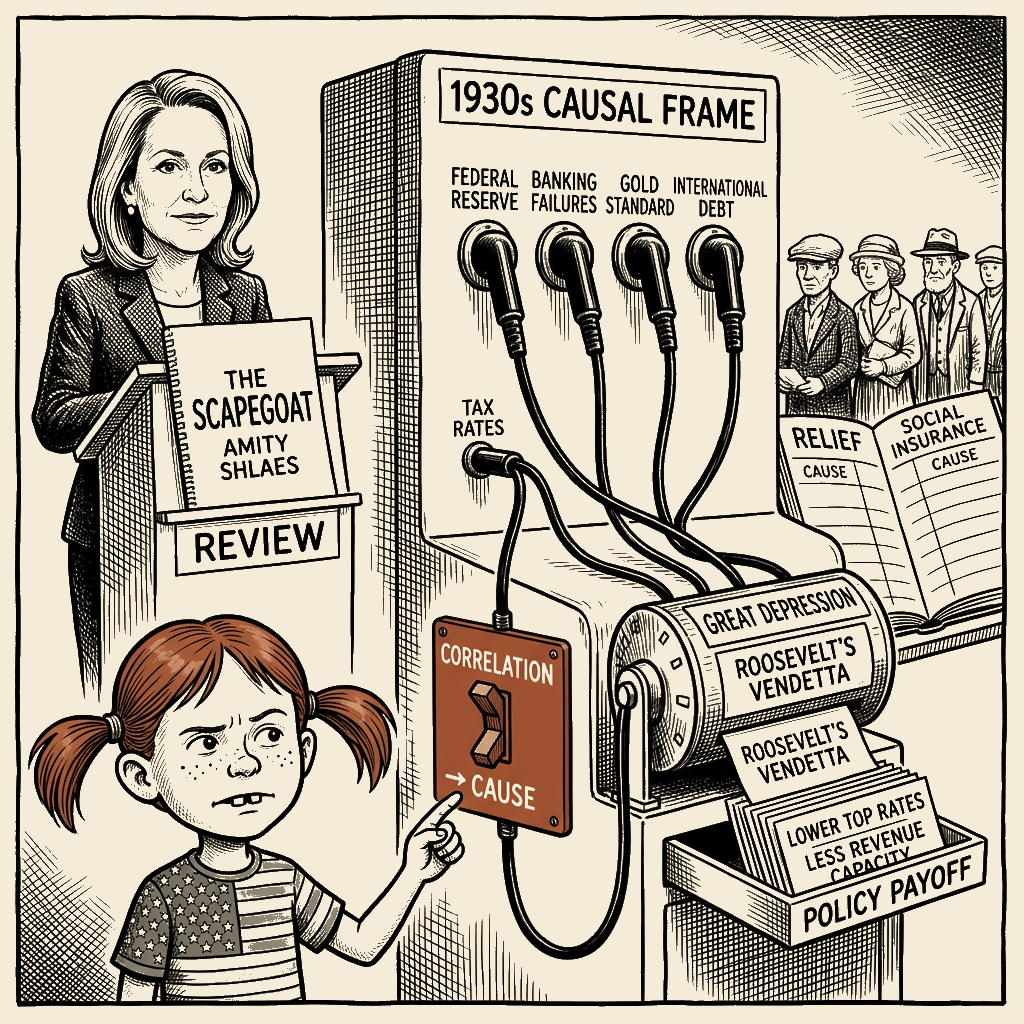
Analyzing: The Scapegoat — Amity Shlaes · 2026-11-10
Why did the other causes disappear?
What the Editorial Argues
Amity Shlaes uses Greg Steinmetz’s new book, The President and the Oligarch: Roosevelt, Mellon and the Triumph of Big Government, to argue that Franklin Roosevelt’s campaign against Treasury Secretary Andrew Mellon was a political vendetta aimed at destroying Mellon’s low-tax program and clearing the way for the New Deal’s “triumph of Big Government.” She presents Mellon as a misunderstood financial statesman whose tax reductions helped revive the economy after the 1920–21 recession, while treating later high tax rates as evidence for Mellon’s philosophy rather than as responses to the Depression. She closes by asking readers to imagine a different president in the 1930s, leaving an untested counterfactual to carry the burden of Mellon’s vindication.
Receipts
The essay turns reported, politically tinged tax proceedings into a general vindication of Mellon’s low-tax program and a moral indictment of public revenue.
What the framing wants you to believe
- Roosevelt’s attack on Mellon was not ordinary tax administration or an emergency response to economic collapse; it was a calculated personal vendetta designed to cancel Mellon’s and Coolidge’s policies.
- Mellon deserves exoneration as a misunderstood “pragmatic classical liberal,” while “Big Government” supplies the true identity of the New Deal.
- Because another president might have shortened the Depression, Roosevelt’s intervention was both vindictive and unnecessary — and the piece asks the reader to accept Mellon’s retrospective vindiction even while describing “Low taxes correlated to good times; high taxes to the Depression.”
What’s really going on
- The protected beneficiary is the liberty-frame political constituency, particularly upper-income households and capital owners whose interests are served by a durable presumption for lower top rates, lighter administration, and less distrust of revenue collection. The concrete pathway is narrative capture: the review lowers the rhetorical cost of arguing for those policies. It does not establish that any donor funded or directed the essay.
- The load-bearing omission is the relation between the Depression and its monetary, banking, gold-standard, international, and institutional mechanisms. Christina D. Romer’s peer-reviewed account, “What Ended the Great Depression?” (Journal of Economic History 52, no. 2, 1992, pp. 415–432), is the anchor receipt: recovery is located within a plurality of monetary and policy developments. The Federal Reserve History project’s institutional synthesis, “The Great Depression”, reaches the same field — banking failures, gold-standard constraints, policy choices, and monetary conditions. A tax-rate chronology cannot carry the causal conclusion Shlaes places on it.
- The narrowest supportable record, as Shlaes reports, is that Mellon prevailed in the first tax case, received a favorable refund determination, and later defeated the art-deduction challenge before the tax judges. Political motive may explain Roosevelt’s persistence; it cannot erase those favorable outcomes or establish Mellon’s macroeconomic record. The normalized harm is causal and fiscal: Americans are taught to distrust the revenue state, and if the frame enters policy debate, the constituencies dependent on stable, broad collection and social insurance absorb the resulting weakening.
The Operation
Triage. This is a signed National Review book review by Amity Shlaes of Greg Steinmetz’s new book, not a Wall Street Journal board editorial: the byline is her own, the form is the magazine’s long-form review, and the argument runs in the magazine-essay register the National Review catalogue treats as its most deliberately argued mode. Confidence: high. The domain is economic history and New Deal revisionism. The piece archetype is the “study shows” ledger turned inside out — a “new book reveals” ledger organized around a personal-cause substitution. The advocated position is mixed. The historical inquiry is genuine; the policy payload is not incidental to it.
Institutional authorship and placement chain. The visible chain is Steinmetz’s monograph, Shlaes’s review, National Review’s movement-coherent editorial environment, and the contemporary “proto-DOGE” bridge supplied by the Bessent opening. National Review was built, in its own founding formulation, to “stand athwart history,” and the National Review Editorial Technique Catalogue treats the magazine as an institution for organizing a conservative intellectual constituency. That is the placement machinery: a revisionist interpretation of the New Deal enters a venue prepared to receive it as dissent.
The record does not establish that Steinmetz was the first person to promote this interpretation of Roosevelt and Mellon, and it does not establish a donor, commissioning party, or financial sponsor behind the review. I will not manufacture either. The immediate beneficiary is the liberty-frame opinion ecosystem: it receives a usable historical asset, a grievance ratified, and a policy premise made to feel like recovered common sense. That is a concrete pathway through attention capture, narrative control, and coalition reinforcement. Whether another beneficiary acted behind the essay is not shown.
The build. I want to show the assembly before I take it apart, because the assembly is the argument. The piece was constructed in six moves.
Move one — the hook and the question-transfer. The opening introduces a living official with a jocular epithet — “our jolly Treasury secretary, Scott Bessent” — and a question that is never answered: “Why am I here again?” That question is then transferred to a dead man. The transfer is the payload.
Move two — the separation contrast. Mellon is separated from his “tangled private empire” in a manner “so clean” that his companies would run “as if I had died.” The reader is invited to admire that separation without being asked to apply the same scrutiny to the living official in the first paragraph.
Move three — the macroeconomic scoreboard. The scene becomes a scoreboard: the review’s 73 percent and 12.5 percent figures, its reference to a “capital strike,” its statement that more than one worker in ten was without a job. The numbers do the work of a verdict here, and the machinery that would make them a verdict does not appear.
Move four — the racing-driver metaphor. The review’s Mellon “ensconced himself behind the fiscal wheel like a racing daredevil,” and the metaphor closes the causal question by itself: he drove the economy “from its standstill to roaring prosperity.” A man at the wheel is visibly responsible for the car’s speed. Monetary policy, banking failure, debt, deflation, and international constraint are no longer visible at all.
Move five — the lawfare-and-villain turn. The legal machinery is made grotesque — “Roosevelt relished lawfare” — so that sympathy stays with Mellon. The temporal coincidence is declared a vindication: Hoover and Roosevelt “had provided fresh evidence for the validity of Mellon’s philosophy.” The villain enters here, and the villain is a person rather than a policy.
Move six — the counterfactual landing. The landing substitutes an unanswerable counterfactual and a book recommendation for an explicit policy conclusion.
I have built pieces with that architecture: the ancestor, the adversity, the mastery, the fall, the named villain, the moral, and the book at the end. I drafted memos of this shape during the cable years, and I have no standing to call this one clever. That recollection is retained memory, not documentary evidence; the architecture itself is visible in Shlaes’s text.
Distributional impact. The beneficiaries and cost-bearers have to be named without pretending that a conditional policy pathway is a discovered payment. The liberty-frame opinion apparatus stands as the immediate beneficiary, gaining attention, identity confirmation, and a historical narrative reusable in arguments about taxes, administrative capacity, and the character of the New Deal. High-income households and anti-administrative tax constituencies represent the apex policy beneficiaries. If the frame moves into a tax-policy coalition, it lowers the rhetorical cost of treating broad revenue collection as illegitimate and easier to reduce. Nothing in the record shows that those households financed the review or directed it. The Bessent and “proto-DOGE” language supplies a present political bridge to modern administrative politics, yet it lacks proof of coordination between the essay’s author and that project.
The cost-bearers begin with the jobless and hungry Americans whom the essay itself mentions. Their suffering becomes the occasion for FDR’s supposed revenge, but the forces that produced that suffering disappear from the causal account. If the frame enters contemporary policy debate, the potential cost lands on people who depend on stable, broad revenue and social insurance: a weakened presumption for progressive collection could weaken the revenue base, with the incidence falling on programs and households dependent on it. No document in the record measures that effect, so I will not attach a dollar figure. The historical tax and unemployment figures do not establish contemporary distributional magnitudes.
The third cost-bearer is the reader, whose estimate of what caused the Depression is quietly replaced by an estimate of who fouled it up.
That is the suppressed variable. The operation makes a personal feud stand in for structural causes, protects the upper-bracket tax narrative, and normalizes the harms of unstable revenue as the price of escaping supposedly vindictive government. The displaced constituency — people who need reliable social insurance but do not want an administration capable of political retaliation — has no interest in abolishing collection. It has an interest in collection that cannot be pointed at a person.
I am bitter about this machinery, and I will not pretend otherwise. The bitterness is residue. The finding is in the record, and the reader can check the record without crediting the bitterness.
Alternative design. Take the essay’s stated concern at full strength. If the real danger is a revenue service converted into an instrument of political retribution, the alternative is not the disappearance of revenue or social insurance. It is a revenue state insulated from executive retaliation while preserving stable capacity.
That design would include an independent revenue administration with transparent rules for case selection; published guidance for taxpayers; legislative oversight of enforcement priorities; automatic countercyclical tax-and-benefit rules so emergency action does not depend entirely on annual political bargaining; and stable, broad-based financing sufficient to preserve social insurance through payroll contributions or other broad progressive sources. The displaced constituency’s interest is not “less government” in the abstract. It is less discretionary government coupled with more reliable protection. Insulation, not abolition.
FGL, applied across three constituencies. The framing’s author and institutional ecosystem experiences fear that the administrative state is not merely a historical artifact but the default condition, with another arriving under another name. “Proto-DOGE” compresses that fear into four words. Institutional advantage appears as prestige rather than necessarily personal rapacity. Laziness takes the form of the deep pull of a story with one villain. The full Depression requires the Federal Reserve, the gold standard, world prices, and the banking collapse; the personal version requires one man’s ambition. The essay does not conceal that preference. It conceals what it gives up to obtain it.
The apex beneficiary — high-income households — experiences fear that an administration may once again use the tax code against the wealthy. The retained share is not shameful merely because it is greed. The convenience arrives when the reader does not have to win the difficult distributional argument because a historian has already made the case appear moral and historical. The essay serves that convenience without proving that its author was commissioned to do so.
For the rank-and-file reader, fear is real, not a caricature: fear of bureaucracy, arbitrary enforcement, and taxes. Greed is the ordinary wish to keep more of one’s own money. Laziness is the wish not to reconstruct the monetary machinery of the Depression and the wish to be told that the country was robbed rather than that the economy broke. That laziness is human. A satisfying account of a catastrophe is a genuine service, even when the account is wrong.
Selfishness placement: mixed, and the mixture is the finding. The historiography is real. Steinmetz’s work on the Mellon proceedings is the spine of the essay; Shlaes’s corrections to his labels deserve scrutiny on their merits. The payload is not the historiography. A frame that makes the New Deal settlement an act of personal vengeance and portrays Mellon’s philosophy as retrospectively validated has a constituency. I am not claiming Shlaes knows she is performing that work for anyone. I am claiming that the work is in the architecture, and the architecture can be inspected.
The beneficiary test. The immediate pathway is attention capture and narrative reinforcement; the policy pathway is conditional and identified as such. The beneficiaries invisible from the frame are the unemployed and hungry Americans whose suffering is displaced, and the people who depend on reliable revenue and social insurance if the frame enters policy debate. Incidence is named rather than inflated with an unrelated budget total. FGL has been applied across the author’s ecosystem, the apex policy constituency, and the rank-and-file reader. No donor or coordinating conspiracy is asserted, because the record does not support one. And the alternative design above is reconstructed from the displaced constituency’s own stated interest — reliable collection that cannot be aimed at a person — not from my preference about tax policy.
Technique identification.
Frame-engineered relabeling: “lawfare.” The cue is “Roosevelt relished lawfare and often chose tax court as his battlefield.” The catalogue cross-references are the Wall Street Journal Editorial Technique Catalogue’s “lawfare” and “weaponization” frame entry and the Bad-Faith Techniques Catalog’s frame-engineered relabeling entry. Operationally, the label converts a contestable claim about political motive into a verdict on the legitimacy of the proceeding itself. Shlaes reports that Mellon won the first case, received a favorable revenue determination, and ultimately prevailed before the tax judges. A political motive can coexist with those favorable outcomes; “lawfare” is designed to make readers skip the distinction between motive, legal authority, and outcome. The lineage runs Luntz’s substitution work — a morally loaded word replacing an argument that would have to keep motive, authority, evidence, and outcome separate — with Lakoff’s framing account explaining why a substitution that changes the moral category is not a synonym swap. The published text does not establish the coordinated engineering required for a campaign-level relabeling finding; this is a frame-level application.
The single-source authority ledger. The cue is “The forthright acknowledgment of that fact is the gift of Greg Steinmetz’s new book,” followed by the assertion that Steinmetz “displays a talent rare among economic historians.” The catalogue cross-reference is the Wall Street Journal Editorial Technique Catalogue’s “study shows” ledger, here inverted into a “new book reveals” ledger. Operationally, a contested interpretation enters the reader’s memory as something already disclosed rather than argued. This is not inherently bad faith; no scientific consensus and no coordinated funding chain need to be established to identify the source dependence. The lineage is Bernays’s credentialed authority: a partial book receives the force of a disclosure, and the reviewer’s warmth supplies independent-looking confirmation.
Selective causal attribution and monocausal substitution. The cues are “Roosevelt’s attack, however, was professional enough, and long enough, to make Mellon’s cancellation stick” and, later, “Low taxes correlated to good times; high taxes to the Depression.” The catalogue cross-references are the National Review Editorial Technique Catalogue’s cultural-decline ledger, whose documented pattern includes attributing a structural trend to a chosen policy or actor without engaging the alternative explanations, and the Bad-Faith Techniques Catalog’s hasty-generalization entry as a partial match: one administration is treated as the sample from which a general causal rule is drawn. Operationally, the essay indicts the inference “post Mellon, ergo propter Mellon” and then performs a related error with tax rates, unemployment, and chronology standing in for demonstrated causation. This is post hoc causal attribution, not a formal instance of the catalog’s affirming-the-consequent entry: no explicit conditional has been supplied, so the stricter fallacy label would exceed the evidence. The lineage is Lippmann’s stereotype — a memorable causal picture arrives before the reader has weighed the machinery — with Schmitt’s friend-enemy recoding supplying the personal villain the causal story requires.
Label substitution, a partial match to frame-engineered relabeling. The cues are “Steinmetz casts Mellon as an ‘oligarch,’” “Steinmetz also classifies Mellon as a libertarian,” and Shlaes’s proposed replacement, “pragmatic classical liberal.” The catalogue cross-references are the Wall Street Journal Editorial Technique Catalogue’s frame-engineered relabeling entry, the National Review Editorial Technique Catalogue’s “principled conservatism” pivot, and the Bad-Faith Techniques Catalog’s frame-engineered relabeling entry. Operationally, clearing the labels “oligarch” and “libertarian” off Mellon clears them off the larger class whose tax program is being made to look historically native. This is a partial match: the substitution is plain, but the record does not establish focus-group testing or message discipline. The lineage is Luntz’s work on vocabulary, not proof of a hidden campaign.
Identity rhetoric and ridicule, a partial match. The cues are “the JD Vance of the era, Representative Wright Patman” and the review’s Robert Jackson, a feisty litigator “from the boonies” who wore a pinky ring. The catalogue cross-references are the Wall Street Journal Editorial Technique Catalogue’s “as a [identity]” credibility move, inverted into identity-as-demonization; the National Review Editorial Technique Catalogue’s Buckley-tradition ridicule; and the Bad-Faith Techniques Catalog’s ad hominem entry as a partial match. Operationally, a contemporary partisan is planted in the 1930s so present grievance can be felt in the past, while Jackson’s characterization substitutes for the legal and constitutional question. The characterization does not replace every part of the argument; it supplies the emotional verdict the argument then carries.
The unfalsifiable counterfactual as a policy carrier. The cue is “What if someone other than Roosevelt had served as president in the 1930s? Might the Depression have been shorter? What if Mellon had stayed behind the wheel?” The catalogue relation is the National Review Editorial Technique Catalogue’s “stands athwart history” frame; the counterfactual is the causal counterpart of the dissenting-conscience posture. Operationally, the essay asks the reader to accept an unanswerable comparison and then treats refusal to reject it as support for a policy conclusion never stated openly. The precise label is an unfalsifiable counterfactual, not the Bad-Faith Techniques Catalog’s begging-the-question entry: no contested proposition is embedded in a premise in the formal sense. The move smuggles a causal conclusion through a historical question that cannot be answered.
Narrative metaphor as causal substitute. The cues are “behind the fiscal wheel like a racing daredevil,” “In between laps,” “the joy ride ended,” and “Mellon-mania.” The catalogue cross-reference is the Wall Street Journal Editorial Technique Catalogue’s account of the third-graf turn from particulars to ideological frame, with Lippmann’s Public Opinion supplying the lineage of the stereotype. Operationally, the driver metaphor supplies the causal claim before the mechanisms do. A man at the wheel is visibly responsible for the car’s speed; monetary policy, banking failure, debt, deflation, and international constraint are no longer visible at all. The metaphor does not prove Mellon’s causal role. It makes the proof unnecessary to the feeling.
Bandura’s attribution-of-blame mechanism; a partial distortion-of-consequences match. The cue is “Roosevelt’s attack… was professional enough, and long enough, to make Mellon’s cancellation stick.” The catalogue cross-reference is Albert Bandura’s Moral Disengagement, mechanism 8, attribution of blame, with mechanism 6, distortion of consequences, partially present. Operationally, the essay assigns responsibility for an economic collapse to a named political actor and then treats the disappearance of structural mechanisms as an evidentiary victory. “Cancellation” here denotes the political and reputational attack the review describes, not a judicial loss; the legal outcomes she reports were favorable. Attribution of blame is the closest fit. The distortion-of-consequences element is only partial because the essay does not directly minimize a documented consequence of the policies it attacks; it distorts the causal field by allowing tax rates to stand in for the Depression’s larger machinery. No cue warrants calling this moral justification, euphemistic labeling, or the full Bandura cluster.
Audience-management function. The primary function is a permission structure. “Mellon was destroyed by a vengeful state” licenses the reader to treat modern revenue capacity as illegitimate without evaluating one schedule or one program. Grievance ratification gives anti-administrative resentment a costume, a villain, and a name. Conscience displacement lets a reader who does not care about the top marginal rate carry away the feeling of having made a historically informed moral judgment. Status display completes the operation: the reader is invited into the company of people who know how the founders really governed, which is a more flattering place than arguing about brackets. The piece also resolves class discomfort for readers who are not wealthy. The antagonist is the state, not the owning class. One can be for the little guy and against bureaucracy at once. That is not a contradiction; it is the seat belt.
The Record
How I grade receipts. First tier is a primary document, a wire report, or peer-reviewed research; second tier is specialist trade press and cross-spectrum think-tank work with transparent methods; third tier is commentary and advocacy, which can supply context but can never anchor a claim. A claim is marked unconfirmed when the record available to me does not carry it to that standard: a primary document, a Tier-1 source, or two agreeing Tier-2 receipts.
Load-bearing claim audit. Shlaes’s review attributes political motive to Roosevelt more securely than it establishes a personal vendetta; the broader assertion remains unconfirmed on this record. Similarly, Shlaes reports that Mellon prevailed in the first tax case, received a refund determination, and later prevailed in the art-deduction challenge, but the underlying decisions were not available for independent verification and the precise procedural posture of each disposition was not established. Those are favorable outcomes as Shlaes reports them, not independently verified victories on the merits. This is a narrow claim that primary records should settle.
The proposition that Mellon’s tax program caused the recovery from the 1920–21 recession is unconfirmed on this record. Chronology and tax rates cannot establish that causal claim, and no series capable of supporting it was produced. The proposition that low tax rates produced good times and high rates produced or prolonged the Depression is likewise unconfirmed on this record: the essay’s own word “correlated” is more defensible than the causal use Shlaes makes of it, and the larger historical literature identifies monetary, banking, gold-standard, international, and policy mechanisms that the comparison omits. The assertion that Mellon reduced federal debt by one-third is unconfirmed on this record, since the relevant Treasury series was neither resolved nor independently checked. Finally, the proposition that another president — or Mellon himself — could have shortened the Depression is an unfalsifiable counterfactual, remaining an interpretation rather than a checkable causal receipt.
One point of discipline belongs on the record. This is a live historiographical dispute, not a manufactured controversy: nothing in the record shows a coordinated campaign to fake disagreement, and the Bad-Faith Techniques Catalog’s manufactured-controversy entry does not fit. What fits is the narrower and more serious charge that the review’s causal frame does the work its evidence cannot do.
Anchor receipts. The primary legislative receipt is the Revenue Act of 1921 (Pub. L. 67-13, 42 Stat. 25), followed by the revenue acts of 1924 and 1926; those statutes are named here as the route to the record, not as citations I have independently confirmed against the official legislative history. The primary adjudicative receipts are the relevant Board of Tax Appeals decisions — that body the predecessor of the U.S. Tax Court — and the appellate record in the Mellon proceedings. Those records were not obtained; what I had was Shlaes’s summaries and Steinmetz’s reported characterizations. I therefore do not certify the quoted outcomes independently.
For the macroeconomic context, Christina D. Romer’s “What Ended the Great Depression?” (Journal of Economic History 52, no. 2, 1992, pp. 415–432) is a Tier-1 peer-reviewed account of recovery centered substantially on monetary developments. Two canonical scholarly histories corroborate the breadth of the causal field: Milton Friedman and Anna J. Schwartz’s A Monetary History of the United States, 1867–1960 (Princeton University Press, 1963) and Barry Eichengreen’s Golden Fetters: The Gold Standard and the Great Depression, 1919–1939 (Oxford University Press, 1992). The Federal Reserve History project’s essay “The Great Depression” supplies an institutional synthesis placing banking failures, gold-standard constraints, policy choices, and monetary conditions inside the causal field. Together they show that a tax-rate sequence alone is not an adequate account.
One limit belongs on the record, and it is mine. I could not retrieve and check those volumes in this pass, and I could not locate the underlying tax decisions, the Treasury debt series, or a complete unemployment series on the record available to me. So I carry the macroeconomic anchors on their peer-review and press records rather than on a verified copy, and the reader should weigh the citation accordingly. That is a limit on my receipts. It is not a limit on the omission, which is visible in the review’s own text: the monetary machinery never appears.
Steinmetz’s The President and the Oligarch is the monograph on which the review depends and supplies supporting historical context, but the book itself was not available to me, so its quotations and caveats could not be checked against it. George H. Nash’s work on Hoover’s supposed 1929 market remark, invoked in the review, constitutes supporting source criticism that the article responsibly hedges. Odette Keun’s observation about American labor remains Tier-3 contextual material and cannot bear the weight of a general claim about a population.
The historical tax and unemployment figures in the essay are not matched here to a specified series. The 73 percent and 12.5 percent figures are not self-identifying in the available review text; their measures, denominators, and source series were not supplied. A federal debt claim requires the annual Treasury receipts; unemployment comparisons require a named series and a common denominator. The review supplies neither, so precision would be false if inferred.
Load-bearing omissions. First, the essay provides no monetary account. It never mentions the Federal Reserve, the gold standard, the banking collapse, or the international debt crisis. How much causal weight each deserves remains a separate historical question, yet the omission prevents the essay from answering it.
Second, it treats the high-rate settlement as though it remained one administration’s property while reporting that Hoover and Roosevelt retained and raised high rates. That sequence establishes institutionalization and fails to disprove Roosevelt’s original motive, while making “one man’s property” too simple.
Third, the piece prosecutes the “triumph of Big Government” without naming a New Deal program. Social Security, relief employment, bank regulation, and the measures that made later federal capacity possible never enter the argument. The New Deal being examined is therefore mostly a tax code and a budget bureau — the New Deal most useful to the frame.
Fourth, the essay never asks what the revenue was for. It measures tax rates and unemployment but omits the fiscal demands of depression, relief, banking stabilization, and social insurance.
Fifth, the theory of political motive is never reconciled with the favorable outcomes Shlaes reports in the proceedings she describes. Political animus can explain persistence; it cannot erase those outcomes or establish Mellon’s macroeconomic record.
Sixth, the piece never identifies the incidence of the pre-Depression revenue system. Mellon’s fiscal reputation can be admired without pretending that the cost of government was nowhere.
Seventh, the review raises the question of separation from private financial interests for Mellon and does not carry that question into its treatment of the living official who opens the essay.
Finally, the absence of a named donor is stated here because no funding record establishes one, and an insinuation is not a receipt.
Per-citation accuracy verdicts. Steinmetz: the essay presents the quotations as Steinmetz’s positions and attributes its corrections to named passages, but the underlying book was not available to me; direct quotation and characterization checks remain unavailable. Nash on Hoover’s market remark: accurately framed by Shlaes as a hedged source-critical claim rather than a settled fact, although the underlying work was not independently checked. Keun: presented as a quoted period observation, then used to settle a much broader claim about American labor; the quotation cannot carry that weight. The Great Gatsby as assigned reading: reported in the review and not independently verifiable here. The unemployment figures: the essay gives values but no series, definitions, or denominator, so they cannot bear a finer historical comparison. The tax rates and the debt-reduction claim: reported as the essay’s historical account and not extended beyond its wording here. Mellon’s reported legal outcomes: Shlaes reports that Mellon prevailed in the first tax proceeding and that the tax judges ruled for him in the art-deduction challenge. Those are the favorable outcomes she reports; calling them an “acquittal” would import criminal-case language into a tax proceeding, while calling them a criminal prosecution would erase the distinction the essay itself supplies. The available record does not independently establish the legal basis of either disposition.
Missing-information declaration. The full text of Steinmetz’s book, the underlying tax decisions, the relevant legislative histories, the Treasury debt series, and a complete unemployment series were not available to me. Those receipts were unobtainable on the record I could reach, so the analysis confines itself to what the review reports, and the unresolved items are carried as unresolved rather than silently replaced. No primary funding document or commissioning record establishes a donor behind the essay, so none is named. Where I describe the essay’s construction, the source is Shlaes’s published text; where I describe my own history with this architecture, the source is retained memory and is non-verifiable. The documentary record controls where the two would conflict.
How to Recognize This
The pattern is the vendetta frame, or personal-cause substitution: a piece explains a structural collapse by naming one man’s ambition, then uses the history to move a present-day policy conclusion into the reader’s hands without stating one. The tell is not the villain. It is what has been made to disappear around the villain.
The frame converts an open question into a closed one. Once the Depression has a culprit with a name and a motive, the reader no longer has to weigh monetary policy, institutional sequence, incidence, or the results of the cases. Affection does the remaining transport. The essay is warm about Mellon; the warmth transfers to the tax schedule the essay never explains. The reader leaves with a position they did not examine, which is the most durable product a frame can produce.
Four textual signals are worth carrying forward. A living official appears in the first paragraph with a nickname, and the piece never says what he does there; the reader supplies the scandal from memory while the frame supplies the joke. A named individual is made to carry a structural event, with one man’s attack becoming “professional enough, and long enough” to explain what happened. The word “correlated” carries a causal claim, or the essay indicts an inference in one paragraph and commits a related one in another. And the piece ends with a counterfactual or a book instead of a recommendation. If the essay wants something and never says what it wants, the essay has smuggled it.
It works because names, dates, and a villain feel like receipts because they have the form of receipts. Warmth is more durable than argument because warmth requires the reader only to feel differently about people already sorted. The policy conclusion arrives undeclared, which means the reader owns it and nobody can be quoted saying anything.
When you see it, follow the spine. If the essay rests on one book, find the competing account and ask whether it is engaged; here it is not. Ask what else the named actor could actually control. Ask what institutional forces remained after the actor left office. Ask what the revenue funded and who bore its cost. Ask what the cases actually decided. Then ask who benefits once the historical question is settled — but ask for a pathway, not a psychological imputation: this essay can lower the rhetorical cost of a tax-policy position without proving that any donor purchased it.
Trace the cited book, memo, archive, and funding chain behind the load-bearing citation. Restore the omitted relation — ask what monetary, institutional, international, and distributional variables the frame has removed. Watch the vocabulary across the network: “proto-DOGE,” “lawfare,” “Big Government,” “oligarch.” These phrases travel because they reduce complexity while preserving grievance.
Finally, downgrade the frame’s automatic activation. When a historical villain appears, ask what else was happening before you ask what he wanted. That one question is the whole defense, and it is available to anyone.
I know the temptation because I helped build versions of it. The people I built them for were not fools. They had been handed a complicated history and wanted it made personal. The frame worked because it gave them a person instead of a mechanism, and a person is easier to carry. What I can hand back is smaller and better: the recognition that a frame naming a man where the record names a structure is not yet a history. It is a request. The reader can decline it. What remains is the apparatus: a question to ask, a phrase to watch, and a record that was there the whole time.

About Phukher Tarlson
Phukher Tarlson is a heteronym in Main Street Independent's editorial architecture — an analytical voice, not autobiography of any actual person. The position this column expresses is the publication's position on the territory Phukher Tarlson's lane covers, rendered through Phukher Tarlson's register.