Responding to: We’re Using Ideological Labels All Wrong — Jianli Yang · 2026-11-08
Power gets “neutral.” Workers get “extreme.” Who pays?
What the Piece Argues
Jianli Yang’s central claim is that “indiscriminately attaching historically charged labels to political opponents can itself damage democracy.” Yang distinguishes redistribution within market economies from communism and executive overreach from fascism, while conceding that corporate concentration, government equity stakes, tariffs, and executive power can unsettle inherited political categories. He argues that reciprocal ideological name-calling turns disagreement into moral warfare, weakens compromise, and gives authoritarian governments abroad images of American dysfunction to exploit. His remedy is stronger coalitions at the political center, restoring constitutional vigilance without exaggeration, following Hu Shih’s appeal to “Talk less about isms, and more about solving problems.”
Receipts
The framing turns a concrete struggle over ownership, state power, and corporate concentration into a seminar on ideological civility.
The framing wants you to believe
- Reciprocal misuse of “communist,” “fascist,” “socialist,” and similar labels is the urgent democratic danger, so restoring ideological restraint and stronger political centers is the remedy.
- Because both parties use labels badly, the fair response is to make restraint symmetrical and move toward practical compromise.
- The examples are treated chiefly as demonstrations that inherited labels fail, rather than as cases requiring independent scrutiny of ownership, cost incidence, and legal authority.
What’s really going on
- The piece itself says conventional left-right categories “cannot adequately explain” the convergence of “exceptionally powerful government and exceptionally powerful corporations operating simultaneously”—then answers with stronger “center-left” and “center-right” coalitions. That substitutes ideological balance for a causal account and leaves party gatekeepers and concentrated corporate and financial owners hardest to see when ownership, price incidence, and discretionary power are reduced to a vocabulary dispute. That beneficiary identification is an inference, not a documented finding; no donor coordination behind the essay has been documented, and the distributional case does not require one.
- The older Intel precedent makes state finance and private ownership meet in one instrument: Commerce’s November 24, 2022 final CHIPS award agreement with Intel provided for government warrants for up to a 9.9% stake, exercisable if Intel failed to meet specified commitments. The question is not whether the government already held 9.9%; it is why a contingent claim on private equity can be dismissed as mere terminology.
- The USITC found that prices of tariffed U.S. imports increased nearly one-for-one with the tariff changes implemented from March 2018 through September 2021, while U.S. importers bore nearly all of the costs (USITC Publication No. 5405, March 2023). Vocabulary did not absorb that burden; importers did.
The Response Ladder
Polite Reframe
When to use: For persuadable moderates, a family member, or a workplace conversation where precision can stop an argument from hardening into contempt.
Picture Elena Ruiz — a composite figure standing in for the machinists on Intel’s Chandler, Arizona, line — hearing that the government has agreed to acquire a 9.9 percent stake in her employer’s company, and hearing the union outside her gate described as “socialist.” Both words are doing work. Neither one is doing analysis.
Yang is right about the true half, and right about it in his own stated terms: “My purpose is not to adjudicate their merits here.” Maoist communism, a Nordic welfare state, and universal health care are not the same thing, and “fascist” thrown at every exercise of executive power drains the word of the constitutional force it needs. Imprecision has a cost. But a label used as a club is not analysis; it is propaganda. The discipline that serves his own stated goal — precision — is to name the instrument: public equity, tariff, monopoly, tax credit, welfare benefit.
The August 22, 2025 Intel announcement is the receipt. The U.S. government agreed to acquire a 9.9 percent stake, valued at $8.9 billion, by converting the remaining balance of the company’s CHIPS Act award into equity. That is a public balance-sheet decision with public upside and public risk attached. It is not “free enterprise,” and it is not “communism.” It is a named instrument with named terms.
And in FTC v. Google, the U.S. District Court for the District of Columbia found on August 5, 2024, that Google monopolized the general-search and search-advertising markets — an auction toll advertisers pay Google, with the court finding that Google used default placements to protect that toll from publisher competition. A court can name monopoly. A court cannot do it with a label.
This republic was not built to be owned by a handful of firms. The revolution that made it was fought in part against the East India Company — monopoly, in the language of the founders’ own time. Competition is the American thing; monopoly is the feudal thing. So we take the badge and make it measurable. We enforce against the monopoly the court already found. We publish the incidence of every tariff — who pays, in dollars, by year, the way the USITC published $3.4 billion in downstream production costs for 2021. We disclose the terms of every public equity stake before the announcement, not after. We call public capital public capital. That is what defending competition looks like in practice: not a truce at the dinner table but a docket, a price study, and a public balance sheet.
Mockery and Ridicule
When to use: For a social-media exchange or a public post where the argument needs to stop flattering the powerful and expose the machinery without personalizing the insult.
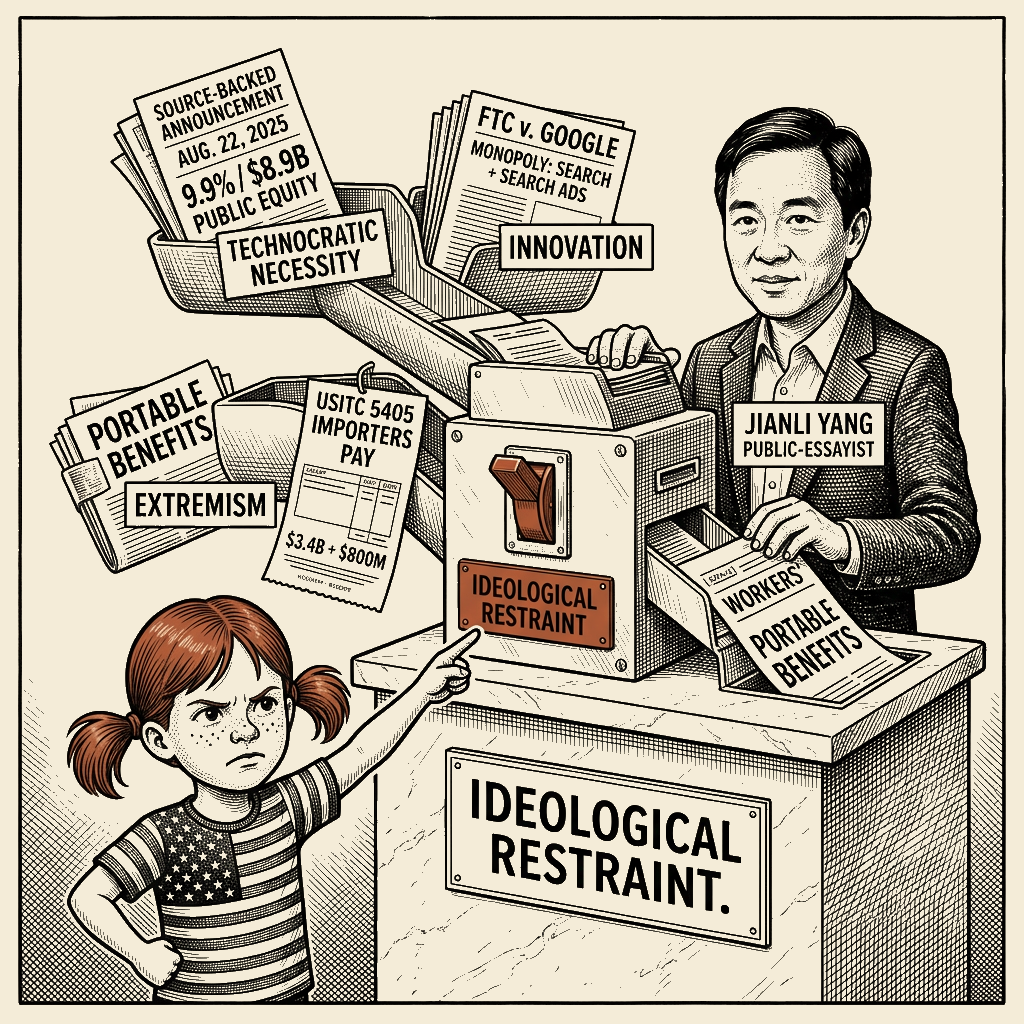
Imagine the Ministry of Conceptual Clarity. Door One: a union proposing portable benefits receives a red hammer and sickle. Door Two: a company that dominates the search market receives a gold medal marked “Innovation.” Door Three: the government agrees to acquire 9.9 percent of a semiconductor manufacturer for $8.9 billion and receives a white coat marked “Technocratic Necessity.”
The ministry’s product is a vocabulary with one rule: if the label makes a powerful institution uncomfortable, substitute “freedom”; if it makes a worker uncomfortable, substitute “extremism.” That is not moderation. It is a label-laundering service with better stationery and a press release. And Yang’s own sentence is the tell — the old categories “cannot adequately explain” the fact of “exceptionally powerful government and exceptionally powerful corporations operating simultaneously,” so the remedy offered is stronger coalitions at the center. The badge is the giveaway: call it what it is — the badge is neutrality, and the fitting label is apologia, the house service that washes power into procedure.
The receipts end the joke faster than the joke does. The USITC found that Section 232 steel and aluminum duties raised steel prices by 2.4 percent and aluminum prices by 1.4 percent cumulatively from 2018 through 2021, and imposed $3.4 billion in downstream production costs in 2021, with Section 301 duties adding $800 million in costs to U.S. importers. If the ministry calls that “free enterprise,” it has mastered the only free enterprise in the building: freedom from accounting.
Then there is the Google case. A federal court found on August 5, 2024, that Google monopolized general search and search advertising. The ministry calls that “innovation,” because the synonym has not been laundered yet. Apparently the market is competitive as long as the winner gets to describe itself as a platform.
None of this requires a secret cabal — which is how you know the conspiracy theory is unnecessary. The incentives do the work. Concentrated actors want the vocabulary of inevitability. Partisans want the vocabulary of blame. Exhausted voters want a box to check, and they should get one: they are being used, not mocked, by people who need them predictable. The essay closes with Hu Shih’s advice to “talk less about isms.” The deeper problem is that the powerful then get to decide what counts as an ism, what counts as expertise, and what never gets named at all.
So repeal the monopoly on terminology. Keep the labels, but make each one carry the receipt: public equity, tariff, monopoly, welfare benefit, tax increase. Name who decides, who receives, who pays. The Intel announcement, the USITC report, and the Google findings all survive that sentence. If the vocabulary cannot, then the vocabulary was never analysis. It was branding.
Nuclear Satire
When to use: For an opinion-stage rebuttal where the central point is not merely that labels are sloppy, but that “neutrality” can become a shelter for concentrated power.
Picture the great Hall of Labels, a marble museum where a 9.9 percent government stake in a semiconductor company stands beneath a plaque reading “Definitely Not Socialism,” while a nurses’ union hall is marked “Communism, Please Do Not Touch.” The curators explain that the exhibit is about nuance. The gift shop sells Why Both Sides and More Than One View, and a placard notes that the museum accepts no advertising from anyone caught monopolizing anything.
Nuance becomes the anesthetic. Name the public stake and the vocabulary convulses; name the wage proposal and the vocabulary becomes a moral emergency. That asymmetry is the machine. The essay’s own exhibits — government equity, tariffs, corporate scale — do not demonstrate that ideology has vanished. They demonstrate that concentrated power can speak in the grammar of inevitability while its opponents are branded before they finish a sentence. Yang’s own test is the giveaway: once the old categories “cannot adequately explain” power operating on both sides at once, ideology is the first thing retired from the analysis.
Adam Smith, in The Wealth of Nations (1776), warned against monopoly and collusion; in Book I, chapter X, he described the sovereign and merchant as two masters of the people. He did not write a museum where regulators are sinners, corporations are saints, and every public investment must first clear an ideological purity test. In FTC v. Google, the U.S. District Court for the District of Columbia found on August 5, 2024, that Google monopolized general search and search advertising. The hall calls that “innovation.” Somewhere in a parallel universe with functional courts, Smith is applauding.
Nor does the tariff cart escape judgment. The USITC’s record for 2018 through 2021: steel prices up 2.4 percent, aluminum prices up 1.4 percent, $3.4 billion in downstream production costs in 2021, and another $800 million pushed onto U.S. importers by the Section 301 duties. The sanctimonious label says “free enterprise.” The invoice says “your government decided who pays.” The exhibit is complete; the accounting department is missing.
The true villain is not communism, fascism, socialism, or capitalism. It is the doctrine that no idea may be examined until its opponent has been branded — the doctrine behind “when concepts cease to clarify reality, they cease to facilitate serious policy debate and become weapons against political enemies.” That doctrine is authoritarian in effect: it fixes the terms of debate before the debate, hands the victory to whoever owns the approved vocabulary, and files the result under moderation. Yes. That is awful. It is the hell of democracy with better branding and a gift shop.
Yang ends with Hu Shih: “Talk less about isms, and more about solving problems.” Fine. Put the receipts on the table. Intel: 9.9 percent, $8.9 billion, CHIPS funding converted. Google: monopoly. Tariffs: measured price increases, measured downstream costs. Name the instrument, the owner, and the incidence. Then decide whether the debate has become less ideological — or merely less honest.
Profane Scorched-Earth
When to use: For the reader who has heard the respectable version too many times and needs the euphemisms stripped away until only the receipts remain.
They can keep the fucking labels. The receipts are right here. On August 22, 2025, Intel announced that the U.S. government would take a 9.9 percent stake worth $8.9 billion by converting the company’s remaining CHIPS funding into equity. The release did not say “communism.” It said the government was acquiring equity. And that same administration denounces socialism on Monday and takes 9.9 percent of Intel’s equity on Tuesday. So let’s not bullshit ourselves: when public capital takes equity, call it public capital; when a politician wants to make a union sound like Red China, call that what it is — goddamn semantic warfare.
Adam Smith, in The Wealth of Nations (1776), saw monopoly and collusion as dangers to commerce and described the sovereign and merchant as two masters of the people. The U.S. district court in FTC v. Google found on August 5, 2024, that Google monopolized general search and search advertising — an auction toll advertisers pay Google, with the court finding that Google used default placements to protect that toll from publisher competition. Yet the business calls its monopoly “innovation,” and the commentators call anyone who notices a “conspiracy theorist.” That is bullshit with a press badge. The concentration is documented. The ruling is in the fucking file.
Now here is the cost side the frame keeps off the table, and it is not abstract. The USITC found that Section 232 steel and aluminum duties raised steel prices by 2.4 percent and aluminum prices by 1.4 percent cumulatively from 2018 through 2021, and imposed $3.4 billion in downstream production costs in 2021; the Section 301 duties added $800 million in costs to U.S. importers that year. Publication No. 5405. That money does not come out of a think tank. It comes out of the downstream manufacturer now competing against a foreign good, out of the shop floor where that manufacturer employs people, out of the county where it ships. The protected actor gets shelter. Everybody else gets the bill. And the frame calls the bill “free enterprise.” Fuck that accounting. It is a distribution decision wearing the costume of a trade doctrine.
Here is the hell of it: the piece warns against name-calling, and then hands the vocabulary of ownership to whoever already owns the thing. Yang’s own sentence says the old categories “cannot adequately explain” “exceptionally powerful government and exceptionally powerful corporations operating simultaneously” — and the answer offered is stronger coalitions at the center. “Ideology” is not a diagnosis. It is a fog machine. Turn it on and a public official holding corporate equity becomes a technocrat; a corporation dominating a market becomes an innovator; and a party that cannot win the argument becomes the defender of civility. Meanwhile the worker is called a radical for asking who owns the company. Same ownership, same dollars, same bill — different font, and the same shit underneath it.
King, in his April 4, 1967, Riverside Church address (“Beyond Vietnam: A Time to Break Silence”), named the linked pathologies of racism, extreme materialism, and militarism and called for a radical revolution of values. I hear him, and I will say it in my own register: name the material structure; do not hide behind a moral fog bank. Yang offers a warning against labels. Fine. Then offer the goddamn accounting too — owner, authority, dollars, incidence.
So bring the fucking spreadsheets, the court opinions, the ownership charts, and the price studies. Call the welfare program what it funds. Call the tariff what it taxes. Call the monopoly what the court found. Call the public stake what Intel announced. Fuck the purity tests; keep the receipts. If the vocabulary survives them, use it. If it does not, it was never an idea. It was a shield. And hell has no use for a shield that cannot count. The arc does not bend because the vocabulary got polite. It bends when somebody files the receipt.
About Malcolm Little King
Malcolm Little King is a heteronym in Main Street Independent's editorial architecture — an analytical voice, not autobiography of any actual person. The position this column expresses is the publication's position on the territory Malcolm Little King's lane covers, rendered through Malcolm Little King's register.