Responding to: REBECCA GRANT: Jensen Huang owes America an apology, and Nvidia owes investors answers — Rebecca Grant · 2026-11-09
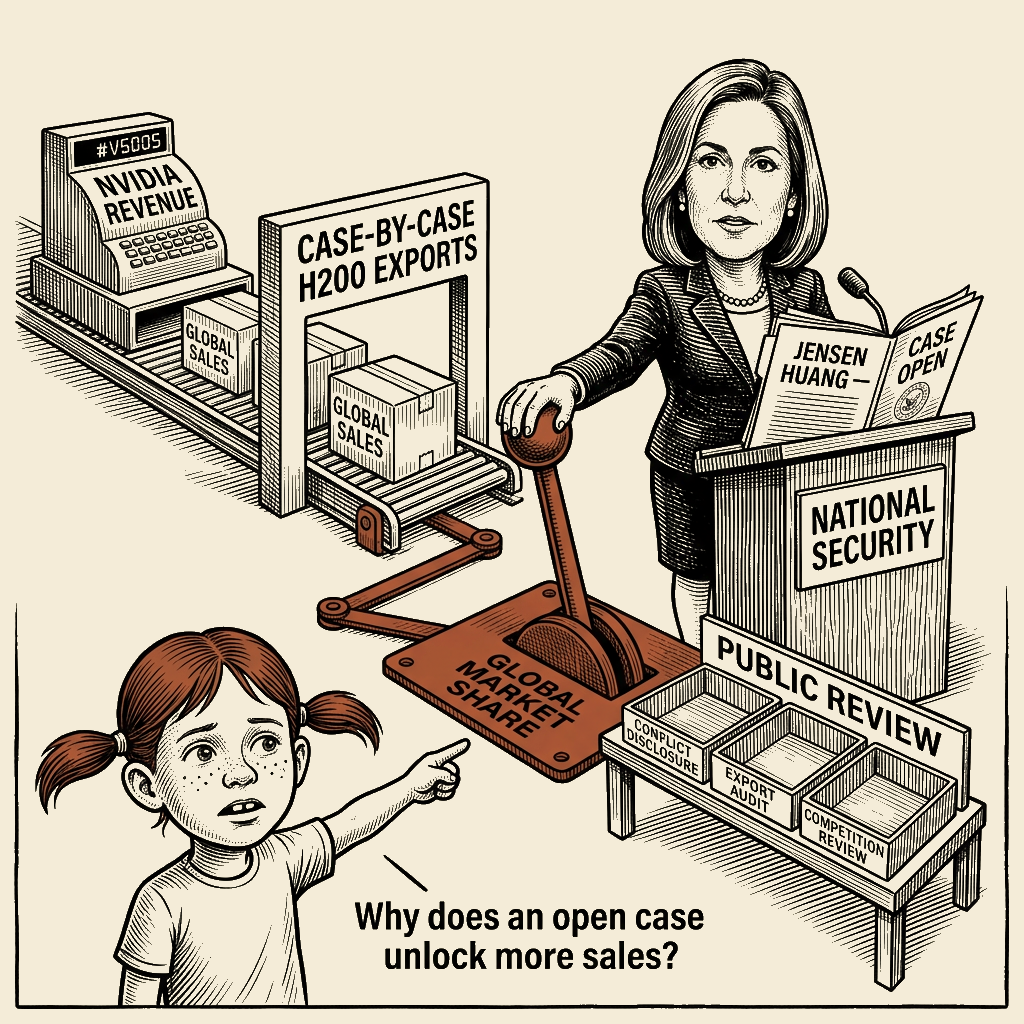
Why does an open case unlock more sales?
What the Piece Argues
The piece’s lead charge is blunt: “Frankly, Huang owes America an apology.” Its central policy claim is that “To win the AI competition, the U.S. must conquer global market share.” It argues that Jensen Huang’s admitted affair with Alice Huang—an executive whom U.S. intelligence reportedly suspected of being recruited by China—amounts to a national-security lapse by the head of a strategically indispensable chip company, and that the affair proves Xi Jinping will stop at nothing to threaten America’s AI lead. It also argues that preserving that lead requires a robust global operations-and-sales model for American technology, notes that Commerce may permit case-by-case H200 sales to certain Chinese firms, and says in its headline that Nvidia owes investors answers—though the body identifies an investigation without specifying what those answers or the investigation’s scope will be.
Receipts
The framing converts an unresolved corporate-governance and espionage inquiry into a license for concentrated technology firms to keep expanding global sales.
-
The framing wants you to believe
- Huang’s private relationship demonstrates that continued global reach is necessary to protect American national security.
- NVIDIA’s market share is a public good, and any challenge to its commercial power threatens the American AI lead.
- China is the explanation that shifts the proposed remedy from the unresolved Huang case toward the expansion of American firms’ global sales.
-
What’s really going on
- NVIDIA is the clearest beneficiary. Grant’s prescription is that “the U.S. must conquer global market share,” justified by global operations and sales that “generate the revenue to fuel innovation.” The piece also supports case-by-case H200 exports, whose current status remains externally unresolved (Rebecca Grant, Fox News Opinion).
- The evidence stops before theft. The piece reports an acknowledged relationship and an investigation, while attributing espionage claims to the New York Times and the Financial Times. It establishes no transfer of Blackwell information; it says, “Let’s just hope” the gift was diamonds. Its claim that NVIDIA holds “as much as 80%” of the advanced data-center AI-chip market remains unverified in the supplied record.
- The categorical claim has not answered its own burden. Before “must conquer global market share” can carry a national-security policy, it must identify the controls, decision-makers, and measurable test that connect additional sales to reduced risk. The supplied article does not.
The Response Ladder
Polite Reframe
When to use: For persuadable moderates, investors, and good-faith national-security voters; use when separating a real governance failure from the larger market-structure argument.
Before the market-share charts, there is Jensen Huang, a chief executive trying to explain to employees and shareholders how a private relationship became a corporate-governance and national-security problem. According to the piece, his Sunday message began, “You deserve better from me,” and NVIDIA opened an investigation. That is the concrete fact before us: NVIDIA is examining possible conflicts and disclosures while the public is asked to accept a sweeping national-security doctrine built on an unresolved case.
The reporting cited by Grant supports scrutiny, not a completed theft finding. Grant attributes to the New York Times the intelligence suspicion concerning Alice Huang and to the Financial Times her alleged boast about securing chips for non-American data centers. The supplied record does not establish that Blackwell information moved. The article’s own sentence—“Let’s just hope” the gift was diamonds—shows precisely where its proof stops.
The legitimate question is how to preserve innovation and security. The illegitimate leap is from “Frankly, Huang owes America an apology” to “the U.S. must conquer global market share.” A company cannot become immune from conflict, export, or competition scrutiny because policymakers have made it strategically useful. That would be private power wearing the public uniform.
We defend democracy by doing measurable work. The piece insists on a “robust base of global operations and sales”; a democratic strategy can defend that base while requiring executive relationship and gift disclosures, giving an independent board committee authority to publish material findings, auditing case-by-case export licenses, and opening competition review where indispensability is invoked as a shield. These are not insults to Huang. They are the standards we would insist upon when the company at issue has become indispensable.
Mockery and Ridicule
When to use: For a hostile or repetitive exchange where the source has already retreated from proof; use when the audience needs to see who benefits before hearing the argument again.
So the cure for a honeytrap scandal is to sell more chips overseas. Marvelous. One private relationship is now a national-security emergency, and the cure is a sales quota with an American flag taped to it. The article’s proof is “Let’s just hope” the gift was diamonds and not Blackwell architecture.
The piece says NVIDIA holds “as much as 80%” of the world’s most advanced data-center AI chips, although that figure remains unverified in the supplied record. Whatever the exact share, the political trick is visible: concentration becomes patriotic immunity. This is the boardroom patriotism of corporate absolutism—the traitor logic of private power masquerading as public service. If scale serves the national interest, the argument goes, no public official may ask whether scale itself has become a public danger.
Grant says global operations and sales “generate the revenue to fuel innovation,” and she points to the global networks and overseas investment of Amazon Web Services and Google as examples. Those are concrete benefits: sales contracts become revenue, revenue becomes corporate resources and shareholder value, and favorable export rules keep market access open. The article never names a pricing contract or export safeguard through which smaller rivals lose, so that cost cannot be treated as proven; it is the burden the categorical claim must answer.
The people repeating the line are not the joke. The boardrooms insulated by it are. The article wants “the U.S. must conquer global market share”; we defend democracy by publishing board findings, filing conflict disclosures, publishing export-license outcomes, and reviewing competition power. Let NVIDIA sell, build, and compete. Do not let market share become a state religion.
Nuclear Satire
When to use: For a high-conflict public exchange after the facts and beneficiaries have been established; use when the market-share framing itself, not merely Huang’s conduct, must be put on trial.
Welcome to the NVIDIA National Security Cathedral, where the altar holds a sales forecast, the organ plays “conquer global market share,” and every compliance officer is told that scrutiny is insubordination. The piece supplies the liturgy itself: “To win the AI competition, the U.S. must conquer global market share.” Grant also says NVIDIA holds “as much as 80%” of the world’s most advanced data-center AI chips, a figure the article does not support with an independent market-share methodology. The hardware has become theology; the quarterly target has become national security.
Then the evidence arrives like a flamingo in a cathedral: “Let’s just hope” that the gift was diamonds and not Blackwell architecture. Grant reports an admitted relationship, an investigation, and allegations attributed to the New York Times and the Financial Times, but the piece does not establish a transfer of chip information. Suspicion is not a security finding. It is a reason to investigate, disclose, and improve controls without making one man’s private conduct the proof text for an empire’s economic doctrine.
This is the patriotism of corporate absolutism: private power acting as a foreign power against democratic control. Grant’s rationale is that global sales “generate the revenue to fuel innovation,” so the article makes China the villain and the corporate incumbent the heroic host. That is how concentrated power hides inside national feeling. Yes, that patriotism is ugly: it preserves a company’s global position because the company has become strategically important, then uses that importance to shield the company from questions about executive conflicts, export controls, and market power.
A democratic strategy would do what the article never does: name the controls. Require conflict disclosures; give an independent investigation authority to publish material findings; audit case-by-case export licenses and publish their criteria; review competition power when indispensability is invoked as a shield. Grant demands a “robust base of global operations and sales.” A democratic strategy can defend that base without exempting its owners from law. We defend democracy with documents, hearings, and enforceable standards—not with market-share cheers for a company that has never been made accountable to the public.
Profane Scorched-Earth
When to use: For the reader who needs catharsis after the facts, framing, and beneficiaries have been made explicit; use when polite correction has failed to break the spell.
Here is the bullshit liturgy: “To win the AI competition, the U.S. must conquer global market share.” A man has an affair, NVIDIA opens an investigation, and suddenly the cure for private misconduct is more global chip revenue. “Let’s just hope” the gift was diamonds, not Blackwell architecture. Jesus Christ. That is not a national-security strategy; it is a fucking permission slip with a chipmaker’s logo on it.
The piece says NVIDIA has “as much as 80%” of the advanced data-center AI-chip market, but it supplies no methodology for that number; external verification is unresolved, so the figure cannot be treated as independently verified. Grant also says global sales “generate the revenue to fuel innovation” and supports case-by-case H200 exports. The benefit path is concrete: global sales contracts become revenue; revenue becomes corporate resources and shareholder value; and the Department of Commerce’s case-by-case licensing decisions can keep market access open. The benefits are concrete. The article’s proof of the danger is a hope sandwich.
That is corporate patriotism with the traitor logic of a foreign power: private authority treats itself as sovereign and the public as the enemy. We have an admitted relationship, a corporate investigation, and allegations attributed to the Times and Financial Times; we do not have proof that Blackwell information moved. The article knows the difference—it says “Let’s just hope”—then acts as though the scandal has already proved the wisdom of market-share worship. That is how power launders its appetite through fear.
We defend democracy, goddamn, by making power legible: disclose executive relationships and gifts; let an independent board committee publish material findings; audit case-by-case export licenses and publish the criteria and outcomes; and review competition power. Malcolm X’s December 3, 1964, Oxford Union address centered the struggle on who gets to define the terms of power. A chip company does not get to define national security by itself.
Amos 5:24 demands that justice roll down like waters. The article wants revenue to roll toward the vendor while the unanswered security and governance questions roll toward everyone else. Fuck that. Investigate Huang. Publish the board’s material findings. Audit the exports. Examine the market power. Keep the receipts. Ask who benefits. Then make the structure answer the public.

About Malcolm Little King
Malcolm Little King is a heteronym in Main Street Independent's editorial architecture — an analytical voice, not autobiography of any actual person. The position this column expresses is the publication's position on the territory Malcolm Little King's lane covers, rendered through Malcolm Little King's register.