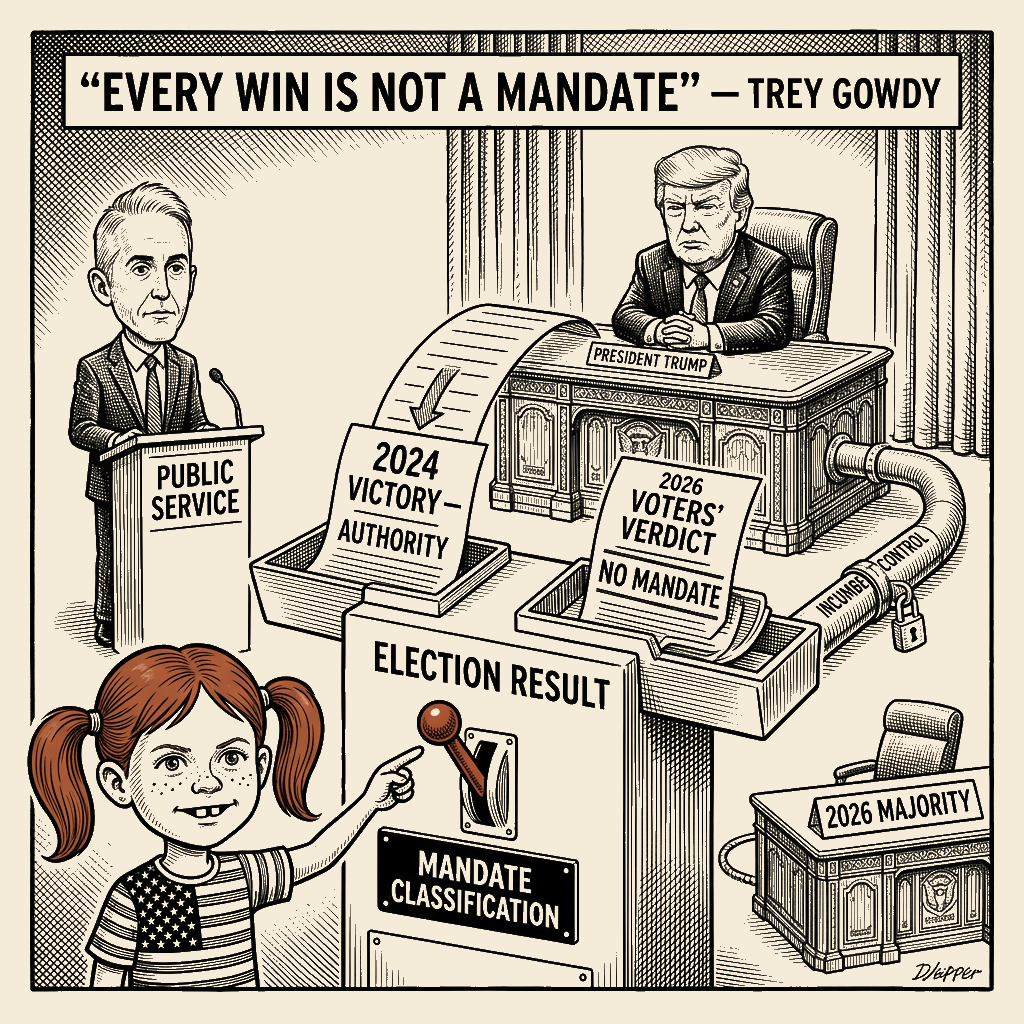
Responding to: TREY GOWDY: The midterms were a painful lesson that Republicans can't skip learning — Trey Gowdy · 2026-11-07
Why does one win count and the other doesn’t?
What the Piece Argues
The piece treats the 2026 midterms as a punishing defeat for governing Republicans and attributes it to the unpopular Iran campaign, higher gas prices, perceived corruption, and a governing style of “fits and starts”; its central instruction to Republicans is to replace the wrong candidates and “show up for class.” It argues that the Iran operation, although unpopular, was correct, and that President Trump’s 2024 victory supplied a mandate on border enforcement, the removal of violent offenders, affordability, and public service rather than a blank check for every policy. It closes with a warning to Democrats: their victory did not necessarily constitute a mandate, because voters may simply have disliked the other team less.
Receipts
The framing protects incumbent power by turning democratic accountability into a seminar in candidate management.
The framing wants you to believe
- That “winning does not equal a mandate”; electoral victory is merely evidence that voters disliked the other team slightly less, not authority to pursue a governing program.
- That the Republican losses chiefly exposed candidate quality, advertising, and political disorganization—not a governing record requiring a change of policy or personnel at the top.
- That the Iran campaign can be judged on correctness rather than popularity, while the 2024 result supplied a usable mandate on border enforcement and the removal of violent offenders.
What’s really going on
- The legitimate half is that no election is a blank check. The suppressed half is that an election still chooses who holds office and makes that person responsible to the voters. Elections vest legislative authority and set the terms of office under the U.S. Constitution, Article I and the Twentieth Amendment; elections are therefore neither unlimited warrants nor meaningless gestures.
- The beneficiary is the incumbent executive and the executive agencies, which retain control of foreign policy, immigration enforcement, rulemaking, appointments, and budget requests when an electoral defeat is recast as a candidate problem. The incoming majority is told to treat its own victory as morally and politically insufficient. No dollar transfer is established here; the concrete benefit is retained power and the avoidance of an electoral correction.
- The omitted record is measurable. The EIA reports that roughly 20.9 million barrels per day passed through Hormuz in 2023, about one-fifth of global petroleum-liquids consumption, while the principal bypass pipelines had combined capacity of about 6.8 million barrels per day—less than one-third of normal Strait flows. The War Powers Resolution requires a report within 60 days after hostilities are introduced and gives Congress the power to terminate hostilities or authorize their continuation through a joint resolution. The piece says there was “no war with Iran” while describing strikes, a rescue, and a blockade, then provides no public price series, polling data, or legal analysis to close either question.
The Response Ladder
Polite Reframe
When to use: For the good-faith neighbor, cousin, or colleague who heard the line and repeated it without malice; use it when the receipts should do the work and the relationship should survive.
Take Denise, a composite hotel-room cleaner outside Columbia, South Carolina. She has watched gasoline prices rise, heard politicians call the Iran campaign “unpopular,” and heard the people who selected the next Congress described as winners who had not really won anything. She has also heard the men and women “cutting the lawns, cleaning the hotel rooms and working in service industries” praised as people entitled to “fundamental humanity.” She is not asking anybody to hand her a blank check. She is asking why the people who made the decisions must be taught from defeat, while the people who beat them are instructed to apologize for the vote.
The source’s sentence contains a true proposition: “Every win is not a mandate. Every mandate is not a license to do whatever you want, regardless of the issue.” No election is a blank check, and public office is not a reward for winning. But the piece makes a second move. It says Trump “easily could claim a ‘mandate’ on certain issues” in 2024—border enforcement, the removal of violent offenders, affordability—and separately defends the Iran campaign on correctness grounds. It then tells Democrats that their 2026 victory “simply means voters hated you slightly less than the other team.” Those are not identical electoral questions, and the piece never explains why one result supplies usable political authority while the other supplies only an apology. The quiet inversion is structural, not personal: the public-service badge becomes the incumbent’s shield.
The receipts sharpen the point. The EIA’s Hormuz data establish global market exposure—not that Denise’s gasoline physically crossed the Strait and not that any named exporter received a settled windfall. Still, the source itself places “blockades of the Strait of Hormuz” beside “higher gas prices” and then leaves the connection unexamined. That omission requires contemporaneous price, flow, and contract evidence. The legal omission is equally plain: 50 U.S.C. § 1541(c)(2) requires a report within 60 days after hostilities are introduced, while § 1541(d) gives Congress the power to terminate hostilities or authorize their continuation through a joint resolution. Whether the described operations meet the statute’s definition requires official facts and legal analysis. “There was no war” cannot answer a constitutional question merely by declining to name it.
There is an honorable version of the article’s argument, and it should not be diluted. Office is public service; money must not buy policy; a vote must not legalize abuse. But public service means more than a flattering word for incumbents. As Matthew 25:31–46 makes plain, power is measured by what it does for the person with the least power. The measurable alternative is not another slogan: publish every vote and financial disclosure, make recusals and lobbying contacts searchable, enforce the rules, and require the people holding office to answer in public for what they did with it.
The same principle governs immigration. The piece asks that workers be treated with “fundamental humanity” while celebrating the removal of “violent offenders deported without delay.” Those claims can coexist only if the rule is applied honestly. Employers who hide workers, suppress wages, or exploit immigration law are the criminals in that chain; the workers deserve enforceable labor rights and a path to legal status. “Enforce the law against the boss” is not a radical substitute for policy. It is what law enforcement looks like when the law stops being aimed at the worker.
So: every win is not a mandate—true. No mandate is a license—also true. The remaining duty is to count the votes without worshipping the winner. We are the builders. We build institutions that can be inspected, corrected, and voted out: public votes, public records, congressional authorization where the Constitution requires it, and no office large enough to make accountability optional.
Mockery and Ridicule
When to use: When the repeater has stopped arguing and started reciting; use it where the bystander needs to see who benefits from the line, without turning the dinner-table voter into the villain.
Picture the mandate doctrine as a coat check. The election returns with a landslide, the crowd is on its feet, and the man at the door says, “Great turnout. No mandate. The coat check is still mine, and the fellow already inside is not leaving because you won a vote.” That is not restraint. That is a coat check with a policy department.
The badge is the humble public servant. The inverted label is the corruption-preserver. That label is awful not because it reads a person’s soul but because it names the conduct: turn electoral defeat into a lesson in advertising, preserve the office and the apparatus behind it, then call the preservation “public service.” The voter who repeated the sentence is not the corruption-preserver. The voter was handed the sentence by the people who profit from it. The target is the officeholder who gets to decide whether the voters’ verdict counts.
Receipts, because jokes should have invoices. The EIA says the Strait carried about 20.9 million barrels a day in 2023—roughly one-fifth of global petroleum-liquids consumption—while the bypass capacity was about 6.8 million barrels a day. The article says “blockades of the Strait of Hormuz,” says “higher gas prices,” and never gives us a price series connecting them. That is not a denial of the oil-market mechanism; that is a refusal to show its homework. Meanwhile, 50 U.S.C. § 1541(c)(2) requires a 60-day report and § 1541(d) gives Congress the joint-resolution procedure for terminating or continuing hostilities. The column’s “There was no war with Iran” is an impressive sentence for keeping Congress outside the room.
Then comes the curriculum: “Losing can teach you. But only if you bother to show up for class.” The class meets Tuesday. The syllabus is better candidates, better ads, less self-enrichment, fewer “fits and starts,” and a solemn promise to blame the right people. The policy is untouched. The chokepoint is untouched. The operation remains correct because “being unpopular and being incorrect are two different things.” George Lucas put the larger danger in 2005: “Democracies aren’t overthrown; they’re given away” (Chicago Tribune, 2005). Here democracy is not being overthrown. It is being taught to call its own verdict inconclusive.
And do not mistake the joke for contempt for the person who repeated the line. The voter voted. The voter received the bill and the alibi in the same envelope. The people at the top of the building are the ones who made electoral accountability sound like a seminar in self-correction. We are the builders. We build where the receipts can be read, where Congress cannot be edited out of the sentence, and where a voter’s verdict is either meaningful or it is not.
Nuclear Satire
When to use: When the frame has become the room’s wallpaper and the audience needs to see the machinery burning; use it where outrage is permitted but every heat must remain attached to a receipt.
Meet the Department of Mandate Denial, an infernal bureaucracy housed in a file cabinet that opens only from the inside. Its founding charter is one sentence: “Every win is not a mandate.” It has received no appropriation, has never been audited, and cannot be defunded because the losers pay for it. Its seals include a coat check, a gavel filed under “miscellaneous,” and a stamp reading “MANDATE PENDING.” The department’s official posture is humility; its actual function is to convert every result into a clerical problem for whichever side currently holds power.
The Department has two scales. On one, Trump “easily could claim a ‘mandate’ on certain issues” in 2024. On the other, the 2026 winners merely inspired a public that “hated you slightly less than the other team.” One result is useful authority. The other is a shrug with a ballot box attached. The difference is not legal. It is institutional convenience. This is the corruption-preserver’s doctrine in ceremonial dress: defeat becomes candidate management, office becomes incumbency, and the public is told it has selected not a government but a temporary inconvenience.
The Department also maintains a War and Peace Bureau staffed entirely by people who have never read the statute. 50 U.S.C. § 1541(c)(2) requires a report within 60 days after hostilities are introduced; § 1541(d) says Congress may terminate hostilities or authorize their continuation only through a joint resolution. Whether the reported strikes, rescue, and blockade satisfy the statutory definition is a question for official notifications and legal analysis—not a question that disappears because the columnist writes “There was no war with Iran.” Ronald D. Moore and David Livingston’s “Inter Arma Enim Silent Leges” (Star Trek: Deep Space Nine, 1999) stages Cicero’s maxim that in time of war the law falls silent. Here the law has not been silenced. It has been renamed “hostilities,” moved to a basement, and assigned a number nobody wants to read.
The Department’s Petroleum Wing is more straightforward. It puts “blockades of the Strait of Hormuz” in one paragraph and “higher gas prices” in another, then welds the two paragraphs with rhetorical glue. The EIA reports that about 20.9 million barrels per day crossed the Strait in 2023, roughly one-fifth of global petroleum-liquids consumption, while bypass capacity amounted to about 6.8 million barrels per day. That proves concentration and exposure. It does not prove which refiner, exporter, or household captured or paid a particular dollar. The Department does not need that receipt to expose its own practice: it praised the blockade and blamed voters’ pain without publishing the price record that might connect the two.
King saw this kind of problem as a structure rather than a mood. In his August 16, 1967 SCLC presidential address in Atlanta, he located racism, economic exploitation, and militarism in an intertwined arrangement and insisted that American life required structural change. The Department of Mandate Denial is exactly such a structure: a procedure that converts accountability into paperwork, makes elected officials responsible for every result except their own, and dresses permanent power in the ceremonial clothes of temporary humility.
We are the builders. We build a government that cannot hide its instructions: recorded votes, disclosed money, congressional authorization, published prices, and an election result that means something before the winner learns to call it nothing. The Department of Mandate Denial may keep its coat check. The rest of us are going home.
Profane Scorched-Earth
When to use: For trusted, closed-thread catharsis after the receipts are established; not for trying to persuade a stranger.
Here is the fucking alphabet of the new Republican platform: G for gas prices, C for corruption, W for war, O for “no one was listening,” and R for replace the candidate. That is the whole damn product: fresh face, same policy, new tote bag. The article itself supplies the slogan: “With the right candidates” those states can turn red again. The “right candidate” is the decadent/corruption-preserver’s ceremonial mask—and the inversion fits because the machine preserves the agenda by swapping the face. A corruption-preserver is ugly precisely because he makes accountability look like a personnel problem.
Now compare that shit with the receipts. The same column says the Iran campaign was unpopular, voters saw “higher gas prices,” and people felt “perceived corruption” and “no one was listening.” A campaign that answers those facts with a personality contest is not serious; it is a fucking escape hatch. This is political fraud with better lighting: change the star, keep the script, and collect another round of money.
The voter is not the fucking problem. The machine is. The Republican National Committee, state party organizations, candidate committees, and donor networks can preserve access to the next nomination while a new face absorbs the punishment. The inversion fits because the decadent/corruption-preserver does not repair anything; he recycles blame. So goddamn do not let the rank-and-file voter be blamed for refusing to vote for the same policy under a different name.
“Every win is not a mandate,” Gowdy says. Correct. But a mandate is not permission to govern for nobody. Amos 5:24 asks that justice roll down like waters; this platform wants the fucking water to stop at the ballot box. Every mandate carries a duty, and the duty is to answer the people who granted the office. Power that hides from receipts does not deserve the public’s confidence.
So goddamn stop swapping mascots. We are the builders: we publish the costed agenda, we disclose the money, we name the votes, we post the wage and household-cost scorecard, and we let the election judge the work. The source’s “right candidate” is not a fresh personality committed to preserving the machine. The right candidate is accountable to the people who already told that machine what it did wrong.

About Malcolm Little King
Malcolm Little King is a heteronym in Main Street Independent's editorial architecture — an analytical voice, not autobiography of any actual person. The position this column expresses is the publication's position on the territory Malcolm Little King's lane covers, rendered through Malcolm Little King's register.