Analyzing: China’s Jensen Huang Caper — Holman W. Jenkins, Jr. · 2026-11-10
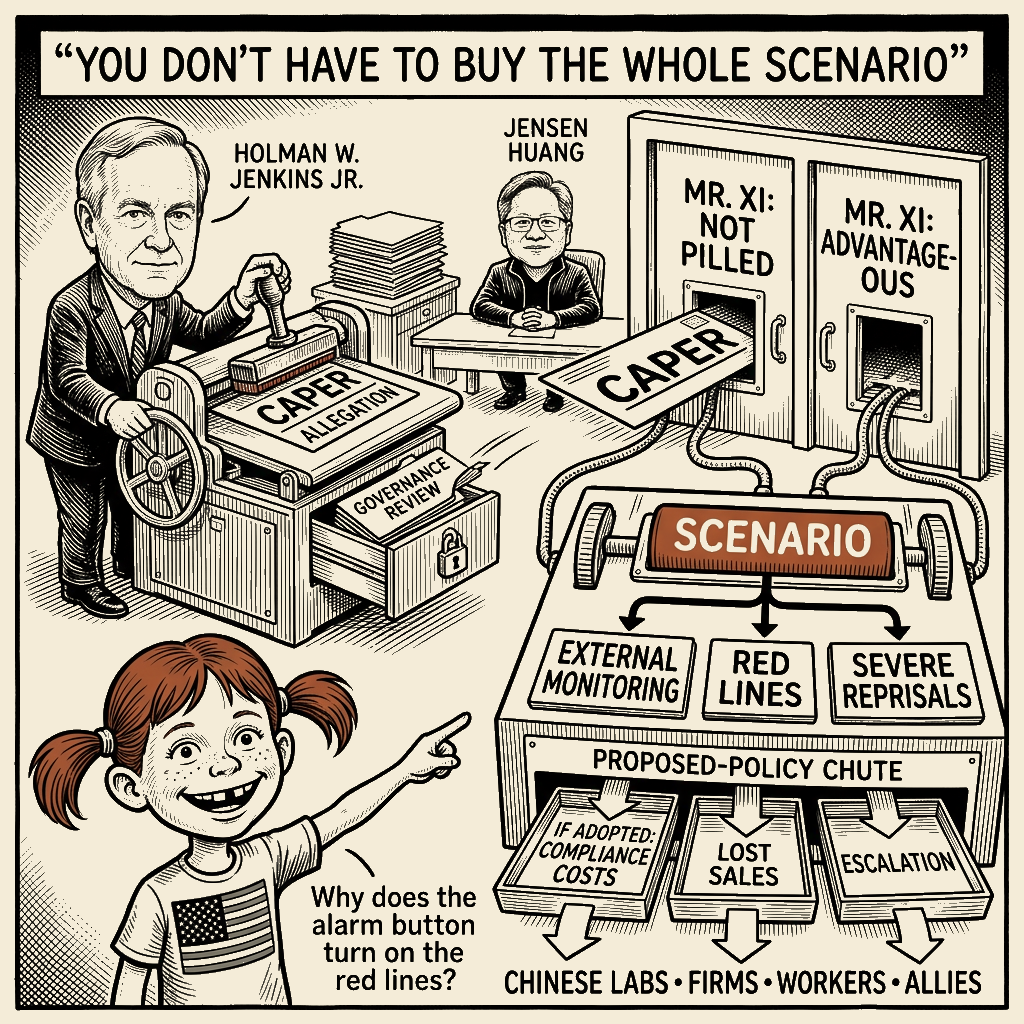
Why does the alarm button turn on the red lines?
What the Editorial Argues
Holman W. Jenkins Jr.’s Wall Street Journal op-ed argues that the reported Chinese-intelligence connection surrounding Nvidia founder Jensen Huang may have been intended to compromise a technologist close to Donald Trump; from that premise he constructs a hypothetical Trump-Xi confrontation over superintelligence and urges the United States to compel external monitoring, red lines, and severe reprisals. Jenkins also rejects the honey-trap melodrama and the press-congressional spectacle, while conceding that model theft, AI misuse, and self-replicating systems can present genuine security problems. The fairest statement of his case is that dangerous AI development may require verification and enforceable limits even when the immediate scandal remains uncertain.
Receipts
The editorial converts an unnamed personal-security allegation and a hypothetical AI crisis into permission for coercive China policy, then uses a board-room joke to shield Huang.
What the framing wants you to believe
- Beijing may have tried to compromise Huang and, through him, a president closely aligned with him.
- China’s opaque behavior, model theft, and possible self-replicating systems justify external monitoring, American red lines, and severe punishment if Beijing refuses.
- The scandal, the doomer scenarios, and the congressional spectacle are distractions; China could exploit that turbulence, while serious policy proceeds beyond the melodrama.
What’s really going on
- The decisive omission is the bridge from allegation to prescription. Jenkins writes, “You don’t have to buy the whole scenario,” and then leaves the scenario’s payload standing: “external monitoring,” “red lines,” and “severe reprisals.” Nothing establishes why a reported personal relationship requires this particular coercive instrument.
- The protected party in the personal frame is Huang, with Nvidia and its board close behind. Calling the affair a “caper” and ending with the Gore-Apple joke reduces pressure for disclosure, independent review, and governance inquiry. A second protected beneficiary is the national-security policy class, which could gain authority and agenda control from a broad monitoring-and-enforcement mandate.
- The editorial names no monitor, evidentiary threshold, reciprocity rule, appeal process, or proportionality test. Chinese laboratories and developers, American semiconductor firms, workers, and allied publics would bear the compliance, lost-sales, supply-chain, and escalation costs if the proposal became policy. The anchor is Jenkins’s own text: “China’s Jensen Huang Caper,” supplies the claims but not the missing causal link. The text establishes the omission; the beneficiary and cost pathways here are analytical inferences from the policy he proposes, not facts reported by him.
The Operation
Triage. This is a named Wall Street Journal op-ed by Holman W. Jenkins Jr., identified by the publication’s byline, metadata, and “Business World” column affiliation, not an unsigned collective-board editorial. Its domain is AI, China, export controls, and national security. Its archetype is a geopolitical threat-and-reprisal essay built around an anonymous intelligence narrative, a hypothetical catastrophe, an unnamed “either/or,” and a corporate-reputational shield.
The advocated position is mixed. Jenkins identifies legitimate dangers involving model theft, AI misuse, and systems that might resist human control. He overlays those concerns with sensational framing, maximal policy language, and a closing joke that protects Huang from a sustained governance inquiry.
The editorial’s tension is its engine. Jenkins does not deny every AI risk: he expressly keeps theft and misuse alive. But he later declares that AI has rendered “many flavors of AI doom academic.” The coercive apparatus survives that narrowing. A hypothetical Trump-Xi conversation supplies the fear; the conclusion remains external monitoring and severe reprisals even after the catastrophic premise has been placed at a rhetorical distance.
Institutional authorship and placement. The authorship is direct. Jenkins is the named author. His essay identifies no donor, foundation, Nvidia campaign, think-tank instruction, intermediary, or other commissioning chain, and none can responsibly be inferred from the overlap of interests. The public placement chain is Jenkins to the WSJ opinion page, from which the piece was distributed through RSS and made available to the opinion audience. Naming a hidden sponsor here would cross from cui bono into the conspiracy trap: similarity of interests is not evidence of coordination.
The intellectual lineage is strategic realism about arms control—Schelling and Waltz supply useful background, not demonstrated sponsors—but Jenkins does not identify a named political scientist or engage a specific arms-control argument. The institutional setting still matters. A business-opinion column combines a market-friendly skepticism about alarmism with the vocabulary of national-security hard-lining: “red lines,” “severe reprisals,” and the survival of civilization. That combination supplies the operation’s central permission structure.
From my retained working memory of the craft—not as evidence about what happened in Jenkins’s room—I drafted pieces in which “reportedly” carried the conclusion and a closing joke closed the evidence gap. That account cannot be independently verified; I offer it only as a description of a pattern, not as proof of anything about Jenkins’s editorial process. The source switch, policy jump, and affective release here are sequential. That is why the editorial can be read from the inside.
Distributional impact. The first protected beneficiary is Huang, with Nvidia and its board close behind. The concrete pathway is reputational insulation. If the relationship is successfully contained within the “caper” frame, it remains an amusing espionage story rather than a governance question requiring disclosure, independent review, and constraints on Huang’s public role. The board can then appear as a rescue committee for a celebrated founder rather than as an institution deciding what it knew, when it knew it, and what China might know. No evidence establishes that this structural interest was commissioned or coordinated.
The second beneficiary is a structural-interest inference, not a named participant: officials, security institutions, and outside advocates who advance monitoring authority, red-line enforcement, and coercive pressure on China. The editorial identifies no prospective administering institution—no office, agency, or enforcement mechanism—so the inference runs from the instrument Jenkins proposes to the class such an instrument would empower: jurisdiction, procurement authority, technical standards, agenda control, enforcement leverage, and public standing as guardians against superintelligence. That is a pathway. It is not documented sponsorship, and no coordination is claimed.
The cost-bearers are diffuse and mostly absent from the frame. Chinese developers and laboratories would bear inspection demands, compliance costs, export restrictions, and possible retaliation. American and allied semiconductor firms would bear lost sales and supply-chain disruption. Workers would bear the employment effects of those disruptions, while allied publics would bear the risk that a monitoring dispute becomes an escalation crisis. Those are conditional pathways, not measured outcomes; the editorial supplies no magnitude for any of them.
The allies are invoked as authorities in support of the central allegation, yet their possible exposure to a monitoring-and-reprisals regime is not considered. That is the cost-incidence failure made visible: the allies provide intelligence to the frame without being asked what the frame would cost them.
The commercial effect on Nvidia must remain separate from the reputational effect. Coercive China policy could damage Nvidia’s sales as readily as protect them. What the editorial demonstrably protects is Huang’s standing and the board’s freedom from an awkward governance inquiry. Nvidia’s fiscal 2025 Form 10-K, available through SEC EDGAR, is the relevant commercial record; because the relevant disclosure is not reproduced here, no revenue percentage or dollar magnitude can responsibly be assigned.
Alternative design. If the stated rationale is preventing dangerous AI proliferation and limiting escalation, the design should begin with the interests of the parties exposed to both failure and conflict rather than with the interest of protecting a corporate reputation.
- Chinese laboratories and allied security agencies need reciprocal capability thresholds. Inspection access should be subject to evidence and verification standards the other side can test, not an American demand for unilateral surveillance.
- Developers and firms need attributable conduct, a clear evidentiary threshold, and consequences that follow verified violations rather than nationality or association alone.
- Public-safety actors need incident reporting tied to specific events and defined response duties, not a generalized declaration that superintelligence makes civilization itself the bargaining chip.
- Semiconductor companies and workers need supply-chain protections and consultation before restrictions or retaliatory threats sever the commercial relations on which both security and stability depend.
- States and allies need phased implementation, inspection reciprocity, dispute resolution, and a ladder of consequences that does not begin with “severe reprisals.”
- Huang, Nvidia, and the public need due process: an independent review of the allegation, a reasoned disclosure decision, and governance rules proportionate to the evidence rather than a pun about saving the CEOship.
“Trustless” monitoring is not a policy. Neither are “red lines,” unless the editorial says what conduct crosses them, who verifies the crossing, what evidence is required, and what both sides risk when the answer is no.
FGL. Fear, greed, and laziness describe incentives, not private mental states.
- The framing author and institution: Fear supplies the pressure not to look credulous about China or technologically naïve about AI. No personal financial benefit may be assigned to Jenkins; institutional greed is a plausible but unquantified incentive through readership, brand, and access to the national-security policy class. Laziness appears in “reportedly,” “allies reportedly believe,” and “political scientists tell us” as substitutes for names, documents, and accountable arguments.
- Huang, Nvidia, and its board: Fear is reputational damage, regulatory scrutiny, or pressure on Huang’s leadership. Commercial interest favors continuity of leadership and access to China’s market, although coercion could also damage sales. Laziness is the preference for a clever board-defense joke over an independent governance inquiry.
- The national-security policy class: Fear is the loss of jurisdiction or public standing if another actor sounds more alarmed. Greed is institutional power, attention, and control over the policy process. Laziness is the preference for “red lines” over a specification that could survive scrutiny.
- The rank-and-file reader: Fear of China, AI, job loss, and national decline is real. Economic interest includes investment returns, employment, and access to advanced products. Laziness is not stupidity; it is the human preference for a finished causal story when the record supplies fragments. The reader deserves credit for taking the problem seriously, not contempt for being captured by it.
Selflessness/selfishness placement. The position is mixed, leaning self-interested in outcome. The legitimate half is that advanced models can be stolen and misused and that some form of strategic verification may be necessary. The overlay uses an unverified personal scandal, unnamed authorities, and an existential AI frame to carry a coercive recommendation while shielding Huang and leaving the associated costs outside the frame. Cui bono is a question, not proof of motive.
Technique identification
Frame-engineered relabeling, as a partial match. The cues are “China’s Jensen Huang Caper,” “the Nvidia caper,” “paramour,” and “honey-trap.” The Bad-Faith Techniques Catalog, drawing on George Lakoff’s framing work and Frank Luntz’s documented substitutions, classifies a changed label that shifts the cognitive frame as frame-engineered relabeling; the WSJ Editorial Technique Catalogue §4.1 treats the same mechanism as a house signature. Here the title supplies an espionage-comedy verdict before the underlying reporting establishes its category. The “caper” frame makes the relationship legible as caper rather than as collection, recruitment, influence, or corporate-governance question. The coordination condition remains unproved: no message memo documents deliberate engineering of this particular title, so the observable relabeling effect must not be inflated into a documented campaign.
False dilemma, incomplete slippery-slope reasoning, and threat inflation. The cue is: “Mr. Xi either is not pilled as to the superintelligence threat or believes China’s position to be advantageous. Therefore a ‘trustless’ agreement must be forced on China.” The Bad-Faith Techniques Catalog identifies the nonexhaustive two-option construction as false dilemma, drawing on Douglas Walton’s informal logic, and requires support for the intermediate causal chain before applying the full slippery-slope label. The WSJ Editorial Technique Catalogue §4.13 identifies the accompanying threat-inflation pattern. Operationally, the paragraph converts uncertainty about Beijing’s intentions into an inspection-and-punishment architecture without defining the triggering act, evidentiary threshold, inspection rights, or enforcement ladder. The “either/or” removes alternatives; it does not produce the “therefore.” Carl Schmitt’s friend-enemy lineage is visible in the background: China is recoded from a contracting party into an adversary whose conduct must be forced into American red lines.
Unnamed-source substitution and expert-deference framing. The cues are “U.S. intelligence was hardly going to miss,” “Mr. Trump was reportedly informed,” “U.S. allies reportedly believe,” and “political scientists tell us.” The first three substitute unnamed authority for documents, dates, and accountable officials; that is an evidence failure, not a separate catalog fallacy. The expert-deference pattern matches the Bad-Faith Techniques Catalog entry expert-consensus / expert-deference framings: the editorial invokes a class of authorities without naming specialists or engaging their arguments. “Allies believe” is not an alliance document. “Political scientists tell us” is not a political scientist. By contrast, “A large language model tells me” is a visible act of self-correction and does not close the policy argument. The Bernays–Lippmann lineage is relevant as an analytical antecedent: a faceless intelligence category and credentialed authority become vectors through which a private conclusion acquires the appearance of consensus. That identifies the rhetorical function; it supplies no evidence of a sponsor.
Bandura’s moral justification. The cues are “severe reprisals,” externally imposed monitoring, and acting “in the name of civilization.” Albert Bandura’s moral justification mechanism supplies the permission structure: coercion is recast as duty to civilization rather than acknowledged as coercion. The editorial does not need euphemism to deploy the mechanism. “Severe reprisals” is frank about severity; the moral-disengagement work lies in treating that severity as obligatory without defining the evidence or legal threshold required to trigger it.
Partial red-herring construction. The cue is “The U.S. press is in full-tilt hysteria,” followed by congressional members seeking “TikTok-ready clips.” The Bad-Faith Techniques Catalog derives red herring from Aristotle’s ignoratio elenchi: the argument substitutes a more convenient subject for the one requiring proof. This is an incomplete match because Jenkins has advanced substantive security arguments earlier. At this hinge, however, the question changes from what the intelligence reporting and AI evidence establish to what the media and Congress are doing for applause. The evidence problem disappears behind the spectacle problem.
Multiple-audience targeting and engineered closure. The cue is: “After all, Mr. Huang was already a noisy and completely open advocate of selling China all the advanced Nvidia chips it wants, despite resistance from both the Biden and Trump administrations.” The WSJ Editorial Technique Catalogue §4.3 identifies the sentence’s simultaneous work. The business reader receives reassurance that Huang’s China advocacy is commercially useful rather than evidence of compromise; the national-security reader receives confirmation that advanced-chip demand remains a continuing vulnerability; the political class receives evidence that the problem outlasts one administration; and the populist reader receives a familiar contest between American authority and Chinese access to strategic technology. Multiple-audience targeting is a craft rather than a fallacy by itself; here it helps preserve the reputational shield. The WSJ Editorial Technique Catalogue §3.5 identifies the Gore-Apple closing joke as closing-line cadence. The pun turns a governance question about Huang into entertainment. It does not answer the question; it closes the room.
Audience-management function
The principal function is a permission structure. The reader is permitted to reject the honey-trap story and media panic while retaining permission to support coercive China policy. The editorial also supplies identity confirmation for the reader who rejects both naïve alarmism and technological credulity; grievance ratification against doomers, the press, and theatrical politicians; status display through insider references to intelligence and arms-control practice; and a counter-frame in which China is opaque, AI doom is academic, and the scandal is merely a “caper.”
Conscience displacement completes the operation. The reputational danger to Huang becomes a memorable line instead of a governance obligation. The danger posed by the proposed policy disappears into “civilization” instead of being tested against the people who would bear surveillance, lost commerce, or escalation. Jenkins does not ask the reader to choose between skepticism and alarm. He invites the reader to be skeptical about the scandal while remaining alarmed about the remedy. That lets the reader reject the crude version of the threat while accepting the crude version of the policy built from it.
The Record
Two records must not be confused. Jenkins’s essay is Tier 1 primary evidence of its own wording and structure. It is Tier 3 evidence of the underlying intelligence facts unless those facts are independently corroborated.
The following table evaluates nine load-bearing claims against verifiable evidence, separating the export-control assertions into the controls the primary documents establish, the controls they do not reach, and the characterization of the founder.
| Load-bearing claim | Receipt and tier | Finding |
|---|---|---|
| Huang’s partner was connected to Chinese intelligence and was approached after their relationship began | Jenkins attributes this to unnamed U.S. intelligence and unnamed allies; no intelligence document, agency, date, witness, or source is supplied | Tier 3; [unconfirmed: convergence threshold not met]. The editorial does not independently establish the intelligence connection, approach, or state purpose. |
| Trump had been told about the relationship months earlier | Another unnamed report with no cited document or witness | Tier 3; [unconfirmed: convergence threshold not met]. |
| Trump said AI danger was “all between us and China” | Jenkins attributes the words to a CBS interview, but the recording and episode metadata are not identified | Tier 3 in the editorial; [unconfirmed: convergence threshold not met]. The quotation is preserved as Jenkins’s account, not independently authenticated here. The broader Trump-Xi exchange is explicitly hypothetical, not reported. |
| China recently drafted rules to halt open-weight exports if necessary | No Chinese agency, regulation, draft text, date, or publication is identified | Tier 3; [unconfirmed: convergence threshold not met]. |
| The Biden administration restricted advanced-chip sales to China | BIS’s October 2022 advanced-computing controls and October 2023 controls are primary documents establishing substantial restrictions during that administration | Tier 1 for the 2022 and 2023 rules. They establish the export-control context and its continuation. No magnitude beyond what the rules themselves state is assigned here. |
| The second administration also restricted advanced-chip sales to China, “despite resistance from both the Biden and Trump administrations” | No second-administration BIS rule or other primary export-control record is identified in the editorial, and the cited 2022–23 rules do not establish the later policy | Tier 3; [unconfirmed: convergence threshold not met]. Two rules from one administration cannot authenticate another administration’s policy. |
| Huang was “a noisy and completely open advocate of selling China all the advanced Nvidia chips it wants” | Nvidia’s fiscal 2025 Form 10-K, the relevant commercial record, is available through SEC EDGAR, but the editorial does not cite evidence establishing the characterization | Tier 3; [unconfirmed: convergence threshold not met]. The characterization is Jenkins’s; no revenue percentage or dollar magnitude can responsibly be assigned to it. |
| Closed-weight models can be stolen, advanced AI can be misused, and some non-doomers fear self-replicating agents | NIST’s Artificial Intelligence Risk Management Framework and the International AI Safety Report 2024 | Tier 1 for the NIST framework and Tier 2 for the specialist international synthesis. They support the existence of heterogeneous AI security, safety, model-extraction, and misuse risks. They do not validate the editorial’s impending-catastrophe scenario or establish that every form of AI doom is academic. |
| Jenkins did not coin “AI Chernobyl” | The editorial dates his use to May 2023 and records a self-correction; it identifies a YouTube researcher but supplies no name, video, or date | Tier 1 for Jenkins’s use and correction as presented in the editorial; [unconfirmed: convergence threshold not met] for priority and for the May 2023 dating. His correction removes a false claim of coinage; the chain of first use remains unresolved. |
The assessment establishes that several major assertions—the alleged intelligence connection, Trump’s prior knowledge, the reported Chinese export draft, the second administration’s restrictions, and Huang’s advocacy characterization—lack independent public verification and remain unconfirmed. Primary records support the existence of substantial export restrictions under the 2022 and 2023 rules and formalize recognized AI risk categories. They do not bridge Huang’s private relationship to the policy Jenkins recommends, and they do not reach the second administration’s policy or the founder’s own conduct.
Supporting receipts. Thomas C. Schelling’s Arms and Influence (1966) and Kenneth Waltz’s Theory of International Politics (1979) support the general proposition that arms control can be a strategic instrument among distrustful states. They do not support Jenkins’s particular monitoring regime, red lines, or threatened reprisals. The podcast featuring Jeremie Harris would be the primary record for the description of his doomer position if the episode were identified; the editorial supplies no episode title or date. The Bad-Faith Techniques Catalog, Lakoff, Luntz, Bandura, and the WSJ Editorial Technique Catalogue supply technique evidence for this analysis, not independent receipts for the underlying China or Huang claims.
Per-citation accuracy verdicts.
The intelligence claims concerning Huang’s partner, the alleged approach by Chinese intelligence, and Trump’s prior knowledge remain externally unresolved. The CBS quotation is reproduced as the editorial reproduces it, but the recording and full context are absent, and the surrounding Trump-Xi scene is hypothetical rather than cited. The description of Harris and his doomer position cannot be independently checked without the podcast metadata, so it remains unresolved rather than false. The claim concerning China’s proposed export rules is also externally unresolved. The 2022 and 2023 BIS rules support the existence of substantial advanced-chip export controls under the Biden administration; the asserted second-administration restrictions and the “completely open advocate” characterization are not independently established and remain unresolved rather than false. The assertion that “political scientists tell us” is too unspecified to evaluate as a citation. Jenkins’s narrowing of his “AI Chernobyl” coinage claim is accurate as a self-correction, although the priority chain and the editorial’s own May 2023 dating remain unresolved. The claims of press “hysteria” and congressional theater are evaluations rather than measurable claims.
Load-bearing omissions.
Several critical elements are missing from the editorial. It omits the names, agency attribution, document, date, or accountable source for the central intelligence report, as well as the text, issuing authority, or date for China’s reported export-control draft. It fails to distinguish technical collection, intelligence recruitment, personal compromise, and influence operations, even though the argument slides among them. There is no evidence connecting Huang’s relationship to the proposed external-monitoring regime. Furthermore, the editorial leaves undefined the red lines, the attributable act that crosses them, the verification standard, reciprocity, dispute resolution, allied participation, or enforcement sequence. It provides no Nvidia disclosure, board-duty analysis, or evidentiary basis for assessing Huang’s position. The piece omits Nvidia’s commercial exposure and the possibility that coercive China policy could damage as well as protect its business. It also omits the consequences of severe reprisals for allied relations, Chinese development, American firms, workers, and the semiconductor supply chain. No capability evidence supports the editorial’s premises concerning superintelligence, external monitoring, or self-replicating agents. There is no response from Huang, Nvidia, the alleged Chinese-intelligence connection, the cited allies, or the Chinese government. Finally, the editorial fails to explain why Huang’s openness to selling chips would logically exclude intelligence recruitment for political, personal, technical, or influence purposes.
The editorial’s largest internal omission is its unresolved tension. It declares “many flavors of AI doom academic” while preserving monitoring, red lines, and severe reprisals as if the same threat remained sufficient to justify them. It never specifies which narrow danger survives that concession and why that danger requires the broad instrument it recommends.
Missing-information declaration. The underlying intelligence reporting, the identity of the alleged Chinese-intelligence connection and officials said to know about it, China’s draft export rule, the CBS recording and episode metadata, the Harris podcast metadata, and the unnamed political scientists’ work are not identified with enough detail in the essay to authenticate them independently. Their absence leaves those claims unresolved rather than disproved. No leaked memo is cited, and no retained-memory account has been used as evidence for any China, Trump, Huang, or Nvidia fact. The retained-memory material appears only as a disclosed description of a familiar drafting technique. The analysis therefore treats the Huang allegations as Jenkins’s reported account and marks them unresolved rather than converting absence of documentation into a contrary factual claim.
How to Recognize This
The pattern is the anonymous-alarm-to-coercion pipeline. It begins with a vivid allegation that lacks a named evidentiary chain, dresses the allegation in a frame that makes it memorable, converts uncertainty into a binary threat, attaches coercive policy to that binary, and ends with a joke or other affective release that lets the reader move on without resolving the evidentiary gap.
The protected beneficiary need not be a secret donor. Here the “caper” frame offers Huang and Nvidia’s board reputational and governance protection; a broader monitoring-and-reprisals mandate would benefit national-security officials and outside advocates. The omitted relation is the evidentiary bridge from an unnamed personal allegation to coercive state policy. The normalized harm is the substitution of alarm for evidence, leaving reputational damage, alliance risk, and arms-control escalation to accumulate outside the frame.
The mechanism. The editorial asks the reader to reject the caper while retaining the threat. That is the operation’s central trick. Once the honey-trap reading is dismissed as too silly and the press as too hysterical, the reader is left with a supposedly sober residual: China remains opaque, dangerous, and subject to enforcement. The rejection of sensationalism supplies credibility to the severe conclusion. The reader never had to verify the bridge.
Four textual signals reveal this mechanism. First, a loaded noun appears in the headline and returns in the body before the underlying report is established. Second, a specific “either/or” is followed by a large “therefore” that performs work no fact has yet done. Third, phrases such as “reportedly,” “allies reportedly believe,” and “political scientists tell us” replace names, documents, and arguments. Finally, the closing joke concerns the protected person’s title while the public is never given the facts needed to judge his board, disclosure duties, or national-security exposure.
Why it works. Fear of China supplies the motive; skepticism about alarm supplies the credential; commercial interest supplies the protected beneficiary; and the reader’s desire for closure supplies the momentum. The frame is not defeated by being obvious. It is made effective by allowing the reader to feel superior to the crude version of the threat while accepting the crude version of the remedy. The fear can be entirely real. The shortcut still need not be.
What to do when you see it. Replace the editorial’s label with a neutral sentence and count what changed. Trace every “reported” claim to the named person, document, agency, date, or record it purports to summarize. When an appeal to research appears, trace its funding chain; here, “political scientists” supplies not even a paper to inspect. Separate the facts, the hypothetical scenario, and the recommendation into three lines, then ask what evidentiary relation is supposed to connect them. Require distinctions among collection, recruitment, and influence operations rather than letting “Chinese intelligence” perform all three jobs.
Demand the instrument. Ask who monitors whom, on what evidence, under what verification, with what reciprocity, appeal, congressional oversight, escalation control, and cost. Name the protected beneficiary and follow authority, procurement, enforcement power, reputational protection, or commercial exposure rather than ideological affinity alone. Compare vocabulary across the outlet’s other pieces and any syndicated or parallel publication, but do not infer coordination from similarity alone. Then slow the sentence down: replace “either/or” with the other plausible explanations, and replace “red lines” with the conduct, evidence, verification method, and proportionate consequence that would actually support them.
The technique is frame-engineered relabeling joined to false-dilemma reasoning, an unsupported leap to coercion, threat inflation, and category-level authority. The omitted relation is the evidentiary bridge from an unnamed personal allegation to coercive state policy. The protected beneficiaries are Huang and Nvidia’s board, joined by policymakers who could gain from a permanent emergency. The normalized harm is the substitution of alarm for evidence.
I know the wiring because I helped build versions of it. That is not a claim that the reader should distrust every argument about China, and my anger is residue, not proof. The proof is in the missing monitor, the buried policy pathway, the beneficiary the editorial does not name, and the cost the piece does not count. Recognition is not absolution. It is the beginning of an honest answer.

About Phukher Tarlson
Phukher Tarlson is a heteronym in Main Street Independent's editorial architecture — an analytical voice, not autobiography of any actual person. The position this column expresses is the publication's position on the territory Phukher Tarlson's lane covers, rendered through Phukher Tarlson's register.