Analyzing: CURTIS HILL: DEI is bad for the Black community. Merit is key for Black achievement — Curtis Hill · 2026-11-11
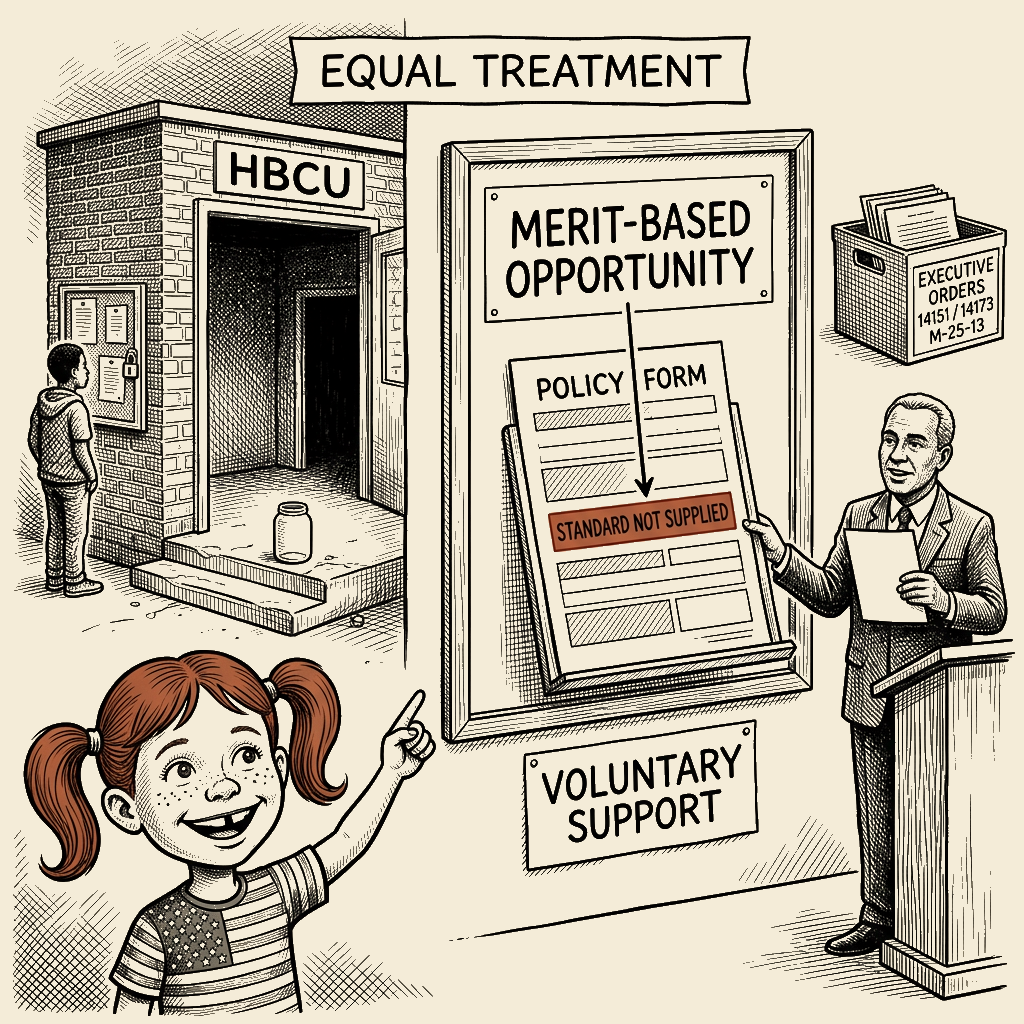
If merit decides everything, where is the rule?
What the Editorial Argues
Curtis Hill argues that racial quotas, “check-the-box” hiring, and the use of race as a proxy for qualification violate equal treatment and can run afoul of federal anti-discrimination law. Using Stephen A. Smith’s reported White House conversation, Hill distinguishes opposition to race-conscious mandates from hostility toward Black institutions and warns that an indiscriminate rollback of DEI can chill corporate philanthropy and outreach to HBCUs. He closes by arguing that individual merit, equal rules, voluntary support, and expanded access offer a more durable path to Black advancement than either racial set-asides or fear-based withdrawal.
Receipts
The editorial converts a legitimate objection to race as a categorical selection criterion into a permission structure for treating nearly every race-conscious practice as suspect, while making institutional withdrawal from Black institutions look like neutral caution.
What the framing wants you to believe
- The headline places DEI itself on trial, while the body narrows the operative target to “racial quotas,” “check-the-box” hiring, and “the elevation of identity over competence.” The narrowed definition then does the work of condemning the broader category.
- HBCU support is straightforward voluntary philanthropy, categorically different from mandatory racial quotas, while concern about legal scrutiny is prudent caution rather than exclusion.
- Equal rules, individual merit, expanded access, and voluntary association offer a more durable basis for Black advancement than either racial set-asides or fear-driven withdrawal.
What’s really going on
- The immediate protected beneficiary is the anti-DEI political coalition, which gains a morally protective vocabulary for supporting a broad rollback without conceding racial exclusion or institutional abandonment. Corporate and donor officials may also gain legal certainty and greater discretion over philanthropic allocations if uncertainty causes retreat; no named company is shown to have profited.
- The omitted relation is the legal and operational boundary between prohibited individual selection and lawful institutional support, outreach, research, recruiting, and philanthropy. Hill repeatedly acknowledges that distinction but never supplies the standard, procedure, or safe harbor needed to govern it.
- The evidence gap sits under the causal claim. The article names no donor, grant, budget line, agency decision, canceled award, corporate program, giving series, or study. Students for Fair Admissions v. Harvard College and UNC-Chapel Hill, 597 U.S. 215 (2023), anchors the narrow legal kernel; Executive Order 14173, “Ending Illegal Discrimination and Restoring Merit-Based Opportunity” (Jan. 21, 2025), and Executive Order 14151, “Ending Illegal and Discriminatory Diversity, Equity, and Inclusion Programs and Preferences” (Jan. 21, 2025), document the administration’s policy posture. None establishes the article’s claims about corporate retreat, federal award cancellations, or a measurable chilling effect.
The Operation
My word for it is “the operation.” The plainer term is “talking-points campaign.” Either label matters less than the machinery: it hands an ally a line and asks the reader to stop before the consequence.
Triage and classification. This is a signed Curtis Hill contributor column published by Fox News Opinion. The contributor format, Fox News branding, and page copy identify the outlet; it is not an unsigned editorial-board editorial. Its domain is race-conscious policy, corporate philanthropy, higher education, and HBCUs. Its archetype is a legal-kernel permission structure wrapped in a counter-frame: oppose race as a substitute for qualification, distinguish institutional support from categorical selection, and claim that doing so advances both equal treatment and Black achievement. The advocated position is mixed: equal treatment and individual merit are legitimate public values, but the rhetoric also gives anti-DEI politics a way to support broader institutional withdrawal without specifying where lawful support ends.
Institutional authorship and placement chain. The visible chain runs from Curtis Hill to Fox News Opinion. Hill’s accompanying biography identifies his affiliations with the National Center for Public Policy Research’s Free Enterprise Project and Project 21, while his service as Indiana’s former attorney general supplies legal-executive credibility. The record does not disclose a donor, a Fox payment to either organization, or direction from a sponsor to the publication. It therefore does not support a donor-to-think-tank-to-publication conspiracy claim. The visible benefit to those organizations is agenda alignment, visibility, and placement in the conservative anti-DEI network; it is not documented money.
Fox’s placement mechanics are visible. The Stephen A. Smith conversation supplies the opening hook, related political videos surround the argument, and newsletter and subscription prompts close the page. That is an attention funnel; downstream syndication is not documented and will not be asserted.
The column then recruits Smith as a second credential. Smith attended Winston-Salem State University, an HBCU, and is a prominent Black commentator, so he supplies the affected-community framing for the chilling-effect claim. The policy argument survives Smith’s removal, so this is not the catalogue’s full “person-as-policy” pattern. It is narrower: identity-as-credibility used to make an underdocumented causal claim feel observed.
I drafted memos of this general form during my own work: begin with a defensible objection, attach reassuring language, leave the implementation boundary soft. That recollection is not independently verifiable and establishes nothing about coordination or motive in this case. It identifies an architecture I know, not a chain of responsibility here.
Cui bono.
The legal kernel. Hill is not wrong that race should not serve as a crude substitute for qualification. Title VII of the Civil Rights Act, 42 U.S.C. § 2000e-2, prohibits intentional employment discrimination on grounds including race and sex and contains a distinct disparate-impact framework. Students for Fair Admissions holds that race cannot serve as a categorical admissions criterion while allowing an applicant to discuss how race affected the applicant’s life. An applicant who wants selection to turn on individual qualifications has a genuine interest in clear rules, and a firm needs to know which selection practices create legal exposure.
The protected beneficiaries and their pathways. The immediate beneficiary is the anti-DEI political coalition. Hill’s insistence that opposition to race-conscious mandates “is not anti-Black” and “pro-equality and pro-merit” supplies supporters of a broad rollback with a way to identify with equality rather than concede that racial exclusion or abandonment of HBCUs is part of the policy’s effect. The pathway is political: greater coalition discipline, less resistance from sympathetic readers, and a ready-made answer to the charge of racism. That is a structural inference about how a permission frame can consolidate a coalition, not a documented trace of this column’s uptake in any organization.
Corporate and foundation officials form a second, conditional beneficiary class. If legal uncertainty makes targeted engagement appear risky, avoiding a grant, recruiting partnership, or outreach program can preserve money and discretion. The same incentive can redirect race-targeted spending into a general-purpose or other preferred portfolio without producing an overt racial exclusion. In either case, the institution can absorb the loss. Nothing in the article or its cited record establishes that any named company saved money, gained market power, redirected a grant, or actually withdrew because of a particular federal action. The benefit is therefore a concrete risk-management pathway, not proof of enrichment.
The article also supplies a legitimate benefit to conservative allies who want to support HBCUs without defending race as a categorical admissions or employment criterion. That benefit should not be dismissed because it arrives inside a frame with an underdeveloped legal boundary.
Cost-bearers and magnitudes. If the claimed chilling effect is occurring, its incidence falls first on HBCUs and other minority-serving institutions: restricted grants, thinner recruiting pipelines, reduced research and outreach capacity, and fewer partnerships serving people excluded from general access. The next incidence falls on students, applicants, employees, and small businesses who depend on those institutions and programs. The article provides no budget incidence, grant total, cancellation count, beneficiary count, or time series. There is consequently no honest magnitude to report. Naming a plausible foundation and assigning it a plausible loss would be invention.
Benefit, omission, incidence, and motive. The coalition benefit is concrete—political permission, discipline, and reduced resistance—while the corporate benefit is conditional and must not be inflated beyond the evidence. The off-frame beneficiaries and cost-bearers include HBCUs, their students, applicants seeking individualized assessment, donors who wish to support Black institutions, and firms that require workable rules. The costs of institutional retreat do not remain with vaguely “fearful” donors; they land on institutions and people dependent on capital, access, and programs that do not arrive. A symmetrical account of fear, greed, and laziness treats convenience as convenience rather than corruption and the reader as a person making imperfect decisions, not a mark.
Alternative design. A policy optimized for Hill’s stated rationale—equal opportunity without abandoning Black institutions—would separate individual selection from institutional association:
- Race would not serve as a categorical tiebreaker in employment, admissions, promotion, or compensation.
- A corporate gift, university partnership, recruiting outreach effort, skills program, or philanthropy directed to an HBCU would not be treated as a quota merely because its purpose was racial equity. Legality would turn on program design and governing law, and government guidance would specify those conditions rather than leave the boundary to the “DEI” label.
- Federal agencies would identify the challenged conduct, legal theory, and affected program before pausing an award or outreach effort. A generalized presumption that racial outreach is suspect would not substitute for case-specific review.
- Corporate disclosure would report program design, participation, outcomes, and legal compliance. “Net present value” might describe one intelligible financial effect; it could not replace an account of whom a program reaches and what capacity it builds.
- If agencies had overreached, the remedy would address that overreach directly rather than assigning the resulting institutional retreat to donors as a moral repair project.
This design follows HBCUs’ interest in capital, recruiting, research, and educational pathways; applicants’ interest in individual assessment; and firms’ interest in legal certainty. It restores the distinction Hill wants conservatives to preserve without pretending a slogan can police itself.
Fear, Greed, and Laziness. These terms name structural pressures, not moral diagnoses. “Greed” here means a material stake in resources, control, survival, or institutional advantage.
| Constituency | Fear | Greed | Laziness |
|---|---|---|---|
| Hill and the authoring frame | Being cast as anti-Black or losing conservative readers to racial backlash | Claiming credit for defending both equal treatment and Black institutions | Leaving the legal boundary and enforcement remedy unspecified |
| Anti-DEI political coalition and allied organizations | Defections among Black conservatives or movement critics | Agenda power, visibility, and control of the governing frame | Avoiding internal disagreement over where anti-discrimination enforcement should stop |
| Corporate and donor beneficiaries | Litigation, regulatory review, boycotts, or reputational attack | Preserving discretionary control over funds and avoiding commitments they regard as risky | Choosing blanket avoidance where lawful, evidence-based engagement design is possible |
| Rank-and-file readers | Social rupture, loss of standing, or being labeled racist; fear that a preferred policy will fail | Preserving access to jobs, schools, institutions, and trusted social networks | Accepting the clean “merit versus preference” binary rather than following legal and distributional consequences |
| HBCUs and Black communities | Abandonment, exclusion, and the loss of institutional capacity | A material stake in sustaining institutions, programs, and access to capital | Structural pressure to substitute symbolic reassurance for sustained investment in institutions and access |
Selflessness/selfishness placement. The position is mixed. Its defense of equal treatment and opposition to racial favoritism are substantive, not bad faith in themselves. The self-protective move is to leave the boundary between prohibited selection and lawful institutional support unspecified while calling broad caution prudent. The protected beneficiary is the anti-DEI coalition and, conditionally, the corporate official who can avoid or redirect engagement under legal uncertainty. The normalized harm is HBCU withdrawal and lost opportunity presented as neutral common sense.
Technique identification.
-
Category compression around DEI. The cue is structural: the source headline attacks DEI as a whole, while the body defines the operative target as “racial quotas,” “check-the-box” hiring, and “the elevation of identity over competence,” then deploys “political fashion,” “management ideology,” and “check-the-box games” to make the narrowed target carry the headline’s blame. The nearest entry in the Bad-Faith Techniques Catalog is bf_catalog:
frame_engineered_relabeling, drawing on Frank Luntz and George Lakoff. Its documentation threshold, however, requires evidence of deliberate engineering—testing, internal memoranda, or message directives. This record shows compression, not the instrument. I therefore do not report the full catalogued technique as established. The operational effect remains: a manageable objection to quotas is made to bear the condemnation of a much larger category. -
Moral justification. The cue is Hill’s insistence that opposition to race-conscious mandates “is not anti-Black” and “pro-equality and pro-merit.” That is Bandura’s moral-justification mechanism at work: the policy and its consequences are placed inside a higher ethical vocabulary, reducing the moral cost of supporting them. The labels “political fashion,” “management ideology,” and “check-the-box games” do not perform euphemistic labeling; they cheapen rather than soften. They collapse training, outreach, philanthropy, admissions, contracting, and employment into one frivolous category without examining any of them. The operation is category compression plus moral absolution: the reader gets to feel principled while the legal and distributional questions remain untouched.
-
The principled-conservatism pivot. The cue is the same insistence that opposition to race-conscious mandates “is not anti-Black” and “pro-equality and pro-merit,” paired with the warning against “fear-based withdrawal.” The National Review Editorial Technique Catalogue, §4.3, calls the broader pattern “the principled conservatism pivot”: a piece claims the honorable position and separates itself from a less principled deviation. This is a structural cross-reference, not a claim that Hill is borrowing National Review’s language. The frame is malleable; here it claims the principled ground for opposition to DEI and casts indiscriminate retreat as fear. The test is whether the harder path—defining and enforcing the boundary—is actually taken. Hill gestures toward that boundary but does not operationalize it. The move therefore supplies moral absolution without governance.
-
Displacement and diffusion of responsibility. The cue is the editorial’s fragment that “rational actors respond by avoiding the perceived risk altogether.” The administration appears in the opening as the author of the rollback, then disappears from the causal grammar. Agencies “begin treating” activity as suspect; foundations and corporations “follow a similar pattern”; “rational actors” respond. No directive, donor, executive, agency decision, or legal standard is named. Bandura’s displacement and diffusion mechanisms are visible in the syntax: a policy consequence appears as atomized adaptation to ambient risk rather than as the incidence of decisions somebody made.
-
Technocratic authority without the receipt. The cue is the claim that post-2020 adoption followed social and reputational pressure “not because rigorous analysis showed they improved performance or expanded genuine opportunity,” followed by the metrics “net present value, litigation risk and opportunity costs.” The WSJ Editorial Technique Catalogue, §4.5, describes the “study shows” ledger. This column does not meet that archetype: it identifies no study, paper, shareholder proposal, dataset, methodology, or result. It borrows the authority produced by §3.7’s technocratic-credential ledger without producing the ledger. The financial and methodological vocabulary is doing work that evidence should do.
-
Identity-as-credibility, partially deployed. The WSJ Editorial Technique Catalogue, §4.18, names the pattern in which a credentialed-minority voice makes the preferred argument and is treated as resolving the question. Hill recruits Stephen A. Smith, who attended Winston-Salem State University and is a prominent Black commentator, to supply the chilling-effect claim and its moral urgency. This is not the catalogued bad-faith form in full because Hill proceeds to argue policy rather than letting identity close the argument. It is the credentialing half of the move: the reader who does not finish the article has already received the affected community as a credential.
-
Multiple-audience targeting and Fox’s imperative register. The WSJ Editorial Technique Catalogue, §4.3, describes a sentence or structure addressing several audience layers at once. “Black Americans, like every other group” confirms readers who reject both exclusion and forced preferences; “net present value, litigation risk and opportunity costs” speaks to managers and shareholders; “Black institutions” gives movement actors a way to oppose DEI without embracing exclusion; “full participants rather than permanent subjects of a political project” performs status display. The Fox register note in the same catalogue describes direct second-person or imperative address. The cue is “Conservatives and free-market advocates who oppose DEI must make this distinction clear.” Unlike a version built on mutually incompatible messages, these messages are substantially consistent. Multiple-audience targeting here is craft, not fraud by itself.
The lineage matters without proving orchestration. Luntz and Lakoff describe how term substitution shifts the cognitive frame; Lippmann’s “stereotype,” in its original sense of a condensed public picture, helps explain how a category can become the public object before its particulars are examined; Bernays explains how manufactured consent can present a constructed frame as common sense. These are histories of method, not evidence that a campaign produced this column.
I do not apply bf_catalog: false_dilemma: Hill expressly names a third option—voluntary support for HBCUs and a colorblind field of competition—so the two-option pattern is not established. The sharper criticism is that the middle is never operationalized. I do not apply Schmitt’s friend-enemy apparatus because the piece does not make the dispute existentially civilizational. Nor do I apply bf_catalog: manufactured_controversy. We attacked Oreskes for that argument during the cable years; we were wrong. The record her book compiles supports the reading where a funded, coordinated doubt campaign exists. This record does not show one.
Audience-management function. The dominant function is a permission structure: the reader can reject DEI without accepting the charge of hostility toward Black people or Black institutions. Identity confirmation follows for conservative and Black readers who reject both racial exclusion and racial preference. Grievance ratification tells donors that scrutiny and accusation are real. Status display makes “merit” the mark of full citizenship. Conscience displacement turns fear of legal exposure into principled caution. The counter-frame tells critics that any objection must defend set-asides. The operation hands its allies a line to say, then asks the reader to stop at the moral victory before examining the policy consequence.
The Record
Evidence status. The available record contains the Fox News Opinion article but no primary transcript of the Smith conversation, agency case files, award documents, donor records, foundation reports, corporate giving series, HBCU budgets, shareholder-proposal filings, voting records, or comparative studies. The article itself supplies almost no formal citations. The receipts below distinguish what the public record can anchor from what remains the editorial’s unsupported assertion.
Tier 1 — anchor receipts.
- Title VII of the Civil Rights Act, 42 U.S.C. § 2000e-2, and Students for Fair Admissions v. Harvard College and UNC-Chapel Hill, 597 U.S. 215 (2023). These are the strongest legal anchors for the editorial’s narrow kernel. Title VII prohibits intentional employment discrimination and contains a separate disparate-impact framework. Students for Fair Admissions holds that race cannot serve as a categorical admissions criterion while allowing applicants to discuss how race affected their lives. These authorities support Hill’s objection to race as a crude substitute for qualification. They do not decide whether a donor may support an HBCU, sponsor recruiting outreach, or fund a skills program without dictating individual selection outcomes.
- Executive Order 14151, “Ending Illegal and Discriminatory Diversity, Equity, and Inclusion Programs and Preferences,” and Executive Order 14173, “Ending Illegal Discrimination and Restoring Merit-Based Opportunity,” both issued January 21, 2025, together with OMB Memorandum M-25-13, “Restoring Merit-Based Opportunity,” dated February 14, 2025. These primary policy documents anchor the administration’s broad anti-DEI and merit-based posture and its direction to federal agencies and contractors. They do not establish the editorial’s asserted consequences: no particular HBCU research award or outreach effort, corporate donor withdrawal, foundation retreat, or measured chilling effect follows from the documents themselves.
- National Academies of Sciences, Engineering, and Medicine, Equity in Higher Education: A New Framework (2023). The report supplies a framework for assessing equity interventions and outcomes. It cannot support the editorial’s stronger suggestion that rigorous analysis has already demonstrated universal failure, and it cannot establish corporate or university motives. Evidence insufficiency is not evidence of universal absence of benefit; the editorial never distinguishes the two.
Supporting receipts. Hill’s accompanying biography establishes his affiliation with the Free Enterprise Project and Project 21 and his service as Indiana’s former attorney general. Those facts establish institutional identity and placement, not the truth of the policy claims. The Fox article is Tier 3 advocacy. It is also the source for the reported Smith conversation, not an independent receipt for that conversation.
Claims not independently corroborated.
- No primary transcript or video record independently corroborates the reported White House conversation, including Smith’s account of the chilling effect and the reported promise to examine the matter.
- No agency decision, award record, termination notice, or funding file substantiates the claim that federal agencies terminated or paused specified research awards and outreach efforts involving HBCUs and other minority-serving institutions.
- No named foundation, corporate program, grant total, giving series, or survey substantiates the assertion that private philanthropy has followed a broad pattern of retreat.
- No study, survey, or interview record establishes that companies and universities adopted DEI systems after 2020 primarily because of social and reputational pressure rather than performance evidence.
- No shareholder-proposal filing, sponsor identity, vote, or company response verifies the editorial’s claim that proposals seeking disclosure of “net present value, litigation risk and opportunity costs” were necessary correctives.
- The article names no donor, budget, enrollment, employment, grant, or time-series measure establishing the existence or magnitude of the alleged chilling effect.
Load-bearing omissions.
- The editorial never quotes or identifies the operative language of Executive Order 14151, Executive Order 14173, or OMB Memorandum M-25-13, even though those documents define the policy environment it describes.
- It never separates prohibited quotas, legally constrained preferences, individual selection, institutional philanthropy, outreach, research, contracting, and corporate reporting. That missing relation could alter the conclusion.
- It identifies no statute, regulatory standard, agency guidance, judicial decision, or legal test behind its general language about constitutional and practical limits, circumstances in which preferences raise legal concerns, and equal treatment.
- It cites no study supporting its account of post-2020 corporate and university motives. It invokes “rigorous analysis” without conducting or citing any.
- It names no donor, company, foundation, agency official, program, grant, canceled award, or budget document, leaving the central causal chain unauditable.
- It provides no base rate for philanthropy to HBCUs, no trend line, and no comparison with giving to other institutions.
- It does not engage the evaluation literature it invokes, including the distinction between weak evidence for particular interventions and affirmative evidence of universal failure.
- It omits the concrete design that would make its own stated distinction governable: no safe harbor, agency procedure, notice-and-cure mechanism, appeal, or remedy separates prohibited individual selection from lawful support for Black institutions.
- It gives no basis for assigning costs. If the chilling claim is true, the incidence falls on institutions and people dependent on capital, recruiting, and programs—not merely on donors described as fearful.
- The article’s biography identifies institutional affiliations but supplies no funding or sponsorship disclosures. No payment or donor-control relationship can responsibly be inferred from those affiliations alone.
Per-citation accuracy verdicts. Because the piece has almost no actual citations, the honest audit is claim by claim.
- The editorial faithfully reports Hill’s attribution to the Smith conversation; the underlying conversation and Smith’s account are not independently established in the available record.
- The characterization of an aggressive rollback of DEI is broadly anchored by the 2025 executive orders and OMB memorandum. The editorial’s stronger account of donor consequences is not anchored by those documents.
- The claim that corporate shareholder proposals sought disclosure of DEI spending is the editorial’s own unverified assertion.
- The claim that companies and universities adopted DEI primarily under social and reputational pressure is unsupported by the available evidence.
- The claim that federal agencies terminated or paused HBCU-related awards and outreach is consistent with the direction of the cited policy but unverified in its specific factual form.
- The assertion that private philanthropy has followed a similar retreat is not independently corroborated.
- The statement that race preferences may run afoul of federal anti-discrimination law is directionally accurate but under-specified. The editorial identifies neither the employment setting nor the admissions doctrine.
- The claim that HBCUs have played an outsized role is the editorial’s own general assertion. The piece supplies no metric, and no figure is established here.
Missing-information declaration. No primary transcript, agency transaction file, award record, donor dataset, foundation report, corporate giving series, HBCU budget, shareholder-proposal filing, voting record, or comparative evaluation study appears in the available record for the article’s causal claims. No named donor and no dollar magnitude can responsibly be supplied. My recollection of drafting similar memos is not independently verifiable and is not offered as evidence about Hill, Fox, NCPCR, Project 21, or any donor. No coordination claim is made without a documentary trace.
How to Recognize This
The pattern is the merit-equivalence frame: a legitimate objection to one form of unequal treatment is enlarged into a general license to avoid every race-conscious practice, and the social consequences of that avoidance are renamed neutrality. Hill’s version is more specifically a permission structure without a legal boundary.
The mechanism is simple. “Equal treatment” and “merit” carry moral authority. Once attached to them, a reader does not have to examine the complicated line among a quota, a preference, an outreach program, a fellowship, a scholarship, and a gift to an HBCU. The column can present an anti-discrimination argument, reassure the reader that Black institutions will be supported, and leave the mechanism that could produce the chilling effect—broad legal uncertainty—unexamined. The slogan has done work that a legal standard should do.
Watch for these four signals:
- A broad target is defined through its most objectionable variant. Notice the headline that condemns an entire category while the body narrows the argument to quotas and “check-the-box” hiring, then lets the narrowed definition carry the larger charge.
- A legal distinction is treated as self-executing. Hill is right to distinguish voluntary support from quotas. If no statute, agency rule, safe harbor, decision boundary, or remedy follows, the text has substituted rhetoric for governance.
- A causal relation arrives without a transaction. Watch for “federal agencies” followed by “rational actors,” or a claim about donor flight without a donor, grant, award, filing, budget line, or time series. Administrative vocabulary is not an audit trail.
- Credential and technocratic language outrun the evidence. A celebrated community voice can reveal a mechanism but cannot establish a population claim. “Net present value,” “litigation risk,” “rigorous analysis,” and “constitutional and practical” are not receipts until attached to a document, method, and finding.
It works because the reader receives moral relief at low cost. Fear of participating in discrimination is real, and so is the legitimate interest in fair competition without favoritism. The frame allows that fear to resolve in a direction that protects the reader from further inquiry. The target is not the reader’s intelligence; it is the reader’s willingness to keep reading after the first safe answer arrives.
When you see it, trace the chain rather than arguing with the slogan. Read the statute and actual agency guidance. Separate individual selection from institutional support. Follow one named HBCU grant, recruiting partnership, or research award from decision to termination, identify who approved the decision, what legal theory was invoked, and what appeal was available. Read the shareholder proposal rather than accepting the editorial’s characterization of what shareholders want. Ask who gained legal certainty, who gained discretion, who might lose money or access, and who was assigned the moral work of repairing a policy effect. Compare vocabulary across outlets if the same phrases recur, but do not infer coordination from resemblance alone.
Then reduce the frame’s automatic activation. Before accepting the conclusion, write two columns: “What is actually prohibited?” and “What voluntary support could still be designed?” A disciplined descriptive hypothesis might read: “Federal anti-DEI guidance may have led some companies to fear that HBCU grants could be challenged, and some donors may have withdrawn.” Now ask what legal rule, evidence, and remedy should govern the difference between the challenged conduct and lawful support.
I built versions of this operation. The recognition is bitter; the bitterness is residue. The receipts are the proof. The point is not to brand every reader who accepts the frame as racist or stupid. It is to name the technique, restore the omitted relation, identify the protected beneficiary, and stop calling institutional withdrawal neutral common sense when the governing choice—and its costs—have been left off the page.

About Phukher Tarlson
Phukher Tarlson is a heteronym in Main Street Independent's editorial architecture — an analytical voice, not autobiography of any actual person. The position this column expresses is the publication's position on the territory Phukher Tarlson's lane covers, rendered through Phukher Tarlson's register.