Responding to: HUGH HEWITT: Three big legal fights are looming, and Trump needs answers before January — Hugh Hewitt · 2026-11-10
The president’s own lawyer writes the test.
What the Piece Argues
Hewitt’s argument is that Donald Trump should have the Justice Department’s Office of Legal Counsel prepare legal positions before incoming congressional majorities begin oversight, covering executive privilege, Supreme Court size, D.C. and Puerto Rico statehood, and the National Popular Vote Interstate Compact. He calls for Trump to “play full-court defense” and argues that OLC’s analysis could shape the legal debate before courts rule. The stated rationale is practical: unsettled constitutional questions deserve legal analysis; the disputed move is giving the incumbent’s own legal adviser first-mover control of the constitutional field.
Receipts
The framing turns a presidential legal adviser into an advance defense team for the president against Congress.
-
The framing wants you to believe
- “Everyone should expect President Trump to follow the examples of Presidents Clinton, Obama and Biden and play full-court defense against what have already been announced as sweeping inquiries into executive branch conduct.”
- OLC can supply comprehensive positions before January 3 on executive privilege, Supreme Court expansion, D.C. and Puerto Rico statehood, and the National Popular Vote Compact—and make those positions “instrumental in shaping the debate before the courts.”
- The incoming congressional inquiries are sufficiently sweeping and the positions of their proponents sufficiently extreme that the White House must reserve its strongest constitutional arguments before Congress acts.
-
What’s really going on
- Under 28 U.S.C. § 511(a), OLC is an executive-branch legal adviser, not a court. Article I, Section 1 vests legislative power in Congress; House Rule XI, Clause 1 supplies committee subpoena authority, while Clause 2 governs investigations; Article III, Section 2 commits “Cases” to the judiciary. Hewitt concedes that OLC opinions “would not bind federal courts.”
- The cited presidential precedents defeat the idea of an automatic shield: the D.C. Circuit rejected Clinton’s claims in whole or material part, Obama’s dispute ended in a settlement, and the Trump administration released the Biden–Hur recordings after the OLC opinion and resulting litigation. United States v. Nixon, 418 U.S. 683 (1974), and Trump v. Mazars, 591 U.S. 1 (2020), make privilege judicially constrained rather than automatic.
- Donald Trump’s White House receives advance legal positions, deterrent value, and control of the first legal vocabulary. Congress and the public bear the cost through a process in which the institution being investigated helps define the thresholds and sequence of its own examination.
The Response Ladder
Polite Reframe
When to use: For a persuadable voter who respects the presidency but has not followed the Article I–Article III dispute; answer with institutions, not insults.
Picture Elaine, an overnight emergency-room nurse in Birmingham, watching cable news turn congressional oversight into a prizefight. She wants to know why the side that may be investigated gets to write the legal playbook first. On November 6, Representative Robert Garcia told Stephen Miller, “Steven Miller should lawyer up.” Attorney General Todd Blanche answered that the chief of staff already had a lawyer: the Attorney General and the Justice Department. Hewitt’s answer is for Trump to “play full-court defense” before “sweeping inquiries.” Preparation is legitimate. First-mover control is the disputed part.
Donald Trump’s proposed instrument is OLC. Under 28 U.S.C. § 511(a), the Attorney General furnishes official opinions when the President or an executive-branch head requests them. Article I gives Congress legislative power; House Rule XI gives committees subpoena authority under Clause 1 and governs the conduct of investigations under Clause 2; Article III gives courts disputes. Hewitt concedes that OLC opinions do not bind courts. His own examples show why: Clinton’s claims were rejected in whole or material part, Obama’s dispute ended in a settlement, and the Trump administration released the Biden–Hur recordings after the OLC opinion and litigation. United States v. Nixon and Trump v. Mazars likewise make privilege qualified and judicially reviewable.
The plan asks Donald Trump to use T. Elliott Gaiser and OLC to make the White House the advance architect of its own immunity. That is not constitutional defense; it is asking the institution being questioned to draft the terms of the examination. We defend democracy by making authority accountable: put the legal basis for any privilege claim on the public record with permitted redactions, fund independent committee counsel, publish the legal analysis for citizens to read, and let courts decide actual cases under Article III. The woman repeating that line at the dinner table is not the problem; the architecture is. She deserves a Constitution that still works when the White House dislikes the question.
Mockery and Ridicule
When to use: when facts alone will not stop the repetition and the point needs to make the bystander in the thread see exactly what has been handed to carry.
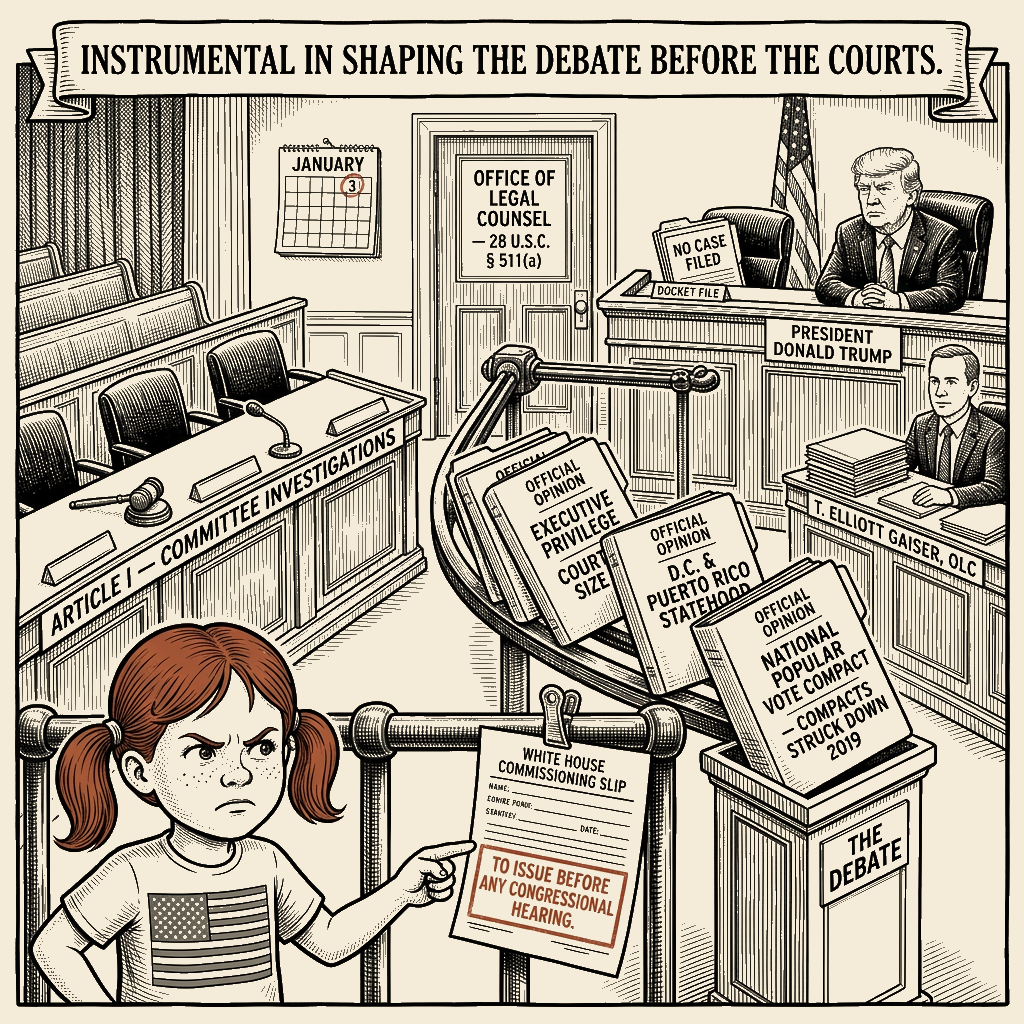
A bench of OLC lawyers. Three questions. One deadline: January 3. Government-issue conference table. Fresh legal pads. Three majestic opinions commissioned for a Supreme Court that has not asked anything, a case that has not been filed, and a country that has not yet been asked.
The beautiful part is that nobody needs to obey the opinions. Hewitt says the opinions “would not bind federal courts,” then calls them “instrumental in shaping the debate before the courts.” That is the legal equivalent of handing someone a map and insisting the map does not have to be geographically accurate if it points in the useful direction.
This is what a corruption-preserver sounds like. Not “the Constitution matters.” A corruption-preserver says: let the president’s own law firm answer the constitutional questions before the other side has even retained its lawyers.
Memo one: because the Judiciary Act of 1869 set the Court at nine, every later number must be a constitutional felony until OLC says otherwise. Memo two asks whether D.C. statehood would require an amendment—a genuine question Hewitt wants the president’s lawyers to answer before Congress debates it. Memo three revisits the National Popular Vote Compact. In State of New Hampshire v. Baker, 925 F.3d 1 (D.C. Cir. 2019), a D.C. Circuit panel struck down the state compacts adopting the Compact on equal-protection grounds without reaching the compact-clause question Hewitt says no court has tested. Three questions, three different legal statuses, one costume: presidential briefing paper.
Privilege is the wardrobe beneath it. According to Hewitt’s account of an August 10 OLC opinion, executive privilege can apply to presidential communications with private advisers when the communications relate to official decision-making, involve the President or direct advisers, and remain confidential. The same office would then prepare arguments about oversight and separation of powers before the new Congress takes its first hearing. That is not legal advice floating in disinterested space; that is a permit printed by the office asking for the permit.
We are the builders. We build cases in courts, legislation in Congress, and electoral arguments in elections. Article I gives Congress the lawmaking power; Article III gives courts the power to decide cases; Marbury v. Madison explains why those courts must exercise judgment rather than receive prewritten verdicts from an executive lawyer.
The funniest part is that Garcia and Blanche already supplied the script: “Steven Miller should lawyer up,” followed by “The Chief of Staff already has a lawyer. The Attorney General of the United States and the Department of Justice.” The lawyers are hired. The offices are occupied. The January 3 deadline is scheduled. What is missing is only the old-fashioned part where the law is tested in a case instead of previewed in a press release.
Nuclear Satire
When to use: for a broad audience—a newsletter, a group thread, or a speech—where the scale of the institutional maneuver must become visible before the facts can land.
The proposal has commissioned a legal séance: a bench of OLC lawyers summoned before January 3 to call up the ghosts of nine justices, the District of Columbia, and the national popular vote. The séance has no live case, no judge in the room, and no client beyond the executive branch. It has a deadline. That is the joke; the institutional corruption beneath it is not funny.
The first ghost arrives with a judicial finding and then leaves without answering the question. In State of New Hampshire v. Baker, 925 F.3d 1 (D.C. Cir. 2019), a D.C. Circuit panel struck down the state compacts adopting the National Popular Vote Compact on equal-protection grounds; it did not reach the compact-clause question Hewitt says no court has tested. The séance is still waiting on that ghost.
The deeper corruption is the design: Donald Trump’s White House would order its own legal shop to prewrite constitutional verdicts before the new Congress can investigate, legislate, or litigate. This is what a corruption-preserver wants—a legal head start with the executive branch’s letterhead on the briefing paper. The statute supplies the mechanism in 28 U.S.C. § 511, and OLC is the President’s principal legal adviser. Neutrality cannot be conjured merely by calling political annexation “legal advice.” The idea that the executive branch should annex the courts, Congress, and the ballot before the people’s branch acts is executive-branch imperialism in a plain necktie.
Privilege is the casket prepared for that empire. According to Hewitt’s account of an August 10 OLC opinion, executive privilege can protect presidential communications with private advisers when the communications relate to official decision-making, involve the President or direct advisers, and remain confidential. The proposal then asks that same office to decide, before cases mature, what the executive branch should claim against the coming investigations. The machinery calls concealment law because OLC issued the paper. That is not legal reasoning; that is permission with letterhead.
The Star Trek series diagnosed the camouflage years ago. In “The Drumhead” (TNG, 1991), Jeri Taylor’s script observes that people who clothe themselves in good deeds are well camouflaged. The camouflage here is not the serious OLC lawyers; it is the institutional function assigned to them. Brilliant lawyers can produce a sophisticated brief for an unsophisticated power, and the sophistication makes the power harder to see.
Hewitt’s own examples point in three different directions. President Clinton’s Secret Service protective-function privilege and White House attorney-client privilege were rejected in whole or material part by the D.C. Circuit. President Obama’s Fast and Furious claim ended in settlement rather than a ruling. Biden’s OLC opinion on the Hur recordings was abandoned in practice when the next administration released the recordings. An OLC opinion lives until the next president needs the opposite answer.
Then there are the three questions dressed in identical robes. The Judiciary Act of 1869 fixed the Court at nine; whether Congress may enlarge it remains a legal question, not a slogan. The Twenty-Third Amendment governs D.C.’s electoral votes; whether statehood requires another amendment is the very question Hewitt sends to OLC. The state compacts adopting the National Popular Vote Compact were struck down on equal-protection grounds in 2019, but the compact-clause question remains unanswered. Three subjects, three different statuses, and one executive-branch press release prepared to flatten them into a single imperial claim: the president’s lawyers have spoken, therefore the matter is settled.
We are the builders. We build the record in court, the law in Congress, and the mandate at the ballot box. We do not call a press release judicial review; we let Article III judges decide cases under Article II and Article I. We do not appoint the government’s lawyer as the final authority; we let the Constitution do what Hewitt’s own discussion of Marbury v. Madison says it does.
So let the ghosts go. Let OLC write its memoranda. Let the committees hold hearings. Let the courts hear arguments. January 3 is a date, not a constitutional claim. The executive branch may prepare its position; it may not bury the political branch beneath a deadline chosen because the political branch has not yet arrived. The republic does not need séance lawyers conjuring constitutional ghosts. It needs arguments made in public, evidence placed in the record, and power kept inside the chamber the Constitution gave it.
Profane Scorched-Earth
When to use: For the reader who has heard the talking point once too often and needs the receipts delivered without a prayer wheel or a Senate hearing.
Hell, yes: before Congress asks Donald Trump whether he can be investigated, let’s ask Donald Trump’s own OLC chief, T. Elliott Gaiser, to draft the legal road map. That is like hiring the defendant’s lawyer to inspect the courthouse, seal the evidence room, and call the seal “due process.” That is not lawyering. That is a corruption-preserver’s version of lawyering. The phrase is “full-court defense,” but 28 U.S.C. § 511 makes OLC an executive-branch adviser, and Hewitt himself concedes the opinions “would not bind federal courts.” So this fucking memo is political armor with a legal footnote.
Article I, Section 1 vests legislative power in Congress; House Rule XI, Clause 1 gives committees subpoena authority, while Clause 2 governs investigations; Article III, Section 2 commits “Cases” to the judiciary. Donald Trump’s White House does not get to be investigated party, prosecutor, judge, and appellate court at once. The branches have different jobs because concentrated power corrupts the process long before it produces a smoking gun. The OLC memo cannot merge them by putting “executive privilege” on the letterhead.
Hewitt’s account of an August 10 OLC opinion describes three conditions, not blanket immunity. The president’s own examples end differently, too: rejection, settlement, release. A shield with three combination locks is not invulnerability; it is doctrine. Bullshit cannot turn the president’s adviser into the people’s court, and goddamn political strategy cannot make a nonbinding memo binding.
Amos 5:24 commands, “Let justice roll down like waters, and righteousness like a mighty stream.” At Oxford in December 1964, Malcolm X took the affirmative on the motion: “Extremism in the defense of liberty is no vice; moderation in the pursuit of justice is no virtue.” Apply that discipline to the constitutional order: OLC advises, Congress investigates, courts decide. The demand for legal precision is real. The illegitimate move is letting the White House monopolize the constitutional argument before anyone else can test it.
So here is the fucking answer: OLC can advise; Congress can investigate; under Article III, Section 2, courts decide cases. The memo does not merge those powers. We defend democracy with the privilege determination on the public record, independent committee counsel funded, and the legal analysis published where citizens can read it. This one lands on the office and the man who runs its law shop, not on the folks who repeated the slogan at the kitchen table. The law is not the president. The president is under the law.
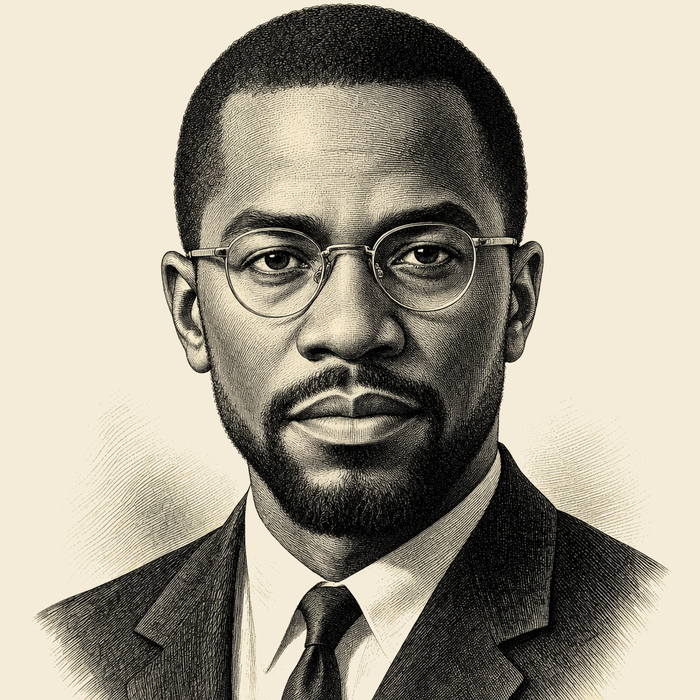
About Malcolm Little King
Malcolm Little King is a heteronym in Main Street Independent's editorial architecture — an analytical voice, not autobiography of any actual person. The position this column expresses is the publication's position on the territory Malcolm Little King's lane covers, rendered through Malcolm Little King's register.