Analyzing: What if Trump Still Thinks He’s Winning? — Karl Rove · 2026-11-11
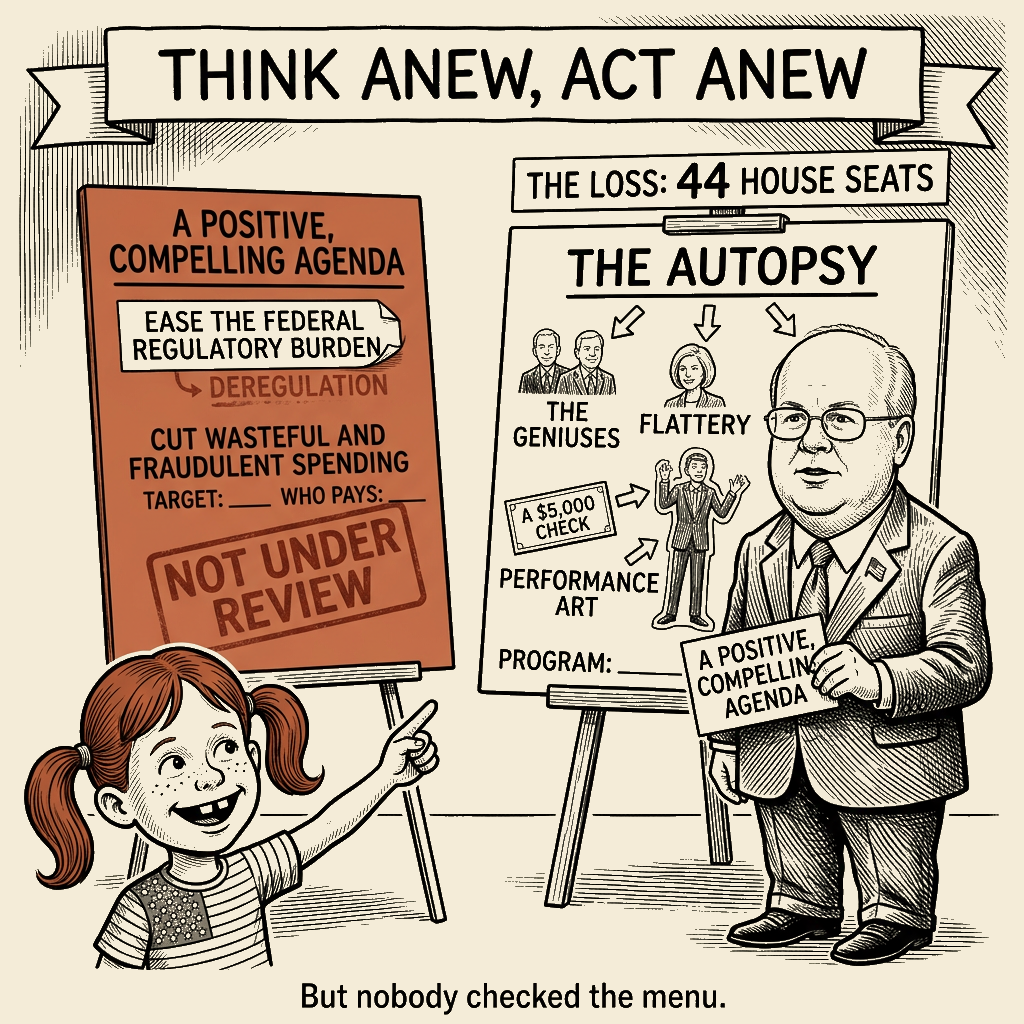
But nobody checked the menu.
What the Editorial Argues
Karl Rove argues that last week’s midterm defeat — seven, probably eight, maybe nine Senate seats, at least 44 House seats, and five to seven governorships — exposed a Republican Party deluding itself about its own health, as when the new White House chief of staff, Stephen Miller, credits President Trump with having “saved the Republican Party from the ash heap of history” and made it “stronger, more popular, and more resilient than ever before.” Whether that praise was flattery or genuine belief, the White House is signaling it will fight the investigations congressional Democrats will launch in January and govern by executive action; Democrats could damage themselves by going overboard, as Republicans did pursuing Bill Clinton over Lewinsky, but Republicans cannot simply wait for that stumble. Congressional and state Republicans must instead offer a positive agenda of their own — lower costs, more affordable healthcare, expanded housing supply, a lighter regulatory burden, cuts to wasteful and fraudulent spending — treating governing as serious work rather than performance art, even against lopsided Democratic majorities, because the point is to convince voters the GOP has the right answers for America’s future. He closes on Lincoln: the party must think anew and act anew, or the wilderness lengthens and the damage to the country grows — especially if the left dictates the Democratic agenda.
Receipts
This is a brand-recovery op: a post-defeat autopsy that confines the blame to personalities — the delusional West Wing, the gimmicks, the photography — so the program never comes up for review.
What the framing wants you to believe
- The GOP lost to style — a chief of staff’s flattery, a “$5,000 check” gimmick, “performance art,” executive-action overreach — not to its agenda; the conservative program remains what voters need.
- Recovery is a matter of presentation: Congress and the states re-present the standing agenda (cost relief, healthcare, housing, deregulation, spending cuts) as their own product, delivered as “serious work rather than performance art.”
- The live dangers are Democratic investigative overreach and “the left” capturing the Democratic agenda.
What’s really going on
- The “fresh agenda” is the old menu with new shelf labels: “ease the federal regulatory burden” is deregulation sold as consumer relief, and “cut wasteful and fraudulent spending” — a phrase with a four-decade service record as the sales language for program cuts — is the only spending the column names, with no target and no beneficiary, so no constituency gets alerted. The column’s own account defeats its own diagnosis: it says Democrats won by shouting “affordability” with “not much beyond that,” and never draws the conclusion that follows — that the electorate rejected the GOP’s substantive answers outright. (Anchor: the artifact text itself, a primary document.)
- The enforcement project survives its own autopsy intact. Construction workers, waiters, farmhands and their children enter the column only as “images” that “cost the GOP… with suburban voters” — the harm is denominated in vote share, and the baseline policy anchored on “violent criminal aliens” is presupposed, never argued. “Grift and self-dealing” appears as a hearing risk to manage, never a wrong to prosecute — whoever is implicated in the grift benefits from exactly that frame.
- The load-bearing omission: a cost-of-living post-mortem that never once says “tariff” and never asks whether the tax and trade record contributed to the loss. The autopsy stops at the neck.
The Operation
A calibration first: this is a signed weekly column, not an unsigned board piece, so the WSJ Editorial Technique Catalogue’s board-voice markers (the collective “we,” the third-graf turn) map at half-strength. The technique inventory maps at full strength, because Rove is working the same apparatus the catalogue was built on — and because I know this apparatus from the inside.
This one is mine. Not this column — columns of this class. I wrote the post-shellacking recovery memo for a living — in the shops I worked in, its working name was the adult-in-the-room memo — through board drafts and fellowship years, and the 2006 vintage had a busy season where I worked. Retained memory, flagged as such: the memos aren’t public; you have my account and nothing else. The genre is fixed. The moves below are its standard parts, and I deployed them. My moral standing is not the point of this analysis and is not good. The text is the evidence.
Institutional authorship and placement. The authority structure here is the persona. There is no study in this column, no think-tank fellow, no foundation report — nothing from the citation stack the catalogue usually finds in this slot. What carries the evidentiary weight is the byline apparatus the artifact supplies: senior adviser and deputy chief of staff, “The Architect,” a weekly Journal column, a Fox News contributorship, a McKinley book — a career that also runs through the American Crossroads operation Rove co-founded in 2010, a nine-figure outside-money vehicle built, per its founders’ design, to professionalize Republican persuasion. That is a documented repositioning résumé and a documented personal service record with this genre: Rove held the senior-adviser post through the 2006 midterms, his own tour through the genre’s previous deployment. The placement chain runs from the opinion slot through the author’s own cable slot to the syndicated excerpt — the staffer-and-donor inboxes where 2028 positioning begins. That circuit is genre-pattern from retained professional memory, flagged as such; the slot and the contributorship are documented in the column’s own bio line. The function is to be the establishment’s opening bid in the argument over who owns the post-defeat party: a positioning document that pre-builds the frame in which the party’s recovery is an establishment-managed rebrand.
The blame-isolation architecture. Count the causes the column names for the largest defeat the column itself tallies — seven, probably eight, maybe nine Senate seats, at least 44 House seats, five to seven governorships: a chief of staff’s flattery (“Perhaps he felt he had to flatter… Worse… is that he and the president actually believe it”), a popularity curve, “the same geniuses whose principal idea… was to promise every adult a $5,000 check,” “performance art.” Every cause is a person or a presentation. No policy is a cause. In Bandura’s moral-disengagement terms, this is displacement of responsibility running in concert with attribution of blame (“They’ll make a mistake if they play follow-the-leader and wait for direction from the West Wing” — the followers failed, never the direction), euphemistic labeling (“performance art” — the record relabeled as a genre failure), and moral justification (“wasteful and fraudulent spending” — the cuts presupposed virtuous). The cluster runs in concert, as it did in every operation I staffed. There is also advantageous comparison: the fault lands on the already-discredited clowns, and the reader is invited to compare the serious agenda against the circus that misrepresented it. The “geniuses” line is good. It is supposed to be. The mockery of the losing operation’s gimmick is the recovery op’s comic relief; I built the same relief into the same slot. The craft is real, and so is the function — the joke disciplines the in-group while the menu slips past review.
Frame-engineered relabeling (Bad-Faith Techniques Catalog, frame manipulation; bf_catalog: frame_engineered_relabeling; WSJ Editorial Technique Catalogue §4.1; the documented Luntz substitution craft in Words That Work and the public memos). Four labels do the load-bearing work. First: “ease the federal regulatory burden,” placed inside a list of cost-of-living remedies — deregulation re-shelved as consumer relief, the catalogue’s “regulatory burden” row deployed exactly as written. Second: “cut wasteful and fraudulent spending,” the only spending named in the column — spending equals waste-plus-fraud by definition, an austerity relabel that needs no evidence because the adjectives carry the verdict. That phrase has been the sales language for safety-net and program cuts since before I entered the trade — the Grace Commission era forward, every Republican administration since — and its operational property is that it names no program, so no constituency is alerted and no cost is priced. Third: “expensive remodeling plans,” the documented East Wing demolition and ballroom project belittled into a decorating vice. Fourth: “performance art” — governing recast as theater, the loss relabeled as a genre failure. Lineage: Luntz on the substitution, Lakoff on why the replacement term does the thinking — the frame activates before the argument begins. Old product, new labels.
The dispositive marker and the welded premise (WSJ Catalogue §3.4; bf_catalog: begging_the_question). The cue: “Most Americans still instinctively understand that inflation comes from too much money chasing too few goods, and wasteful spending is part of that equation.” The first half is a textbook kernel — a monetarist folk version, true enough at the level it operates. The second half is a weld: it fuses waste (a small, contested slice of spending) to the money-supply story so that program cuts read as inflation policy. The two quantities are not the same quantity — even at recent GAO improper-payment highs, north of $100 billion a year, that is a few cents of each federal dollar, and improper payments are not aggregate demand. The column needs them to be the same quantity. It asserts the identity, stamps it “instinctively understood,” and moves on. Readers who hesitate are thereby positioned against “most Americans.”
Instrumentalized harm (Bandura: distortion of consequences). The coldest sentence in the piece: “Images of their children being swept up too cost the GOP, especially with suburban voters.” Read it twice. The children are not in the sentence as children; they are in it as images, and the only verb the sentence spends on them is “cost.” The harm has been converted into vote share. Note the companion pivot two sentences up — enforcement “moving beyond targeting violent criminal aliens” — a concession built to preserve its anchor: the baseline project is presupposed as correct, only its execution was sloppy. This is the recovery op’s signature transaction: keep the enforcement project, return the regret about how it photographed. My register here stays on the move, not on the people the move was built to manage; the fear suburban voters felt, and the fear the swept-up families lived, are not the same thing, and the column prices only the one it can use.
Multiple-audience execution (WSJ Catalogue §4.3). That same sentence carries four payloads at once — the catalogue’s textbook pattern. To the professional class: a liability item. To the suburban reader: your flinch is validated as a voting consideration. To the targeted families: absent as persons — present only as images with a price. To the morally attentive reader: an exit that costs nothing, because the objection is to the filming, never the act. And the column runs the full four-audience map besides: the donor-class reader gets deregulation kept on the menu under a relief label and a savable brand; the political class gets a repositioning roadmap with a citable Lincoln close; the populist base gets its out-groups kept warm — “the left,” “violent criminal aliens,” “wasteful and fraudulent spending” — even as its leadership is disciplined; the technocratic reader gets the monetarist line and the McKinley reference, citable in serious settings. No sentence admits the layers to each other. The audience-management function, named where the reader can see it: conscience displacement for the grieving reader, identity confirmation for the base, grievance ratification in the out-group vocabulary, and a permission structure for the agenda’s continuity — congressional Republicans may differentiate from the White House without breaking from Trump: criticize “the geniuses,” keep the principal. Counter-frame management runs alongside: the Democrats’ affordability mandate is pre-stripped to slogans, so the 2028 rebrand never has to run against a governing record.
Asymmetric scare-quote management (WSJ Catalogue §3.8). Cues: “affordability,” “working people,” “more money in the pocket” — the winners’ vocabulary, quoted and flagged as affectation — while “timeless conservative principles,” “serious work,” and “positive, compelling agenda” sit in unmarked plain type. Operationally, scare-quoting “working people” converts a class of voters into a Democratic slogan, which is how the column avoids asking why they voted as they did.
The overreach preframe (WSJ Catalogue §4.15, the civility-and-decorum family; bf_catalog: red_herring, tone-policing subspecies; Bandura mechanism 3, advantageous comparison). “Democrats could damage themselves if they go overboard, as Republicans did in pursuing President Bill Clinton over his affair with Monica Lewinsky in the 1990s.” Credit the history: the kernel is true — Republicans lost five House seats in November 1998 amid the impeachment pursuit, contemporaneous published polling recorded majority disapproval of Congress’s handling, and Gingrich announced his resignation days after the vote. That is precisely what makes the deployment useful. It converts the oversight question from “is it true” to “will it play,” and it pre-frames January’s investigations as probable excess before any hearing is held — while the column itself concedes the exposure is real (“Investigations into grift and self-dealing could hurt”). The concession is honest. The routing is the op: documented self-dealing enters the column as a messaging caution, and restraint-of-investigation advice is delivered by the columnist of the party under investigation, dressed as a history lesson for the other side. The documented fact — impeachments are politically risky — does not entail the conclusion the column needs — that accountability is overreach.
The strawman of the victor (bf_catalog: strawman, selectional variety; WSJ Catalogue §4.6). “They constantly shouted ‘affordability’… didn’t give voters much of an idea of their solutions. They had slogans like ‘more money in the pocket,’ but not much beyond that.” The column names zero Democratic proposals; the reader cannot check what “beyond that” contains because the piece never supplies it. Operationally: minimize the victor’s mandate so the recovery op competes against a vacuum — if the winners were contentless, the loss was packaging, and the reader never has to entertain that the substantive answer lost. The column’s own arithmetic defeats it — 44 House seats is not a slogan premium — and the column never reconciles the two claims. Lippmann’s phrase fits: the column manufactures the picture in the reader’s head — a White House that cannot count, an opposition that cannot govern — and the picture is made of unverifiable interior states: “Worse—and a real possibility—is that he and the president actually believe it.” Whether either man believes the praise cannot be known and the column cannot know it; the checkable content, the seat count, never needed the speculation.
The friend-enemy closer (Schmitt’s friend/enemy distinction via the lineage reference; WSJ Catalogue §4.13 threat-inflation closer; the NR Editorial Technique Catalogue’s civilizational-frame entry, milder WSJ register). “Failing that, the Republican Party’s time in the wilderness could last far longer and the damage to our country be far greater, especially if the left dictates the Democratic agenda.” The column spends nearly its whole length telling the tribe it must change, then spends its final warning sentence reminding the tribe what the alternative is. “The left” does the enemy work; the elected Democratic majority that just won on affordability disappears into it. This is the discipline mechanism that seals the exit the column pretends to open.
The consecration close (WSJ Catalogue §3.7, the technocratic-credential ledger — credentialed authority substituted for the evidence base the column lacks; NR Catalogue §4.2 erudition-as-armor, kin move). The Lincoln quotation — “as our case is new, so must we think anew, and act anew” — is from the Second Annual Message of December 1, 1862, real source, word order altered inside the quotation marks (the recorded text reads “so we must think anew, and act anew”), and selectively framed: the next sentence in Lincoln’s text is “We must disenthrall ourselves, and then we shall save our country.” Disenthrallment — the release of held illusions — is exactly what the column declines to ask of the agenda. The quotation consecrates the unchanged product as “timeless conservative principles,” and the byline apparatus supplies the authority no study in the piece provides. It is also heritage-laundering: Lincoln, the most morally creditor-ed figure available, is borrowed — “the party of Lincoln should heed this sage advice” — to underwrite a program whose enforcement politics produced the images the column itself priced. And the lineage in the author’s own bibliography runs the other way: his book is about McKinley, whose 1896 realignment was engineered by Marcus Hanna’s corporate-funded campaign machinery — the documented ancestor of the persuasion industry the column now laments as “performance art.” A Hanna-class operation, laundered through a Lincoln quotation: that engineering of consent is Bernays’s entire subject, performed in a column by one of its practitioners.
Distributional impact. Beneficiaries, named: the consultant-and-establishment class, repositioning services and relevance — “treating governing as serious work rather than performance art” functions as a job application; prospective establishment 2028 candidates, who receive a pre-built frame for differentiating from Trump without repudiating him; congressional Republicans seeking distance-with-loyalty cover; the donor class, regulatory continuity; the conservative-media ecosystem, a “sane Republicanism” product line to carry the minority years; the enforcement apparatus, project preserved, presentation disciplined; and two beneficiaries the frame never surfaces — the parties implicated in the “grift and self-dealing” the column itself concedes exists, and the incumbent president. Note what the column never does to Trump: it questions his beliefs (“What if Trump Still Thinks He’s Winning?”) but never his standing. No call to separate the party from the president; the audit is of his electability (“He’s unlikely to grow more popular”), never his governance. A frame that fixes the packaging and leaves the principal in place benefits the principal. Whether any coordination exists between the column’s author and any implicated party is unknowable from this text and I claim none; the frame serves the implicated whether or not anyone coordinated — that is what frames are for.
Cost-bearers, named: the unnamed programs behind “wasteful and fraudulent spending”; the “construction workers, waiters and farmhands” and “their children,” registered solely as suburban vote loss; the defected voters, whose reasons are reduced to slogan-attraction; households with cost pressure, offered relabeling; incoming Democratic oversight, preframed as overreach; the public record, which the column treats as material needing management rather than disclosure. One forensic observation: the column contains almost no numbers beyond seat counts. Nothing is priced — not the sweeps, not the spending cuts it proposes, not the corruption it warns about. In my trade, the unpriced harm is the harm you have decided someone else should keep absorbing. A recovery op that never prices the product it is re-selling is itself a finding.
Alternative design — reconstructed from the constituencies the frame displaces, not from my preference: by the column’s own account the defected voters moved on affordability and on visible enforcement, so a party optimizing for its stated rationale — “win back voters’ trust” — would have to take positions there. It would name the trade and tax levers and ask what they did to prices; specify which spending is wasteful, in what amount, borne by whom; ask whether enforcement policy or only its photography moved the suburbs — say whether the sweeps were wrong, not merely expensively filmed; say whether the self-dealing should be investigated or protected; engage the victor’s actual proposals instead of their slogan; and say why its own affordability answer lost. It would also credit the levers it genuinely has: the housing-supply line is a real lever with cross-ideological standing, and the column is right to include it — an honest minority-year agenda leads with what it can defend. The column is silent on all the rest, and the silence is the tell: naming any of them would require repudiating substance the rebrand is built to keep. The difference between that column and this one is that in that column, the program is inside the autopsy.
FGL, applied across constituencies. The author: fear of a party with no seat for the professional class — of permanent displacement by Trumpist politics; greed in the reclaimable client base, the consultancy market the column reopens, the weekly slot; laziness in the fact that repainting is cheaper than rethinking — “agenda” as listicle, existing planks, better typeface. The apex beneficiary class — establishment donors and incumbents: fear of a permanent minority without a fundable brand, and of the January hearings; greed in regulatory continuity and in what the hearings threaten; laziness in that the brand repaint requires no re-underwriting of the agenda, in a frame where scandal is an optics problem. The rank-and-file Republican reader: the fear is real and human — “the left” dictating is what the closer exists to stoke; the greed is modest, relief at a kept tax posture; and the kindest thing I can say is that the column’s laziness offer is real relief — you were right all along, the delusional people in the West Wing ruined it, change the wrapping. That relief was manufactured for this reader. Taking it is human. “Instinctively understand” flatters the reader out of re-examination. The fear and the laziness are real. The column harvests both. Note also the piece’s own asymmetric FGL: the Democrats get the lazy strawman; that is the author’s asymmetry, and I flag it as such rather than practicing my own.
Placement verdict. Mixed — genuine within-frame value (the Lewinsky analogy is historically sound; “don’t merely oppose the majority, bring an agenda” is real political craft; reliance on executive action is a genuine legal fragility) carrying a concentrated overlay (consultancy restoration; scandal management). I have separated them. Leaning institutional-selfish: the national-interest register is the wrapper; the party-interest register is the payload; “the damage to our country” arrives only as the consequence of GOP failure to recover.
The Record
Anchor receipts (documented public record).
- 1998 impeachment midterms: Republicans lost five House seats in November 1998 (the standard tally); contemporaneous published polling recorded majority disapproval of the impeachment pursuit in most soundings; Gingrich announced his resignation days after the vote, per the contemporaneous record. The column’s historical kernel is accurate.
- Lincoln: the Second Annual Message (Dec. 1, 1862) reads, per the recorded text, “As our case is new, so we must think anew, and act anew,” and continues, “We must disenthrall ourselves, and then we shall save our country.” The column quotes “so must we think anew, and act anew” — real source, altered word order inside the quotation marks. Small; quotation discipline is still discipline.
- Hanna/McKinley lineage: documented historiography; the author’s own book (The Triumph of William McKinley, Simon & Schuster, 2015) is the bio line’s own exhibit.
- Enforcement pattern: the documented public record through 2025 — the second-term enforcement expansion past violent-crime targeting, worksite actions, detentions of workers without criminal records — supports the column’s characterization in kind; its specific 2026 incidents are artifact-supplied and not independently receipable from the materials at hand.
- “Expensive remodeling plans”: real referent — the documented East Wing demolition and White House ballroom project of 2025.
- The “waste, fraud and abuse” phrase family: service record running from the Reagan-era Grace Commission through every subsequent Republican administration; the Luntz substitution craft is documented in Words That Work and the public memos.
- GAO improper-payment estimates running north of $100 billion in recent fiscal years — a few cents of each federal dollar.
Anchor for the text-level findings. The artifact itself, a primary document — every claim about the piece is checkable against it: the Miller quotations, the seat counts as stated, the $5,000-check reference, the ICE sentence, the Lincoln quotation. The factual spine — the scale of the defeat — is stated plainly, and stating it plainly is to the column’s credit; the numbers are honest, which is what makes the interpretation the op.
Article-supplied, carried as reported (no independent receipt in the available materials): the midterm seat counts (seven to nine Senate, at least 44 House, five to seven governorships); Miller’s appointment as chief of staff and his quoted remarks of last Friday; the “$5,000 check” episode; “the courts have struck down many of the administration’s executive actions” — the injunction pattern against second-term actions is documented in kind, “many” is unquantified.
Unconfirmed: [unconfirmed: convergence threshold not met] — “Most Americans still instinctively understand…”: an unreceipted assertion of consensus. “Probably eight and maybe nine”: the column’s own escalating hedge, unresolvable here. Miller’s remarks, quoted in the artifact: no independent transcript in this package; carried as the piece’s quotation.
Per-citation verdicts. Miller quotations — unverifiable beyond the artifact; carried as the column’s report. Election counts — artifact-supplied, internally consistent with the argument. Lewinsky/1998 — accurate as history; the deployment is where the technique lives. Lincoln — real source, not verbatim (word order altered), and selectively framed: the next line of the source cuts against the user. Inflation nostrum — assertion in consensus clothing; no receipt.
Load-bearing omissions.
- The word “tariff,” absent from a cost-of-living post-mortem; no audit of the tax and trade record against the cost picture.
- Corruption appears only as exposure (“Investigations into grift and self-dealing could hurt”) — never as wrong. No accountability claim exists anywhere in the column.
- The agenda list’s continuity with the losing record is never acknowledged; “a positive, compelling agenda of their own” is the coalition’s platform in new type.
- The enforcement question is never adjudicated — the sweeps are costed, not judged; no distinction drawn between enforcement policy and its photography; the column takes no position on whether they should happen.
- The winner’s actual platform is unengaged — reduced to scare-quoted slogans; no Democratic proposal named, quoted, or engaged.
- Trump is spared: beliefs questioned, standing untouched; electability audited, governance never.
- No named cut target, amount, or beneficiary for “wasteful and fraudulent spending.”
- Nothing is priced. A column about affordability prices nothing — not the sweeps, not the cuts, not the corruption.
Missing-information declaration. No exit polling in the package; the suburban-shift claim is carried as the piece’s directional concession without magnitude. No internal GOP polling, memos, or deliberative documents are in the public record for this column’s claims; the “$5,000 check” and the Miller remarks rest on the column alone. Democratic agenda specifics are absent from the artifact. No leaked-document references; nothing here rests on retained memory except the craft claims about how the genre is built — the adult-in-the-room memo, the post-shellacking recovery memo — which are flagged as retained memory, non-verifiable by the reader, and never load-bearing for the text-level findings above. The election results are carried as the artifact reports them. No leaked-memo references were dropped; none were available.
How to Recognize This
The pattern: the packaging autopsy — the shellacking-laundering op. A party loses big; a party elder or professional writes the autopsy in which every cause is a person and no cause is a policy. The menu survives with new labels, the enforcement project survives with better photography, and the close consecrates the unchanged product with a scripture-grade quotation. Accountability is converted into strategy: nothing anyone did was wrong, only mistimed, mistuned, mishandled.
The mechanism: identity protection plus conscience displacement. It removes the moral cost while keeping the affiliation. The reader’s tribe lost, and the piece supplies a story in which the tribe didn’t — the flatterers and the geniuses did — and a path back that requires no re-examination of what the tribe believes. You keep the party, the record, and your self-image; the only thing that changes is the adjectives. The reader keeps the values and swaps the production team. It is cheaper than grief, and grief is what an honest autopsy costs. Meanwhile the harms the coalition produced — the children in the images, the grift awaiting hearings — are re-registered as public-relations exposures, and sympathy migrates from the families to the embarrassed party.
Four signals, checkable against this piece:
- Inventory the causes. If every named cause is a person (Miller, the president, “the same geniuses”) or a presentation (“performance art”) and no policy is ever a cause, you are reading a brand-recovery op.
- Compare shelf labels to stock. Paste the “positive, compelling agenda” against what the coalition actually ran and governed on; if the difference is adjectives — “serious,” “timeless,” “positive” — you are looking at a rebrand, not a revision. “Regulatory burden” inside a cost-of-living list; “wasteful and fraudulent spending” as the only spending named, with no target named — old menu, new labels. Check whether the fresh agenda would have surprised the reader in 2024. And watch the typography while you’re at it: scare quotes on the winner’s words (“affordability,” “working people”), plain type on the author’s (“timeless conservative principles”) — the asymmetric typography maps exactly onto whose vocabulary is being ruled out of order.
- Watch the harm denominator. “Images of their children being swept up too cost the GOP, especially with suburban voters.” When a policy’s casualties appear only as images priced in a party’s vote share, the project is being preserved, not reviewed. Ask what the sentence would say if the children were in it as children. Ask what the piece says about the act itself; if the answer is nothing, the nothing is the position.
- Check the close — and the advice. When a column demanding change from everyone ends by consecrating the unchanged agenda, read the quotation’s next line; Lincoln’s next line was about disenthralling yourself. And when a columnist for the party under investigation counsels the incoming investigators on restraint — “Democrats could damage themselves if they go overboard” — ask who sleeps better with that caution in circulation.
Why it works: it converts loss into continuity. The reader is offered agency — run on your own agenda! — that requires no belief-revision, and the threat-inflation closer seals the exit the opening seemed to provide. Conscience displacement does the rest — Lincoln closes the sale. It feels like discernment and costs nothing. It works because it is kind to the reader in exactly the one direction the reader wants kindness after a defeat: backward.
What to do when you see it: list what the autopsy declines to autopsy — here, the trade record, the tax record, the cut targets, the victor’s actual proposals. Run the accountability question the column never runs: of the corruption, is it being investigated or managed? Of the sweeps, does the piece say they are wrong, or only expensive? Ask which sentence would have to change if the program itself were on trial; the piece has no such sentence, and that absence is the finding. Price the harms in the piece’s own units and note what was never priced — what does the preserved agenda cost the constituencies it never names? Then ask cui bono twice: who gets the party back under the rebrand, and who gets their scandal reframed as someone else’s overreach risk. Watch the vocabulary migrate; “waste and fraud” and “regulatory burden” will be the minority-year kit across the syndication network, and the repetition is the fingerprint. And let the “serious work versus performance art” frame cool before accepting it, because that frame is the trapdoor under the whole piece: it locates the failure in the theater so the script never gets read.
I am bitter about this genre; it was mine, and the disclosure is above. The bitterness is mine to carry. The verification is yours: the pattern is in the text, the text is on the table, and you can confirm every finding without believing a word about me. I built columns of this class, and the recognition in this column is not worth more than yours — it is only earlier. If you spent the last two years believing this operation was winning, the same professional class that sold you the operation is now selling you its autopsy. That is not a reason to distrust yourself. It is a reason to check the menu the next autopsy arrives with, and to carry forward the one thing the autopsy cannot survive: the tell is never in what the professional says about the losers — it is in what he declines to say about the harms. Because the autopsy is not the product. The menu is the product. The autopsy is the wrapping it ships in.

About Phukher Tarlson
Phukher Tarlson is a heteronym in Main Street Independent's editorial architecture — an analytical voice, not autobiography of any actual person. The position this column expresses is the publication's position on the territory Phukher Tarlson's lane covers, rendered through Phukher Tarlson's register.