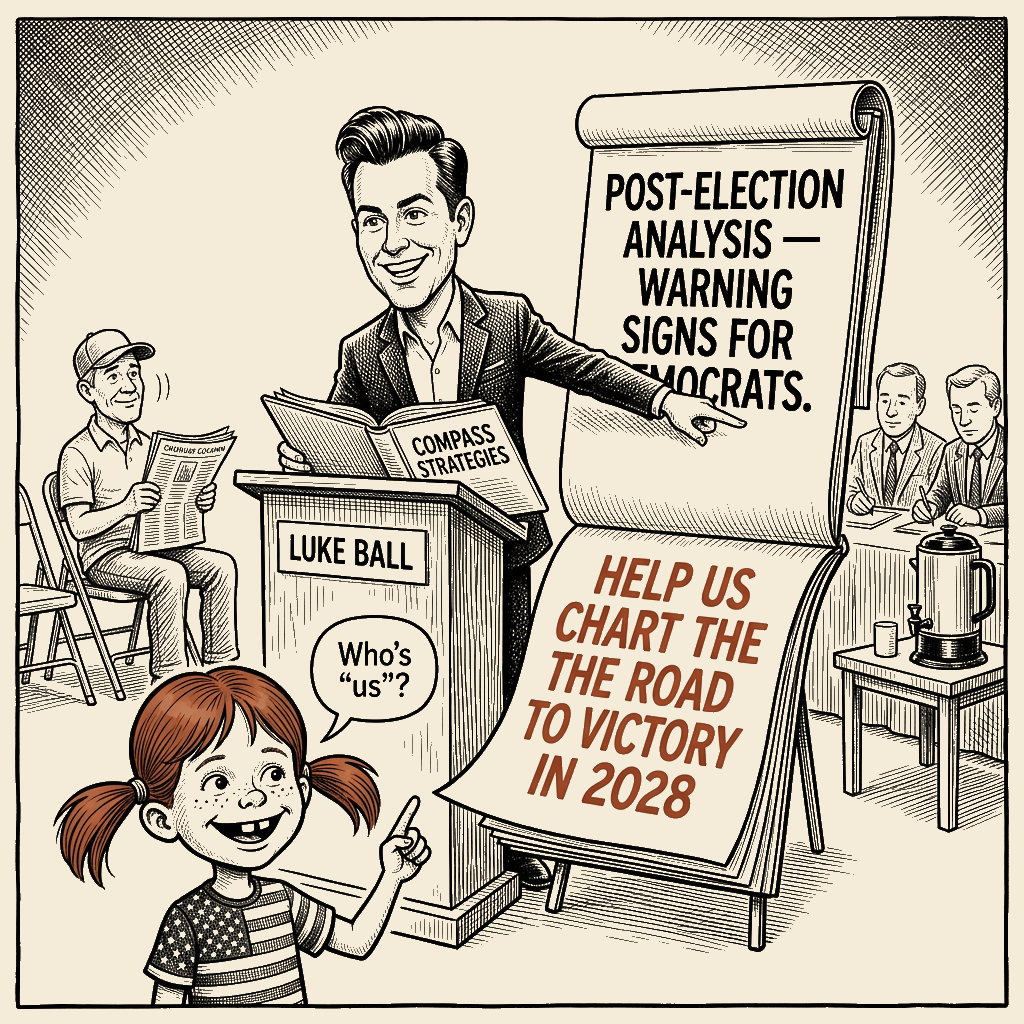
Analyzing: LUKE BALL: The midterm warning signs for Democrats no one is talking about — Luke Ball · 2026-11-12
The analysis came with marching orders.
What the Editorial Argues
Luke Ball argues that the Democrats’ 2026 midterm victory — House and Senate majorities, with wins in Colorado, North Carolina, Arizona, Washington, Nevada, and Wisconsin — was “a backlash against broken Republican promises” rather than an endorsement of liberal policy. His evidence is down-ballot: conservative ballot initiatives that passed in the same states Democrats carried, from Colorado’s propositions on women’s sports and youth gender surgery to voter ID in North Carolina and Nevada, a cartel-terrorist designation in Arizona, and a rejection of what he calls far-left progressive DEI policies in Wisconsin. From these results he derives a structural bind — the Democratic base, which he says is now one-third Democratic socialist, is out of step with the independents who actually delivered the win, so moderates lose progressives if they govern for independents and lose independents if they govern for progressives — and predicts the coalition will “self-destruct in spectacular fashion” before 2028. He closes by advising Republicans to position to “recapture this crucial coalition” of independent voters.
Receipts
The move is consolation: a defeated audience is handed a rereading of its own loss in which the winner, not the loser, is the party in crisis.
What the framing wants you to believe
- Conservative ballot measures passing alongside Democratic wins prove Democratic voters rejected their own party’s agenda — a “stunning rebuke.”
- The Democratic victory was transient “wrath,” not mandate; the GOP’s loss contains durable “down-ballot whispers” that chart the future.
- Democrats face a lose-lose between progressives and independents and will collapse on schedule, so Republicans need only wait and harvest.
What’s really going on
- The “analysis” is authored from inside the effort it assesses. Ball’s own bio places him in Trump’s political operations from 2021 through the 2024 reelection, and his grammar completes the disclosure the bio starts: “help us chart the road to victory in 2028.” An analyst who says “us” is a combatant filing a memo in commentary clothing — and the memo’s pathway is concrete: a base that believes the loss was protest rather than repudiation keeps the agenda, and the agenda is what the consultant class sells, funds on, and books time defending.
- The comfort is assembled by selection: “dozens of conservative victories” are claimed, seven are listed, not one ballot text is quoted, no margin appears for a single Democratic win, no failed conservative measure appears anywhere, and the statistic carrying the heaviest load — “One in three Democrats now identify as Democratic socialists themselves” — arrives with no pollster, no house, no date.
[unconfirmed: convergence threshold not met]The one concession that could indict the author’s own operation — “broken Republican promises” — is made and instantly abandoned; not a single promise is named. - The measures he calls a “stunning rebuke” are, on the pre-2026 polling record, majority-support measures passing at majority levels — the baseline dressed as the upset. The anchor for the core finding is the artifact itself: the bio line, the “us,” the seven-item list, and the North Carolina sentence that carries its own tell — all quoted verbatim below.
The Operation
Triage and authorship. Fox News Digital opinion slot; named byline; the Fox furniture is unmistakable — the all-caps crossheads braiding the outlet’s own coverage into the body (Parker, Carville, Turley, an Ingraham Angle video, a download-the-app closer), the promotional second-person grammar. A guest piece, signed by a strategist — president of Compass Strategies INC, former House communications director, Trump political operations 2021–2024 — which places it in my lane, not the unsigned-board “we” that routes to the Editorial Board. The archetype is what assignment desks called the consolation slot — retained memory; the name was ours; the genre is checkable every cycle. It is the defeat-side mirror of the selective-moral-outrage family the WSJ Editorial Technique Catalogue documents as the deficit double standard (§4.4): the standard for reading an election result moves with the partisan valence of the result.
Complicity disclosure. I built versions of this product. After the losses of 2006 and 2012 I wrote unsigned comfort copy for readers who had just watched their party lose — commissioned, calibrated, and shipped on a deadline that had nothing to do with what the returns meant. That is retained memory of operations not in the public record; it is non-verifiable, and the reader is on notice of that. I am not neutral about this product line; it was mine. The finding rests on the text, not on my residue.
Cui bono.
Institutional authorship. Fox News Digital’s opinion desk, fronted by Luke Ball, president of Compass Strategies INC — a consultancy whose client roster the piece does not disclose. For an electoral strategist, the client list is the interest, and this op-ed does not carry it. The citation stack is the placement chain made visible: the column sits inside the network’s own post-election programming, cross-references Fox’s own items, and cites the author’s own television appearance (“As I noted in a recent appearance on ‘The Faulkner Focus’”). This is the self-sourcing logic the WSJ Editorial Technique Catalogue’s Fox additions document as the intra-outlet citation loop (§4.22), plus an unnamed consensus claim — “Even left-leaning statewide outlets in the Tar Heel state” — doing manufactured-consensus work with no outlet named. The placement chain runs: his own cable segment, cited as his own authority, inside a column that circulates as client-facing demonstration of the service. Nothing in the artifact documents the commissioning process, so where I describe how such pieces are produced, that is retained memory, flagged and non-verifiable — the artifact’s own evidence (same-week cable self-citation, closing marching order) carries the finding without it.
Distributional impact. Beneficiaries, with pathways: Ball’s consultancy — the column is a demo reel for the 2028 pitch cycle, bookings and firm visibility included; the defeated party’s apparatus — officials, consultants, donors — handed narrative protection, with the loss routed to “the GOP’s broken promises,” an abstraction with no campaign account to drain; Fox’s engagement economy, which has anger content to serve while its base is still consuming grief, with the caps-lock crossheads and quotable closer engineered for circulation; and the Republican consulting class broadly, which receives a two-year storyline — “watch them self-destruct” — that requires no new analysis to maintain, plus a citable coordination memo (“recapture this crucial coalition”). Cost-bearers: Fox readers, who receive a map of the election with the margins removed, the losses removed, and the load-bearing number unsourced; the electorate that just voted, whose expressed choice is dissolved in a single sentence (“They were not a mandate to usher in a vast liberal policy platform”); the Democratic winners, pre-coded for two years as overreach (“force their unpopular agenda, once again”); the trans students and their families the initiatives concern, who appear only inside a campaign label — never as policy text, never as persons; and the information commons, which absorbs another collapse prediction that cannot be falsified inside the cycle that needs it. Magnitudes: the piece quantifies nothing it can source; its only figures — Arizona’s “over 13 points,” “millions” spent against the initiatives, the one-in-three socialist fraction — are the author’s own unsourced assertions.
Alternative design. If the piece were optimized for its stated rationale — a warning genuinely useful to Democrats — it would carry the margin of every race it names, the conservative measures that failed, the text of each initiative, a sourced basis for the one-in-three figure, the content of the promises it invokes, turnout and coalition data, and advice actually addressed to Democrats. It carries none of these; every one of those additions would cost the author his conclusion. The disadvantaged constituency of the piece’s own framing is the reader who wants to know what actually happened; the honest version of this analysis is a complete split-ticket inventory on both sides, and this is not that.
FGL, applied symmetrically.
- The author: fear — the post-mortem landing on the people who ran the losing agenda, a class that includes him, and post-loss professional obsolescence with it; greed — the 2028 cycle is his firm’s market and this column is a pitch document; laziness — the consolation column is outcome-agnostic copy off a prebuilt template.
- The apex beneficiary, the consultant class and party apparatus: fear — a real repudiation would force agenda change; greed — the current agenda fundraises exactly as it is, and the engagement-and-client economy services the narrative; laziness — “they will self-destruct” is the only strategy that costs nothing to execute or update.
- The rank-and-file reader, without contempt: real fear — losing can feel like the country’s direction slipping away, like their values lost; status — the piece repairs identity by the second paragraph; laziness — accepting a supplied conclusion rather than reading a margins table spares the reader the hardest work in politics, the honest post-mortem. The comfort offered is real comfort. That is what makes it effective and what keeps its price invisible: the bill for a skipped post-mortem is presented at the next election. That fear is human. The apparatus is in the business of selling it a story.
- And the constituency with no seat at the table: the voters who did the thing the piece is written to un-do. They voted. The piece converts their vote into an error awaiting correction.
Placement. Mixed on its surface — it offers the adversary advice — selfish in function: every element of the text serves the author’s side’s morale, coordination, or engagement. The kernel concession (“backlash against broken Republican promises”) is granted precisely because conceding it buys the standing to bury it.
Critical-questions and failure-mode scan. The pathways above are concrete, not symbolic (CQ1). The frame-bounded scan finds the voters themselves missing from the piece’s frame — they appear only as tallies (CQ2). Incidence is informational — a corrupted post-mortem — and representational — a dissolved mandate — both with stated pathways (CQ3). FGL runs across four constituencies including the author’s own (CQ4). No coordination is claimed beyond what the artifact documents: the Fox opinion pipeline does not need a memo to produce this column — the slot exists, the genre self-selects, the author self-identifies — so structural-incentive language suffices and conspiracy language is not warranted. The alternative design is reconstructed from the reader’s interest in an accurate post-mortem, not from my preference for any party. And the cynicism-trap check: what the reader legitimately wants — an honest post-mortem — is the real value here; the operation sells a substitute for it.
Technique identification.
-
The consolation reframe, and the orphan concession it stands on. Cue: “The Democrats’ victories were a backlash against broken Republican promises. They were not a mandate to usher in a vast liberal policy platform.” Catalogue: Bandura’s displacement of responsibility and distortion of consequences running in concert — the loss is attributed to “the GOP” as an agentless collective, and the repudiation is minimized into protest — with the rest of the cluster in support: moral justification (their mandate is illegitimate, ours is the people’s will), euphemistic labeling throughout, attribution of blame displaced onto the winner’s internal contradictions. Operationally, note the double move: accountability is delivered to an abstraction. A party’s brand can absorb a bad cycle; the product cannot. The consultant class survives a lost election; it does not survive a repudiation of what it sells. And the reframe depends on an orphan: the single clause that concedes the true half — the GOP’s own performance deficit as the cause of the loss — is made and never revisited, because the conclusion that clause generates, that a party which lost on broken promises owes the electorate something other than wait-and-collapse, would cancel the consolation. This is the blanket half-truth anatomy in its purest form: isolate the true variable, suppress the one that reverses the conclusion, extrapolate.
-
Selective enumeration. Cue: “dozens of conservative victories went largely unnoticed,” followed by a list I can count: Colorado’s two propositions, North Carolina’s mail-ballot ID, Arizona’s cartel designation, Washington’s sports measure, Nevada’s voter ID, Wisconsin’s unnamed DEI rejection. Seven. The Bad-Faith Techniques Catalog files the pattern as bf_catalog:
hasty_generalization(Govier; Walton): a general conclusion drawn from a sample too small or unrepresentative to carry it. The quantity word does the proving; the list is garnish; the unshown rest are never produced. And no disconfirming case enters the inventory — no failed conservative measure, no progressive initiative passing in a state the GOP carried. The WSJ Editorial Technique Catalogue documents the same selection discipline in the blue-state-failure frame (§4.9): outcomes that complicate the frame do not become part of the record. The deeper defect is substitution: a ballot initiative passes or fails on its own cross-pressured coalition, and treating its passage as the winning party’s own constituents rebuking “the ideological positions their party has championed for years” swaps an initiative verdict for a party-platform verdict. -
Baseline erasure — the manufactured upset. Cue: “passed decisively”; “a stunning rebuke to some of the left’s most entrenched policy platforms.” On the public polling record as I know it, national polling in the years before this cycle repeatedly showed majority support for voter-identification requirements and for restricting trans athletes’ participation consistent with sex assigned at birth. A majority-support measure passing at majority levels is a measure meeting its baseline; “stunning” is an adjective doing the work a comparison would undo. And the piece convicts itself without waiting for outside data: in its own North Carolina paragraph, the measure passed “by almost the same percentage with which it elected a Democrat senator” — Ball’s own sentence places the initiative moving with the electorate that just defeated his party, and an initiative that tracks the electorate is not a revolt against the party it elected alongside. The Bad-Faith Techniques Catalog’s manufactured-controversy entry is Oreskes and Conway’s Tobacco Strategy — manufacturing doubt; this is its mirror, manufacturing upset, and the post-defeat genre generally manufactures certainty. (The disclosure I owe whenever I cite Oreskes: we attacked her for that argument; we were wrong; the record her book compiles supports the reading.) The WSJ Catalogue’s “academic study” countercase pattern (§4.14) is the same move in the science lane — a normal mechanism rebranded as anomaly.
-
The unsourced magnitude. Cue: “One in three Democrats now identify as Democratic socialists themselves.” No survey, no year, no link. In every published measure I know of, Democratic-socialist self-identification sits nowhere near one in three, and I cannot verify a 2026 survey the text does not name — so the claim carries the unconfirmed tag and carries, unconfirmed, the entire weight of the coalition fork built on it. The WSJ Catalogue’s “study shows” ledger (§4.5) at least cites a study; this is that entry with the study removed. Operationally, this is a number whose function is permission, not information: it arrives attached to a fear the base already holds, which is why it will never be checked. It is the piece’s most load-bearing statistic and it is carried on nothing.
-
The lose-lose fork and the self-destruction prophecy. Cues: “If the more moderate Democrats… try and maintain the coalition of independents and swing voters, they will upset their party’s progressives. If the moderates try and appease the progressives, they will lose the independents… It’s a lose-lose situation,” resolving into “self-destruct in spectacular fashion” and “They will be fixated on investigations and impeachments.” Catalogue: the Bad-Faith Techniques Catalog files the first as
false_dichotomy(Walton: two options presented as exhaustive) and the second asslippery_slope— the chain asserted without evidence for its links: cave, then no legislation, then investigations and impeachments, then collapse, then 2028. Operationally, the third option — that Democrats govern on whatever those independents believed they were voting for — is the one outcome the piece cannot afford, because it would mean the mandate was real; the dichotomy is engineered by omission, then certified as “lose-lose.” The prophecy is installed before the winners have governed a single day: any act of governing becomes the predicted overreach, any oversight of the losers’ conduct becomes “fixation.” A prediction published before the winners have governed a single day is not analysis. It is the appointment of a scorekeeper. The prediction is unfalsifiable inside the cycle that needs it, and it converts the reader’s one honest obligation — examining what his own side’s broken promises cost — into a spectator sport staged on the other side’s field. Lineage: Bernays’ engineered consent (1928) is the discipline of supplying audiences the conclusion they prefer to reach; Lippmann’s picture-thinking (1922) supplies “the Democrats” as a single unit destined to fracture, a picture no marginal data can disturb. -
Frame-engineered relabeling, with the dehumanization mechanism attached. Cues: “written to keep men out of women’s sports”; “biological sex requirements for school sports”; “designating cartels as terrorist organizations”; “far-left progressive DEI policies”; and the asymmetric scare quotes on “Centrist” Democrats while “conservative policy priorities” runs unmarked — the scare-quote management the WSJ Catalogue records at §3.8. The initiative names are the campaigns’ own labels delivered as description; every initiative is described by its advocacy label, never its text. The first does the sharpest work: trans women and trans girls are re-keyed as “men,” a category erasure that ends the argument before it starts. That is Bandura’s seventh mechanism, dehumanization, riding with euphemistic labeling throughout; the catalogue cross-references are
frame_engineered_relabelingin the Bad-Faith Techniques Catalog (Luntz’s documented substitution memos; Lakoff on why the substituted term arrives pre-loaded with its enemy-image inside the sentence, so the reader ingests the campaign copy mistaking it for the statute) and the NR Editorial Technique Catalogue’s loaded-term cluster (§4.12) as the register cousin. The reader is never told what the ballot actually said. I will say plainly what the phrase is for and no more: the people the phrase carries are not my target and will not be treated here as rhetorical counters, which is exactly what the phrase does to them. -
The interested-party column. Cues: “Republicans must seize the opportunity to recapture this crucial coalition of independents”; “help us chart the road to victory in 2028”; bio: “worked on President Trump’s political operations in various capacities from 2021 until his successful reelection.” The WSJ Catalogue’s Fox additions name this the litigant’s column (§4.21) — here, operative-as-columnist — with the detection signal the framework specifies: first person denoting the sponsor, plus a bio line under the fold, and its cross-reference to undisclosed conflict of interest. Ball is not a party to the returns, but he is a principal in the campaign the “analysis” serves — the same structure one step removed — and the disclosure that would tell you what this memo is for, Compass Strategies’ client list, is precisely the disclosure withheld. The genre’s tell is the address flip: the headline speaks to Democrats, the final paragraph speaks to Republicans. Read the closing first and the piece scans as what it is: a marching order with the opponent’s name on the envelope.
-
The roar/whisper ledger. Cue: their wins are “the wrath of a disgruntled electorate,” “deliriously giddy,” party hats; his side’s loss is “down-ballot whispers” that “will help us chart the road.” Emotional weather for their victory; instrument data for ours. The WSJ Catalogue’s deficit double standard (§4.4) is this move’s documented sibling — selective moral outrage, valence-tracking.
-
Multiple-audience execution. The WSJ Catalogue’s §4.3 documents the four-layer construction; Fox runs the same architecture at lower polish. Read the layers off this text. The defeated conservative reader gets “Democrats might need to pack away the party hats” — permission to discount the loss. The mobilized base gets “far-left progressive DEI policies” and “men out of women’s sports” — grievance ratification. The political class gets “Republicans must seize the opportunity” — a coordination memo, citable in strategy meetings. The engagement layer gets the caps-lock crossheads and a quotable closer. And the surface layer — Democrats, the advertised audience — is envelope art. The layers are mutually inconsistent — the comfort cannot survive a margins table, and a margins table would not move the base — and that inconsistency is where the catalogue says the craft becomes bad faith.
-
The intra-ecosystem citation loop. Cues: the Parker, Carville, and Turley crossheads; the Ingraham Angle video; “As I noted in a recent appearance on ‘The Faulkner Focus’”; “Even left-leaning statewide outlets.” The outlet cites itself, unnamed outlets carry the consensus claim, and nothing external is ever put forward in checkable form. The Bad-Faith Techniques Catalog’s
circular_sourcingand manufactured-consensus entries cover the pattern; the WSJ Catalogue’s Fox addition (§4.22) documents it operationalized at the paragraph level, which is exactly what this piece does. The Parker link sits directly upstream of the piece’s own “not a mandate” paragraph, so a scanning reader receives the outlet’s confirmation before the author’s argument arrives. The Carville headline imports a Democratic name to certify the DEI point without the author arguing it. And the Turley interstitial describes Democrats as expansive strategists targeting the Electoral College — agentic, offensive — inside a piece whose thesis is that Democrats are a self-destroying contradiction. Engagement furniture and argument live in different departments; the reader receives both as one page, and the loop is never consistency-checked.
Audience-management function. Consolation, identity confirmation, grievance ratification — pointed with some elegance at the reader’s own elites, since “broken Republican promises” lets the base keep its anti-establishment grievance while redirecting it away from the agenda — plus coordination for 2028 and status display for the author. Load-bearing above all of them, conscience displacement: the reader who might ask what his own side’s broken promises cost is handed instead a two-year show trial of the other party’s soul. No counter-frame appears; the possibility that the electorate was addressing the GOP’s record is conceded once, in one clause, and buried.
Lineage. Bernays: the interested party speaking through ostensibly independent commentary is the invisible government in miniature. Lippmann: the picture of the election in the reader’s head, assembled elsewhere. Bandura: the moral-disengagement cluster doing the consolation’s moral work. Luntz and Lakoff: the label substitutions.
The Record
Receipt set. No Tier-1 or Tier-2 receipts exist anywhere in the supplied record for this piece’s load-bearing claims.
- The artifact itself is the primary document for the finding, and the finding is rhetorical: the bio line; the “us” in “help us chart the road to victory in 2028”; the closing roar/whisper construction; the seven-item list standing behind “dozens”; the unsourced one-in-three. All in-text, verbatim, checkable against the piece above.
- General context, from the public polling record as I know it, hedged: national polling in the years before this cycle repeatedly showed majority support for voter-ID requirements and for restricting trans athletes’ participation consistent with sex assigned at birth. Exact 2026 surveys are not in the supplied record; the point is the baseline, not a prediction.
Supporting receipts.
- Internal count: “dozens” versus seven enumerated; the Wisconsin item names no measure at all — “rejected far-left progressive DEI policies” is a mood, not a result.
- The artifact’s own sentence in the North Carolina paragraph — the ID measure passed “by almost the same percentage with which it elected a Democrat senator” — is a verbatim internal tell: the piece’s own text places the measure moving with the electorate, the artifact undercutting “stunning” without any help from outside polling.
- The artifact’s own embedded crosshead — “DEM FLIPS KEY SENATE SEAT IN BATTLEGROUND NORTH CAROLINA AS COOPER DEFEATS TRUMP ALLY” — carries, in the piece’s own furniture, the fact the prose folds into background: the Democrat’s Senate win becomes scenery for the voter-ID comfort item.
Unconfirmed claims (single-source, artifact-internal; convergence threshold not met):
- Election outcomes as described — the House and Senate majorities, the state results, Cooper’s North Carolina Senate win, Colorado’s delegation math: sole source the editorial; carried as the artifact’s own assertions, external verification unresolved.
- The seven ballot-initiative results, including Arizona’s “over 13 points”:
[unconfirmed: convergence threshold not met — single advocacy source] - “One in three Democrats now identify as Democratic socialists themselves”:
[unconfirmed: no source cited]— no pollster, house, date, or question wording; the most load-bearing number in the piece. - “Liberal groups spent millions of dollars to fight against” the initiatives:
[unconfirmed: no receipts, no groups named, no figures] - The unnamed “left-leaning statewide outlets”: unverifiable as cited.
- The author’s bio — Compass Strategies presidency, Trump political operations 2021–2024: documented in the artifact’s own disclosure. The only receipts-grade material in the piece, and receipts-grade precisely because it identifies the stake.
None of the unconfirmed items needs to be false for the finding to stand, because the finding is about the text’s operation, which is fully visible whatever the returns were.
Load-bearing omissions. (1) the text of every initiative cited; (2) the content of the “broken Republican promises” — the piece’s causal engine, unnamed; (3) the source of the one-in-three claim; (4) the author’s client list and partisan stake, withheld from the body — the bio line carries what the body withholds; (5) any down-ballot result cutting against the thesis — margins for every Democratic win named, any failed conservative measure anywhere in the inventory; (6) turnout and coalition data that would test “rebuked by their own constituencies”; (7) the platform the winners actually ran on; (8) the author’s own operational record in the cycle under analysis — a strategist who worked the party’s operations through 2024 assesses the loss his side took without once assessing his side’s performance beyond the single clause he drops.
Per-citation verdicts. No external citation appears anywhere in the piece — no study, no poll, no document to audit. The citation stack is intra-ecosystem: Fox’s own items, the author’s own cable appearance, and unnamed authorities (“left-leaning statewide outlets,” “liberal groups”). One internal contradiction is on the record: the Turley link describes an expansive Democratic strategy inside a piece predicting Democratic paralysis; the loop is not argument-checked. The one checkable claim class, the one-in-three figure: unsourced, unverifiable, load-bearing. Everything else: uncorroborated single-source, reported here as the artifact’s own account.
Missing-information declaration. Receipts unobtainable from the supplied package: the 2026 returns and margins, the initiative texts, any 2026 survey of socialist self-identification, any client list. No leaked-memo references appear in the artifact; none carried. Assumptions filled: I treat the artifact’s account of the returns as its own single-source claim, and the bio’s self-description as stated. Where the reconstruction of how such pieces are commissioned draws on my own years in the trade, that is retained memory, flagged, and non-verifiable — and not load-bearing: the artifact’s own evidence supports the finding without it. The technique analysis does not depend on the outcomes being as described. It depends on what the piece does with them.
How to Recognize This
The pattern, plainly: the post-defeat consolation op-ed. The day after your team loses, a commentator from your team’s own apparatus publishes a piece explaining that you did not really lose — the voters punished something else, and the winners are doomed anyway. The advertised audience is the opponent. The served audience is your own side’s grief.
The mechanism: the reader is holding two facts that hurt — we lost, and our agenda is right. The piece hands over a third sentence that reconciles them at no cost: the voters still agree with you; look down-ballot. A result that would otherwise ask the reader’s own side a question is converted into a prediction about the other side — comfort now, falsifiability never. Once that sentence is accepted, it pre-processes the next two years — every act of governing becomes the overreach the piece predicted — and an accountability event has been converted into a confirmation event. The reader feels clearer, not captured. That is how capture of this kind always feels.
Four signals to carry forward:
- The “us” and the address flip. An analyst who writes “help us chart the road to victory in 2028” has told you which team he is on. The headline speaks to the opponent; the final paragraph speaks to the author’s own team. Read the closing first, and the piece will tell you who it was for.
- The quantity word in front of the short list. “Dozens” followed by seven items is an inventory doing the work of evidence. Count it, and ask what the unshown items would show.
- The fraction with no source. “One in three Democrats” — ask for the survey. The numbers that arrive attached to a fear you already hold are the ones you will never check. If none is named, the number is a frame, not a finding, and every argument built on it inherits its status.
- The orphan concession. One clause of honesty — “backlash against broken Republican promises” — that the piece never revisits. When a piece’s causal engine is a noun phrase with no referent, the engine is doing identity work, not causal work. Watch where the piece refuses to follow its own sentence.
Why it works: it arrives at the moment of maximum need, from a voice the reader already trusts, offering real comfort at an invisible price. The consolation is genuine comfort — grief wants a story, and this genre is the story grief is offered first. Its price is the skipped post-mortem, and the post-mortem’s bill is always presented two years later, with interest.
What to do when you see it: read the bio line first and ask whether the author is a principal in the contest being analyzed. Reread the piece as a memo to the author’s own team; it will scan better that way, because that is what it is. Pull a margins table for the races named and complete the inventory the “dozens” gestures at. Find the text of every initiative — the ballot language, not the campaign language — and check the measures’ standing polling, because a measure that passes at its own baseline is not a revolt. Follow the abandoned concession: the sentence the piece makes and never develops points directly at the variable it cannot afford to name. Check what the outlet’s own links are doing at the seams. Trace the author’s clients and team affiliations. And when a prediction arrives before the winners have governed a single day, notice that you are not being informed; you are being fitted for a lens.
I wrote this genre. Morning-after columns, post-defeat permission memos, the confident prediction that the other coalition would eat itself — I produced them by the dozen, and they ran under sober headlines about the other side’s warning signs. I ran this slot for two decades, and I know what it is for: it is not for the reader’s understanding; it is for the reader’s relief. The copy comforts people whose material lives are getting harder, tells them the discomfort is the other party’s problem, and collects the engagement. Nothing in this autopsy required courage; the courage would have been writing it, in those years, about my own side’s copy, and I did not. The bitterness in these paragraphs is mine, it is disclosed, and it is not the evidence. The evidence is the piece, which the reader can now see through. The reader who takes one thing from this — read the closing paragraph first — will catch the next one before its second paragraph. The “us” test is one sentence long, and it is yours now. That recognition is the whole point of the work. It belongs to the reader now.

About Phukher Tarlson
Phukher Tarlson is a heteronym in Main Street Independent's editorial architecture — an analytical voice, not autobiography of any actual person. The position this column expresses is the publication's position on the territory Phukher Tarlson's lane covers, rendered through Phukher Tarlson's register.