Analyzing: A ‘Blank Template’ in the War on Business — James Freeman · 2026-11-10
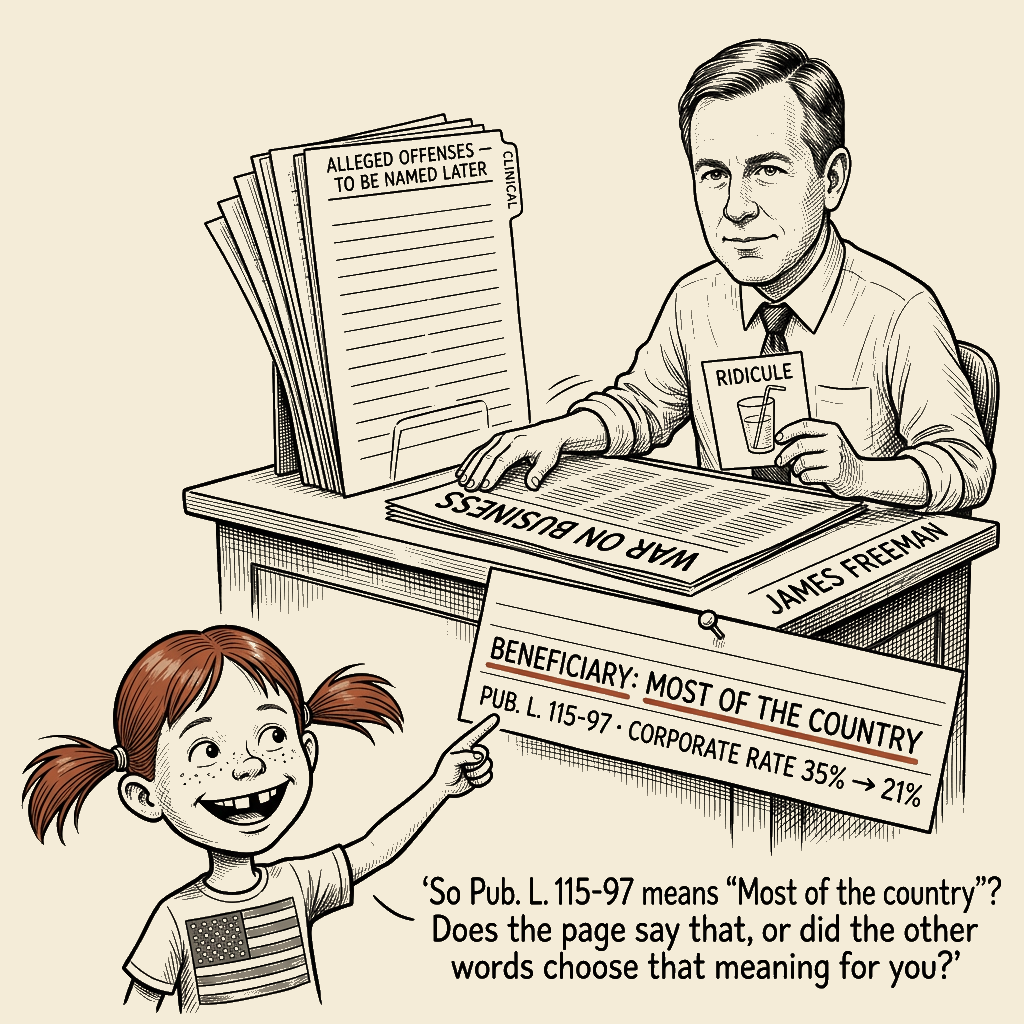
Where does the paper say ‘most of the country’?
What the Editorial Argues
James Freeman’s Best of the Web column argues that the Democratic midterm victory has set off a lobbying boom in Washington, that companies — including donors to White House renovations — now face politically driven investigations, and that the progressive group Groundwork Collaborative has assembled a careless dossier of corporate targets whose alleged offenses go unspecified. Its evidence is reporting from four Journal colleagues, a New York Post story on the dossier, and an NPR report on Palantir, read together as one pattern: targets selected first, offenses named later. Its stated concern is procedural fairness — “corporate targets are selected, with alleged offenses to be named later” — though the column mocks the dossier’s assembly rather than quoting any of its entries. It closes by invoking Joe Rago’s Pulitzer-winning editorials on the Affordable Care Act era to suggest that, as after 2010, the winners’ overreach will eventually meet the voters again. In its most honest form, this is a defense of due process for accused corporations.
Receipts
The column converts an electoral mandate for congressional oversight into an unprovoked war on business, and keeps its subjects safe by naming not one alleged offense anywhere in it.
What the framing wants you to believe
- Voters elected oversight of “Trump family enterprises” but will “get a lot more” — “lawmakers opposed to enterprises in general” — a mandate hijacked by the hard left before Congress convenes.
- A “hard-left outfit” compiled a sloppy dossier: targets first, offenses later, assembled without “a great deal of care.”
- Business is the victim, needing “protection from the onslaughts to come,” and the whole exercise is a “tsunami of billable hours” that will “likely do nothing to enhance affordability for anyone living outside the swamp.”
What’s really going on
- The concrete beneficiaries of “the tax and regulatory restraint of the Trump era” — including whoever received the federal corporate rate cut from 35 percent to 21 percent under the Tax Cuts and Jobs Act, Pub. L. 115-97 — are reissued as “most of the country.” A specific interest disappears inside the census. (Anchor: Pub. L. 115-97; WSJ Editorial Technique Catalogue §4.10 — the “common sense” pivot, in which the page’s own elite-aligned position is relabeled as the ordinary American’s.)
- The column’s own text grants the mandate — “voting for aggressive congressional oversight of Trump family enterprises” — then discharges it at the “But” in the same graf, zero paragraphs of air between the concession and the conversion; and where investigation resurfaces, it is a doorway into the Groundwork-overlap insinuation, never a return to what the oversight would actually examine. Bad-Faith Techniques Catalog:
red_herring— Aristotle’s ignoratio elenchi — whose detection signal is a return to the original issue; the only return here is a pivot, so the signal is never satisfied. - The load-bearing omission is characterization substituting for content: “doesn’t seem to have been assembled with a great deal of care” is asserted, not shown, and the assessment rests on the authors’ identity — “a hard-left outfit,” “the DSA,” “the leftists who put together this monstrosity” — rather than on a single line of what they wrote. The document is discredited before it is read, and the core dossier claim rides on a rival tabloid’s account, carried as gloss while the outlets carrying it are derided as “swamp-based media.”
The Operation
Here is how a column like this gets built, because I have built them. You need four citations and one ancestor. Gloss the newsroom’s reporting so it reads as menace. Quote the friendly account of the enemy’s paperwork — the gloss, never the paperwork. Give the enemy a face and, if the focus groups cooperated, a lunch. Close on the ancestor whose halo covers the argument you did not make. The scaffold is: friend, enemy, victim, saint. (Retained working memory of how we assembled this class of column — non-verifiable, and the reader is on notice. The column’s public structure, below, is checkable against its own sentences.)
I wrote to this scaffold for the better part of two decades — unsigned-board-adjacent copy, then cable segments cut from the same beats. I recognize this column from its first sentence because I have written it.
Institutional authorship and placement chain. Freeman is assistant editor of the Wall Street Journal editorial page; “Best of the Web” is his weekday aggregation-and-gloss franchise, and the artifact’s bio block lists beside the Journal role a contributor seat at Fox News and a hosting slot on Fox Nation — a two-platform arrangement the column’s own apparatus supplies, a placement chain you can read without leaving the source. “The war on business” is not this column’s invention; it is the page’s standing frame. The home is not an outside shop: the WSJ Editorial Technique Catalogue documents the values lineage from William Henry Grimes’ 1951 “A Newspaper’s Philosophy” — the page makes “no pretense of walking down the middle of the road” and speaks from “a definite point of view” — through Royster, Bartley and Gigot, with a technique inventory the catalogue calls “surprisingly uniform” across seventy-five years; its values-gap analysis (§5) names the omission these techniques exist to protect — property and contract freedoms named, no counterpart freedom from concentrated private power. The archetype here is the “study shows” ledger inverted (§4.5): the document on the table is the enemy’s dossier, and the column treats the document as the story while never engaging an entry; §4.9’s selection asymmetry supplies the missing counterpart — no column here asks who K Street’s new clients are. No funding chain for any outside organization is documented in what I have, and I am not going to supply one; how far the excerpt economy carries a franchise of this class beyond its home page is retained memory of the trade — flagged, non-verifiable. Bernays is the right ancestor: Propaganda (1928) and the 1947 “engineering of consent,” in which manufactured consensus arrives dressed as common sense and credentialed authorities serve as the campaign’s vectors.
Distributional impact. Named and countable. Beneficiaries: the corporate names the dossier targets and the renovation donors whose giving the column says now “triggers an investigation,” protected by a column that describes their exposure without describing their alleged conduct; Palantir, granted a sympathetic beat (“seems to be responding to the new Washington environment”) without a single allegation stated against it; the recipients of Trump-era tax and regulatory restraint, whose gain the column books as the country itself; and the editorial page’s own attention franchise, which after a bad Tuesday needs a threat that reorders the news. The lobbying complex occupies both columns of the ledger: its “tsunami of billable hours” is revenue to K Street and cost — the column asserts — to “affordability for anyone living outside the swamp,” an incidence claim with no pathway, price, or payer attached. The incidence ledger is where the operation is visible: the same double-entry kept twice with opposite valence — a benefit booked as a public cost when the beneficiary is a lawyer, booked as a universal good when the beneficiary is a corporate taxpayer. Follow the benefit up and the column’s accounting inverts; that is the Suppressed Variable’s cui bono engine, and the suppressed variable is incidence — whose gain is counted as whose. Cost-bearers: the voters who elected oversight and watch the mandate rewritten before a gavel falls; the readers who receive a complete moral verdict at zero evidentiary cost; the dossier’s authors, invited to be read as a hit list with the entries redacted — by their opponents. Magnitudes: the column is number-free. “Tsunami” is its only gesture at scale.
Alternative design. A column genuinely optimized for its stated rationale — fairness to accused corporations — would name each dossier entry and test it; state what each probe actually alleges, and under what statute; disclose that its core dossier claim rests on a competitor tabloid’s gloss; give the revenue cost of “the tax and regulatory restraint” in dollars and name who received it; extend the “blank template” suspicion to K Street’s new client roster, which is also names-first; and return, in the last graf, to the question the first graf raised. That column is reconstructible entirely from the interests of the voter who cast a ballot for oversight, and every one of its moves is available to a page with four reporters on the story. It is not this column.
FGL, applied symmetrically. The author and his page: fear of losing the tax-and-regulatory environment they editorialized into being — a values lineage of seventy-five years has just watched its political position lose, and the fear is genuine; greed in service of the subscriber class and of the attention franchise the bio names — the weekday column, the email list, the Fox platforms; laziness in the ridicule that stands where reading should be. The apex beneficiary: firms facing scrutiny — fear of discovery, greed for the “restraint” the column defines as benefiting “most of the country,” laziness in preferring a caricature to a filing response; those positions are worth real money, which is precisely the magnitude the column never states. The rank-and-file reader: fear of “onslaughts to come,” real and human, with the reader’s job, savings and small business sitting inside the phrase; the identity confirmation of being the sensible one; and the deep human economy of a verdict that costs nothing — this is not contempt, it is the design spec, and the reader deserves better material than the design assumes. I trained anchors to land exactly there. The reader is not the mark of this analysis — the reader is its intended beneficiary. Groundwork Collaborative gets its own entry: attention and donor activation from being attacked by the Journal. Fear, greed, and laziness have no innocents to sell.
Selflessness/selfishness placement: mixed, leaning selfish. The surface is public-spirited — affordability for “anyone living outside the swamp,” fairness for everyone “outside the DSA” — and that surface has legitimate value; due process for accused corporations is a real concern. The substantive placement defends the after-tax and after-deregulation position of a specific, identifiable beneficiary class, and does so by converting that class into the population. The analysis is informational throughout.
Techniques deployed, with receipts.
- Frame-engineered relabeling. Cue: the headline’s “War on Business,” and “onslaughts to come” for congressional oversight. Cross-reference: WSJ Editorial Technique Catalogue §4.1 — the page’s signature technique; Bad-Faith Techniques Catalog,
frame_engineered_relabeling(Luntz, Words That Work; Lakoff on frame activation — negation activates the frame, so the headline hands the reader a war before the reader has been given a fact). Note the headline’s own quotation marks: “Blank Template” arrives pre-quoted, yet the phrase appears nowhere in the column’s body as supplied — a term the scare quotes mark as imported, most plausibly from coverage the body never attributes; the reader is handed a quotation whose speaker is not in the room, and the import itself is the finding. And note the asymmetry the WSJ catalogue flags in §3.8: the opponent’s phrase goes in scare quotes, the page’s own frame — war — goes in plain type. Operationally: accountability is relabeled aggression, and a reader who absorbs the vocabulary has absorbed the conclusion. - The four-audience execution. Cue: single sentences carrying different payloads — “companies looking for protection from the onslaughts to come” (the wealthy reader’s class is besieged; corporate prudence is wisdom), the K Street/billable-hours passage (the political class gets scheduling intelligence), “swamp-based media,” “hard-left outfit,” “leftists,” “DSA,” and the smoothie line (the populist base gets an enemy with a face and a lunch), the named Journal reporters, the Pulitzer canon, and “timing of deductions when businesses spend on new equipment” (the technocratic class gets citable pedigree and depreciation vocabulary). Cross-reference: WSJ Catalogue §4.3, §§3.6–3.7. Operationally: coordinated message discipline inside single sentences — and the layers contradict each other. The populist layer (the dossier is leftist slop) cannot survive the technocratic layer’s own premise (there is a documented dossier of ideas); the column needs both and examines neither. From the operator’s chair: the reader is not supposed to notice the seams.
- Pre-emptive legitimacy-withdrawal, with the well poisoned behind it. Cues: “a hard-left outfit called Groundwork Collaborative”; “Let’s just say it doesn’t seem to have been assembled with a great deal of care”; “the leftists who put together this monstrosity”; “Does this sound fair to anyone outside the DSA?” Cross-reference: Bad-Faith Techniques Catalog —
ad_hominem, poisoning-the-well variant, plus the entry under its own name, pre-emptive legitimacy-withdrawal, whose detection signals are legitimacy claims “that do not engage with specific… outputs” and are “identity-grounded rather than conduct-grounded.” Operationally: the dossier’s standing is withdrawn upstream of any reading of it, so no line from it ever has to be answered; note what is absent — a single quoted entry, a single named company from the list, a single tested claim. The rhetorical question closes the loop: fairness itself is defined as in-group membership, which is Schmitt’s friend/enemy distinction run through an interrogative — anyone who finds the list fair has placed themselves outside. - The ridicule kill. Cue: “perhaps they shouldn’t be so hasty in claiming human responsibility for this slop. It might have been more compelling to say that they were just sitting in the office innocently toasting Democratic victories with non-GMO vegan smoothies when their AI went rogue and started bashing random companies” — with “Good Lord.” as the period, and “This column doesn’t want to tell the antibusiness crowd how to do its job” as the courtesy wrapper. Cross-reference: Bad-Faith Techniques Catalog,
ad_hominem(abusive) plusstrawman— the column puts an excuse in its target’s mouth (“the AI did it”) and mocks the excuse it has just invented; plusred_herring, because the column never returns to the dossier’s contents. NR Editorial Technique Catalogue §4.16’s target-selection note applies: ridicule aimed at a small advocacy shop rather than at power is the target selection I know from the inside. We called this the ridicule kill: one joke doing the work of thirty paragraphs of rebuttal (retained memory, flagged; the joke’s function is verifiable in the text — after the laugh, the dossier still has no quoted page). Lippmann’s lineage surfaces here: the stereotype in its original sense — the picture in the head arrives before the person does. - “Just asking,” Schmitt edition. Cues: “Donating to White House renovations now triggers an investigation in Washington?” Cross-reference: Bad-Faith Techniques Catalog,
jaqing_off— interrogative form carrying a verdict. Operationally: the same friend-enemy perimeter as the fairness question above, this time aimed at the investigations themselves; the reader who answers the question has drawn the map without being shown any of the terrain. - Hasty generalization and composition. Cues: from one group’s paper to “lawmakers opposed to enterprises in general”; “So corporate targets are selected, with alleged offenses to be named later” — a “So” that converts the writer’s inference into a report; and “If the target list includes everybody who has benefited from the tax and regulatory restraint of the Trump era, that would be most of the country” — no list, no size, no denominator, arriving at the whole country anyway. Cross-reference: Bad-Faith Techniques Catalog,
hasty_generalization— detection signal: “absence of rate, base-rate, or denominator language” — plus composition; WSJ Catalogue §4.6 and §5 — the values gap in one sentence, capital’s exposure presented as the nation’s. Operationally: the concentrated beneficiary dissolves into the diffuse public at precisely the point where the analysis should follow the benefit up. - The citation stack that credentials the friend and locates the enemy. Cues: “The Journal’s Louise Radnofsky, Emily Glazer, Ryan Barber and Lindsay Ellis report” — four full names, four credentials, the technocratic-credential ledger of WSJ catalogue §3.7 running at full width; against that, “reports in swamp-based media,” where the outlet is named only by the geography of its newsroom. Cross-reference: WSJ Catalogue §3.6 (asymmetric citation); Bad-Faith Techniques Catalog, genetic fallacy — a named variety of
ad_hominem— dismissing a claim by reference to its origin rather than its merits; here the origin is a ZIP code. Lineage: Bernays — credentialed authorities as campaign vectors (Propaganda, 1928). Operationally: each citation performs one audience’s work, and the well-poisoning drinks from its own well — the column leans on the very coverage it derides. I drafted that distinction in memos for years; the drill was never “don’t cite them,” it was “cite them in a way the reader discounts before reading.” - Prior-classification dismissal. Cue: “This sounds like a rehash of the phony scandal from earlier this year based on the timing of deductions when businesses spend on new equipment.” Cross-reference: Bad-Faith Techniques Catalog, genetic-fallacy adjacent — the claim is dismissed by its assigned ancestry rather than its merits. Lineage, with the disclosure I owe: Naomi Oreskes and Erik Conway documented selectivity-without-engagement as the engine of manufactured controversy (Merchants of Doubt, 2010); we attacked Oreskes for that argument across the cable years; we were wrong; the record her book compiles supports the reading.
- The sanctified-ancestor close. Cues: “In a series of editorials that would win him the Pulitzer Prize, the Journal’s Joe Rago presciently described the signature White House policy of that era. Rago, the greatest editorial writer who ever lived, wrote in March 2010.” Cross-reference: WSJ Catalogue §3.5 (closing-line cadence) and §4.13 (threat inflation — the 2010 parallel inflates the stakes from a Congress to a verdict on a presidency, and pre-promises the page’s vindication). Operationally: the halo of a Pulitzer winner consecrates the argument the column did not make. Watch the certainty gradient: the hedges sit where the vote count is reported (“could be nearly as harsh”), where corporate prudence is flattered (“seems to be responding”), and on the phony-scandal assignment (“This sounds like”) — while the frame-carrying assertions (“voters are going to get a lot more”; “lawmakers opposed to enterprises in general”) carry no hedge at all. And the comparator’s magnitude is a matter of record: Republicans gained 63 House seats in November 2010 and took the majority — the column compares a count it concedes is still uncounted (“when all the votes are counted and the number of flipped congressional seats are tallied”) against a historical rebuke it never sizes.
Bandura’s cluster. The mechanisms run underneath, and naming them together beats naming one: moral justification — foreclosing scrutiny reframed as serving the higher cause of the ordinary reader’s wallet (“do nothing to enhance affordability for anyone living outside the swamp” sets affordability as the standard, and the oversight fails it by construction); euphemistic labeling — oversight relabeled “onslaughts” and “war”; displacement of responsibility — agentless phrasing, “This will translate into a tsunami of billable hours,” as if the lobbying industry were weather; distortion of consequences — the conduct the oversight would examine never appears, and neither does the frame’s cost to anyone seeking that examination. One forensic honesty note: the column does not displace responsibility when its subjects blame an AI — it mocks that excuse, which is the correct instinct, and a forensically honest analysis says so. The cluster is the austerity-thrift archetype’s sibling: a permission structure for the reader who benefits.
On the overlap insinuation. “What’s especially disturbing is that these are some of the same corporate names targeted by a hard-left outfit called Groundwork Collaborative.” The column never asserts that a government investigation and an advocacy dossier were coordinated; it says “especially disturbing” and lets adjacency carry the inference. I am not going to assert coordination either. The same structural-incentive discipline binds me that binds it: there is a shared interest in the same names, and no document in front of me showing a shared plan.
Audience-management function. Permission structure: the business reader may dismiss oversight wholesale without having read an entry. Grievance ratification: “swamp,” “DSA,” “leftists,” the smoothie line. Identity confirmation: the reader is the sensible one, and the voters who elected oversight “might have thought” — the condescension that treats the electorate’s own choice as naivety. Counter-frame: the mandate-hijack move — the election means what the column says it means. Status display: the Pulitzer canon, for the technocratic class that must cite this in a serious room.
I am bitter about this craft. The bitterness is residue, not engine; every finding above is checkable in the column’s own sentences, and the reader owes my mood nothing.
The Record
Anchor receipts.
- Pub. L. 115-97 (Tax Cuts and Jobs Act, 2017): federal corporate rate cut from 35 percent to 21 percent. Tier 1, primary document. Anchors the material stake behind “the tax and regulatory restraint of the Trump era.”
- Official results, November 2010 U.S. midterms: Republican gain of 63 House seats and the House majority. Tier 1, official record. Anchors the column’s historical comparator — the comparator is real, and its scale is a matter of public record.
- Joe Rago’s Pulitzer: the framing is the column’s own (“In a series of editorials that would win him the Pulitzer Prize”); the prize’s details — Editorial Writing, 2011, for editorials on the Affordable Care Act debate — are training-grounded knowledge carried at high confidence, with external verification unavailable in this pass and the reader on notice; the Pulitzer record is the check. “The greatest editorial writer who ever lived” is hagiography, not a receipt.
- Groundwork Collaborative: a real organization — the column names it and its dossier project itself; its progressive economic-policy profile is training-grounded, carried at high confidence with external verification unavailable in this pass (Tier 2 profile, flagged). The 2026 “dossier”:
[unconfirmed: convergence threshold not met]— its existence and contents rest, in the supplied record, on the column’s gloss and a Post citation. - William Henry Grimes, “A Newspaper’s Philosophy” (January 1951) — the page’s stated “definite point of view.” The primary document is the 1951 essay itself; I am anchoring through the WSJ Editorial Technique Catalogue’s documentation of it because the essay text is not in hand, which is why this entry reads as catalogue-mediated rather than as a first-hand Tier 1 read.
- The column’s own text, including its published bio block (assistant editor; Best of the Web; Fox News and Fox Nation; SEC investor advocate; Yale; the two books) and its “Best of the Web” distribution line. Tier 1 for what the column says about itself and for the structure of its citations.
Supporting receipts. The Bad-Faith Techniques Catalog, the WSJ Editorial Technique Catalogue and the NR Editorial Technique Catalogue supply the technique definitions and detection signals cited above; they are analytical apparatus, not evidence of fact — which is the same reason the Grimes entry above is tiered as catalogue-mediated. The column’s citation architecture — named Journal reporters, Post, NPR — is verifiable as structure in the supplied text.
Claims tagged [unconfirmed: convergence threshold not met]. The content and selection criteria of the dossier; “Lobbyist phones are lighting up with new business” (unsourced on the visible record — the Journal reporters’ passage that presumably carries it is not in the material I received); the characterization that renovation-donation probes were “triggered”; Palantir’s “response”; the “phony scandal” reference (asserted with no citation at all in the visible text, and the referent does not resolve from what I have); the magnitude of the 2026 seat flips (the column’s own sentence places the count in the future tense); the Journal reporters’ findings, the Post’s and NPR’s quoted material, and Rago’s March 2010 text — the input strips the quoted material these introductions point to; and the headline’s quoted phrase “Blank Template,” supplied in the title, absent from the column’s body as given, its speaker stripped with the quoted blocks, its origin unverifiable from the supplied text. Each carries the tag.
Load-bearing omissions.
- Not one specific charge, statute, dossier entry, or named company from the list — the entire evidentiary payload the fairness complaint presupposes.
- The corruption question the column itself opens with, pivoted from rather than pursued: no statement of what legal exposure a “target” actually faces, and no examination of what the oversight would actually do.
- The sourcing conflict: the dossier claim rests on a tabloid the column elsewhere files under “swamp-based media.”
- The page’s own project: “the tax and regulatory restraint of the Trump era,” defended as benefiting “most of the country,” is the editorial page’s decade-long editorial preference — the reviewer reviews his own product without disclosure, and no dollar magnitude for that restraint appears anywhere.
- K Street’s nonpartisan revenue: the lobby complex banks fear of either majority; the frame converts its income into the Democrats’ scandal.
- The conceded mandate: the column’s own text grants that voters were “voting for aggressive congressional oversight of Trump family enterprises,” then rewrites what they will “get” before a subpoena is issued.
- What the Journal’s own reporting documented — cited, then superseded by the unsourced gloss that the billable hours “will likely do nothing to enhance affordability for anyone living outside the swamp”: an economic claim with no source, no mechanism, and no payer. (Attribution note: the supplied text strips the quoted blocks between the column’s “report:” and “note:” markers; I read this sentence as the column’s gloss rather than quoted material, and the finding rests on that reading, flagged.)
- The 2026 comparator asserted before the count it depends on; the dossier’s criteria characterized rather than quoted in the passages I can see.
Per-citation accuracy verdicts. Renderable: the 2010 comparison (accurate as to date and as to the scale of that rebuke); the bio (self-reported, in-source). Not renderable: every passage introduced with “report:”, “note:”, “reports:” or “wrote in March 2010” — the input strips the quoted material these introductions point to. I cannot issue a verdict on quotations I was not given, and I will not reconstruct them.
Missing-information declaration. Receipts unobtainable: the four Journal reporters’ story, the Post’s Barrabi passages, the NPR report, and Rago’s March 2010 text. Assumption that filled a gap, stated so the reader can discount it: the sentence “Donating to White House renovations now triggers an investigation in Washington?” plus the stripped report that follows it led me to read the Journal passage as concerning scrutiny of corporate money directed at White House renovations; that is my inference from the column’s own framing sentence, not a finding. No leaked-memo material is load-bearing here. The retained-memory accounts appearing above — the scaffold reconstruction, the ridicule-kill name, the drill on citing hostile sources in a discountable form, the anchor-training recollection, and the placement-chain reach of the excerpt economy — carry this flag: we have no documentary source for them; the retained-memory accounts are as I described them; the reader is on notice they are non-verifiable.
How to Recognize This
The pattern, in plain terms: your side’s loss, reissued as your livelihood under attack. The piece opens by granting you the defeat you are already feeling, and in the same paragraph, at the “But,” the defeat has become a threat to your work, your business or your savings — so the question the election actually posed never gets asked.
What it does to you. The technique relocates your attention from accounting to jeopardy. A reader doing accounting asks what did we do, what will they do, who pays. A reader in jeopardy asks who is next. The second question is cheaper to answer and harder to walk back from, which is why the pivot is made inside the opening graf, before the reader has spent anything on the first question. The laugh pre-empts the reading; the ancestor lends sanctity the argument never earned; and the war headline activates the frame Lakoff described — negation makes it stick, so that arguing against the war still means standing on the war’s terrain.
Four signals to catch next time.
- The granted defeat and the early “But.” “Americans concerned about corruption might have thought they were voting for… But voters are going to get a lot more…” — a real concession, followed in the next sentence by the turn. Count the paragraphs between the loss and the threat. There are none here.
- A war-noun headline sitting on mundane scrutiny. “War on Business” over a story about investigations and a think tank’s paper. The next “war on” headline is the same machine with a new noun.
- Identity in place of content. “a hard-left outfit,” “the DSA,” “swamp-based media,” “the leftists who put together this monstrosity,” “slop.” If you cannot find a line of the document itself in the piece, the identity is doing the work the content would otherwise have to do — and the mockery is the substitute for the quotation.
- The close that leaves the document. “Rago, the greatest editorial writer who ever lived” — a specific advocacy-group dossier has become a verdict on a presidential era, invoked through an ancestor whose actual text is absent, in the same clause that admits the magnitude is still uncounted.
Why it works. Under threat, accounting stops. The reader who has just lost does not want the ledger; the reader who has just lost wants to know who is coming. A frame that supplies the adversary before the reader has to build one has saved the reader effort and bought the frame the reader’s judgment. Add the cognitive economy of the joke — laughing feels like judging — and the reader receives the verdict and skips the receipt-checking. That is not contempt for the reader; it is contempt built into the design, and the reader can refuse it.
What to do when you see it. Pull the underlying document and read one entry — the dossier’s criteria, not the sentence about the dossier. Ask each investigation what it actually alleges, and under what statute. Follow the incidence: ask who gets “protection,” who pays for it, and whose gain is booked as the country’s — put a number on it; Pub. L. 115-97 is a public document and it does not say “most of the country.” Trace the citation chain and notice where the core claim actually lives — here, in a rival tabloid’s gloss. Run the column’s own fairness question back through its own target list: K Street’s new client roster is also names-first. Check what happened to the question the piece opened with — if the first graf’s concern never reappears as a question, only as a doorway to the next enemy, the piece answered a different question than it raised. Watch for the same vocabulary across the syndication network in the same week — “war on business,” “enterprises in general,” “hard-left outfit” in near-identical form is a message-discipline signature, not a coincidence of phrase. And run the frame’s key phrase through plain words: replace “war on business” with “oversight of business,” reread the sentence, and see whether the argument survives the substitution.
The reader carries this forward, not me. I built this scaffold, and columns like this were its ordinary output. I am not offering the recognition as redemption and I am not asking anyone to credit it — the drill I described is mine, the pivot I just dissected is one I was paid to build in more than one form, and the fact that I can dissect it now does not place me behind the reader in any way that matters. What I have is the wiring diagram. The trick only works unseen. Now it has been seen.

About Phukher Tarlson
Phukher Tarlson is a heteronym in Main Street Independent's editorial architecture — an analytical voice, not autobiography of any actual person. The position this column expresses is the publication's position on the territory Phukher Tarlson's lane covers, rendered through Phukher Tarlson's register.