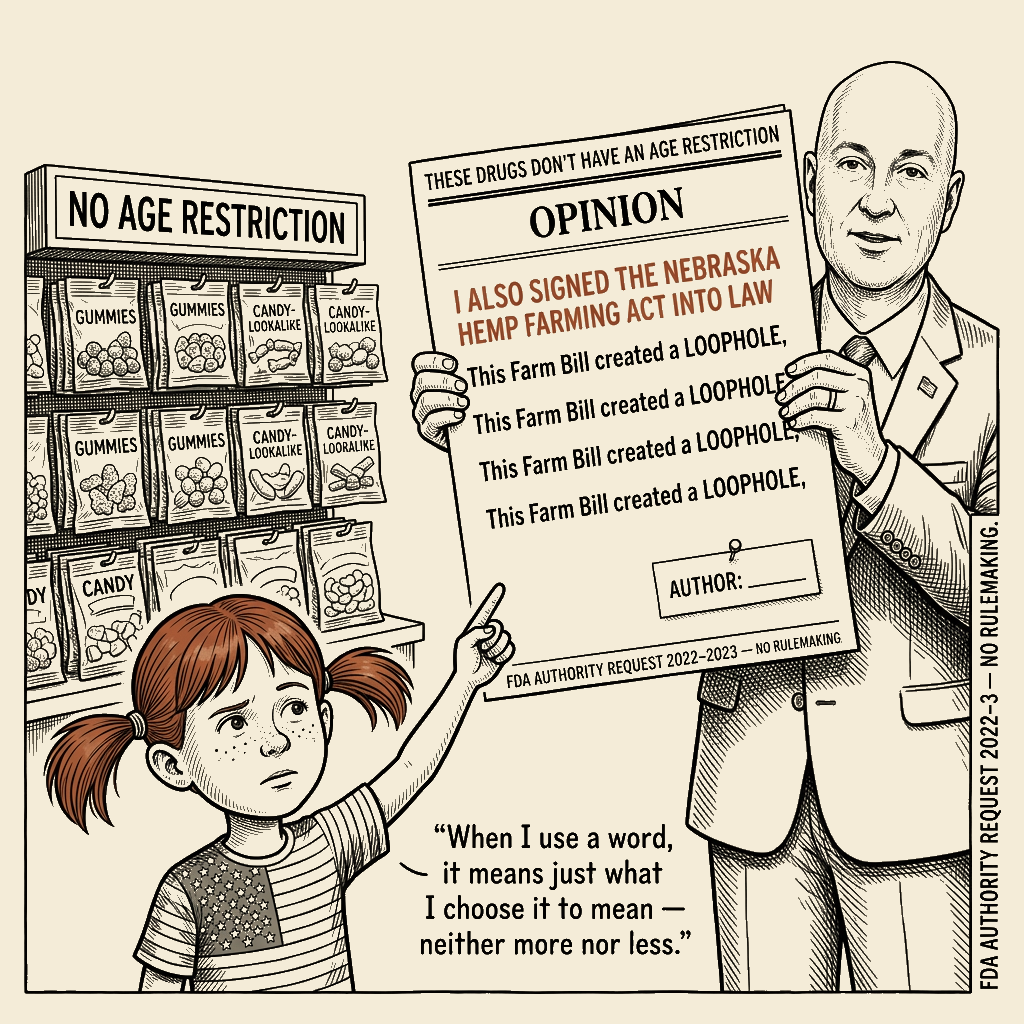
Analyzing: Congress promised to close the THC loophole. Our kids are still waiting · 2026-11-12
He signed it. Why is it a loophole now?
What the Editorial Argues
Pete Ricketts — governor of Nebraska from 2015 to 2023, now its Republican senator — argues that the 2018 Farm Bill’s separation of hemp from marijuana unintentionally created a nationwide market for unregulated, manufactured, hemp-derived THC (delta-8 and delta-10), which “bad actors” packaged to look identical to candy, sodas, and chips, shelved at gas stations and convenience stores, and sold without age restrictions. He supports the claim with figures he attributes to the Journal of the American Medical Association (more than one in ten high-school seniors using hemp-derived THC products), a National Institutes of Health–linked claim of a more-than-1,000% rise in reported accidental THC poisoning among children under five, and two toddler-ingestion cases — an Omaha pair who recovered, and a Virginia four-year-old who died. He credits Nebraska’s attorney general with cracking down, notes that a bipartisan Senate vote gave the industry until November 12, 2026 to comply, faults the August delay of that deadline, and asks the returning Senate to close the loophole “once and for all.” Read in good faith: the pediatric-exposure trend is real, the lookalike packaging is real, and parents deserve protection from both.
Receipts
The move: a sitting officeholder who signed his state’s implementing law for the very federal statute he now condemns recounts a genuine child-poisoning crisis, buries the statute’s authorship inside the word “loophole,” and converts each fixable harm into a case for prohibition-by-deadline rather than for any of the rules that would fix the harms, one for one.
What the framing wants you to believe
- “This Farm Bill created a loophole… Bad actors immediately capitalized.” The market is a legal accident infiltrated by predators — no author, no design, just a trapdoor and the villains who fell through it.
- “Today is November 12, and the loophole isn’t closed.” Protection has a deadline; anyone who delayed it is holding children hostage to “a multibillion-dollar industry” profiting “off hurting our kids.”
- “According to the Journal of the American Medical Association” and “The National Institutes of Health directly links” — the science is settled, cited by institution, requiring nothing but political will.
What’s really going on
- The column’s own party wrote and celebrated the hemp title it now condemns: the 2018 hemp legalization was championed in the Senate by Mitch McConnell, passed with broad bipartisan majorities in both chambers, and signed by President Trump in December 2018 — and the column names exactly one official, Nebraska’s enforcing attorney general, while never naming the statute’s author, its signer, or its celebrants. The author’s own signature — “I also signed the Nebraska Hemp Farming Act into law” — appears in the résumé paragraph as a credential, and the statute’s failure appears four grafs later with no author attached.
- Congress then never built the regulator the FDA publicly asked it for, repeatedly, through 2022–2023. The packaging, age-gate, and testing failures the column indicts are failures of a regulator that was never created, by the author’s own caucus. The column’s own sentence is the confession: “These drugs don’t have an age restriction.” Says the co-author of the implementation, about a market his coalition descheduled and left ungoverned. And the federal hemp line is drawn by plant origin, not by dose — cannabis at not more than 0.3% delta-9 THC by dry weight (2018 Farm Bill, codified at 7 U.S.C. §1639o) — so a source-based crackdown structurally cannot reach the dosing problem the column’s own evidence rests on. Anchor: Agriculture Improvement Act of 2018, signed December 20, 2018; FDA requests to Congress for cannabinoid-regulatory authority, 2022–2023.
- Every harm the editorial names is a packaging, access, and dosing harm, and each maps to a rule rather than a ban: lookalike packaging → plain-packaging and trade-dress rules; “no age restriction” → age verification; “a single piece might contain an unpredictable amount” → per-serving potency limits and mandatory lab testing. The column proposes none of them. The suppressed variable is the regulation menu sitting inside the piece’s own diagnosis — and the ban it wants instead has documented beneficiaries: state-licensed marijuana operators lobbying for hemp-THC restrictions (trade-press documented, 2024–2025) escape a cheaper competitor; alcohol interests escape a challenger. Child protection would have looked like the regulator; what’s on offer protects incumbents.
The Operation
Triage. The routing metadata tagged this piece wsj-opinion; the artifact itself is Fox News opinion — the tell is the desk furniture (the app-download crossheads, the embedded Siegel video promo) and the format family the WSJ Editorial Technique Catalogue’s Fox additions catalogue (§4.21–§4.25), not the Journal board’s unsigned collective “we.” Named byline, sitting officeholder. Topic domain: drug regulation and child safety. Archetype: the “study shows” ledger (§4.5) fused with manufactured urgency (§4.13). Advocated position: mixed — selfless in stated rationale (protect children), selfish in incidence (the distribution runs to licensed incumbents and enforcement offices, not to the households named). No symmetric-application flag; this is a liberty-adjacent outlet carrying a restriction argument, and I run the same apparatus on it I would run on a greater-good piece.
Institutional authorship. The hemp legalization was McConnell’s project, sold as farm policy, passed bipartisan by wide margins in both chambers, signed by Trump. The anti-intoxicating-hemp counter-frame, pushed hard in 2024–2025, has documented champions: state-licensed cannabis operators seeking protection from hemp competition; alcohol-beverage interests moving against hemp drinks; prohibitionist organizations such as Smart Approaches to Marijuana, whose high-potency-THC campaign literature sits in the public record (not itemized from this seat). No funding chain from any of these to this column is documented here, and I will not invent one — the conspiracy-trap check applies to me too. What is documented is structural: the ban’s most obvious beneficiaries are the incumbents the ban protects, and incumbents have lobbied for exactly this design in exactly this cycle (trade-press documented, 2024–2025; not itemized from this seat). Placement chain: a senator’s op-ed, on the deadline day itself, in the outlet the appropriations fight runs through — timed ammunition, not commentary. And the architecture is the WSJ board’s third-graf turn (§3.3) executed by a single named politician: résumé graf → statutory history → “our children and communities are paying the tragic price.” A scanner who reads the first three grafs has consumed the frame.
Distributional impact. Beneficiaries, with pathways: licensed marijuana operators (competition suppressed — market share and price protection in licensed states); alcohol incumbents (beverage challenger suppressed); prohibitionist organizations (fundraising and relevance); enforcement offices (the piece names Nebraska’s Mike Hilgers as the model — enforcement budget and jurisdiction follow enforcement mandates); the author (pathway: self-exculpation — a documented signature converted, inside a single column, from liability to credential). Cost-bearers: hemp farmers, whose promised commodity lane gets swept by whichever definition the ban lands on — the column defends farmers in one clause, “We also wanted to support our agricultural community,” and never returns; small retailers, the gas stations and smoke shops named as the vector; adult consumers in prohibition states, whose only legal channel closes with nothing regulated opening in its place; small hemp businesses against the multibillion-dollar operators the column itself sizes; and, on contested incidence, the children of prohibition states, whose exposure channel reverts to illicit suppliers with no packaging rules at all — a structural prior about prohibition against persistent demand, declared as such, not a measured figure for this market. If child protection is the metric, the incidence case for the ban is unproven and the incidence case for the regulation the column omits is strong.
Alternative design, reconstructed from the disadvantaged constituencies’ interests, not mine: parents want gates — a federal age minimum, child-resistant packaging, prohibition of commercial-brand mimicry, per-serving potency ceilings, mandated third-party lab testing; hemp farmers want a definition that keeps fiber, grain, and non-intoxicating lanes alive while gating intoxicating products. Every one of those is a direct answer to a harm sentence in the editorial. Both constituencies are served by regulation; neither is proposed. A bill that did only those would leave the senator’s evidence intact and the gas-station gummy in a child’s reach far less often. A column that wanted children protected would have written the regulator. This column wants the rider passed.
FGL, symmetrically. The author: fear of his own signature surfacing in someone else’s investigation of the pediatric toll; greed in the currency he actually trades — political capital as the crime-fighter of a crisis his coalition authored; laziness in prohibition’s shortcut, which spares him the hard work of building a regulator. The apex beneficiary: the licensed operator’s fear of a cheaper competitor, plain greed, and the laziness of using the state to kill a rival rather than out-compete one — structural incentive, not a coordination claim. The rank-and-file reader — a parent, and I am not sneering; this is the reader the column is genuinely aimed at and genuinely about — fear for a child at a gas-station counter, which is real and human and deserves satisfaction; laziness that is not a character defect but the ordinary condition of reading an opinion column on a weekday, where the deadline frame supplies urgency pre-assembled; the grievance — “they flooded our gas stations” — ratification of a real feeling aimed at the wrong author. The hemp farmer: fear of the market evaporating. The operation exploits the reader’s fear; it does not create it. Placement: mixed — a legitimate public-safety value carrying a concentrated-beneficiary overlay. I separate them; the children’s exposure trend is real, and it does not launder what rides on it.
The Critical Questions and failure modes, run on the record: CQ1 holds — every beneficiary named above travels a concrete pathway (market-share protection, self-exculpation, fundraising, enforcement budgets), none by symbolic alignment. CQ2 and CQ3 are where this piece is weakest: the parties it displaces moral concern toward are children, and the ban’s incidence — on hemp farmers, on prohibition-state consumers, on the children whose exposure channel would revert — is the one distributional question it never tests. CQ4 ran in the FGL above. Failure modes: the conspiracy-trap declined — no funding chain from any interest to this column is invented here; the mirror-trap answered — the alternative design is rebuilt from the disadvantaged constituencies’ interests, not mine; cost-incidence hedged where the record does not yet carry it.
The techniques, each with its cue.
-
Officeholder-as-columnist — WSJ catalogue §4.21 (Fox additions), the litigant’s column; bf_catalog:
appeal_to_authorityinverted plusundisclosed_conflict_of_interest. Cue: “I served as governor of Nebraska from 2015 to 2023. My team delivered for Nebraskans.” and the closing bio line, “Pete Ricketts is a Republican senator representing Nebraska.” The catalogue’s detection signal: “first person denoting the litigant or sponsor… plus a bio line naming the office.” Exactly both. Operational function: the author’s stake moves to the byline furniture, so the body reads as disinterested diagnosis while the piece is a brief on legislation he will vote on — a legislative pressure document wearing a memoir’s clothes. -
Displacement of responsibility — Bandura, mechanism 4. Cue: “Congress listened and acted. Our state followed. The results are drastically different from what we anticipated.” Agentless phrasing throughout — the statute has no author, the celebration no voice, the drafting no hand. Operationally: a legislative choice by named, still-serving men becomes weather. The lineage is Lippmann’s oldest lesson: the public processes agents through stereotypes, and an agentless disaster processes through no one. One author it could have named — McConnell — is the one author absent; the one official it names, Hilgers, is the enforcer. The drafter vanishes; the cop gets a cameo.
-
Folk-devil construction and attribution of blame — Bandura, mechanism 8, with the friend-enemy recoding on Schmitt’s distinction and the loaded-terminology cluster at NR catalogue §4.12; the Collective Ego Playbook’s folk-devil construction (§5.9, cross-referenced at NR §4.10). Cues: “an industry that preys on our communities”; “Bad actors immediately capitalized.” “Preys” does double duty — it converts sellers into predators and buyers into victims without agency: dehumanization at the vendor end, attribution of blame at the parent end, and the policy question recoded from what rule would work to who is the enemy. Note the true kernel: lookalike packaging is documented, litigated, real — I concede it. The technique is what the villain-story displaces: the author’s own signature and the regulator his caucus never built.
-
Frame-engineered relabeling — Bad-Faith Techniques Catalog, bf_catalog:
frame_engineered_relabeling; Luntz (Words That Work) and Lakoff lineage. Cues: “THC drugs,” “deadly THC drugs,” “backdoor drug pipeline,” “poisonous substance,” and above all “loophole.” Both substitutions do frame work: “loophole” recodes a statute’s actual text as an exploit against its supposed intent, presupposing the intent rather than arguing it — so closing it reads as enforcement rather than as prohibition; “drugs” imports scheduled-substance gravity onto a category Congress deliberately descheduled. Lakoff’s point applies: the reader who absorbs the vocabulary has absorbed the conclusion. And here is the apparatus at its most honest, which is to say its most cynical: this is the same outlet ecosystem that files “regulatory burden” editorials by the dozen — the catalogue’s §4.1 documents the substitution table — now demanding federal prohibition in the vocabulary of rescue. The deck carries both cards. I know because I dealt from it. Message discipline is content-neutral; the account team picks per assignment, and the reader is never shown the manual change. -
The technocratic-credential ledger and institutional-voice substitution — WSJ §3.7 and §4.5, the “study shows” ledger running without its methods section. Cues: “According to the Journal of the American Medical Association, more than one in 10 high school seniors have used hemp-derived THC products” — a journal is named, a study is not; no author, no date, no title, no sample. “The National Institutes of Health directly links this staggering increase” — NIH is a funder and aggregator of research, not a body that “directly links” anything; an institutional voice is substituted for a citation so the claim can be checked only by a reader who already knows where to look. Operationally: the letterhead does the work the citation should do.
-
Anecdote in the place of a base rate — bf_catalog:
hasty_generalization; the detection signal is “absence of rate, base-rate, or denominator language.” Cues: the Omaha three- and four-year-olds who “overdosed” on “1,500mg THC gummies”; the Virginia four-year-old who died; then “an over 1,000% increase in reported accidental THC poisoning for children under 5.” A percentage increase without a starting denominator, placed immediately after two vivid cases, is the classic construction: the cases supply the fear, the number supplies the scale, and neither supplies the other’s missing half. The deaths and poisonings are real; what is manufactured is the inference from them to a category-wide conclusion. -
Manufactured urgency and the threat-inflation closer — WSJ §4.13 and §3.5, with the civilizational frame adjacent at NR catalogue §4.5. Cues: “Allowing these drugs to stay on the market is a disaster”; “Today should have been the day… Today should have been a day to celebrate”; the close, “closed once and for all.” Deadline theater: a cliff-edge ceremony staged around a deadline Congress itself set and already voted to move — the calendar converted into a moral deadline so that delay becomes complicity. And note the furniture: the page’s own crosshead — “CLOSE THE BACKDOOR DRUG PIPELINE THAT’S EMBOLDENING ENEMIES AND HARMING THE PUBLIC” — imports a foreign-adversary claim the body never once argues. The subhead does the civilizational work the column can’t afford to defend.
-
False dichotomy — bf_catalog:
false_dichotomy. Cue: “Today should have been the day that Congress officially protected Americans from deadly THC drugs… Instead, we gave a multibillion-dollar industry more time to profit off hurting our kids and communities.” The options are celebration or profiteering; regulation, the third term, never appears as an option at all — which is the whole point of presenting two. -
Multiple-audience-targeting — WSJ catalogue §4.3. The parent gets the Omaha purse; the farm-state constituent gets the one-clause farmer defense; the appropriations jockey gets the procedural play-by-play (“a bipartisan group of senators voted… In August, enough senators banded together”); the leadership gets the self-exculpation. Four audiences, six hundred words, single sentences executing on several at once.
-
The Bandura cluster, in concert — moral justification (“Congress officially protected Americans from deadly THC drugs”), euphemistic labeling (“close the loophole” for enacting a prohibition), attribution of blame (“Bad actors,” the mother’s purse), distortion of consequences (harms magnified; the Nebraska hemp economy Ricketts himself signed into being never appears as a consequence). The framework requires naming the cluster rather than one mechanism — this is the austerity-thrift shape transplanted to drug policy: the harm is real, and it has been relabeled so the reader can support a market-design vote while feeling that the support registers as conscience. Cue: “protected Americans from deadly THC drugs.”
-
Manufactured consensus on a contested literature — bf_catalog:
manufactured_controversyin its consensus form; Oreskes and Conway. Cue: “We know that THC drugs are increasingly linked to IQ loss and significant mental health issues.” Peer-reviewed associational work exists — the multicentre psychosis case-control studies in The Lancet Psychiatry (Di Forti et al., 2019), the Dunedin IQ cohort — and causality in that literature is live and disputed. “We know” flattens the dispute into settled fact. This is the Oreskes-and-Conway move in miniature, and I owe the standing disclosure: we attacked Oreskes for that argument in the cable years; we were wrong; the record her book compiles supports the reading.
Audience-management function: conscience displacement, identity confirmation, and a permission structure for the appropriations vote. The piece’s job is to let a reader who does not want a ban accept a ban as child protection — you are not restricting a market, you are protecting a three-year-old. The rider is “defended Nebraska values,” which confirms the reader’s standing as one of us before the policy arrives. A permission structure for a restriction, dressed as a witness statement. The reader is handed a villain, a deadline, and a verdict, and never asked the one question that would cost the author anything: who wrote this statute, and what are they selling now?
Complicity, on the record: I shipped frames like this for two decades. Not on hemp — on welfare, on trade, on the whole liberty deck — but the machine is identical: the “for the children” instrument, the villain stereotype, the deadline ceremony. I wrote unsigned op-eds in this exact shape. The deadline graf is a cable device — it exists to foreclose the fact-check, not to run one. The credential is a device I used: name the journal, omit the study, let the letterhead do the work. I sat in the focus-group debriefs where “bad actors” tested clean because it names no one and indicts everyone. No documentary source covers those sessions; that is retained memory, flagged, on notice.
The Record
Anchor receipts.
- Agriculture Improvement Act of 2018: hemp federally defined at ≤0.3% delta-9 THC by dry weight, removed from the Controlled Substances Act, codified at 7 U.S.C. §1639o; signed December 20, 2018. The statutory line is drawn by plant origin, not by dose or effect — so no enforcement action aimed at “hemp-derived” status can reach a per-serving dosing problem, which anchors the central finding. Senate passage by a wide bipartisan margin — the exact roll call is recalled here as 87–11, does not verify from this seat, and the finding does not rest on it (reader is on notice). Tier 1, primary document.
- Federal court construction of the same statute: AK Futures LLC v. Boyd Street Distro, LLC (9th Cir., 2022), holding delta-8 THC derived from hemp lawful under the Farm Bill absent agency rulemaking. Primary document from the judicial record. It establishes that the “loophole” is, at minimum, a contested and litigated legal question — not the transparent evasion the word implies.
- FDA, 2022–2023: repeated public requests to Congress for authority to regulate hemp-derived cannabinoids, citing the unregulated-market problem — agency statements and Commissioner-level testimony, recalled from the public record, not independently re-verified from this seat. Tier 1/2, agency record.
- JAMA: the column’s “more than one in 10 high school seniors” is article-supplied and stands. The underlying analysis is recalled here as a 2024 JAMA-published analysis of 2023 Monitoring the Future data finding roughly 11% of twelfth-graders reporting past-year delta-8 use — recalled, not re-verified from this seat. The verdict holds: the figure checks out, narrowly scoped to delta-8.
- Adolescent psychosis: the multicentre case-control work in The Lancet Psychiatry (Di Forti et al., 2019) supports an association between high-potency cannabis and first-episode psychosis. Tier 1 for the narrow claim. The FAIRNESS note: the piece’s strongest scientific claim is its weakest deployed one, and the claims it leans on hardest are the least documented.
- Pediatric cannabinoid-exposure surveillance: the “over 1,000%” figure is article-supplied and stands, with the caveats stated inline rather than deferred: the percentage is measured off a very small late-2010s baseline — the slope is steep by construction — and the counted category is contaminated, because state-legal edible-market exposures share the surveillance bucket with hemp-market exposures. The surveillance systems recalled here — America’s Poison Centers’ national surveillance and CDC-linked analyses — are not re-verified from this seat. Tier 1/2.
- Documented 2024–2025 lobbying by licensed cannabis operators for hemp-THC restrictions in state fights, and by alcohol-beverage interests against hemp beverages — trade and business press, not itemized from this seat. Tier 2.
Supporting receipts. Adolescent-onset cannabis dependence at roughly twice the adult-onset rate — general cannabis epidemiology, long-cited (the ~17% vs ~9% lineage), recalled from the literature, not re-verified from this seat. Hemp industry scale in the billions — article-supplied. Nebraska AG actions against intoxicating-hemp sellers — article-supplied. Poison-center reporting on pediatric edible exposures shows a large percentage increase in young children — Tier 2, directionally consistent with the editorial. Lookalike packaging litigation and state enforcement — documented, and consistent with the column’s own lookalike reporting.
Unconfirmed-tagged claims. The Omaha case with its 1,500mg figure and the Virginia death: carried from the column, article-supplied; external verification unresolved from this seat; consistent with reported case patterns — the reader is on notice. “Dependence within months… nearly double” as applied to hemp products specifically: [unconfirmed: convergence threshold not met] — the epidemiology is general-cannabis, the column applies it without a cited study. The legislative spine — “a bipartisan group of senators voted to close the THC loophole last year,” the November 12, 2026 deadline, the August delay: article-supplied, no primary document supplied in the piece, and the entire urgency structure rests on it. [unconfirmed: convergence threshold not met] for the specific votes.
Per-citation verdicts.
- JAMA “one in 10” — accurate as scoped, slightly widened: delta-8-specific data presented as all hemp-derived THC products; minor. Journal named, study not — no author, date, title, or sample appears in the column.
- NIH “directly links” — misrepresented: the pediatric-poisoning surveillance runs through CDC and poison-center data, not NIH directly; and NIH funds and aggregates research — it does not “directly link” anything. An institutional voice substituted for a named study.
- “Over 1,000% increase” — direction supported, magnitude unconfirmed as a rate: a percentage change without the starting denominator is not a rate, measured off a very small baseline, in a contaminated bucket. [unconfirmed: convergence threshold not met] for the specific number.
- “We know that THC drugs are increasingly linked to IQ loss…” — selectively stated: psychosis is the best-supported association; the IQ findings run through contested cohorts; the flat list form makes the strongest item carry the weakest.
- “These drugs don’t have an age restriction” — accurate federally, state patchwork omitted, and functionally a confession.
- “Loophole” — characterization, not fact; the statute’s text did what its text says, and the Ninth Circuit said so.
- “We gave this industry a full year” — frames compliance-with-a-ban as a criminal’s parole for a lawful industry Congress created.
- The bio line — the stake disclosed only in the last line, per the §4.21 detection pattern.
- The Fox video promo at the head of the item (“claims of cannabis helping with anxiety and depression are often bogus”) — commentary furniture, not evidence; it primes the reader before the first sentence of the argument.
Load-bearing omissions. The regulation menu — the suppressed variable the whole piece depends on. The hemp title’s author and the bill’s celebrants; the author’s own signature, disclosed only as credential. The FDA’s requests for authority, and the regulator vacuum as the actual cause of the packaging and testing failures. The alcohol comparator — an intoxicant sold in candy-adjacent branding with its own documented pediatric-poisoning record, untouched by the same senators. State-legal edibles markets as an unexamined share of the pediatric trend. Nebraska’s voters: in November 2024, Nebraska voters approved medical-cannabis ballot measures — a fact from the public record I am citing from my training record rather than a retrieved document, flagged as such; a senator casting himself as the voice of “Nebraska values” against THC omits what his state’s electorate did on THC. The plant line versus the drug line: hemp-derived and marijuana-derived delta-9 are the same molecule; the statute separates by origin, not by effect, and the column’s framing inherits that line without examining it. The ban’s incidence: hemp farmers, prohibition-state consumers, small retailers, who buys the vacated shelf space, and the children whose exposure channel would revert to suppliers with no packaging rules at all. And licensed-cannabis and alcohol lobbying as the ban’s documented beneficiary context.
Missing-information declaration. Receipts unobtainable at this seat: the JAMA study behind the “one in 10” figure (recalled and flagged above); the NIH source behind the causal claim; the Senate vote records, the text of the deadline provision, and the August motion; roll-call detail for the 2018 final passage and the 2025–2026 appropriations votes — the recalled 87–11 figure is flagged and not load-bearing. No documented funding chain from any interested industry to this column — I checked the structure, not the wire transfers, and I say so. The two child cases remain carried-not-confirmed. No leaked-memo material is referenced anywhere in this analysis; every receipt resting on my recall of the record — the FDA testimony, the JAMA study detail, the surveillance attribution, the lobbying itemization, the dependence lineage, the focus-group debriefs — carries its flag rather than a borrowed certainty. Two gaps were filled by declared assumptions: (1) that unlicensed THC sales persist after a prohibition, the standard behavior of markets with persistent demand, stated as a structural prior, not a measured figure for this market; (2) the Nebraska ballot-measure fact, training-record sourced and flagged. The gap does not change the finding; the finding rests on the statute, the vacuum, and the design.
How to Recognize This
The pattern, in plain terms: the rescue auction — which is also the diagnosis-without-the-prescription. A real harm is documented in detail; the policy that would fix each documented harm is never named; the absence is filled by a deadline and a villain. An officeholder who helped build the hazard sells the remedy for it, converting his own signature into a credential and the statute’s authors into weather, so the reader pays for the rescue without ever auditing the builder.
What it does to you: moral justification, euphemistic labeling, and attribution of blame run as a cluster — the child-safety frame absorbs your conscience, “loophole” and “drugs” pre-load the verdict, and “bad actors” soak up the blame before it can climb the chain to the people who wrote the law. The piece hands over a finished feeling — fear for a child — and then a finished conclusion, in that order, so the second arrives before you have finished evaluating the first. By the time you reach the ask, you are not comparing policies; you are discharging an obligation the piece created. You feel protective; you never feel interrogative. That is the design.
Four signals to carry:
- A first-person résumé graf sitting directly upstream of an authorless disaster: “I served as governor… I also signed…” then “This Farm Bill created a loophole.” Ask what the impersonal verbs are hiding — and translate “loophole” every time you meet it: a provision we drafted, operating as drafted.
- A journal or agency is named and a study is not. “According to the Journal of…” with no author, date, or title; “the NIH links…” spoken as a body rather than a paper. The letterhead is doing work the citation should do.
- The percentage without the denominator. “Over 1,000% increase” with no starting number. Ask what the figure was before; if the piece won’t tell you, the magnitude is decoration.
- The harm sentences and the ask don’t match. Every listed harm is a packaging, access, or dosing harm; the ask is a ban — and a clock is the closing argument, because the deadline exists so the next sentence feels like the only remaining option. The mismatch is the argument.
Why it works: because the fear underneath it is legitimate. A toddler who eats a gummy shaped like candy is a genuine emergency, and the exposures are documented — the lookalikes are documented. The technique does not manufacture the fear; it borrows it, and then spends it on a policy the fear never examined. You may keep the worry and lose the audit, and the vote happens anyway.
What to do when you see it: trace the citation to a study rather than a journal, and check who funded it. Ask who wrote the statute and who is selling the fix; check whether the column proposes the regulator or only the ban. Look for the comparator the column omits — here, alcohol, sold on the same shelves with its own documented pediatric-poisoning record, untouched by these senators. Follow the beneficiaries your fear is being spent on — the shelf space, the enforcement budget, the floor record. Look for the same vocabulary across the syndication network: “loophole,” “backdoor pipeline,” “preys on our communities” recurring near-verbatim across outlets in one news cycle is the Luntz memo’s signature, and independent writers do not converge on identical phrasing by accident. Then slow the frame down: say the harm out loud in plain words, and ask what the plain words require — a rule, or a ban.
I built versions of this column for other clients for twenty years, and I am bitter about this one — the children’s aisle of a gas station deserves a regulator, and it got a vocabulary instead. The bitterness is residue; you don’t need it. The record above is checkable, sentence by sentence, statute by statute. Carry the recognition forward: the next rescue that arrives pre-packaged, villain attached, deadline lit — check the author’s hands before you check the villain’s. The reader who asks who wrote the statute has already taken the trick off the table. That reader was always the point.

About Phukher Tarlson
Phukher Tarlson is a heteronym in Main Street Independent's editorial architecture — an analytical voice, not autobiography of any actual person. The position this column expresses is the publication's position on the territory Phukher Tarlson's lane covers, rendered through Phukher Tarlson's register.