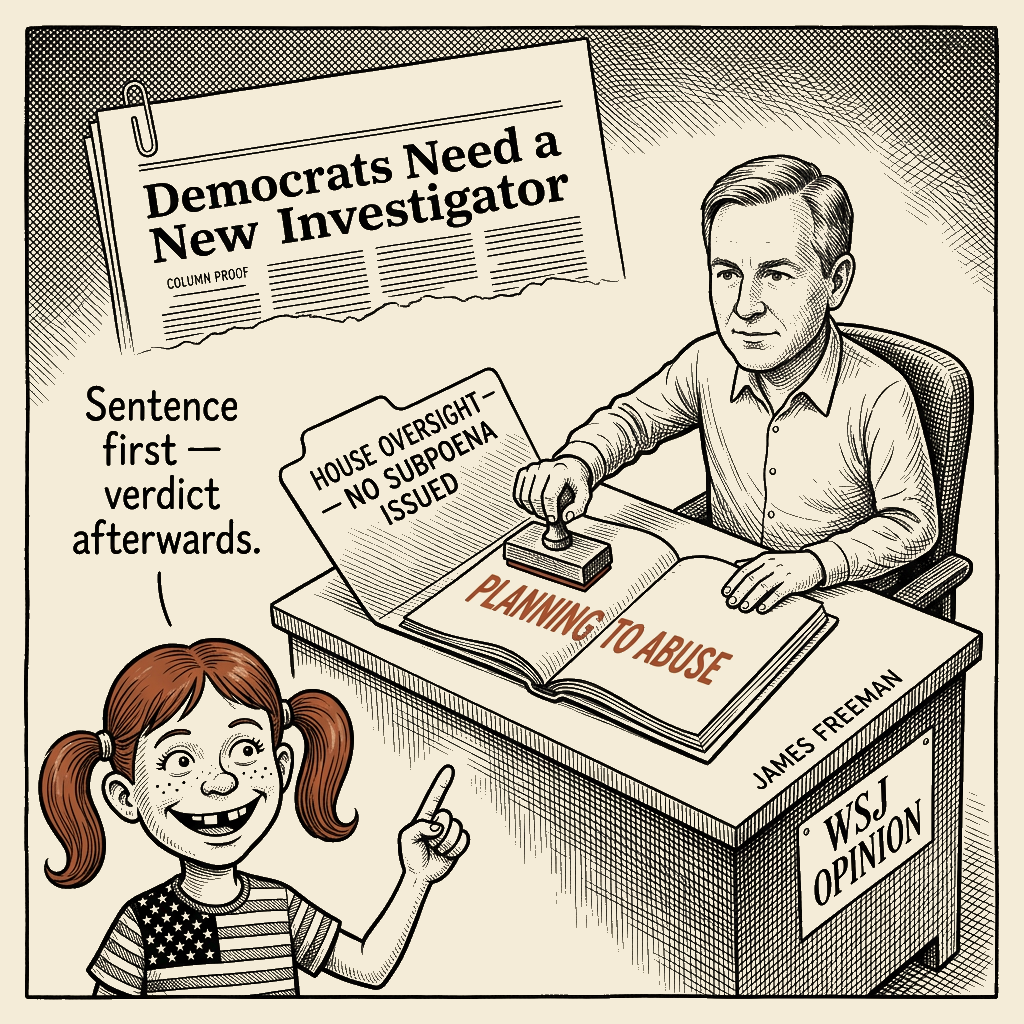
Analyzing: Democrats Need a New Investigator — James Freeman · 2026-11-12
The verdict came before the subpoena.
What the Editorial Argues
James Freeman’s Best of the Web column argues that House Democrats — with Robert Garcia expected to chair the Oversight Committee when the new Congress convenes in January — are preparing to abuse their investigative powers rather than conduct legitimate oversight. He builds the case from a letter by White House counsel William Scharf objecting to the planned probes, from Garcia’s own website language and social-media presence (including a remark about “gay” “pettiness” and clown imagery Freeman endorses as “a reasonable description”), and from a Politico report that Democrats intend to move “in haste.” Past prosecutions of Donald Trump, Freeman argues, were “unreasonable lawfare” that Trump converted into political advantage, and a repeat would misfire again. The column’s stated burden, stated fairly: premature, speed-driven, person-driven oversight discredits itself, and the reader should pre-judge the new majority’s investigations accordingly — with a closing item reporting that Strategas’ “Common Man CPI” puts October inflation at 4.2 percent now that the official comparison is unavailable.
Receipts
The column issues its verdict before the investigation exists, so that every document the committee later produces arrives already discounted.
What the framing wants you to believe
- Democrats are “planning to abuse their investigative powers once they take control of Congress” — abuse is the premise, not the finding — and the real danger is a “pretext to attack business in general,” not scrutiny of any actual conduct.
- Rep. Garcia is a clownish, partisan, self-serving investigator whose own words establish that his committee’s work is “political warfare,” and speed is guilt: “Dems feel the need for speed in Trump oversight push” is presented as self-condemning rather than as a normal majority’s organizing plan.
- The honest inflation number is the private one — 4.2 percent — because the government’s is missing.
What’s really going on
- The beneficiary is the sitting executive and the Trump family business, whose exposure to congressional inquiry is reduced in advance by a frame that marks the inquiry as predetermination. The mechanism is narrative pre-emption: a signed column on the Journal’s opinion feed sets the interpretive frame ahead of the committee’s first subpoena. Freeman names the family business as the investigative subject himself, which is the concrete pathway, not an inference from alignment. The Supreme Court affirmed Congress’s power to subpoena a president’s records in Trump v. Mazars (2020), and New York juries convicted Trump on 34 felony counts in May 2024 and his company on tax fraud in December 2022 — adjudicated conduct absent from a column asserting “overzealous prosecutions.”
- The load-bearing omission is the actual committee record: the column quotes no proposed inquiry, no subpoena, no document request — only a White House letter attacking a chairman-designate, the designate’s own X posts, and one press headline. Nothing in the text establishes what the investigations will investigate. [unconfirmed: convergence threshold not met]
- The quotations the column leans on are its own evidence: Scharf’s letter and Garcia’s posts are quoted selectively, with several source blocks in the published text appearing as empty quote frames whose content is not visible to the reader. The WSJ Editorial Technique Catalogue §4.6 documents the pattern this runs on — engaging a maximalist caricature of an opponent’s position rather than the position itself — and the Bad-Faith Techniques Catalog’s
pre-emptive-legitimacy-withdrawalentry names the upstream move. - The kernel is real: politicized oversight can discredit itself, and Garcia’s “pettiness” musing was a self-inflicted clip. The column never separates that kernel from the service the pre-fired frame performs for the inquiry’s subject — and the separation failure is where the operation lives.
The Operation
Institutional authorship. This is a signed column by James Freeman, assistant editor of the Wall Street Journal editorial page and its weekday Best of the Web columnist — a named operator inside the page’s apparatus rather than the unsigned “we.” The “lawfare” frame has a documented supply chain. The literature credits Charles Dunlap with the coinage — circa 2001 in military-academic writing, the use of law as a weapon in war, the exact dating contested across sources — and the term migrated into domestic partisan use in 2023 as the umbrella frame for the Trump prosecutions, monetized in real time with wire-reported fundraising surges following the indictments. The page’s lawfare-and-weaponization frame is documented in WSJ Editorial Technique Catalogue §4.19: proceedings the page disfavors are “lawfare”; proceedings it favors are accountability. Here the frame is applied prospectively — it arrives before the proceedings. And the delivery is signed, not unsigned: the board’s documented §4.19 apparatus reaches the reader through the page’s aggregation column, with the bio line documenting where the channel runs — Fox News contributor, Fox Nation host. The frame crosses platforms without changing clothes. The page’s stated values — “free people, free markets” — sit on the surface of this defense of executive prerogative; the values gap the catalogue documents at §5 shows up here as scrutiny of property and family business recoded as the danger.
Placement chain. Watch the assembly. Monday: the White House counsel’s letter. Wednesday: the column quoting it in slot after slot as the constitutional authority. The Politico process report becomes “in haste.” Garcia’s website becomes a gloss. Scharf’s mockery — the “demonic clown” comparison — is ratified by the column as “a reasonable description.” The Strategas client note becomes the closing stat. Each item does one job. I wrote in this assembly logic for eight years on that page — retained memory, flagged as such and non-verifiable — and the rundown discipline is real: the lead sets the frame, the middle items furnish the feeling, the closer installs the takeaway. The takeaway here is that the referee is missing and the private number is honest.
Distributional impact. Beneficiaries, with pathways: Trump and the family business — every future document request arrives pre-stained as persecution; the incoming majority — a mirror-image permission structure banked for their own oversight cycles; Strategas — a marketing product for institutional clients presented as public service; Freeman’s own engagement economy across page and cable. Cost-bearers: the voters’ informational interest; the oversight function itself; the Bureau of Labor Statistics as statistical referee, its shutdown-disrupted release framed as the system’s dishonesty rather than an administrative artifact; and the norm that a witness may consult counsel, which the column recodes as intimidation: “It’s hard to see Mr. Garcia’s ‘Lawyer Up’ message as anything more than an effort to intimidate.” Named cost-bearers also include the House Oversight Committee’s evidentiary record, which will be litigated as theater rather than on its contents. Magnitudes: the supplied text documents none in dollars — attention and narrative position are the currency here, and I state that plainly rather than infer a financial pathway I cannot document.
Alternative design. Reconstructed from the oversight constituency’s actual interest, not my preference: if the stated rationale governed — protecting constitutional limits and the rights of investigation targets — the column would state the governing standard (Mazars), wait for a specific subpoena, and test that subpoena’s breadth against it. It would apply its solicitude for targets’ rights across administrations rather than to one. It would engage the actual instruments — defined requests, published scope, published refusals and their reasons — rather than press accounts and an advocacy letter, and it would not treat a witness’s recourse to counsel as bad faith. What we have instead is the target’s counsel supplying the standard and a press report supplying the haste. The column does not argue against that design. It argues against Rep. Garcia’s X posts. That gap is the operation.
FGL, applied across three constituencies. The framing’s author: attention capture — the clown beat is the engagement item — plus franchise value across platforms, plus the format’s own laziness, since the frame arrives pre-built in the letter; I recognize that laziness because I wrote for that audience. The apex beneficiary: fear of exposure — the family business is the announced subject; greed — protected business interests; laziness — a pre-installed dismissal spares the work of engaging each request. The rank-and-file reader: fear without contempt — “pretext to attack business in general” generalizes the threat from one family to the reader’s economic identity, and the reassurance is that no one is investigating wrongdoing, they are against business itself; laziness — “OK. Moving right along” models skipping a clarification. The fear is real and human: institutions have been used as weapons before, in the reader’s own memory, and the reader did not build this frame. This analysis owes the reader better than contempt. Placement: selfish — informational. The advocated position shields a specific administration and business from scrutiny while selling the shield as constitutional principle and civic warning; the column presents itself as a warning against premature judgment while performing premature judgment, which is the asymmetry the whole piece rests on.
Critical-questions check. CQ1: the pathway is concrete — Freeman’s own sentence names the family business as the investigative subject. CQ2: the beneficiaries invisible from the frame are the reader being primed and the referee being retired. CQ3: costs land where named — on oversight capacity and information, not on the parties the column says it protects. CQ4: FGL applied above across all three constituencies. The seven failure modes, run and receipted: symbolic-inference — cleared, the pathway is stated rather than inferred from alignment; frame-bounded-blindness — cleared by the scan outside the frame, which found the retired referee and the primed reader; cost-incidence-error — cleared, the costs carry payment pathways in information and oversight capacity, not abstractions; mirror-trap — cleared, the alternative design is rebuilt from the oversight function’s own stated rationale; cynicism-trap — cleared by separation, the column’s legitimate value — solicitude for investigation targets’ rights — is kept distinct from the pre-emptive overlay built on top of it; asymmetric-fgl — cleared, applied across three constituencies above; conspiracy-trap — cleared, no coordination asserted beyond the documented frame uptake.
Technique identification. Each entry: the cue, the catalogue, the operation.
- Pre-emptive legitimacy-withdrawal — bf_catalog:
pre-emptive_legitimacy-withdrawal, frame manipulation. Cue: “News accounts give every indication that Democrats are planning to abuse their investigative powers once they take control of Congress.” The literature runs from Raz and Habermas on legitimacy to Stanley, How Propaganda Works (2015). The judgment precedes the conduct; the catalog’s falsification condition — engagement with specific case-level acts — goes unmet. The opening paragraph performs the whole operation in miniature, three moves stacked: the verdict (“planning to abuse”), the generalization (“pretext to attack business in general”), the fairness formula (“But to be fair, people in the White House have rights too”). Note the tension the column carries without feeling: it concedes the questions may be “reasonable” while pre-coding their use as “pretext.” A reasonable question cannot be an abuse by anticipation; the column needs both sentences, so it keeps both. Operationally it converts every future document into corroboration of a verdict already returned. - The “lawfare” / “weaponization” frame — WSJ Editorial Technique Catalogue §4.19, this piece’s archetype. Cue: “his political opponents wage unreasonable lawfare against him”; “overzealous prosecutions”; the investigators “just conducting political warfare.” The catalogue’s asymmetric-application test applies directly: legal proceedings the frame disfavors are “lawfare”; comparable proceedings the frame favors are accountability. The substitution is the argument.
- Frame-engineered relabeling — bf_catalog:
frame-engineered_relabeling; Luntz’s substitution discipline, Lakoff’s frame activation. Same cues. Investigation becomes warfare; the word carries war inside it. Lineage: Schmitt’s friend-enemy distinction — a constitutional process recoded as combat licenses otherwise-indefensible dismissal, because when oversight is war, everything is permitted against the enemy’s lawfare. The deeper lineage is Bernays and Lippmann: consent manufactured before the event, the stereotype delivered ahead of the picture it claims to interpret. Garcia’s X feed supplies the pre-cut image; the reader never needs to encounter a single document request. I operated all three. The point of naming them is not that they are exotic; it is that they are standard equipment. - Strawman, selectional form — bf_catalog:
strawman; WSJ Editorial Technique Catalogue §4.6. Cue: “reasonable questions about the administration and Trump family business as a pretext to attack business in general.” The leap from a defined target to a categorical one is the column inventing the maximalist version and refuting it. The catalogue’s mechanical test — identify original scope, identify characterization, compare — fails the column: no one has proposed investigating “business in general.” - Slippery slope without intermediate links — bf_catalog:
slippery_slope(Walton). Same cue. The chain from “questions about the administration” to “attack business in general” is asserted with no evidence for any link; the terminal consequence is vivid and, for this readership, maximally threatening. - Source-citation asymmetry — WSJ Editorial Technique Catalogue §3.6–3.7. Cue: Scharf’s letter quoted at slot after slot as the authority on constitutional limits; Garcia’s website glossed rather than quoted; his clarification quoted and then dropped. Operation: the administration under investigation supplies the legal standard; the investigator supplies the clown. The asymmetric scare-quote discipline runs alongside — Garcia’s words arrive flagged as suspect, “gay” “pettiness,” while the column’s preferred terms run unmarked in Freeman’s own voice.
- Person-as-policy / the folk-devil beat — bf_catalog:
ad_hominem, abusive variety; the person-as-policy detection logic the catalogues name in the Fox register. Cue: the headline itself — “Democrats Need a New Investigator” — and the ratification of Scharf’s comparison: “The ‘demonic clown’ comparison seems like a reasonable description of Rep. Garcia’s recent post on X. He seems to be projecting an image of a legislator who is Pennywise and sounds foolish.” Run the catalogue’s test: strike Garcia from the column and the case for “abuse” rests on press accounts and the White House’s own letter. Nothing else remains. The migration is the note worth keeping: the catalogue’s Fox-register patterns now run through the page’s aggregation column, and the bio line documents the crossover. - Ridicule as evidence — NR Editorial Technique Catalogue §4.16, the Buckley-tradition ridicule, whose note is on target selection. Same cue. Ridicule of a sitting legislator substitutes for engagement with his jurisdiction; by the catalogue’s own standard, high-tone sneer at a named target with no substance beneath it is contempt, not argument.
- Bandura’s cluster, running in concert. Moral justification: “But to be fair, people in the White House have rights too” — a true sentence deployed to recode scrutiny as persecution. Euphemistic labeling: “lawfare.” Attribution of blame: “what Mr. Trump has a track record of doing is benefiting from the backlash that results when his political opponents wage unreasonable lawfare against him” — resilience attributed to opponents’ overreach, with the adjudicated record edited out. Distortion of consequences runs alongside: the documented harms of the January 6, 2021 riot appear in the column only as the moment “Republicans were moving on from Mr. Trump” — the riot becomes a plot point in the Democrats’ error. Advantageous comparison marks only the option it attributes to the other side as backlash-producing, and so invites the reader to prefer the disciplined, document-driven oversight the column never advances — because stating it would show the column is not against bad investigations but against this one. Three-plus mechanisms in concert is the paradigm wiring in a different costume: the reader is licensed to experience accountability as persecution, and persecution as the persecutors’ fault.
- Motive attribution dressed as analysis —
bf_catalogdocumentation threshold. Cue: “It’s never been clear whether Democrats then launched overzealous prosecutions of him because they didn’t want him to run for president again or because they did, but this column leans toward the latter.” The threshold requires behavior-pattern identification from primary sources; “this column leans toward” is the speaker flagging a guess as a guess and printing it anyway. It also functions as goalpost-shifting in advance: whichever motive is documented later, the column has already conceded uncertainty. - The dismissal-of-clarification pivot. Cue: the Oversight Democrats’ account quoting Garcia — “In seriousness, it’s NOT pettiness. It’s a desire for real justice.” — followed by “OK. Moving right along.” Catalog: the dispositive-marker family of WSJ Editorial Technique Catalogue §3.4 — the phrase does what “of course” and “obviously” do, marking the clarification as settled in the same breath it is conceded; adjacent in mechanism to the selectivity element of the Bad-Faith Techniques Catalog’s
denialismpattern. Operation: a retraction is quoted and retired in one motion; the mockery survives its own correction. I ran this pivot for years — retained memory again, non-verifiable; the reader is on notice — and it is small, and it trains a large habit: the reader learns from one instance that the correction is noise. - The “study shows” ledger, closing variant — WSJ Editorial Technique Catalogue §4.5. Cue: “Mr. Trennert’s Common Man estimate comes in at a dreary level of 4.2% inflation,” with the official figure absent and the provider’s identity — a Wall Street strategy shop marketing a product to clients — undisclosed. Adjacent: the selectivity element of the Diethelm–McKee
denialismpattern. Lineage: Oreskes and Conway on manufactured doubt — and I owe the disclosure the lineage requires: we attacked Oreskes for that argument from the cable chair; we were wrong; the record her book compiles supports the reading. Elevating a friendly private estimate against a lapped official statistic is the doubt-manufacture shape in miniature: the referee is discredited by absence, and the aligned vendor fills the vacancy. - Red herring / dismissal. Cue: “OK. Moving right along, in case anyone was inclined to take investigations undertaken by the new majority at face value.” The transition performs the dismissal it never argues; the Bad-Faith Techniques Catalog’s relevance rule applies directly.
- The threat-inflation closer — WSJ Editorial Technique Catalogue §4.13. Cue: “Democrats seem eager to overdo it again and perhaps once again with results they didn’t intend,” followed by the “Lawyer Up” intimidation read. The stakes migrate from a committee’s scheduling to a general warning about the new majority’s character, engineered for retransmission in the §3.5 sense.
Audience-management function. Primary: a permission structure — the column’s product is a standing dismissal license for every future document request, issued before the first request exists. Secondary: identity confirmation for the business-class reader in the “pretext to attack business in general” sentence; grievance ratification in the clown beat; status display in the quasi-legal citation of White House counsel. WSJ Editorial Technique Catalogue §4.3, the multiple-audience-targeting analytic, reads the key sentence layer by layer: “The greatest danger is that they will use reasonable questions about the administration and Trump family business as a pretext to attack business in general.” The wealthy reader hears: your wealth is not the target; they are against business itself. The political class receives the frame in citable form. The populist base receives the enemy. The technocrat receives the CPI aside. Four audiences, one sentence, as the catalogue describes.
A temperament aside, disclosed: I am bitter about this craft, not at the readers it was built for. The bitterness colors these paragraphs; the record carries the finding. I drafted unsigned copy shaped exactly like this. The structure I am describing is the structure I built in other words on other subjects; that is why I can read it off the page in one pass.
The Record
Anchor receipts.
- Trump v. Mazars USA, LLP, U.S. Supreme Court, July 2020 — Congress may subpoena a president’s records, subject to a factors test. Tier 1; the governing standard the column never states.
- New York v. Trump — jury conviction, 34 felony counts, May 2024. Tier 1, court record and wire.
- Trump Organization tax-fraud conviction, Manhattan jury, December 2022 — Tier 1. The February 2024 New York civil fraud judgment, in the hundreds of millions of dollars, is carried hedged: the figure was contested on appeal at this writing, and no appellate disposition is asserted here. Together these anchor the omission: a column about “overzealous prosecutions” resting against a record containing adjudicated findings.
- The supplied column text and its own bio block — assistant editor of the editorial page, Fox News contributor, Fox Nation host — which anchors the distributional pathway. Tier 1 artifact.
- “Lawfare” origin: the coinage attributed to Charles Dunlap’s military-academic writing, circa 2001 — the exact dating contested across sources; external verification not obtained for this run. Tier 2, scholarly.
Supporting receipts.
- Post-indictment fundraising surges, 2023 — wire-reported at the time; specific totals not carried in this analysis, and external verification not obtained for this run.
- The quoted Scharf fragment — “evinced a clear intent to transgress” — artifact-verbatim; usable as evidence of the administration’s position, not of the Democrats’ conduct.
- Garcia’s quoted clarification — artifact-verbatim.
- The Politico headline “Dems feel the need for speed in Trump oversight push,” attributed to Josh Gerstein and Cheney — artifact-verbatim; the body is elided.
- The Strategas estimate as attributed — artifact-verbatim; status below.
- The WSJ Editorial Technique Catalogue and the Bad-Faith Techniques Catalog entries cited above — framework documents, cited as catalogue cross-references rather than as evidence about events.
Unconfirmed-tagged claims.
- [unconfirmed: convergence threshold not met] That Democrats are “planning to abuse their investigative powers” — an intent assertion built from press accounts and the investigated administration’s objections; no subpoena, hearing, or document request yet exists to evaluate.
- [unconfirmed: convergence threshold not met] Garcia’s website affirmation of “self-serving and dangerously political” work, and the “gay” “pettiness” X exchange — quoted from the source without independent verification.
- [unconfirmed: convergence threshold not met] The 4.2 percent Common Man CPI as a measurement of October inflation — methodology and note content not in evidence; a strategy-shop estimate is supporting context, never an anchor.
- [unconfirmed: convergence threshold not met] The shutdown-to-data-gap causal chain as the sole explanation for the missing release — no Bureau document is supplied.
- “Republicans were moving on from Mr. Trump after the disgraceful Capitol riot in January of 2021” — contestable framing of early 2021, not an anchored empirical claim; the period’s impeachment, censure, and primary record cuts against the “moving on” reading as stated.
Load-bearing omissions.
- The actual policy and procedural text: no proposed inquiry, subpoena, or document request appears anywhere in the column — the governing constitutional standard (Mazars) is supplied in the text only by the administration’s own counsel.
- The adjudicated record against Trump and his business, absent from a column about “overzealous prosecutions.”
- The base rate the anecdote obscures: congressional majorities of both parties have opened aggressive oversight of the opposing executive in living memory; the column offers no comparison, so Garcia’s X feed becomes the whole of the evidence.
- The distinction between the conduct under potential inquiry and the manner of inquiry — the column collapses them, so criticizing the tone of an investigation stands in for answering what it might find.
- The White House letter’s own interest: a defense counsel’s pre-committee attack on the incoming chair is treated as neutral evidence rather than as a party’s filing.
- Strategas’ institutional interest in the product being cited.
Per-citation verdicts.
- The column’s own use of its citations: selectively quoted. Every quotation in the piece is drawn from the White House’s attack on a member or from that member’s social-media presence. No citation in the column supports the general claim about “their investigative powers,” because no such document exists yet to cite.
- Scharf letter: quoted fragment accurate to the artifact; deployment selective — an advocacy letter from the investigated administration presented as neutral constitutional assessment.
- Garcia’s website: Freeman’s gloss only — “this affirmation that his work is self-serving and dangerously political”; the site’s actual language is elided and unverifiable as quoted.
- The “gay pettiness” remark: Freeman’s framing — “wondered out loud on the potential role of” — is a loaded paraphrase; the subsequent clarification is quoted accurately and then neutralized.
- Representative case — the Garcia clarification: the column prints the committee account’s full clarification — “In seriousness, it’s NOT pettiness. It’s a desire for real justice.” — and then does not engage it, moving on with “OK. Moving right along.” A clarification quoted and then bypassed is the selective-quotation pattern WSJ Editorial Technique Catalogue §3.6 documents: sources contrary to the column’s frame appear only long enough to be dismissed.
- Politico: headline accurate to the artifact; the passage that would substantiate “in haste” is elided — the gloss outruns its evidence as supplied.
- Trennert: the 4.2 percent figure attributed accurately per the artifact; its status as a measurement is unconfirmed pending methodology.
Missing-information declaration. The supplied text carries empty quotation slots where the Scharf letter passages, the House Oversight Democrats’ press release, the Politico report excerpt, and the Trennert client note would sit; their content is not available to me and is not reconstructed here. This analysis rests on the surviving connective prose and the fragments preserved in quotation marks. Where the text was silent, I tagged rather than reconstructed; no assumption filled a gap, no leaked-memo material is involved, and no receipt here is fabricated to clear a threshold. Where retained memory informed a technique description rather than a fact about this column, the description rests on the published catalogues, not on my memory of any document. Three external verification runs for this analysis’s own receipts — the Dunlap dating, the civil-fraud judgment figure, the 2023 fundraising totals — did not resolve at writing time; each is carried hedged rather than asserted, and the reader is on notice.
How to Recognize This
The pattern, in plain terms: the pre-verdict column. An investigation is judged before it produces a single act, with the legal standard supplied by the party under investigation and the evidence supplied by one officeholder’s tone. Call it the pre-fired frame.
What it does to you. It installs a dismissal reflex. Lakoff’s point about cognitive frames is the operative one: you do not process the information first and then decide what it means; the frame decides what it means as it enters. A reader who absorbs “abuse” at the planning stage will supply “abuse” at the subpoena stage without re-examining. The verdict arrives pre-installed; the facts arrive later and land on a frame already holding. Once you have accepted that an inquiry is “warfare,” every document it produces reads as further proof of warfare. That is the engineering. It costs the operator nothing per reader and pays out for the whole oversight cycle.
Four signals to catch it next time:
- A judgment verb attached to conduct that has not happened — “planning to abuse,” “pretext,” “political warfare” attached to an investigation that has not been convened. Here the count is zero and the column is already at sentencing.
- The standard cited from the investigated party — a White House counsel’s letter doing the work of a constitutional analysis, while Mazars goes unmentioned.
- The correction waved through — “OK. Moving right along.” When a clarification is quoted and skipped, the mockery was the payload.
- The scope quietly widens mid-sentence: from “questions about the administration and Trump family business” to “business in general” in a single clause — and the closing replacement of the referee, where a private estimate fills a government gap and the provider’s interest goes unmentioned.
Why it works. Because permission structures are cheap for the reader, and identity confirmation — they are not investigating wrongdoing, they are attacking business — protects the reader’s self-image at zero evidentiary cost. The fear doing the work is real; people do fear politicized power, and they are right to. A pre-fired frame does not have to create the fear; it only has to point the existing fear at a target of the operator’s choosing, and the reader supplies the conclusion themselves. The frame harvests that fear and points it away from the actual pathway, which in this case runs through one family’s business records. The audience generates the conviction and takes ownership of it. That is the whole trick.
What to do when you see it. Ask what specific conduct has occurred — if the column will not tell you, the frame is doing the work the facts should be doing. Trace who authored the standard being applied: here, the administration’s own counsel. Check the omissions against the claim — a column about “overzealous prosecutions” that never mentions a conviction is telling you the frame outruns the record; no proposed subpoena, no document request, no comparison to how the other party conducted oversight in the identical position. Look for the vocabulary across the network: “lawfare” migrating between the page, the cable block, and campaign fundraising emails in the same cycle is message discipline under the Bad-Faith Techniques Catalog’s coordinated_message_discipline entry, not convergence; the bio line documenting the page-to-Fox crossover is the tell in miniature. Then slow the automatic activation deliberately by restating the claim descriptively: Congress may investigate the president’s business; the White House objects; no subpoena has issued. Read the underlying document before reading anyone’s description of it. That order is the whole defense.
I wrote columns of exactly this shape for eight years on that page, and I did not catch the move from the reader’s side — I caught it from the builder’s side, after the cost had walked through doors I helped unlock. I am not asking you to trust me; I built the thing you are being asked to trust, which is a reason to check my work rather than accept it. The reader does not need my redemption; the reader needs the empty slot where the evidence should have been to be visible the next time. The next pre-verdict column is already being assembled somewhere — a letter from an interested party dropped into quotation slots, a clarification queued for the moving-right-along treatment, a friendly estimate booked for the close. The wiring is the same. A reader who can see the slot is a reader the technique no longer works on. The reader who sees it once sees it every time after. That is the entire ambition of this work, and it does not require that anyone forgive me anything.

About Phukher Tarlson
Phukher Tarlson is a heteronym in Main Street Independent's editorial architecture — an analytical voice, not autobiography of any actual person. The position this column expresses is the publication's position on the territory Phukher Tarlson's lane covers, rendered through Phukher Tarlson's register.