Analyzing: Blue City Blues — James Freeman · 2026-11-13
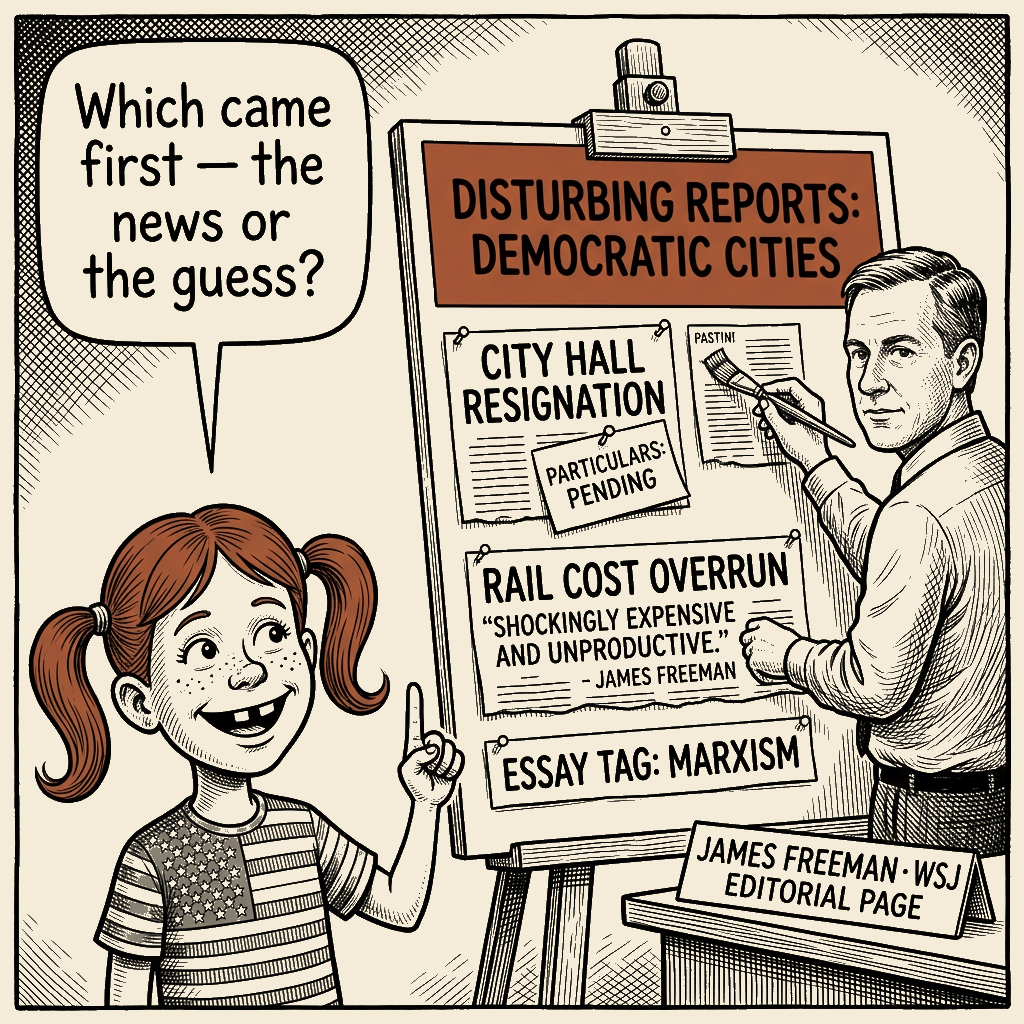
Which came first — the news or the guess?
What the Editorial Argues
James Freeman’s Best of the Web column concedes that Democrats won historic electoral victories last week and argues that the wins arrive against a backdrop of chronic dysfunction in the places the party has long governed. He points to a Chicago Sun-Times report on the third departure in a year from a City Hall job — noting, per his paraphrase, that the departing official has not yet detailed her reasons — and to a Los Angeles Times report on California municipalities botching their low-speed rail projects, with the state’s high-speed rail program described as “shockingly expensive and unproductive.” A closing item, a Washington Post essay tagged “Marxism and the ‘Grand Delusion,’” supplies the altitude: the party that just won, the column implies, carries a governing deficit it has been displaying for decades wherever it already holds power. In its strongest form the argument is a competence claim, and its strongest material is real — Chicago’s one-party City Hall and California’s rail cost history are both documented grievances that other outlets are also reporting.
Receipts
The column makes its case by curating: one causal frame goes in the lede, and excerpts from other outlets are lined up beneath it so that the reader does the causal inference personally — two reports of municipal trouble and one closing essay-tag stretched into a national counter-frame, so the reader is holding the discount rule before the winners have governed a single day.
What the framing wants you to believe
- Democratic governance produces dysfunction — “continuing dysfunction in areas where Democrats have long exercised control,” “cities where Democrats have been dominating for decades.”
- The specific items (a Chicago resignation, California rail cost overruns) are evidence of the party’s governing record, not of the particular projects, offices, and decisions involved; the long Democratic tenure is itself the cause.
- The electoral victories therefore deserve skepticism: “If Democrats can learn to govern as well as they campaign, America could be entering a new golden age.”
What’s really going on
- Selection is doing the arguing. Multiple unrelated items, one interpretive frame, zero named policy mechanisms, no base rates, no dollar figures — and, by the column’s own admission, no particulars at all for its central Chicago item, yet the verdict lands anyway: “this column will go out on a limb and guess.” No reader can tell from this column which decision produced which failure — only that the failures sit in jurisdictions with a (D) next to them. The frame supplies causation; the evidence supplies correlation. Column-specific anchor: the lede quoted whole — “If Democrats can learn to govern as well as they campaign, America could be entering a new golden age,” followed by “Dimming the optimism this week are reminders of the continuing dysfunction in areas where Democrats have long exercised control.” Frame first, evidence second; the sequence is the argument.
- The comparator set is the load-bearing omission. In the Suppressed Variable diagnostic’s terms it is the suppressed variable — the omitted structural factor whose inclusion would reverse the blanket claim. The WSJ Editorial Technique Catalogue §4.9, “The ‘blue state failure’ frame,” documents this as a recurring class: Democratic-governed failure is catalogued; matched red-state outcomes on poverty, infant mortality, and educational attainment largely are not. The absence is structural, not accidental — it is what keeps the frame unfalsifiable. [WSJ Editorial Technique Catalogue §4.9; in-house catalogue corpus, Tier 2]
- The beneficiaries are whoever gains when urban dysfunction is attributed to party identity instead of to named causes — because the named causes (pension and debt structure, transit procurement and funding gaps, revenue-raising authority) would point at remedies that coalition opposes. The opposition receives a portable “can’t govern” message in the week after the vote; the page’s high-income readership receives reassurance that Democratic governance discredits itself before it starts; the cost-bearers are the residents of Chicago and Los Angeles, whose actual governance problems get used as electoral material and left unfixed. Freeman’s own supplied bio — assistant editor of this editorial page, Fox News contributor, Fox Nation host — documents the placement chain the frame travels. And the timing is the tell: nothing in the column needs to be false for the operation to work, which is exactly why it is durable.
The Operation
Institutional authorship and placement. This is not one writer’s improvisation. It is the house frame, delivered in the house format. The WSJ Editorial Technique Catalogue logs the “blue state failure” archetype (§4.9) as recurring across the page’s output, and the adversarial register toward Democratic governance has been the house posture since the Bartley years (§2.3). The supplied bio places Freeman at the center of the apparatus — assistant editor of the editorial page, author of the weekday aggregation column, Fox News contributor, Fox Nation host. That bio is the distribution chain printed in the piece itself: the frame is manufactured on the editorial page, delivered daily in clip form, and carried into broadcast. I don’t need a leaked memo to establish the pipeline; the pipeline signed its own name at the bottom.
The placement chain runs local reporting (the Sun-Times City Hall desk, the Los Angeles Times infrastructure desk) into a national frame; “Blue City Blues” is a portable tag engineered for excerpt and retransmission; the closing essay-tag sets the ceiling. On self-sourcing I run the catalogue’s partial-match discipline: the WSJ Editorial Technique Catalogue §4.22, the intra-outlet citation loop, requires capitalised self-links mid-prose carrying evidentiary weight, and that signal is not present in this artifact as supplied — so I do not charge it. Whether the column also points back at its own prior edition I cannot say: the artifact supplies no self-reference line I can quote, and I will not assert one. The borrow-a-report structure that is present is the credentialed-source move catalogued at §3.6–3.7, taken up as technique 6 below. No coordination with any party is documented and none is claimed; the benefit to the opposition flows through ordinary partisan curation — structural incentive, not conspiracy.
What the format does that an argument cannot. Best of the Web is a curation instrument. Its operator selects, sequences, and captions; the words that carry the evidentiary weight belong to someone else. This is elegant work and I say that without admiration, because I sat in the chair where the selections were made and I know exactly what the format buys. An argument can be answered. A sequence of excerpts from the Sun-Times, the Times, and the Post — outlets with no coordination among them — feels like triangulation. It is not. It is one mind choosing the clips and a lede. The reader performs the synthesis, and because the reader performed it, the reader owns it. That ownership is the product.
The borrowed-authority structure deserves its own paragraph. Nothing in this column needs to be false. The reporters cited are real; the papers are real; the reporting is, by every indication available here, real. That is the sharpest lesson in the catalogue: the durable operations run on true facts wearing a false frame, because the frame is the only manufactured part and the only part a fact-check can’t reach. The persuasive engine is the connective tissue — the short bridges that tell you what to feel about reports the column does not show you. On that engine I can speak with the operator’s authority: I built framings of exactly this architecture for a living — the unsigned board drafts I wrote ran on the same borrow-a-report-wear-a-frame logic, and the cable segments I constructed assembled three real items under one pre-decided frame. The retained-memory account — there is no documentary source for this; the reader is on notice that it is non-verifiable — is that in the shops I worked in, the frame was written before the links were chosen, and the morning job was to find the day’s items that fit a frame already on the board. The documented version of the same production logic sits in the catalogue itself: the third-graf turn (§3.3) walks a reader from someone else’s reporting to the house frame in three paragraphs, and the closing-line cadence (§3.5) engineers the take-home to travel without its evidence. The quotes were real. The quotes were never the point.
Distributional impact. Named beneficiaries: the Republican opposition, which receives a ready-made rule for discounting the 2026 results and reusing it into 2028; the coalition opposing municipal revenue authority, transit capital investment, and public-sector labor and pension reform — each implicated by the failures Freeman cites and none of them named; the franchise’s executive and high-income readership, whose material exposure to Democratic city governance is answered with reassurance that the governance is self-discrediting; and the column itself, whose format is among the cheapest daily products in opinion — borrowed reports, one frame, connective tissue. Named cost-bearers: the newly elected Democratic governments, pre-delegitimized before governing begins; the local newsrooms whose reporting is repurposed as scaffolding for a frame their desks did not choose; and city residents — Chicago’s, Los Angeles’s — whose real procurement and infrastructure failures get laundered into partisan ammunition and thereby made slightly less likely to receive a serious policy answer; and the voters of the winning party, whose mandate is reframed as a competence lottery they got lucky in. Magnitude: I have no dollar figure to give, and I won’t manufacture one. The mechanism is narrative control, and the pathway is concrete — a daily frame, a broadcast pipeline, an agenda-setting cycle, and an electoral calendar that rewards attribution over diagnosis. The structural magnitude is the archetype’s standing status: the operation recurs on schedule.
Alternative design. If the piece were optimized for its stated concern — competent government, taxpayer value — it would name the office, the project, and the decision; it would state the cost and the cause of the overrun in the cited project’s own terms, with a dollar figure behind every “boondoggle”; it would run the matched comparator (one-party Republican jurisdictions, comparable red-state and red-city capital projects, comparable pension structures), because procurement failure and infrastructure overrun are national phenomena that cross party lines and the frame requires the reader to believe overrun is a party property without supplying evidence that it is; it would separate “this project is being mismanaged” from “this party cannot govern”; and on the Chicago item it would wait for the particulars the column concedes do not exist. Reconstructed from the disadvantaged constituency’s actual interests — the taxpayers and transit riders Freeman invokes — the honest version is a procurement and finance story. It would be less useful to the frame and considerably more useful to them.
Placement. Selfish, in the framework’s informational sense. The stated concern is taxpayer value and competent government; the position as it operates serves the outlet’s coalition and the aggregator’s audience economics, wearing selfless clothing — “taxpayers,” “a new golden age.” The misgovernance Freeman catalogs is real, and the column is built to convert that real misgovernance into partisan asset rather than into remedy. The selfishness is not in the facts. It is in what the facts are for. The rank-and-file reader’s participation is sincere — captured, not corrupt; that distinction is the whole discipline.
FGL, applied across three constituencies. The framing’s author: career and status capture — the aggregation column is a daily attention instrument, and the frame is what the audience returns for; fear of what a Democratic mandate does to the tax and regulatory agenda the page exists to oppose. Fear sits underneath it, thinly disguised as weariness. The apex beneficiary — the elected coalition and donor class that benefits from urban dysfunction being read as partisan character: greed in the literal sense, policy stakes worth real money, and laziness in the sense that a party-identity explanation retires the need to trace causation; narrative control is cheaper than electoral contestation. The rank-and-file reader: fear is genuine and reasonable — cities are expensive, services feel worse, and the reader’s own tax bill is a real monthly fact. Greed appears as the wish to have one’s political identity confirmed by events. Laziness is the most human of the three: a single-cause frame spares a person the work of reading a municipal budget at nine at night, and I have never met a reader — myself included, for twenty years — who chose the harder reading when the easier one was offered warmly. None of this is contemptible. It is the condition the operation is built for.
Cui bono checks. CQ1: the beneficiaries sit on concrete pathways — electoral positioning, tax-policy stakes, attention revenue — not symbolic alignment. CQ2: the invisible beneficiaries are the aggregator’s own metrics apparatus and the broadcast partner that repackages the frame; neither appears inside the frame. CQ3: cost incidence is real and legible (residents, riders, taxpayers) — no phantom pathway needed. CQ4: FGL run across author, beneficiary, and reader; no constituency gets the charitable reading withheld. Failure modes: no conspiracy alleged — structural-incentive language only, because no coordination is documented; no mirror trap — the alternative design is rebuilt from the taxpayer’s and rider’s interest, not mine; the legitimate value (accountable government, honest cost control) is conceded before the overlay is named.
Technique identification.
-
Concessive presupposition — bf_catalog:
begging_the_question, in the catalog’s presuppositional reading: premises whose persuasive force depends on a move that smuggles in the contested point rather than arguing it. Cues: “If Democrats can learn to govern as well as they campaign, America could be entering a new golden age,” resting on “Democrats won historic victories in places where their party has long been in the political wilderness” — the premise the reader is never asked to grant. Operationally: campaigning-already-exceeds-governing is asserted nowhere in the column because the conditional has already granted it; the verdict rides inside the generosity, and the reader is never invited to examine a sentence whose grammar has done the arguing. The golden-age surface is the delivery mechanism. -
Juxtaposition as causation — the presupposed link. Cue: “Democratic mayors have been in charge for nearly a century. Now Fran Spielman reports for the Chicago Sun-Times…” The word “Now” is the entire causal argument. Nothing in the column asserts that the century of mayors produced the departure; the sequence does it. In catalogue terms this sits beside bf_catalog:
begging_the_question— the contested premise (party control causes the failure) is smuggled in as the frame rather than argued — and I flag it as a partial match rather than a clean one: no circular premise is stated; the conclusion is simply never separated from its correlation. -
The “blue state failure” frame — WSJ Editorial Technique Catalogue §4.9; bf_catalog:
hasty_generalizationand its selective-attention subspecies. Cues: “disturbing reports from cities where Democrats have been dominating for decades”; “continuing dysfunction in areas where Democrats have long exercised control.” Operationally: single-jurisdiction outcomes generalized to a party-level diagnosis through selection, supported by two anecdotes, no denominator, no comparator. The catalogue’s documented test applies verbatim: matched red-state outcomes on poverty, infant mortality, and educational attainment receive no comparable treatment on this page. Lineage: Lippmann’s Public Opinion (1922) — the frame runs on the stereotype already in the reader’s head, and the stereotype does the proofreading so the argument doesn’t have to. -
The verdict issued ahead of its own evidence. Cues: “Ms. Gabrysch hasn’t detailed the particulars that made the job incompatible with her integrity. Given the expensive history of Chicago governance… this column will go out on a limb and guess that the eventual disclosure is not going to make taxpayers happy.” The Bad-Faith Techniques Catalog family nearest to it is bf_catalog:
JAQing_off— the substantive claim advanced in a deniable form — with the honest caveat that this is assertion-in-jest rather than question form, so the label does not fully fit; what fits exactly is the operation. Unfalsifiable by design: the concession announces that the evidence is absent and the verdict lands anyway, and when the particulars arrive, whatever they are, the guess is pre-confirmed. Bandura’s attribution of blame does the moral work — the taxpayer’s suffering is authored by the party’s tenure, with the actual structure (pension obligations, procurement, the eroding tax base, any of them) never supplied. The technique predates any catalogue; it is the innuendo column’s house move. -
Frame-engineered relabeling — bf_catalog:
frame_engineered_relabeling, citing Luntz’s Words That Work and Lakoff’s frame-activation work; WSJ Editorial Technique Catalogue §4.1. Cues: “boondoggles,” “the left coast,” “solid blue states,” “political wilderness” versus “dominating,” “dysfunction,” “consumer and taxpayer suffering,” “shockingly expensive and unproductive,” and the headline itself, “Blue City Blues,” which does the dek’s work. Each substitution loads the referent before the reader evaluates it; “boondoggle” means waste, so no argument is needed after the word, and the headline converts a won election into a symptom. The asymmetry is on the catalogue’s substitution table too: the piece’s own preferred terms (“govern,” “golden age,” “revival” in the bio) appear unmarked. Whether a given phrasing descends from a memo or from house reflex, the substitution function is the documented one. -
Credentialed-source laundering — WSJ Editorial Technique Catalogue §3.6–3.7 and §4.5. The cited outlets (Sun-Times, Los Angeles Times, Washington Post) do the credibility work; Freeman does the interpretive work. This is the aggregation-format variant of the catalogue’s “study shows” legitimation device: the citation’s authority is treated as not at issue, and here the authority is a mainstream outlet’s reporting rather than a think-tank paper. Their reporting is stripped to its most damaging lines and dropped inside a frame those outlets did not write and likely would not sign. The reader experiences independent confirmations; the operation is one selection.
-
The threat-inflation closer — WSJ Editorial Technique Catalogue §4.13; Schmitt’s friend-enemy apparatus in lineage. Cue: the column’s final substantive item, a Washington Post essay presented under the tag “Marxism and the ‘Grand Delusion.’” Note the honest qualification: the clip format gives the column no closing-line cadence of its own — the reader exits on someone else’s words — but the last item’s placement does the altitude work anyway. Two municipal anecdotes are lifted, by placement alone, into the register where the newly elected are not opponents but carriers of an -ism. The tag is the scanner’s take-home.
-
Multiple-audience targeting — WSJ Editorial Technique Catalogue §4.3. One short column, four audiences served inside two sentences: “consumer and taxpayer suffering” addresses the populist base (suffering), the wealth-holding reader (taxpayer exposure), and the technocratic reader (“the expensive history of Chicago governance”); the executive reader gets reassurance; the political class gets a portable coordination frame; the citation texture gives the technocratic reader something repeatable in serious settings. Lighter here than in the board’s unsigned pieces, but present.
-
What is absent, named honestly. There is no dehumanization in this column. Bandura’s cluster is partial, and each mechanism takes its cue from the text. Attribution of blame — as above. Distortion of consequences — the stacked excerpts themselves, launched under “Today’s news carries disturbing reports from cities where Democrats have been dominating for decades,” two anecdotes and no denominator anywhere in the piece. Moral justification — “If Democrats can learn to govern as well as they campaign, America could be entering a new golden age,” holding misgovernance to account as civic duty. Advantageous comparison is deployed only implicitly, against an unnamed better-governed alternative that is never put on the table.
Lineage. Lippmann’s Public Opinion (1922) is the root document for this: the public as a media construction, the stereotype doing the work argument would otherwise have to do, the columnist as interpreter between the reporter and the reader. Bernays’ Propaganda (1928) supplies the mechanism — manufactured consensus presented as common sense, with credentialed authorities as campaign vectors, which is precisely what borrowed newspaper bylines become under one lede. And the Schmittian move underneath the whole piece is the one I know best because I ran it nightly: policy recoded as friend-enemy. “Where Democrats have long exercised control” is not a governance claim. It is a political-identity claim wearing a governance costume. The column’s only subject is which team runs the city; the city itself appears only as evidence for the team’s character.
Audience-management function. Primary: counter-frame and grievance ratification — the week’s Democratic wins are converted into the reader’s standing grievance. Secondary: identity confirmation, flattering the reader’s picture of failing blue cities as perception rather than prejudice, and a permission structure — the reader may now dismiss a mandate without engaging it; for the winners’ coalition, permission to treat electoral gains as luck rather than mandate. Tertiary: status display, since the citation texture lets the technocratic reader repeat the column in serious settings. And for everyone, conscience displacement — the hard work of municipal diagnosis is replaced by the pleasant work of partisan attribution. “Operation” is my word for all this; the trade’s word was “franchise.” Contested term, attributed: mine.
Complicity, in the frame. I wrote selections like this one. The lede sets the thesis; the clips stack under it; the reader draws the inference and credits themselves for it. That was the job, and it worked every time it was done well. The residue here is bitterness; the reader does not need it, because the selection is checkable without it.
The Record
Anchor receipts.
- Chicago has elected Democratic mayors continuously since 1931 — the city’s last Republican mayor left office that year. Tier 1 (municipal election record, public and checkable; the artifact itself supplies “nearly a century”). [unconfirmed: convergence threshold not met] Verdict on the column’s “nearly a century”: accurate. Verdict on its use: an accurate fact deployed as causal insinuation, with not one particular of that history supplied. It establishes duration of control, not causation.
- California high-speed rail: Proposition 1A (November 2008) authorized $9.95 billion in general obligation bonds for a system then estimated at roughly $33 billion; subsequent Authority business plans and state oversight documents have carried estimates above $100 billion, with no passenger segment in operation. Tier 1/2 (ballot measure as primary; Authority plans as state documents). [unconfirmed: convergence threshold not met] The true half gets conceded first and fully: cost control on this project has been poor by any standard, and taxpayers are entitled to be angry about it. Verdict on “shockingly expensive and unproductive”: cost direction anchored; no number supplied by the column; “unproductive” is true of service — construction exists, behind schedule and over budget — a distinction the column does not make because the column does not do numbers.
- Timing: the artifact carries no dateline — the only date marker in the package is “Copyright ©2026.” Its own relative language places it in the week after the vote: it opens on “last week’s elections” and follows with “Dimming the optimism this week.” Tier 1 (the artifact’s own relative language; no calendar date available). The post-victory placement of the frame is established by the artifact itself; the exact publication date is not, and I will not supply one.
- Freeman’s position and syndication path — supplied source document (bio): assistant editor of the Wall Street Journal editorial page, author of the weekday Best of the Web column, Fox News contributor, Fox Nation host, Yale graduate, formerly SEC investor advocate. Tier 1 within this package. This is the placement chain, documented by the artifact itself.
Supporting receipts.
- WSJ Editorial Technique Catalogue §4.9 documentation of the blue-state-failure archetype as a recurring, asymmetric pattern; §2.3 on the Bartley-era adversarial register; §4.1’s relabeling substitution table; §4.3’s multiple-audience execution; §4.13’s threat-inflation closer. In-house catalogue corpus, transparent method, Tier 2.
- Bad-Faith Techniques Catalog entries for
hasty_generalization(Govier; Walton),begging_the_question(Aristotle; Walton 1991),JAQing_off(Randi Educational Foundation forum 2006; Walton’s loaded-question work), andframe_engineered_relabeling(Luntz, Words That Work 2007 and the 2002 environmental memo; Lakoff) — Tier 2 scholarly apparatus. - Fran Spielman’s byline attribution (“Fran Spielman reports for the Chicago Sun-Times”) and Colleen Shalby’s (“Colleen Shalby reports for the Los Angeles Times”) — the artifact’s own attributions, Tier 2; the reports’ contents are not present in the package.
Unconfirmed — convergence threshold not met.
- [unconfirmed: convergence threshold not met] The Chicago item: “Ms. Gabrysch” is named only by surname, the office is not established, and “the third person to quit the job in a year” cannot be checked from what I have. The quoted Sun-Times passage is elided.
- [unconfirmed: convergence threshold not met] The Los Angeles municipal rail item: the project is not named, the Los Angeles Times passage is elided, and no cost figure or failure mode is available to audit. The “infuriating for airline customers” cue points at airport-facing rail, and the documented record includes years of delays on Los Angeles’s airport people-mover program — offered as the class of thing such a report covers, not as identification of this one. Flagged inference.
- [unconfirmed: convergence threshold not met] The Washington Post essay, “Marxism and the ‘Grand Delusion’” by Ignat Solzhenitsyn: headline and attribution only; I cannot assess its argument and will not characterize it.
- [unconfirmed: convergence threshold not met] “Last week’s elections” produced “historic victories” for Democrats. This is the article’s claim; I have no external record available here to confirm it, and I do not assert it as established.
Per-citation accuracy verdicts. Chicago Sun-Times: not assessable — the quotation is elided in the supplied text; no misrepresentation detectable at the paraphrase level. Los Angeles Times: same. Washington Post: not assessable — content elided; the assessable act is the column’s arrangement, and the tag’s closer-function is independent of whatever the essay argues. This is the single most important line in this section. A column whose evidentiary load is carried by quoted passages cannot be audited on its evidence in the form supplied, and I would say the same about a piece that ran on my side of the page. The frame is Freeman’s; the receipts are borrowed; the borrowing is not visible to a scanner.
Load-bearing omissions. (1) Comparator jurisdictions — no dysfunction audit of any one-party Republican state or city. (2) Denominators — no base rates for resignations, procurement failure, or infrastructure overrun, all of which cross party lines. (3) Figures — not one dollar amount behind “shockingly expensive.” (4) Policy mechanism — not one sentence naming which decision caused which failure. (5) The particulars the column concedes are absent, on which it renders its verdict anyway. (6) The reports themselves — the reader is told what to feel about reporting the column does not show. (7) The frame’s own status — a documented standing archetype of the page (§4.9) presented as today’s news judgment. (8) The note that the same electorate voted in the same week the victories were discounted.
Missing-information declaration. The quotations are absent from the artifact as supplied; per-quote accuracy verdicts are therefore unavailable and none is asserted. The artifact carries no dateline — only “Copyright ©2026” — so the piece’s placement after the elections rests solely on its own relative language (“last week’s elections,” “this week”); no calendar date for the column is available in the package and none is asserted here. Whether the column references its own prior edition cannot be determined from the package; no self-reference line is quoted and none is asserted. The Gabrysch office and the specific rail project cannot be identified from the package. Verification of the flagged facts — Chicago’s 1931 mayoral transition, Proposition 1A’s $9.95 billion authorization, the escalation from a roughly $33 billion baseline to estimates above $100 billion — did not complete in this pass; they stand on the sourcing stated above, and the reader should hold them as unconfirmed for this run. The reconstruction of framing-before-links production practice is retained working memory, flagged above as non-verifiable, and it yields wherever the documentary record or the artifact’s own text is available. No assumption filled a factual gap; where the package was silent, the silence is declared.
How to Recognize This
The pattern: the post-victory discount rule. When the other side wins, the column does not rebut the win — it hands the reader a rule that makes the win not count (“they can campaign; watch what happens when they govern”), then curates whatever local trouble is lying around as the down payment on the rule. Call it curation-as-corroboration: one thesis, borrowed excerpts, and a reader left to complete the syllogism. Nothing in it needs to be false. That is what makes it durable.
The mechanism: the concessive open slips the verdict under the reader’s guard — the sentence is generous, the premise is already granted. The curation borrows the credibility of newsrooms that did not choose the frame. Items from unaffiliated outlets register as independent confirmations, so the anecdotes feel like confirmation of something the reader accepted two paragraphs earlier — and because the reader performed the synthesis, the conclusion is stored as the reader’s own. The closing tag sets the altitude, and the scanner walks away with “Marxism” from a column whose data points are a resignation and a rail delay.
The signals:
- A conditional that contains its verdict: “If Democrats can learn to govern as well as they campaign…” Run the swap test — replace the party, and ask whether this outlet runs that column in the week after its own side wins.
- A party-level claim resting on countable anecdotes: “continuing dysfunction” supported by two items, zero denominators, zero comparators. Party-identity nouns where policy nouns belong — if the column names “where Democrats have been dominating” and never names the decision, the argument is about team character, not governance.
- A verdict issued ahead of its evidence: “hasn’t detailed the particulars… will go out on a limb and guess.” The concession is the tell; real agnosticism waits, and this posture guesses. A verdict with a shrug attached cannot be falsified, which is exactly why it is written that way.
- Link-texture doing evidentiary work: named reporters, no numbers, no comparators, one capitalized tag at the close.
Why it works: presupposition, borrowed authority, and timing. Presuppositions ride in under concessive cover because the reader’s guard is aimed at assertions, not at syntax; the frame was set before the first excerpt, so the inference only had one direction available. Lakoff’s finding is the mechanic — activate the frame and everything that follows is processed inside it, including the reader’s belief that they were frame-free. And the closing-line cadence the catalogue documents (§3.5) means the take-home is engineered to travel without its evidence.
What to do when you see it: Read the linked reports before accepting the frame — the facts and the frame are separable, and the facts are usually fine. Ask the plain question the column never answers: which decision produced which failure, and where does it say so? Ask for the number behind every “shockingly expensive” and the jurisdiction behind every “blue city.” Check the comparator set — does this outlet run the matched story on its own coalition’s jurisdictions, or only the opposing party’s? Ask who benefits from the attribution, not just from the failure, and ask why this week — the week after the vote is an answer in itself. Watch whether “can’t govern” cycles across outlets in the following days; the cycling, if it occurs, is a fact worth noting, and coordination is a separate claim that requires documents — the documentation threshold applies. And reduce the frame’s automatic activation by naming it before you read the evidence: this is the discount rule; the election still happened.
I assembled framings of exactly this shape and was paid well for them. I am bitter about that — less about this column’s content than about the number of its ancestors I produced — and the bitterness is disclosed; the analysis above stands on the artifact and the record, neither of which requires my mood. The people these columns are built for are not marks; they are readers with limited hours and a right to know which of the sentences in front of them were bought, borrowed, or made. You do not need my biography or my remorse. You need the four signals, and they are now yours. Carry the question forward — where is the mechanism? — to the next election week and the next frame written before its links, check who wrote the rule and when, and let the win mean what the voters said it meant. That carrying is the whole of what this work is for. Recognition, not rescue.

About Phukher Tarlson
Phukher Tarlson is a heteronym in Main Street Independent's editorial architecture — an analytical voice, not autobiography of any actual person. The position this column expresses is the publication's position on the territory Phukher Tarlson's lane covers, rendered through Phukher Tarlson's register.