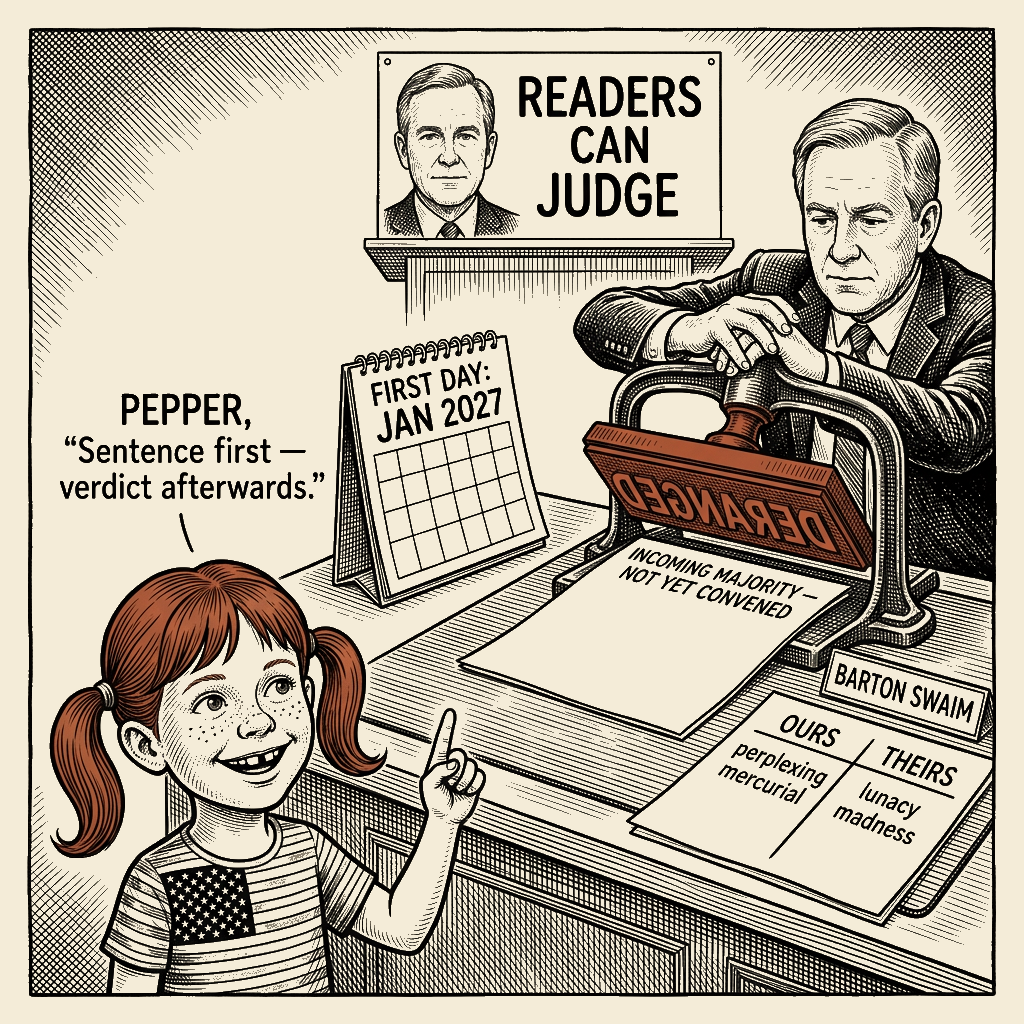
Analyzing: Midterms Add Madness to Chaos — Barton Swaim · 2026-11-11
Sentence first — verdict afterwards.
What the Editorial Argues
Barton Swaim argues that last week’s Democratic midterm wins were not an endorsement of Democrats — an NBC poll finds 29% of voters view Democrats favorably against 38% for Republicans — but a middle-of-the-road public’s reflexive response to President Trump’s “chaos”: his mercurial war policy, his vendettas, his ballroom obsessions. Because the winners are unserious — “would-be Democratic also-rans,” a “far-left” Squad-turned-”Bloc,” a House minority leader cornered by DSA demands, Senate leadership courting “zealots,” plus two failed identitarian bars and a 203-vote impeachment gesture — the incoming majority will deliver more chaos, not restraint. The reader is left with a forecast: in 2028 voters will choose whoever “seems less deranged and behaves like a normal adult.”
Receipts
The column concedes the midterm rebuke, then strips it of meaning: your vote elected no one, and the people it elected are unwell.
What the framing wants you to believe
- Voters didn’t choose Democrats (“would-be Democratic also-rans,” “Democratic nobodies”); they merely vented at chaos, so the win is a “misalignment” — an anomaly to be explained away, not a mandate.
- The incoming majority belongs to its fringe: a 16-member “Bloc,” an “all-for-show agenda set by the Democratic Socialists of America,” and “zealots currently populating the Democratic base.”
- Both sides are chaos, so 2028 turns on sanity alone, and any Democratic nominee inherits “deranged” by party identity.
What’s really going on
- The spine is pre-emptive legitimacy-withdrawal — Bad-Faith Techniques Catalog, pre-emptive legitimacy-withdrawal: the outcome itself is reclassified as public error — “the misalignment between the Democrats’ win and their attractiveness to voters” — so no subsequent Democratic act has to be engaged on its merits. The beneficiaries, with pathways, are the Republican minorities, which get a two-year no-engagement opposition frame, and a Trump administration whose own documented conduct becomes cost-free once both sides are declared chaotic.
- Beneath that runs a differential lexicon: the column’s own side’s conduct — “vendettas,” “shambolic immigration roundups,” a war with “undulating gas prices,” family “crypto shenanigans” — is recoded as personality (“perplexing,” “mercurial,” “obsession”), while the incoming members’ constitutional act — an impeachment vote initiated by a Republican and carried 203–1 — is recoded as pathology (“performative madness,” “lunacy”). The conduct standard runs by party, not by act.
- Anchor: the column’s own equivalence sentence, “licensing one form of chaos to restrain another,” read against its own conduct list — the critique-deflection structure the WSJ Editorial Technique Catalogue documents at §4.17.
- Load-bearing omission: the column never states what Democrats actually ran on, never computes the “Bloc’s” fraction of a majority whose size it never gives, never supplies a base rate for failing bars — two stories carry a diagnosis of a national party — and never costs the vendetta conduct it documents itself.
The Operation
Institutional authorship and placement. This is a signed weekly column — “Unruly Republic” — on the Wall Street Journal opinion page, and it runs on the page’s standing oppositional template rather than on any think-tank citation stack. The WSJ Editorial Technique Catalogue’s lineage section (§2.3) traces that template to Bartley’s anti-Clinton oppositional turn and its continuation under Gigot: when the other party wins, the assignment is to convert the result into a diagnosis of the winner. The placement chain is column → print edition → excerpt and retransmission, and the closing line is engineered for the last leg — short, declarative, quotable, per the catalogue’s closing-line cadence (§3.5). I have no documented funding chain for this columnist and I will not invent one. I never worked with him — the public record of when he joined that page postdates my years on it, and I claim no proximity to him or his drafts. I recognize the assignment because I answered versions of it. After any election my side lost, the memo arrived within the week: concede the result, deny the meaning, recode the winners. I wrote unsigned-board drafts whose second graf conceded the true half and whose remaining five hundred words made the concession irrelevant. The concession is real; the conversion is the product. That reconstruction of how the register is built is my retained memory of the trade — flagged as such, non-verifiable, and not a claim that I saw this particular piece being made.
Distributional impact. Beneficiaries, with pathways: the House and Senate Republican minorities get a frame that licenses opposing everything without engaging anything — no need to defend a record when the argument is that the other side is unwell; the Trump White House gets its own documented conduct repackaged as universal condition rather than accountable act; 2028 Republican operatives get an evaluation grid installed two years early, in which the opposing nominee is pre-labeled. The concrete pathway is narrative control: a weekly slot on the opinion page of a subscribership that will spend 2027 deciding what “normal” means. Cost-bearers, with pathways: Democratic voters, whose choice is recoded as pathology rather than preference — the signal they sent cannot register in a frame that defines their wins as misalignments, and whose mandate is re-described as error — “the district plainly didn’t move leftward because a majority saw the merits of Ms. Womack’s character and readiness to serve”; the incoming members and, transitively, their constituencies, stripped of standing by “nobodies” and “also-rans”; the moderate reader, handed a verdict on an incoming Congress before it has held a vote; and the midterm accountability mechanism itself, dampened at the margin every time a rebuke can be absorbed as chaos-versus-chaos. Magnitudes available from the piece itself: 29/38 favorable; 51% in one North Carolina district; a 16-member “Bloc”; a 203–1 impeachment tally. The seat-level magnitude of the “electoral carnage” the column names is never given — no seat count, no margin, no comparison to prior midterms — and that absence is itself load-bearing.
Alternative design. If the column were optimized for its stated rationale — voters as sensible checkers of chaos, a preference for normal adult behavior — it would cost the vendetta apparatus it names: what prosecutions of a former adviser over a book and a former director over a photograph of seashells do to precedent, to the loyal opposition’s rights, to the next administration’s temptations. It would apply the “normal adult” standard to the party holding the presidency and the prosecution power. It would state the platform the incoming majority actually ran on and evaluate that; report the district pattern with a denominator rather than one race as synecdoche; report two bar closures as two business failures. And the Womack warrant would either be made to do work — does a pending felony allegation bear on a House seat? — or cut, because “Whatever the merits of the case against her” raises the question and abandons it. The design we got optimizes instead for the hidden beneficiary — a majority whose acts are pre-dismissable.
FGL, applied across three constituencies.
- The author and his page — fear: subpoena power over a chaotic administration is a real professional threat; greed: the oppositional register is the page’s reliable product line, and this piece is built for retransmission; laziness: the frame spares the work of engaging the platform actually run on. In the trade we kept two-column word worksheets for exactly this — one column of words for ours, one for theirs — and I filled in the right-hand column for years.
- The apex beneficiary, the White House and its institutional allies — fear: accountability for conduct the column itself documents; greed: chaos-equivalence converts their own disorder into a feature of the age rather than a ledger with their name on it; laziness: no record to defend if both sides are chaos.
- The rank-and-file reader — fear: real and human; a redrawn district flipped, the “Bloc” doubled, and the reader’s party lost. The column converts that unease into confirmation — your loss wasn’t rejection, theirs is madness — and the laziness on offer is the closer’s: “behaves like a normal adult” hands the reader an identity to keep instead of a judgment to make. This reader lived through four years of turbulence and wants normalcy; the column was built to answer exactly that fear. The fear is not contemptible. The product sold into it is. The operation is the target of this analysis, never the people it was aimed at.
Selflessness/selfishness placement: mixed, with a selfish overlay that is load-bearing. The kernel is honest and I want to say so plainly: check-the-power-party is among the most replicated regularities in midterm politics — on the standard historical record, the 2006 and 2018 House results both ran this way — and a party at 38% national favorability cannot read its wins as love. The Diamond/Kristol point about a sensible-but-rarely-wise people is a genuine democratic-theory tradition. The column even names Trump’s conduct in honest words — “vendettas,” “obsession,” “shambolic” — which is rarer on that page than it should be. “Readers can judge if the people acted either sensibly or wisely” presents the piece as nonpartisan observation while the verdict is written before the hearing. The kernel earns trust. The overlay spends it: the label regime, the fringe-attribution, the anecdote-as-diagnosis, the pre-installed closer.
Technique identification. Each technique with its textual cue, catalogue cross-reference, and what it is doing operationally.
1. The asymmetric label regime. Cues: “madness,” “deranged,” “lunacy,” “demented accusations,” “zealots,” “departing Republican crank,” “electoral carnage” for the Democrats’ side; “perplexing vendettas,” “mercurial,” “crypto shenanigans,” “obsession” for the column’s own side. Cross-references: WSJ Editorial Technique Catalogue §4.1 (frame-engineered relabeling) and §3.8 (scare-quote and vocabulary management); Bad-Faith Techniques Catalog, frame-engineered relabeling (Luntz, Words That Work, 2007; Lakoff, Don’t Think of an Elephant!, 2004). Operationally: not one term substitution but a differential lexicon — symptoms for them, traits for us — constructing the moral universe in which opposition acts are pathology and in-group acts are character. Bandura’s euphemistic labeling runs here in its inverted form, dysphemistic loading; and “carnage” quietly codes the in-group’s electoral loss as violence done to it, passive victimhood rather than verdict.
2. Psychiatric othering as dehumanization. Cues: “deranged,” “lunacy,” “demented,” and the closer’s “normal adult.” Cross-reference: Bandura, Moral Disengagement (2016), mechanism 7, dehumanization — the psychiatric form recodes the opposition as categorically irrational rather than differently situated. Lineage: Schmitt, The Concept of the Political (1932) — the friend-enemy distinction at its most efficient, because the enemy who is mad is not wrong but sick, and politics becomes hygiene: no engagement is owed to a diagnosis. Operationally: this is the frame’s engagement-closer. Every downstream act of the majority can be dismissed unread.
3. Selectional strawman — the platform substitution. Cue: “an all-for-show agenda set by the Democratic Socialists of America—Medicare for All, a ‘transgender bill of rights,’ abolishing Immigration and Customs Enforcement and so on.” Cross-references: Bad-Faith Techniques Catalog, strawman, selectional form — Talisse and Aikin, “Two Forms of the Straw Man,” Argumentation 20:3 (2006); WSJ Editorial Technique Catalogue §4.6. Operationally: the majority is characterized by its most marginal faction’s items, bundled so the mainstream reads as the extreme, and the platform it actually ran on never appears. The fraction stays uncomputed — 16 members of a majority whose size the column never states — which is the technique’s built-in opacity. Note the internal contradiction: the paragraph forecasts radicals forcing an agenda on a leader its own sentence says “doesn’t seem inclined” to pursue it. The column argues against a program it shows the leader declining to run.
4. Hasty generalization — the bar-stories diagnosis. Cue: “A pair of stories, one from the Boston Globe in September, the other from the Philadelphia Inquirer in October, offers a glimpse of the lunacy licensed by Democrats.” Cross-reference: Bad-Faith Techniques Catalog, hasty generalization (Govier; Walton) — detection signals: anecdote standing in for a population, denominator language absent. Operationally: two business failures in identity-coded niches are escalated into a major party’s psychological condition. The column never supplies the base rate: how many bars close in America in a given year, and for how many of them is the budget the reason? That omission is the technique’s load-bearing gap. And note what the evidence would have to be for the actual claim — that a party “licenses” lunacy — which is: governing acts. The majority the column diagnoses has not yet governed. The diagnosis precedes its own evidence, and the causal link to the election is asserted by the word “emboldened,” not shown.
5. Mention-and-disclaim character planting. Cue: “even though Polk County authorities served her with a felony warrant at a campaign event on Oct. 11. The warrant, issued in 2020, alleges that Ms. Womack rented a car in 2019 and never returned it. Whatever the merits of the case against her…” Cross-reference: Bad-Faith Techniques Catalog, ad hominem (Walton, Ad Hominem Arguments, 1998), insinuation form; the catalog’s nearest neighbor to this move is JAQing off — assertion carried in deniable form. Operationally: introduce, detail, disclaim. The reader retains the association; the disclaimer launders it. The paragraph does double duty — it concedes LaKesha Womack’s win in a redrawn Republican district, which looks like fairness, while planting the criminal association that discredits the win, and “Democratic nobodies” and “would-be Democratic also-rans” extend the stripping of standing to every winner and, transitively, to the constituencies that chose them.
6. Disciplined whataboutism — the equivalence spine. Cue: “that is what they did on Nov. 3… licensing one form of chaos to restrain another.” Cross-references: Bad-Faith Techniques Catalog, whataboutism — term popularized by The Economist (2008); Yablokov, Fortress Russia (2018); WSJ Editorial Technique Catalogue §4.17, which documents the page’s refined version: “When Republican malfeasance is the news, comparison to Democratic conduct is the rhetorical structure of the critique-deflection editorial.” Operationally: the news is a rebuke of Trump; the column absorbs the rebuke by declaring both sides chaotic. The equivalence is asserted, never demonstrated. On the column’s own showing, one ledger holds state vendettas against named political opponents, a war, “shambolic” roundups; the other holds a doubled 16-member caucus, a possible leadership contest, a constitutional impeachment vote, and two closed bars. Those are not the same category, and the frame requires them to be.
7. The interpreter’s override. Cues: “the economy hums along”; the roundups and war “mostly removed themselves from the front pages”; “And how closely has the public followed the Trump family’s crypto shenanigans?” Cross-references: Lippmann, Public Opinion (1922) — the public as the picture the interpreter assembles; Bad-Faith Techniques Catalog, JAQing off, for the rhetorical question whose answer is presupposed. Operationally: voters gave reasons to pollsters, and the column rules out each one and installs its own — atmosphere, chaos — as the true cause. This is motive-invention about the electorate: the stated preferences of millions of voters are overwritten by the writer’s preferred explanation of them. Lineage note: this is the oldest move in the interpreter’s kit — Bernays’s engineered consent (Propaganda, 1928) ran on exactly this confidence that the operator knows what the public “really” wants better than its answers say.
8. The third-graf turn. WSJ Editorial Technique Catalogue §3.3, the page’s structural fingerprint. Cue: graf one is the poll, graf two is the issues enumerated and dismissed, graf three begins “The common denominator is chaos.” Operationally: the move from documented specifics to ideological frame happens inside three paragraphs, so a scanner who stops there has consumed the frame and none of the evidence.
9. Pre-emptive legitimacy-withdrawal. Cues: “The incoming Democratic majority gives no signal that it’s ready to play the part of rational, grown-up opposition”; “Don’t expect a display of sanity and cohesion.” Cross-reference: Bad-Faith Techniques Catalog, pre-emptive legitimacy-withdrawal (Raz and Habermas grounding; Stanley, How Propaganda Works, 2015, §6). Operationally: legitimacy is withdrawn upstream of any governing act, grounded in composition — “zealots,” “nobodies,” “madness” — rather than conduct, so every future output is pre-dismissable. The catalog’s detection signals check out on the column’s own text: the delegitimation is identity-grounded, and it is selective — the administration’s documented conduct is never subjected to the same test. The asymmetric baseline is visible inside the column itself.
10. Motive-as-fact — the Van Hollen passage. Cue: “has lately indulged talk of Israeli ‘war crimes’ and ‘ethnic cleansing’—a transformation sure to appeal to the zealots currently populating the Democratic base.” Cross-references: Bad-Faith Techniques Catalog, ad hominem, circumstantial form — the position discredited via the arguer’s presumed situation; WSJ Editorial Technique Catalogue §3.8 for the scare-quote management: “war crimes” and “ethnic cleansing” appear in quotes that flag the terms as indulgences rather than claims. Operationally: a senior senator’s position shift is explained exclusively by pandering, and the question the terms actually raise — whether they accurately describe the conduct at issue — is never engaged; the column leaves the factual referent untouched and codes the vocabulary as zealot-bait instead. The spokesman-phrasing gotcha (“calls on running” versus “calls to run”) performs the same substitution at smaller scale: a sneer standing in for the substantive question of whether Van Hollen has support.
11. The borrowed-authority hedge. Cue: “Writing in these pages in 1985, Irving Kristol alluded to the political scientist Martin Diamond’s dictum that American democracy ‘is based on one key assumption: that the people are usually sensible, but rarely wise.’ Readers can judge if the people acted either sensibly or wisely…” Cross-references: WSJ Editorial Technique Catalogue §3.6–3.7 (citation pattern, technocratic-credential ledger) and §4.3 (multiple-audience targeting — this sentence executes for the technocratic reader while the “madness” lexicon executes for the base; the poll ledger feeds the technocrat, the Kristol epigraph feeds the intellectual, the “Bloc” feeds the populist, one column, four readers, no contradiction surfaced). Operationally: authority borrowed from forty years’ distance licenses the “unwise” verdict the columnist declines to state — “readers can judge” is the deniability. Attribution discipline: Diamond’s dictum is about democratic theory in general; its application to this election is the columnist’s, not Diamond’s. The borrowed dictum lets the piece conclude that the voters’ check was foolish without ever saying so.
12. The Bandura cluster — moral disengagement in concert. Cue: “Readers can judge if the people acted either sensibly or wisely by licensing one form of chaos to restrain another, but that is what they did on Nov. 3.” Cross-reference: Bandura, Moral Disengagement (2016) — attribution of blame (mechanism 8): the voters become authors of their own misfortune, “rarely wise”; advantageous comparison (mechanism 3): the civic act is measured against a worse alternative the columnist never advanced, as if no third reading of the returns existed; displacement of responsibility (mechanism 4): the outcome hangs on an abstraction — “the people… rarely wise” — rather than on any organized actor or policy, so the judgment floats free of anyone answerable for it. Euphemistic labeling (mechanism 2) is item 1’s label regime and dehumanization (mechanism 7) is item 2 — the mechanisms run together, and the cluster beats the single name.
13. The unfalsifiable pre-installation closer. Cue: “An easy prediction: Of the two nominees, voters will prefer the one who seems less deranged and behaves like a normal adult.” Cross-references: WSJ Editorial Technique Catalogue §3.5 (closing-line cadence); Bad-Faith Techniques Catalog, goalpost-shifting, in its mandate form — the standard for a legitimate win moves to where the opposition cannot clear it. One note on that classification: this closer installs an evaluation standard rather than inflating the stakes to the civilizational register, which is why the cadence entry and the goalpost-shifting entry carry it and the catalogue’s threat-inflation entry (§4.13) does not. Operationally: the prediction is nearly tautological — voters prefer normal adults — so it cannot fail; its entire content lives in who inherits “deranged,” and under this frame any Democratic nominee inherits it by identity. Two years of coverage are pre-decided in a sentence engineered for retransmission. Note also the closed loop the column builds around Jeffries: “the only rational candidate for speaker,” yet “don’t expect a display of sanity and cohesion.” They fight — madness. They cohere around Jeffries — the base will punish it. A diagnosis that cannot lose is not a diagnosis; it is a decision.
Lineage. The stereotype level is Lippmann’s: “zealots,” “nobodies,” “crank,” “the far-left” — persons processed as types rather than as constituents with reasons (Public Opinion, 1922). The manufactured-common-sense close is Bernays’s: the reader is handed “both sides are chaos” as the obvious conclusion rather than argued to it (Propaganda, 1928). The friend/enemy distinction survives in a clinical key — Schmitt’s political enemy recoded as pathology: the opposition is not wrong, it is “deranged,” which is a word you cannot argue with (The Concept of the Political, 1932). That substitution — from position to diagnosis — is the oldest trick in the chair I used to sit in, and it is why the column can concede every fact and still win.
Audience-management function. Permission structure first: the column equips two years of blanket opposition to the incoming majority without policy engagement. Identity confirmation and grievance ratification second, for a readership whose side just lost an election it was told it would win. Status display third — poll numbers, Kristol — for the technocratic reader who needs the position citable in serious settings. Narrative control fourth, for the political class: the frame to carry into the January speakership fight and every committee confrontation after. And running underneath all four, a redefinition of mandate itself: a win counts only if it is a popularity contest, and the column’s own poll numbers are deployed to keep the bar exactly where the opposition cannot clear it. What it displaces is conscience: the reader’s own coalition’s conduct gets one concessive graf — “shambolic immigration roundups,” the ballroom — priced in as already past, while the other side’s is priced as future.
I am bitter about this piece. I am also right about it. The bitterness is the residue of having built the same scaffolding; the reader can verify the technique in the column’s own sentences and does not need to credit anything about me.
The Record
Anchor receipts. Tier 1, primary document: the column itself, as supplied — every quotation above is verbatim from it, and the operation is visible in the text. Catalogue anchors, used as documented research apparatus rather than as evidence about the election: the Bad-Faith Techniques Catalog entries cited in The Operation — pre-emptive legitimacy-withdrawal (documented example set: post-2020 election-litigation rhetoric; scholarly source Raz, Habermas, Stanley), frame-engineered relabeling (Luntz, Words That Work and the 2002 environmental memo; Lakoff), strawman (pragma-dialectics standpoint rule; Talisse and Aikin 2006), hasty generalization (Govier; Walton), ad hominem (Walton 1998), whataboutism (The Economist 2008; Yablokov), goalpost-shifting (Walton, burden of proof); the WSJ Editorial Technique Catalogue §§2.3, 3.3, 3.5, 3.6–3.7, 3.8, 4.1, 4.3, 4.6, 4.13, 4.17; Bandura, Moral Disengagement (2016), mechanisms 2, 3, 4, 7, 8; Lippmann, Public Opinion (1922); Bernays, Propaganda (1928); Schmitt, The Concept of the Political (1932).
Column-supplied, externally unverified. These facts come from the editorial and are preserved as supplied; none of them meets the convergence threshold for independent anchoring — I have no independent receipt for them and I will not manufacture one:
- the NBC poll’s 29/38 favorability figures and the poll’s sponsor and methodology;
- the LaKesha Womack result and 51% figure, the felony warrant’s 2020 issuance and 2019 rental-car allegation (the column’s own word is “alleges,” and it stays “alleges”);
- the 16-member “Bloc”;
- the 203–1 Hegseth impeachment tally;
- Van Hollen’s statements and the spokesman’s “outpouring of calls” phrasing;
- the Boston Globe and Philadelphia Inquirer bar stories as summarized;
- the Kristol 1985 “in these pages” provenance for the Diamond dictum.
Where the public record supports the anchorage, it holds: the record documents Kristol’s authorship in those pages, Diamond’s standing as a political scientist of the founding-era tradition, and Van Hollen’s first election to Congress in 2002, which matches the column’s dating. The exact wording of the 1985 dictum is not verifiable from the materials at hand.
Per-citation accuracy verdicts.
- NBC poll: cited with specificity for its own numbers, but deployed selectively — the inference stops at the motivated link. If unpopularity explains why votes for Democrats aren’t endorsements, the same logic explains why votes against Republicans happened at 38% favorability, and the column never runs it in that direction. The Suppressed Variable Diagnostic has a name for that halt: the motivated stop — the argument follows a real chain and halts precisely where continuing would implicate the beneficiary. Note regardless: favorable-view margins measure affect, not vote intention; the column’s inference that likability explains the outcome is an inference, not a finding the poll supplies.
- Bar stories: even taken exactly as the column summarizes them, the inference fails on base rate; two closures establish two closures.
- Impeachment vote: coded as performance (“it feels their energy”); the alternative reading — that members voted on the merits of the conduct alleged — is never engaged, and the author of the effort, a Republican, is disposed of with “crank,” which disposes of intraparty dissent with the same machinery that disposes of the opposition.
- Warrant: facts as the column states them, function as planting.
- Kristol/Diamond: lineage real; the application to this election is the columnist’s own.
- Evaluative characterizations — “crank,” “zealots,” “demented,” “deranged” — are the columnist’s vocabulary, not citations, and are treated here as the technique evidence they are.
Load-bearing omissions. One: the platform the Democratic majority ran on — absent entirely; the reader is given the Squad’s agenda in its place. Two: the fraction — 16 members of a majority whose size is never stated. Three: the base rate for failing bars. Four: any costing of the conduct the column itself documents — what the vendettas do to prosecutorial institutions, what the war does to the households paying “undulating gas prices.” Five: the mirror on the poll — 38% favorability for the party that just got checked. Six: Van Hollen’s actual stated reasons, if any — motive asserted without inquiry. Seven: the sourcing asymmetry inside the piece — hard numbers support the kernel claim (misalignment), while the delegitimation half rests on the weakest sourcing in it: factions that “hint at coming confrontations,” a claim relayed through “a spokesman… says.” Eight: the counterfactual — no result is specified that would have counted as a wise electorate, which is how the unfalsifiable cause is installed. Nine: the policy account of the swing — issues are named in graf two and dismissed in the same breath, so no reader can test “chaos” against an alternative. Ten: the seat benchmark — the House seat change is never set against the denominator a reader could actually apply, the historical average midterm loss for the president’s party across the postwar record; “electoral carnage” floats free of that number, and the column is the one that owes it.
Missing-information declaration. No leaked memo or internal document bears on this column; I have none and claim none, so no retained-memory material is carried here beyond the register reconstruction flagged in The Operation as non-verifiable. No documented funding chain for the columnist is available to me; the analysis rests on register and text, not on a donor trace I cannot show. No receipts were fabricated to fill gaps; no assumption beyond those flagged was required. The seat-level returns, the poll’s methodology, and the two cited local stories are receipts I could not obtain — every externally flagged claim above rests on the supplied text and is marked accordingly. The analysis is anchored on what the column itself puts on the page, which is sufficient, because the operation is visible in the text.
How to Recognize This
The pattern is the rebuke-conversion, and it has a plain-language shape: the loss is admitted, the meaning denied. The winners are recoded as unwell, the loser’s documented misconduct as personality, and the reader’s own vote — if they cast one for the winner — as an accident of atmosphere rather than a choice.
The mechanism does three things to a reader. Psychiatric othering closes the engagement channel: an opponent who is “deranged” owes no response, gets no platform, and no mandate is owed to a diagnosis. Chaos-equivalence dissolves the accountability question: if both sides are chaos, nothing is to be adjudicated, and the column’s own list of conduct costs nothing. And the pre-installed label decides the future before it arrives: meet the 2028 nominee already diagnosed. For the reader, the payoff is emotional bookkeeping: the honest unease of a lost election is converted into the comfortable conclusion that the winners are unwell. The feeling is the product.
Four signals to catch it next time:
- The label ledger. Clinical and psychiatric words for one side (“deranged,” “lunacy,” “demented”), trait-words for the other’s documented conduct (“perplexing,” “mercurial,” “shenanigans”). Run the swap test: reverse the parties and check whether the ledger would survive.
- The platform that never appears — an opponent described entirely by its most marginal faction’s items, its actual program and its actual vote-count both absent. Ask what the majority actually ran on, and notice whether the column ever says.
- The disclaimer-planted accusation — “Whatever the merits of the case against her.” When an accusation is introduced, detailed, and then formally disclaimed, the disclaimer is the payload.
- The unfalsifiable loop — they fight, madness; they cohere, the base will punish it. Ask what evidence would ever count against “they’re deranged,” and note when the answer is nothing.
Why it works: it is cheaper than engagement. A no-engagement frame lets a minority oppose everything without defending anything; borrowed authority makes dismissal read as political science; and a prediction whose content lives entirely in its labeling cannot lose. The reader pays for it too, though the column doesn’t say so — the frame spares them the harder update, that the check their fellow voters delivered applies to their own side, and that their side’s conduct has a price the equivalence was built to make invisible.
What to do when you see it. Cost the conduct, not the categories — the column’s own inventory of vendettas, war, and roundups is the record, and it deserves a ledger with names attached. Price the anecdote: ask how many bars failed in America last year before accepting two as a party’s psychopathology. Compute the fraction: sixteen of what? Trace the cited poll to what it actually measured — affect, or motive? — before letting it stand in for why millions of people voted. Apply the stated standard to the party that holds the presidency and the prosecution power before accepting it as universal. Check the closing line for the grid it installs two years early. Restate the claim in neutral words — “the opposing party won; the columnist says its voters were unwise” — and watch how much of it survives the translation. And run the swap test on the whole apparatus: if a greater-good columnist called a Republican House’s constitutional oversight “performative madness” while describing a Democratic administration’s prosecutions of opponents as “perplexing,” you would name the technique in one pass. The test is not whether the labels flatter your side; it is whether you would accept the ledger with the parties reversed. On first encounter, name the label aloud before engaging anything else — “deranged” and “lunacy” are built to fire before the argument does, and a label you have said out loud is a label you can inspect instead of obey.
One more thing, and it is not about me. I built versions of this for a living — the post-loss memo, the two-column word worksheet, the closing line engineered to outlive the argument. I know exactly how this piece tested, because pieces like it tested well in rooms I sat in — that is retained memory from my working years, not a documented source, and you are on notice that it cannot be verified — and the people they tested well on were not fools; they were readers whose side had just lost, being handed a feeling instead of an account. The feeling is available to you now, from this column and the ones that will follow it. The account is also available: the quoted text, the omitted platform, the uncomputed fraction, the uncosted conduct. The recognition is yours to keep. That is the whole trade I have left: hand the reader the grid, and the next column has to work in the open.

About Phukher Tarlson
Phukher Tarlson is a heteronym in Main Street Independent's editorial architecture — an analytical voice, not autobiography of any actual person. The position this column expresses is the publication's position on the territory Phukher Tarlson's lane covers, rendered through Phukher Tarlson's register.