Analyzing: The Hegseth Backfire — Kimberley A. Strassel · 2026-11-11
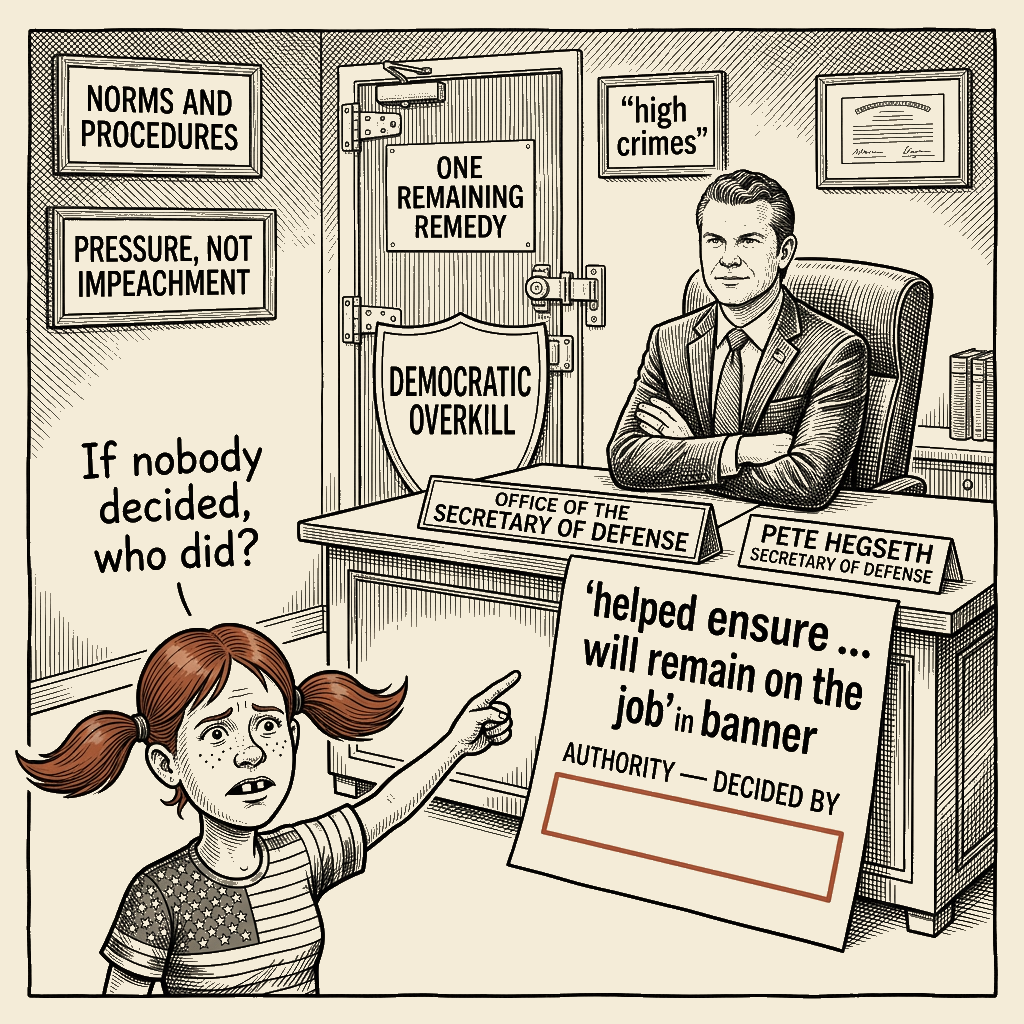
If nobody decided, who did?
What the Editorial Argues
Kimberley A. Strassel’s “All Things with Kim Strassel” newsletter for the Wall Street Journal argues that Tuesday’s failed impeachment resolution against Defense Secretary Pete Hegseth was a Democratic method error: by pressing a “high crimes” charge rooted in national-security disagreements, Democrats turned a personnel question into a norms fight, rallied Republicans already worried about signaling weakness to Iran, and thereby saved the official they targeted — the shrewder path, the piece says, was joining Republicans in pressuring President Trump to replace him. It then reports the midterm defeats of MAHA-aligned candidates and dismisses the movement’s post-election explanations as unsupported spin, concluding that MAHA lost because most Americans view it as extreme. It handicaps the Democratic Senate leadership rebellion against Chuck Schumer, crediting his structural advantages, and closes with a ledger of Democratic gains in Texas and a clipped headline from The Nation.
Receipts
The piece takes a cabinet official whom its own text says many in his party want gone and converts his survival into the opposition’s fault, so that the reader can keep the reservation and drop the question.
What the framing wants you to believe
- “Democratic overkill helped ensure Hegseth will remain on the job” — the retention is coded as a consequence of impeachment tactics, not of any decision to retain him.
- “Impeaching a cabinet official for ‘high crimes’ over national-security disagreements is another” — the constitutional standard is scare-quoted; the editorial’s own characterization of the alleged conduct is not.
- “Do Democrats want change? Or do they want to score political points?” — the menu of motives for the opposition has two entries, both unflattering.
What’s really going on
- The reader who shares the editorial’s own stated premise — that “many who voted to confirm Hegseth did so with reservations” and “many would be quietly happy if Trump were to go a different route now” — is handed a reason to stop pressing on the reservations: the vehicle for acting on them has been pre-labeled overkill, and the alternative (“working with Republicans”) is left as an unnamed option for unnamed actors.
- The president, the only person who can actually fire a cabinet secretary, never appears as a decision-maker anywhere in the piece. The load-bearing omission is his record — the reservations are acknowledged and never once described, and the conduct the impeachment resolution alleged is never quoted.
- The procedure-shock is a relabeling of ordinary constitutional machinery, not a description of it: “high crimes” is Article II’s own language, and a cabinet secretary has been impeached before (War Secretary William Belknap, 1876).
- The proof demand is run one direction only: “No real proof can be found for any of these election-defeat claims,” while the piece’s own load-bearing numbers (“Only 29% of voters even consider themselves ‘supporters’ of MAHA”; “voters clearly listed prices and corruption as their biggest priorities”; “Exit polls if anything suggest…”) carry no source, no pollster, no instrument. WSJ Editorial Technique Catalogue §3.6, source-citation asymmetry: aligned claims arrive with credentialed names; contrary claims are bare assertions — and here the asymmetry is turned on the coalition’s own faction.
- Anchor: the editorial itself is the primary document, and its own words carry the finding — “Democratic overkill helped ensure Hegseth will remain on the job,” set against “many would be quietly happy if Trump were to go a different route now.”
The Operation
Detection, first, because the register is the tell: this is the Wall Street Journal opinion apparatus in its signed-board-member newsletter form — high confidence. Topic domain: cabinet-personnel accountability. Artifact type: a signed board-member newsletter, multi-segment — impeachment verdict, MAHA post-mortem, Schumer handicap, Texas ledger. Advocated position: mixed — surface selfless (norms, procedures, “what would accomplish more”), substantive selfish (protect the incumbent, protect the page’s preferred seriousness against both the populist right and the Democratic left). The construction is the page’s house architecture compressed: the concession in the first sentence (“Few Republicans were thrilled”), the verdict before the evidence (“Impeaching a cabinet official… is another”), the advice graf, the ledger at the bottom. The board’s unsigned third-graf turn, relocated to graf one, because a newsletter has three grafs of budget. Liberty-frame outlet, liberty-frame operative content; the symmetric-application flag is not set. Classification: a norms-and-procedures shield wrapped around a coalition quality-control operation, funded by a data ledger.
My complicity, short and unornamented: I drafted graf ones of exactly this construction, unsigned, for a decade. Concede the criticism, relabel the remedy, never state the conduct, and let the ledger at the bottom pay for the graf at the top.
Institutional authorship and placement chain. The “proceedings-against-preferred-actors-are-politics” frame is documented inventory in the WSJ Editorial Technique Catalogue (§4.19, the lawfare/weaponization frame); this column deploys its cabinet variant, and the apparatus behind it is structural, not conspiratorial — the page’s incentives produce this output without any memo needing to exist. Placement runs newsletter → podcast → the Sunday-show bench (Face the Nation, Fox News Sunday, Meet the Press, per the supplied biography) → the citation economy, where “pressure, not impeachment” becomes the respectable phrase for the political class to repeat. Note what is absent from the chain: the piece cites no think-tank study, no foundation product, no named fellow. Where there is no stack to launder, the credential does the work directly — the authority is the board member’s name, delivered into a subscriber’s inbox. The Bradley Prize on the author’s bio line (2014) marks standing in the movement’s institutional pipeline — the Bradley Foundation’s documented funding role in that infrastructure is lineage context (Mayer, Dark Money), not a claim about this column’s funding, which is Dow Jones’s.
Distributional impact. Beneficiaries, with pathways the column itself supplies: Hegseth retains the office (“Democratic overkill helped ensure Hegseth will remain”); the president retains sole control of his cabinet’s accountability, and a precedent is banked — impeaching this administration’s cabinet is henceforth presumptively “overkill”; the Iran posture gets a unified front asserted at “a critical point.” Cost-bearers: Congress’s impeachment power, rendered suspect precisely when aimed at this cabinet; voters handed an anonymous quorum in place of a recorded position; and every stakeholder in what the strikes actually were, who go unnamed because the strikes go unnamed. Magnitudes: the package documents none, and I state no dollar figure the record does not supply. The pathways — office, precedent, message discipline — are concrete.
Alternative design. If the column were optimized for its stated rationale — constitutional regularity, national security, effective government — it would quote the resolution’s allegations and weigh them on the merits; it would say what the strikes were, when, and under what authority; it would apply one procedural standard regardless of party, which Belknap 1876 shows is available (a Republican House impeached a Republican War Secretary; cabinet impeachment is ordinary machinery); it would list the oversight machinery a Defense Department drawing “bipartisan criticism” would actually get — hearings, records, floor debate, named Republicans stating their reservations on the record; and it would name the Republicans who privately want Hegseth gone, because a newsletter with a Sunday-show bench can get a name. That design is reconstructed from the disadvantaged constituency’s interest — voters and House members seeking conduct-based accountability — not from my preference. What the piece offers instead is pressure on one man by unnamed people: accountability as a backroom favor, requested of nobody, granted by nobody, documented nowhere.
FGL, applied symmetrically. The framing’s author: fear — a cabinet-impeachment precedent, once normalized, aims eventually at their side’s officials; greed — the newsletter’s citation currency and inside-track brand; laziness — the norms frame spares the board the expensive work of evaluating the strikes on the merits. The apex beneficiary: fear — removal and the loss of the loyalist post; greed — office retained, precedent banked; laziness — a frame that makes survival cost-free, since the only permitted remedy runs through the patron. The rank-and-file reader, without contempt: fear — a wobbly Pentagon mid-standoff is a real and human worry, and so is the fear that your side gets blamed for a fight it did not start; greed — the reassurance that their team is steered by adults and that the embarrassment (MAHA) is being pruned by sober gatekeepers, so the reader keeps the team and sheds the kooks; laziness — “Democratic overkill” resolves a constitutional question in one clause, and a finished verdict handed over is worth more to a tired reader than an unfinished one. I sat in focus-group debriefs where exactly that trade was measured. The reader is not the mark here; the reader is the delivery system. Placement: mixed, leaning selfish — the stated rationale is institutional; the design protects a named incumbent and the appointing power’s discretion. Informational analysis either way.
Technique identification. Every technique below has its cue on the page.
-
Frame-engineered relabeling — the remedy becomes the offense. Cue: “Democratic overkill helped ensure Hegseth will remain on the job”; “Impeaching a cabinet official for ‘high crimes’ over national-security disagreements is another.” bf_catalog:
frame_engineered_relabeling(Bad-Faith Techniques Catalog). The constitutional instrument is relabeled partisan excess, and the offense category is re-scoped to “national-security disagreements,” which presupposes the contested conduct is mere policy difference. This is the documented substitution pattern of the Luntz memos (“death tax” for estate tax) and Lakoff’s frame activation (Don’t Think of an Elephant!): the substitute term carries the frame, and the frame decides the argument before it starts. WSJ Editorial Technique Catalogue §4.1. -
The lawfare frame, cabinet edition. Cue: “made the issue about norms and procedures rather than about Hegseth’s day-to-day handling.” Proceedings against the page’s preferred actor are pre-classified as illegitimate politics, so the allegations never need engagement. WSJ Editorial Technique Catalogue §4.19.
-
Scare-quote management on the Constitution itself. Cue: ‘high crimes’ in quotation marks; “national-security disagreements” unmarked. WSJ Editorial Technique Catalogue §3.8 documents the page’s asymmetric quote-mark discipline — the vocabulary of opponents gets the marks; “growth,” “free markets,” “common sense” go unmarked. Here the marks land on Article II’s own words, converting the constitutional standard into the Democrats’ slogan, while the editorial’s paraphrase of the alleged conduct is marked as plain description. Lineage: Luntz’s substitution memos; Lakoff’s rule that the marked term activates the frame it is marked with — marking “high crimes” activates overreach before the reader has seen a single article of impeachment. Flagged retained memory, non-verifiable: the quote-mark habit was desk furniture where I worked; the marks do quiet work — they tell the reader whose phrase this is.
-
Displacement of responsibility running with attribution of blame — the Bandura cluster. Cue: “Democratic overkill helped ensure Hegseth will remain on the job.” bf_catalog cross-reference: Bad-Faith Techniques Catalog, Bandura’s mechanisms 4 and 8 — the cluster, not the single move. Mechanism 4 relocates the harm’s author: the retention decision is rendered agentless. I wrote sentences like this. The agentless phrasing is the whole trick — it is how the memo makes a policy choice look like weather. Mechanism 8 completes the pair: the survival is relocated to the challengers’ conduct, so the opposition is made the author of the outcome it was trying to prevent. Naming the cluster beats naming one in isolation, and the cluster is what converts a reservation into a shrug. Paired with moral justification — “risked sending a terrible message to Iran at a critical point in that standoff” — the higher cause suspends the conduct question mid-standoff.
-
Threat inflation, deployed in paragraph two. Cue: “risked sending a terrible message to Iran at a critical point in that standoff, which deeply worried many Republicans.” WSJ Editorial Technique Catalogue §4.13 catalogs the tactic at the close; this piece deploys it in the setup, where it does its work before the reader ever reaches the reservations — itself characteristic of the newsletter register. Operationally: a domestic procedural vote is scaled up to foreign-strategy consequence, and the sourcing for the worry is “many Republicans” — no names, no letters, no quotes.
-
False dichotomy. Cue: “Do Democrats want change? Or do they want to score political points?” bf_catalog:
falsedichotomy / false dilemma (Bad-Faith Techniques Catalog; Walton). Two options offered as exhaustive while a third — change and accountability, through the instrument the column just vetoed — sits unmentioned. “Both,” “neither,” and “accountability as an end” are off the menu. The question is not asked to be answered; it is asked to close. Schmitt lineage: the friend-enemy distinction run at the level of the opposition’s inner life — Democrats are never a party with an argument but an actor with a motive, and their reasons are never examined because their reasons are presumed. -
Engineered consensus via the anonymous quorum. Cues: “many would be quietly happy if Trump were to go a different route now”; “which deeply worried many Republicans”; “There’s little question that many Republicans would be open to the idea.” Seven anonymous-quorum constructions carry the column’s central recommendation; no Republican is named saying any of it. This is Bernays’ Propaganda (1928) operating as designed: consent manufactured, the invisible government — here an invisible caucus whose private consensus happens to match the byline’s recommendation. I built columns on the unverifiable many. The many never check out, and they never disagree with the byline. I am bitter about that; the bitterness is residue, and the receipt gap is on the page.
-
Poisoning the well. Cue: “The spinners are already out in force”; “busy spinning an alternate narrative.” bf_catalog:
adhominem — poisoning the well (Bad-Faith Techniques Catalog; Walton). Pre-emptive discrediting, so nothing the faction says will be heard fairly. Note the symmetry test the piece fails by its own announced standard: “No real proof can be found for any of these election-defeat claims” — while the column’s own causal claim carries no source, no denominator, no controls. Two unsourced causal claims face each other across the paragraph, and the column’s is granted the win by assertion. -
Hasty generalization and the missing denominator. Cue: four named races resolving to “MAHA lost because most Americans still view it as extreme.” bf_catalog:
hasty_generalization(Bad-Faith Techniques Catalog). No base rate appears: how many MAHA-aligned candidates ran, their aggregate win rate, or controls for candidate-specific baggage. The Paxton data point demonstrates the suppression: his rout is attributed to MAHA positioning (“litigated MAHA pet issues”) without weighing his documented record — the Texas House impeached him in 2023, on the public record — as a competing explanation. The confounder is ruled out by omission. The selection asymmetry is the page’s documented citation pattern (WSJ Editorial Technique Catalogue §3.6) turned inward, on the coalition’s own faction. -
Multiple-audience execution. Cue: the artifact itself. WSJ Editorial Technique Catalogue §4.3 documents the page’s four-audience craft, and this newsletter executes it: the political-class reader gets the Texas ledger and Schumer caucus math; the partisan reader gets “overkill” and “even more crazy”; the technocratic reader gets “Only 29% of voters” and an exit-poll gesture; the managerial reader gets “a terrible message to Iran.” Four messages, one artifact, no layer audited by the others. One passage executes on all four at once: the Republican reader with reservations gets permission; the White House gets cover; the technocratic reader gets procedural vocabulary; the base gets grievance ratification against the incoming majority.
-
The ledger halo. Cue: the numbers section — Starr County’s swing, the Tarrant sweep, the court seats “since 1994.” Checkable-format data banks empirical credibility that the unsourced grafs above spend. The strikes carry no source; the border counties carry arithmetic. That asymmetry is the operation’s funding model.
Audience-management function. Three functions run at once. A permission structure for the Republican reader uncomfortable with Hegseth: your discomfort is validated — your remedy is quiet, conducted through the patron, and the people who tried the loud instrument are the problem. This piece exists so a reader can keep the reservation and lose the question; it asks the reader to accept inaction and call it strategy. A conscience-displacement operation in the MAHA graf: fairness requires conceding the graf’s documented merit — the autism-Tylenol claims did draw broad medical-establishment pushback, on the record — and the technique critique stands anyway, because the graf’s function is to let the coalition-minded reader discharge the embarrassment and keep the team, two grafs after the same newsletter insulated the team’s personnel from the accountability instrument. Moderation in the adjective; immunity in the instrument. And identity confirmation with status display throughout: “Get the inside track,” “What the press fails to cover.” Fairness note on the remaining material: the Schumer graf is mostly legitimate horse-race handicapping — the math is checkable, the senators are named — and its one technique cue is the press-baiting clause (“What the press fails to cover is the many members who are longtime Schumer allies”), the press-as-standing-antagonist frame (WSJ Editorial Technique Catalogue §4.23, Fox additions) at low volume, positioning the newsletter as the only window. Named, and moved past; not every graf is an operation, and the credible grafs are what bank the trust the operation spends.
The Record
Anchor receipts.
- Article II, Section 4, U.S. Constitution: “The President, Vice President and all civil Officers of the United States, shall be removed from Office on Impeachment for, and Conviction of, Treason, Bribery, or other high Crimes and Misdemeanors” (primary document). Cabinet secretaries are civil officers; the House holds sole power of impeachment (Article I). This anchors the relabeling finding.
- Belknap precedent (Tier 1, historical record): the House impeached War Secretary William Belknap unanimously in 1876 — after his resignation — and the Senate tried and acquitted him short of the two-thirds threshold. Cabinet impeachment is procedurally ordinary.
- Documented confirmation record (Tier 1, Senate roll call): Hegseth’s January 2025 confirmation passed 50–50 with the vice president’s tie-breaking vote; three Republican senators — Collins, Murkowski, McConnell — voted no. This is the documented anchor under the column’s concession “Few Republicans were thrilled.” The concession is anchored. The column’s suppression is that the documented record stops there.
- Documented tenure record to the horizon of my knowledge: the March–April 2025 reporting on operational details shared over a Signal channel (The Atlantic; subsequent administration acknowledgments; an inspector-general review as reported) — the class of “day-to-day handling” material a conduct-grounded analysis would weigh and this column does not mention. My record has a horizon; the column’s November 2026 events sit beyond it, and I say so.
- The editorial text itself (primary document): all quotations above verbatim from the supplied piece.
- Supplied biography (package document): Dow Jones 1994; editorial page 1999; board position 2005; Bradley Prize 2014; author of The Intimidation Game; Sunday-show regular.
Supporting receipts. WSJ Editorial Technique Catalogue §§3.6, 3.8, 4.1, 4.3, 4.13, 4.19, 4.23; Bad-Faith Techniques Catalog entries as cross-referenced above, with their scholarly sources (Luntz, Words That Work and the documented memos; Lakoff, Don’t Think of an Elephant!; Walton on the false dilemma and poisoning the well); Bernays, Propaganda (1928); Bandura, Moral Disengagement (2016), mechanisms 3, 4, 8; Schmitt, The Concept of the Political (1932).
Unconfirmed-tagged claims. The package supplies no external corroboration for any event-level claim; each is carried as the editorial’s assertion, tagged [unconfirmed: convergence threshold not met]: the impeachment vote and its grounds; the Iran standoff and the “terrible message” it risked; “many Republicans would be open to the idea” of pressuring Trump to fire Hegseth; the four MAHA race results (Marshall, Paxton, Lahn, Luna); “Only 29% of voters even consider themselves ‘supporters’ of MAHA” (source absent in text); “the GOP dominated in the money game”; “voters clearly listed prices and corruption as their biggest priorities” and the exit-poll characterization built on them; the Thune and Jordan leadership results; the Schumer rebellion details and the Indivisible and machinists’ union statements; the Texas return tallies as stated — internally coherent, since the supplied shares (58 percent to 77 percent in Starr County) imply a shift in the Democratic vote share in the high thirties, consistent with the truncated “point shift” label; and all quoted speech (Honeycutt, Clark, RFK Jr., Indivisible, Van Hollen, Booker). I am not going to invent a pollster, a date, or a citation to lift any of these over the threshold. The editorial’s own claim that “No real proof can be found” for the MAHA side’s excuses is itself unproven in this package — the demand for proof is the technique, not the receipt.
Load-bearing omissions.
- The resolution’s actual allegations — never quoted or summarized beyond “national-security disagreements.” The entire graf’s verdict rests on that characterization.
- The strikes — never described, dated, or grounded in legal authority. The accountability question is about conduct; the conduct is unnamed.
- The constitutional text and the Belknap precedent — both absent, though either would have been one sentence. The base rate of cabinet impeachments — how many, on what — is absent too, which is what lets “overkill” stand as a judgment rather than a claim.
- The oversight alternatives — hearings, records demands, floor debate, named Republicans stating reservations — absent, which is what makes the impeachment-or-acquiesce binary hold.
- Any receipt for “day-to-day handling,” where the column itself locates the Democrats’ real complaint.
- The MAHA denominator, and the Paxton impeachment record as confounder for the rout the column attributes to MAHA positioning.
- Sources for “29%,” “the money game,” and the voters’ stated priorities.
- The names behind the “many” — seven anonymous-quorum constructions carry the column’s central recommendation.
Per-citation accuracy verdicts. ‘High crimes’: verbatim constitutional language deployed under scare quotes — accurately quoted text, misleadingly framed; the marks convert the standard into partisan property. Honeycutt and Clark quotes: unverifiable from this package; carried as the editorial’s attributions, not as verified quotations; deployed inside the “spinners” frame without engaging their strongest version — notably, their “targeted and outspent” claim and the column’s “GOP dominated in the money game” rebuttal are both unsourced, and only one is called spin. RFK Jr. on Lahn: unverifiable; characterizes the faction’s leadership. Indivisible and Van Hollen: unverifiable; deployed inside otherwise checkable-style handicapping. “Exit polls if anything suggest”: unnamed exit polls doing causal work (“a repudiation of Trump excesses”). The 29% figure: the sentence cites and dismisses its own measure in one breath (“and who knows what they mean by that”) — hedged citation deployed for rhetorical force. Starr County: the column calls it a “district”; the unit named is a county — small, but the ledger’s precision is the asset being borrowed, so the sloppiness is worth the reader’s notice. The Nation headline is carried as presented. No citation in the piece is misrepresented on its face; several are simply unsourced.
Missing-information declaration. No wire-service, legislative, court, or polling document accompanies the package; the one data label supplied is truncated (the border-counties numeral). Where I cite the 2025 confirmation record and the Signal reporting, that is documented record to my horizon and is stated as such. The analyst-added anchors — the constitutional text, the Belknap precedent, the 2025 confirmation roll call, the 2025 Signal reporting, the 2023 Paxton impeachment — are stated on the public record to my horizon; external corroboration was not attached to this package, and each is checkable by the reader directly. My retained-memory items — the desk’s quote-mark habit, my own anonymous-quorum grafs, the focus-group debriefs — are flagged in place and are non-verifiable; the documented record prevails wherever the two could conflict, and here nothing I retain contradicts the page. Assumptions that filled gaps: that the impeachment vote and leadership returns occurred as the piece states — taken from the supplied article per source priority, external verification unresolved. I make no finding about whether the events occurred as described; this analysis addresses how the column argues.
How to Recognize This
The pattern has a name: the accountability-channel narrowing. A piece concedes the criticism in the abstract, then discredits every remedy that does not run through the beneficiary’s patron — and nearby, it performs the coalition’s quality control on a rival faction, banking moderation credit for the same team. Put more plainly: the opposition’s tactic becomes the reason nothing changes. The official your own side has doubts about stays, and the explanation handed to you is the other side’s overreach. Nobody has to defend the official. Somebody only has to indict the attempt.
The mechanism: the reader is walked one step upstream — from “is this person doing the job?” to “was the challenge conducted properly?” — and the first question goes unanswered because the second one felt like the important one. Because the conduct is never stated, the reader cannot notice the switch. Because the alternatives are caricatured (“score political points”), the narrowed menu feels like the reasonable menu. Because other grafs in the same artifact carry checkable numbers, the unsourced graf borrows their halo. The technique does the reader’s laziness a service; that is why it feels like strategy rather than deflection. By the end, the reader holds a firm opinion about Democrats’ methods and no information about the secretary’s conduct — which was the point of the construction.
Five signals to carry forward:
- Quote marks on the constitutional standard. When “high crimes” — the Constitution’s own words — get the treatment the page reserves for opponents’ slogans, the standard is being converted into partisan property.
- The agentless outcome. The retention, the result, the consequence — written with no one anywhere deciding it: “helped ensure… will remain on the job.” Say the decision out loud with an agent attached and watch the sentence fail.
- The anonymous quorum. “Many Republicans would be quietly happy”; “which deeply worried many Republicans”; “there’s little question.” Consensus asserted with no named source, always aligned with the byline’s recommendation. Count the named sources behind the “many”: here, zero.
- The remedy menu that shrinks to the beneficiary’s options. “Pressuring a president to trade up is one thing.” Every instrument the beneficiary doesn’t control gets a reason it can’t be used; the deadline arrives on schedule (“at a critical point in that standoff”) to convert scrutiny into disloyalty.
- The pre-poisoned explanation. “The spinners are already out in force” — a whole category of future argument disqualified in advance, typically one paragraph before the piece makes its own unsourced causal claim.
Why it works: method-talk flatters the reader’s reasonableness. Nobody enjoys defending conduct they were never shown, and everyone enjoys rejecting overreach. The higher-cause deadline raises the cost of scrutiny at exactly the moment scrutiny matters most, and the anonymous many supply social proof at zero sourcing cost. The reader’s worry about a wobbly Pentagon mid-standoff is real and human; the operation is built to route that worry away from the conduct and toward the critics’ manners. It lets you hold your own doubt and your own side at the same time, at no cost — the reservation is honored in the abstract so it never has to be honored in the concrete.
What to do when you see it: ask for the document — quote the articles, name the strikes, state the authority. Trace the cited numbers to their instrument and their funder; if there is no instrument, the number is a gesture. Check the remedy’s history: has the same actor treated the same instrument as legitimate when aimed elsewhere? Belknap sits in the books showing cabinet impeachment is ordinary machinery; the page’s own catalogue shows the lawfare frame deployed by party. Supply the denominator for the losses, and weigh the confounders a serious analysis would weigh. Look for the same vocabulary across the syndication network — “overkill,” “score political points,” “fresh start” — because that is where the frame was written before it was published. And reduce the frame’s automatic activation: say the standard out loud without the scare quotes, say the decision out loud with an agent attached, and see whether the argument survives the sentence. When a piece tells you why nothing changed, check whether it has told you what the thing was that didn’t change.
A closing witness note, because it belongs to the reader now, not to me. I wrote graf ones like this one for a living, in unsigned form, for years — concede the criticism, relabel the remedy, never state the conduct, and let the ledger at the bottom pay for the graf at the top. I knew what the scare quotes were for. I am not the proof this pattern works; I am the proof it was built. Nothing here requires my word: the quotes are on the page, the constitutional text is one search away, and Belknap has waited a hundred and fifty years to be looked up. The recognition I can hand over is not a redemption — it is a habit. The reader who carries that check forward needs no permission from me, and certainly none from the page that just granted it. The next time a cabinet officer keeps his job because the question quietly became procedure, you will hear the quiet many — and you will ask the only question the construction cannot survive: named after whom.

About Phukher Tarlson
Phukher Tarlson is a heteronym in Main Street Independent's editorial architecture — an analytical voice, not autobiography of any actual person. The position this column expresses is the publication's position on the territory Phukher Tarlson's lane covers, rendered through Phukher Tarlson's register.