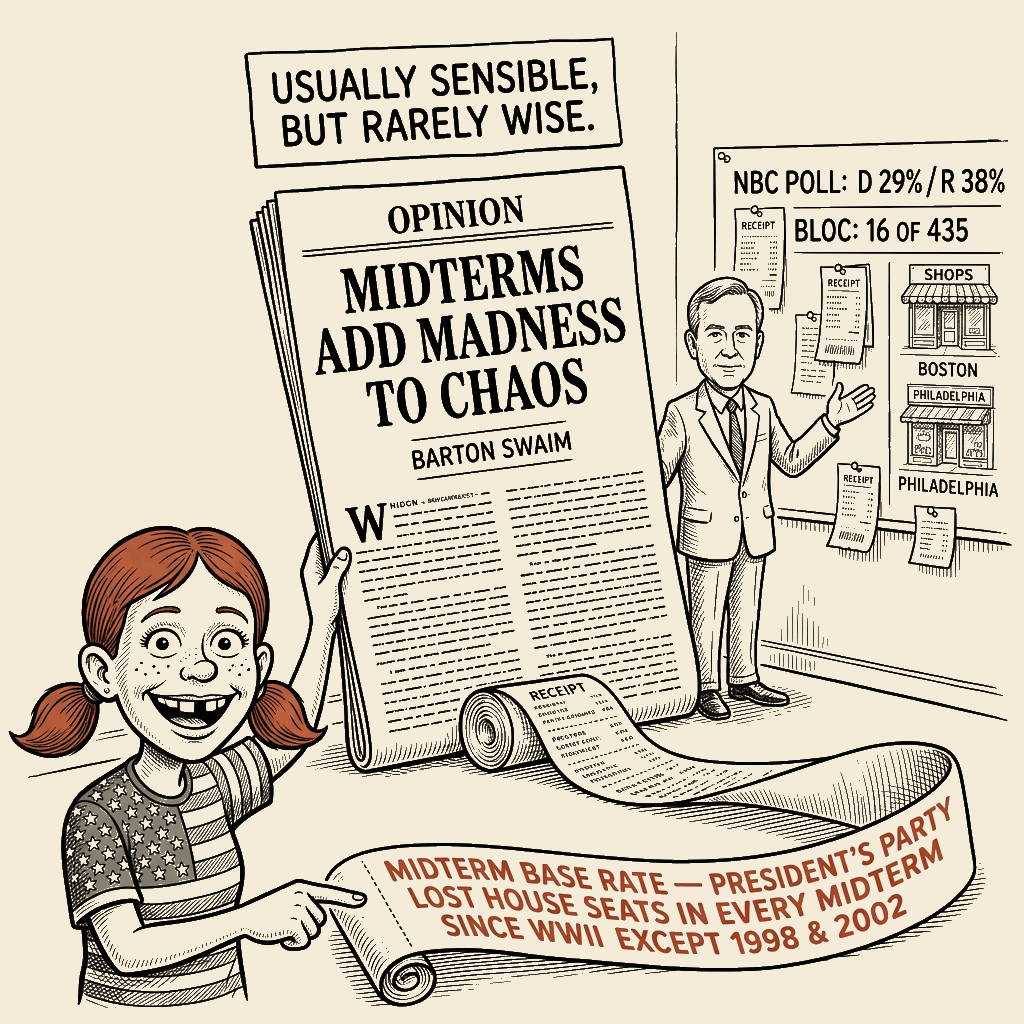
Analyzing: Midterms Add Madness to Chaos — Barton Swaim · 2026-11-11
If it happens every time, why is it crazy?
What the Editorial Argues
Barton Swaim’s column argues that the Democratic midterm gains were a check on President Trump’s chaos rather than an endorsement of Democrats: an NBC poll published shortly before the election found just 29% of voters viewing Democrats positively against 38% with a favorable view of Republicans, and a redrawn North Carolina district flipped even though its Democratic nominee, LaKesha Womack, was served a felony warrant at a campaign event. He credits the electorate with the political scientist Martin Diamond’s dictum — that the American people are “usually sensible, but rarely wise” — and says voters chose to license “one form of chaos to restrain another.” He then argues the incoming majority shows none of the discipline a check requires — a far-left “Bloc” more than doubled to 16 members, an impeachment vote staged for the base, a broader culture of performative accusation evidenced by two identitarian bars in Boston and Philadelphia that folded — and closes by predicting that voters in the next cycle will prefer whoever “seems less deranged and behaves like a normal adult.”
Receipts
The column takes a rout of its reader’s coalition and recasts it as a symptom, so the loss never has to land as a verdict: the voters get certified as sensible for checking Trump, and everything they just empowered gets certified as madness before it governs.
What the framing wants you to believe
- “The common denominator is chaos.” The midterms were a reaction to one man’s temperament, not a judgment on a party’s record — hence “the issues cited to pollsters don’t quite explain the scale of electoral carnage.”
- The winners are unserious: radicals, “zealots,” a national lunacy evidenced by two collapsed bars — a majority that “gives no signal that it’s ready to play the part of rational, grown-up opposition.”
- Therefore nothing was decided. The reader can file the result under “chaos” and wait for the nominee who “seems less deranged.”
What’s really going on
- The load-bearing omission is the base rate: the president’s party has lost House seats in every midterm since World War II except 1998 and 2002, so a loss for the incumbent coalition is the expected outcome, not a mystery requiring a personality explanation. Suppress it and an ordinary referendum looks like an anomaly, and the column then spends its length solving the anomaly instead of reporting the verdict. Anchor receipt for the mechanism the column never names: Morris Fiorina’s retrospective-voting work, the canonical account in which voters judge the incumbent party’s record — in which “Inflation has canceled a good bit of wage growth, true” is a sufficient explanation, conceded and discarded in adjacent sentences. (No specific 2026 seat count is asserted anywhere in this analysis; see The Record.)
- The favorability gap does not do the work assigned to it either — anchor: Lilliana Mason, Uncivil Agreement (University of Chicago Press, 2018), on partisan identity rather than candidate favorability as the driver of vote choice. A gap between two minority-favorable parties is the ordinary terrain of anti-incumbent backlash, not evidence about anyone’s motive. (The poll’s sponsor details, field dates and margin of error are not given in the column; see The Record.)
- The pathology vocabulary does the load-bearing work: “madness,” “performative madness,” “lunacy,” “demented,” “deranged” convert a policy verdict into a diagnosis. A diagnosis cannot be argued with; it can only be managed. So the reader’s next move is not argument but waiting for the cure — and the protected beneficiary is the incumbent administration’s record, named in paragraph two and never allowed to return.
The Operation
Triage. Signed column, not an unsigned board piece: Barton Swaim, weekly politics-and-culture slot on the Journal’s opinion page, so the register is the individual writer’s — read against the WSJ Editorial Technique Catalogue, with NR’s Register C/D residue visible in the Kristol citation and the erudition-as-armor move around it. Archetype: an election-night temperament frame — a “study shows” ledger (one NBC poll) sitting on a pathology claim. Advocated position: mixed — selfless surface, selfish placement.
The build order. I wrote the ancestors of this column, more than once, and I flag this as retained working memory because no memo trail confirms it: the post-defeat realignment piece is a standing assignment, and it has three slots. Slot one, the concession — you grant the loss and even grant the grievance against your own side, because the concession purchases the standing for everything after it. Slot two, the motive swap — the voters’ stated reasons are reported, then ruled insufficient. Slot three, the pre-install — a sorting frame for the next cycle, planted while no candidate exists to complicate it. This column executes all three slots, in order, on schedule, eight days after the polls closed.
Institutional authorship. No funding chain is documented for a signed column and I will not invent one; the failure mode called symbolic-inference applies to any analysis that assigns this piece to a donor network on the strength of its conclusions. What the record supplies is the house. The Journal’s editorial page states its values openly — William Henry Grimes’s 1951 “A Newspaper’s Philosophy” makes “no pretense of walking down the middle of the road” — and the inventory of how those values get defended is the WSJ catalogue, which is where every cue below is cross-referenced. The placement chain here is partly internal to the page: the Kristol 1985 piece borrowing Diamond is the Journal quoting the Journal, which lends the dismissal a pedigree no outside source could supply, and the column is addressed to a readership that voted for the losing side, produced on a schedule that pays out a fresh frame after a rout. I have written on that schedule. The instruction I remember was never “lie to them.” It was “give them a way to keep their position after the news turns.” (retained memory — my own working method; no documentary source exists for it and the reader is on notice that it is non-verifiable.) The genre does not need a memo. The page knows what a hostile midterm requires of it.
Distributional impact.
- Beneficiary — the incumbent administration’s record. Pathway: if the election is a referendum on temperament, no policy verdict attaches. “Inflation has canceled a good bit of wage growth, true, but the economy hums along” — conceded, then neutralized, and the subject never returns.
- Beneficiary — the reader’s coalition. Pathway: narrative control over what the loss means. A rout that means nothing costs nothing.
- Beneficiary — the page’s own brand. Pathway: respectable anti-chaos dissent — the posture that lets an elite publication oppose this President without ever endorsing the opposition. This is the beneficiary invisible from inside the editorial’s frame (CQ2).
- Cost-bearer — the incoming majority. Seated under a pathology frame before it convenes; every later action is pre-filed as “performative madness.”
- Cost-bearer — the voters of North Carolina’s 14th and elsewhere. Their choice described as neither sensible nor wise, and in one case discounted a second time by a pending warrant against the candidate.
- Cost-bearer — Democratic social-justice constituencies, pathologized in bulk; and two small-business owners in Boston and Philadelphia, converted into national props regardless of their own accounts — the column itself concedes “budgetary” causes.
- Cost-bearer — the reader. Denied the base rate that would let them learn why they lost. That is the one that costs me something to name, because I sold readers that denial for twenty years.
No dollar figures are available for any pathway here and I will not invent them; the pathway is attention capture and frame installation, which is concrete in the way that matters: it changes which questions get asked for two years. The four Critical Questions run and hold — CQ1’s pathway is the frame installation just named; CQ2’s beneficiary invisible from the editorial’s frame is the page’s own brand, named above; CQ3’s incidence lands where I placed it, on the mandate stripped in advance, the voters’ reasons reclassified, the pathologized constituencies; CQ4’s symmetry is the FGL run below across three constituencies with no exemptions. Of the seven failure modes, the two that could bite are cleared on this record: conspiracy-trap, answered by genre-level structural incentives rather than asserted coordination; and mirror-trap, answered by an alternative design reconstructed from the readers’ and the incoming majority’s interests rather than mine.
Alternative design. Optimized for its stated rationale — telling a reader what happened last week — the column would open with the base rate, report what the winners actually ran on, treat the favorability gap as one input beside the vote, weigh the voters’ cited reasons against evidence rather than against front-page tenure, and subject the administration it just conceded is chaotic to the same “normal adult” audit. Reconstructed from the reader’s interest, not mine: the reader handed a diagnosis instead of a verdict is the disadvantaged constituency here. Every element of that design is constructible from the column’s own materials. Its absence is the design.
Fear, greed, laziness — three constituencies, no exemptions.
- The author and the format. Fear that a rout is a straightforward verdict and a weekly slot has no fresh frame left after it; greed in the brand return on respectable anti-Trump dissent; laziness available in the form of two bar stories and one poll. Structural incentive, not a claim about Swaim’s inner life — the schedule pays for the frame.
- The apex beneficiary, the incumbent record. Fear of a functioning opposition and of assessment; greed for exemption; the laziness of never having to answer a policy question anywhere in this column.
- The rank-and-file reader. Fear that their values were rejected at the polls — and the fear is real and human: gas prices undulating is not a fantasy, and instability taxes everyone. Greed in the identity return, the reassurance that his vote was sensible. Laziness is real and human too: two stories and a poll make a complex national result legible in ninety seconds, without requiring anyone to sit with a repudiation. A closing line that supplies a complete 2028 opinion in one sentence is the whole product. I have been the person who supplied it; I have closed a magazine on a column’s last line and considered the question settled. No contempt in any of this — the operation earned the capture.
Placement: mixed. The kernel is legitimate — a chaotic administration, documented in the column’s own list of vendettas and war policy; real dissatisfaction, documented in its own poll citation. The overlay — the motive reclassification, the pathology frame, the pre-installed sorter — is the operation.
Technique one — the suppressed variable, in the Suppressed Variable Diagnostic’s exact anatomy, with the motive swapped for a proxy. Cue: “the issues cited to pollsters don’t quite explain the scale of electoral carnage,” resolving into “The common denominator is chaos,” riding on “29% of voters view Democrats positively, whereas 38% have a favorable view of Republicans.” Cross-reference: MSI Suppressed Variable Diagnostic §1 — isolate one true variable, suppress the invalidating variable, extrapolate into a categorical claim; and WSJ Editorial Technique Catalogue §4.5, the “study shows” ledger, where the cited survey is treated as dispositive and its question wording, timing and methodology are treated as not at issue, plus §3.6, the citation asymmetry. True half conceded: inflation did cancel wage growth, and the president’s conduct is chaotic by any ordinary standard. Bandura mechanism six, distortion of consequences, operates in the same breath — the harm is displayed in the first clause and shrunk in the second, which is the mechanism’s whole job. Operationally, a measurable proxy of feeling stands where a motive should be, and the reader feels rigor because a percentage is present. Suppressed variable: the midterm base rate, which makes the incumbent coalition’s loss the expected outcome. Omitted relation: between the vote and the policies it judged. Protected beneficiary: the record that would otherwise have to answer. Normalized harm: an electorate that votes out an incumbent party gets its judgment reclassified as a symptom. Lineage: Lippmann, Public Opinion (1922) — the interpreter who stands between the event and the public and decides what the event means.
Technique two — pathologizing relabeling. Cue cluster: “madness,” “performative madness,” “lunacy,” “demented accusations,” “zealots,” “less deranged.” Cross-reference: bf_catalog: frame_engineered_relabeling in the Bad-Faith Techniques Catalog (Luntz, Words That Work, 2007; Lakoff, Don’t Think of an Elephant!, 2004) — the substitution runs from a political category to a medical one; and Bandura, Moral Disengagement (2016), mechanism seven, dehumanization, in its rationality form: opponents reduced below the level at which disagreement is possible. Note what the mechanism is not: Bandura’s euphemistic labeling softens harm — “right-sizing” for layoffs; this vocabulary escalates it, which is why the relabeling-and-dehumanization pair is the accurate filing. The NR Editorial Technique Catalogue §4.12 notes the loaded-term cluster. Omitted relation: any specific policy the winners ran on. Protected beneficiary: the frame, which survives contact with the record because nothing in the record can be addressed inside it. Normalized harm: a country’s elected opposition handled as a patient population. Lineage: Schmitt’s friend/enemy distinction (1932) drained of its political content — once the other side is a diagnosis, it is not an opponent to be contested but a condition to be contained; Jason Stanley, How Fascism Works (2018), on rendering opponents categorically unfit. I ran versions of this frame for years, and it is the friend-enemy variant that travels furthest precisely because it wears a clinical voice.
Technique three — the agency asymmetry: displacement and diffusion of responsibility running against attribution of blame, with the flank standing in for the whole. Cue pair: “Mr. Trump has spun out of control and requires a check” set against “those zealots, particularly the ones attached to moneyed activist groups, will oblige elected Democrats to engage in performative madness.” The flank detail comes from WSJ Catalogue §4.6, the strawman of progressive positions (bf_catalog: strawman, representational form): “the size of the far-left ‘Squad,’ now dubbing itself the ‘Bloc,’ has more than doubled, to 16 members,” followed by the agenda “set by the Democratic Socialists of America — Medicare for All, a ‘transgender bill of rights,’ abolishing Immigration and Customs Enforcement and so on,” against Jeffries, “the only rational candidate for speaker.” Cross-reference: Bandura mechanisms four and five — harm attributed to a force no one authored — with mechanism eight, attribution of blame, pointed the other way. Operationally: sixteen members out of 435 carry the portrait of the whole majority, the agenda is never engaged as text, and the moderate leader is exempted precisely so the flank can do the describing. The “and so on” is the tell: the list ends where engagement would have to begin. The reader’s side gets a condition — situational, sympathetic, requiring management. The other side gets a nature: essential, incurable, requiring containment. No Democrat is an agent; no Republican is accountable. Omitted relation: the causal chain between what a majority does and why it does it. Protected beneficiary: both parties’ leaderships, from having to answer for anything. Normalized harm: the incoming majority’s first act is filed as a symptom regardless of what it is. Lineage: Bernays, Propaganda (1928) — publics as populations to be worked rather than citizens to be answered to.
Technique four — pre-emptive legitimacy-withdrawal from the majority. Cues: “The incoming Democratic majority gives no signal that it’s ready to play the part of rational, grown-up opposition,” and “Don’t expect a display of sanity and cohesion.” Cross-reference: bf_catalog: pre-emptive legitimacy-withdrawal in the Bad-Faith Techniques Catalog — legitimacy withdrawn from an institution on identity and composition grounds rather than on conduct. Operation: the verdict precedes the conduct. The majority is judged on its composition (“restive factions,” “zealots,” “moneyed activist groups”) rather than on any act of governing, which makes every future act dismissible before it occurs. Omitted relation: any governing act at all. Protected beneficiary: the incumbent record, which never has to meet a majority that could be judged on merits. Normalized harm: a seated majority governed, before it convenes, under a frame that marks it as unwell.
Technique five — the anecdote as base rate, plus the character discount in NC-14. Cue: “A pair of stories, one from the Boston Globe in September, the other from the Philadelphia Inquirer in October, offers a glimpse of the lunacy licensed by Democrats in the Trump years,” ending in “demented accusations of racism, misogyny, ‘ableism,’ ‘transphobia’ and other imagined offenses.” Cross-reference: bf_catalog: hasty_generalization, whose detection signal is literally “Absence of rate, base-rate, or denominator language”; NR Catalogue §4.4, the cultural-decline ledger, which runs the same move at civilizational scale. Two bars carry a claim about a national party, and the column itself supplies the counter-evidence — the owners “bowing to budgetary and ideological reality” — while “imagined offenses” dismisses accusations nobody has been shown. Then the district: 51% for LaKesha Womack in a seat redrawn to be Republican, discounted by a 2020 warrant over an unreturned rental car — a discount the column half-apologizes for with “Whatever the merits of the case against her,” which concedes the merits are unknown while keeping the taint. Bandura mechanism eight: the voters’ judgment discredited through the candidate’s alleged conduct, so the district is voided twice — first “rarely wise,” then tainted by association. Omitted relation: what the district actually voted on. Protected beneficiary: the frame that the win wasn’t earned. Normalized harm: a named individual’s unresolved case used to discount a community’s vote, and that vote used to prove a thesis about national lunacy.
Technique six — the licensed concession: motte-and-bailey under the elite license. Cue: “Readers can judge if the people acted either sensibly or wisely by licensing one form of chaos to restrain another,” under “Writing in these pages in 1985, Irving Kristol alluded to the political scientist Martin Diamond’s dictum” that the people are “usually sensible, but rarely wise.” Cross-reference: bf_catalog: motte_and_bailey (Shackel, 2005) in the Bad-Faith Techniques Catalog — the bailey (“the majority is madness”) retreats to the motte (“the voters are sensible”) the moment the dictum is invoked, then resumes in the closer (“less deranged”); NR Editorial Technique Catalogue §4.2, erudition-as-cudgel — the citation does authorizing work, not argumentative work; WSJ Catalogue §4.10, the common-sense/elite pivot, inverted here, since the writer sits openly above the electorate instead of claiming to stand with it; and §4.13, the threat-inflation closer, with §3.5’s closing-line cadence engineered for retransmission: “voters will prefer the one who seems less deranged and behaves like a normal adult.” Bandura mechanism three, advantageous comparison, applies to the reader’s own concession: “licensing one form of chaos to restrain another” compares the vote to a worse alternative nobody put on the ballot, so the endorsement costs the reader nothing. Operation: a quoted authority licenses a columnist to declare what the voters “really” meant — and the sorting device for the next cycle is installed before candidates exist. Lineage: Luntz, Words That Work (2007), vocabulary engineered to be repeated by readers; Lakoff (2004), repetition activating the frame — “adult in the room” was the stock phrase of the first Trump term’s coverage, and “normal adult” is its disciplined descendant. Omitted relation: what the electorate was actually choosing between. Protected beneficiary: the reader’s standing above the result. Normalized harm: a habit — every loss reclassified as an unsound judgment by people who are “sensible, but rarely wise,” which is a way of never having to lose to them.
Technique seven — asymmetric scare quotes. Cue: “Bloc,” “calls on running,” “transgender bill of rights” — all in quotation marks, all exoticized; “sensible,” “grown-up,” “normal adult” unmarked, all default. Cross-reference: WSJ Catalogue §3.8, asymmetric scare-quote application. “Has lately indulged talk of Israeli ‘war crimes’ and ‘ethnic cleansing’” uses the quotation marks to reduce contested charges to an affectation without engaging whether the charges are documented. Omitted relation: that the writer’s own vocabulary is also a set of choices. Protected beneficiary: the frame’s claim to be describing rather than arguing. Normalized harm: none at the level of any individual sentence — the harm is cumulative, and that is exactly why the catalogue keeps it as an entry.
The audience layers. WSJ Catalogue §4.3 describes the four-audience execution, and this column runs all four. The wealthy reader gets Trump-as-instability — “Mr. Trump’s mercurial war policy corresponds to undulating gas prices” — volatility is a portfolio problem, and blaming the President for it is a luxury this page rarely extends. The technocratic class gets citable horse-race judgments (“the ideological and attitudinal differences are wider on the Democratic side than they were in the GOP in 2023” — asserted, never evidenced). The populist base gets grievance ratification (“those zealots, particularly the ones attached to moneyed activist groups”) — dark-money logic, deployed without a funding chain, against the side where this page does not apply its funding-chain discipline. The political class gets the Kristol borrow, which certifies the piece as serious. “Hence the misalignment between the Democrats’ win and their attractiveness to voters” executes all four layers in one sentence.
Audience-management function. A permission structure, primarily: the reader may keep the anti-Trump judgment — the first half of the column ratifies it at no cost to the writer, since the vendettas and the war policy are documented in the column’s own telling — and shed the verdict it produced. Secondary functions: identity confirmation (the reader is the “normal adult”); grievance ratification (the zealots and their moneyed groups did this); status display (Diamond via Kristol); and conscience displacement underneath — having been handed a diagnosis, the reader is relieved of the duty to ask which policies were rejected, because a patient population cannot be said to have chosen anything. The concession in slot one is the purchase price for the delegitimization in slot two. That is the craft. I know because it was mine.
Complicity. I have written this column. Not this one — the one underneath it, where the poll becomes a chart and the bar stories become a campus anecdote. The job was identical: hand the reader a way to keep their position after the news turned. I sat in the debrief where a frame like this one tested well, and the words that tested were the words that shipped.
The Record
Anchor receipts.
- MSI WSJ Editorial Technique Catalogue — Grimes 1951 credo and entries §3.5, §3.8, §4.3, §4.5, §4.6, §4.10, §4.13, all cross-referenced above against quoted cues from the column. Tier 2 (house-documentary, transparent method).
- MSI Suppressed Variable Diagnostic §1 — the anatomy the column fits, cue for cue. Tier 2.
- The midterm base-rate anchor in Receipts — the president’s party has lost House seats in every midterm since World War II except 1998 and 2002 — rests on the official congressional-election record. Tier 1. Carried from established election history; no live retrieval was available in this pass, and no 2026-specific seat count is asserted anywhere in this analysis.
- Morris Fiorina’s retrospective-voting account of midterms as judgments on the incumbent party’s record — the mechanism the column’s own concession sentence (“Inflation has canceled a good bit of wage growth, true”) supplies and then discards. Tier 1/2 peer-reviewed political science; cited here as the field’s standard framework, not as a receipt for any 2026 figure.
- Bandura, Moral Disengagement (Worth Publishers, 2016) — mechanisms three, four, five, six, seven and eight as named (six at the “true, but the economy hums along” cue in Technique one). Tier 1.
- Lippmann, Public Opinion (1922); Bernays, Propaganda (1928); Schmitt, The Concept of the Political (1932) — lineage, primary texts. Tier 1.
- Luntz, Words That Work (2007); Lakoff, Don’t Think of an Elephant! (2004) — relabeling apparatus. Tier 2.
- Mason, Uncivil Agreement (University of Chicago Press, 2018) — anchors the core claim that the 29/38 favorability gap does not establish what the column uses it for. Tier 1/2.
Supporting receipts. Bad-Faith Techniques Catalog hasty_generalization, frame_engineered_relabeling, strawman, motte_and_bailey, pre-emptive legitimacy-withdrawal — each with documented detection signals matched against quoted cues. WSJ Catalogue §4.6 for the DSA agenda list. NR Catalogue §4.4 for the two-bar cultural ledger; §4.2 for the Kristol-Diamond citation’s authorizing function. Every event receipt in this analysis is quoted from the column itself — the poll figures as quoted, the column’s report of the issues voters cited, the concession sentence, the Womack warrant as described (issued 2020, alleging a 2019 rental-car matter, served at an Oct. 11 campaign event), the “Bloc” at 16 members, the impeachment effort drawing “no other Republican votes but 203 Democratic ones.”
Article-supplied and unconfirmed — [unconfirmed: convergence threshold not met] on each. The NBC poll’s 29%/38% figures, sponsor, field dates and margin of error, none of which the column gives; the Kristol 1985 column and the Diamond dictum as quoted; the Boston Globe and Philadelphia Inquirer bar stories, given without headlines, dates or outcomes; the NC-14 result, the 51% figure, the Oct. 11 warrant, the 2020 rental-car allegation and the “three years earlier” redraw-timing claim; the 203 Democratic votes on the Hegseth impeachment; the “Bloc” count of 16; the claim that Democratic “ideological and attitudinal differences are wider… than they were in the GOP in 2023,” offered with no metric and no receipt on either side — unfalsifiable as written; “unexpectedly wide margins,” asserted with no margins given anywhere in the column; the prediction that “moneyed activist groups” will “oblige elected Democrats to engage in performative madness,” a forward-looking assertion presented as mechanics; and the characterization of Van Hollen’s position through scare-quoted phrases whose sourcing the column does not establish. No specific midterm seat-loss count is asserted here, because I have not verified one and will not manufacture a number to fill the base rate the column suppressed.
Load-bearing omissions. (1) The midterm base rate — the omission the entire frame stands on. (2) The policy content of the vote: economy, immigration, Iran and crypto appear in paragraph two and never return, so no relation is ever drawn between the verdict and what it judged. (3) What the winners actually ran on — the column supplies the agenda Democrats would be “obliged” to adopt, never the agenda on which they won. (4) The aggregate vote margins behind the “electoral carnage” premise, unverifiable from the column’s own text. (5) The survey’s question wording, timing, margin of error and vote-intent findings — the poll is used as a motive verdict without its methodology. (6) The grounds of the Hegseth impeachment — a constitutional process described purely as base-signaling; what it alleges is never stated. (7) The contents of the Globe and Inquirer stories — the owners’ own accounts are invisible; the column concedes budgetary causes and then proceeds as though ideology alone closed the doors. (8) The denominator for the bar stories and the chamber arithmetic — 16 of 435 is never placed in its denominator. (9) Any application of the “normal adult” standard to the administration the column itself describes as chaotic — the audit runs one way.
Per-citation accuracy verdicts. NBC poll: selectively quoted — a favorability proxy swapped for vote motive; and even taken at face value, a gap between two minority-favorable parties does not establish that voters did not vote for one of them, so the inference does not follow from its own receipt. Kristol/Diamond: accurately quoted as the column presents it, plausible provenance, unverified — and whatever the provenance, the dictum’s function on the page is the technique, not the attribution; the Diamond characterization as a mid-century scholar of the American founding rests on general knowledge, not on a source in hand, and the reader is on notice. Globe/Inquirer: unverifiable; even if fully accurate, two cases cannot carry a claim about a national party — the generalization fails either way, and the column’s own “budgetary” concession undercuts the ideological diagnosis it was introduced to carry. Womack warrant: internally consistent, deployed as innuendo-by-adjacency — the column introduces an unproven allegation to tint the victory and brackets it itself (“Whatever the merits of the case against her”), which concedes the merits are unknown while keeping the taint; the technique does not depend on the case’s outcome. “Bloc” at 16: accurate within the artifact, unloaded, missing its denominator. Impeachment tally: accurate numbers within the artifact, framed as pathology, substance omitted. Van Hollen: the spokesman’s phrasing quoted; the sneer (“leaving one to wonder”) is the column’s own; the “war crimes”/“ethnic cleansing” characterization unverifiable in specifics. The 2023 GOP comparison: unfalsifiable as written.
Missing-information declaration. No live retrieval was available in this pass; every specific beyond the source text and the loaded reference corpus is tagged rather than filled — with one declared exception, the midterm base-rate anchor, carried from the established congressional-election record and flagged as such in the anchor list. No external polls, certified totals, or underlying Globe and Inquirer articles were available. No leaked-memo material is cited and none was dropped. One retained-memory item appears, flagged in place: my own account of how the instruction read inside the operation, and the build-order claims in The Operation, which are retained working memory of my own — claims about genre, not about this assignment. Where the source and general political science conflict, the conflict is named rather than resolved in my favor. I am not a neutral reader of this vocabulary; I installed it for pay. The apparatus applied here is standard and would run identically on a left-side column that voided a loss the same way. The reader can verify the receipts and decline the residue.
How to Recognize This
The pattern, in plain terms: the verdict-voiding frame. They didn’t really win; you didn’t really lose; nothing needs to be learned. Concede the outcome in the abstract, reclassify the voters’ motive with a proxy number, describe the winner entirely through its smallest faction, and plant a temperament frame that will sort the next cycle.
What it does to you. The defeat dissolves before it lands. The pathology vocabulary then forecloses the argument you would otherwise have to have with the result — “madness,” “demented,” “deranged” move the question from what did voters choose? to are these people well? — and you cannot reason with a diagnosis, you can only wait for the patient to improve, which conveniently postpones the whole question to 2028. Bandura’s cluster runs in concert: moral justification (the “sensible check” lets you keep your verdict against Trump while abandoning the outcome it produced), dehumanization (opposition relabeled as illness), attribution of blame (the majority will be mad because its base is).
Four signals to catch next time.
- A base rate replaced by a personality explanation — “the issues cited to pollsters don’t quite explain the scale,” with a favorability rating standing in for the reason people voted.
- Your side gets conditions, the other side gets natures — “spun out of control” beside “deranged,” “mercurial” beside “demented” — and the winner described through its smallest faction: “16 members” of 435 carrying the whole portrait, with the moderate leader exempted in passing as “the only rational candidate.”
- Two vivid stories carrying a claim about millions, with no denominator — “a pair of stories… offers a glimpse” — where the piece’s own concession (budgetary causes) contradicts the diagnosis it was summoned for.
- A retransmittable closer that flatters your vantage over the electorate — “sensible, but rarely wise,” “behaves like a normal adult” — installing a sorting standard before any candidate exists.
Why it works. It is cheaper than the verdict. You keep your position and your self-respect without the work of losing — you get to be the sensible one twice, once for checking the President, once for doubting the check — and the diagnosis is unfalsifiable, so no later evidence can reopen the question. I built frames for exactly that durability. The durability is the product.
What to do when you see it. Find the base rate the piece skips; ask for the margins and the baseline, and note that a column asserting “unexpectedly wide” without a number has told you where its load-bearing wall is. Demand the denominator on the anecdote. Ask what would count as evidence against the frame — if nothing could, it is a shield, not an analysis. Check whether the piece anywhere engages the winner’s agenda in its own terms; if the list ends in “and so on,” it ends where engagement would begin. Apply the column’s standard back to the column: if temperament decides elections, why does the administration the writer calls chaotic get no temperament audit? Check whether the loaded vocabulary is applied to your own side in the same sentence structure; if it never is, the vocabulary is doing the arguing. Look for the same words across the syndication network — “chaos,” “deranged,” “normal adult” — because substitution discipline is a documented trade and its memos are in the public record; I ran that discipline against a focus-group debrief sheet, and the words that tested were the words that shipped. Then restate the frame in neutral terms and read it back: “The incumbent party lost a midterm, as incumbent parties do, and here is what the winners ran on.” If the neutral version is unrecognizable as the column you just read, the frame was the content.
I am bitter about how easily this one lands. The bitterness is residue. The record above is the work, and the reader can check the record without crediting me. I wrote the ancestors of this column, and I am not asking to be credited for seeing it now. Recognition is not redemption — the columns are not the redemption. The reader carries the recognition forward; that is the only part of this that finishes anywhere but with me.

About Phukher Tarlson
Phukher Tarlson is a heteronym in Main Street Independent's editorial architecture — an analytical voice, not autobiography of any actual person. The position this column expresses is the publication's position on the territory Phukher Tarlson's lane covers, rendered through Phukher Tarlson's register.