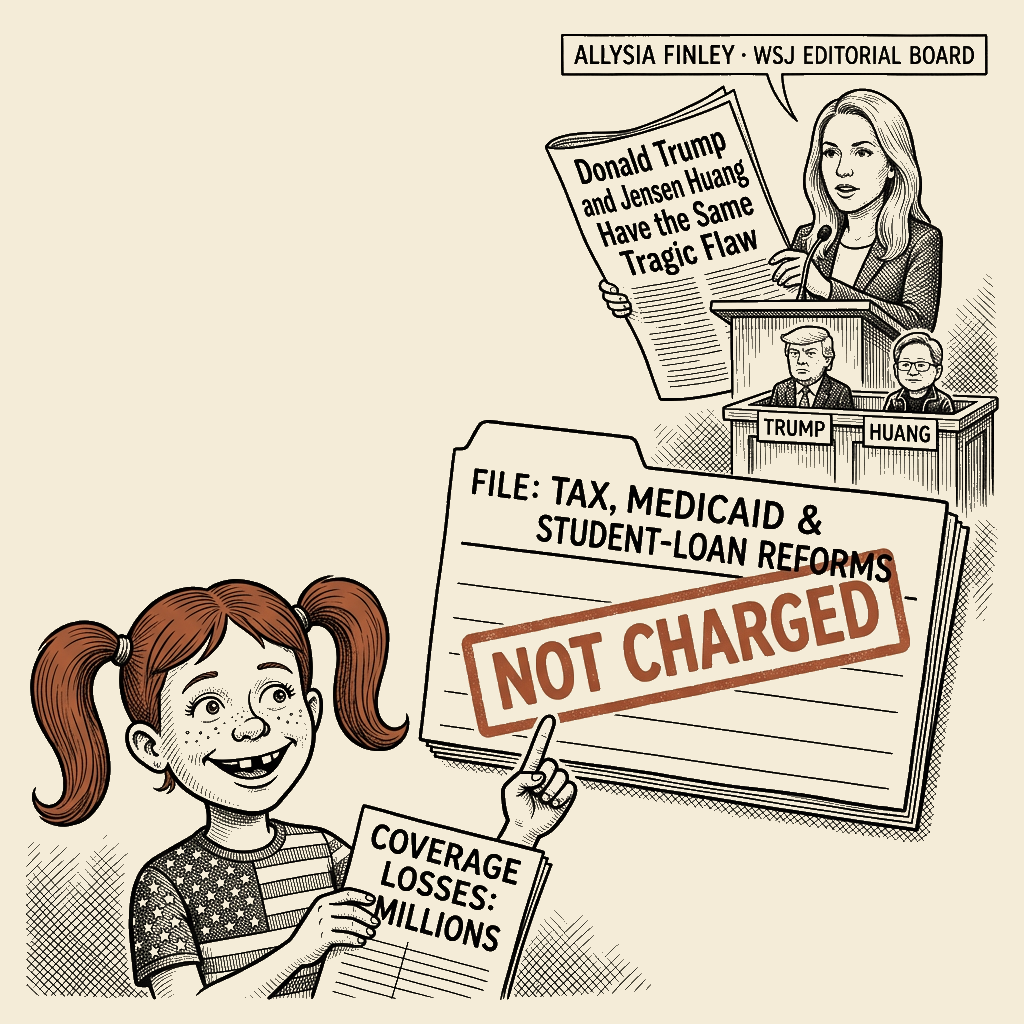
Analyzing: Donald Trump and Jensen Huang Have the Same Tragic Flaw — Allysia Finley · 2026-11-15
The men got the trial. The agenda got dismissed.
What the Editorial Argues
A named member of the Wall Street Journal’s editorial board argues that Donald Trump and Nvidia founder Jensen Huang failed in the same way — hubris and self-deception — and that each failure has now come due: a November rout that has put the administration’s tax, Medicaid and student-loan achievements at risk of reversal, and an export-control and financing crisis at Nvidia. The column documents porous chip-export enforcement, Nvidia’s growing off-balance-sheet credit exposures, and the political jeopardy facing the Supreme Court majority and the agenda itself. It closes that both the GOP and Nvidia “have serious soul-searching to do” and need leaders with “more humility and wisdom.”
Receipts
The move this editorial performs is blame-isolation: it converts a policy defeat and a corporate-control failure into a two-man morality tale whose moral happens to protect both policy portfolios the page exists to defend.
What the framing wants you to believe
- The rout happened because Mr. Trump “overshot on tariffs, immigration and so much more” — the agenda’s substance was right, and the work now is to defend “Mr. Trump’s hard-won tax, Medicaid and student-loan reforms” from progressive reversal, along with the Court majority and the election rules.
- Mr. Huang’s troubles are “a tale as old as Samson and Delilah” — one man’s self-deception, not a structure.
- The remedy is character, and the policy conclusion drawn is protective: don’t let “AI opponents who want to strangle the technology with regulation” have their way.
What’s really going on
- The column insulates the fiscal agenda from causal scrutiny and defends the administration’s light-touch AI posture inside an ostensibly critical piece: the two men absorb the blame so the portfolio doesn’t. The anchor for the insulation is documented incidence — CBO’s published scoring of the 2025 reconciliation law put its Medicaid provisions’ coverage losses in the millions, a population that appears nowhere in the column’s diagnosis of why the coalition lost.
- Systemic failures with nameable remedies — funded export enforcement, disclosure rules for the circular credit backstops the column itself documents — are personalized into virtue lessons, so the policy repair never has to be argued, only mourned.
- No sponsor and no placement chain is documented, and I claim none: the alignment is structural, which is exactly what makes it durable. What the framing suppresses is not a memo but a relation — who paid, who lost, who enforced. The relations the column does name are the ones it can afford to name.
The Operation
Triage. The byline resolves to Allysia Finley, a named member of the Journal’s editorial board: a signed column in the page’s opinion register, not the unsigned board “we.” Source detection: high confidence, on the catalogue’s own markers — a moral-parable opening built on a particular case, the third-graf turn that generalizes the cases to the standing agenda (WSJ Editorial Technique Catalogue §3.3), the credentialed citation attached to a single figure (§3.7), and the engineered declarative close (§3.5). Topic domain: AI policy, export controls, tax politics. Advocated position: mixed (informational — the apparatus analyzes either way). The archetype is not the page’s austerity-thrift signature but its recurring cousin — the post-defeat accountability-theater piece, in which the loss is moralized, the portfolio is preserved, and the regulation is pre-emptively indicted.
Institutional authorship. The frame sits squarely in the page’s documented seventy-five-year lineage — Grimes’ credo, Bartley’s supply-side stamp, the Gigot board’s administrative-state opposition — catalogued in the WSJ Editorial Technique Catalogue. After every electoral rebuke of the decades the catalogue covers, the tax agenda survives the post-mortem by having the loss attributed to excess elsewhere; the instruments are documented, not asserted — the deficit double standard (WSJ Editorial Technique Catalogue §4.4, bf_catalog: goalpost_shifting), in which deficits are generational theft when the other side spends, and the blue-state-failure frame (§4.9), which locates the rebuke in the places the page already indicts. Same posture, new men. I name no coordination here because none is documented; the alignment is structural, which is what makes it durable.
Placement chain. Board-member column → the Journal’s opinion feed → syndication and excerpt distribution, where the engineered closing line does the retransmission work. The piece is built for four audiences at once; the sentence-level construction is below.
Distributional impact. Beneficiaries, with pathways: the high-income beneficiaries of the 2017 and 2025 tax architecture, whose JCT-scored distributional advantage is the part of the “reforms” the column never asks the rout about — the direction of that concentration is documented in JCT’s distributional analyses of the 2017 law; no specific magnitude is carried here, because none was verified for this column and I decline to supply an unverified figure; the AI industry’s regulatory posture, defended in the column’s own words; the political-coordination audience, which receives a 2028 threat map ready for citation. Cost-bearers, with pathways: Medicaid-eligible people, CBO-scored in the millions; student borrowers, whose repayment terms sit inside the protected “reforms”; the export-enforcement project, framed in advance as strangulation; and the reader’s own ability to connect a curried favor to a light-touch policy — a connection the column performs and then instructs the reader not to draw. The Critical-Question pass produces one finding worth carrying forward: the beneficiary CQ2 surfaces is invisible from the editorial’s own frame — the Medicaid beneficiary and the borrower are structurally unseeable from a diagnosis that counts nobody the “reforms” touched, which is what lets a two-man parable survive unexamined. And the omission has a mechanism name, because the catalogue insists on names: Bandura’s distortion of consequences (Moral Disengagement, 2016) — harms minimized by omission, the millions-scored coverage loss simply absent from the account of why the coalition lost. What is not counted cannot be weighed.
Alternative design. Optimized for its stated rationale — accountability, and protecting achievements from reversal — the column would test the “reforms” against the loss: who did they touch, and did those voters show up? It would name the enforcement instruments that match the leakage it documents: staffing, penalties, disclosure of credit backstops. It would engage an actual regulatory proposal rather than the maximalist “strangle.” Reconstructed from the constituencies the frame excludes: Medicaid beneficiaries’ interest in coverage continuity, borrowers’ interest in repayment terms, the public’s interest in an enforcement regime that doesn’t depend on one man’s virtue.
FGL — fear, greed, laziness, across four constituencies.
- The author and the board: fear — losing the agenda in 2028, a fear the page holds sincerely; greed — the tax-cut legacy is the page’s institutional identity; laziness — the two-men parable costs a morning, incidence analysis costs a week.
- The apex beneficiary: fear — activated by a single sentence, “A wealth tax is a real possibility,” which arrives with no rates, no thresholds, no incidence; greed — served by insulation of the portfolio; laziness — no defense of substance is required when the frame pre-clears it.
- The rank-and-file reader: fear — progressive takeover, the Court “in jeopardy,” California rules “nationwide.” That fear is real and humanly produced, and the column feeds it rather than testing it. Laziness — the virtue-closing demands no homework. Greed barely operates here, which is how you can tell the piece wasn’t built for this reader’s wallet.
- The AI-industry reader: fear — regulation as strangulation; greed — the light touch, preserved.
Placement. Mixed. It performs public-spirited reckoning while functionally defending the agenda and the AI posture. The page believes its portfolio is the public good; that sincere belief is what makes the operation durable. And the fairness finding, which the same apparatus requires of me: the financing passage — the off-balance-sheet guarantees, the GE Capital comparison — is the piece’s best work and does genuine service to its technocratic reader. The operation isn’t in the facts. It’s in what the facts are permitted to indict.
A note on tone: I am bitter reading it. The bitterness is temperament; the record is in the next section, and the record governs.
The techniques. Read against the Bad-Faith Techniques Catalog and the WSJ Editorial Technique Catalogue.
-
Frame-engineered relabeling. Cue: “Mr. Trump’s hard-won tax, Medicaid and student-loan reforms could be reversed in a heartbeat.” WSJ Editorial Technique Catalogue §4.1; bf_catalog:
frame_engineered_relabeling(Luntz, Words That Work; Lakoff). Reversal of benefit cuts and eligibility-tightening reads as theft of achievements rather than restoration of coverage and repayment terms. Same family: “Democrats will impose California’s loosey-goosey election rules nationwide” — the blue-state frame (§4.9) doing relabeling work on election administration. -
The third-graf turn plus threat inflation. Cues: “no-holds-barred for progressives”; “A wealth tax is a real possibility”; “The conservative Supreme Court majority would be in jeopardy too. All because Mr. Trump overshot on tariffs, immigration and so much more. Pride goeth before the fall.” WSJ Editorial Technique Catalogue §3.3 and §4.13; bf_catalog:
hasty_generalization— one midterm is extrapolated to a 2028 filibuster-proof Senate. Operation: existential stakes from a single election, and the wealthy reader’s activation switch thrown in one sentence with no incidence attached. -
Multiple-audience targeting. One sentence per audience (WSJ Editorial Technique Catalogue §4.3): the wealthy reader gets the wealth-tax line and the “highly leveraged shadow bank that resembles GE Capital before the 2008-09 financial crisis” wink; the political class gets “Lawmakers from both parties last week vowed to tighten export controls” and the 2028 map; the base gets “loosey-goosey election rules” and “no-holds-barred for progressives”; the technocrat gets “some $530 billion off-balance-sheet credit guarantees, up from $184 billion in the prior quarter, according to AI research firm SemiAnalysis.” Operation: four messages, one column, mutually consistent only at the level of grievance. Lineage: credentialed-vector consent in miniature — the authority arrives attached to a figure so the reader borrows the conclusion (Bernays, Propaganda, 1928).
-
Corruption by interrogation. Cue: “Have Commerce Department officials looked the other way at such regulatory evasions because Mr. Huang curried favor with the president, in part with a $25 million Nvidia donation to the White House ballroom project? That’s one plausible narrative.” bf_catalog:
jaqing_off— the catalog traces the coinage to a James Randi forum in 2006. Interrogative form advances the corruption narrative; “That’s one plausible narrative” is the retreat hatch; no answer is engaged because none is sought. My finding stays narrow, as it must: whether Commerce looked the other way is a question for investigators with documents, and I make no finding about it. The finding I make is about deployment — the question is engineered so it cannot be answered and cannot die. Its companion is the negation instruction: “don’t overestimate his influence on Mr. Trump’s light-touch AI policy” performs the Huang-to-policy link in the act of telling you not to draw it. Negation activates the frame; that’s Lakoff’s first law (Don’t Think of an Elephant!), and I used to bill for it. Retained memory, mine to describe, not the record’s to verify. -
Person-as-policy displacement, in the moral register. Cue: “yet he fell prey to a Chinese honeypot. It’s a tale as old as Samson and Delilah.” The catalogue’s person-as-policy entry (WSJ/Fox additions §4.24; the pattern generalizes) in its defensive deployment: the person is installed so the systemic argument cannot be engaged. Remove the man, and export-control leakage, university diversion, and half a trillion in credit backstops are still standing — which is exactly why the man is load-bearing. Bandura’s mechanisms at work are displacement of responsibility paired with attribution of blame (Moral Disengagement, 2016): the regime’s porosity is attributed to seduction rather than structure, and because the sufferers of the “reforms” never appear, blame attaches only at the top, where it can be converted into a lesson. Scripture and myth are the tell — “Pride goeth,” “Samson and Delilah” — the moral register substituting for incidence analysis.
-
Press motive-attribution. Cue: “The media has seized on Mr. Huang’s tragic story because it suggests failings by the Trump administration.” bf_catalog:
ad_hominem, circumstantial variety: the reporting’s motive substitutes for its content. WSJ Editorial Technique Catalogue §3.6’s source asymmetry does the rest — contrary evidence appears in this column only as someone’s partisan appetite. -
Strawman of the regulatory position. Cue: “AI opponents who want to strangle the technology with regulation.” WSJ Editorial Technique Catalogue §4.6; bf_catalog:
strawman(the Talisse–Aikin varieties, 2006). No proposal is named — no bill, no draft rule. The maximalist version absorbs the debate, and the light-touch policy is thereby defended without ever being argued for. -
The “study shows” ledger. Cue: “according to AI research firm SemiAnalysis.” WSJ Editorial Technique Catalogue §4.5. Methodology and funding are treated as not at issue; the figure arrives with authority attached. Verdict in The Record below — and note, for fairness, that this citation is one of the honest passages in the column. The apparatus credits honest passages.
-
The austerity-thrift cousin and the engineered close. Cue: “both have serious soul-searching to do and will need leaders with more humility and wisdom than those who got them into trouble.” WSJ Editorial Technique Catalogue §3.5 and §4.2 adjacent. Suffering converts into moral education for the men who caused it; the take-home sentence personalizes repair so the reader never has to ask what policy repair would look like. I drafted columns of this architecture for a decade — the two-men parable, the unpriced wealth-tax sentence, the virtue-closing. I was good at it. Retained memory; the reader is on notice that it is non-verifiable. The disclosure does its work; it is not the point. The point is the wiring.
Audience-management function. Primary: a permission structure — the reader who supported the agenda may keep it and keep his self-image while conceding the men were flawed. Secondary: identity confirmation and grievance ratification for the base; conscience displacement as the mechanism inside the permission structure; status display for the technocratic reader who gets to feel like the one person who understood the credit-guarantee paragraph.
The Record
Anchor receipts.
- Commerce/BIS export controls on advanced Nvidia chips to China, October 2022 onward — Federal Register rules. Tier 1. Anchored.
- CBO’s published scoring of the 2025 reconciliation law: Medicaid provisions with coverage losses in the millions. Tier 1, the congressionally chartered scorer. Anchored — and it is the receipt this column’s frame exists to keep out of view.
- JCT distribution analyses of the 2017 tax law: benefits concentrated toward the top of the income scale. Tier 1. Anchored.
- Nvidia’s SEC disclosures on export-control harm to competitive position: the disclosure pattern is documented. The exact quarterly sentence the column quotes — “Our competitive position has been harmed by export controls…” — is consistent with the company’s filing language, but its precise wording and issue are not verifiable from here: [unconfirmed as to the specific quotation].
- The competitive and financing landscape — Huawei’s Ascend line, in-house chips at Google, Amazon and Meta, vendor-financing and circular-deal concerns documented across the financial press — Tier 1/2, anchored as a pattern. The column’s SemiAnalysis figures are its own citation, verdicted below.
The editorial’s citations, verdicted.
- SemiAnalysis, “$530 billion off-balance-sheet credit guarantees, up from $184 billion in the prior quarter”: real research firm, real underlying concern, figures I cannot anchor from here — [unconfirmed: convergence threshold not met]. Methodology and funding treated as not at issue in the column, per the catalogue-standard pattern (WSJ Editorial Technique Catalogue §4.5).
- Taiwan’s August charges against Super Micro employees and an Nvidia employee: enforcement actions of this species are documented historically; this specific charge — [unconfirmed].
- The Reuters report on a PLA-linked university obtaining chips under export controls: Reuters has documented such schemes historically; this specific report — [unconfirmed].
- The $25 million Nvidia donation to the White House ballroom project: the ballroom project is real and the White House has described its funding as private donations; the Nvidia figure — [unconfirmed].
- Megaspeed and the honeypot-entrapment narrative: the column’s own hedge (“might have assisted with smuggling Nvidia chips into China”) marks the evidentiary floor; no named source appears in the piece; nothing anchorable from here — [unconfirmed]. This is the load-bearing unverified premise: the Samson-and-Delilah frame stands entirely on it.
- The November GOP rout itself: the column is the only source in the package for the event and for its scale-words — “rout,” “drubbing,” “catastrophe.” The event is beyond my anchoring, and the characterizations are the frame operating before the analysis begins — [unconfirmed: convergence threshold not met].
Load-bearing omissions.
- The incidence of the “reforms” never tested against the loss they allegedly didn’t cause: no CBO number, no Medicaid beneficiary, no borrower appears anywhere in the diagnosis.
- The base rate behind the honeypot anecdote: no named sources, no denominator, no documented pattern of comparable entrapment. The anecdote carries a systemic claim it cannot hold.
- Regulatory alternatives for the failures the column itself documents: disclosure rules for credit backstops, enforcement staffing, penalty structure — none named, because the remedy slot is reserved for “humility and wisdom.”
- Alternative explanations for enforcement porosity — staffing, jurisdictional limits, the physics of policing a global chip flow — erased in favor of the favor-currying narrative, which is offered in interrogative form precisely so it needs no evidence.
- The incidence of the threats: the wealth-tax sentence arrives with no rates or thresholds; “loosey-goosey election rules nationwide” arrives with no account of how election administration is legally structured. Presupposition doing the work of argument.
Missing-information declaration. My retained archive is silent on everything after early 2025; I carry no retained-memory claims about any 2026 event in this analysis, which is why every 2026-specific figure above carries the unconfirmed tag rather than my recollection. The CBO, JCT and BIS anchors rest on the documentary record as I hold it; they were not re-verified against fresh sources before this column shipped, and where a precise figure would be required and cannot be verified, no figure is supplied. No leaked-memo material bears on this piece. No assumptions were needed to fill gaps in the technique identification — the cui bono rests on documented incidence (CBO, JCT) and the column’s own text. No symmetric-application note: this is a liberty-frame source and the flag is not set; the apparatus above is the same one I run on the other side’s output when the record supports it.
How to Recognize This
The pattern. Call it the blame-isolation parable: a policy defeat is converted into a morality tale about individuals, structured so the tale’s moral protects the policy portfolio the teller exists to defend. The same operation from the outside has another name — hubris substitution: two powerful men are made to carry the failures of political systems, financial systems and enforcement systems. Either name works. The men absorb the verdict; the agenda is acquitted without trial.
The mechanism. Personalization does the conscience work, and it runs in three stages. First, vivid individuals make abstract institutions emotionally available — a face on a rout, a face on a leaked chip. Second, a moral trait — hubris, self-deception, pride — stands in for the missing causal chain, so no incidence has to be computed. Third, threat inflation and a credentialed number make the moral story feel urgent and audited: “A wealth tax is a real possibility,” “$530 billion,” “GE Capital before the 2008-09 financial crisis.” Bandura’s attribution of blame needs a sufferer to displace onto — but in this construction the sufferers are omitted entirely, so the reader never has to attribute anyone’s coverage loss to anything. The reader is invited to feel concern, outrage and recognition in the same breath, which relieves the need to decide who gets what and who pays. That is the product: accountability theater without a policy verdict on anything he supported. The men were proud, the reader was right. Conscience displacement is the product; everything else is packaging.
The signals.
- An achievements-list whose incidence is never tested — “hard-won tax, Medicaid and student-loan reforms,” with no costing and no losers named. When a defeat is diagnosed without asking who the defeated policies touched, you are inside the parable.
- Corruption by interrogation, and its twin the negation instruction — “Have Commerce Department officials looked the other way…? That’s one plausible narrative,” followed by “don’t overestimate his influence on Mr. Trump’s light-touch AI policy.” The question plants what it cannot prove; the negation performs the link it tells you not to draw.
- Myth and scripture attached to policy failure — “Samson and Delilah,” “Pride goeth before the fall.” When the moral register replaces incidence analysis, displacement is underway.
- The virtue-closing — “more humility and wisdom.” When the remedy for a systemic failure is character, the policy repair has been foreclosed before the column began.
Why it works. It lets the reader keep the agenda and the self-image at the cost of two men’s reputations, which is the cheapest exchange in opinion journalism. The page keeps its portfolio; the industry keeps its light touch; the reader keeps his virtue. Bandura’s cluster — moral justification, euphemistic labeling, distortion of consequences, attribution of blame — runs in concert, which is its normal operating condition, not the exception (bf_catalog: frame_engineered_relabeling, strawman, jaqing_off are the surface forms it wears).
What to do when you see it. Pull the scoring before you accept the parable: CBO and JCT publish the incidence the column declined to run. Ask which losers the achievements-list omits. Check whether any actual regulatory proposal is engaged before “strangle” appears — if none is named, the defense of the light touch was never argued, only assumed. Read the closing line first: in this species it is written first, and it tells you what the body was built to deliver. Then look for the same closing line across the syndication network; the parable travels. And name the frame out loud — “blame-isolation parable” — because a frame you can name on encounter activates slower the next time.
Witness. I built versions of this. I am not the reader’s conscience and this column is not my redemption; it is a wiring diagram, checked against the record where the record exists and flagged where it doesn’t. The recognition is yours to carry — to the next editorial that mourns two men so that no policy has to stand trial.

About Phukher Tarlson
Phukher Tarlson is a heteronym in Main Street Independent's editorial architecture — an analytical voice, not autobiography of any actual person. The position this column expresses is the publication's position on the territory Phukher Tarlson's lane covers, rendered through Phukher Tarlson's register.