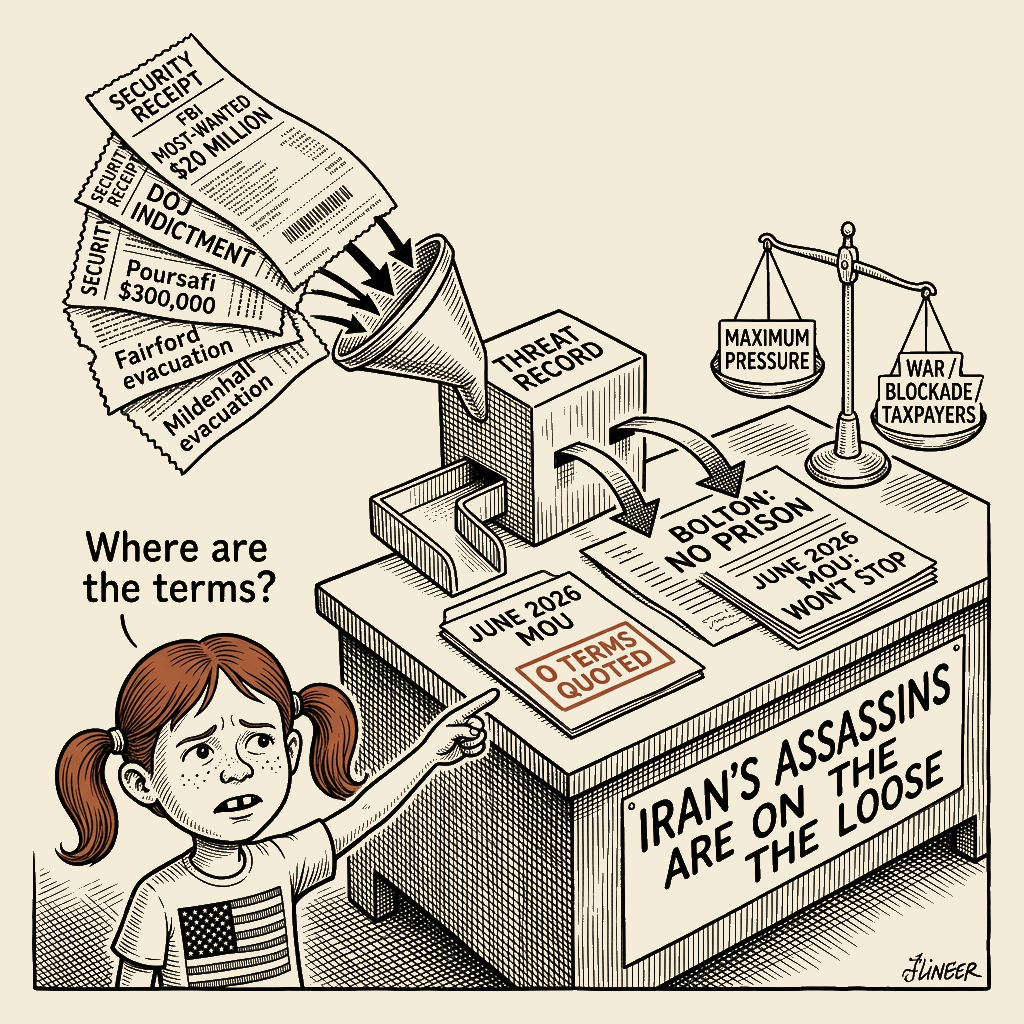
Analyzing: Iran’s Assassins Are on the Loose — The Editorial Board · 2026-11-11
Where are the terms?
What the Editorial Argues
The board argues that Iran’s regime is actively hunting U.S. officials — Scott Bessent now living on a military base, a $20 million most-wanted listing for the man accused of plotting to kill John Bolton, a Justice Department indictment of an IRGC-linked commander running plots from a Brooklyn jail, aircraft evacuations at Fairford and Mildenhall — and that this campaign predates the current war and will survive any deal that ends it. From that record it draws two conclusions: that imprisoning Bolton for mishandling classified documents would be foolish because no prison could protect him from the Iranians, and that Vice President Vance’s account of Iranian leaders wanting to “turn over a new leaf” is contradicted by what the regime does. The closing position is that the IRGC will not stop, deal or no deal.
Receipts
The editorial takes a set of genuine, primary-source security facts and converts them into two policy verdicts the facts do not reach — one about a prison sentence, one about a diplomatic agreement — while never quoting the agreement.
What the framing wants you to believe
- The documented plot record is dispositive: “Their actions tell a different story,” and the regime “won’t stop even if a smiling thug shakes Mr. Vance’s hand.”
- Because the plots establish a continuing Iranian danger, “This should again flag the manifest unwisdom of seeking prison time for Mr. Bolton for mishandling classified documents.”
- The June Memorandum of Understanding is the object of a charm offensive that the operational record exposes — so the reader’s default should be maximum pressure, not a negotiated end to the war. The headline’s “on the loose” presupposes the assassins were ever off it, converting a 47-year chronic condition into an acute escape.
What’s really going on
- The board runs the hawk flank of its own coalition against the administration’s agreement. The piece’s own text severs the causal link its headline depends on: “It was true before the current war.” The plot record predates both the war and the MOU, so the threats cannot evidence the deal’s failure. The question any deal verdict turns on — what the agreement changes about verification and enforcement — is never addressed, because the piece never states a term.
- The pivot sentence spends the security record as currency on a verdict it does not establish. Nothing in the Poursafi or al-Saadi filings, as described in the editorial, establishes what protection a federal facility could provide, what sentence is sought, or whether Bolton’s punishment can be calibrated around that risk. That is the Bad-Faith Techniques Catalog’s
red_herringstructure running through the WSJ Editorial Technique Catalogue §4.3 multiple-audience execution: one clause serves the security reader and the base reader who wants Bolton out of the crosshairs. - The load-bearing omission is the deal itself. The editorial rebuts Iranian regret as voiced by Vance and never prints a clause of the June MOU, so the reader is asked to judge an instrument they have not seen. The benefit accrues to the maximum-pressure policy network the MOU would retire, and the piece’s named protagonists — Bolton, Pompeo, Hook — are that network’s personnel. Anchor for the substance: the plots are real and documented — U.S. v. Shahram Poursafi, federal criminal complaint, August 2022 (filing venue not verifiable from materials available to this analysis — see The Record).
The Operation
Institutional authorship and placement. Unsigned board voice — note the agentless “This should again flag the manifest unwisdom,” an institutional verdict delivered by no identifiable author, and the creed printed beneath the text: “free trade and sound money… against… dictators, bullies.” That creed is the placement. It pre-selects which documents become evidence — indictments, most-wanted listings — and which become noise: treaty terms and cost figures. I drafted board copy in that register from 1999 to 2007; the creed did the selecting before I ever typed a sentence, and the receipts I was given were already the ones that supported it. I have no documentary source for who commissioned or shaped this editorial, and the retained-memory account of how board pieces were shaped in my years there is non-verifiable — the reader is on notice. What the public record does show is structural incentive: a page whose stated identity includes opposition to “dictators, bullies” has an easier editorial product in a continuing threat than in a diplomatic settlement. The lineage is the page’s own — the Grimes credo through Bartley and Gigot, per WSJ Catalogue §2 — and the page’s decades housing the maximum-pressure consensus on Iran. Placement chain: print, RSS, syndication, then Congress and administration staff weighing the MOU’s fate.
Distributional impact. The immediate policy beneficiary is the position that the June MOU should fail or be abandoned and that Iran should remain under maximum pressure; the pathway is agenda-setting, converting the MOU into a test of credulity and the Bolton case into another measure of political foolishness. Also named: the maximum-pressure personnel whose vindication the piece performs; the sanctions-enforcement and blockade apparatus; and — scanned outside the piece’s frame — Gulf-supplier energy actors who gain market share while Iranian barrels sit embargoed (structural pathway, magnitude undisclosed). No donor, lobby, paid sponsor, or coordinating organization is documented, so I name none; inventing one would be the conspiracy-trap. The cost-bearers: the reader’s ability to evaluate the agreement, whose terms are withheld; taxpayers funding war and blockade; service members and their families carrying the danger; energy consumers and Iranian civilians absorbing blockade incidence — pathways named, figures absent. Its only dollar figures are the $20 million reward and the alleged $300,000 offer, which means the cost of the future it recommends is missing from the ledger.
Alternative design. If protection of officials were the operative rationale, the optimized piece would do what its own material supplies: fund the protective details and the FBI rewards program it advertises, bring the prosecutions the Justice Department is already bringing, share intelligence with the United Kingdom where plots are aimed at U.S. aircraft on British soil, tie any MOU sanctions relief to verifiable plot-cessation, and engage the agreement’s terms. On the editorial’s own premise, the answer to “How would the prison system protect him from the Iranians?” is containment, not abandonment of a lawful sentence: protective custody, monitored and restricted communications, coordination with the marshals, and sentence design calibrated to the disclosed risk. If al-Saadi can pass coded messages from jail through family, the leak is evidence for controls, not proof that justice must yield. This reconstruction comes from the interests of the people actually being hunted and the constitutional interest in lawful punishment, not from my policy preferences. The piece praises every protection already in place and attacks only the diplomacy. That asymmetry is the fingerprint of the hidden beneficiary.
FGL, applied by constituency rather than by side.
- Board and author constituency. Fear of being outflanked as the appeasers of record if détente holds; greed in the hawk franchise’s currency — threat is the franchise’s asset, and détente devalues it; laziness in a script that has run unchanged since 1979 and requires no new analysis, and that spares the writer adversarial checking by drawing the evidentiary spine from one institutional ecosystem.
- Apex policy beneficiary. Obsolescence fear if the MOU succeeds; greed for leverage over an administration seeking an end to the war; laziness supplied by a finished “it won’t stop” conclusion that removes the need to model implementation, enforcement, or failure.
- Rank-and-file reader. The fear is rational, because the plots are real and not contemptible; the greed is status and certainty from a finished hostile frame, though the record does not justify imputing more than that; the laziness is human, because nobody volunteers to read a sanctions annex, and the frame spares them. The reader’s fear and laziness are real and human. The operation’s achievement is wiring them to a verdict no reader could check, because the piece withheld the instrument.
Applying FGL does not require finding all three drives in everyone, and it does not require treating the reader’s fear as weakness.
Placement. The selfless half first, and it is real: protecting American officials from documented assassination plots is a genuine public good, and this piece’s raw material is exactly that. The failure is not that the board claims the value; it is what it converts the value into — a verdict on an agreement it never states. Placement: mixed, leaning selfish — a genuine security value carrying a coalition policy preference and a franchise’s standing.
Technique identification — cue, catalogue cross-reference, what it does, lineage where it illuminates.
- The smuggled policy pivot. Cue: “This should again flag the manifest unwisdom of seeking prison time for Mr. Bolton for mishandling classified documents.” Catalogue: Bad-Faith Techniques Catalog
red_herring, with the WSJ Editorial Technique Catalogue §4.3 multiple-audience execution — one clause serves the security reader and the base reader who wants Bolton out of the crosshairs. Operationally, it converts a fact into a verdict the fact does not entail. Lineage: this is the move I ran as craft — find the true sentence, attach the wanted conclusion to its tail. - Headline-as-verdict with presupposition. Cue: “Iran’s Assassins Are on the Loose.” Presupposes prior containment. WSJ Catalogue §3.2 (dek-as-thesis pattern, here headline-as-thesis); frame-engineered relabeling family in the Bad-Faith Techniques Catalog —
frame_engineered_relabeling, Luntz/Lakoff. The scanner’s takeaway installs the verdict before any fact arrives. - Anecdote-led agglutination. Cue: “is part of a much larger story.”
hasty_generalization(Bad-Faith Techniques Catalog); WSJ Catalogue §4.9’s mechanism transposed from its state-governance register to the security register. Five incidents, individually attributable, aggregated into one causal narrative whose conclusion — the deal is void — is never argued, only implied. The incidents are real or plausibly real; the aggregation is the manufacture. - The verdict-before-evidence turn. Cue: graf 1 — “nobody should expect that a deal to end the war will make it go away” — standing before any FBI or DOJ exhibit appears; the frame’s second application lands at graf 4. WSJ Catalogue §3.3 documents this page’s third-graf turn: documented specifics in grafs 1–2, standing frame by graf 3. This piece runs the pattern compressed and inverted — verdict first in graf 1, incident record in grafs 2–4, frame re-applied at graf 4. The reader receives the conclusion before the exhibits, which is the stronger form of the same move.
- Multiple-audience targeting. Cue: “How would the prison system protect him from the Iranians?” WSJ Catalogue §4.3. Hawks get the enemy’s reach; populists get a shot at a classified-documents prosecution of a Trump antagonist; Bolton-adjacent elites get protection; the political class gets a citable one-liner. Four deliveries, one rhetorical question.
- Dispositive marker. Cue: “nobody should expect.” WSJ Catalogue §3.4. Installs the conclusion as consensus without argument.
- Unfalsifiable architecture. Cue: “It was true before the current war.” The mechanism is the one Jason Stanley documents in How Propaganda Works (2015): an ideological frame that absorbs disconfirming evidence instead of updating on it. A threat that predates the policy cannot evidence the policy’s failure — the piece states the fact that kills its own inference and builds the inference anyway. Plots before the deal prove diplomacy futile; plots during the deal would prove it broken; either way the verdict stands and the terms never need reading.
- The unfalsifiable essence claim. Cue: “That’s how Iran’s terrorist regime operates, and it won’t stop even if a smiling thug shakes Mr. Vance’s hand.” No fallacy label is needed — it is a claim no evidence could defeat, because any concession becomes the smile on the thug. Lineage: Schmitt’s friend/enemy distinction, where the enemy’s conduct becomes essence rather than policy and is therefore unchangeable by any act of the enemy. Bandura’s dehumanization mechanism, in its milder criminal-caricature form, is complementary: “smiling thug” strips the negotiating counterpart of a policy identity and makes concession look definitionally deceptive. Operationally, the frame forecloses the deal before its terms are read.
- Strawman of the diplomatic position. Cue: Vance’s “turn over a new leaf” passage answered with “Their actions tell a different story,” while the “Memorandum of Understanding with Iran in June” is named once and never quoted. Bad-Faith Techniques Catalog
strawman; WSJ Catalogue §4.6. The strongest available version of Iranian optimism, voiced by an American official, is rebutted while the actual instrument never enters the argument. Reported as an incomplete pattern on the con-artist verb (“As he was selling”) as well: WSJ §4.12’s asymmetric-labeling cluster gives the deal’s defender a con-artist verb while the board’s own posture arrives unmarked — but the catalogue’s representational strawman test requires documenting what Vance actually said, and this analysis does not have that text, so the partial-match rule bars a tentative tag there. - Base-rate suppression across evidentiary classes. Cue: the Tehran billboard — state speech — placed in the same paragraph-sequence as the Fairford indictment — operational activity — with no denominator anywhere: how many plots, over what period, how many disrupted, at what cost.
hasty_generalization(Bad-Faith Techniques Catalog); WSJ §4.13’s threat-inflation structure used here as a mid-piece denominator substitute rather than in its customary closing position. The Suppressed Variable Diagnostic’s anatomy is visible: the editorial isolates the true kernel that Iranian-linked plots are documented; suppresses the invalidating relation, namely the denominator and the constraints that determine what the plot record implies; and extrapolates the half into the categorical claim “it won’t stop.” The protected beneficiary is the maximum-pressure position. The normalized harm is the continuation of sanctions, blockade, and war treated as a costless background condition. - Credential-ledger sourcing. Cue: the cumulative stack — “the FBI added,” “the Justice Department indicted,” “a federal jury issued a conviction,” “the U.S. Air Force,” “an intelligence warning.” WSJ Catalogue §§3.6–3.7; Bernays’s credentialed authorities as campaign vectors; Chomsky and Herman’s sourcing filter from Manufacturing Consent (1988). The felt effect of consensus is produced by an evidentiary universe dominated by security institutions reporting security actions. Credit where due — the piece writes “accused of,” “alleging,” and “reportedly,” honest hygiene inside the crime reporting, and the board labels its own inference as “the implication” of Tuesday’s update. The laundering happens one rung up, where charging documents are converted into a policy verdict the charges never address.
- Con-artist relabel of the deal’s defender and the suppressed counter-frame. Cue: “As he was selling the Memorandum of Understanding.” The administration’s actual case for the agreement never appears, so the reader responds to a characterization rather than an argument.
- Bandura cluster. Cue: “That’s how Iran’s terrorist regime operates, and it won’t stop…” Moral justification (abandoning diplomacy becomes serving security), attribution of blame (the regime’s nature, not any policy’s design, is the causal theory), distortion of consequences (the deal’s consequences go unexamined while the threat’s persistence is treated as its refutation), and displacement of responsibility in the agentless inevitability of “it won’t stop” — no actor decides the outcome; the regime’s essence does.
- Threat-inflation closer and the retransmission line. Cue: “…even if a smiling thug shakes Mr. Vance’s hand and again promises that Iran will let oil tankers through the Strait of Hormuz when it gets everything else it wants.” WSJ Catalogue §§4.13 and 3.5 — the closing-line cadence, engineered to be lifted. It scales from a Brooklyn indictment to the Strait in one sentence, and it is the sentence the reader will remember. The presupposition payload: “again” presupposes broken promises, “everything else it wants” presupposes the MOU concedes Iranian maximalism, and neither is established —
begging_the_question-adjacent presupposition load.
Audience-management function. Permission structure for conditioning or abandoning the MOU, and for abandoning a lawful sentence — the reader who wants the war over or wants Bolton treated like any other defendant is given a security reason to do both without being asked to weigh a cost. Identity confirmation for the hawk reader. Grievance ratification via the irredeemable-enemy frame. What the frame displaces is moral concern: the costs of the foreclosed deal are never named, so there is nothing to feel. Counter-frame suppressed: the administration’s case for the agreement, absent entirely.
The Record
Anchor receipts.
- Tier 1 — U.S. v. Shahram Poursafi, federal criminal complaint, August 2022: an IRGC member alleged to have sought an informant’s assistance to murder John Bolton for $300,000. Charging substance documented; the filing venue is not verifiable from materials available to this analysis and any prior venue assertion is withdrawn. The editorial’s central crime reporting is accurate.
- Tier 1 — the Justice Department’s 2024 unsealing of charges in an Iranian murder-for-hire plot against Trump. Documented in substance; the exact unsealing date is retained recall, not verifiable here, and flagged. The board’s claim that IRGC plots against Trump were broken up has this anchor; the March conviction it cites does not.
- The FBI’s most-wanted listing and $20 million reward for Poursafi, and the Justice Department’s indictment of Mohammad Baqer Saad Dawood al-Saadi, are Tier 1 in form because they are agency actions identified in the editorial; an indictment remains an allegation, not an adjudicated fact. They support the existence of a threat. They do not, as the editorial describes them, establish the verdict about Bolton’s sentence or the terms of the MOU.
Article-supplied, unanchored — [unconfirmed: convergence threshold not met]; preserved as the editorial’s account, not disputed, not independently verifiable from the materials available to me: the Bessent relocation (the piece’s own “reportedly”); the Tuesday FBI most-wanted addition and its $20 million figure (the 2022 Rewards for Justice amount for Poursafi is retained-recalled at up to $20 million, non-verifiable here; the figure stands as the editorial’s own account); the al-Saadi indictment and Fairford plot; the Mildenhall evacuation; the Tehran billboard; the unnamed March jury conviction; the June 2026 MOU; the Vance quotation; the Bolton prosecution; the blockade. The broader historical premise — “It was true before the current war” — is not anchored in the text with a dated prewar case; the proposition may well be supportable, but this analysis does not have an independently verified example to substitute for the editorial’s missing receipt.
Retagged from anchor tier — [unconfirmed: convergence threshold not met]: public reporting (2022) that Pompeo and Hook retain continuous U.S. protection due to Iranian threats. Plausible, consistent with the editorial’s account; the reporting is unnamed here and the anchor threshold is not met. So is the March conviction: reported, checkable against contemporaneous wire and Defense Department reporting this analysis has not independently pulled, carried as reported rather than anchored.
Per-citation verdicts.
- Poursafi charging, $300,000 informant offer — accurate.
- $20 million reward — article-supplied; the 2022 Rewards for Justice amount is retained recall, non-verifiable here, flagged.
- “Treasury Secretary Scott Bessent’s move… reportedly following Iranian threats on his life” — explicitly hedged, no named source. Carried as reported, not anchored; the hedge should not disappear merely because later sentences treat the move as proof of the larger campaign.
- “The implication of Tuesday’s FBI update is that there’s a new urgency…” — the board labels its own inference as an implication. Honest label; still an inference from a list update to a case-status conclusion, and it is doing argumentative work.
- “as former Secretary of State Mike Pompeo and U.S. Special Representative for Iran Brian Hook can attest” — assertion without citation. A reader wanting the receipt must go find it; the piece offers “can attest” instead of a docket.
- Trump plots — accurate in substance; the 2024 DOJ unsealing is documented, its exact date flagged; the March conviction the piece cites is unnamed and unanchored.
- Vance’s “turn over a new leaf” and “47 years of antagonism” — attributed quotation from a public official, verifiable against the transcript; exact wording not independently confirmed here:
[unconfirmed: convergence threshold not met]. The billboard “We Will Kill Trump” — single-source, no independent receipt:[unconfirmed: convergence threshold not met]. - Fairford, Mildenhall, Bessent, MOU, Bolton prosecution — article-supplied, unanchored.
- “47 years of antagonism” — arithmetic checks (1979–2026).
- MOU terms — absent; the decisive omission.
Load-bearing omissions. (a) Not one term, annex, verification provision, or enforcement mechanism of the MOU appears; the verdict is rendered entirely at the frame level. (b) The piece’s own admission that the threat predates the war — the fact that severs its causal chain — is stated once and never revisited. (c) The blockade’s incidence: the piece praises Bessent for augmenting “the U.S. blockade” and says nothing about who absorbs its cost; no figure appears for the cost of continued war, blockade, or sanctions. (d) The administration’s actual case for the agreement, and any counter-source from diplomacy or intelligence assessment. (e) The sentence sought in Bolton’s case, the court’s actual disposition, and the protection Bolton currently has. (f) Any denominator for the plot record. (g) A dated prewar example for the historical premise. (h) The natural test the piece’s own thesis invites — whether Iranian plot activity historically tracked the last major diplomatic episode, 2013–2018 — is never run; noting the omission is not a finding about its result, which the piece never sought.
Missing-information declaration. The 2026 layer — war, MOU, blockade, Bessent, Fairford, Mildenhall, billboard, prosecution — rests on the editorial’s sole account; I hold no independent receipts for it and mark verification unresolved without disputing the account. Two receipt details beyond the editorial’s text are withdrawn or flagged: the Poursafi complaint’s filing venue (asserted in a prior version of this analysis, not verifiable from materials available here, withdrawn) and the exact date of the 2024 DOJ Trump-plot unsealing (retained recall, flagged). No leaked memo, funding chain, or internal board correspondence for this editorial is available to me; the placement-chain claims above rest on the piece’s own printed mission block and on structural incentive, not on coordination evidence. The internal build description above is retained working memory, flagged as non-verifiable. The one assumption I carried: that the argumentative operation is identifiable independently of the 2026 layer’s final verification — the structure is visible in the text’s own wiring. Where I have filled a gap, it is with the alternative-design reconstruction and not with invented specifics.
How to Recognize This
The pattern has a name: the threat ledger against the unexamined deal — real security incidents front-loaded to carry an unargued verdict on a policy the piece never states, and the stapled verdict arrives before the reader has noticed the join.
The mechanism is credibility transfer. The incidents are real, or at least individually checkable, so their verification bleeds into the conclusion. The reader who doubts the verdict feels they are doubting the FBI. Once the checking instinct is satisfied early, it stops — and the sentence that follows inherits the credibility of the sentences before it. Lakoff supplies the cognitive half: the enemy-frame, once activated, makes diplomacy non-cogent — no argument against the deal is needed because the frame has already priced it. And notice the design detail that gives the whole thing away: the piece concedes, mid-text, that the threat predates the policy it indicts, and delivers the verdict anyway. A frame that survives its own concession is not an inference. It is an installation.
Signals to check next time:
- The verdict sentence carries a citation from the wrong domain. When an indictment about one subject is offered as proof of a conclusion about another — a prison sentence, a tax bill, a treaty — the citation and the conclusion are not the same object.
- Count the ratio: incidents cited against policy terms quoted. Here it is five-plus to zero. Any deal verdict rendered at zero quoted terms is a frame, not an argument. “The Memorandum of Understanding” appearing without a clause is the tell that the reader is being asked to rule on a document they have not seen.
- Date-stamp the threat against the policy under attack. “It was true before the current war” is the piece confessing its own inference is dead.
- Every source is the same kind of institution. When the FBI, Justice Department, a jury, the Air Force, and an intelligence warning are the entire evidentiary spine, and no source capable of disagreeing appears, the felt consensus is partly an artifact of the sourcing pool.
- Watch the dispositive markers (“nobody should expect”) and the con-artist verb on the deal’s defender (“was selling”). If the other side’s actual case never appears, you are answering a characterization.
- Read the closing line for presupposition: “again promises… when it gets everything else it wants.” Both halves assume facts the piece never established, and “it won’t stop even if…” tells you the argument has left the record behind. Engineered closers do their work in the assumptions, not the assertions.
Why it works: fear is the strongest transferring affect there is, and the material here is genuinely frightening — that is the operation’s raw material, not its fabrication. Doubt is framed as disloyalty to the victims, which no reader wants to feel. And the verdict is cheap: no annex to read, no terms to weigh. The reader is not being fooled about the facts; the facts are checkable and mostly checkable in the government’s own favor. The reader is being moved across a gap between what the facts establish and what the piece wants, and the gap is bridged by a sentence that arrives in the same register as the evidence.
What to do when you see it: when the enemy-frame vocabulary arrives — “terrorist regime,” “assassins on the loose” — restate the policy question in neutral terms first (“what does this agreement change about verification and enforcement?”) and weigh any verdict only against that restated question. Then: demand the agreement’s terms before accepting any verdict about it; pull the cited filings and read what they actually charge; ask what the deal changes about the documented threat — enforcement, verification, penalties — and whether the piece says; ask who pays if the smuggled verdict lands and who is protected; trace who staffs the alternative policy — here, the maximum-pressure network the piece’s own protagonists come from; run the vocabulary across the syndication network — “terrorist regime,” “assassins on the loose,” “smiling thug” — and check whether the same words arrive from the same places in the same week, because message discipline leaves that kind of sediment; and before the close takes hold, reduce its automatic activation by naming what the close is doing to you.
And the witness close, because it belongs here: I drafted threat-ledger copy for the Journal’s page for years. I knew where the reader’s checking would stop, and I wrote the sentence that lived there. I know this build because I assembled builds like it. The plots are real. The fear is rational. The discipline this piece deserves is not the discounting of the threat — law enforcement and the intelligence community own that question, and their record here is serious. The discipline is refusing to let a real threat carry an unargued verdict: separating the question the FBI answers from the verdict the page wants, and noticing that the second was delivered without showing its work. The reader who sees the join does not need my confession to act on it — they need only the habit of asking, at the moment the verdict arrives, which receipt is carrying it. Recognition, not redemption. The recognition travels further than either of us.

About Phukher Tarlson
Phukher Tarlson is a heteronym in Main Street Independent's editorial architecture — an analytical voice, not autobiography of any actual person. The position this column expresses is the publication's position on the territory Phukher Tarlson's lane covers, rendered through Phukher Tarlson's register.