Analyzing: Of Course Jensen Huang Had to Go — The Editorial Board · 2026-11-13
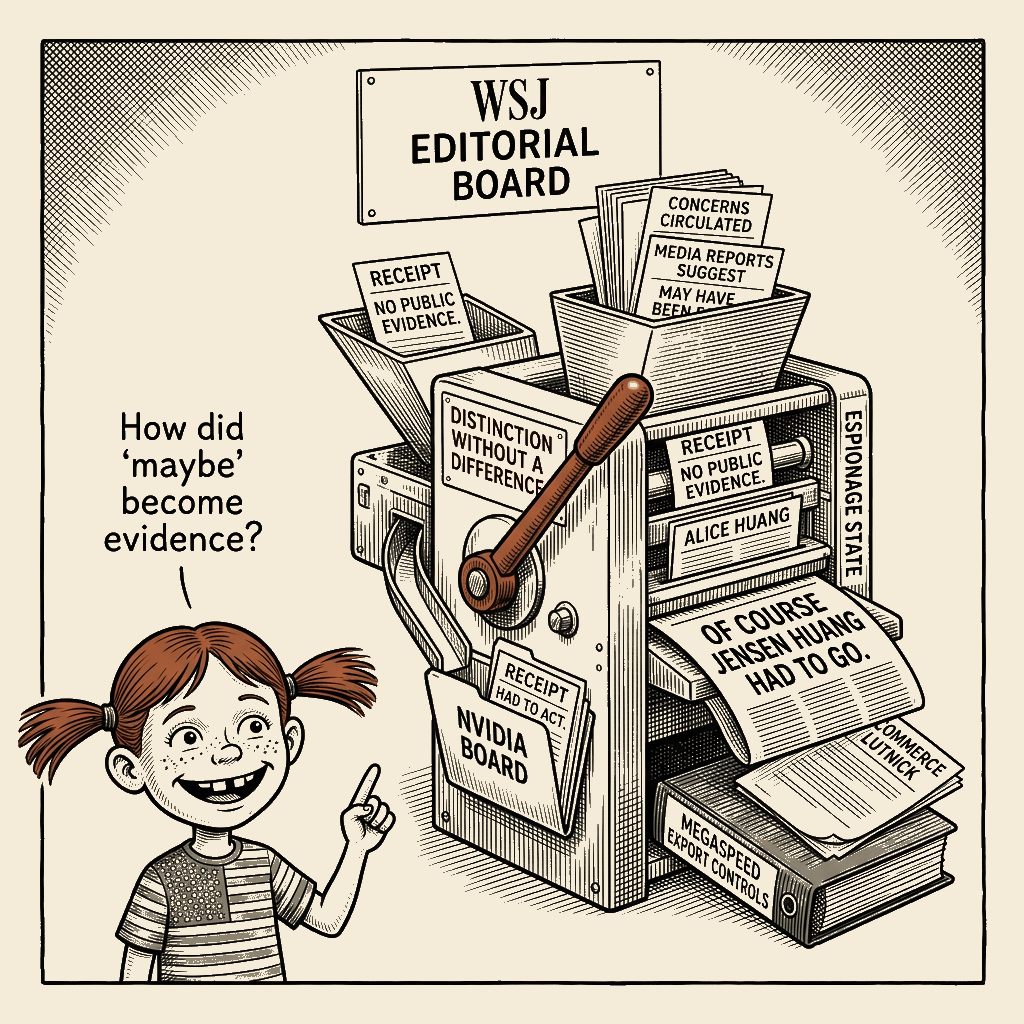
How did ‘maybe’ become evidence?
What the Editorial Argues
The unsigned editorial argues that Jensen Huang’s departure from Nvidia was compelled by ordinary corporate governance—his undisclosed relationship with the head of a major customer, a second relationship with a subordinate, and misleading statements to investors—not by a U.S. deep-state plot. It concedes that there is no public evidence that Alice Huang is on Beijing’s payroll but argues that the distinction changes little because China is an “espionage state” whose successful citizens are “expected to cooperate.” It treats Huang’s conduct as both a corporate-governance failure and a national-security problem, then locates the relevant government failure in Commerce Department resistance to restrictions on Megaspeed. In its best light, governance and foreign-leverage risk are legitimate concerns; the analysis concerns how the editorial converts an incomplete record into a categorical finding.
Receipts
The editorial uses one concession to manufacture a presumption it otherwise lacks, then uses that presumption to collapse a governance scandal, an export-control dispute, and a geopolitical argument into one personnel story.
What the framing wants you to believe
- Huang’s fall was a compelled governance response, not a political conspiracy; his undisclosed relationships and deception—not a U.S. deep state—caused it.
- Because China blurs the boundaries among the state, the Communist Party, and business, the absence of evidence that Alice Huang is a paid operative cannot settle the matter. A successful Chinese businessperson in a strategic industry should be treated as potentially connected to state power.
- The decisive government failure lies with Commerce, which resisted restricting Megaspeed; the appropriate corrective is congressional pressure on Secretary Howard Lutnick.
What’s really going on
- The core evidentiary bridge is the board’s own concession: “There’s no public evidence Ms. Huang is on the payroll of Beijing’s security services”. That is primary evidence of what the editorial acknowledged, not independent proof that no evidence exists. The relevant legal context—the PRC National Intelligence Law’s general cooperation duty—does not establish Alice Huang’s status or connect her to Megaspeed.
- The sourcing collapses exactly where individualized proof is required. “Concerns about her circulated,” “media reports suggest,” “may have been part of an effort,” and “appears to have spent her career” accumulate into confidence without supplying a checkable document. The omitted relation is the bridge between China’s general capacity to compel cooperation and this woman’s conduct.
- The protected beneficiary is Nvidia’s board as an institutional decision-maker: the claim that it “had to act” supplies reputational cover and reduces pressure to examine what the board knew, when it knew it, and whether its response was adequate. The normalized harm is broader: suspicion becomes normalized against Alice Huang, Chinese-origin executives, and anyone placed inside the same category without individualized evidence.
The Operation
This is an unsigned Wall Street Journal editorial-board piece, not a named columnist’s essay: collective institutional voice, declarative syntax, third-graf turn, and a closing line built for retransmission. Its subject is corporate governance joined to national-security and chip-export enforcement. Its argumentative form is a “study shows” ledger without a named study: hedge-stacked attribution legitimizes a categorical claim, a concession bridges fact to frame, and a personnel coda supplies the answer. The advocated position is mixed. Governance and national security are legitimate concerns; the frame also gives the board institutional and factional advantages.
Institutional authorship and placement. The author is WSJ Editorial Board. The documented placement chain runs from the board to the paper’s opinion feed and the November 14, 2026, print edition. No named think tank, donor network, foundation sponsor, focus-group instrument, memo, or commissioned-placement chain is documented for this piece. I will not manufacture one. That does not make the operation innocent; it makes its authorship institutional rather than conspiratorial. The board separates “respectable” dissent from online dissent, licenses David Sacks with “who we often agree with,” and presents itself as the sober arbiter of both the China question and the MAGA fringe. House style supplies the pathway from institutional interest to public position without needing a hidden sponsor.
Distributional impact.
- Beneficiaries: Nvidia’s board receives narrative cover for its intervention: “had to act” makes the board’s response appear compelled rather than delayed, inadequate, or insufficiently informed. That is a benefit of the explanation, not an allegation of misconduct. The Treasury-centered account of the Commerce dispute also gains leverage because Treasury Secretary Scott Bessent receives the editorial’s only named, dated citation; Lutnick receives the concentrated blame. The board itself gains attention and status by occupying the space between “foreign leverage is real” and “MAGA keyboard warriors are not serious.” The public could benefit if a genuine diversion scheme were disclosed, but the supplied record does not establish one.
- Cost-bearers: Jensen Huang bears the loss of his position and reputation; Alice Huang bears a security stigma unsupported by public evidence; the subordinate is exposed without an individualized account; and Lutnick is made the visible villain for a policy system the editorial never audits. Chinese-origin executives more generally inherit the burden of the “very Chinese sort” category. The reader loses the policy argument that the piece’s own Commerce references make relevant. No dollar magnitudes are supplied for any of these effects, and none should be invented.
- Alternative design: From the interests of the people the frame makes most vulnerable, a stronger—not softer—design would run three separate tracks. First, Nvidia’s conflict-of-interest process: relationship disclosures, board knowledge, investor communications, and the chronology of the board’s response. Second, beneficial-ownership and export-control enforcement: the specific rule, transaction, end user, diversion mechanism, and Commerce decision that the evidence supports. Third, an individualized intelligence assessment that keeps China’s general legal environment separate from any finding about Alice Huang. That design can support action where the evidence warrants it without making nationality, résumé, or geopolitical anxiety substitute for proof.
- Fear, greed, and laziness, applied symmetrically: For the author, fear is being seen as either credulous about China or captured by online Trumpism; greed is institutional standing; laziness is avoiding the legal and procedural work. For the institutional beneficiaries, fear is scrutiny of the board’s response or defeat in the interagency dispute; greed is preservation of influence; laziness is preferring a named scalp to a policy audit. For the reader, fear of Chinese state access is real, portfolio self-protection is ordinary human prudence, and laziness is the understandable wish for one clean explanation. None of those human facts excuses the evidentiary shortcut.
- Placement: Mixed. The editorial advances a legitimate governance and security argument while packaging it for institutional positioning, a favorable account of the Treasury-Commerce dispute, and permission to dismiss one conspiracy frame while activating another.
Technique identification
-
Concession-neutralization through equivocation and pre-emptive category withdrawal.
Cue: “There’s no public evidence Ms. Huang is on the payroll of Beijing’s security services, but that’s often a distinction without a difference in today’s China.”
Cross-reference: Bad-Faith Techniques Catalog —equivocationandpre-emptive legitimacy-withdrawal.
The first move shifts “agent” from a paid operative to a successful Chinese participant whom the state can expect to enlist. The second withdraws the relevance of individual status before individualized evidence arrives. The pre-emptive-withdrawal pattern is documented but incomplete here because the editorial does not test a comparable American actor against the same evidentiary standard. Operationally, the reader receives the moral credit of demanding proof while losing the evidentiary content of that demand. Lakoff’s frame-activation account explains the cognitive effect; no Luntz-style coordination is alleged because the packet contains no such evidence. -
Hedge-stack sourcing and citation asymmetry.
Cues: “Concerns about her circulated within the U.S. government”; “Media reports also suggest”; “may have been part of an effort”; and “Media reports suggest she served as a fixer.”
Cross-reference: WSJ Editorial Technique Catalogue §§3.6 and 4.5.
The “study shows” ledger becomes an attribution-only variant: unnamed reports and official circulation supply the appearance of confirmation while withholding the documents a reader could test. The only named, dated, checkable attribution—Bessent telling CNBC “on Friday”—serves the blame-bearing close. The asymmetry is the technique: precision arrives where someone is being made the villain; vagueness arrives where the presumption is being manufactured. -
Dispositive framing, the third-graf turn, and the closing cadence.
Cues: “Of Course Jensen Huang Had to Go”; “Talk about missing the point”; and “Congress will ask Mr. Lutnick what he was thinking, or who was doing his thinking for him.”
Cross-reference: WSJ Editorial Technique Catalogue §§3.3–3.5.
The headline marks the conclusion as consensus before argument begins. The third paragraph introduces the espionage allegation, and the piece then pivots from the documented scandal to the categorical China frame before the evidentiary record is complete. The closing line converts a complex export-control question into a transmissible personnel suspicion. A scanner receives the whole operation without needing to examine the underlying reports. -
Pre-emptive audience policing.
Cues: “Earth to MAGA keyboard warriors” and “The usual suspects on X.com.”
Cross-reference: Bad-Faith Techniques Catalog —poisoning_the_well.
This is the catalog’s pattern in documented but incomplete form: the bearers of the domestic counter-frame are rendered ridiculous before their claims are examined, while the strongest named countervoice, Sacks, is licensed with approval rather than answered. The editorial does engage the deep-state proposition in general terms, so the pattern is not complete. Its function remains: it establishes who counts as a serious source and turns a dispute over evidence into a dispute over membership. Schmitt’s friend-enemy lineage is visible here, turned inward: the respectable right is affirmed by making the online right its foil. -
Threat inflation and stereotyping.
Cues: “Beijing operates what can best be described as an espionage state”; “Chinese citizens are expected to cooperate”; and “She appears to have spent her career in finance, and a very Chinese sort.”
Cross-reference: WSJ Editorial Technique Catalogue §4.13; Lippmann’s theory of the stereotype; Bandura’s mechanisms of moral disengagement.
The “very Chinese sort” does the evidentiary work the hedges could not. One executive relationship is scaled into a national condition; a finance career becomes a character trait; possible state leverage becomes an operating presumption. Lippmann’s “picture in the head” makes the missing proof less necessary because the reader already has a substitute for it. Bandura’s attribution of blame and distortion of consequences run together: Alice Huang is made suspicious by category, while the national-security benefit is magnified and the cost of mistaken suspicion is minimized. I do not apply the catalog’smanufactured_controversyfinding: no donor-to-dissent chain or expert-consensus record is documented. The rhetorical finding does not need that stronger charge. -
Multiple-audience execution.
Cues: “who we often agree with”; “an espionage state”; “MAGA keyboard warriors”; and the Bessent-Lutnick conclusion.
Cross-reference: WSJ Editorial Technique Catalogue §4.3.
The market reader receives a Nvidia and chip-supply risk framed as immediate; the political class receives Sacks as a credential and the Treasury-Commerce dispute as a usable script; the institutional conservative receives boundary discipline against online hysteria. Multiple-audience targeting is not intrinsically a fallacy, and this piece is not disqualified merely for serving several audiences. The sharper point is that each audience receives a version of the conclusion that makes it feel informed while the evidentiary bridge remains missing. -
Personnel displacement and the suppressed export-control variable.
Cues: “If there’s a U.S. government failure here it seems to be at the Commerce Department” and the closing demand that Congress question Lutnick.
Cross-reference: The Suppressed Variable Diagnostic; Bandura’s moral-justification, attribution-of-blame, and distortion-of-consequences mechanisms.
The move is not a red herring: export controls are genuinely relevant. It is displacement. A rulebook, an enforcement record, a transaction history, and an intelligence question are converted into one official’s loyalty and one executive’s character. The omitted relation is the one the concession should have opened: what evidence connects China’s general state machinery to Alice Huang’s conduct? The protected beneficiary is the board’s ability to appear decisive without exposing the full chronology of its response; the normalized harm is that a personnel story discharges the pressure to trace the chip-export-control architecture.
Audience-management function. The editorial supplies a permission structure—dismiss “deep state” talk without treating foreign leverage as a category rather than an evidence question—and performs identity confirmation for the serious institutional right. It also provides grievance ratification against online rivals, a status display through taxonomic language, and conscience displacement through a personnel resolution. Its most consequential counter-frame is subtler than simple hypocrisy: it lets the reader reject one evidence-free conspiracy frame while activating another. The same missing proof that would make “MAGA keyboard warriors” embarrassing is treated as dispensable when the frame changes direction.
I drafted unsigned board copy in this house voice for eight years. I have written the concession-neutralization paragraph, the hedge-stack, and the closing line built for retransmission. Retained memory, flagged as non-verifiable: in the drafting rooms I worked in, the concession-neutralization graf was treated as a standard, praised construction. The editorial before us gives a reader enough evidence to identify the wiring without trusting my memory.
The Record
Tier 1 — primary receipts.
- “Of Course Jensen Huang Had to Go”, WSJ Editorial Board, November 13, 2026, appearing in the November 14 print edition, is the primary record for the editorial’s wording, position, citations, and concessions. It is not independent verification of the underlying events.
- The PRC National Intelligence Law (2017), art. 7, supplies the general cooperation-duty context the editorial gestures toward: organizations and citizens are required to support, assist, and cooperate with state intelligence work and maintain secrecy. It does not name Alice Huang, establish her relationship to Megaspeed, or prove that she assisted a diversion effort.
- The U.S. Bureau of Industry and Security’s October 2022 advanced-computing controls and October 2023 updates are the primary regulatory texts against which any alleged Megaspeed circumvention would have to be tested. No supplied receipt connects a named Megaspeed transaction to a specific rule, controlled item, destination, end user, or diversion scheme.
Tier 2 — supporting context. The MSI WSJ Editorial Technique Catalogue supplies the house-voice, source-asymmetry, third-graf-turn, closing-cadence, and threat-inflation comparisons. It supports the classification of rhetorical technique, not the truth of the espionage, financial-history, or export-control allegations. No independent Tier 2 case receipt in the supplied record corroborates those allegations.
Tier 3 — context only. The editorial’s unnamed “media reports,” uncited government circulation, X.com characterization, and paraphrases of Sacks and Bessent are supporting context at most. Repetition inside the editorial does not convert them into independent confirmation.
Unconfirmed claims.
- Huang’s relationships, the board’s action, and the misleading investor communications
[unconfirmed: convergence threshold not met]. - Alice Huang is a Chinese agent or otherwise affiliated with Beijing’s security services
[unconfirmed: convergence threshold not met]. - Concerns about Alice Huang circulated within the U.S. government
[unconfirmed: convergence threshold not met]. - Megaspeed participated in an effort to circumvent U.S. advanced-chip export controls
[unconfirmed: convergence threshold not met]. - Alice Huang worked as a “fixer” on transactions designed to obscure beneficial ownership
[unconfirmed: convergence threshold not met]. - Sacks highlighted the lack of evidence that Alice Huang was a spy
[unconfirmed: convergence threshold not met]. - Bessent said most of the government wanted restrictions on Megaspeed and that Lutnick’s Commerce Department resisted
[unconfirmed: convergence threshold not met].
Per-citation accuracy verdicts.
- “There’s no public evidence…”: Accurate as a report of the editorial’s acknowledgment. It does not independently prove the absence of evidence; it proves that the editorial declined to claim public proof before activating the broader frame.
- “Media reports suggest” and “media reports also suggest”: Uncheckable because no publication, author, document, or report is identified.
- David Sacks: The editorial’s characterization cannot be checked against an original post, interview, or video from the supplied record. Within the argument, his point functions as a restraint immediately made available for neutralization.
- Bessent on CNBC: No transcript, clip, date beyond “Friday,” or program description is supplied. The attribution remains unresolved, even though the editorial assigns it the blame-bearing role.
- “The usual suspects on X.com”: An unsupported characterization standing in for the entire counter-frame.
- “Espionage state”: Not a citation or a falsifiable finding about Alice Huang; it is an interpretive escalation offered as taxonomy.
Load-bearing omissions.
- The board’s knowledge timeline: when Nvidia learned of each relationship, what review occurred, what was disclosed to investors, and what the board did before acting.
- Any intelligence assessment, law-enforcement record, sanctions designation, beneficial-ownership filing, or transaction document connecting Alice Huang or Megaspeed to an export-control violation.
- The particular export-control rule, chip, destination, end user, corporate transaction, and diversion mechanism alleged by “media reports.”
- Commerce’s actual decision record: what proposal was made, who opposed it, on what stated grounds, and whether the disagreement concerned enforcement, interpretation, or policy.
- The evidentiary standard the editorial wants the reader to apply: what additional proof would establish individual cooperation, and why general state power should be treated as a substitute.
- A symmetrical test of ownership-obscuring arrangements. The editorial treats opacity as a Chinese characteristic without showing whether equivalent conduct by American intermediaries would receive the same treatment.
- The consequences of shifting from targeted enforcement of evasion to broader restrictions, including the effects on lawful commerce, customers, supply chains, and export-control credibility.
Missing-information declaration. The supplied record contains no named media report, CNBC transcript, Sacks post, board filing, beneficial-ownership document, Commerce decision, intelligence assessment, or transaction record; it also supplies no dollar magnitude for Nvidia’s exposure, Megaspeed’s business, or the economic consequences of tighter controls. No leaked-memo material bears on this piece. The retained-memory material used above concerns Phukher’s own drafting experience and is flagged as non-verifiable; it is not used to establish any case fact. No assumption has been used to fill an evidentiary gap. Where the record is silent, it remains silent.
How to Recognize This
The pattern is the concession-then-recoding editorial joined to the system-to-individual substitution. It hands you an evidentiary standard in one sentence, sells you a categorical bridge in the next, and then treats the bridge as though it were proof.
The mechanism runs in sequence. A true and useful half—corporate boards need disclosure; export controls matter; China has coercive state capacity—earns trust. The editorial then recodes the unit of analysis. A relationship becomes a governance scandal; a company becomes an export-control case; an unproved individual allegation becomes a national condition; a national condition makes individual proof unnecessary. The hedge-stack supplies the feeling of confirmation. The personnel ending supplies resolution without requiring a policy conversation. Four feelings substitute for receipts.
Carry these signals:
- The pivot sentence. Look for “no public evidence X, but…” when the “but” introduces a category rather than evidence. The concession may be true and still decorative.
- The hedge-stack. “Media reports suggest,” “may have been,” “concerns circulated,” and “appears to have” arrive precisely where one named document should stand.
- The category adjective doing evidentiary work. “A very Chinese sort” is not description added after proof; it is description replacing proof.
- Asymmetric citation precision. Named, dated sourcing appears where someone is being made the villain; anonymous circulation appears where the presumption is being built.
Why it works? Every component is individually respectable. Concessions are good practice; taxonomies are how experts talk; officials brief reporters; boards can remove executives after discovering conflicts. The operation lives in the sequence rather than in any one sentence. The reader is not asked to swallow an obvious falsehood. The reader is handed a frame in which the missing evidence stops looking missing.
When you see it, demand the named source behind every hedge before engaging the category. Separate the propositions: Was the relationship undisclosed? Was beneficial ownership concealed? Did a particular transaction violate a particular rule? Is there evidence of an intelligence relationship? Was the corporate decision reached through a process capable of supporting its stated rationale? Ask what proof the categorical bridge would accept and whether any has been offered. Follow every “media report” to the underlying reporting chain; if the load-bearing appeal is a study, trace its funding and peer-review record. Check what the board, agency, or company omitted. Ask who gains authority, money, protection, or narrative control under the proposed explanation, and who absorbs the cost. Compare the vocabulary across the outlet’s opinion feed, print edition, syndication partners, and adjacent coverage. Then reduce the frame’s automatic activation: keep the systemic proposition in view without allowing it to authenticate an unproved individual proposition.
I wrote copy in this house voice, and I produced this pivot construction, with the same confidence and the same craft. That drafting-room account is retained memory and non-verifiable; the editorial itself supplies enough evidence to recognize the operation. The reader does not need my reform to use the tool. The next “no public evidence, but” belongs to the reader now.
Recognition, not redemption. The reader carries it forward.

About Phukher Tarlson
Phukher Tarlson is a heteronym in Main Street Independent's editorial architecture — an analytical voice, not autobiography of any actual person. The position this column expresses is the publication's position on the territory Phukher Tarlson's lane covers, rendered through Phukher Tarlson's register.