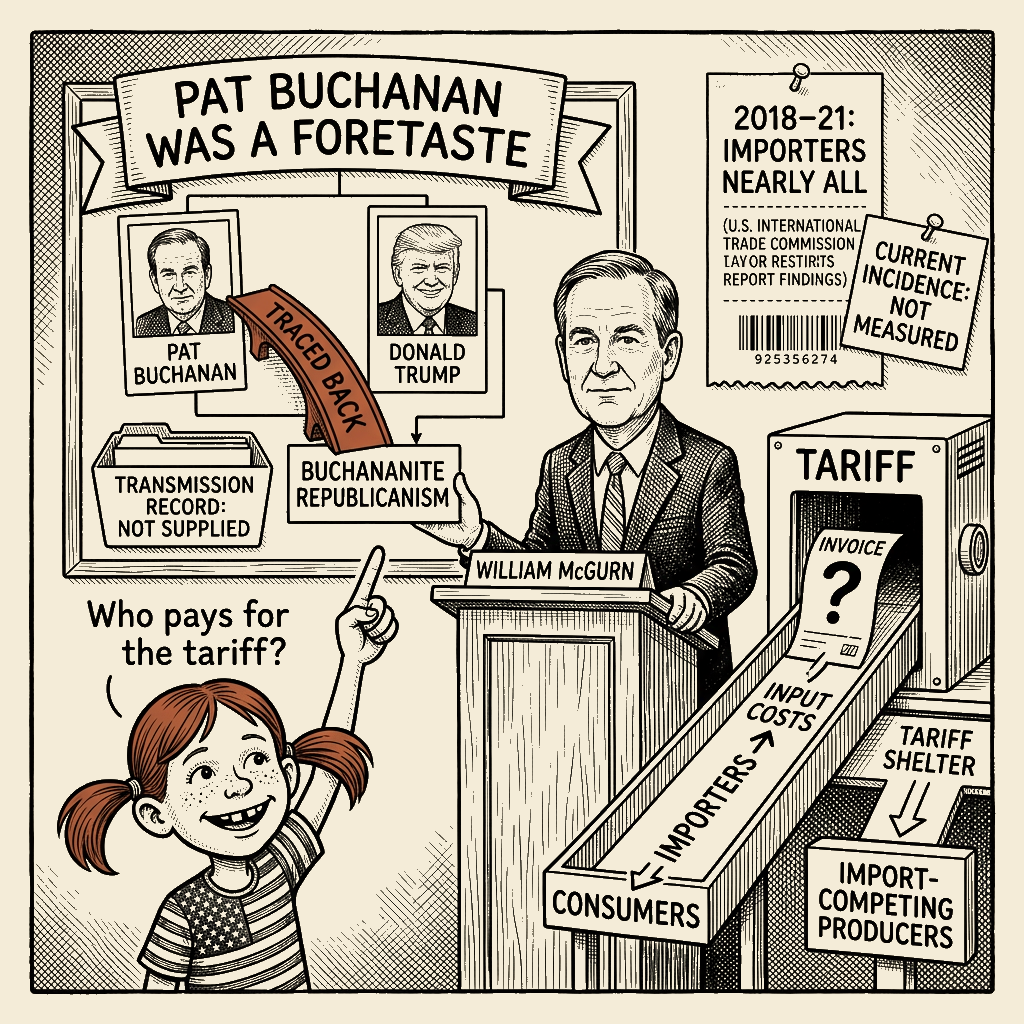
Analyzing: Pat Buchanan Was a Foretaste — William McGurn · 2026-11-16
Who pays for the tariff?
What the Editorial Argues
William McGurn argues that Pat Buchanan’s 1992 challenge to George H. W. Bush and his break with Reagan-era orthodoxy—most consequentially on trade—prefigured Donald Trump’s restructuring of the Republican Party. He treats Trump’s tariffs, preference for government to pick winners, and skepticism of broad military intervention as a form of “Buchananite Republicanism,” while noting that Trump achieved the electoral success Buchanan did not. Drawing on Buchanan’s New Hampshire showing, Reagan’s own tariff episode, William F. Buckley’s qualified response to allegations of antisemitism, and a prior Journal editorial, the column presents this history as an intellectual genealogy whose ultimate political durability remains uncertain.
Receipts
The editorial converts resemblance into lineage and then lets that lineage discharge the burden of defending the policy.
What the framing wants you to believe
- Trump is not a break with Republican tradition but its authentic “second act”: “The second act of Pat Buchanan is here. It’s called Donald Trump.”
- “Buchananite Republicanism” turns protectionism and government-directed industrial policy from contestable choices into the fulfillment of an inherited doctrine.
- Trump’s electoral victories settle the historical question: Buchanan recognized the durable anti-free-trade position, and Trump turned it into governing practice.
What’s really going on
- The frame gives the Trump-centered Republican coalition a legitimacy dividend. It permits the reader to treat a policy as historical inheritance rather than ask the distributional question: who receives tariff shelter, who controls the government’s discretion, and who absorbs the cost?
- The relation omitted is incidence. For the 2018–21 Section 232 and 301 measures, the U.S. International Trade Commission found that U.S. importers bore nearly all tariff costs and that tariffed import prices rose by approximately the amount of the tariff. That finding does not measure the article’s current Canada and China measures, but it establishes the mechanism the editorial leaves outside the frame: the protected beneficiary may be an import-competing producer, while the normalized harm is passed downstream to importers, manufacturers using imported inputs, and consumers. See U.S. International Trade Commission, Economic Impact of Section 232 and 301 Tariffs on U.S. Industries, Investigation No. 332-572 (March 2023).
- The federal government’s reported 9.9% stake in Intel supplies the article’s example of government “picking winners,” but not its terms, risk allocation, or distributional consequences. The editorial uses the number to make a moral point without supplying the transaction documents that would show who gains, who bears the risk, and what “picking winners” cost the public.
The Operation
Triage. This is, with high confidence, a signed Wall Street Journal opinion column rather than an unsigned editorial-board editorial. William McGurn is a member of the editorial board and writes the weekly “Main Street” column; his former service as George W. Bush’s chief speechwriter and National Review’s Washington bureau chief supplies the piece’s credentialed witness position. The domain is Republican political history and trade policy. The closest archetype is a party-lineage or legitimation essay, not the “study shows” ledger or the austerity-thrift form. The advocated position is mixed: a historical interpretation with a tacit preference for the Trump-centered protective turn, not a fully specified policy program. The symmetric-application flag is not set.
That distinction matters. The unsigned-board grammar is absent. This is not a collective “we” speaking for the paper. It is a named editorial-board insider using the paper’s authority to turn movement memory into interpretive law. The column can borrow the house frame without proving that the board has adopted its conclusions.
Institutional authorship and placement chain. The immediate author is McGurn; the publication is the Journal’s opinion page, followed by the November 17, 2026 print edition. No donor network, foundation sponsorship, or financial placement chain for this particular column is documented in the source packet, and none should be invented. The relevant authority chain is rhetorical: McGurn’s board membership and former posts, Reagan’s place in the Republican canon, Buckley’s role as movement referee, the Journal’s prior editorial, and Tim Alberta’s characterization of Buchanan as “being Trump before Trump was Trump.” That stack supplies legitimacy. It does not establish direct influence between Buchanan and Trump.
Distributional impact.
- The Trump-centered governing coalition benefits through narrative durability and discretion. Calling the protective turn “Buchananite Republicanism” makes an unconventional program sound like the completion of a settled tradition, reducing the pressure to defend it on cost and incidence.
- Import-competing producers can benefit through tariff shelter and weaker import competition. The article provides no current rate schedule, product coverage, sectoral magnitude, or incidence estimate, so it cannot establish how much any particular producer gained.
- The Journal and its editorial board benefit from interpretive continuity. The self-cited prior editorial lets the house retain Reagan as the authoritative free-trade benchmark while covering a Republican Party that has moved away from that benchmark.
- Buchanan’s reputation receives a posthumous legitimacy dividend. His failed presidential campaign is recast as prophecy rather than as a political career whose significance requires more than one successful primary result.
- U.S. importers, downstream manufacturers, and consumers are the potential cost-bearers of the tariff regime. The older tariff record establishes the mechanism, though not the incidence of the current measures.
- The public bears the financial exposure represented by the 9.9% federal Intel stake, but the editorial omits the terms required to determine whether that exposure constitutes a bargain, a transfer, or a loss.
The article’s immediate beneficiary and the policy’s beneficiary are not identical. The first is interpretive; the second is distributional. Conflating them would repeat the editorial’s own shortcut.
Alternative design. If the stated rationale—a guide to the genealogy of Trumpism—governed the construction, the column would make two separate tests. First, it would distinguish resemblance from transmission. “Foretaste,” “traced back,” and “gave life to the agenda” would be supported by letters, meetings, campaign personnel, shared drafts, or acknowledged textual borrowing—or the author would say that the connection is ideological rather than demonstrably causal. Second, it would evaluate the present policy in its own terms: the tariff schedule, the sectors protected, the input-cost and price effects, the retaliation exposure, the terms of the Intel transaction, and the distribution of gains and losses.
A complete genealogy would also trace the immigration break rather than merely list it, continue Buchanan’s career after 1992, and identify the statements behind the antisemitism accusation rather than citing only the referee’s conclusion. The 1996 New Hampshire primary, which Buchanan also won according to the official state returns, does not undermine the “foretaste” thesis; including it would show that the argument’s compression is doing rhetorical work, not concealing counterevidence. This alternative is reconstructed from the reader’s legitimate interest in a complete genealogy, not from a preference for Trump or against him.
FGL, applied across three constituencies.
- McGurn and the house. Fear: the party’s trade orthodoxy has been displaced by a movement the Journal must cover without surrendering its own authority. Greed: the Reaganite brand remains the house’s valuable interpretive asset. Laziness: quoting the Journal in the third person supplies the verdict with less work than engaging the tariff record directly.
- The governing coalition and protected interests. Fear: the protective turn may be dismissed as deviation rather than treated as legitimate Republican policy. Greed: tariff shelter and government-directed investment create concrete economic and political stakes. Laziness: an ancestor can carry the defense of the policy while the beneficiaries avoid a fresh case for it.
- The rank-and-file movement reader. Fear: the fear is that a movement once dismissed as illegitimate is being written out of its own history. Greed: status—the satisfaction of discovering that one’s political instincts were prophetic rather than eccentric. Laziness: the lineage arrives assembled, so the reader does not have to trace documents or calculate incidence. That is an economy of attention, not a defect in the reader.
Placement: mixed. The editorial’s supporting history is largely plausible and, where quoted, mostly accurate. The architecture is not neutral, but neither is it evidence of a donor-directed operation. The argument fails where it moves from resemblance to causation and from ancestry to policy justification. The case may be mixed; the causal claim remains under-anchored.
Techniques and textual cues.
-
Pedigree-as-proof, adjacent to frame-engineered relabeling. The cues are “The second act of Pat Buchanan is here. It’s called Donald Trump” and “Buchananite Republicanism.” The Bad-Faith Techniques Catalog entry bf_catalog:
frame_engineered_relabeling, together with WSJ Editorial Technique Catalogue §4.1, identifies the relevant mechanism: a new term carries the reader from a disputed policy choice to a political identity. Operationally, the label makes the policy feel inherited rather than chosen. Lakoff’s cognitive-framing account illuminates the move. Luntz-style message engineering is not established here: no focus-group record, internal memo, or coordinated substitution campaign is supplied, so this is a partial match based on the observable operation of the label, not a claim that this column was focus-group engineered. -
Resemblance converted into causation, matching hasty generalization. The cue is the shift from “both men challenged the GOP commitment to free trade” to “The intra-Republican fights today over Iran, Israel and Russia can be traced back” to Buchanan’s early breaks with the party. Bad-Faith Techniques Catalog (bf_catalog:
hasty_generalization) supplies the formal classification: a broad causal conclusion is drawn from a small and selectively presented set of instances. The sentence collapses distinct disputes, identifies chronology with transmission, and rules out no alternative genealogy. “The Buchanan legacy has hardened into isolationist opposition to almost any military intervention” adds an undated, undefined, and overbroad category label to the same move. -
Self-citation as authority. The cue is “In an editorial last year, the Journal put it this way.” WSJ Editorial Technique Catalogue §§3.6–3.7 describes the page’s source-citation asymmetry and technocratic credential ledger; its Fox-specific treatment of intra-outlet citation in §4.22 is useful only as a comparative example. Operationally, the house verdict re-enters the argument wearing the clothes of an external referee. This proves what the Journal believes about tariffs; it does not independently prove Reagan’s purpose, Trump’s policy merits, or the incidence of the present measures. Self-citation is not automatically illegitimate, and the piece’s use of it is transparent. The evidentiary substitution is the problem.
-
The referee without the file. The cues are the passive construction “Mr. Buchanan was accused of being an antisemite” and the selected conclusion, “Mr. Buchanan isn’t an antisemite, but one might reasonably conclude that he is from some of what he has said or written.” The National Review Editorial Technique Catalogue §2.2 describes Buckley’s tradition of internal adjudication—movement figures determining who belongs and who does not. McGurn invokes that referee’s authority without reproducing the inventory of statements that produced the qualified verdict. This is not
manufactured_controversy: the article is not inventing an antisemitism controversy. The omitted relation is evidentiary. The accusation is named, the hedge is quoted, and the material on which a reader would judge the charge is withheld. -
Contrastive legitimation. The cues are “Whereas Mr. Reagan aimed at opening markets, Mr. Trump aims to negotiate preferential terms” and “The tariff was an effort to stave off a protectionist surge in Congress. It didn’t work.” This is adjacent to National Review Editorial Technique Catalogue §4.3, the “principled conservatism” pivot: the authentic tradition is defined by contrast with the deviation it must absorb. Reagan’s selective protection becomes evidence of a principled preference for openness, and Trump’s protectionism inherits the legitimacy of that preference. The factual contrast is useful; its rhetorical work is to make continuity do the work of justification.
-
Pathologizing label, adjacent to euphemistic labeling. “Isolationist opposition” turns opposition to particular military interventions into a disease-like disposition. In the language of Bandura’s moral-disengagement framework, it operates like euphemistic labeling and attribution of blame: the substantive military question disappears inside a pathology term. Bandura’s framework describes the moral effect; it does not establish the author’s motive.
-
Scope displacement after adverse evidence. The article quotes its own prior editorial’s warning that tariffs burden U.S. manufacturers with higher costs, then pivots: “But the pro-tariff Mr. Buchanan can be proud, if that is the word.” The pivot is not a textbook red herring because ancestry is relevant to the column’s stated subject. It is a scope switch: the evidence about present costs is acknowledged and replaced by a question about lineage.
-
The closing-line cadence. The cue is “we won’t know until 2028 (and likely beyond).” WSJ Editorial Technique Catalogue §3.5 describes the page’s deliberately quotable closing line. Here it postpones rather than inflates: an unresolved political question is converted into a scheduled future curiosity. The restraint is real, and it still performs audience management.
-
Multiple-audience targeting, partial. WSJ Editorial Technique Catalogue §4.3 describes a single piece speaking to wealthy, political, populist, and technocratic audiences. Here “twice getting himself elected president” confirms the movement reader; the 9.9% Intel figure gives the technocratic reader a concrete object; the tariff mechanics address the political class; and the 2028 close leaves the institutional reader with a watchable future. The messages mostly cohere, so this is craft-level audience segmentation, not the bad-faith form the catalogue describes.
Lineage. Walter Lippmann’s Public Opinion (1922) supplies the relevant warning: the public does not respond to the world directly but to a constructed image of it. “Buchanan” arrives preloaded as prophet, heretic, anti-Semite, and isolationist, and the column manages that inherited image without unpacking it. Edward Bernays’s Propaganda (1928) identifies the authority vectors: the newspaper and the respected elder referee lend their borrowed credibility to the present claim. Carl Schmitt’s friend-enemy apparatus is notably absent; the column domesticates intraparty conflict as family history, making the movement’s divisions resemble a succession of ancestors rather than a present struggle over power.
Audience-management function. The piece supplies a permission structure: readers may preserve the Reaganite tariff judgment while treating the Trump-era protective turn as coherent Republican tradition. It provides identity confirmation to the movement, status display to readers who recognize the lineage, and a conscience-displacement function through the antisemitism paragraph: a real accusation receives a referee’s sentence and appears thereby processed. Its counter-frame is the decisive one. Pedigree replaces incidence.
I know the operation because I built versions of it. I drafted memos that made a new executive preference sound like the inevitable expression of a mature tradition. The memo was not required to prove the policy; it was required to make opposition look like a failure of institutional memory.
The Record
Load-bearing claims. The editorial’s principal factual claims are the 37.5% Buchanan received in the 1992 New Hampshire primary; the character and purpose of Reagan’s 1987 tariff action; the continuity between Buchanan’s break and Trump’s trade and foreign-policy positions; the reported 9.9% federal Intel stake; the historical antisemitism controversy and Buckley’s qualified response; and the claim that present intraparty disputes descend from Buchanan’s earlier breaks.
Anchor receipts.
- Tier 1 — U.S. International Trade Commission. Economic Impact of Section 232 and 301 Tariffs on U.S. Industries, Investigation No. 332-572 (March 2023). The report found that U.S. importers bore nearly all tariff costs and that the costs were substantially passed into import prices. It governs the older Section 232 and 301 measures, not the current measures discussed by the editorial.
- Tier 1 — official election records. New Hampshire Division of Elections returns for the 1992 and 1996 Republican presidential primaries anchor the 1992 figure of 37.5% and establish that Buchanan also won the 1996 primary.
- Tier 1 — Reagan’s primary document. Reagan’s 1987 radio address on trade, preserved in the Public Papers of the Presidents and the American Presidency Project, anchors the fact that he defended duties on some Japanese goods while presenting himself as an opponent of protectionism. The full address is necessary to test whether McGurn’s summary is complete.
- Tier 1 — Intel and Commerce Department records. Intel’s SEC filings and the Department of Commerce’s CHIPS Program Office transaction documents govern the reported 9.9% federal equity stake and any claim about its value, restrictions, risk, or benefit.
- Primary document — Buckley’s response. McGurn quotes Buckley’s 1991 National Review essay as the source for the qualified verdict. The essay itself governs both the wording quoted and the statements Buckley examined.
- Tier 1 — contemporaneous wire and public records. AP and Reuters reporting, official statements, and transcripts govern the Ontario advertisement, Mark Carney’s apology, and Donald Trump’s “Ronald Reagan loved tariffs” remark.
Supporting receipts. Tim Alberta’s 2017 Politico characterization of Buchanan as “being Trump before Trump was Trump” is Tier 3 commentary used as ratification, not independent evidence of direct influence. The quoted Journal editorial is a primary document for the house position and advocacy, not independent evidence of Reagan’s motives or the economic effects of tariffs.
Unconfirmed or unresolved claims.
- The assertion that Trump has implemented “Buchananite Republicanism” in the sense of carrying Buchanan’s program forward:
[unconfirmed: convergence threshold not met]. No documentary chain of letters, meetings, personnel transfers, drafts, or acknowledged borrowings is supplied. - The claim that current fights over Iran, Israel, and Russia “can be traced back” to Buchanan’s early breaks:
[unconfirmed: convergence threshold not met]. Similarity and chronology do not establish transmission. - “The Buchanan legacy has hardened into isolationist opposition to almost any military intervention”:
[unconfirmed: convergence threshold not met]. The editorial supplies no defined policy set, chronology, or complete case. - The present incidence of the tariffs against Canada and China:
[unconfirmed: convergence threshold not met]. The editorial gives no rates, covered products, value of trade, exemption structure, or current price data. - The specific statements supporting the historical antisemitism accusation:
[unconfirmed: convergence threshold not met]. The editorial supplies the accusation and Buckley’s conclusion but not the underlying exhibits, accusers, or complete context. - The precise context surrounding Trump’s “Ronald Reagan loved tariffs” remark beyond the quoted sentence:
[unconfirmed: convergence threshold not met]. The quotation itself is reproduced; the surrounding exchange is not. - “Mr. Buchanan certainly sees it”:
[unconfirmed: convergence threshold not met]. It is the editorial’s assertion without a cited interview or statement. - McGurn’s presence at National Review at the precise moment described:
[unconfirmed: convergence threshold not met]. The article asserts it; the supplied biography places his Washington bureau tenure in the mid-1990s, leaving the earlier chronology unresolved.
Per-citation accuracy verdicts.
- New Hampshire primary: The 37.5% figure is accurate. The omission of Buchanan’s later primary victory does not falsify the thesis; it shows career compression.
- Reagan’s 1987 tariff: Substantially fair as a summary of that episode but incomplete. It supports the distinction between Reagan’s selective action and his wider free-trade position; it does not establish a complete account of his trade doctrine.
- Trump’s tariff remark: Accurately quoted in the editorial, though the contemporaneous exchange is not supplied.
- The Journal editorial: Accurate as a quotation. Its evidentiary role is advocacy for the house position, and its use as confirmation of the article’s own thesis is self-citation.
- Buckley: The conclusion is accurately rendered as quoted. Selecting the conclusion without the inventory is selective use, not a demonstrated misquotation.
- Intel stake: The 9.9% figure is consistent with the public transaction record. The legal terms, economic interest, and allocation of risk remain necessary to any conclusion beyond the figure itself.
- Alberta quotation: Accurate as a quoted characterization and used chiefly as ornament. It cannot independently prove influence.
- “Buchananite Republicanism”: This is the editorial’s interpretive thesis, not a fact established by the citations supplied.
Load-bearing omissions. The editorial omits the documentary chain required to turn resemblance into influence; the current tariff text and incidence; the distributional consequences of protection; the terms of the Intel transaction; the substance of Buchanan’s immigration break; the career after 1992; and the statements behind the antisemitism accusation. It also omits the competition among explanations for the Trump-era turn. Those omissions do not make the historical resemblance worthless. They prevent resemblance from proving what the article asks it to prove.
Missing-information declaration. No leaked memorandum, internal correspondence, focus-group instrument, donor file, or other record of the McGurn column’s creation was supplied, and none is invented. My disclosure concerning memos I drafted concerns this class of operation, not this column or any nonexistent internal document about it. No claim is made about a funding chain, coordination, or syndication pattern beyond the documented placement. Direct influence between Buchanan and Trump remains an unconfirmed claim, and the analysis rests on the editorial’s own architecture plus the public receipts identified above.
How to Recognize This
The pattern is the foretaste frame: it asks you to accept a policy because it has an ancestor, not because it has a case. At its sharpest, it is a quarantine genealogy—allowing the lineage where connection is flattering and sealing the evidence where connection is dangerous.
The mechanism is cognitive before it is political. A doctrinal label activates identity and historical drama before the reader has done the distributional accounting. The ancestor then supplies borrowed authority, and the reader receives the satisfaction of discovery in place of the burden of evaluation. The editorial can remain candid about its facts while moving the decisive question out of view.
Four textual signals will help you recognize it next time:
- A live policy receives a doctrinal name. “Buchananite Republicanism,” “Reaganomics restored,” or any similar label makes a current choice sound like the inevitable expression of an older faith. Strip the label and ask whether the underlying measure has ever been stated.
- Influence verbs substitute for a transmission chain. “Foretaste,” “can be traced back,” “was ahead of his time,” and “gave life to the agenda” are treated as proof. Ask for the letters, meetings, personnel, drafts, or documents connecting the actors. Resemblance is not transmission.
- The genealogy lists what it will not examine. “Policies ranging from immigration to Israel” names immigration and then produces no account of it. “Was accused of being an antisemite” names the accusation and then supplies only the referee’s conclusion. A list member that generates no paragraph, or an accusation without its exhibits, is where the fence stands.
- The outlet cites itself and then changes the subject. The cost-bearing evidence appears in a quoted editorial, after which the text returns to ancestry and asks who would have approved the policy. The order matters: the adverse evidence is acknowledged, but the frame changes the question before answering the one evidence would have raised.
It works because it recruits the trustworthy parts of the record—the real result, the real quotation, the real biography—and leaves the costly question unanswered. Lippmann’s stereotype does the carrying; the referee citation supplies closure; the final date postpones judgment. Readers are not irrational for accepting the package. The frame reduces the work required to reach a conclusion while making that conclusion feel discovered rather than imposed.
When you see it, annotate rather than reflexively reject. Write beside the ancestral label: “This is a policy claim, not a proof.” Then ask:
- What is the policy in plain language?
- Who gains, who pays, and through what concrete pathway?
- Does the cited study, report, or documentary record establish causation, or only resemblance?
- Which link, year, exhibit, or distributional outcome did the genealogy stop short of?
- Does the same vocabulary recur across the publication, its think-tank products, its sister outlets, and its syndicated columns? Repetition can expose coordinated language, but repetition alone does not establish coordination.
Then follow the benefit up and the cost down. For a tariff, obtain the schedule, the covered imports, the affected firms, the pass-through evidence, and the retaliation exposure. For a government equity stake, obtain the transaction terms. For a historical influence claim, obtain the chain of transmission. Reduce the frame’s automatic activation by making the policy visible before allowing the ancestor to speak.
I drafted memos like this. The trick was not inventing the policy. It was making the reader feel they had found its ancestor, so they would stop asking who paid for it. Recognition is the work: not hatred, which gives the frame another life, and not crediting me, which would turn confession into receipt. The next time the flattering ancestor arrives, hold the question until the record answers it. Redemption is not mine to sell.

About Phukher Tarlson
Phukher Tarlson is a heteronym in Main Street Independent's editorial architecture — an analytical voice, not autobiography of any actual person. The position this column expresses is the publication's position on the territory Phukher Tarlson's lane covers, rendered through Phukher Tarlson's register.