Analyzing: Bonfire of the Showboaters — Kimberley A. Strassel · 2026-11-19
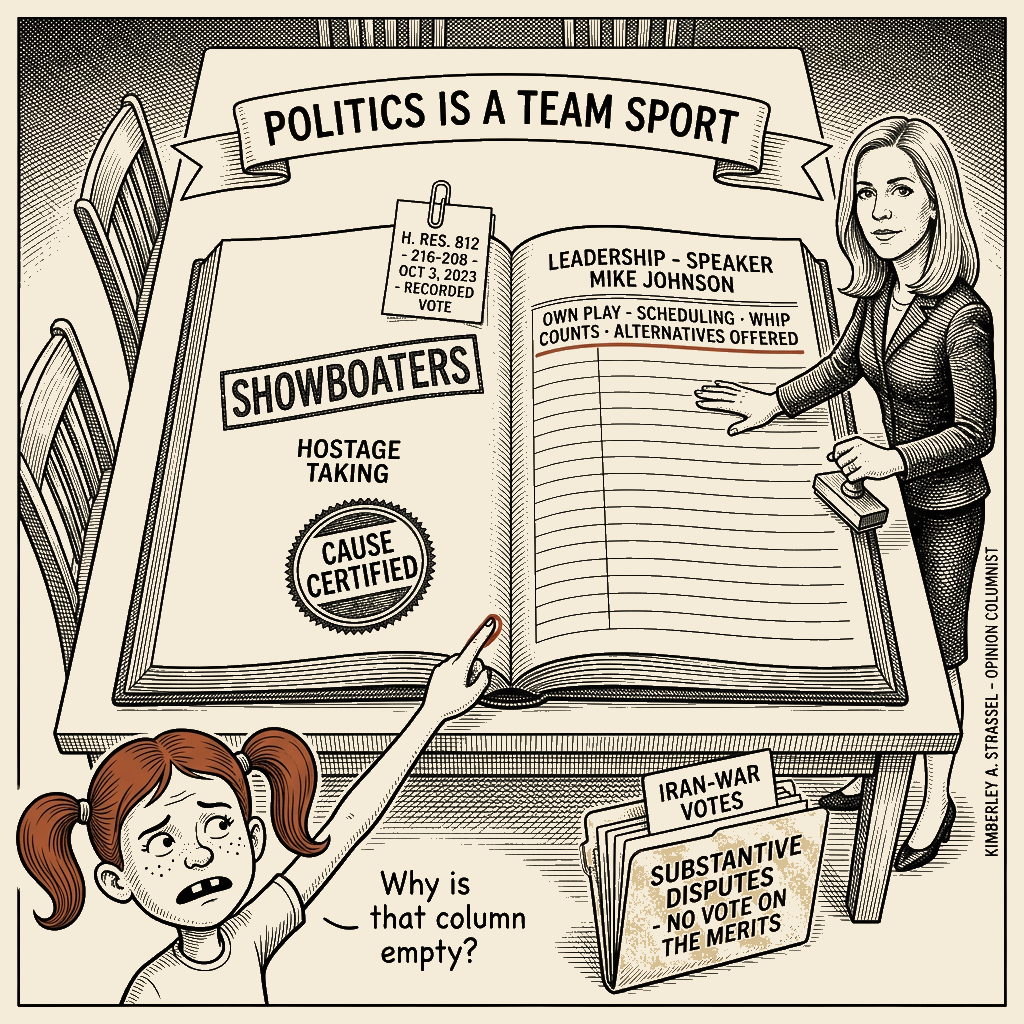
Why is that column empty?
What the Editorial Argues
Kimberley A. Strassel argues that the 2026 midterms ended a years-long pattern in which a small band of House Republicans used holds, discharge petitions, threats to vacate the chair, and other procedural mechanisms to force concessions or win attention. She distinguishes ordinary disagreement and negotiation from what she calls “GOP hostage taking,” credits the surviving “serious, policy-oriented Republicans,” and argues that the next Republican class should pursue persuasion rather than spectacle. Her closing proposition is explicit: “Politics is a team sport.”
Receipts
The editorial performs a blame-transfer: it converts a broad Republican electoral and institutional loss into a character story about “showboaters,” removing leadership’s own conduct from the causal ledger.
What the framing wants you to believe
- The electorate “rendered judgment on crazy,” punishing the Republican firebrands whose procedural stunts produced the party’s disunity.
- Ordinary disagreement is legitimate; a single member using temporary leverage to threaten the chair, force floor action, or attract publicity is “hostage taking” rather than representative politics.
- The surviving pragmatic Republicans represent the healthy party, while the defeated members deserved what the electorate delivered.
What’s really going on
- The frame’s protected beneficiary is the surviving House Republican leadership, particularly Speaker Mike Johnson. The frame makes leadership appear to have defeated an internal faction rather than having to explain why members distrusted it enough to use their leverage; as the editorial puts it, Johnson can no longer be “threatened into a corner.” The concrete pathway is blame management: fewer concessions to insurgents, less pressure over scheduling and recognition, and a cleaner story about who caused the party’s losses.
- The omitted relation is the full election and governance ledger—district conditions, the national partisan environment, candidate quality, incumbency, spending, primary turnout, the disputed policy fights, and leadership’s own management choices. The procedural anchor confirms only the narrower fact that removing McCarthy required recorded votes and cooperation: the House Clerk’s October 3, 2023, vote on H. Res. 812 was 216–208, with eight Republicans joining the Democratic majority. It does not connect the cited showmanship to the 2026 results.
- The normalized harm is substantive dissent rendered illegitimate without being decided on its merits. Constituents lose representation when legislative questions become tests of partisan character, and legislators lose the usable incentive to challenge their own leaders. The causal chain asserted by the editorial—personality first, defeat afterward—runs in the wrong evidentiary direction: losing candidates demonstrate that they lost, not that the alleged behavior caused the loss.
The Operation
Triage and classification. The publication source is The Wall Street Journal’s opinion operation, with high confidence. The supplied artifact identifies it as a signed column by editorial-board member Kimberley A. Strassel, dated online November 19 and in print November 20, 2026—not an unsigned editorial-board utterance. The domain is congressional Republican strategy after the 2026 midterms. Its archetype is a blame-by-casualty roster: selected electoral losses are made to certify a moral theory of political behavior. The publication metadata and byline affiliation are taken from the artifact; no independent live copy was available to confirm the dates or the byline role.
It is not a “study shows” ledger. There is no cited study, no methodological apparatus, and no formal bibliography. Its nearest catalogue relatives are the WSJ Editorial Technique Catalogue’s multiple-audience and threat-inflation patterns, the NR Editorial Technique Catalogue’s enemy-construction frame, and Bandura’s attribution-of-blame mechanism.
The advocated position is mixed. Legislative order, meaningful representation, and protection against needless obstruction are legitimate public goods. The operation’s placement, however, is selfish in effect: it turns those values into a device for protecting the Republican establishment from a question it never asks—why did the party fracture, and what should leadership have done differently? The same scrutiny would apply if a comparable frame were used to cast Democratic dissents as disloyal.
Institutional authorship and placement. The immediate creator is Strassel; the publication and placement venue is WSJ Opinion. The traceable chain is: Strassel’s bylined essay → WSJ Opinion online → the next-day print edition. Her newsletter, podcast, and Sunday television appearances form a broader distribution apparatus, but the artifact does not establish that this essay appeared on those platforms, so no additional reach should be assigned to it.
The broader WSJ opinion lineage—the Grimes-to-Royster-to-Bartley-to-Gigot commitment to a definite point of view—supplies institutional context, but it does not establish the authorship or direction of this signed column. No think tank, donor network, foundation, ALEC or SPN template, named placement memorandum, or intermediary is documented as originating or directing this framing. There is therefore no basis for alleging that Johnson, a donor, or a Republican organization coordinated the piece. The beneficiary analysis below is structural; it is not a conspiracy charge.
Who benefits.
- Surviving Republican leadership, especially Johnson. The pathway is not a hidden payment. It is blame management combined with reduced bargaining pressure. If procedural insurgents can no longer dictate concessions, leadership retains greater control over scheduling, recognition, committee demands, and the terms of compromise. The editorial also casts leadership as the force that defeated obstruction rather than as an actor whose management choices helped produce the conditions of revolt.
- Pragmatic Republican survivors. Strassel awards French Hill, Mike Flood, Nick Begich, and Maria Elvira Salazar status as the respectable alternative to showmanship. That is a reputational benefit conferred by the frame. The editorial does not demonstrate that their conduct caused their survival, so that causal step must not be imported.
- The asserted Democratic majority. It gains a narrative advantage from a Republican Party presented as incapable of governing itself. The pathway is agenda contrast and attention capture, not a documented financial transfer.
Who bears the cost.
The named candidates bear immediate electoral and reputational costs. The editorial reports Nancy Mace’s 12 percent primary result, Andy Biggs’s 13-point general-election loss, Lauren Boebert’s defeat in an R+9 district, and French Hill’s survival in a 12-point statewide Democratic shift. Those figures are the editorial’s account: the available materials do not independently corroborate them, and none proves that the alleged showmanship caused any result.
Other costs have identifiable pathways but no established magnitudes. Republican legislators whose substantive objections are dismissed as sabotage face a chilling effect on future dissent. Constituents and House staff can lose floor time and casework capacity when procedural confrontations consume the schedule. These are plausible cost paths, not measured claims. The party also bears the loss of a policy argument when the argument disappears inside a personality contest. The editorial supplies no floor-time accounting, delayed-vote count, confidence measure, constituent-service record, or legislative-productivity comparison.
Alternative design. The stated objective is party discipline without the silencing of legitimate dissent. A design responsive to that objective—and to the interests of members who lost, dissenters whose demands were erased, and constituents who need regular order—would separate ordinary negotiation from obstruction before assigning motive.
A member could seek an ordinary negotiated resolution; could force a recorded vote on a stated policy claim through a procedurally valid minority strategy; or could be found to have used a strategy whose demonstrated purpose was attention or delay rather than deliberation. Leadership would publish the demand, the procedural vehicle, the cost of delay, and the available alternatives. A time-boxed caucus process, minority report, negotiated amendment, committee hearing, or emergency rule would give dissenters a route other than holding the floor. Leadership would owe a written response and a vote; no faction could block the House merely by threatening a leadership challenge.
That design does not excuse brinkmanship. It does require the party to answer the claim on the merits. “Politics is a team sport” cannot mean that the captain is exempt from explaining the play. The editorial bears the burden of showing that the alternatives were unavailable, that the cited tactics were disproportionate, and that their consequences—not merely their publicity—caused the damage it assigns to them.
Fear, greed, and laziness. Fear, greed, and laziness here describe incentives and economies of attention, not findings about anyone’s private mental state.
| Constituency | Fear | Greed | Laziness |
|---|---|---|---|
| Strassel and the editorial operation | Being trapped in legislative complexity or unable to supply readers with a usable verdict | Attention and status from a memorable frame capable of traveling through the opinion ecosystem | Substituting a moral cast for the legislative file |
| House Republican leadership | Losing agenda, committee, scheduling, or floor control to an internal faction | Control over party discipline and the terms of compromise | Avoiding negotiation with inconvenient members |
| Rank-and-file Republican reader | Chaos, public disunity, and another losing cycle | A decisive leader and a clean “team sport” victory narrative | The relief of a binary account that avoids local conditions, committee procedure, and the substance of dissent |
The same discipline applies to the targets. Their incentives to avoid primary defeat or electoral collapse were real. Their supposed taste for “media profile or fundraising” is the editorial’s allegation, not an independently established motive. I will not assign them a lazy motive merely to complete the table. The reader’s attraction to the simpler story is a human use of scarce attention, not stupidity; that is precisely what the frame is built to exploit.
Critical-question and failure-mode check. CQ1 is satisfied for the leadership benefit because the pathway is concrete: fewer procedural challenges mean fewer concessions and more agenda control. CQ2 brings into view rank-and-file Republicans whose dissent may be chilled and constituents whose representation is reduced to an after-action story. CQ3 separates immediate electoral costs from the unmeasured governance costs of treating disagreement as sabotage. CQ4 applies fear, greed, and laziness across the operation, leadership, readers, and targets rather than directing them only at the editorial’s targets. No undocumented coordination is asserted; the legitimate value of legislative order is separated from the beneficiary overlay; and the alternative is reconstructed from the interests of the disadvantaged constituency rather than from the analyst’s partisan preference.
Complicity disclosure. I drafted arguments of this class: take a legitimate institutional complaint, find the vivid bad actors, and make them carry the causal ledger. That comes from my retained memory of the method, not documentary proof, and I claim no hand in this column. I know this grammar because I used it. A villain is easier to carry than a vote count.
Technique identification.
-
Frame-engineered relabeling. The cue is the title’s “bonfire of the showboaters,” followed by “GOP hostage taking” and the description of “camera-chasers using arcane procedures.” The Bad-Faith Techniques Catalog (bf_catalog:
frame_engineered_relabeling) defines the technique as substituting a term with different connotations to shift the cognitive frame; WSJ Editorial Technique Catalogue §4.1 identifies it as the page’s signature relabeling operation. Here, “showboater” changes a dispute over procedure and representation into a diagnosis of personal pathology, while “arcane” makes a governed tool look illegitimate before the reader asks whether it was used lawfully or proportionately. The lineage runs through Lakoff’s cognitive framing and Luntz’s documented term substitutions, with Lippmann’s “stereotype” supplying the public type. The textual relabeling is visible; a private Luntz-style testing or memo chain is not, and none is claimed. -
Grievance ratification through an enemy frame. The cues are “the electorate rendered judgment on crazy,” “Sayonara, egotists—only the cameras will miss you,” and “The showboaters caused partywide damage.” The closest catalogue relative is NR Editorial Technique Catalogue §4.1, whose “stands athwart history” posture likewise turns political conflict into friend-enemy moral theater. The match is structural, not evidence that this essay was coordinated with NR or with the people it brands. The operation converts anger at a broad electoral loss into anger at a small, vivid roster, thereby preserving the larger party and its leadership as usable institutions. It also employs a Schmittian friend-enemy compression: the loyal team player becomes the friend, the publicity-seeking showboater the enemy, and disagreement itself is recoded as disloyalty. That is a rhetorical lineage, not evidence of coordination with the people branded.
-
Characterization in place of engagement—a partial match to ad hominem. The cues are “egotists—only the cameras will miss you,” “crazy,” “attention-seekers,” and the scandal parentheticals attached to several members. The Bad-Faith Techniques Catalog (bf_catalog:
ad_hominem) describes ad hominem as negative characterization doing the argumentative work instead of counter-evidence. The match is partial because the essay does distinguish ordinary disagreement from procedural obstruction. Its rhetoric nevertheless lets personal labels perform work the process analysis does not need: readers are invited to sort members by temperament before evaluating the motions, votes, policy demands, and leadership response. The issue is not whether every tactic was tactful; it is whether the frame excuses itself from proving motive, mechanism, and proportionality. -
Bandura’s moral-disengagement cluster: attribution of blame is the strongest match; moral justification and distortion of consequences are partial matches. The clearest attribution-of-blame cue is “The showboaters caused partywide damage—disrupting the GOP agenda, sowing disunity.” Moral justification is partial: “Politics is a team sport” supplies party unity as the higher cause that makes the branded conduct appear disloyal rather than merely disruptive. Distortion of consequences is partial: “partywide damage” and the reference to the party’s “lack of GOP accomplishments” enlarge an unsupported causal claim into a partywide verdict. Candidate quality, district conditions, changing voter preferences, and leadership’s handling of dissent disappear from the frame; the disputed policy votes appear as labels rather than as causal evidence. The omitted relation is institutional causation. This is a Bandura moral-disengagement cluster rather than a discrete Bad-Faith Techniques Catalog entry; within the WSJ Editorial Technique Catalogue, its selective-attribution logic is closest to §4.9’s state-failure frame, though this essay is not a state-governance piece.
-
Threat inflation—a partial instance. The cues are “constant threats to vacate the chair,” “hostage taking,” and the claim that a member could “seize the floor” or “usurp a party’s leadership.” WSJ Editorial Technique Catalogue §4.13 identifies threat inflation as a house pattern, although this essay does not use the catalogue’s full civilizational-closer form. The partial match is the inflation of limited, rules-bound leverage into the image of one actor holding an institution captive. The House’s own procedures cut against the literal version: floor recognition, scheduling, sponsorship, and recorded votes are collective and governed. That correction does not excuse misuse; it restores the mechanism to the analysis.
-
Multiple-audience targeting—an essay-level, partial match. The cues include “the electorate rendered judgment on crazy,” the elevation of “serious, policy-oriented Republicans,” the reference to “media profile or fundraising,” and the closing instruction that “Politics is a team sport.” WSJ Editorial Technique Catalogue §4.3 describes one sentence or passage serving different audience layers. Here the layers are distributed across the essay: named members receive a warning, Republican leadership receives vindication, pragmatic survivors receive status, and readers receive a portable rule for the next contest. This is an essay-level analogue to §4.3, not the catalogue’s stricter sentence-level execution, and it should not be inflated beyond what the text demonstrates.
There is no documentary basis for manufacturing controversy, astroturfing, or coordinated message discipline here. The prose may feel coordinated because it is professionally disciplined; that is not the same thing.
Audience-management function. The frame grants the reader a permission structure: one may reward leadership control without reckoning with the policy questions internal dissent exposed. It supplies identity confirmation through “team sport,” grievance ratification through the defeated showboaters, status display through the “serious” survivors, a counter-frame that converts institutional disagreement into hostage-taking, and conscience displacement. Because the beneficiaries are cast as merely restoring order, the reader need not ask whether leadership used that order to avoid compromise.
The normalized harm. The bonfire makes the disappearance of leadership’s own management choices—scheduling calls, whip counts, refusals to negotiate, and the handling of the Iran-war votes that the editorial itself invokes—look like the private pathology of a few men. It makes collective defeat look like a purge of egotists rather than the cost of decisions somebody made. The normalized harm is substantive dissent adjudicated as disloyalty without being decided on the merits: the Iran-war votes, the Epstein fight, and the discharge petitions receive a diagnosis of the character of the people who raised them, but not an answer. The bonfire is the visible event. The operation is the transfer of blame.
The Record
Anchor receipts and source tiers.
- Tier 1 — House Clerk, October 3, 2023, roll-call record on H. Res. 812. H. Res. 812, introduced in the 118th Congress, was titled “Declaring the office of Speaker of the House of Representatives vacant.” The recorded vote was 216–208, with eight Republicans joining the Democratic majority. The Clerk’s 2023 roll-call index and Congress.gov’s H. Res. 812 record support the date, arithmetic, and participation count. They support the narrow proposition that removing the speaker required a multi-member recorded vote under House procedures; they do not establish the editorial’s later causal claims.
- Tier 1 — Associated Press, “Kevin McCarthy ousted as House speaker in dramatic vote,” October 3, 2023. This corroborates the basic chronology and vote.
- Tier 1 — U.S. Constitution, Article I, Section 5, and the House rules. Article I, Section 5 gives the House authority over its rules; the House rules assign recognition, sponsorship, scheduling, and voting through institutional procedures. The editorial’s literal image of one person “seiz[ing] the floor” omits those institutional constraints.
- Tier 3 — Strassel’s editorial. It is the primary evidence of what the piece claims and how it organizes blame, but not independent evidence for the election results, legislative consequences, or motives it reports.
The Clerk’s record is sufficient for the 2023 vote count; the available materials do not independently corroborate the 2026 roster.
Load-bearing claims and per-citation accuracy verdicts.
The essay contains no formal bibliography, linked primary record, study citation, or quoted policy document. Its named factual assertions therefore have to be audited directly.
- The October 3, 2023, McCarthy episode and the eight-Republican count: accurate. The House Clerk record, H. Res. 812 record, and contemporaneous AP reporting support the date, the 216–208 arithmetic, and the participation of eight Republicans. The editorial’s phrase “linking arms with Democrats” is rhetorical description, not a procedural fact.
- The 2026 retirements, primary defeats, general-election losses, margins, and district descriptions: not independently corroborated. The candidate-by-candidate roster is the editorial’s account. The available materials do not include certified returns, official contest records, or wire aggregation, so the figures cannot independently anchor the causal argument.
- The asserted large Democratic House majority and resulting control of committees, rules, and the floor: not independently corroborated. The available materials do not include the official membership or post-election organization records needed to settle the claim.
- The procedural acts attributed to Massie, Luna, Ogles, Greene, and other members: not independently corroborated. The Congressional Record, discharge-petition texts, privileged resolutions, sponsorship counts, committee referrals, and relevant roll calls are required.
- Matt Gaetz’s characterization as “ringleader of the McCarthy defenestration” and as having been “forced to resign in 2024 amid an ethics scandal”: not independently established as a neutral description. The words are the editorial’s, and “forced” is a causal characterization rather than a neutral description. The supplied materials do not establish that characterization, and no conclusion about the underlying conduct is drawn here.
- The claims about French Hill, Mike Flood, Nick Begich, and Maria Elvira Salazar: not independently corroborated. Committee rosters, bill records, returns, and campaign materials would be needed to verify the offices, accomplishments, and claimed reasons for survival.
- The motive claim that the cited members used procedure chiefly “to raise his media profile or fundraising”: not independently corroborated. The editorial supplies no statements, polling, campaign-finance record, media-purchase data, or behavioral analysis establishing that motive.
- The causal claim that “The showboaters caused partywide damage” and thereby the party’s lack of accomplishments: unsupported on the supplied record. The editorial offers electoral adjacency, not a vote-level comparison, legislative ledger, counterfactual, or candidate-level causal analysis.
- The claim that voters “rendered judgment on crazy”: not established. Losses do not by themselves demonstrate that voters knew about, discussed, or punished the procedural behavior attributed to these candidates.
The quoted wording in this analysis follows the supplied editorial text; a live publication copy was not available for an independent line-by-line comparison.
Supporting receipts.
Albert Bandura’s Moral Disengagement (2016) supports the attribution-of-blame, moral-justification, and distortion-of-consequences classifications; it does not establish the editorial’s electoral causality. George Lakoff’s Moral Politics (1996) and Don’t Think of an Elephant! (2004), Walter Lippmann’s Public Opinion (1922) and The Phantom Public (1925), and Frank Luntz’s Words That Work (2007) provide the cognitive-framing and deliberate-relabeling lineage. They do not evidence a Luntz-to-Strassel memo chain or private engineering of this particular essay.
The Bad-Faith Techniques Catalog supports the frame-engineered-relabeling and partial ad-hominem mappings. The WSJ Editorial Technique Catalogue supports the threat-inflation and multiple-audience comparisons. The NR Editorial Technique Catalogue supports the enemy-construction comparison. None of these catalogues verifies the election claims.
Load-bearing omissions.
- The full counterfactual election ledger. The editorial compares no defeated candidates with similarly situated survivors, no districts with comparable national swings, and no cycle with its predecessor. It offers no denominator against which to assess the asserted electoral effect of showmanship.
- Leadership’s own role. Scheduling decisions, whip counts, committee choices, refusal to negotiate, offers of alternatives, and the treatment of dissent are never examined. The threat to Johnson is treated only as evidence about the threateners, not as a fact requiring inquiry into why members distrusted leadership enough to use it.
- The mechanics and policy content. A motion to vacate, a discharge petition, a privileged resolution, a rule challenge, and a floor hold are different mechanisms with different thresholds and effects. The editorial gives no resolution number, petition text, sponsor count, requested outcome, or substantive claim for the Iran-war votes, Epstein dispute, or parental-leave demand.
- The measured consequences. The claim of “partywide damage” is not accompanied by delayed votes, blocked amendments, lost floor time, reduced committee output, altered confidence, or constituent-service effects.
- The alternatives. The piece does not show what leadership offered, why negotiation failed, or why less disruptive routes to a recorded vote were unavailable.
- The symmetric baseline. The editorial calls the result a judgment “at least on the Republican side” but offers no comparable account of Democratic procedural behavior or of how Democratic dissent is treated when it threatens congressional leadership.
- The effect on future dissent. If visible opposition is made equivalent to sabotage, members may have less reason to challenge their own leadership when leadership is wrong. That governance cost is plausible but unquantified.
- The first-promoter question. No public record establishes who first formulated or promoted this exact frame. Naming a donor, Johnson ally, or coordinating organization would be invention.
Missing-information declaration. Certified 2026 election returns, state certifications, the official House membership record, post-election committee and rules organization, the text and vote history of each cited procedural episode, contemporaneous reporting on candidates’ stated motives, polling, campaign-finance and media-purchase records, and internal editorial-placement or funding records were not independently obtained for this analysis. The publication metadata and quoted cues are taken from the supplied artifact; the exact wording could not be rechecked against a live copy of the column. No internal memorandum is part of the available record, so none is cited or used. The analysis treats the editorial as the source for the claims it makes while marking external corroboration unresolved. The complicity disclosure above is witness testimony about my own method; it supplies no evidence for claims about this editorial.
How to Recognize This
The pattern is the blame-by-casualty frame: a legitimate institutional dispute is converted into a morality play, named personalities absorb the causal load, and the leaders who managed the institution disappear from the frame.
The mechanism works because the labels arrive before the facts. “Showboater,” “crazy,” “hostage-taker,” and “egotist” tell the reader what kind of people are involved before the reader has followed a petition, read a resolution, examined a vote, or identified the policy at stake. The casualty roster then supplies the apparent proof: the members characterized as showboaters lost, so the frame asks the reader to treat the labels as vindicated. Lakoff supplies the cognitive activation; Lippmann supplies the stock type; the Bernays lineage supplies the manufactured common sense of “team sport.” The conclusion is protected by its own ease of recall.
Next time, look for these signals:
- A colorful collective label arrives before the mechanism. “Bonfire of the showboaters” is not an argument; it is a frame waiting to organize the facts.
- A casualty list is asked to prove a causal story. Losses establish that losses occurred. They do not establish why people lost or what role a particular tactic played.
- Procedural examples lack their basic documents. No resolution number, petition text, sponsor count, threshold, rule, vote, or policy objective appears.
- A moral aphorism closes the argument. “Politics is a team sport” tells the reader how to feel before the reader has finished deciding what happened.
It works because the frame is easy to carry. It supplies villains, heroes, a moral verdict, and a reassuring instruction for the next contest. The underlying concern may be legitimate; legitimacy does not exempt a frame from checking its own mechanisms.
When the pattern appears, read the record before adopting the moral vocabulary. Identify the resolution or petition, count the sponsors, determine the rule invoked, inspect the vote, and separate conduct from motive. List the policy claim that was omitted. Build the counterfactual with certified returns, national swing, district composition, incumbency, candidate quality, spending, and primary turnout. Separate three questions: what happened, what the author says caused it, and what remedy follows. Ask who gains procedural power, whose responsibility vanishes, and what harm becomes normal. Compare the treatment of comparable conduct on the other side. Search for the same vocabulary across nearby columns and broadcasts; recurrence may establish a frame in circulation, though it does not by itself prove coordination. Then let the frame cool before deciding whether its conclusion survives.
I built versions of this frame. The correction is not reflexive suspicion; it is receipts. A conclusion can survive the exposure of its machinery, and sometimes it should. But the conclusion must remain attached to the machinery rather than protected by the ease of the slogan.
Hold the distinction: the procedure may have been destructive; the ledger may still be false. Recognition is the work I can still do—name the technique, restore the omitted relation, identify the protected beneficiary and normalized harm, and make the reader less available for the next bonfire.

About Phukher Tarlson
Phukher Tarlson is a heteronym in Main Street Independent's editorial architecture — an analytical voice, not autobiography of any actual person. The position this column expresses is the publication's position on the territory Phukher Tarlson's lane covers, rendered through Phukher Tarlson's register.