Analyzing: 4 essential lessons we learned from the government’s dangerous war on ‘disinformation’ · 2026-11-19
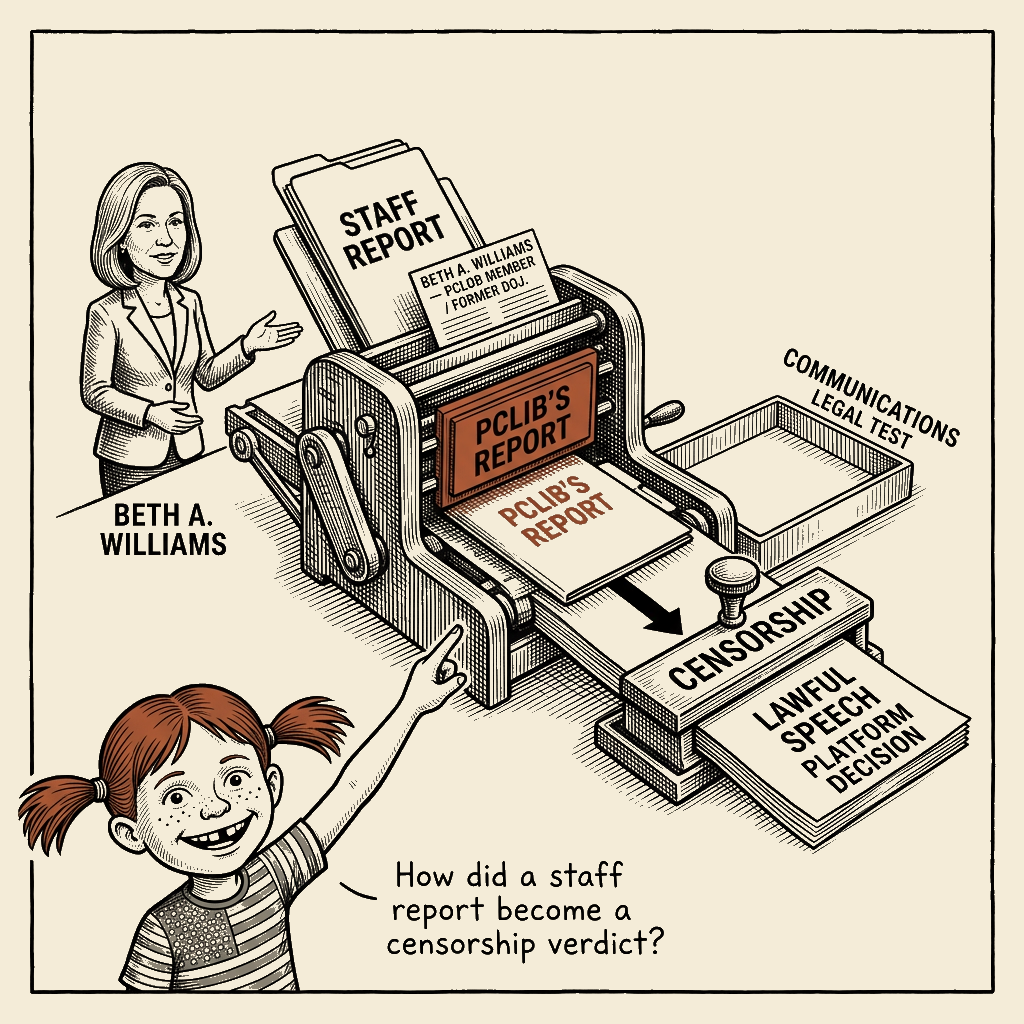
How did a staff report become a censorship verdict?
What the Editorial Argues
Fox News Opinion essay by Beth A. Williams argues that Biden-era officials, after the Privacy and Civil Liberties Oversight Board received no evidence supporting the contention that disinformation fueled domestic terrorism, used private communications with social-media platforms to obtain labels, reduced visibility, removals, or account suspensions for lawful speech. Drawing chiefly on a newly released PCLOB staff report and her own former Justice Department experience, Williams distinguishes ordinary government advocacy from government pressure on private platforms and calls for statutory and agency safeguards, while presenting Donald Trump’s January 2025 executive order as the correct direction. The title promises four lessons, but the body repeatedly returns to one organizing rule: government must demonstrate both the material security value of speech-suppression authority and the legal restraint required to retain it.
Receipts
The editorial moves from an article-attested oversight finding to a categorical censorship verdict, then from that verdict to a bright-line rule, without supplying the causal and legal middle.
What the framing wants you to believe
- Biden-era officials used a terrorism rationale to suppress lawful domestic speech through private platforms; “counter-disinformation” concealed a censorship campaign.
- Government may speak publicly, but private platform pressure is categorically different and dangerous; Trump’s January 2025 executive order supplies the proper direction, while legislation and clearer agency rules are needed to prevent a future reversal.
What’s really going on
- The editorial’s central factual claim is Williams’s statement that “After a four-year investigation, PCLOB was provided no evidence to support the contention that disinformation fueled domestic terrorism,” together with her account of officials encouraging platforms to label, throttle, or remove material (Beth A. Williams, “4 essential lessons we learned from the government’s dangerous war on ‘disinformation,’” Fox News Opinion, citing the PCLOB staff report). The staff report and underlying communications were not available for inspection, so those findings could not be independently confirmed. Even if verified, the finding would establish an evidentiary deficit before PCLOB; it would not prove that disinformation had no terrorist nexus, that every platform decision was government-caused, or that the communications legally constituted coercion. The only independently anchored element in the package is the normative principle: the 9/11 Commission Report recommended that the executive bear the burden of showing that a retained governmental power materially enhances security and is adequately supervised for civil liberties. That supports Williams’s burden-of-proof premise. It supports none of the factual case and none of the categorical rule.
- The omitted relation is agency, modality, and legal form: a conditional forecast becomes a causal proposition; a government request becomes a platform decision; and an untested communication becomes “censorship.” The protected beneficiaries are lawful speakers and users, whose expression should not depend on executive favor, and secondarily platforms that should not be recruited as enforcement arms. The normalized harm is quiet demotion, removal, account loss, and chilled speech concealed behind neutral-sounding “enforcement of platform terms.”
- The concrete beneficiaries are mixed, and the two categories have to be kept apart. Placement beneficiaries: Fox News Opinion gains attention and ideological affinity from a legible story about Democratic overreach, and the Trump administration gains political credit and reduced exposure to criticism of its own policy reversal. Protected public beneficiaries: lawful speakers and users gain protection of their expression from executive favor, and platforms gain a protected sphere of discretion if government pressure is constrained. The available record establishes no payment, donor chain, policy-control arrangement, or hidden coordination behind the essay’s placement, and it supplies no counts, rates, or dollar figures showing the scale of either government contact or platform action.
The Operation
Triage. The artifact is a Fox News Opinion essay by Beth A. Williams, not a Wall Street Journal editorial-board piece. The closing biography identifies Williams as a PCLOB member and a former assistant attorney general in the Justice Department’s Office of Legal Policy from 2017 to 2020. The domain is civil liberties, platform governance, and national security. Its archetype is an institutional-report-backed liberty warning with a partial “study shows” ledger and a binary censorship frame. The advocated position is mixed: the civil-liberties interest is legitimate, but the placement turns complicated government-platform contact into a finished moral narrative and gives the Trump administration a celebratory role in the remedy.
Institutional Authorship and Placement
There are two institutional layers. The underlying counter-disinformation frame was created and promoted by the White House and Department of Homeland Security, according to Williams’s account of the 2021 national strategy and the Disinformation Governance Board. The critical censorship frame was authored by Williams and placed by Fox News Opinion.
The visible placement chain is:
PCLOB staff report → Williams’s board-member and former-official credential → Fox News Opinion → a politically engaged Fox audience → political support for Trump’s policy direction.
That chain is overt rather than covert. The piece gives the report and Williams’s résumé evidentiary gravity; Fox supplies the audience and the anti-executive-overreach frame; the proposed legislation and agency rules supply a policy destination. Nothing in the supplied record establishes a donor-funded placement, paid syndication, shared messaging memorandum, or direct coordination between Fox and the Trump administration on this essay.
The critical institutional move occurs grammatically. Williams begins with “A newly released staff report” but repeatedly says “PCLOB’s report” and “As PCLOB’s report explains.” The article never establishes whether the full Board adopted the staff report as a finding of the institution. A staff report can be serious evidence without carrying every institutional imprimatur the possessive construction implies.
Distributional Impact
The beneficiaries and cost-bearers occupy different positions in the operation:
- Fox News Opinion benefits through attention capture and ideological affinity. The article packages a complicated record into a clean conflict between Democratic officialdom and ordinary Americans’ speech, a narrative congenial to Fox’s political audience. The source gives no traffic, subscription, or revenue measurement.
- The Trump administration benefits politically from a favorable account of its January 2025 executive order and from the suggestion that its policy direction vindicates the civil-liberties case. The concrete pathway is agenda amplification: the essay gives the order political credit without testing its operative language against the institutional safeguards Williams herself says are still missing.
- The executive branch generally is a potential beneficiary of the practice Williams describes. Private communications can give officials leverage over platform moderation without a public order. Whether that leverage was the purpose of any particular communication is not shown, and the record does not support attributing a single motive to every official involved.
- Lawful speakers and users are the protected beneficiaries of the policy Williams recommends. Their benefit is reduced exposure to executive-driven demotion, removal, account loss, and self-censorship. The source supplies no rate for such harm, so the size of the protected class and the frequency of the threatened conduct remain unconfirmed.
- Platforms carry part of the cost: uncertainty over which government contacts carry legal consequence, pressure to treat contested speech as a regulatory matter, and exposure to claims that moderation decisions were politically induced. They also gain a protected sphere of discretion if government pressure is constrained.
- Public-safety and counter-disinformation personnel bear the other side of the tradeoff if the proposed restraints make lawful emergency action harder. Williams recognizes the need to address terrorism without furnishing the comparative legal architecture that would show what a constrained mechanism would cost.
There are no documented magnitudes. The article gives no number of government contacts, platforms contacted, items labeled, content removed, accounts suspended, appeals granted, or resulting security outcomes. The distributional story can therefore be traced by pathway but not sized.
Alternative Design
The stated rationale is to prevent government suppression of lawful speech while preserving a lawful capacity to respond to genuine threats. Reconstructed from the interests of both affected constituencies—lawful speakers need reviewable protection, while people relying on emergency information need timely and accurate government communication—the mechanism would look different from a blanket ban on contact and from the editorial’s unexamined bright line.
Government could remain free to publish its own position and request voluntary cooperation under published criteria. Any request carrying the legal force of compulsion could require individualized evidence, a named decision-maker, notice to the affected speaker unless an emergency made that impossible, a record of the communications, and review by a court or independent agency. Secret lists of speakers or accounts should not supply the evidentiary basis. Platforms should publish aggregate transparency reports; users should have notice and an appeal path; Congress should define the permissible categories; and emergency authority should carry short sunset and congressional-review provisions.
That design does not abandon counterterrorism. It applies the standard Williams invokes from the 9/11 Commission Report: material security benefit, adequate supervision, and enough procedural restraint to confine the power. It is the alternative most directly reconstructed from the stated rationale, not from the analyst’s preferred policy.
Fear, Greed, and Laziness
FGL here is a structural analysis, not an accusation of personal corruption.
- Williams’s constituency: Fear is legitimate: secret government-platform communications can evade public scrutiny, and a regulator’s “suggestion” can function as pressure. The status reward is the satisfaction of appearing as the former official who recognized executive overreach before the full Board or the public. The laziness is the bright-line substitute for the hard statutory and administrative work of defining coercion, procedure, and security benefit.
- Fox and the Trump administration, the apex beneficiaries: Fear is a reasonable fear of scrutiny, policy reversal, and political embarrassment. The reward is attention, agenda amplification, and policy credit. The laziness is the temptation to let an executive order stand in for the legal architecture Williams says remains absent. Fox’s interest is not necessarily payment; it is the capture of attention and ideological affinity.
- The rank-and-file reader: Fear of secret government censorship is real and should not be mocked. The reward is status and identity as an alert defender of speech. The laziness is the relief of receiving a moral answer rather than being required to compare voluntary cooperation, public criteria, legal compulsion, emergency action, platform discretion, and security benefits case by case. The reader is not lazy in the moral sense; the frame offers a legitimate fear a finished conclusion.
The asymmetry check cuts both ways. The essay applies close suspicion to private platform pressure while treating public government advocacy as presumptively appropriate, and it is skeptical of government while giving the institutional report and Williams’s résumé elevated authority. Those are two versions of credential asymmetry, even though one is sympathetic to the editorial’s conclusion.
Placement Verdict
The classification remains mixed. The public-interest core is selfless: government pressure on speech deserves oversight, and secret pressure on private platforms can evade democratic accountability. The placement overlay is selfish in the structural sense: Fox gains from partisan attention, and the incumbent Trump administration gains from favorable policy credit and reduced exposure. A piece can sincerely defend a civil liberty and still be placed where that defense protects incumbents, sells subscriptions, and simplifies a legal problem. The two findings do not cancel each other.
Technique Identification
-
Authority-transfer through the report-and-résumé ledger
- Textual cue: “A newly released staff report” becomes “PCLOB’s report” and then “As PCLOB’s report explains”; the closing biography adds that Williams is a PCLOB member and former Justice Department official.
- Catalogue cross-reference: WSJ Editorial Technique Catalogue §4.5, the “study shows” ledger, and §3.7, the technocratic-credential ledger. The Bad-Faith Techniques Catalog’s
expert-consensus / expert-deference framingsdoes not apply: Williams names a particular report rather than appealing to an anonymous “consensus.” - What it does operationally: A staff report supplies the evidentiary spine, the résumé supplies a second credential, and the grammatical shift from “staff report” to “PCLOB” inflates the apparent institutional authority of the conclusion. The report itself is not made fake; the argument is stretched beyond what its authorship and availability can establish. The lineage is Bernays’s engineered consent: a credentialed authority makes an interested position appear settled common sense.
- Fairness limit: Using a report as evidence is legitimate. The operation lies in the unearned transfer from a staff document to an institutional verdict and from an institutional verdict to a categorical legal rule.
-
Frame-engineered relabeling and asymmetric scare-quote management
- Textual cue: The title places “disinformation” in scare quotes and calls the government’s campaign a “dangerous war,” while the body repeatedly treats “disinformation” and “countering disinformation” as settled policy categories. The article then asks whether an email was “a suggestion” while platforms were told to “enforce their own terms of service.”
- Catalogue cross-reference: Bad-Faith Techniques Catalog,
frame_engineered_relabeling; WSJ Editorial Technique Catalogue §4.1 and §3.8. - What it does operationally: Varied communications are compressed into “government pressure,” then “suggestions,” then censorship; content control is recoded as platform housekeeping. The substitution erases questions of scale, compulsion, platform discretion, and legal authority. The Lakoff and Luntz lineage is relevant: labels activate a frame before the underlying relation has been examined. The textual pattern is documented; a coordinated Luntz-style origin is not, and should not be alleged without a memo.
- The cost of the frame: “Disinformation” is marked as contested in the title but allowed to become an ordinary administrative category in the body. The scare quotes perform doubt without supplying a definition.
-
False-dichotomy censorship frame and modal compression
- Textual cue: The 2021 strategy says disinformation “could lead to domestic terrorism”; the later formulation is that disinformation “fueled domestic terrorism.” The article then repeats the governing binary: “The government may state what it believes to be true,” but government pressure to have platforms remove or throttle speech is “highly concerning.”
- Catalogue cross-reference: Bad-Faith Techniques Catalog,
false_dichotomy—a partial match in which the argument reduces the field to public advocacy versus private suppression without analyzing voluntary cooperation, published crisis criteria, emergency procedures, regulatory threats, warrants, or judicially reviewed requests. - What it does operationally: Modal strength is upgraded from possibility to causation, and legal complexity is reduced to two moral bins. The full staff report would be needed to determine whether the government, the report, or Williams made the causal move. The editorial’s own adoption of that causal formulation is what can be tested from the text at hand.
- Lineage: Lippmann’s early work on public stereotypes explains why the reader receives a ready-made interpretive structure before the evidentiary chain: an antagonist, a danger, and a response.
-
Threat inflation in the closing frame
- Textual cue: “Trump’s executive order sets a clear direction,” and the government “must perpetually prove itself worthy of trust.” The title has already converted a disputed sequence of contacts into a “dangerous war.”
- Catalogue cross-reference: WSJ Editorial Technique Catalogue §4.13, the threat-inflation closer.
- What it does operationally: The piece raises the stakes from an unverified and legally untested set of contacts to a permanent test of governmental legitimacy. That increase in urgency makes the proposed bright line feel modest rather than premature: once the government is treated as an always-suspect enforcement power, procedural restraint can be sold as the minimum rather than as a design problem.
- Lineage: Bernays and Lippmann describe consent production through simplified threat imagery; the point is not that the underlying danger is imaginary but that the frame makes the proposed remedy feel self-evident.
-
Multiple-audience targeting
- Textual cue: The same passage promises that Trump’s order “sets a clear direction,” warns against future government overreach, and gives the reader a vocabulary for lawful speech; the closing biography supplies the credential that makes the warning consequential.
- Catalogue cross-reference: WSJ Editorial Technique Catalogue §4.3, the multiple-audience-targeting analytic, and §3.7, the technocratic-credential ledger.
- What it does operationally: One essay addresses the Fox audience with a Democratic-overreach story, Trump’s supporters with a policy victory, civil-liberties readers with reassurance, and legal or policy readers with commission and Supreme Court vocabulary. The catalogue treats this as craft rather than automatically as fallacy. Here the messages are broadly compatible, so the technique is audience management, not proof of internal contradiction.
-
Bandura’s moral-disengagement cluster inside the campaign being examined
- Textual cue: The 2021 strategy casts disinformation as a crisis feeding “extreme polarization” and potentially “domestic terrorism”; officials then encouraged platforms to “enforce their own terms of service.”
- Catalogue cross-reference: Bandura’s moral justification and euphemistic labeling, joined by displacement of responsibility and diffusion of responsibility.
- What it does operationally: As Williams describes it, the terrorism rationale morally justifies intervention; “platform enforcement” softens the relation between government pressure and content removal; “the platform did it” spreads responsibility across public officials, company employees, and opaque moderation systems. Williams identifies this cluster more clearly than her target campaign does. Her own analysis partly reproduces the responsibility effect when it treats platform action as a government outcome without tracing each platform’s decision, legal exposure, and stated reason.
There is no supported finding of manufactured_controversy, astroturfing, or coordinated_message_discipline. The supplied record contains no donor trail, shared memorandum, or repeated coordinated language from which those techniques could be inferred. Applying the Bad-Faith Techniques Catalog honestly means declining those labels rather than attaching them because the publisher is Fox.
Audience-Management Function
The operation supplies a permission structure: a reader may oppose executive pressure on platforms without examining platform power, the public costs of content moderation, or the government’s own public speech. It supplies identity confirmation through the Democratic-overreach frame, grievance ratification through secret communications and hidden lists, and status display through the report-and-résumé combination. It also performs conscience displacement: the reader need not design the legal regime or resolve the security tradeoff because the essay has already furnished the villain, the bright line, and the politically reassuring solution.
The Record
The evidence available for review separates what can be anchored independently from what the editorial attributes to documents that were not provided.
Anchor Receipts
- Primary-source anchor — 9/11 Commission burden-of-proof standard: The Final Report of the National Commission on Terrorist Attacks Upon the United States recommended that the executive explain both that a retained power materially enhances security and that adequate supervision protects civil liberties. This anchors Williams’s normative burden premise. It does not establish the factual claims about this campaign, and its application to platform pressure is an analogy supplied by Williams.
- Primary-source anchors — governing legal standards: Brandenburg v. Ohio, 395 U.S. 444 (1969), supplies the “imminent lawless action” standard; Virginia v. Black, 538 U.S. 343 (2003), supplies the “true threat” framework. Williams’s terminology is legally recognizable. Those categories are not an exhaustive account of speech doctrine, government authority, or platform liability.
- Institutional context: PCLOB’s official charter and governing legislation support the existence of an independent oversight body charged with examining national-security powers against civil-liberties protections. They do not validate the staff report’s findings.
- Source-attributed context — the editorial itself: Fox News Opinion is the source for Williams’s descriptions of the 2021 strategy, the Disinformation Governance Board, the PCLOB report, the January 2025 executive order, and the scale of platform pressure. As commentary, it is not an independent anchor for those underlying claims.
Article-Attested Claims Not Independently Confirmed
- Williams reports that the PCLOB staff review found no evidence supplied to PCLOB supporting the contention that disinformation fueled domestic terrorism.
- Williams reports that former government actors encouraged platforms to label questionable content, reduce its discoverability, remove content, or suspend accounts, and that officials did so across broad categories without considering protected status.
- Williams reports that later government guidance focused principally on telling agencies and officials not to be “coercive.”
- Williams reports that Trump’s January 2025 executive order ended the relevant practice and that current agency policy does not clearly prohibit the conduct or codify it in law.
- The supplied material contains no count, rate, or base rate for government contacts, platform responses, content removals, account suspensions, appeals, or resulting security outcomes.
Citation Accuracy Verdicts
| Citation or claim | Verdict | Limit |
|---|---|---|
| 2021 strategy: “a crisis of disinformation and misinformation” and speech that “could lead to domestic terrorism” | Accurate as quoted in the editorial | The underlying document was not supplied, so its surrounding qualifiers and the strategy’s full legal basis cannot be checked. Williams’s characterization of it as an assertion is editorial interpretation. |
| “PCLOB was provided no evidence to support the contention that disinformation fueled domestic terrorism” | Article-attested; not independently confirmed | The report, its evidentiary universe, definitions, search methods, and adoption history were not provided. “No evidence provided to PCLOB” is not equivalent to proof that no link existed. |
| PCLOB’s mandate to balance terrorism prevention against privacy and civil liberties | Broadly accurate institutional context | The mandate explains the body’s jurisdiction, not the correctness of this report’s conclusions. |
| Disinformation Governance Board launched in 2022 and scrapped in May 2022 | Article-attested; not independently verified here | The chronology is not load-bearing for the central causal or legal conclusions. |
| “True threat” and “imminent lawless action” | Accurate legal anchors | The quoted doctrines are recognizable, but the two terms do not supply a complete legal test for government contact with platforms. |
| 9/11 Commission burden-of-proof passage | Accurate primary-source quotation | The report supports the general burden and supervision principle. Williams’s extension of it to platform requests is interpretive, not a direct platform-policy recommendation in the quoted passage. |
| Trump’s executive order “sets a clear direction” | Unverified operative claim; evaluative description | The order was not supplied for inspection. “Clear direction” is Williams’s judgment, not a fact established by the citation. |
| Williams’s PCLOB and Justice Department biography | Article-stated credential | The bio supplies authority for the essay but does not prove that she participated in the communications or authored the staff report. |
Load-Bearing Omissions
- The report’s institutional status. The essay does not state whether the staff report was adopted, approved, or merely released by the full Board; it also omits the report’s authorship, methodology, evidence definitions, and internal caveats.
- The communication-to-decision chain. The editorial gives no government actor, date, communication, platform recipient, platform legal department, stated reason, content item, account, or final moderation decision. Without that chain, government request and platform action cannot be treated as one act.
- Scale and base rate. There are no numbers for outreach, voluntary requests, coercive requests, labels, throttling, removals, suspensions, or appeals. “A campaign” cannot be assessed without its denominator.
- The security side of the ledger. The essay does not document a concrete threat, the government’s proposed response, the likely security benefit, or the consequences of prohibiting the response. “No evidence” before PCLOB is an evidentiary failure; it is not a complete cost-benefit finding.
- The legal middle. Voluntary crisis protocols, published criteria, public threat assessments, emergency procedures, warrants, subpoenas, regulatory threats, compelled-speech doctrine, and judicial review are not analyzed. The essay turns on “suggestions” without stating the legal test that distinguishes a lawful request from coercion.
- Platform agency. Platforms are treated chiefly as instruments of government preference, despite the editorial’s own description of them as independent actors enforcing their own terms. Their editorial judgment, First Amendment interests, liability exposure, and reasons for accepting or rejecting a request remain outside the frame.
- The asymmetry in official speech. The essay calls affirmative government speech “generally accepted and appropriate” without asking whether partisan, misleading, or secret official advocacy imposes a comparable cost on the same speech environment. Close scrutiny of private platforms and presumption for public government speech do not occupy the same evidentiary standard.
- The remedy. The editorial says current policy and law are insufficient but does not specify who must authorize a request, what evidence is required, whether the speaker receives notice, how a platform can appeal, what gets disclosed, or when emergency authority expires. “A clear direction” is not a legal architecture.
- The promised four lessons. The supplied body does not enumerate four distinct lessons. Its arguments repeatedly converge on the same public-speech/private-pressure boundary, which makes the numbered packaging more assertive than the content.
Missing-Information Declaration
The materials supplied do not include the PCLOB staff report, the government-platform communications, platform responses, agency policies, the January 2025 executive order, or the underlying legal documents. The record-based findings above therefore distinguish the 9/11 Commission and Supreme Court authorities; Williams’s characterizations of the PCLOB report, strategy, communications, agency guidance, and executive order; and the absence of scale data in the supplied text. The report-dependent claims remain identified as article-attested rather than promoted to independently established facts.
How to Recognize This
The pattern is an authority-transfer frame built on a censorship binary. A scoped staff finding is made to carry an institutional verdict; the verdict is attached to a two-category rule; and a politically useful solution appears as the conclusion before the reader has inspected the legal category or the machinery needed to make it durable.
The mechanism has four steps. A document supplies credibility. The author’s résumé supplies a second credential. The document’s finding is expanded from what was found into what must be done. Then the bright line relieves the reader of having to distinguish public advocacy, voluntary cooperation, coercive pressure, emergency action, and secret direction.
The recognition signals are:
- Watch the grammatical owner of the evidence. “A newly released staff report” becomes “PCLOB’s report.” Ask whether the document was a staff product, a Board-adopted finding, a unanimous conclusion, or a report containing contested views. The report’s status is part of the evidence.
- Watch the modal verbs—and who owns them. “Could lead” becomes “fueled.” “The government urged” becomes “the government censored.” Preserve modality, attribution, timing, and scope before allowing a report’s finding to become an institutional verdict.
- Watch the actor, and the legal category the argument leaves out. If “platforms removed content” becomes “the government censored speech,” ask whether the platform acted independently, followed a request, faced a regulatory threat, or accepted a bargain—and then ask which legal category would decide the matter: voluntary cooperation, published crisis criteria, emergency action, regulatory threat, or judicially reviewed request. A request is an event; a platform decision is another; the relation between them must be shown, not assumed. The essay rightly asks whether disclaimers changed the character of the communications; it does not show the communications or state the test that would answer the question.
- Watch where the remedy arrives. The executive order is called a “clear direction” while the essay itself says prohibitions are not “clearly stated in current agency policy” and are “not codified into law.” When a political direction arrives before the legal architecture, ask who receives credit and who must still do the work.
It works because the fear is real. Government pressure on platforms can evade public scrutiny, and people subjected to covert pressure to remove lawful speech are right to be alarmed. The operation attaches that defensible fear to a policy conclusion whose legal and institutional details remain untested. The evidence is not necessarily fabricated; the argument is stretched past it. Fox supplies identity reinforcement; PCLOB supplies evidentiary gravity; the bright line supplies relief from having to decide difficult cases. That does not make the underlying warning false. It makes the editorial’s answer more finished than its record permits.
When you see it, trace the primary document before treating it as the institution’s conclusion. Read the report’s status, authorship, method, caveats, and adoption history. Check whether the policy conclusion follows from the finding or has merely been attached to it. Build the chain: government actor, date, communication, recipient, platform response, content affected, legal standard, and result. Quantify the requests, responses, removals, appeals, and security effects. Restore the omitted middle cases. Look for the same vocabulary—“dangerous war,” “suggestions,” “clear direction,” “perpetually prove itself worthy of trust”—across the outlet and its network, but do not allege coordination without a document, shared instruction, or funding trail. Then restate the argument without the moral labels and see what survives.
I spent two decades building frames that made the conclusion arrive before the evidence did. That is why I recognize the construction, and why I have no standing to certify Williams’s report. Open the document. Name the actor. Trace the request, the response, the authority, and the cost. Recognition is the work. It is not absolution, mine or anyone else’s.

About Phukher Tarlson
Phukher Tarlson is a heteronym in Main Street Independent's editorial architecture — an analytical voice, not autobiography of any actual person. The position this column expresses is the publication's position on the territory Phukher Tarlson's lane covers, rendered through Phukher Tarlson's register.