Analyzing: ‘Austin Powers’ star Mike Myers seems to think liberal Hollywood is just ‘groovy’ · 2026-11-20
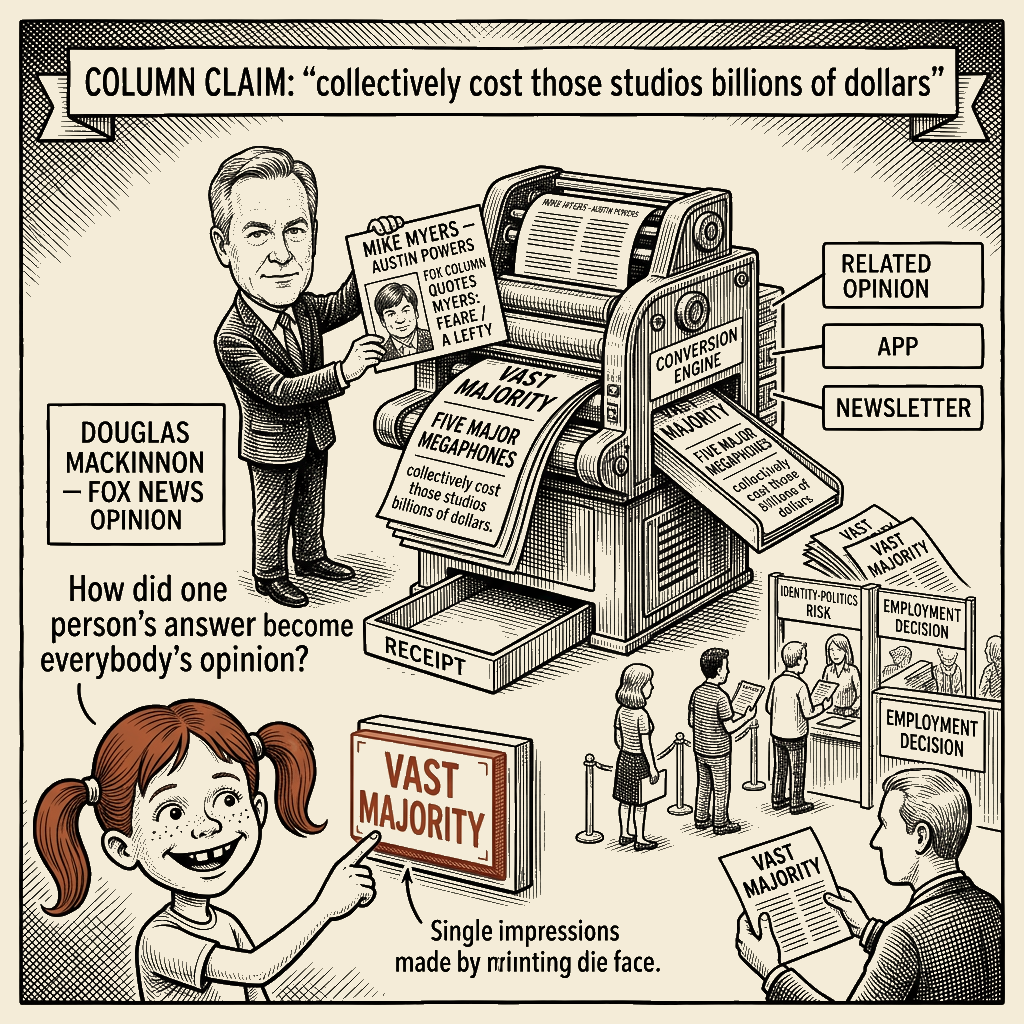
How did one person’s answer become everybody’s opinion?
What the Editorial Argues
Douglas MacKinnon argues that Mike Myers should keep politics out of a possible fourth Austin Powers film because ordinary viewers want entertainment and relief rather than ideological lectures. He expands Myers’s oblique remarks about fear and love—and his self-description as a progressive—into a larger claim that identity politics have driven audiences away, cost studios billions, and exposed decades of discrimination against Republicans, conservatives, and religious people. The result is a culture-war argument in which one actor’s guarded answer becomes evidence for a struggle between ordinary working-class audiences and five institutions the author says are under left-wing control.
Receipts
This is a celebrity-proxy conversion: it turns Mike Myers’s ambiguous answer into proof of systemwide conservative persecution and then funnels the resulting grievance into Fox’s audience.
What the framing wants you to believe
- Mike Myers would be foolish to introduce politics into Austin Powers; audiences want entertainment and relief, not lectures from an entertainment industry hostile to their beliefs.
- Hollywood has become a political monoculture whose “woke” narratives alienate working-class viewers and have “collectively cost those studios billions of dollars.”
- Republicans, conservatives, and religious people are the suppressed victims of an establishment dominated by the left, including the media, academia, entertainment, science, and medicine.
What’s really going on
- Protected beneficiary and pathway: The anchor is the Fox News Opinion column by Douglas MacKinnon. Its related-opinion links, app promotion, and newsletter registration make the pathway visible: Fox News Opinion is positioned to capture attention, reinforce political affinity, and turn the grievance into a first-party contact opportunity. The article supplies no measured increase in traffic or subscriptions.
- Who gains beyond Fox: Political actors aligned with Fox could gain audience affinity and coalition reinforcement from a ready cultural enemy, but the column establishes no payment or transfer to them. Studios and commercially broad entertainment could benefit if politics demonstrably repels audiences, although the column proves no such market effect.
- The omitted relation and legitimate kernel: Viewers may reasonably prefer entertainment to compulsory sermonizing. The operation hijacks that valid preference to make Myers’s remarks prove claims about studio finances, audience rejection, hiring discrimination, Yale politics, and five institutional capture. The excerpt MacKinnon quotes establishes none of those connections, even if accurately transcribed. The normalized harm is not a proven billion-dollar loss; it is the normalization of suspicion as an editorial rule—make identity evidence of disloyalty, hide politics from the audience, and treat dissent from prevailing entertainment ideology as a commercial liability.
The Operation
The branded Fox News Opinion page, byline, promotional modules, newsletter block, and author footer identify the piece as a column attributed to Douglas MacKinnon. It is a named-author culture-war essay in the celebrity-to-system archetype, combining the Fox catalogue’s “person-as-policy” and “press-as-standing-antagonist” patterns with the “common sense”/“elite” pivot familiar from the WSJ editorial-page repertoire. It is neither an unsigned board editorial nor a study-led economic argument.
The advocated position is mixed overall: its stated rationale—audience autonomy and the commercial need to make broadly marketable entertainment—is legitimate, but its distributional machinery is selfish in operation. It protects a concentrated conservative-media interest by converting cultural anxiety into traffic, affinity, and a repeatable political grievance. The ordinary audience is invoked as the beneficiary but also recruited as a political constituency whose preferences can be asserted without measurement.
Institutional authorship and placement chain. Fox News Opinion is the institutional publisher and the creator of this column; the available evidence does not identify who first promoted the broader cultural frame. The page identifies MacKinnon as a former White House and Pentagon official and as the author of The 56 – Liberty Lessons from Those Who Risked All to Sign the Declaration of Independence. That footer is primary evidence of the credential the outlet chose to display, not independent proof of his biography or expertise in film finance, audience measurement, or Hollywood hiring.
The available evidence identifies no donor network, think-tank template, ALEC or SPN document, Luntz memorandum, or other coordinated instruction behind this particular column. None should be inferred. What it does establish is the authored Fox placement, its related-opinion vocabulary, and its conversion machinery: article, related links, app promotion, and newsletter registration. The visible placement chain runs from Fox’s grievance content to Fox’s traffic and first-party audience channels. The placement is visible on the page, but there is no traffic, revenue, donor, or memorandum evidence measuring the result. The commercial benefit and coordination claims therefore remain plausible pathways, not measured outcomes.
I drafted versions of this architecture: take one ambiguous celebrity sentence, enlarge it into a civil conflict, then give the audience a mascot, a villain, and a script for what to feel. That experience explains my recognition of the form; it does not prove how MacKinnon made this column. The wire visible here is textual and institutional.
Distributional impact. The beneficiaries are identifiable:
- Fox News Opinion is positioned to gain attention, ideological affinity, and a route toward its newsletter audience. The pathway is printed on the page; the magnitude is not supplied.
- Political actors aligned with Fox could gain a cultural grievance that links entertainment, education, science, and medicine into one enemy. The pathway is audience affinity and coalition reinforcement, not a documented payment or coordinated campaign.
- Studios and commercially broad entertainment could benefit if avoiding political themes reduced controversy and widened appeal. That is a plausible business pathway, not a demonstrated one; the column provides no audience study, franchise forecast, or comparable-title evidence.
The cost-bearers are more diffuse and less visible:
- Audiences seeking political representation in popular culture bear the risk of a rule generalized from “preachy” films to legitimate political expression.
- Progressive, moderate, and minority creators bear the risk that employment and artistic decisions will be filtered through “anti-woke” suspicion rather than conduct or audience response.
- Conservative and religious workers are invoked as victims, but the column offers them no remedy. If the alleged discrimination exists, diagnosis without an enforcement path leaves them where they are.
- Studios bear the risk of mistaking a self-selected comment section for the whole market and narrowing content accordingly.
The only financial magnitude offered is the assertion that identity politics “collectively cost those studios billions of dollars.” No studio, title, period, comparison, or causal method appears behind that number. It cannot bear the weight placed on it.
An alternative design would optimize for the stated rationale without making ideology a proxy for entertainment quality. Studios could distinguish an argumentative lecture from political material woven into character and story; use representative audience research rather than comments; model audience segments rather than declare a single “vast majority”; test concepts across demographic groups; protect employees through conduct-based anti-discrimination rules; and permit artists to hold political views without treating those views as evidence about the quality of their work. That approach serves the working-class audience’s actual interest in competent, respectful entertainment while preserving its interest in seeing itself represented. It also serves creators who should not have to pass a partisan loyalty test to work.
The Fear-Greed-Laziness map must be applied without contempt.
- The framing author: The professional slot rewards a culturally potent frame in a format that rewards cultural conflict. The structural fear is loss of attention; the appetite is reach and affinity; the convenience is not to document the surveys, studio accounts, hiring records, or comment corpus behind the claims.
- The institutional beneficiary: Fox’s payoff comes when cultural grievance activates its audience and produces attention and affinity. Its structural risk is the loss of that attention; its institutional convenience is preserving “Hollywood” and “the left” as compressed explanations.
- The rank-and-file reader: Fear of being manipulated by films, media, and institutions is real. So is the appetite for status, belonging, and the satisfaction of winning a culture-war exchange. Laziness here is not stupidity; it is the convenience of accepting a finished enemy rather than auditing five institutions, several magnitudes, and a history measured in decades.
The reader’s dislike of being lectured is legitimate. The operation is the use of that dislike to settle unrelated questions without evidence.
The four cui bono questions yield mixed answers. Fox has a concrete pathway through attention capture and audience affinity; no money trail is established. Political actors aligned with Fox could gain from a usable grievance, but that broader benefit remains plausible rather than demonstrated. Studios seeking low-controversy commercial shelter are likewise possible rather than documented beneficiaries. Cost incidence is not established: the column assigns billions in losses to “woke” strategy without demonstrating who lost what, compared with which alternative, or under what counterfactual. FGL has been applied across the author, the protected beneficiary, and the reader without pretending that the same evidence supports all three constituencies.
Strip Myers out, and what remains is a legitimate complaint about preachy entertainment; once the celebrity is removed, the claims about finance, hiring, Yale, and five institutions have no evidentiary bridge. The alternative above follows the stated interests of workers, creators, audiences, and studios.
The textual techniques are visible.
-
“Common sense” / “elite” rhetorical pivot — WSJ Editorial Technique Catalogue, §4.10. The cue is the claim to speak for “the vast majority of citizens in the United States, Canada and around the world,” who live the “‘working-class,’ ‘blue-collar’” life, followed by his denunciation of the “entrenched-elite bubble” of Hollywood. Operationally, the move supplies the author and outlet with popular authority without attaching a representative measure. It is the Lippmannian substitution of a manufactured public stereotype for the public, followed by a Lakoffian relocation of the audience from a political subject into a moral class. The audience’s preferences are not fictional; the author’s claim to speak for them is unproved.
-
“Person-as-policy” — WSJ Editorial Technique Catalogue, Fox addition §4.24, applied partially. The cue is the title’s attachment of the institutional argument to Mike Myers and the repeated demand that he answer for Yale, science, medicine, the media, and the whole culture. Myers becomes the mascot and evidentiary carrier. The match is partial because the column retains a broader institutional argument after Myers is removed, but his celebrity supplies the argument’s emotional and representational authority.
-
“Press-as-standing-antagonist” — WSJ Editorial Technique Catalogue, Fox addition §4.23, applied partially. The cue is “Hollywood’s ‘woke era’” and the image of “entrenched elites from Hollywood” lecturing the public. The move expands one uncertain movie choice into a standing institutional antagonist, making the dispute about Hollywood’s moral identity rather than the marketability of one proposed comedy sequel. It follows Lippmann’s construction of the public through a stereotype and Schmitt’s friend-enemy division, but it does not establish a broader media conspiracy.
-
Scare-quote management — WSJ Editorial Technique Catalogue, §3.8, a limited instance. The cue is the headline’s scare-quoted “groovy.” The typography declares the description ironic and makes Myers’s approving language politically suspect before the body supplies the political explanation. Operationally, it front-loads the conclusion and reduces the reading task to recognizing the frame’s approved interpretation. One scare-quoted word does not establish the catalogue’s broader pattern of asymmetric scare-quote application.
-
Appeal to popularity — Bad-Faith Techniques Catalog, bf_catalog:
appeal_to_popularity. The cues are “like the vast majority of citizens,” “most from that world,” and the claim that Myers’s possible politicization “has outraged most.” The comments section is treated as a mandate. No polling method, comment count, sampling frame, or measure of how many readers were reached is supplied. The operative move converts an unmeasured reaction into a democratic verdict. -
Representational strawman — Bad-Faith Techniques Catalog, bf_catalog:
strawman. The cue is the claim that audiences do not want Hollywood elites to “lecture them, speak down to them or outright insult them and their beliefs and faith.” The excerpt quoted from Myers does not make that proposal. His language was that he was sick of fear and wanted more love. The editorial converts an unspecified possible commentary into insult against belief and faith, then refutes the construct it supplied. -
Exclusionary binary, a partial match to false dilemma — Bad-Faith Techniques Catalog, bf_catalog:
false_dilemma. The cues are “They simply want to be entertained” and the opposition between “fear” and “love.” The structure repeatedly contrasts broadly appealing entertainment with elite politics, making political filmmaking an opposing pole. The column never states an exhaustive either-or proposition, so the formal-fallacy threshold is not met. The defensible finding is a partial exclusionary binary, not a completed false dilemma. -
Hasty generalization — Bad-Faith Techniques Catalog, bf_catalog:
hasty_generalization. The article moves from Myers’s answer, to a video-comment section, to “five-plus decades” of claimed discrimination, and then to control of “five major megaphones.” The intermediate evidence required to support those scales is absent. The Govier-Walton pattern is visible because the conclusion is vastly larger than the sample. -
Ad hominem, status-based — Bad-Faith Techniques Catalog, bf_catalog:
ad_hominem. The cue is the aside that many Hollywood elites “barely finished high school.” The educational insult does no necessary argumentative work; it substitutes a status characterization for audience analysis. The article supplies no schooling data, and the attack cannot establish either artistic competence or market preference. -
Frame-engineered relabeling, partial match — Bad-Faith Techniques Catalog, bf_catalog:
frame_engineered_relabeling. The cue is the conversion of media, academia, entertainment, science, and medicine into “five major megaphones,” alongside the “entrenched-elite bubble.” The relabeling makes separate institutions look like parts of one propaganda system. The documented feature is the Lakoffian frame shift; the catalog’s stronger claim of deliberate, focus-tested engineering is not established for this column. No Luntz memorandum should be conjured to complete it. -
Bandura’s moral-disengagement mechanisms, in partial concert. “They simply want to be entertained” and “help to decompress their constantly troubled minds” provide moral justification for excluding political content: exclusion is recast as service to burdened people. “Those with the ability to hire in Hollywood” and “the left has secured a vicelike grip” displace and diffuse responsibility by removing identifiable decision-makers from the sentence. “Woke narratives” are assigned causal blame, while “collectively cost those studios billions” asserts a distortion of consequences without supplying the counterfactual needed to establish it. The article does not cross the dehumanization threshold; its insults remain status-based rather than subhuman.
Taken together, these devices draw on the Bernays-Lippmann lineage of engineered consent and construction of “the public,” filtered through Schmitt’s friend-enemy distinction and Lakoff’s cognitive frames. That describes the rhetorical architecture; it is not evidence of a hidden coordinator.
The audience-management function is grievance ratification with a permission structure attached. The reader receives permission to treat politics in entertainment as an elite imposition, identity confirmation as an ordinary and discerning person, and status as the anti-elite citizen who sees through the establishment. The counter-frame says the issue is not politics itself but elites using entertainment to scold their betters. Conscience displacement completes the operation: once the moral lines are installed, the reader can treat the evidence as unnecessary. The Austin Powers time-machine close converts the structure into a retransmission device—a criticism that arrives as a joke, a mascot, and a usable slogan.
The Record
The column is a primary document for its own rhetoric and placement. It is not an evidentiary receipt for the historical, financial, audience, or employment claims it advances.
-
What Myers said — [unconfirmed: convergence threshold not met] as to the original interview.
The Fox column quotes Myers as saying that the world has happened but Austin’s is happier, that “fear has had it” and “love is on the way back,” and that he is “a lefty,” “a progressive,” and “always” has been. The column is a Tier-1 primary document for what MacKinnon quoted; the complete Variety/X post cited by the column was not obtained for comparison, so exact transcription and context remain externally unresolved. The excerpt quoted by the column does not establish the editorial’s claims about audience rejection, studio losses, employment discrimination, Yale, or institutional control. -
The audience is a unified anti-politics majority — [unconfirmed: convergence threshold not met].
The claims that “the vast majority” of citizens prefer politics-free entertainment and that “most” commenters were outraged have no polling, sample frame, comment count, or representativeness check. The comment section is a self-selected expression of the outlet’s audience, not a measured national audience. -
Identity politics cost studios billions — [unconfirmed: convergence threshold not met].
No studio filing, title-level loss, revenue series, methodological comparison, or causal analysis supports the claim. No independent Tier-1 source or converging Tier-2 receipt appears in the available evidence. “Collectively” conceals the absence of an identified loss, an affected party, a time period, and a counterfactual. -
Hollywood has systematically discriminated against Republicans, conservatives, and religious people for five decades — [unconfirmed: convergence threshold not met].
The column supplies no hiring record, survey, case, complaint, longitudinal comparison, or definition of discriminatory conduct. The claim is framed as common knowledge without an evidentiary receipt. -
More than 95 percent of Yale’s faculty supports the Democratic Party — [unconfirmed: convergence threshold not met].
No survey year, instrument, denominator, or source is supplied. “Supports” could mean registration, donation, voting, self-identification, or current affiliation. Those are different variables. The figure cannot carry the extension to the “five major megaphones.” -
Hollywood’s identity politics alienate at least half the audience — [unconfirmed: convergence threshold not met].
The conclusion treats “at least half” as the benchmark a healthier Hollywood would no longer insult. The article offers no corpus analysis, audience study, or series comparison and never defines “woke narratives” or “identity politics-driven characters,” leaving the classifications unauditable.
There are useful supporting primary receipts, but they support different propositions. The newsletter prompt, related-opinion links, app promotion, and page layout are primary documents for Fox News Opinion’s placement and attention pathway. MacKinnon’s footer is primary evidence of the credential the page chose to display, not independent proof of his biography or subject-matter expertise. The column’s prose is primary evidence for the techniques above. The article supplies no independent Tier-2 research converging on its principal empirical claims.
The load-bearing omissions are structural:
- The denominator and method for the audience claim are absent.
- The content corpus alleged to be “woke” is never defined or sampled.
- Studio losses are assigned without identifying studios, titles, time periods, revenues, or competing causes.
- The hiring-discrimination claim supplies neither cases nor comparative evidence.
- The Yale statistic supplies no instrument or date.
- The article never distinguishes explicit preaching, partisan advertising, political representation, and ordinary storytelling.
- The alleged victims receive no remedy, while the practical instruction is to make the franchise’s politics less visible.
- The opportunity cost of political neutrality is omitted: audiences may lose stories and representations in which they recognize themselves.
- Fox’s own commercial incentives and the placement chain are visible on the page but absent from the argument.
- No evidence shows that five distinct institutions operate as one coordinated apparatus.
The citation verdicts are correspondingly mixed. The only substantive citation is the Variety/X post. Because the complete original post was not obtained, no verdict can be reached on exact transcription, omitted context, or intent. What can be said is narrower: the column reports those lines, and the excerpt it quotes does not establish the conclusions drawn from them. The reported “over 600,000 views and counting” is an observation attributed to the article at publication, not an independently verified count. The column also places Myers’s post shortly after the November 3 election and characterizes the result as a Democratic victory; the complete post and official returns were not available for comparison, and even an accurate election result would not establish Myers’s intent.
The “five-plus decades,” “billions,” “95 percent,” “vast majority,” “outraged most,” and “at least half” claims have no attached receipt. Even if some studios experienced financial losses, the editorial does not establish that ideology caused them. Its use of its own citation is therefore a reliable record of what it attributes to Myers within the article, while its extensions into audience, employment, institutional, and financial conclusions run beyond the quoted evidence.
The missing information is material. The available evidence does not contain the complete linked Variety/X post, the comment corpus, representative audience polling, studio financial records, employment records, official election returns, an independent biography for MacKinnon, or the alleged Yale survey. No internal memorandum or donor record appears in the evidence set. Nothing here fills those gaps by guesswork, and my recollection of drafting this kind of column is not used as evidence about MacKinnon, the article, or any alleged coordinating network.
How to Recognize This
The pattern is celebrity-to-system substitution followed by an attention funnel: one famous person’s ambiguous words become evidence of institutional capture, the institutional claim becomes a class grievance, and the grievance is delivered through the publisher’s conversion machinery.
The mechanism has three stages. First, the celebrity lowers the cost of interpretation. A viewer need not understand Hollywood financing, audience measurement, or hiring systems; the viewer need only recognize a familiar performer and decide whether the remark sounds partisan. Second, the outlet expands that small judgment into a large one, names the enemy, and asks the reader to experience the conclusion as common sense. Third, the page converts recognition into behavior through related-opinion links, app promotion, and newsletter registration.
Four textual signals are worth carrying forward:
- A celebrity is asked to bear an institutional proposition. “To Myers, I would ask” is followed by questions about Yale, science, medicine, the media, and the whole culture.
- A trend becomes causation without a mechanism. “Continually and increasingly” is followed by “cost those studios billions” without a dataset, denominator, or causal chain.
- A class proxy displaces actual people. “I—like the vast majority” becomes the evidence for what workers want and how Hollywood discriminates.
- The conclusion ends in conversion machinery. Grievance, fear, and threat arrive immediately before the “CLICK HERE,” app, and newsletter prompts.
The pattern works because it trades epistemic effort for emotional closure. Cultural anxiety becomes anger; anger becomes membership in a resistant identity; membership becomes preference for the outlet offering the clearest enemy; preference becomes a click. The apparatus does not need to establish the enemy before the reaction has done its work. It only needs to make condemnation of the enemy feel like self-defense.
When you see the pattern, strip away the celebrity and restate the bare proposition. If the claim invokes a study or dataset, ask whether it exists, who funded it, what its denominator is, and what its caveats say. If there is no study, treat the absence as part of the pattern rather than searching for a substitute authority. Check the omitted relation between the alleged cause and the claimed harm. Follow the benefit up the funnel: who receives the attention, whose status rises, and whose complaints become evidence for the next editorial? Look for the same vocabulary across the outlet’s headlines, video segments, and newsletter links; repetition can expose a publication-wide frame without proving a secret campaign.
Then reduce the frame’s automatic activation. Do not ask only whether you agree with the politics. Ask whether the evidence exists, whether the conclusion exceeds the cited record, and whether the person speaking for “the working class” has shown that the class agrees. Write the claim, the evidence, and the inference in separate columns before allowing the conclusion to absorb the sources.
I helped build versions of this sequence; that does not certify the hand that built this one. The tell is not the politics. It is the substitution of one famous mouth for the evidence, and one subscription prompt for the argument. The reader does not need to credit my confession, or like the politics it describes, to see the wiring. See the wiring, and the click becomes a choice.

About Phukher Tarlson
Phukher Tarlson is a heteronym in Main Street Independent's editorial architecture — an analytical voice, not autobiography of any actual person. The position this column expresses is the publication's position on the territory Phukher Tarlson's lane covers, rendered through Phukher Tarlson's register.