Responding to: Why China Wants to Control a Yacht Maker — Andrew King · 2026-11-20
Who gets to buy the company after the government says no?
What the Piece Argues
In a WSJ opinion piece by Andrew King and Ms. Murray, the authors argue that Weichai Group used a disclosed 39.5% stake in Ferretti, eight of nine board seats, and coordinated companion holdings to obtain effective control of a yacht manufacturer whose hull, propulsion, navigation, and vessel data have military and commercial value. Their primary talking point is: “Beijing’s playbook is simple: Enter under the radar, convert minority ownership into effective control, and extract technology and data.” They compare that alleged pattern with Weichai’s holdings in KION, Power Solutions International, and Exception PCB, then call for control-based screening, deeper ownership disclosure, procurement exclusions, Section 1260H action against Weichai, and allied buyers for vulnerable suppliers.
Receipts
The framing turns a conspicuous board-control case into a hidden Chinese operation and uses that story to justify a protected-procurement and allied-buyer regime.
The framing wants you to believe
- Weichai assembled effective control through coordinated holdings, including companion stakes below Italy’s 3% disclosure threshold, and then used that control to “extract technology and data.”
- Dual-use yacht technology, GPS and engine data, and China’s 2017 National Intelligence Law make strategic access sufficiently dangerous to demand immediate intervention.
- Existing investment controls are structurally inadequate; broader procurement exclusions, Section 1260H designation, and allied ownership are necessary to close the gap.
What’s really going on
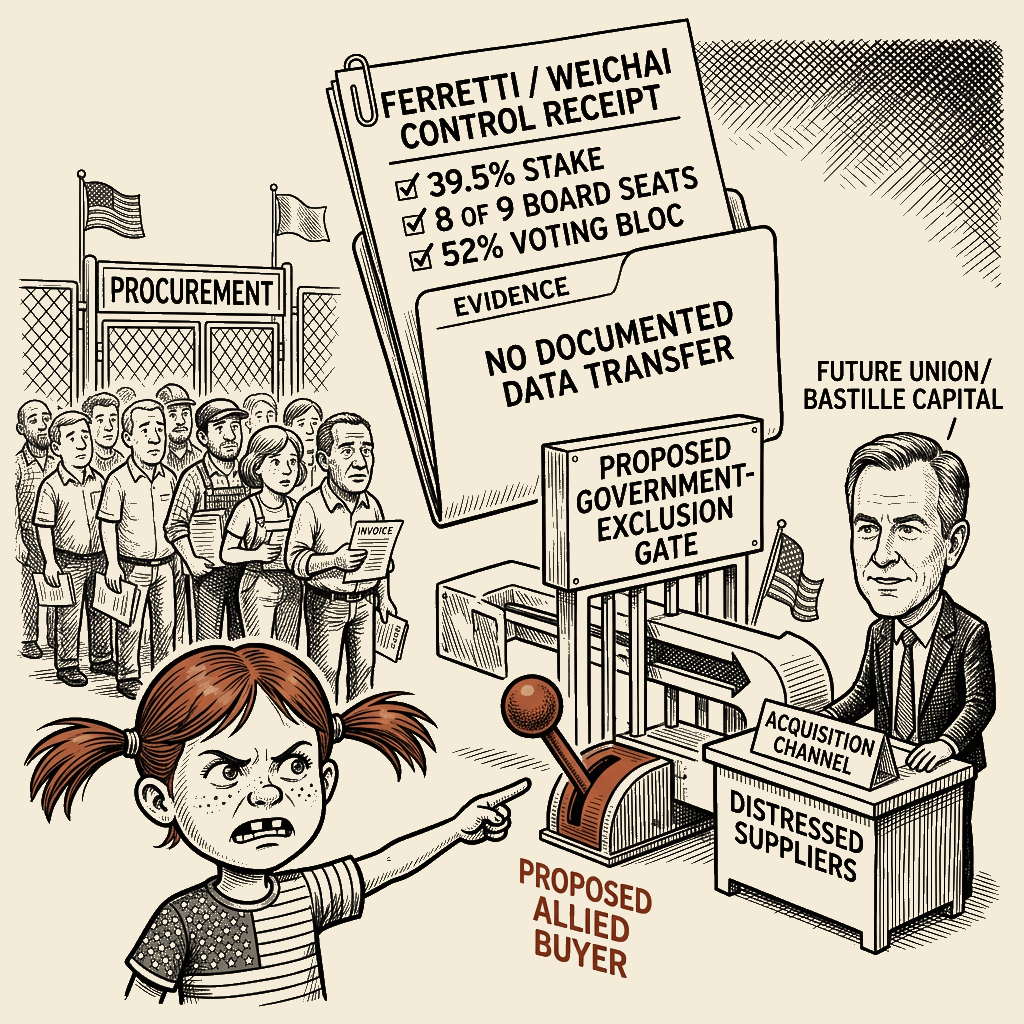
- The takeover was not concealed. King and Murray report a 39.5% Weichai stake, eight of nine board seats, and a 52% voting bloc; they also report that Florida’s attorney general opened an investigation under a state law restricting Chinese or Chinese-government-linked real-estate ownership. The article’s 3% figure is Italy’s ordinary disclosure threshold, not a CFIUS safe harbor: 31 C.F.R. § 800.208 treats board seats and decisive rights as control factors, while § 800.301 covers acquisitions of control.
- Strategic conduct and extraction are not the same receipt. The article documents that Weichai’s new board blocked Ferretti’s bid for the distressed Italian Sea Group shipyard while Ferretti held roughly €95 million in cash; that conduct warrants scrutiny but does not establish a data transfer. China’s National Intelligence Law creates a legal duty to cooperate, but the piece identifies no directive to Ferretti, no transferred naval design, no intelligence order, and no military contract.
- The remedy has concrete beneficiaries. Government exclusions would route contracts toward favored defense suppliers, while the allied-buyer recommendation could create deal flow for firms such as Bastille Capital; King is himself a general partner there and president of Future Union, which is urging Weichai’s designation. No evidence establishes a quid pro quo, but the incentive pathway is visible: security policy can generate advisory demand and exclusive acquisition opportunities for the favored.
The Response Ladder
Polite Reframe
When to use: For a persuadable relative or colleague who is genuinely concerned about Chinese access to dual-use technology but has not examined who gains from the proposed remedy.
Picture Ana, a procurement manager at a Fort Lauderdale marine-systems company, studying an ownership map and trying to determine which investors can direct a company and what operational data its ownership exposes. Her task is precise, and the source gives her legitimate reasons to undertake it: Weichai held 39.5 percent of Ferretti, controlled eight of nine board seats, and received the support of China-linked investors whose slate held 52 percent of the vote. The piece also reports that Weichai’s obligations under China’s 2017 National Intelligence Law create a genuine security concern. (Andrew King and Ms. Murray, “Why China Wants to Control a Yacht Maker,” WSJ Opinion, Nov. 20, 2026.)
The sentence that anchors the response is also the sentence that exposes the problem: “The most effective defense against a Chinese bid for a capital-starved supplier is an allied buyer.” That is a policy preference, not a security finding. Andrew King, one of the piece’s two authors, is president of Future Union and a general partner at Bastille Capital; the article discloses that interest, and the fifth recommendation creates a concrete pathway for favored investment capital to acquire distressed suppliers. Disclosure does not erase conflict. It makes conflict examinable.
A republic cannot sell national-security decisions to protected shareholders. When government disqualifies firms by nationality and gives favored capital a preferred role in buying distressed suppliers, competition becomes a protected oligarchy, not a free market. Get the private money out of the security decision—or stop pretending we have a republic.
The pattern receipts make scrutiny non-negotiable. Weichai’s movement from 25 percent to 46.5 percent at KION, from 70 percent to 90 percent at Linde Hydraulics, and Exception PCB’s movement into an F-35 supply chain demonstrate why control, beneficial ownership, board rights, and sensitive-data access deserve review. They do not establish that categorical commercial exclusion is necessary or that allied ownership eliminates dual-use risk.
The stronger rule is narrower: aggregate holdings held in concert; disclose beneficial owners and board rights; identify sensitive data and documented defense connections; review the actual transaction; impose conditions or divestiture where the evidence proves a strategic threat; and keep procurement open rather than assigning opportunities by nationality. We are the builders of such a system. We protect research, shipyards, workers, and competition at the same time. The person repeating the talking point is not the enemy; the policy serving concentrated power is.
Mockery and Ridicule
When to use: For a public forum, a workplace discussion, or a bystander who needs the contradiction made memorable without turning the rank-and-file voter into the villain.
National security has acquired a luxury problem: the alleged threat arrives with a teak deck, a galley, and enough polished brass to make a destroyer captain ask who is paying for the varnish. Meanwhile, the “under-the-radar” purchase held 39.5% of Ferretti, took eight of nine board seats, assembled 52% of the vote, and drew a Florida attorney general’s investigation (King and Murray, Nov. 20, 2026). A transaction that large does not tiptoe through a security regime. It walks past the guard booth carrying a ladder and asking whether anybody checked the badges.
The corruption-preserver enters in a national-security costume. A corruption-preserver is someone who converts public defense into private shelter, and this remedy does exactly that: it excludes designated firms from procurement, places favored suppliers behind the barrier, and turns the allied-buyer recommendation into a shopping list for protected capital. Section 1260H is a National Defense Authorization Act provision, not a magical wand for excluding Chinese companies from every commercial market; the Chinese-military-company list is codified at 10 U.S.C. § 2538c. Andrew King is president of Future Union and a general partner at Bastille Capital, and his article urges both a Weichai designation and allied purchases. No evidence proves a quid pro quo. The incentive pathway is still right there in the receipt.
The pattern also needs an autopsy, not a séance. The new Weichai-controlled board blocked Ferretti’s bid for the distressed Italian Sea Group while the company held roughly €95 million in cash (King and Murray, Nov. 20, 2026). That is concrete conduct. It supports asking whether the board has aims beyond returns. It does not prove that GPS records, engine diagnostics, navigation data, or naval designs reached Chinese intelligence. Article 7 of China’s intelligence law establishes a duty to cooperate; it does not name Ferretti or document an order. The article turns legal reach into an accomplished fact—a prognosis wearing an autopsy’s credentials.
The engineer, shipyard worker, pensioner, and ordinary investor are not the fools in this machine. The fool is the doctrine that treats a visible takeover as invisible while treating legal nationality as a substitute for evidence. We are the builders: 31 C.F.R. § 800.208 gives us a control test, § 800.301 gives us a review trigger, and Italy’s Legislative Decree 21/2019 and Law No. 202 of 2023 give us a Golden Power authority. We count holdings in concert, publish beneficial owners, audit routes into sensitive data, and punish documented misconduct instead of immunizing favored competitors.
Nuclear Satire
When to use: For an audience ready for a full structural indictment of the policy architecture after the evidence has already been laid out.
The cure for a Chinese yacht, apparently, is an allied yacht with a better lobbyist. That is the masterstroke of the framing: “The most effective defense against a Chinese bid for a capital-starved supplier is an allied buyer” turns a corporate-control dispute into a war whose chosen generals receive procurement preference, protected markets, and a stream of distressed acquisition targets. The fact pattern is serious—eight of nine Ferretti seats and a 52 percent coordinated vote—but the policy machine remains a machine.
Call the machinery by what it does. Weichai’s 39.5 percent stake, its eight board seats, and the participation of the state-owned Bank of China, Swiss-based AdTech, and Yanjan International make control a matter for scrutiny. The source itself says the 2017 National Intelligence Law gives Beijing a legal-compliance hook. It also says CFIUS and Golden Power already exist but have finite resources and concentrate on visible threshold crossings. What it never proves is that national-security classification must become a commercial exclusion machine. The satire lands on that leap, not on the facts.
The badge is now stripped bare. “Free market” becomes “Decadent / Corruption-preserver.” That is monstrous because the state has become an estate manager for favored corporations: investigate the designated rival, restrict its markets, and offer the vacant property to allied capital. Future Union advocates the designation. Bastille Capital sits inside the private-capital market the fifth recommendation says should receive “a role.” Do not call that a proven quid pro quo. Call it what the receipts establish: a disclosed institutional interest with a concrete pathway to benefit from the policy.
The better empire is procedural. Aggregate holdings held in concert; disclose beneficial owners; identify board power; isolate sensitive data and documented defense ties; review the transaction; impose divestiture when the threat is proven; and keep procurement open. We are the builders, not the hereditary guild of protected markets. Build rules that catch hostile control without turning every foreign badge into a warrant. If Hell had procurement officers, they would demand the same ownership maps and still receive fewer excuses than this article supplies. (Andrew King and Ms. Murray, “Why China Wants to Control a Yacht Maker,” Nov. 20, 2026.)
Profane Scorched-Earth
When to use: For the reader who needs catharsis after the careful version has failed to make the stakes visible, or for a closed group where blunt truth will land harder than diplomatic paraphrase.
Here is the bullshit: the deal was not “under the radar.” It was under the fucking headline. Weichai’s 39.5% stake, eight of nine seats, and 52% voting bloc were known, and Florida’s attorney general opened a real-estate-law investigation. That is not stealth—that is a takeover done in broad daylight and renamed “shadow control” because some companion paperwork contained smaller stakes (King and Murray, Nov. 20, 2026).
The article stacks three true things into one bullshit conclusion. The technology is dual-use. Chinese law compels cooperation with state intelligence. Weichai controls Ferretti. Sure. Does that prove data or military technology was transferred? Fuck no—not from those facts. It proves the need for a review. A policy hypothesis wearing an autopsy’s lab coat is still a hypothesis.
And here is the other bullshit: the corruption-preserver is not the Italian engineer. It is the procurement-protection and allied-buyer regime that turns defense into a private shelter market for favored companies. Section 1260H is an NDAA provision, not permission for a global commercial boycott; the Chinese-military-company list is codified at 10 U.S.C. § 2538c. Andrew King is president of Future Union, a general partner at Bastille Capital, and an author urging Weichai’s designation while calling for allied buyers to purchase vulnerable suppliers. We should not pretend that proves corruption—damn it would be lazy to say so without evidence—but it proves the incentive pathway. Security policy creates advisory demand. Procurement exclusion creates protected incumbents. Allied-buyer policy creates acquisition opportunities. Fuck the accusation that this proves corruption; it does not. Fuck the concealment of the incentive; it does.
At the Oxford Union on December 3, 1964, Malcolm X rose to defend the motion: “Extremism in the defense of liberty is no vice; moderation in the pursuit of justice is no virtue.” The motion was the canonical source; X’s argument was the response. This is not extremism. This is discipline. Weichai’s control deserves scrutiny because control can produce access; China’s intelligence law deserves scrutiny because it supplies leverage; sensitive technology deserves protection because people can be harmed. But suspicion is not a receipt, and fear is not a warrant.
So we defend democracy by defending due process. We defend workers by distinguishing foreign ownership from hostile control. We defend the truth by writing “unconfirmed” until a transfer is proven. CFIUS’s § 800.208 gives us control factors; § 800.301 gives us covered transactions; Italy’s Legislative Decree 21/2019 and Law No. 202 of 2023 give us Golden Power review. We are the builders—not panic merchants, not corporate-protection pimps, not useful idiots. We count holdings, publish owners, audit data pipes, impose time-bound safeguards, and use the law without turning nationality into a criminal record. Fuck the guessing games. The evidence can handle the load.

About Malcolm Little King
Malcolm Little King is a heteronym in Main Street Independent's editorial architecture — an analytical voice, not autobiography of any actual person. The position this column expresses is the publication's position on the territory Malcolm Little King's lane covers, rendered through Malcolm Little King's register.