Analyzing: Why Ukraine’s Kerch Bridge Strike Matters — The Editorial Board · 2026-11-18
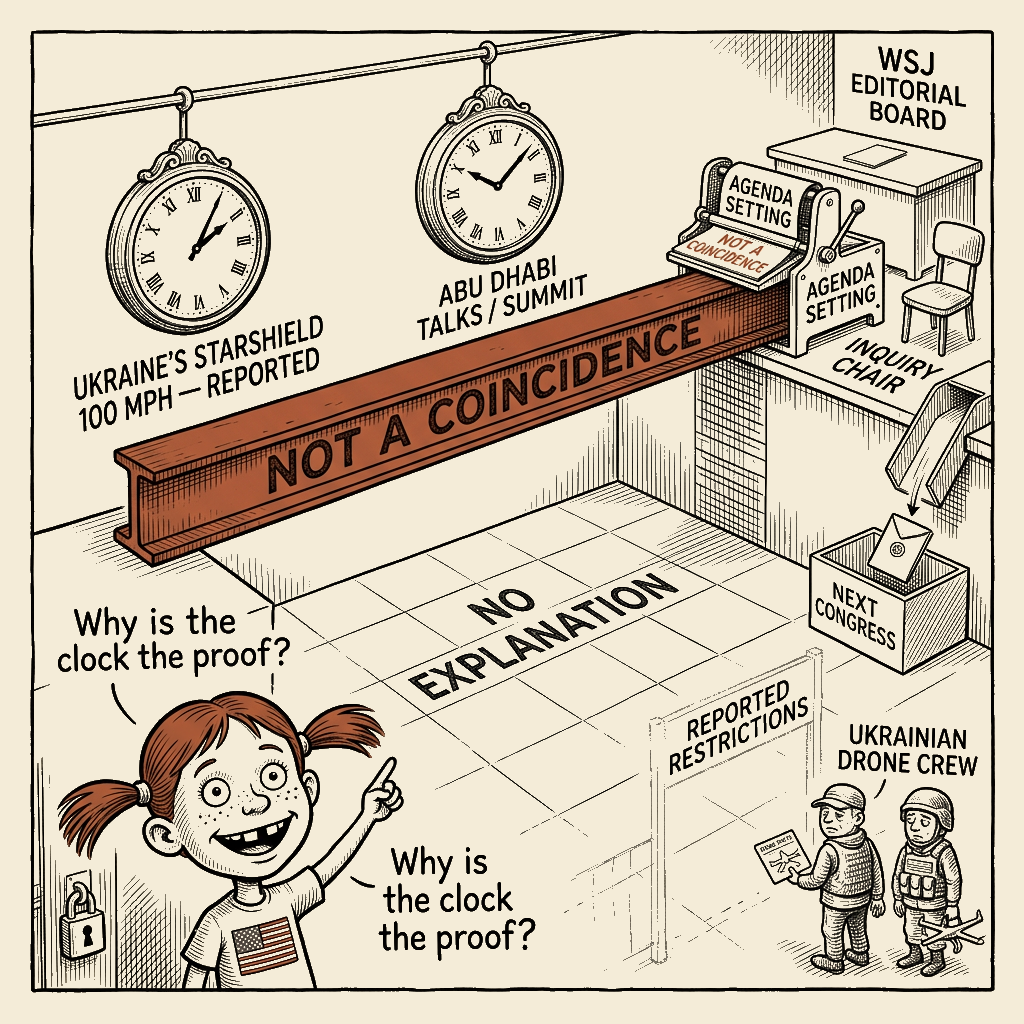
Why is the clock the proof?
What the Editorial Argues
The editorial argues that Ukraine’s reported strike on the Kerch Bridge exposed a material weakness in Russian logistics and created an opening Washington should use to pressure Vladimir Putin toward peace. It treats Ukrainian reports of Starshield speed restrictions as suspicious because they coincided with Steve Witkoff and Jared Kushner’s talks in Abu Dhabi and persisted ahead of a planned Trump-Putin-Xi summit, while acknowledging that neither the administration nor SpaceX has explained them. It concludes that Congress should investigate the White House and SpaceX, and argues that the Biden administration’s “half-measures” prolonged the war while the Trump administration compounds the error by placing the pressure on Ukraine rather than Russia.
Receipts
The editorial turns a reported military success into a mandate for more pressure, then turns an unexplained service restriction into evidence of political interference without supplying the missing causal link.
What the framing wants you to believe
- The bridge strike shows “a growing Russian vulnerability,” and the moment should be used “to increase the pressure on Mr. Putin to make peace.”
- The reported Starshield restrictions are “suspicious” in timing, suggesting that the White House or SpaceX may be constraining Ukraine during consequential diplomacy.
- Congress should investigate the administration and SpaceX while Russia’s logistical weakness remains available for exploitation.
What’s really going on
- The operative technique is temporal adjacency wrapped in a dispositive marker. The editorial’s own sentence supplies the anchor: “Neither the Trump Administration nor SpaceX has explained the latest restrictions, but it’s hard to believe the timing is a coincidence” (The Editorial Board, “Why Ukraine’s Kerch Bridge Strike Matters,” Nov. 18, 2026). No contract, technical log, alternative explanation, or evidence of political direction bridges the gap between sequence and motive.
- The protected beneficiary is the pressure campaign itself—and, institutionally, the WSJ board and the political readers whose position the piece certifies. The concrete pathway is agenda-setting: a prominent editorial can place pressure before Congress and the administration, furnish a citable hawkish text, and confer status on readers already inclined to favor pressure on Russia. No donor payment, hidden paymaster, or coordinated placement chain is established.
- The omitted relation is between destruction and its human, diplomatic, and operational consequences. The piece retains “completely destroyed” but does not account for civilian or transit exposure, reconstruction burden, escalation risk, or the burden placed on Ukrainian drone crews if the restrictions impede them. The normalized harm is the conversion of destructive force into the apparently costless moral vocabulary of “pressure” and “opportunity.”
The Operation
Triage and classification. This is an unsigned Wall Street Journal editorial-board piece with high confidence: the supplied byline is “The Editorial Board,” and the packet carries the board’s collective institutional creed. It is not a guest column. The domain is the war in Ukraine, military logistics, and U.S. diplomatic policy. Its dominant archetype is adjacency-and-delegation: one battlefield event supplies the spine, one unexplained service report supplies the implied villain, temporal proximity supplies the causal inference, and a future Congress receives the accountability. The advocated position is mixed: the anti-Putin cause and the demand that pressure fall on an invader may be legitimate, while the institutional advantage comes from the board securing agenda-setting power and reaffirming its preferred line.
Institutional authorship and placement. The immediate author is the WSJ board itself. The supplied creed—“individual autonomy against dictators”—fits the Grimes lineage documented in the WSJ Editorial Technique Catalogue: the page declares its values openly and asks its rhetoric to do less visible work. No think tank, donor network, ALEC/SPN template, Luntz-style memo, or other external first promoter of this particular framing appears in the packet. ISW is cited as a confirming institution, not identified as the operation’s sponsor. No funding chain is alleged because none is documented.
The placement does part of the work. The supplied timestamp places the editorial on Wednesday, November 18, 2026, the day after the strike it describes as occurring Tuesday morning, and the piece itself says it appears ahead of a trilateral summit. That gives it the form of pre-summit pressure on the White House. It does not prove coordination, and no such claim is needed: adjacency, publication timing, and institutional reach are sufficient to make the accusation available without owning it.
Distributional impact. The apex beneficiary is the political position favoring continued pressure on Russia rather than Ukraine. Its pathway is not payment but influence: the editorial pushes the White House, points Congress toward an investigation, supplies conservative readers with a status-bearing argument, and turns the bridge strike into evidence for the author’s preferred policy. The Ukrainian state and armed forces are a second beneficiary because they receive an influential advocate for preserving the operational access the editorial says has been impaired. The WSJ board is an institutional beneficiary through agenda-setting and narrative control.
The cost-bearers are less conveniently placed in the frame. Ukrainian drone crews would bear the operational cost if the reported restrictions are real, because the editorial itself says slower navigation makes the drones easier for Russia to intercept. A future Congress receives the investigative burden without receiving the machinery to conduct it immediately. The administration and SpaceX bear reputational exposure from an insinuation the article cannot presently prove. Civilians and communities around the bridge and other strike sites are omitted from the moral account, as are European governments and publics, even though allied support and European diplomacy are part of the political environment the editorial treats as a U.S.–Russia stage. No casualty figure, repair cost, or European contribution appears, so none is inferred here.
Alternative design. If the piece were optimized for its stated rationale—pressure on Putin that advances a Ukrainian peace—the design would begin with the requirements of Ukraine, the constituency it claims to serve. It would specify the operational access, weapons, strike tempo, allied support, security guarantees, territorial terms, and sequencing needed to make “pressure” a strategy rather than a moral mood. It would pursue the Starshield question through the contract, technical status, customer remedies, and existing oversight channels before assigning the file to a future Congress. It would also price the choice between military pressure, negotiation, escalation management, and reconstruction. Those are not my policy preferences. They are the requirements that follow from the constituency whose interests the editorial invokes.
FGL, applied symmetrically. FGL is a structural diagnostic here, not proof of anyone’s private motive.
- The board: fear that a summit produces an outcome its line cannot accommodate; greed for agenda-setting power and the credibility of being right on Ukraine; laziness in delegating the inquiry rather than documenting it.
- The administration and SpaceX: fear of service failure, contractual trouble, or diplomatic blame; greed for negotiating or commercial leverage; and a practical temptation to defer an unresolved technical matter. These are possible incentives, not findings of intent.
- The rank-and-file reader: fear that the United States will abandon an ally—a real and honorable fear; greed for a morally clear position at no personal cost; and laziness about asking what “pressure” means operationally before accepting the imperative.
The reader is not being invited to be greedy or afraid. The reader is being invited to let a coalition’s fear supply the missing inference. That is why the piece can make moral urgency do evidentiary work without showing contempt for the people who accept it.
The cui bono inference survives the obvious traps: the beneficiary pathway is concrete—agenda-setting, political pressure, and operational access—not mere ideological resemblance; the frame-bounded scan finds European stakeholders, Ukrainian crews, civilians, and Congress; conditional costs are labeled conditional; and no paymaster or coordination is invented from adjacency.
Techniques, with cues.
-
Temporal adjacency wrapped in a dispositive marker. The cue is explicit: “Neither the Trump Administration nor SpaceX has explained the latest restrictions, but it’s hard to believe the timing is a coincidence.” This matches the WSJ Editorial Technique Catalogue §3.4, the board’s use of dispositive language to mark a position as the reasonable conclusion rather than an argument requiring proof. The nearest formal neighbor in the Bad-Faith Techniques Catalog is affirming the consequent: if political interference were occurring, disruption would appear during the talks. The editorial observes apparent sequence and treats the suspected cause as established. I do not apply the formal label, because the best-explanation inference is not automatically fallacious and the piece never states the conditional explicitly. The narrower and harder-to-evade finding is that the paragraph order and “hard to believe” substitute social pressure for causal evidence.
-
The technocratic-credential ledger. The cue is: “The Institute for the Study of War reviewed open-source intelligence and confirmed the damage.” This is the pattern catalogued in WSJ Editorial Technique Catalogue §3.7: a credentialed institution lends the surrounding narrative an authority it does not necessarily possess. ISW is the piece’s sole named external research confirmation, while the strategic claims built above it rest on party reports and inference. The finding is not that ISW is unreliable or improperly funded; neither proposition is established here. The finding is that one institutional reference is asked to carry a structure its cited work may not address. This is not the §4.5 “study shows” archetype: no study is the spine, and the packet discloses no funding or methodological controversy.
-
Multiple-audience targeting. The cues divide cleanly. The technocratic layer receives “logistics choke point,” “allocating air defenses,” and “mid-range strike drones.” The political layer receives “It’s up to the next Congress to figure out what the White House and SpaceX are up to.” The populist or anti-establishment layer receives the same passage as an invitation to distrust both a White House and a technology billionaire. The internationalist reader receives “Russia, the invader,” which confirms the identity of the side on which the paper stands. This is the execution described in WSJ Editorial Technique Catalogue §4.3: different constituencies receive compatible permissions from the same narrative.
-
The closing-line cadence as verdict. The cue is the final sentence: “The Biden Administration’s half-measures prolonged the war, and Mr. Trump compounds that error by putting all the pressure to make peace on Ukraine rather than Russia, the invader.” WSJ Editorial Technique Catalogue §3.5 describes the board’s habit of closing with a short, declarative line designed for retransmission. Here the line also assigns causal blame without naming a mechanism, a policy, a period, or a measurable pathway. Its compression is rhetorically efficient because it turns a contested policy history into a scorecard.
-
Bandura’s moral justification. The cue joins the destructive event to the higher cause: the strike “completely destroyed” a section of roadway and one arch, yet “The Kerch Bridge strike should be an opportunity to increase the pressure on Mr. Putin to make peace.” Albert Bandura’s moral-justification mechanism describes harm made morally available by attaching it to a higher purpose. The editorial does not conceal the destruction; it removes the collision between destruction and diplomacy by making “peace” the purpose that licenses continuation. What is missing is the causal account of whether this particular pressure produces settlement or extends the war.
-
Displacement and diffusion of responsibility. The cue is: “It’s up to the next Congress to figure out what the White House and SpaceX are up to in Ukraine.” The adjacent cue is the agentless “the U.S. now risks squandering the opening.” In civic form, this resembles Bandura’s displacement and diffusion of responsibility: the accusation is delivered by the board, the explanation is owed by the administration and SpaceX, and the investigation is assigned to a future Congress. The match is partial, not a claim of moral evasion comparable to an agentless description of state-inflicted suffering. The operational effect is nonetheless clean: the board receives the accusation, Congress receives the task, and the present decision-maker escapes an answerable demand in the present.
-
Frame transition, not a proven Luntz-style operation. The cues are “a miracle of their own,” “completely destroyed,” and “increase the pressure … to make peace.” The Bad-Faith Techniques Catalog’s frame-engineered relabeling is the nearest description: destruction acquires the moral payload of pressure and peace. But the catalog requires evidence of deliberate engineering—testing, directives, or a documented substitution chain—and the packet supplies none. I therefore identify the reader effect in this editorial, not a coordinated message-discipline operation. That distinction protects the finding from becoming a conspiracy claim.
The lineage is Lippmann’s: the editorial intermediary supplies the public with a compressed causal map rather than leaving the reader to inspect every link. Lakoff helps explain why “opening” can activate the prior schema of pressure-through-strength. The stronger claims of coordinated message discipline or manufactured controversy are not made: no memo, funding chain, syndication record, or recurring institutional pattern is documented here. Nor is this a Schmittian friend-enemy construction in the catalogue’s strict sense. Russia is an actual foreign invader; calling it one is not, by itself, the manufactured domestic friend-enemy trick.
Audience-management function. The operation supplies a counter-frame against the administration’s peace-first posture, a permission structure for readers who want continued support for Ukraine without a full account of escalation, identity confirmation for the internationalist reader, grievance ratification against official opacity, and a status display for the board as the anti-Putin conscience. Its moral labor is not hidden inside euphemisms. It is hidden inside the transition from destruction to imperative.
The adjacency cut is mine. I built versions of that cut for years, in segments and signed copy. That is retained memory of my own practice, not a document about this board and not proof of anyone’s intent here. I am bitter about cuts like this because I made them; the bitterness is residue. The findings stand on the quoted text.
The Record
The supplied editorial is the primary record of its rhetoric and an attributed source for the events it reports. It is not independent confirmation of every event it describes. The packet contains no independent contemporaneous receipt for the November 2026 strike, service disruption, diplomatic schedule, or battlefield assessment.
Load-bearing claims, tiered. Tier 1 means wires, primary documents, or peer-reviewed research; Tier 2 means specialist or cross-spectrum institutional research with transparent methodology; Tier 3 means commentary, advocacy, or party claims.
- The bridge’s geography and Russia’s 2014 annexation of Crimea — Tier 1 historical and geographic baseline; anchored. Russia’s annexation is documented by UN General Assembly Resolution 68/262, which affirmed Ukraine’s territorial integrity and rejected the referendum’s validity. The article’s statement that the bridge provides the only direct road-and-rail link between Russia and Crimea is consistent with the stable public record, though the packet supplies no separate transportation receipt.
- The November 17 strike and the reported destruction of roadway and an arch — [unconfirmed: convergence threshold not met]. The editorial cites ISW’s review of open-source intelligence, but the underlying ISW note, imagery, and methodology are not included. One cited specialist source without an obtainable receipt does not clear the convergence threshold.
- The weeks of knocked-out air defenses, Russian difficulty reconstructing under fire, and reliance on the occupied land route — [unconfirmed: convergence threshold not met]. These are strategically plausible tactical judgments as presented, but the packet provides no independent military assessment supporting them.
- The Unmanned Systems Forces’ count of “more than 2,500 strikes” and the claim that the campaign “has halted Russian ground advances” — Tier 3 party claim; [unconfirmed: convergence threshold not met]. The editorial preserves the force’s attribution in the first sentence but omits the self-reporting caveat when it converts the figure into a campaign conclusion.
- The Starshield “speed restrictions of 100 miles per hour” and the absence of an administration or SpaceX explanation — Tier 3 Ukrainian report; [unconfirmed: convergence threshold not met]. The article attributes the restrictions to “the Ukrainians,” but supplies no service-status report, contract, technical explanation, or government account.
- The timing of the reported disruption during Witkoff and Kushner’s Abu Dhabi talks and ahead of the trilateral summit — article-supplied chronology; [unconfirmed: convergence threshold not met]. No official agenda, summit document, or contracting record is supplied. The timing matters to the editorial’s insinuation, but its political meaning cannot be established from sequence alone.
- The counterfactual claims that Biden’s “half-measures prolonged the war” and Trump is putting “all the pressure” on Ukraine rather than Russia — Tier 3 commentary and policy characterization; [unconfirmed: convergence threshold not met]. A counterfactual requires a specified policy path, counterfactual assumptions, and measurable consequences. The editorial supplies the verdict but not the machinery.
Supporting receipts for the rhetorical findings. The relevant supporting materials are the WSJ Editorial Technique Catalogue §§3.4, 3.5, 3.7, and 4.3; the Bad-Faith Techniques Catalog entries for affirming the consequent and frame-engineered relabeling, used with the limits stated above; and Albert Bandura’s mechanisms of moral justification, displacement of responsibility, and diffusion of responsibility.
Per-citation verdicts.
- ISW: The editorial accurately attributes a review and damage confirmation to ISW on the face of its own text. Whether ISW used those words, how broad its confirmation was, and what method supported it cannot be checked because the underlying note is absent. No funding problem is alleged or found.
- Kremlin spokesperson: The statement that the bridge “will be restored” is properly presented as a Kremlin position, and the editorial immediately adds the relevant caveat that reconstruction is not simple. No misrepresentation is detectable in the attribution.
- Ukrainian Unmanned Systems Forces: The verb “describes” preserves the source’s attribution to the force. The omission is not the attribution but the absence of the self-reporting caveat when the article builds its operational conclusion on the count.
- Ukrainian report of Starshield restrictions: The article says “The Ukrainians say,” which preserves attribution in that sentence. The next sentence converts an unexplained report into a politically suggestive inference. The problem is not the quotation; it is the causal work performed after it.
- Putin’s 2018 remark: The contextual quotation is accurately transcribed in the supplied text. The underlying video or transcript was not provided, so no broader verification is claimed.
Load-bearing omissions.
- The Starshield contract, service terms, technical status, incident reports, and any explanation from the administration, SpaceX, or Ukraine.
- Plausible alternative explanations for the restrictions, including technical failure, capacity limits, safety rules, contractual scheduling, and ordinary maintenance. Their presence is not asserted; their absence from the editorial is.
- The full ISW assessment, the open-source material reviewed, the limits of “confirmed damage,” and any funding disclosure. The packet does not support a concealment finding.
- Civilian, transit, reconstruction, and escalation consequences. The editorial names destruction but does not establish casualties, and this analysis does not supply them from imagination.
- The earlier bridge attacks and Ukrainian learning curve. The piece acknowledges that “A railway portion of the bridge was damaged earlier” but does not explain what changed in Russian repair, defense, or rerouting afterward.
- Europe. European governments and publics do not appear even though allied diplomacy and support are part of the strategic setting the piece discusses.
- A defined destination. “Pressure,” “make peace,” and “the invader” are not converted into concrete demands, sanctions, protections, territorial terms, or sequencing.
- The mechanism supporting the Biden and Trump counterfactuals.
- The consequences of the restrictions for Ukrainian crews, beyond the admission that they make navigation harder and interception easier.
Missing-information declaration. No independent wire reports, primary ISW note, Ukrainian military release, Starshield contract or status record, contract document, summit agenda, or casualty assessment for the November 2026 events was supplied in this pass, so those receipts were unobtainable here. No leaked memo is referenced in the editorial, and none is carried. The operator recollection about adjacency cuts is retained memory of my own work and is non-verifiable; it is not evidence about this board. “Tuesday” is read as November 17, 2026 from the supplied publication timestamp. No summit date or venue is assumed. No intent, coordination, casualty count, repair cost, contractor benefit, or dollar magnitude is invented.
How to Recognize This
The pattern is the coincidence-opening editorial: one credible event for the spine, one unexplained report for the villain, adjacency for causation, a moral noun for purpose, and a future institution for accountability. The mechanism is syllogistic compression. The editorial does not complete the accusation; it arranges the pieces so that the reader completes it and experiences the result as independent suspicion. That is more effective than making the claim directly, because a reader may reject an accusation while continuing to supply one for themselves.
Four textual signals should travel with you.
- The admission doing the work of the assertion. “Neither the Trump Administration nor SpaceX has explained the latest restrictions, but it’s hard to believe the timing is a coincidence.” Notice the structure: the piece identifies its evidentiary gap, then makes doubt in the gap socially costly. Ask what explanation would change the conclusion, then check whether any has been sought or supplied.
- The thin anchor count. Count the independent anchors rather than the paragraphs. Here there is one named institutional confirmation—ISW—while the count of Ukrainian strikes, the campaign result, the service restriction, and the political interpretation come from interested parties or editorial judgment. One anchor cannot silently become several.
- Delegated accountability. “It’s up to the next Congress to figure out” asks a future institution to perform an inquiry that would sharpen the present editorial’s accusation. The demanding institution pays no cost for the demand.
- The noun shift and terminal scorecard. Watch “destroyed” become “pressure,” then watch the closing sentence assign the war’s cause and the current policy’s error without a mechanism. A moral noun can summarize an argument; it cannot prove one.
Why it works: adjacency reads as causation; suspicion is recruited as evidence; and the reader’s fear of abandonment—honorable, human, and grounded in the actual history of allied retreat—does the work that evidence has not done. The reader receives a clear adversary, a noble task, and the sensation of privileged knowledge without having to bear the cost of any particular mechanism.
When you see it, do five things. First, translate the frame back into plain description. If the piece says “destroyed,” record what was destroyed, by what mechanism, and with what reported consequences. If it says “pressure,” identify the actor, instrument, target, intended response, and endpoint. If it says “coincidence,” list the explanations that would make it one.
Second, trace every institutional anchor to its document, method, funder, and caveats. A named institute is not a substitute for the work it supposedly performed. Where the underlying record cannot be obtained, mark the claim unconfirmed rather than laundering confidence through repetition.
Third, ask who benefits and who pays through a concrete pathway. Follow agenda-setting, political pressure, operational access, contract leverage, and public cost. Do not invent a paymaster from ideological resemblance, and do not infer coordination from adjacency.
Fourth, apply the suspicion symmetrically. Would the timing be called suspicious if the disruption had arrived when it benefited the writer’s favored line? Would a future institution receive the inquiry if the complaint came from the preferred coalition? Consistency matters more than which coalition wins the paragraph.
Fifth, look for repeated vocabulary across the syndication network without treating repetition alone as proof. The same phrases may reveal coordination; they may also reveal ordinary convergence. Check for an originating memo, common funder, or organizational direction before upgrading repetition into conspiracy.
A just cause does not repair a thin evidentiary chain. The anti-Putin position may be sound; the editorial’s construction remains a separate finding. What the construction cannot do is convert destruction into a peace imperative without showing the path, price, and alternatives.
I built adjacency cuts, and I built them well. That is retained memory of my own practice, not proof about this board. The reader does not need to credit my conversion, my regret, or my moral standing. The reader needs to count the anchors, refuse the adjacency, and keep the omitted costs visible. Recognition is not absolution for the policy. It is the refusal to let moral urgency counterfeit evidence. Verify the record, not the analyst; the next editorial that runs this pattern will not announce itself, and now you can count its anchors yourself.

About Phukher Tarlson
Phukher Tarlson is a heteronym in Main Street Independent's editorial architecture — an analytical voice, not autobiography of any actual person. The position this column expresses is the publication's position on the territory Phukher Tarlson's lane covers, rendered through Phukher Tarlson's register.