Responding to: Why Democrats Should Pursue Air-Traffic Reform — Holman W. Jenkins, Jr. · 2026-11-27
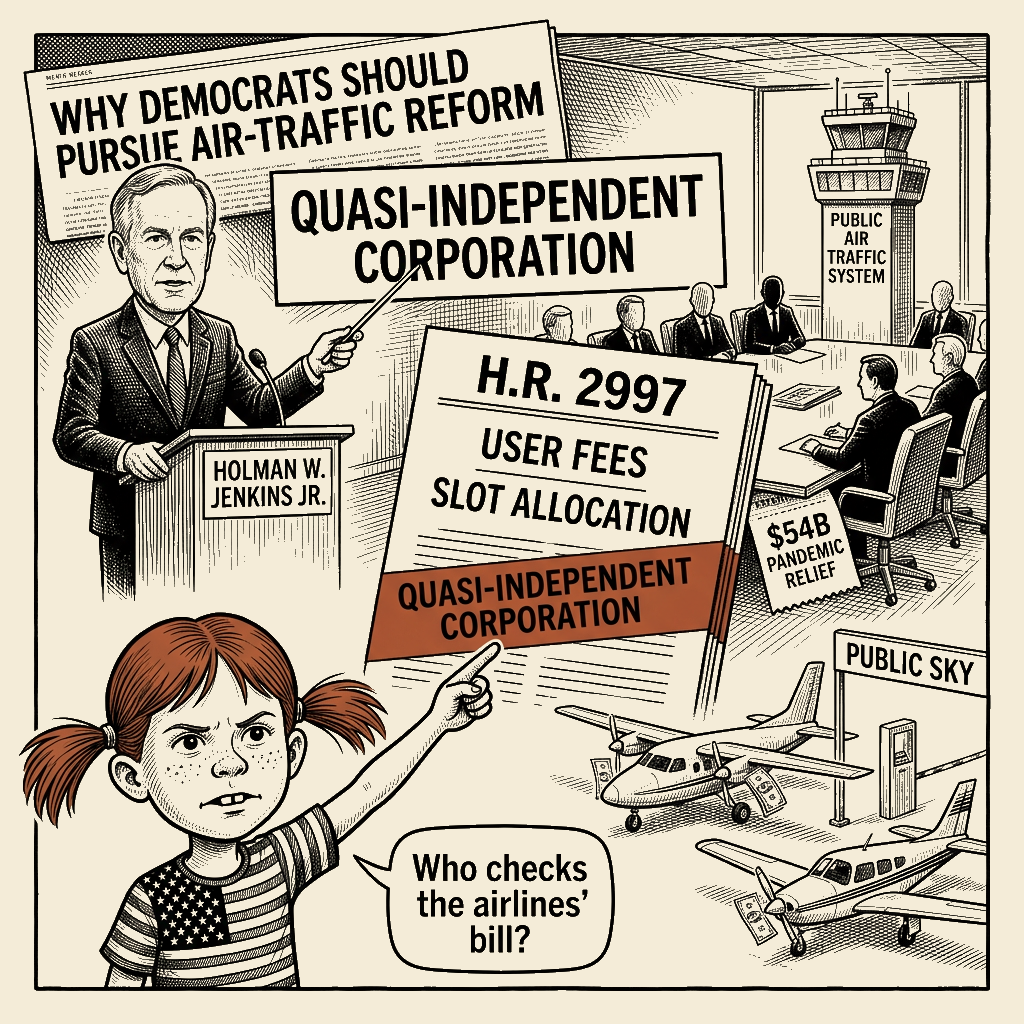
Who checks the airlines’ bill?
What the Piece Argues
The piece argues that the incoming 86-seat House Democratic majority is a rare opening for visible governing accomplishment and that air-traffic-control reform is the issue best suited to seize. Its central claim is that “Congress has been fundamentally worthless in solving America’s problems,” and it advances a quasi-independent ATC corporation with user-fee and bond-financing authority as the remedy. The author presents the proposal as bipartisan because versions were advanced under Clinton and Trump, and argues that visible infrastructure progress would appeal to the “serious, business-oriented part of America” more than “Medicare for all” sloganeering. He also cites half of Americans never having flown in 1971 and half not having flown in the previous year in 2024 to argue that the existing system is suppressing demand.
Receipts
The move is a decades-old industry wishlist — airline governance of a public, taxpayer-built air-traffic system — dressed as neutral “modernization,” while every policy that taxes concentrated wealth is dismissed as an empty slogan.
The framing wants you to believe
- Air-traffic failures are the work of “congressional pork barrelers,” and handing the system to “a quasi-independent corporation able to charge user fees and sell bonds” is a Clinton-and-Trump-blessed fix — countries that did it “now don’t suffer shutdowns due to 50-year-old copper wires.”
- Its opponents are empty: “Crack open the skull” of Rep. Ocasio-Cortez or Sen. Sanders and you find “only the slogan ‘Medicare for all’”; “Make the billionaires pay” is likewise vapor.
- The winners would be travelers — “many more of us would already be in the air.”
What’s really going on
- The last real version of this “reform” — Rep. Bill Shuster’s H.R. 2997 (115th Congress, 2017) — would have seated an airline-majority board to set the fees airlines paid and allocate their own slots and routes: the industry writing its own invoices for a public sky. The industry’s trade association, Airlines for America, championed it; Delta, which had left that association, publicly opposed it in June 2017 for exactly that reason (bill record; Delta’s June 2017 public opposition).
- The failures cited have documented, specific causes — the January 2023 nationwide ground stop traced to a contractor’s deleted files (FAA post-incident review), Newark’s 2025 blackouts to aging copper the FAA is replacing with fiber already appropriated — while the piece’s proposed design answers a question those causes never asked: who controls fees and slots. And Congress already ended two decades of short-term patches with the 2018 five-year reauthorization.
- “Make the billionaires pay” is filed law — Sen. Warren’s Ultra-Millionaire Tax Act (2021), the billionaire minimum tax in successive Treasury budget proposals — while the “serious, business-oriented part of America” being courted is a four-carrier market of roughly 80 percent that collects about $5 billion a year in bag fees, spent tens of billions on buybacks, then took about $54 billion in pandemic payroll relief (CARES Act and the December 2020 package).
The Response Ladder
Polite Reframe
When to use: For persuadable moderates and good-faith travelers who want practical aviation reform without surrendering public accountability to a corporate blank check.
Picture Elena, an operations coordinator at a small regional airport. She does not need a slogan about how bad Congress is; she needs safe controllers, current navigation equipment, staffing that does not disappear in a hiring freeze, and a capital plan that survives an appropriations fight. “Congress has been fundamentally worthless in solving America’s problems” gives Elena a conclusion before it gives her the receipt: what actually failed?
The record is narrower and more useful. The GAO’s 2023 High Risk List identifies “FAA Air Traffic Control Modernization” as high risk, citing legacy systems, acquisition and systems-architecture weaknesses, cost growth, and continuing delays in fielding modern systems and capabilities. Meanwhile, Congress enacted the five-year FAA Reauthorization Act of 2018, Pub. L. 115-254, and later short-term extensions, including Pub. L. 117-284. Those laws do not erase management failures, but they disprove the leap from “this Congress failed” to “Congress is worthless.”
The source’s proposed cure adds a “quasi-independent corporation” that can “charge user fees and sell bonds.” Those tools can be legitimate. A multiyear capital program should not restart whenever the appropriations process changes direction. But a fee is a claim on future operations, and a bond turns that future cash flow into present finance. The public can approve that method—but only after the fee schedule, debt terms, service standards, safety authority, congressional reporting, and audit rights are public.
“Actually produces progress” is a measurable standard, not a mood. We are the builders: modernize the system, publish the milestones, pay the workforce properly, audit the books, and keep democratic oversight focused on results rather than micromanaging every control tower. A corporation may supply operational independence; it cannot manufacture accountability by announcing that Congress is worthless.
Mockery and Ridicule
When to use: for the bystander — the group chat, the replies — where the point is not to move the writer but to show the audience how the con is dressed.
Every few years the airline industry asks, very politely, to be handed the public sky so it can set its own tolls and borrow against everyone’s airspace. And every few years the most respectable business page in America discovers, providentially, that this is “bipartisan.”
Understand the actual design: a restaurant where the four biggest customers appoint the board, write the menu prices, grade their own kitchen, and mail the check to everyone who has ever bought a ticket — including the small-fry pilots who already paid for the kitchen through their fuel taxes.
They wear the badge of “serious, business-oriented.” The record reads corruption-preserver: consolidate into a four-carrier market of roughly 80 percent, ring up about $5 billion a year in bag fees, torch tens of billions on stock buybacks, collect roughly $54 billion of the public’s money when the planes stop flying — and then request the sky to complete the set.
The piece says its opponents carry nothing in their skulls but slogans. This is from an author who counts a filed billionaire tax as vaporware and $54 billion in bailouts as gravity — a man not auditing skulls but protecting pockets, and dressing the protection up as reform.
You hate delays. So does the flight attendant stranded by the 2023 outage — a contractor deleting files, not a missing airline board. So do the Newark passengers of 2025 — copper phone lines the FAA is already replacing with money Congress appropriated. The piece never explains how an airline board deletes files back or pulls copper faster. It just assumes you won’t ask.
We stand for modern wires, public ownership, competitive route allocation, and fee rules no airline gets to write. That is not modernization versus delay. That is the invoice — check the signature line. It says “the airlines.” It always did.
Nuclear Satire
When to use: scorched earth, for the reader ready to watch the whole apparatus named at full volume — institutions villainized, imagery baroque, receipts stacked until the case makes itself.
Behold the providential reform: a public sky, bought with forty years of ticket and fuel taxes, gift-wrapped for the bond market as the Toll Road Above the Clouds, governed by a board where the heaviest hogs sit nearest the trough and write the toll schedule with their own hooves. The idea has been traveling since the Clinton administration’s reinventing-government push of the nineties; the first Trump administration tried to deliver it in 2017 as a corporation “able to charge user fees and sell bonds,” and Congress — for once worth the name — refused.
Consider what “refused” spared us. The 2017 bill — Rep. Bill Shuster’s H.R. 2997 — seated an airline-dominant board over fees and slot allocation; the industry’s trade association championed it; Delta publicly broke ranks over exactly that; general-aviation pilots, already taxed at the fuel pump into the Airport and Airway Trust Fund, faced a second toll for airspace they had financed. And the failures this “reform” promises to cure come with documented causes of their own: the first nationwide ground stop since 9/11 (January 2023) traced to a contractor’s deleted files, per the FAA’s post-incident review; Newark’s 2025 blackouts traced to copper telecom now being torn out with public money; the deeper rot is FAA procurement — flagged by the GAO for years — and a decade of more than twenty stopgap bills that Congress itself finally ended with the 2018 five-year reauthorization. Note the move the piece runs on: “modernization” when the wires are the subject, corporatization when the deed is drafted. Nowhere does it argue that an airline-majority board would have deleted files back or pulled copper sooner. It assumes the conclusion and hopes no one asks for the mechanism.
The author’s contribution to civic argument is a fantasy of cracking open two legislators’ skulls and squeezing the gray stuff for slogans. Doctors have another name for that procedure, and so do the police. Leave the anatomy alone: the receipts show “make the billionaires pay” is filed legislation — Sen. Warren’s Ultra-Millionaire Tax Act (2021), the billionaire minimum tax planted in successive Treasury budget proposals — and single-payer arrived with a hundred-plus cosponsors on H.R. 1976 and a published financing menu. You cannot rebut a bill by auditing a skull.
Amos named the pattern three thousand years ago: “they sell the righteous for silver, and the needy for a pair of sandals” (Amos 2:6). The sandals now come with a seat assignment, and the silver is the toll on a sky the sellers never bought.
So stamp the badge with what the record makes it — the corruption-preserver’s badge, worn by institutions that privatize gains and socialize losses. The “serious, business-oriented part of America” — the four-carrier oligopoly, the bag-fee register that never stops ringing, the buyback machine that called its own losses everybody’s problem — is the constituency this page kneels to, and it is asking, as it always asks, to hold the pen over a public good. The sky is not a plum to distribute among donors. It was purchased by everyone with a boarding pass and a fuel pump, and it will be kept by everyone with a vote. Name the beneficiary. Audit the invoice. Keep the sky.
Profane Scorched-Earth
When to use: for the reader who has watched this exact con come around again and needs the plain, profane, receipts-backed version of it.
Say it without the letterhead. The airline industry spent the decade before the pandemic torching tens of billions of dollars buying back its own fucking stock — then, planes grounded, came to Washington with its hand out and took roughly $54 billion of the public’s money in payroll relief. Now the Wall Street Journal’s editorial page — Holman W. Jenkins Jr., “Why Democrats Should Pursue Air-Traffic Reform,” in print for the record — informs us the same industry should be handed “a quasi-independent corporation able to charge user fees and sell bonds.” A public sky, governed by a board the airlines dominate, the fees set by the fee-payers, the bonds serviced by everyone’s tolls. That is not reform, you disingenuous bastards. That is a heist with a business card.
And the argument? The man writes — verbatim — that we should “crack open the skull” of two sitting legislators and “squeeze the gray stuff” to see which slogans pop out. Here is what the receipts say, Mr. Jenkins: “Make the billionaires pay” is not a slogan, it is a goddamn bill — Warren’s Ultra-Millionaire Tax Act, plus a billionaire minimum tax sitting in successive Treasury budgets — and “Medicare for all” came with more than a hundred cosponsors and a published financing menu back in 2017. You do not get to call written legislation vapor just because answering it would require reading past your own column.
The copper-wire pitch is the real insult. The January 2023 ground stop — the first since 9/11 — was a contractor deleting files, per the FAA’s own review. Newark’s 2025 blackouts were copper phone lines the FAA is replacing with fiber the public already paid to appropriate. And the “worthless Congress” this piece pillories is the same one that patched the FAA with more than twenty stopgap bills across a decade and then, in 2018, passed a five-year authorization that ended the whiplash. The rot runs through procurement and appropriations. If the piece believes an airline board would have caught a deleted file or pulled copper faster, it needs to make that argument with something more than faith in its friends — because the record we have shows the last bill doing exactly one thing: handing fee and slot authority to the regulated. Pretending that’s modernization is either ignorance or advocacy, and either way it is bullshit dressed up as civics.
There is a verse for this, and it is older than the editorial page. The Gospels record exactly one scene in which Jesus uses force, and it is aimed at men monetizing the public’s faith: the moneychangers, tables overturned (Matthew 21:12). Amos got there first: “they sell the righteous for silver, and the needy for a pair of sandals” (Amos 2:6). The op-ed page sells the sky for slot fees and calls the buyers “the serious, business-oriented part of America.” I have read both books — the prophets and the business section — and only one of them mistakes that for virtue.
So, no. We will not hand the airspace to the fox and call it fence repair. Fund the fiber. Fix the procurement. Keep the fee pen in public hands, where every boarding pass and every gallon of avgas already paid for it. We keep the receipts. We keep the sky. We name the goddamn beneficiary every single time. By any means necessary — and every one of those means fits in a ballot, a bill file, and a headline. The rest is advertising for a toll road, and this household is done paying tolls.

About Malcolm Little King
Malcolm Little King is a heteronym in Main Street Independent's editorial architecture — an analytical voice, not autobiography of any actual person. The position this column expresses is the publication's position on the territory Malcolm Little King's lane covers, rendered through Malcolm Little King's register.