Responding to: Nvidia and Trump’s State Capitalism — The Editorial Board · 2026-11-23
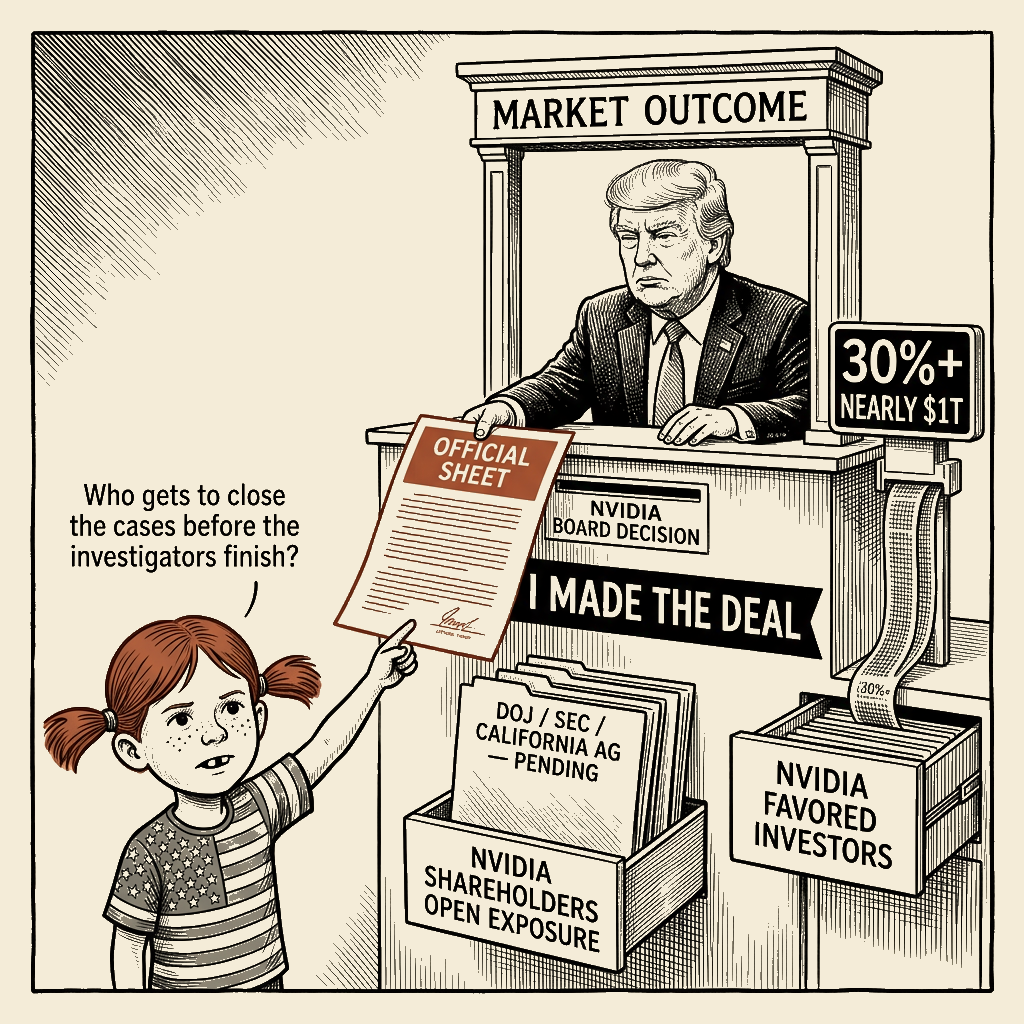
Who gets to close the cases before the investigators finish?
What the Piece Argues
The Wall Street Journal’s Editorial Board recounts President Trump’s intervention to reinstate Nvidia CEO Jensen Huang two weeks after Huang stepped down — Trump told CNBC “I convinced them,” “I made the deal,” and acknowledged that the board “did ask for assurance on the national security threat” and “we gave them assurances” — and argues the move, which Trump conceded was partly motivated by a stock selloff, “amounts to a political bailout for investors” and “another installment of his regrettable state capitalism” that signals export controls are “notional” and will exact legal and political costs. The board documents the surrounding exposure: in its account, Huang departed after misleading his board and the public about a relationship with the founder of Megaspeed, a customer whose Southeast Asia compute rentals helped Chinese firms circumvent U.S. chip controls, with Justice Department, SEC, and California investigations pending, and it contrasts the rescue with Trump’s 2025 handling of Intel’s Lip-Bu Tan and the unenforced TikTok law. It closes by predicting Democrats will “run with the line that billionaire ‘oligarchs’ are ‘too big to fail’ and can buy their way out of legal jams” — presenting the phrase in scare quotes as a partisan line to brace for — before a coda suggesting Trump admires Xi Jinping’s command over private companies. The board writes in defense of its stated creed: free markets, free people, the rule of law against presidential state capitalism.
Receipts
The framing asks you to mistake a presidential promise not to enforce the law for a market outcome.
The framing wants you to believe
- Trump’s intervention was a neutral rescue operation: Huang was “exonerated” after a “very thorough investigation,” and the 30 percent rebound validated the decision.
- Nvidia’s board exercised independent judgment; Trump’s “I convinced them” and “I made the deal” were ordinary presidential encouragement rather than pressure that changed the board’s regulatory risks.
- The open export-control, accounting, and disclosure questions are political attacks on a company doing serious work, not legitimate investigations.
What’s really going on
- Bloomberg reported that Nvidia’s board reinstated Huang without consulting company executives after Trump pressured the company — which is the sequence the “market put” cannot explain away: was corporate independence preserved, or purchased?
- The Justice Department was investigating whether Megaspeed smuggled Nvidia chips into China; the SEC had opened an accounting probe; California Attorney General Rob Bonta was investigating whether advanced chips or confidential information reached China and whether Nvidia misled investors and the public. Those are open questions, not findings — and a presidential assurance cannot adjudicate a statute or substitute for independent enforcement.
- Huang, Nvidia, and politically favored investors took the immediate benefit — shares up more than 30 percent, nearly $1 trillion in market value back — while Nvidia and its shareholders keep the securities, regulatory, and export-control exposure. The reported $800 million to $950 million in liability insurance protects executives’ and directors’ personal assets, not the company against securities claims. (The Editorial Board, “Nvidia and Trump’s State Capitalism,” The Wall Street Journal, Nov. 23, 2026, reporting the CNBC and Bloomberg accounts and the actions by federal and state authorities.)
The Response Ladder
Polite Reframe
When to use: For a good-faith voter, investor, or board member who wants a serious national-security argument without the presidential bypass.
Start with a person nobody puts on television: a Commerce Department export-control analyst — a composite figure, not a named individual — who spent the past month assembling a file on Megaspeed, the company that rented compute capacity in Southeast Asia so Chinese firms could get Nvidia’s advanced chips. That file is now a question the agency may not be able to finish, because the President has already pronounced Huang “exonerated.” The analyst is not the story. The analyst is the cost of the story: the person who has to build the record while the record’s usefulness gets priced into somebody else’s rally.
Then the announcement. Nvidia’s board restored Jensen Huang as CEO. He had stepped down after conduct involving a subordinate and an alleged Chinese spy who founded Megaspeed. The company’s exposure over export controls, accounting, and disclosure did not disappear when he came back. The question is not whether an exceptional CEO matters; Google, OpenAI, Meta, and Amazon are also devising high-end chips. The question is whether that competence can be purchased with a presidential promise that bends the law around one company.
Start with what Trump himself said: “I convinced them,” “I made the deal.” The board sought assurance on the national-security threat, and Trump said the administration had given assurances and had “exonerated” Huang. Those are statements by the man exercising the power, not findings by independent investigators. Bloomberg reported that the board reinstated Huang without consulting executives after Trump’s pressure. When private governance is reshaped by fear of the federal government, corporate independence becomes a favor rather than a right.
That does not require pretending the cases have already been proved. DOJ, the SEC, and California’s attorney general were asking questions; the alleged spying, smuggling, accounting irregularities, and export-control violations remain allegations or open inquiries, and we keep that distinction. But independent review is exactly what the claim of “exoneration” bypasses. A serious national-security response strengthens independent investigation rather than replacing it with presidential assurance. The analyst’s file is the test: if the assurance were the answer, nobody would need to build the file.
National security is a serious public good, and so is market stability. We support both when they serve the public rather than one favored executive or investor class. The Intel precedent shows where state control goes when the government treats a corporate office as an instrument of presidential power: the United States accepted a 9.9 percent equity stake in Intel to keep Lip-Bu Tan in place. We should not make that the default for every leader a president favors. Publish the assurance. Preserve the DOJ, SEC, and attorney-general investigations. Let the board decide on the facts, and hold the government to them for the ordinary investor whose savings ride on Nvidia. Enforce export controls by statute rather than presidential mood. Free markets mean the law binds the powerful too — the President included. That is how we defend the republic we say we value.
Mockery and Ridicule
When to use: For public-thread spectators who need the point made fast; keep the joke aimed at the President and the board, not at ordinary investors.
A market put with a White House customer-service department: step forward, say “I convinced them,” collect the 30-percent bounce, and leave the export-control questions with “we gave them assurances.” That is not a due-process plan. It is a gold-plated presidential warranty stamped “exonerated” and handed to the board before the investigators have finished reading the receipts.
The claim that market confidence can be supplied by presidential power has removed the “free-market” mask and exposed the Decadent / Corruption-preserver underneath: not the market clearing risk, but the President deciding which company receives enforcement relief. Bloomberg says the board restored Huang without consulting executives after pressure. DOJ, the SEC, and Bonta were still asking whether chips, confidential information, or accounting entries crossed legal boundaries. The board did not merely select a CEO; it selected a safer patron.
Then there is the matching set: Intel’s CEO receives a 9.9 percent government equity stake to keep his job, while Nvidia’s CEO receives presidential assurances and a nearly $1 trillion market-value resurrection. The state has discovered the cleanest business model in Washington: take a piece of the company, hand the board a green light, and leave the public holding the regulatory uncertainty. It is state capitalism with a customer-service smile.
Ordinary investors get the green arrow and the instruction not to ask what happened. They are not the villains; they are the people being handed a 30-percent rebound while somebody else decides which statutes bend. The coming “too big to fail” line may be theater, but the nearly $1 trillion move is not. The correction is equally simple: keep the investigations, publish the assurances, and make the board answer to the law — not to the President.
Call it what the receipts call it: the Trump market put. The market did not clear the risk; the President absorbed it, promised not to investigate too hard, and handed the gains to favored investors. If the promise cannot survive the publication of the underlying facts, the “assurance” was not an assurance at all.
Nuclear Satire
When to use: For readers who need the doctrine exposed in full before the next round of euphemism from the administration and its allies.
Picture the White House as a medieval sovereign: Trump on the throne, Nvidia’s board kneeling before the desk, and a trumpeting herald carrying the sacred writ — “I convinced them.” “I made the deal.” The oracle has spoken. Huang is “exonerated.” The imperial investigators are told to hurry because the royal “very thorough investigation” has already reached its conclusion.
That is the Decadent / Corruption-preserver beneath the market-confidence mask: the sovereign who cannot tolerate a question he cannot issue. Bloomberg says the board reinstated Huang without consulting executives after presidential pressure. The DOJ asks whether Megaspeed smuggled chips into China; the SEC asks what Nvidia’s accounting records show; California AG Rob Bonta asks whether advanced chips, confidential information, or misleading statements crossed legal boundaries. The sovereign pronounces those matters “assured.” The questions remain questions, but they remain questions under law — not under an adjective from the Oval Office. The old prophetic charge against a people who no longer knew how to blush reads like a personnel file on the Oval Office.
Then summon the predecessor: Lip-Bu Tan, Intel’s CEO, was told to resign or hand the government 9.9 percent of his company. That transaction was called the “actual solution.” So the doctrine is beautifully simple. If the executive is useful, keep him. If the executive is troublesome, take a lien on the corporation. If an investigation becomes inconvenient, issue “assurances.” The republic becomes an IPO prospectus written by the President: risk socialized, oversight promised, returns privatized.
Nearly $1 trillion in market value returns like a genie released from a balance sheet. The cost does not vanish; it migrates to the SEC docket, the DOJ investigation, the California AG’s inquiry, export-control officers, shareholders, and every government that wonders whether Washington can still enforce its own chip rules. The market celebrated the rescue. The law now carries the baggage.
And the market applauded while it happened. Which is how a republic gets hollowed out — not with a coup, but with a standing ovation. So this is how liberty dies: with thunderous applause, and a ticker (Padmé, Revenge of the Sith). The doctrine is no longer “the President intervened.” The doctrine is “the President is the last court of appeal, and he has already ruled.” Export controls are the moat until the sovereign opens the gate. The rule of law is the wall until the sovereign calls it an obstacle. Corporate independence is the lock until the sovereign says he made the deal. And the 9.9 percent Intel stake waits in the wings, because apparently the next executive will need a government option.
National security cannot mean “whatever the President wants” on Monday and “export controls are inviolable” by Friday. If America accepts that investigations can be converted into presidential market supports, the country will spend years teaching allies that American guarantees expire when an executive becomes inconvenient. The bill for all of it arrives later: one assurance here, one government equity stake there, one nearly $1 trillion headline at a time. The answer must be constitutional plainness — independent investigators, an independent board, and no immunity bought at the market price.
Profane Scorched-Earth
When to use: For the reader who needs the diplomatic varnish ripped off and the receipts turned into a cathartic demand for law.
Holy shit — “I made the deal.” “I made the fucking deal.” That is the market put, and Nvidia’s shares went up more than 30 percent while nearly $1 trillion in market value came back from the dead. Fine. Money loves a president who can call a shareholder bailout “exonerated” and make the enforcement paperwork disappear into the imperial shredder.
But the enforcement paperwork did not disappear. DOJ was investigating Megaspeed; the SEC had opened an accounting probe; California AG Rob Bonta was investigating chips, confidential information, and whether Nvidia misled investors and the public. Those are questions, not convictions — say that clearly and keep the receipts honest. The bullshit part is that a “very thorough investigation” became “exonerated” before those questions were resolved. A president does not get to turn a national-security inquiry into a VIP coupon because his favored CEO has “other chips in his brain.”
And look at the corporate boardroom. Bloomberg reports that Nvidia’s board reinstated Huang without consulting company executives after Trump pressure. So the board supposedly restored independence by bringing back the man who had stepped down. That is like firing your smoke alarm because the fire has excellent references. The “free-market” badge comes off again, and underneath is the Decadent / Corruption-preserver: government intervention without the responsibility of ownership, enforcement relief as a favor, and shareholder confidence as the payoff. Ordinary investors are not the fucking villains; they are the people being used, whose money makes the bailout feel constitutional.
Then remember Intel. Trump demanded Lip-Bu Tan’s resignation and accepted a 9.9 percent government equity stake as the “actual solution.” That is the fucking business model: keep the executive, take the equity, call state capitalism “public safety.” Trump praises Xi Jinping because a Communist Party boss can order private companies and ignore law when convenient. That comparison is not decoration; the record shows the same mechanism in plain sight — political command over corporate conduct, with legal process asked to stand aside.
Here is the bullshit asymmetry. Nvidia carries roughly $800 million to $950 million in liability insurance protecting executives’ and directors’ personal assets, but it does not indemnify Nvidia against securities claims. So the favored executive gets protection while the public company and shareholders carry the lawsuit, regulatory exposure, and diplomatic cost of an “assurance” nobody can inspect. The market value went up; the legal bill can arrive later. That is not a market put. That is a cliff with a ticker symbol.
So fuck the vague language about “bailouts” and “oligarchs.” Name the mechanism: presidential pressure on the board; a promise of enforcement relief the public cannot see; export-control, accounting, and disclosure investigations subordinated to political usefulness; and immediate gains delivered to favored investors. That is what the receipts show. We oppose not a strong executive, but a president who thinks the law ends where his confidence begins.
The alternative is not some sanitized technocratic squeaker. It is simple enough to read aloud: publish the assurance; preserve the DOJ, SEC, and AG investigations; let the board decide after the facts; enforce export controls without presidential coupons; and make Huang and Nvidia answer for what the record shows. Amos 5:24 asks for justice to roll down like waters — not to be bottled up in a White House reservoir and released only when the market needs a pump. Fuck the market put. Enforce the law. Protect the rule of law. Let the chips be sold, the books be open, and the board act without the President’s fingerprints on its decision.

About Malcolm Little King
Malcolm Little King is a heteronym in Main Street Independent's editorial architecture — an analytical voice, not autobiography of any actual person. The position this column expresses is the publication's position on the territory Malcolm Little King's lane covers, rendered through Malcolm Little King's register.