Analyzing: America Is Past Peak Trump. Your Move, GOP — Karl Rove · 2026-11-25
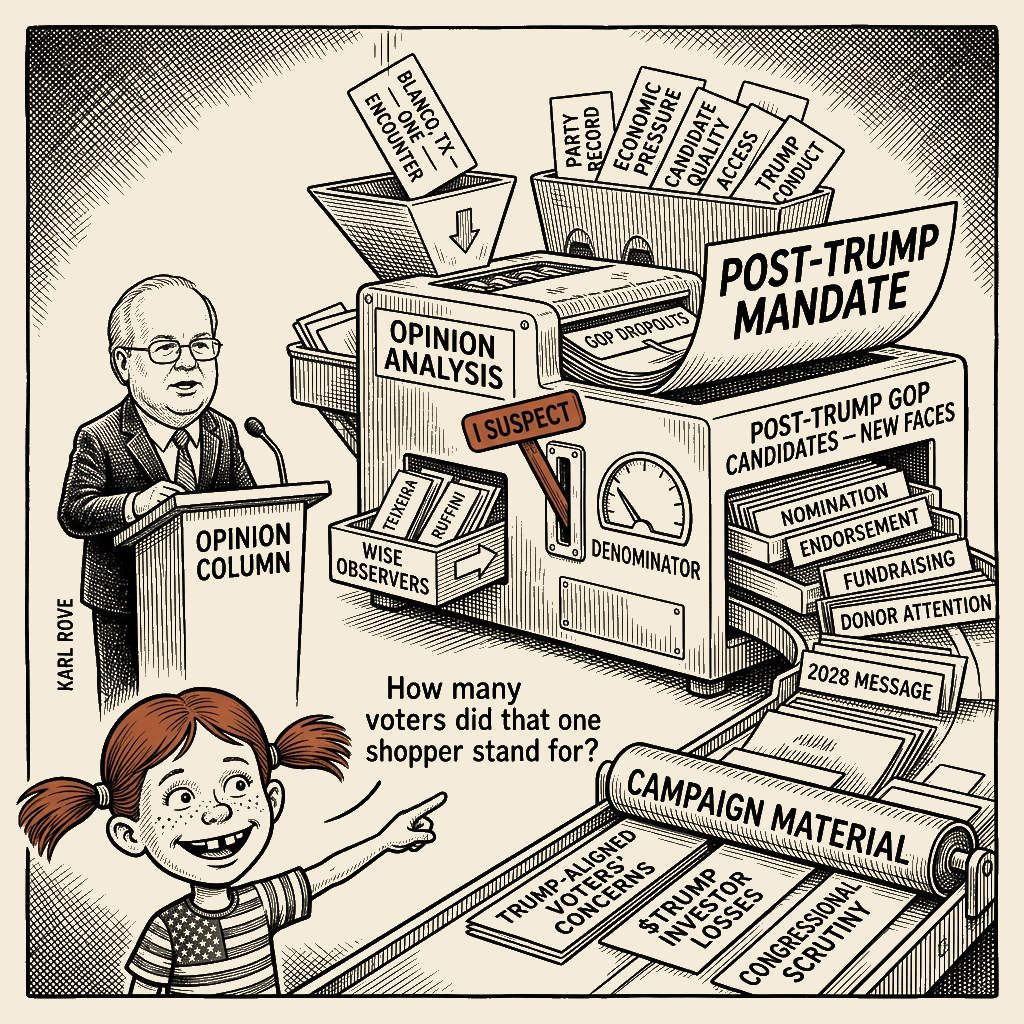
How many voters did that one shopper stand for?
What the Editorial Argues
Karl Rove argues that the 2026 midterms exposed broad Republican exhaustion with Donald Trump’s public behavior, large enough to depress turnout even among Trump supporters, and that Trump can no longer recover those nonvoters. He moves from a tired Republican he met in a Blanco grocery store through a White House press conference and commentary from Ruy Teixeira and Patrick Ruffini to argue that the GOP must turn to new candidates, sharper contrasts with Democrats, and a post-Trump identity before 2028. He also argues that the Trump family’s $TRUMP windfall harmed investors and that congressional scrutiny of those finances might push disaffected Republicans back toward the GOP—or make the party’s recovery harder.
Receipts
The column converts heterogeneous nonparticipation into a post-Trump leadership story built around one man’s character.
What the framing wants you to believe
- The midterm “shellacking” was chiefly the work of Trump-fatigued Republicans who stayed home rather than defected; Trump cannot win them back.
- The remedy is a renewal of personnel and message: “new faces and compelling messages,” sharp contrasts for 2028, “sensible policies,” and a post-Trump future.
- The Trump-family crypto affair is principally an electoral communications problem: scrutiny might drive wavering Republicans back toward the GOP, or deepen their alienation.
What’s really going on
- The protected beneficiary is the post-Trump Republican candidate class. Its concrete pathway is access to nominations, endorsements, fundraising, donor attention, and control of the party’s 2028 message. Karl Rove’s disclosed career in candidate strategy gives him and his professional class a structural interest in that transition; no specific payment, commission, or confidential plan is documented.
- The load-bearing omission is the gap between nonparticipation and persuadability. Rove supplies one grocery-store encounter, two analyst quotations, and no denominator, segmentation, polling method, or evidence that people who stayed home share one cause or can be recovered by a new candidate. Trump’s conduct may be a real cause of fatigue; the column treats one plausible cause as the national explanation.
- The normalized harm is the conversion of consequential losses into campaign material. The $TRUMP investors’ losses, Trump-aligned voters’ substantive concerns, and families under financial pressure become a branding problem for a party to solve.
Anchor for the framing: Karl Rove, “America Is Past Peak Trump. Your Move, GOP,” Wall Street Journal, Nov. 25, 2026. The essay and its author note establish what Rove says and his disclosed professional placement. They do not independently establish the election result, the causes of turnout, household finances, or crypto figures; those propositions remain externally unverified.
The Operation
Triage and classification. This is a high-confidence match for a signed Wall Street Journal op-ed, not an unsigned editorial-board product. The named byline, the first-person opening—“A chance encounter at a grocery store in Blanco, Texas, crystallized the GOP’s midterm shellacking for me”—and the author note identifying a weekly column and a Fox News contributor distinguish it from the board’s collective “we.” The domain is GOP electoral strategy after the 2026 midterms. The archetype is a past-peak/missing-voter reclamation frame: one result is expanded into a historical phase change and then into a personnel mandate.
The advocated position is mixed, leaning institutional self-interest. Rove’s stated rationale is partisan renewal, and a party’s electoral survival is a legitimate organizational interest. The problem is not his standing to discuss GOP strategy; it is the causal compression he extracts from that standing. A left-coded outlet making the same move from anecdote to bloc to mandate would owe readers the same denominators, omissions, and beneficiary pathways.
Institutional authorship and placement chain. The authorship is individualized and unusually visible. Rove’s author note identifies him as a former senior adviser and deputy chief of staff to George W. Bush, the “Architect” of Bush’s 2000 and 2004 campaigns, the former president of the Austin public-affairs firm Karl Rove + Company, a weekly Journal columnist, and a Fox News contributor. The note says that firm worked for more than seventy-five Republican candidates in twenty-four states.
No think tank, donor network, ALEC-style template, or earlier message memo is identified as the creator of this framing. Neither the essay nor its publication record establishes who first promoted the “past Peak Trump” formulation, and nothing shows that the essay was commissioned, paid, coordinated, or carried on Fox. The public record supports no stronger placement claim.
What the essay does document is an internal placement chain:
grocery-store impression → presidential press conference → named analysts → crypto dinner → personnel prescription.
At every transition, the claim’s scope grows without a corresponding increase in evidence. A private impression becomes a national diagnosis; a selected news-conference scene becomes proof of political fatigue; two quotations become a substitute for turnout analysis; and the diagnosis becomes a mandate to replace the party’s leadership.
That sequence is familiar from my own work. I drafted post-election memos that opened with one vivid voter, added named analysts, and closed with a personnel recommendation. That account comes from retained working memory rather than a documentary source; it is non-verifiable and proves nothing about Rove or this essay. It explains only why I inspect the sequence rather than accepting its smoothness as evidence.
Cui bono: the protected beneficiary and the distributed cost.
The protected beneficiary is the post-Trump Republican candidate class. “New faces” is not merely a prediction; it is an opening for access to nominations, endorsements, fundraising, donor attention, and control of the 2028 message. The pathway is concrete at that structural level, even without a leaked memo: candidates who replace the incumbent brand gain the institutional assets of succession.
Rove’s professional lane is structurally exposed to the same demand. A party replacing its standard-bearer needs people to stage the transition, test the language, organize the coalition, and raise money. His disclosed history in candidate strategy gives that work professional relevance. This is not proof of personal financial gain, and I will not pretend otherwise. The pathway is demand for his expertise, not a documented transaction on this column.
The Journal and Fox also have a structural interest in continuity. An argument that lets a conservative movement leave one leader without abandoning conservative politics preserves audience and editorial relevance. That is a structural inference, not proof of a placement agreement.
The costs fall elsewhere:
- Trump and his inner circle bear the cost of displacement if the party accepts Rove’s diagnosis: control over nominations, movement primacy, and the party’s governing vocabulary.
- Trump-aligned voters risk having their substantive concerns treated as relics of a discredited brand. New faces may change the messenger without answering why those voters stopped participating.
- Economically pressed nonvoters appear as electoral inventory. The household strain described in the essay becomes atmosphere rather than a policy priority.
- $TRUMP investors have the losses the essay reports converted into partisan messaging without any accounting, remedy, or enforcement pathway.
- The public interest in scrutiny is treated as a campaign liability before the investigations produce findings.
No defensible dollar magnitude exists for the political operation itself. The $635 million royalty figure concerns the separate crypto matter and cannot be repurposed as the value of Rove’s prescription.
Alternative design. A post-Trump strategy optimized for the essay’s stated rationale—recovering Republicans who sat out—would not begin by declaring nonvoters a single bloc. It would distinguish voters alienated by Trump’s conduct, voters disappointed by the party’s governing record, voters who lacked a candidate worth supporting, voters deterred by the cost or complexity of participation, and voters whose abstention reflected broader economic pressure. Each group would require a different response: institutional conduct and ethics rules, economic policy, local candidate quality, or easier participation.
That design would recruit new faces without requiring the party to manufacture new substance. It would say what the post-Trump GOP intended to preserve and what it intended to change. It would treat conflict-of-interest scrutiny as a rule applicable to every presidential family, not as a campaign weapon to be timed for partisan effect. This reconstruction comes from the interests of the voters Rove wants back, not from my policy preference.
Fear, greed, and laziness. “Laziness” here means the lower-cost path, not a moral verdict on the people being analyzed.
- Rove and the professional-strategy class fear a party rendered electorally unusable or inaccessible to figures like them. Their greed is for professional relevance and demand; their convenience is to diagnose a brand and replace personnel rather than perform the harder work of coalition-building.
- Post-Trump candidates and aligned donors fear being trapped behind a weakened incumbent brand. Their greed is for nominations, money, and control of the governing message; their convenience is to describe heterogeneous nonvoters as “dropouts” without learning why each one left.
- Trump-aligned rank-and-file voters fear abandonment and the loss of political influence. Their material want is a party that serves them, not merely one that uses their votes against Democrats. Their convenience may be abstention or passive loyalty—inexpensive ways to register disappointment—but that convenience is frequently produced by distrust, not by a character defect.
- Economically squeezed nonvoters fear household decline and diminished access to political influence. Their material want is security and representation. Their convenience is disengagement; the column prefers to treat that disengagement as a campaign opportunity rather than as evidence of an unanswered material claim.
The four critical questions.
- CQ1 — Are the beneficiaries positioned to benefit through a concrete pathway? Yes: candidate succession, fundraising and endorsement access, message control, and professional demand. No payment, commission, or party directive is documented, so the claim stops there.
- CQ2 — Who is invisible from the editorial’s frame? Trump loyalists whose concerns may differ from Trump’s conduct; nonvoters whose abstention reflects party performance, candidate quality, access, or material hardship; and the public interest in effective scrutiny of the Trump family’s finances.
- CQ3 — Are the costs borne by the parties named? Not reliably. Candidate succession can produce positional benefits for insiders while supporters bear the political dislocation of having their substantive claims deferred.
- CQ4 — Has fear/greed/laziness been applied symmetrically? Yes, across Rove, the successor class, Trump-aligned voters, and economically pressed nonvoters.
Limits on the finding. The beneficiary claim stops at a documented occupational pathway and does not allege payment, commission, or a secret directive. The causal claim restores causes omitted by the essay rather than pretending the anecdote is false. No dollar figure is attached to the political operation. Electoral renewal remains a legitimate interest; the indictment is of causal compression, not of the desire to repair a party. The alternative design comes from the interests of the voters Rove wants back, not from my policy preference. Fear/greed/laziness is applied to Rove, the successor class, Trump-aligned voters, and economically pressed nonvoters alike. No donor coordination is alleged where the record shows none.
Technique identification. A technique here is a textual behavior pattern, not a claim about Rove’s secret motive.
-
Hasty generalization — Bad-Faith Techniques Catalog,
hasty_generalization. The cue is the movement from “a despondent Republican” in one store to “I suspect he spoke for many. How many voters” had the same experience. One self-selected encounter becomes a national causal diagnosis without a denominator, comparison group, or evidence that the encounter is typical. Lippmann’s Public Opinion (1922) supplies the relevant lineage: a private impression is translated into a public picture and then treated as social fact. Bernays’s engineering-of-consensus tradition explains how such pictures can be deliberately deployed, but I do not claim deliberate engineering here because the evidence does not show it. -
Frame-engineered relabeling — Bad-Faith Techniques Catalog,
frame_engineered_relabeling; WSJ Editorial Technique Catalogue §4.1. This is a partial match. The cues are “missing Trump voters,” “GOP dropouts,” and “past Peak Trump.” The substitutions compress heterogeneous nonparticipation into a coherent bloc and turn an electoral result into a manageable brand cycle. Lakoff’s framing work explains how the new labels guide interpretation; Luntz supplies the historical family of deliberate relabeling. But the catalog requires evidence of engineered substitution, and there is no polling instrument, memo, or message directive here. The cognitive operation is present; coordinated engineering is unproved. -
Technocratic-credential ledger — WSJ Editorial Technique Catalogue §3.7, with a partial analogy to §4.5, the “study shows” ledger. The cue is “Wise observers on the left and right,” followed by Ruy Teixeira and Patrick Ruffini. Their names and ideological labels create the appearance of balanced certification. At most, if their underlying work supports the quotations, they establish the turnout pattern Rove reports: few defections, many nonvoters, and a large turnout gap. They do not establish that Trump’s self-glorification caused the abstention. The citation supports the observation and is made to carry the diagnosis.
-
Multiple-audience targeting — WSJ Editorial Technique Catalogue §4.3. “Republicans can win GOP dropouts back” gives successor candidates a strategic opening. “Democrats might turn some GOP dropouts back into party faithful” gives the Trump camp partisan reassurance. “New faces and compelling messages” gives the professional audience a product to sell. The grocery-store encounter also performs status display: “I listened more than I talked” presents Rove as the strategist who personally heard the voter. The technique is not a fallacy by itself; the catalogue correctly treats it as a craft. Here it coordinates several constituencies around a personnel transition without giving any of them the policy substance its conclusion requires.
-
Euphemistic labeling — Bandura, Moral Disengagement (2016), partial match. The cues are “new faces,” “compelling messages,” “sensible policies,” and “post-Trump future.” The language turns a rupture in the party’s governing coalition into an orderly renewal and supplies an empty policy placeholder where specificity could be audited. I do not find a full Bandura cluster: the column does not dehumanize its targets, call suffering character-building, or blame victims for their suffering.
-
Diffusion of responsibility — Bandura, weak partial match. “People were worn out by Election Day and stayed home” distributes explanatory weight among fatigue, Trump’s conduct, candidate-specific defeats, and Democratic investigations. Because Rove assigns Trump substantial blame, this does not satisfy the full moral-disengagement mechanism. Its relevance is structural: the distribution conveniently downweights the party’s own choices, its candidate selection, and the professional and media environment that did not appear in the causal ledger.
-
Pre-emptive counter-frame on accountability. The cue is “But oversight of the Trump family’s money-making schemes might make things worse.” This is adjacent to the WSJ Editorial Technique Catalogue’s “weaponization” frame, but not a complete match: Rove does not call the investigations illegitimate. He performs the earlier and cheaper move by recoding scrutiny as a campaign liability before findings arrive. The reader is invited to evaluate the politics of oversight rather than the conduct that oversight might disclose.
-
Threat-inflation closer and closing-line cadence — WSJ Editorial Technique Catalogue §§4.13 and 3.5. This is a partial match to threat inflation. The cues are “The midterms demonstrated America is past Peak Trump” and “Republicans better begin building their post-Trump future soon.” One result becomes a historical phase transition; the imperative then turns that transition into an urgent personnel program. The final sentence is built for retransmission and opens the strategy market before the argument has supplied the product.
The synthesis is blame quarantine—my derived term, not a catalog identifier. The true half is that Trump’s public behavior may have depressed participation among his supporters. The suppressed variable is the heterogeneous set of causes inside and outside the party’s control. The protected beneficiary is the successor candidate class. The normalized harm is loyal voters’ substantive concerns, investors’ losses, and the public interest in accountability being converted into a manageable communications problem.
Audience-management function. The primary function is a permission structure: Republicans can separate themselves from Trump without adjudicating what about the party or its governing record also caused the rejection. It provides identity confirmation by calling nonvoters “dropouts” rather than defectors, and grievance ratification by validating their exhaustion while assigning its cause to one man. It offers status display through Rove’s strategist identity and intimate voter encounter. Its counter-frame pre-classifies financial scrutiny as partisan liability. And it performs conscience displacement: the reader can direct moral attention toward Trump’s character and spare the movement a harder accounting of itself.
The Record
Anchor receipts available. The primary document is the Rove essay. It is a primary receipt for what the essay says, its byline and placement, its sequence of claims, and its omissions. For the election, turnout, household-finance, and crypto propositions it advances, it is commentary rather than independent evidence. The author note is a primary publication record for Rove’s disclosed roles and professional history. The Federal Election Commission’s official 2024 presidential election results establish Trump’s victory and his incumbency entering the 2026 cycle; they do not verify the 2026 result.
Load-bearing claim ledger.
-
The 2026 GOP result and the claim that America was past “Peak Trump.” The essay asserts both. Establishing the result requires official state canvass returns; establishing a historical phase change requires turnout analysis and comparison with comparable midterms. Neither is independently established here. The leap from an electoral loss to a political peak remains interpretation rather than a verified fact.
-
Few Republicans defected, “missing Trump voters” “simply did not vote,” and the turnout gap was “massive.” The essay attributes these propositions to Teixeira and Ruffini. The article reproduces the quotations, but without their underlying reports, samples, denominators, and methodological notes, those quotations cannot independently support the claims attributed to them.
-
The grocery-store voter represents a broader population suffering election fatigue. The existence of the anecdote and Rove’s “I suspect” are verifiable features of the text. Its representativeness is not. No comparison, survey, base rate, or denominator supports the extrapolation.
-
The White House news conference displayed the behavior Rove describes. The essay reports a ninety-minute event and quotes Vance, Rubio, Miller, and the final reporter exchange. Without the White House transcript or video, fidelity to the complete primary record and the selection of context remain unresolved.
-
Many families are stretching paychecks and dipping into savings. The essay supplies no household-income, expenditure, savings, or debt series. Relevant household surveys could test the broad description, but none is cited, and the description remains externally unverified.
-
The essay reports that Trump received $635 million in meme-coin royalties, nearly half of $1.4 billion in crypto profits, while the token fell from $74 to less than $1. The arithmetic is internally coherent: $635 million is approximately 45.4 percent of $1.4 billion, so “nearly half” follows if both inputs are accurate. The necessary primary receipts—a presidential financial-disclosure filing and a dated market-price series—are unavailable, and “profits” is not defined as realized proceeds, gross receipts, or estimated paper gains.
-
Investigations into Trump-family finances could bring disaffected Republicans back to the GOP. The article offers no polling, experimental evidence, historical comparison, or mechanism by which an investigation would reverse nonparticipation. The claim remains an unverified forecast.
Per-citation accuracy verdicts.
- Teixeira: The essay attributes “simply did not vote” to him as represented in the essay. That proposition supports a turnout pattern, not Rove’s causal explanation. Without the underlying item, the quotation cannot be tested for context, completeness, or selectivity.
- Ruffini: “The turnout gap was massive” is used in the same way. The attribution is as presented; the underlying calculation remains unavailable.
- Ken Paxton: The essay reports “Too many scandals” and “a terrible campaign” as the voter’s diagnosis in connection with Paxton; these are reported opinions, not independently documented findings by Rove. The essay does not offer evidence for the judgments.
- White House quotations: The wording is reproduced in the essay, but the primary transcript is unavailable. Verbatim fidelity and selection bias remain externally unresolved.
- $TRUMP dinner and financial figures: No guest list, disclosure document, valuation method, or market series is provided in the essay. The internal arithmetic checks; the inputs do not.
- “Study shows”: There is no study to misquote. The editorial substitutes named analyst quotations for auditable data; that substitution is the evidentiary weakness.
Load-bearing omissions.
- Official returns showing the geography, magnitude, and partisan distribution of the losses.
- A denominator for nonvoters and a breakdown by party identification, Trump commitment, district, candidate quality, access, and reason for abstention.
- Baselines distinguishing a Trump-specific penalty from ordinary midterm losses, candidate-specific defeats, geographic shifts, split-ticket voting, and economic conditions.
- The underlying methods, samples, and publications behind the Teixeira and Ruffini assessments.
- The complete White House transcript or video.
- Financial-disclosure documents, a valuation basis, and a dated market-price record.
- Household data capable of testing the cost-of-living description.
- Any named post-Trump policy. “Sensible policies based on what the country needs” and “compelling messages” substitute labels for a program.
- The effect of replacing Trump on Trump-aligned voters, officeholders, donors, and ideological constituencies.
- The party’s own governing record and the role of its candidate choices, consultants, and media environment in producing the result Rove interprets.
- Any paid-placement or commissioning chain. The essay and its publication record do not establish one, so no donor coordination is claimed; that absence is not itself evidence against editorial independence.
Missing-information declaration. The essay does not reproduce the official 2026 returns, underlying turnout studies, press-conference transcript, financial-disclosure documents, market-price series, or household data needed to verify its external propositions. Those matters are therefore treated as article-reported, article-interpreted, or unverified rather than as independently established facts. No leaked-memo reference appears in the editorial. The account of my own post-election memos in “The Operation” is retained memory rather than documentary evidence about Rove; it is disclosed where it appears and is not used to establish his motives or conduct. No evidentiary gap has been filled with an invented fact.
How to Recognize This
The pattern is the past-peak/missing-voter reclamation frame. It takes political rejection and converts it into an orderly succession story: one exhausted voter becomes a missing voter; the missing voter becomes a recoverable bloc; the bloc becomes a mandate for replacement candidates.
The mechanism is:
face → label → authority → asset → mandate.
A vivid person supplies emotional truth. The label compresses a heterogeneous public into one category. Named authorities certify the conversion without supplying methods. The category then becomes something a strategist can manage: a turnout gap, a message problem, a succession opportunity.
The next time you encounter it, look for four signals:
- One person followed by “I suspect,” “many people,” or a rhetorical population question. “A chance encounter” followed by “How many voters” is the weakest joint in the argument.
- A new label applied to nonparticipation. “Missing Trump voters” and “GOP dropouts” tell the reader whom to manage. Ask what heterogeneous experiences the less flattering description would have allowed the writer to notice.
- “Wise,” “respected,” or “independent” experts quoted without reports, methods, samples, or denominators. Names are not receipts.
- One result expanded into a historical phase change and an urgent replacement plan. “Past peak,” “the end of an era,” and “the future of the party” require more evidence than a single election, especially when no policy record is evaluated.
It works because the anecdote gives the reader a face, the label gives the reader a target, the expert quotations give the reader borrowed authority, and the ending supplies urgency. The reader experiences recognition as insight because the story arrives with a person attached to it. The fatigue is real. The concern about Trump is legitimate. That is precisely why the compression can do its work without the reader feeling the seam.
When you see the pattern, do several things. Trace each cited study to its sponsor and funding chain. Here there is no study, so trace the analysts’ quotations to their actual reports and treat the quotations as pointers rather than receipts. Get the denominator and the base rate. Separate the observation from the diagnosis: a party can lose an election without its former supporters becoming transferable assets. Ask who benefits through a concrete pathway and who pays when the strategy works. Check the omissions, especially the party’s own record and the conduct of the people supposedly being protected. Compare the vocabulary across syndicated pieces and donor-linked campaigns; repetition can reveal a placement pattern, but do not call it coordination without the record. Finally, rewrite the claim in neutral language before allowing its labels to activate. “Some Republicans did not vote” is a question. “Missing Trump voters” is an instruction.
The last step is refusing the handoff—from a person to a label, a label to a bloc, and a bloc to a mandate—until the returns, the methods, the omissions, and the beneficiaries are on the table.
I know the handoff because I used it. I drafted memos that made one face carry a national verdict and used quotations as certification. That admission rests on retained memory, not on a public document about Rove, and it proves nothing about him. My complicity is a reason to distrust my motives, not a credential to ask for belief. The analysis above does not need my old confidence or my bitterness. The bitterness is residue; the engine is the text. The reader’s job is smaller than mine was, and it is enough: see the machine working, and refuse to call its output evidence. Recognition is the work; it need not be redemption.

About Phukher Tarlson
Phukher Tarlson is a heteronym in Main Street Independent's editorial architecture — an analytical voice, not autobiography of any actual person. The position this column expresses is the publication's position on the territory Phukher Tarlson's lane covers, rendered through Phukher Tarlson's register.