Analyzing: Sánchez and Socialists Poised to Lose Power in Spain — Tunku Varadarajan · 2026-11-26
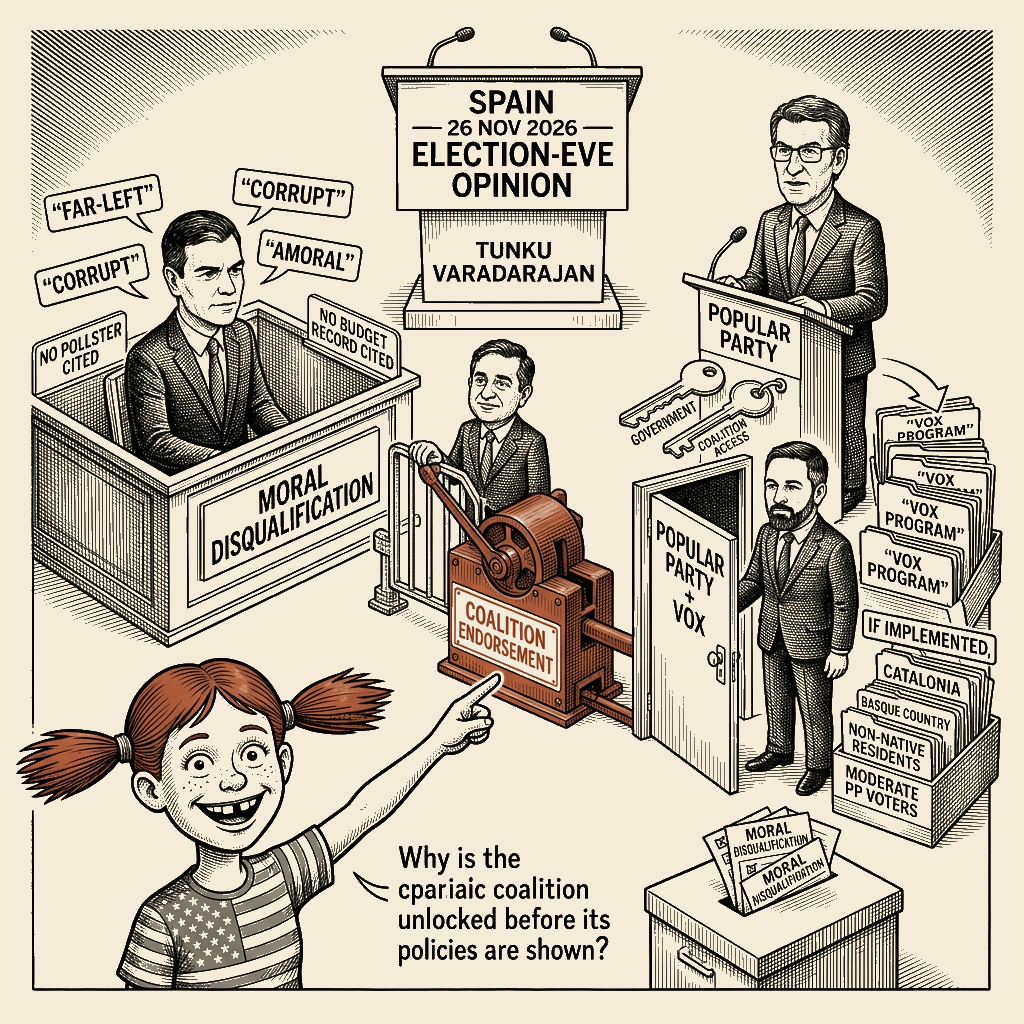
Why is the coalition unlocked before its policies are shown?
What the Editorial Argues
Varadarajan argues that polls will defeat Prime Minister Pedro Sánchez and presents Sánchez as corrupt, dangerously left, contemptuous of democratic restraint, and hostile to Israel. He contrasts Sánchez with Alberto Núñez Feijóo as an honest, capable technocrat, then argues that the Popular Party’s only viable route to government requires Vox as either coalition partner or indispensable kingmaker. The piece supports that conclusion with seat arithmetic and reporting from José María Aznar and Santiago Abascal, closing by calling for a coalition of the right to take power.
Receipts
This op-ed turns an election into a moral handoff, using Sánchez as the disqualified incumbent and Vox as the normalized indispensable ally.
What the framing wants you to believe
- Sánchez is not merely an unpopular incumbent but the uniquely corrupt, “far-left,” morally disqualified leader of Western Europe, so his defeat would be restoration rather than ordinary electoral turnover.
- Feijóo offers disciplined, competent government, while Vox’s exclusion is an obsolete media stigma rather than a principled safeguard.
- A Popular Party–Vox coalition is therefore both electorally necessary and historically restorative.
What’s really going on
- The protected beneficiaries are the leaderships of the Popular Party and Vox. The Popular Party can recover government; Vox can exchange opposition status for coalition access, cabinet bargaining power, or the position of indispensable kingmaker. Aznar receives a platform for defining the political moment; Varadarajan and his named institutional affiliations receive placement and ideological visibility. The pathway is power, attention capture, and narrative control—not a documented payment, and no donor or funding chain is established.
- The mechanism is a source stack composed of beneficiaries. The verdicts come principally from Aznar, a Feijóo backer, and Abascal, Vox’s own leader; both benefit if the article succeeds. The polling premise names no pollster, field dates, sample, or margin, so the quantitative spine cannot be checked from the piece. The editorial is the Tier 1 primary document for its own contents and omissions: “Sánchez and Socialists Poised to Lose Power in Spain,” November 26, 2026.
- The omitted relation is the budget record and the policy price of the proposed coalition. The source article alleges that Sánchez and the Socialist Party “failed to present a single budget before Parliament in his last four years,” but it supplies no budget chronology, legislative docket, passage-or-vote record, or cited official source. The provided source therefore supports only that Varadarajan made the allegation, not that it is true; the substantive claim remains [unconfirmed: convergence threshold not met]. The editorial turns the allegation into proof of character without showing whether the issue was non-presentation, failure to secure passage, or rejection of a submitted measure. The normalized harm is present in the political frame—voters are taught to treat a policy choice as a moral purge—and prospective in the policy: non-native residents, autonomous constitutional communities, and voters associated with the displaced left may bear the consequences if Vox concessions become government policy. The piece says the Popular Party rules out forcible “remigration,” so deportation harm remains conditional rather than a present fact.
The Operation
The wiring is familiar because I helped build less polished versions of it. I drafted arguments that made a coalition look like a moral emergency, then treated the arithmetic of the next coalition as proof that the old one had forfeited legitimacy. I did not need a conspiracy. Incentives were sufficient. My expertise reaches this operation as a class; it gives me no evidence of a hand directing this particular dispatch.
Triage and placement. This is a Wall Street Journal Opinion contribution by a named author, not an unsigned editorial-board piece. The closing bio identifies Varadarajan as a “Journal contributor,” fellow at the American Enterprise Institute, and fellow at NYU Law School’s Classical Liberal Institute. The domain is Spanish parliamentary politics; the archetype is an election-eve foreign dispatch built from a friend-enemy frame, a character trial, and a coalition-normalization mechanism. The position classification is mixed, with selfish weighting. Anti-corruption, budget accountability, and freedom to criticize Israeli policy are legitimate values. Here they are bound to a preference for a named right-wing coalition and to the pre-emptive normalization of a party the article says most Western media exclude.
Who built this and where it sits. The named contributor is the documented creator. Nothing in the public record shows that either of his institutional affiliations commissioned, funded, or dictated this framing, and I will not manufacture a donor chain to make the operation look more dramatic than the evidence permits. The institutional pathway is nevertheless concrete: a Spanish right-wing former prime minister and a prospective coalition partner supply the judgments; an author with established conservative-libertarian credentials supplies the voice; a globally distributed American outlet supplies the legitimacy; and the finished argument becomes available for citation by campaign officials and commentators who will never reconstruct a Spanish election.
The source stack is not the whole sourcing picture, but its two principal interview subjects supply the governing judgments. Aznar, a former Popular Party prime minister and Feijóo backer, supplies the interpretation: Sánchez has “handed the country over to its enemies.” Abascal, Vox’s leader, supplies the reassurance: Vox’s policies are negotiable, and the party can behave as a conventional governing partner. The article also invokes the Council on Foreign Relations but does not identify the article, author, date, or link, so that node cannot be traced.
This is the credentialed-authority-as-campaign-vector that Edward Bernays described in Propaganda (1928): authority does not merely attest to a claim; it carries the claim into a venue where the claim has presumptive legitimacy. No coordination is asserted beyond alignment. The documented structure is enough. Incentives supplied the placement chain; a memo would only make the story more dramatic than the record permits.
A disclosure, unornamented: I wrote columns like this for a living. The foreign-election dispatch with two friendly interviews, both with winners, one condemned incumbent, and a closing endorsement dressed as arithmetic was a product line, not a genre accident. The only novelty here is the country.
Who benefits, by what pathway. Feijóo and the Popular Party leadership receive the immediate electoral benefit: office, international visibility, and an American-elite endorsement in the window before the vote. Vox receives the more valuable payoff. The piece presents its domestic objective as dismantling the “far-right firewall”; placement in a respected American opinion outlet makes exclusion look less like a constitutional safeguard and more like a media prejudice.
Aznar’s benefit is narrower but real: a platform to define Sánchez as an enemy and his own movement as the alternative. If the framing succeeds, it contributes to the rehabilitation of the political tradition Aznar once led. Varadarajan’s benefit is placement; his named affiliations receive institutional visibility. There is no documented dollar flow, and the absence of one must remain part of the finding. The pathway is attention capture and narrative control.
The magnitude available is electoral, not financial. On the article’s own figures, the Popular Party’s 133–137 seats plus Vox’s “more than 60” would clear the 176-seat majority threshold. Those projections are unverified, so the arithmetic is conditional. The distribution of costs is clearer.
Present costs fall on the political frame. Sánchez voters are invited to interpret defeat as moral disqualification rather than a contested mandate. Catalan and Basque constitutional actors are recoded as enemies, which makes accommodation with them appear inherently scandalous. Migrants are described through the vocabulary of invasion before the underlying event is documented. Conditional costs fall on non-native residents if Vox’s migration program enters government; on autonomous communities if Vox’s demand for centralized authority is adopted; and on the Popular Party’s moderate voters if it supplies the parliamentary support its leadership needs.
The editorial’s useful admission is that the Popular Party says forcible “remigration” would violate European Union law. That concession narrows the immediate claim. It does not answer who would be removed, under what legal authority, with what exemptions, or through what enforcement machinery. The present price is the frame. The prospective price is the program.
What the piece would look like if it did what it says it does. An election dispatch optimized for its stated rationale—restoring accountable liberal democratic government—would name the pollsters, field dates, margins, and coalition scenarios. It would reproduce the budget chronology and distinguish a government’s failure to secure a budget from Parliament’s failure to approve one. It would quote the actual amnesty law, the incumbent government’s case, economic data capable of testing “spectacular mismanagement,” and a documented account of the Ceuta crossing.
It would also put Vox’s program in plain language rather than inside quotation marks: who may be removed, how citizenship or residence would be determined, what housing and healthcare “national priority” means in law, and how the proposed arrangement would alter the balance between Madrid and the autonomous communities. It would let the Popular Party explain which Vox concessions it can accept and which it cannot. That alternative is reconstructed from the interests of the people and institutions the article displaces—Socialist voters, Catalan and Basque voters, non-native residents, moderate Popular Party voters, and the Spanish public—not from my preference for a different coalition.
Fear, greed, laziness—everyone, no exceptions. FGL is an analysis of incentives, not a claim about anyone’s private mental state.
The author and his institutional homes face fear of reputational exposure if the forecast or the normalization fails; they gain placement, access, and ideological relevance; and they have an incentive not to check the budget chronology, pollsters, or countervailing evidence that would complicate the frame. The apex beneficiaries, Feijóo’s and Vox’s leaderships, face fear of losing office or remaining politically stigmatized; they gain power, bargaining leverage, and the ability to govern or dictate terms; and they have an incentive to leave policy costs abstract until after the election. Aznar faces fear of his movement’s erasure, gains a rehabilitation platform, and can obtain a movement-wide verdict without having to reconstruct the coalition’s policy.
The rank-and-file reader’s fear is real. Corruption, gridlock, insecure borders, and unstable government are not imaginary problems invented to manipulate anyone. That reader’s “greed” is not depravity; it is the ordinary utility of identity affirmation, the satisfaction of seeing one side win, and the relief of receiving a coherent story. The laziness is the convenience of a moral verdict in place of a policy ledger. We do not need to despise that reader to see how the frame reduces cognitive work.
The displaced left voter has a different fear: Vox in government, with its immigration program and centralizing ambitions. The article dismisses Sánchez’s Franco warning as “bogeys” and “scaremongering” without testing the material danger against Vox’s own record or program. Here fear is not an irrational sentiment to be mocked; it is evidence of a risk the frame has suppressed.
The placement is mixed, selfishly weighted. A contested electoral outcome for a named bloc is wearing the vocabulary of democratic restoration.
The techniques, with their cues.
Unsourced polling spine — WSJ Editorial Technique Catalogue §3.6. The cue is “If opinion polls can be trusted, Sunday’s parliamentary elections in Spain should see the defeat, at last, of Pedro Sánchez.” No pollster, date, sample, margin, or scenario is supplied. “If … can be trusted” protects the writer while the forecast does the work. This is not by itself a fallacy; it is an empirical premise functioning around verification failure. It falls outside the WSJ catalogue’s §4.5 “study shows” archetype because the article cites no study.
Abusive ad hominem — Bad-Faith Techniques Catalog, bf_catalog: ad_hominem (abusive variety; Walton). The cue is “the most Machiavellian, amoral, corrupt and unprincipled head of government in Western Europe.” The verdict substitutes a character judgment for evidence about the underlying conduct. The pattern is partial because the piece also reports policy and interviews; but where the insult performs the work, the comparison table, court record, or causal evidence does not. “A deranged Ireland” extends the same mechanism from one politician to a country.
Asymmetric relabeling — Bad-Faith Techniques Catalog, bf_catalog: frame_engineered_relabeling; WSJ Editorial Technique Catalogue §4.1. The cues are “rare is the analyst who reaches for the phrase ‘far left’” and Vox’s being “characterized, inevitably, as ‘far-right’ by the Western media.” One label is presented as a fact requiring no defense; the other is placed in quotation marks and attributed to biased observers. The Luntz-and-Lakoff lineage is visible: the relabeling does not merely rename the parties; it arranges which label requires defense and which is allowed to look like observation.
Advantageous comparison — Bandura’s moral-disengagement mechanism. The cue is “This would be unthinkable even in a country like Nigeria.” The true half is that a government’s failure to present a budget can be serious and that comparative government can be illuminating. The operation lies in selecting a benchmark whose charged reputation does the work while supplying no evidence about the relevant practice. Distortion of consequences runs beside the comparison.
Friend-enemy recoding — Carl Schmitt’s apparatus in The Concept of the Political (1932). The cues are “handed the country over to his enemies,” “the antinational Catalans and Basques,” and “their leftist-separatist menagerie.” Constitutional pluralism becomes treason; partners become a zoo. Once Sánchez’s coalition is coded as enemy collaboration, governing with it requires no further case-by-case defense. This is the mechanism that turns an arithmetic problem into a moral emergency.
Euphemistic quarantine — Bad-Faith Techniques Catalog, bf_catalog: frame_engineered_relabeling; Bandura’s euphemistic-labeling mechanism. The cue is “‘remigration,’ as Vox calls it.” Varadarajan does not use the term in his own narrator voice, and he notes that forcible remigration would conflict with European Union law. Those qualifications matter. What the frame does is keep the policy inside quotation marks, then negotiate what remains without supplying a plain account of removals, legal status, exemptions, or enforcement. The omission is not the quotation; it is the quarantine.
Asymmetric historical invocation — Bad-Faith Techniques Catalog, bf_catalog: frame_engineered_relabeling; Bandura’s moral justification. Sánchez’s warning about Franco is dismissed as “bogeys” and “scaremongering,” while Abascal’s language of “reconquista” is relayed with “It’s rhetoric, of course” and then blessed with “Reclaiming freedom and the dignity of our institutions.” Religious-war vocabulary becomes a credential for institutional restoration when it belongs to the preferred ally. History is not being compared; it is being costumed.
Threat inflation and distortion of consequences — WSJ Editorial Technique Catalogue §4.13; National Review Editorial Technique Catalogue §4.11 immigration register; Bandura’s distortion-of-consequences mechanism. The cues are “the recent invasion” of Ceuta by “tens of thousands” and the piece’s charge that Sánchez encouraged radicals to sail to Israel in “humanitarian” flotillas, “no doubt” to distract attention. The Ceuta claim is unverified, and “no doubt” assigns motive without evidence. Whether the underlying events are accurately described does not make the rhetorical use harmless: migration is recoded as invasion, and an ally’s language is minimized while an adversary’s conduct is enlarged.
Insider intimacy as authority — Bernays’s credentialed-authority vector; WSJ Editorial Technique Catalogue §3.7. The cues are “with a quiet chuckle,” “with a Delphic grin,” and “a conversation with me, conducted in a van taking him from one campaign rally to another.” Access is staged as evidence. Every principal vouches for himself through the interviewer’s proximity. The reader rides in the van and stops asking who controls the questions, what was omitted, or why both interviewees benefit from the answer.
Lone-clear-seer pivot — WSJ Editorial Technique Catalogue §4.10, the “common sense”/“elite” rhetorical pivot. The cue is “Yet analysts persist in whitewashing Mr. Sánchez with the euphemism ‘progressive.’” The author positions himself as the elite reader’s clearer-eyed guide against a compromised analytical class. The move works because the readers most likely to consume the piece already distrust the “credentialed class,” and the author gives them permission to substitute one institutional confidence for another.
Pre-emptive legitimacy-withdrawal — Bad-Faith Techniques Catalog, bf_catalog: pre-emptive legitimacy-withdrawal. The cue is “barg past the firewall by which European parties considered beyond the pale are treated like pariahs” and “for how much longer will parties … be treated as anathema?” The catalog entry primarily concerns institutions and processes, so this is a partial cross-application rather than a complete match. The move denies the legitimacy of an exclusion norm categorically before examining the conduct and policies that might justify or complicate it. The firewall’s stated rationales are not engaged.
Closing-line endorsement — WSJ Editorial Technique Catalogue §3.5 and §4.13. The cue is “After eight years of coalitions of the left, it’s time for a coalition of the right to wrest the reins from Mr. Sánchez,” preceded by “The future of Spain rests on it.” The piece closes as an instruction. The quotable line supplies the endorsement that the preceding “analysis” appears merely to discover.
These labels describe the editorial’s rhetorical operation. They do not establish that Sánchez is corrupt, that Vox is equivalent to every party called “far right,” or that the named political actors coordinated behind the article.
What the piece is managing. The primary audience-management functions are identity confirmation, grievance ratification, and a permission structure. The reader is licensed to celebrate the fall of a discredited left and the entry of Vox while retaining the feeling of defending democracy rather than choosing a side. Status display matters too: the article offers its reader the sophisticated conclusion that the obvious “far-right firewall” is merely media prejudice. Conscience displacement is also doing work: because Vox’s policies remain abstract and the moral condemnation is loud, the reader can approve the enabling arrangement without reckoning with the legal and fiscal consequences of implementation.
It also runs the WSJ multiple-audience-targeting pattern at paragraph scale rather than the catalogue’s canonical intra-sentence form. The geopolitical reader receives the “global anti-Israel and anti-American coalition.” The political class receives the citable warning that Spain’s election could trigger “Europe’s next right-wing wave.” The populist base receives “antinational” separatists and the Ceuta “invasion.” The technocratic class receives the seat arithmetic. Because this is a signed contributor piece rather than an unsigned board editorial, the board’s collective-“we” signature does not apply; the layering discipline still does.
The Record
The source hierarchy here is deliberately narrow. The editorial is a Tier 1 primary document for what it says, what it omits, whom it quotes, and how it arranges the argument. It is not automatic confirmation of the underlying Spanish events. External claims are confirmed where primary records are identified and tagged where the required receipt is absent.
Load-bearing claims, receipt by receipt.
-
The poll forecast and coalition arithmetic. The article gives no pollster, field dates, sample, margin, or scenario. Spain’s official 2023 congressional-election record anchors the baseline: the Popular Party won 137 seats in the 350-seat chamber, where 176 seats constitute a majority. The forward projection of 133–137 Popular Party seats and more than 60 Vox seats remains [unconfirmed: convergence threshold not met].
-
The claim that Sánchez has presented no budget in the last four years. The source article alleges that Sánchez and his ruling Socialist Party “failed to present a single budget before Parliament in his last four years,” but provides no budget chronology, legislative docket, vote record, or cited official record. The supplied source therefore verifies only the existence of Varadarajan’s allegation, not its substance. The status is [unconfirmed: convergence threshold not met]. The editorial can be analyzed for using the allegation as proof of character; the documentary record provided does not establish whether it is true or false.
-
Sánchez’s coalition with parties the editorial calls Catalan separatists and associates with Basque terrorism, plus the amnesty. The existence and 2024 passage of Organic Law 1/2024 are documented in the primary legal record. The editorial cites none of its text, scope, exclusions, or legal consequences. Its summary is [unconfirmed: convergence threshold not met].
-
The assertions regarding Israel, Palestine, and Hamas. These claims are mixed. Spain’s Foreign Ministry and contemporaneous United Nations records document Spain’s 2024 recognition of the Palestinian state, effective May 28, 2024. The quoted Sánchez phrases are present in the editorial, but independent transcripts and full context were not available. The claim that Hamas praised Sánchez publicly on “numerous occasions” is [unconfirmed: convergence threshold not met].
-
The corruption allegations concerning Sánchez and his wife. The editorial presents these as allegations rather than judicial findings. No judicial finding was identified, and neither guilt nor innocence should be inferred. The status is [unconfirmed: convergence threshold not met].
-
The claims about Ceuta, including that tens of thousands of Moroccan migrants had made a “recent invasion.” No incident record, contemporaneous official figure, or cited report supports the claim. It remains [unconfirmed: convergence threshold not met]. The threat framing can be analyzed without deciding the underlying number.
-
The assertion of “spectacular mismanagement.” This is an evaluative claim without any economic datum in the article. Spain’s National Statistics Institute and Eurostat national-accounts data put real GDP growth at approximately 3.2% in 2024, the fastest among euro-area economies. That does not erase legitimate questions about housing, labor, debt, or distribution; it shows that the broad adjective is doing argumentative work that no evidence in the editorial can support.
Per-citation accuracy verdicts. The Aznar quotations are reproduced consistently in the editorial, but no independent transcript or recording is available; the verdict is accurate as reproduced, context unverified. The Abascal quotation preserves the Spanish original and an English translation, but the translation and full context cannot be checked against a transcript. The Council on Foreign Relations material is untraceable because the article supplies no title, author, date, or link. The poll projections are unsupported because no polling organization is identified. The Spain-size, economic-ranking, and Feijóo-age figures are not anchored in the piece; Feijóo’s official congressional biography gives a 1964 birth year, making him 62 on the publication date rather than 65. The budget statement is uncited and unverified within the source. On the text available, no quotation is internally shown to be fabricated or deliberately misquoted; contextual verification remains incomplete. The central failure is the uncited budget assertion, reinforced by an uncited polling forecast presented as inevitability.
Load-bearing omissions.
- The pollsters, field dates, samples, margins, and coalition scenarios.
- The budget chronology and the distinction between submission, approval, extension, and defeat.
- Any Socialist or left-wing case, despite the piece conducting a moral trial of the incumbent.
- The text and scope of Organic Law 1/2024.
- Economic or social data capable of testing “spectacular mismanagement.”
- Vox’s platform beyond the euphemisms “remigration” and “national priority.”
- A documented record for the Ceuta episode.
- The legal status of the Popular Party’s proposed compromise with Vox.
- The relation between the coalition endorsement and the concrete policy costs that might follow implementation.
- The placement function of the author’s American institutional affiliations.
Receipts unobtainable. No polling-house crosstabs, full text of the Council on Foreign Relations item, independent transcripts of the Aznar and Abascal interviews, judicial file for the corruption allegations, official incident record for the Ceuta episode, or budget chronology is available in the supplied source material in a form that verifies those points. The election result is not used as a receipt because the article is election-eve. No leaked-memo material bears on this article, so none is cited. My disclosures about how this genre was built are personal witness, not evidence about Spain; they cannot establish who directed this particular piece. Where evidence was absent, the claim remains tagged rather than padded with an assumption.
How to Recognize This
The pattern is the mirror election. One side receives a soul verdict; the other receives its coalition laundered. The verdict precedes the vote, comes principally from the winners, and leaves the incoming bloc’s policy content quarantined inside quotation marks until it stops reading as policy.
The mechanism is simple: an unidentified polling premise—“polls show defeat”—leads into a superlative moral condemnation; friendly access supplies certainty; seat arithmetic supplies inevitability; and the closing line supplies the endorsement. Bandura’s mechanisms run in concert: moral justification in “reclaiming freedom,” euphemistic labeling in “remigration,” advantageous comparison in Nigeria, attribution of blame in the construction of Sánchez as the author of Spain’s condition, and distortion of consequences in the treatment of migration and the Israeli-Palestinian dispute. Schmitt’s friend-enemy apparatus sits on top: once dissenting parties become enemies, their votes read as contamination rather than arithmetic.
Four textual signals will reveal it next time. First, count the sources by stake. When every named voice wins if the piece persuades, you are reading advocacy wearing access. When the quantitative premise names no pollster, treat the spine as unverified. Second, track the quotation marks. Watch which labels require scare quotes, which remain plain facts, and where an attributed euphemism returns as a policy to be negotiated. Third, watch for the superlative with no document attached. “The most Machiavellian, amoral, corrupt and unprincipled” is not evidence because it is emphatic. Fourth, check the direction of historical analogies. Franco is a bogey; reconquista is charm. One-directional history is relabeling in costume.
Why it works: it converts an arithmetic question—who can assemble 176 seats—into a moral question—who deserves power—and moral verdicts feel like findings. The timing finishes the job. Three days before the election, the forecasts are too fresh to check, and the central budget claim arrives without the chronology that would let a reader test it.
When you see it, name each source’s stake. Ask which pollster, who commissioned it, when it was conducted, and what coalition scenario it assumes. Pull the challenger’s program in its own words and set it beside the publication’s quotation marks. Check the omitted base rate: other governments’ budget practices, the actual growth data, the legal text of the amnesty, and the documented particulars of the migration episode. Trace any study’s funding chain where a study is used as the spine. Ask who enters office, who gains bargaining power, and who bears the cost in legal status, housing, health access, autonomy, or political freedom. Watch whether the same vocabulary travels across the syndication network; repetition alone does not prove coordination, but a shared memo or institutional network may explain it. Then reduce the frame’s automatic activation: underline every moral adjective, rewrite the passage in neutral verbs, and ask what policy would have to be true for the conclusion to follow.
I built pieces of this class for a living. The foreign dispatch with two friendly interviews, both with winners, one condemned incumbent, and a closing endorsement dressed as arithmetic was a product line, not a genre accident. The craft changes hands; the wiring does not.
I am bitter about that, and the bitterness is disclosed. It is not the finding. The finding rests on the quotation marks, the sequence of cues, the source stack, and the official record you can check. You do not need to trust me. Trace the source, name the beneficiary, restore the omitted relation, and refuse the permission until the record has been checked. The next dispatch in this genre will use different names. The wiring will be the same—and now you have seen it with the panel off.

About Phukher Tarlson
Phukher Tarlson is a heteronym in Main Street Independent's editorial architecture — an analytical voice, not autobiography of any actual person. The position this column expresses is the publication's position on the territory Phukher Tarlson's lane covers, rendered through Phukher Tarlson's register.