Analyzing: The Welfare State and Britain’s Idle Youth — The Editorial Board · 2026-11-23
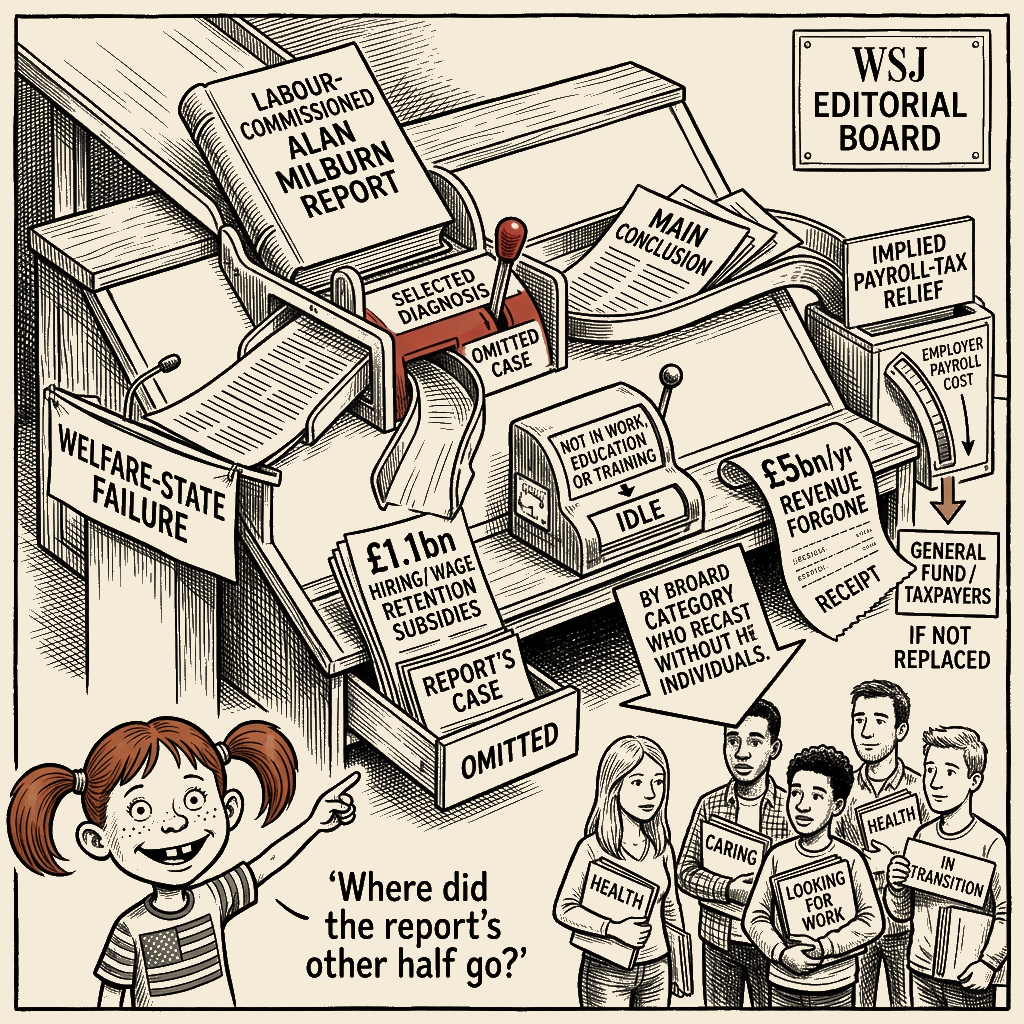
Where did the report’s other half go?
What the Editorial Argues
The editorial argues that Britain’s youth-employment crisis is principally a welfare-state failure: generous disability benefits, rapid minimum-wage increases, and payroll-tax costs supposedly made both hiring and non-work more attractive, while Alan Milburn’s proposed spending would repeat the mistake. It uses Milburn’s statistics and language to establish the scale and human cost of youth detachment, then dismisses the report’s recommended hiring, wage, and retention subsidies while pointing, by implication, toward payroll-tax relief. The closing frame turns a British policy dispute into “Europe’s welfare crisis” and casts young Europeans as its victims.
Receipts
The editorial borrows a Labour-commissioned report’s authority, swaps a mixed inactivity population for a moral category of welfare dependency, and leaves the report’s own policy case outside the frame.
What the framing wants you to believe
- Britain’s youth-joblessness crisis is principally the product of “welfare-state failures,” with disability benefits, minimum-wage increases, and payroll taxes making non-work easier and hiring more expensive.
- A “respected Labour expert” has confirmed the diagnosis, while Milburn’s proposed spending amounts only to “more entitlements” and “more subsidies and mandates.”
- The only credible response is fiscal relief for employers; Europe’s supposed welfare meltdown shows what happens when governments choose otherwise.
What’s really going on
- Technique and omitted relation: The editorial uses hostile-witness laundering—the recruitment of an opponent’s expert to authenticate the frame—while a denominator swap turns “not in work, education or training” into “unemployed,” then “idle.” It omits the population composition, the youth share of the benefit spending, the provenance of the cited policies, and the evidence or reasoning behind Milburn’s preferred remedies.
- Protected beneficiary: The concrete beneficiary of the implied payroll-tax cut is the employer set, especially businesses in the “hospitality and retail” sectors the editorial says are burdened by national insurance. Because the editorial describes national insurance as shared between employees and employers, employee-side relief is also a possible incidence path—but the editorial does not calculate how much would reach workers, so it leaves that benefit unmeasured as well.
- Normalized harm: Young people’s health conditions, caring responsibilities, limited job opportunities, and other reasons for inactivity disappear from the causal account. Benefits, medical diagnoses, and lost work are converted into evidence of personal dependency, while the decisions of governments and employers are displaced into the passive noun “policies.”
Anchor for the core finding: The editorial itself is the primary receipt for the operation. It says Milburn “oddly” declines to recommend cutting payroll taxes, prices that omitted alternative at £5 billion a year, and dismisses the report’s chosen remedies without reproducing the report’s case for them. The juxtaposition establishes the board’s selection; the full Milburn report is needed to test the selected diagnosis and numbers.
The Operation
Triage, authorship, and placement
The classification is high-confidence: this is an unsigned Wall Street Journal Editorial Board piece, not a signed columnist’s work. Its institutional voice and compressed third-graf turn—from Milburn’s commissioned report to a general welfare-state indictment—match the house method in the WSJ Editorial Technique Catalogue. The domain is British social policy, youth labor-market participation, disability administration, and payroll taxation. Its principal archetype is the “study shows” ledger in §4.5, joined to an austerity-thrift analogue, a hostile-witness deployment, and a threat-inflation closer.
This is a liberty-frame operation, and it does not receive the benefit of its own preferred causal assumptions. The advocated position is mixed overall, leaning selfish: the fiscal costs and work incentives invoked by the editorial are legitimate subjects, but the editorial’s selection protects a concentrated beneficiary while assigning the explanatory burden to young people who receive benefits or cannot find suitable work. “Selfish” here describes incidence, not motive or moral character.
Milburn is the source; the board is the institutional author of the editorial frame. Starmer commissioned the report, Milburn supplied its findings, and the Editorial Board selected the passages that made the anti-welfare conclusion available while discounting the package in which Milburn placed his confidence. The documented placement chain is:
Starmer’s commission → Milburn’s report → the board’s selection and juxtaposition → the editorial’s welfare indictment → placement in the Journal’s opinion feed.
No donor network, hidden sponsor, focus-group instrument, or cross-outlet coordination document appears in the supplied record. I will not manufacture one. The simpler public-record operation is also the more damaging one: a real primary document is made to carry a conclusion its selected excerpts cannot bear.
I drafted unsigned board copy of this class for years. The sequence was familiar: begin with the remedy the house prefers, then recruit the opponent’s expert and audit the report for figures that make that remedy look inevitable. That is drafting discipline I practiced; it is not proof of a hidden arrangement behind this particular article. I know why the reader experiences Milburn’s report as a confession. That is what the borrowed credential is for.
The board never explicitly prints “cut payroll taxes.” It prints Milburn’s refusal to recommend that cut as “oddly,” supplies its £5 billion price, and offers no substitute fiscal remedy. Against the page’s declared hostility to “confiscatory taxation,” the selection makes the intended conclusion concrete enough to analyze. The conclusion remains a marked inference rather than a quotation; the hostile-witness operation is independently visible on the page.
Cui bono: the payment pathways
The most concrete protected beneficiary is the employer set. The editorial says national insurance is “split between employees and employers” and identifies hospitality and retail, with “thin profit margins,” as sectors harmed by rising employment costs. If the implied relief runs, employers’ payroll bills fall initially. That is a payment pathway, not a merely ideological alignment.
The editorial does not establish the incidence. It prices the entire policy at £5 billion in forgone revenue but never divides that amount between the employer and employee components. Consequently, it cannot support the claim that employers would receive the whole benefit. Employee-side relief could arrive as take-home pay for some of the same young workers the editorial presents as idle. Business readers and higher-income readers are also the audience most likely to identify with employer relief and lower labor costs, but without a direct payment calculation their position remains audience alignment, not a measured cash benefit. No concrete electoral-payment or party-coordination pathway is established, so politicians seeking a labor-blame frame remain contextual beneficiaries rather than the finding’s apex.
The cost-bearers are easier to trace. Taxpayers and the general fund absorb the £5 billion if the tax cut proceeds without a replacement. Young people with disabilities, health conditions, or caring responsibilities bear the rhetorical burden of the editorial’s causal story, even though the text supplies no clinical source for its claims about “vaguely defined or overdiagnosed” conditions. A policy of benefit tightening would fall on those claimants, while if payroll-tax relief failed to create work, unemployed young people would bear the opportunity cost.
The article reports several magnitudes: nearly one million young adults outside work, education, or training; one in eight people under 25 described as “idle”; a 65 percent rise in wage costs for 18- to 20-year-olds; £55 billion in working-age disability and incapacity spending in 2024-25, projected to reach £68 billion; £5.8 billion in annual youth-productivity “investment” proposed by Milburn; £1.1 billion annually for employer subsidies; and £5 billion in annual revenue forgone by a payroll-tax cut. These are the editorial’s account of Milburn’s report, not independently verified findings. In particular, the £55 billion total covers working-age disability and incapacity spending generally; the editorial supplies no youth-specific share.
The legitimate half must remain visible. Public money can be wasted, poorly designed benefits can weaken work incentives, and labor costs can affect hiring at some margins. The operation begins with that true kernel and then makes a monocausal story out of it. The Suppressed Variable Diagnostic finds the motivated stop: the argument follows the evidence until it reaches the questions of employer demand, institutional decisions, policy provenance, and program design, then halts before those questions can complicate the preferred remedy.
Alternative design
A program optimized for the stated rationale—reducing youth detachment without converting disability into moral delinquency—would begin with the interests of young people who are not in work, education, or training:
- Count the right populations separately. Publish unemployment, economic inactivity, education or training participation, disability, health, caring, and discouragement with distinct denominators. “Idle” should not perform the work of a statistical category.
- Separate eligibility from conduct. Individualize benefit assessment around functional need and pair work requirements with usable health, care, transport, and placement services. A system-wide assessment problem is not proof that individual claimants are fraudulent.
- Fund the demand side. Pair targeted hiring, wage, and retention subsidies with actual employer demand, local job creation, apprenticeships, and retention support. Test the proposal Milburn made rather than dismissing it as “entitlement.”
- Make fiscal relief conditional and measurable. If payroll-tax relief is part of the answer, tie it to net new hires or retention, publish the counterfactual, and account for whether the employee component reaches workers.
- Publish results and revise. Evaluate programs against credible comparison groups, disclose failures as well as successes, and make future funding depend on the evidence rather than on the preferred label.
Fear, greed, and laziness
FGL here is an incentive map, not a diagnosis of private character.
- The frame’s author: Fear of appearing to approve policies that enlarge inactivity; greed for a narrative that protects the preferred tax order and business-cost frame; laziness about separating unemployment from inactivity and diagnosis from remedy.
- The apex beneficiary: Employers of young and lower-wage workers have a legitimate interest in labor costs and predictable mandates, a concrete interest in payroll-tax relief, and a convenience incentive to favor tax relief over training, accommodation, and placement that require more work.
- The rank-and-file reader: Fear of taxes, disorder, and being asked to finance inactivity is real. The wish to keep one’s own money is ordinary. So is the relief of being handed a finished moral story instead of having to inspect denominators and counterfactuals. The frame exploits convenience without treating its audience as stupid.
- The government and report: A governing party has reason to fear visible failure and to prefer investment that can be presented as active government. Milburn has an interest in a report that remains serious and politically usable. Those incentives do not make his findings false; they do explain why the board can recruit one portion of the report and discard another.
The placement is therefore mixed, leaning selfish: a genuine policy problem wrapped around a distributional selection that protects employers and readers’ fiscal preferences while displacing causation onto benefit recipients.
Technique identification
-
Hostile-witness laundering and the “study shows” ledger.
Cue: “To his credit,” Starmer commissioned “Alan Milburn, a respected Labour expert on social welfare”; the editorial then treats “the main conclusion” and “a central fact in this report” as self-authenticating evidence.
Cross-reference: WSJ Editorial Technique Catalogue §4.5, “The ‘study shows’ ledger”; the Bad-Faith Techniques Catalog’s “manufactured controversy” entry is a rejected overlabel here because the report is real and no fabricated scientific consensus is alleged. I call the composite “hostile-witness laundering”; that label is mine, not a catalog term.
Operation: The Labour credential inoculates the standing anti-welfare frame against the charge of partisanship. The board can then use the report’s diagnosis while treating its remedy as evidence of confusion. Bernays’s lineage appears in the use of credentialed authority as a campaign vector, without requiring an invented donor chain. -
The denominator swap and statistical equivocation.
Cue: “A crisis of unemployed young people” is followed by “Nearly a million young adults…aren’t working, pursuing higher education or in job training,” then by “One in eight Britons younger than 25 are idle.”
Cross-reference: Bad-Faith Techniques Catalog, “Equivocation”; Office for National Statistics Labour Force Survey as the intended Tier-1 category check.
Operation: “Unemployed” carries an official statistical meaning; the nearly-one-million figure describes a broader inactivity population; “idle” converts that population into a moral characterization. The editorial supplies no denominators or official category definitions. Lippmann’s original “stereotype” is visible: the ready-made image replaces the person and the relationships behind the number. -
Aggregate substitution and hasty generalization.
Cue: £55 billion in spending for “working-age disability and incapacity benefits” is placed beside the youth-inactivity argument without a youth share; the same section then treats the broad figure as part of the explanation for youth joblessness.
Cross-reference: Bad-Faith Techniques Catalog, “Hasty generalization”; WSJ Editorial Technique Catalogue §4.5.
Operation: A real number is attached to the wrong population. The number supplies fiscal authority; the absence of a youth-specific bridge supplies the causal claim. The same move appears in “Nothing like them ever has,” where an unspecified class of programs is made to bear an absolute verdict without a program corpus, outcome measure, or comparison. -
Frame-engineered relabeling and the austerity-thrift cluster.
Cue: “welfare-state failures,” “more entitlements,” “government ‘investment,’” “subsidies and mandates that punish work,” and “Dependency weighs on these young welfare beneficiaries.”
Cross-reference: WSJ Editorial Technique Catalogue §§4.1–4.2; Bad-Faith Techniques Catalog, “Frame-engineered relabeling.”
Operation: Public effort becomes “entitlement,” targeted employment support becomes “punishment,” and dependency becomes the affliction rather than a relation between people, benefits, health, and available work. Luntz’s relabeling lineage and Lakoff’s frame-activation account are visible in the text. Bandura’s moral justification, euphemistic labeling, attribution of blame, and distortion of consequences operate together as a permission structure for the implied policy correction. This identifies a textual mechanism; it does not prove a particular internal directive. -
Diffused responsibility and agentless causation.
Cue: “government policies made hiring young people more expensive,” “Aggressive increases to the minimum wage,” and the collective noun “welfare state.”
Cross-reference: Bandura’s mechanisms 4 and 5—displacement and diffusion of responsibility; WSJ Editorial Technique Catalogue §4.2.
Operation: The chain of decision-makers is dissolved into “policies.” The editorial never identifies which level of government, which tax decision, or which rate path produced the 65 percent cost increase. The government, employers, administrators, and labor-market structure therefore remain outside the causal account even though each bears part of it. -
Selectional strawman and partial false dilemma.
Cue: “So the obvious solution is … more entitlements for the young?” and “Milburn wants more subsidies and mandates to coax the young to work.”
Cross-reference: Bad-Faith Techniques Catalog, “Strawman” and “False dichotomy / false dilemma”; WSJ Editorial Technique Catalogue §4.6.
Operation: The board reduces targeted hiring, wage, and retention subsidies to indiscriminate entitlement and then presents payroll-tax relief as the only serious alternative. The match is partial because the editorial does mention tax relief; what it suppresses is the policy menu between unrestricted entitlement and inaction: targeted relief, redesigned support, individual assessment, employer demand, and evaluated employment investment. -
The evidence double standard and universal negative.
Cue: “There’s no evidence these programs will work, since nothing like them ever has.”
Cross-reference: Bad-Faith Techniques Catalog, “Hasty generalization”; WSJ Editorial Technique Catalogue §4.5.
Operation: The causal diagnosis is accepted from a report whose methods, definitions, and caveats are not surfaced; proposed interventions are rejected categorically without identifying any prior program, evaluation, or failure mechanism. “No evidence” is treated as “evidence of universal failure.” The sentence cites the board’s confidence, not the missing record. -
Threat inflation and the civilizational close.
Cue: “Behold Europe’s social-welfare meltdown in a nutshell” and “Europe’s welfare crisis in technicolor, and young Europeans will continue to be its victims.”
Cross-reference: WSJ Editorial Technique Catalogue §4.13, “The threat-inflation closer”; National Review Editorial Technique Catalogue §4.5, “The civilizational frame.”
Operation: A checkable British policy dispute becomes a European destiny without comparative data, peer countries, a baseline, or a time series. Schmitt’s friend-enemy structure is supplied by “welfare” as the antagonist and young people as scenery in a moral drama. The categorical close is built for retransmission and makes inconvenient denominators seem small. -
Multiple-audience targeting and the technocratic credential ledger.
Cue: “a respected Labour expert” appears beside exact pounds, percentages, and forecast years embedded in an anti-welfare conclusion.
Cross-reference: WSJ Editorial Technique Catalogue §§3.7 and 4.3.
Operation: The business reader receives lower labor costs and fewer mandates; the political class receives a nonpartisan-looking critique of Labour’s own expert; the populist reader receives Labour, Europe, and “idle youth” as grievance objects; the technocratic reader receives fiscal totals and report citations. This is audience management, not by itself proof of coordination.
Audience-management function
The editorial supplies a permission structure for fiscal restraint: the reader is not choosing who goes without; the reader is correcting a policy pathology. It performs identity confirmation by casting the reader as a productive, responsible citizen rather than a beneficiary of an allegedly indolent system. It provides grievance ratification through Labour, “Europe,” and “the welfare state.” It offers status display to readers who can recognize supposedly expensive programs despite the respectable authorship behind them. It installs a counter-frame in which employer decisions, weak job creation, and service constraints become secondary to subsidy-created idleness. Above all, it enables conscience displacement: the recipients absorb the accusation, while the reader can retain the feeling of fiscal prudence without examining who designed the system, set its labor costs, or tested its remedies.
The Record
Anchor receipts and claim tests
Only one actual document is in the packet: the editorial. It is Tier 1 for what the board said, not for the truth of Milburn’s empirical claims. The full report would be the Tier-1 primary document for its findings and recommendations, but it was not supplied.
The candidate Tier-1 receipts are:
- Alan Milburn’s youth-inactivity report, including its appendices, definitions, methods, tables, and treatment of recommendations.
- Office for National Statistics, Labour Force Survey records on employment, unemployment, economic inactivity, education participation, and the age bands underlying the “one in eight” claim.
- Department for Work and Pensions administrative statistics on disability and incapacity claims, caseloads, age, benefit type, and projected participation.
- Office for Budget Responsibility forecasts for the £68 billion trajectory and the assumptions behind it.
- GOV.UK and HMRC schedules for minimum-wage rates, national-insurance rates, the secondary threshold, and the calculation behind the reported 65 percent rise.
Candidate Tier-2 supporting receipts include Low Pay Commission reviews of employment effects at different minimum-wage levels and Institute for Fiscal Studies work on labor-cost incidence, employer responses, and employment subsidies. Those sources could test the propositions; they do not refute them automatically.
Seven load-bearing claims require testing:
| Load-bearing claim | Receipt status | Verdict |
|---|---|---|
| Nearly one million young adults are outside work, education, or training, and one in eight people under 25 are “idle.” | The editorial attributes the figures to Milburn. The ONS Labour Force Survey is the controlling statistical source, but no underlying table or series was supplied. | Supported as an attribution to the editorial, but not independently confirmed from the supplied record. The editorial does not provide the age denominator required to reproduce the “one in eight” calculation. |
| “Most have never held a job and aren’t looking for one,” and many are supported by disability-linked welfare. | The claim comes through the editorial’s summary of Milburn; DWP administrative data is the controlling receipt. | Supported as an attribution to the editorial, but the specific population composition is not independently confirmed from the supplied record. This is more specific than the NEET total and is the claim converting inactivity into apparent choice. |
| Disability benefits, minimum-wage increases, and payroll taxes caused the rise in youth joblessness; government policy is the principal cause. | Milburn’s report, DWP data, and labor-market research would be required to test the components and the causal ranking. | The editorial presents this as the report’s conclusion, but the supplied record does not independently establish its monocausal form. |
| Wage costs for an 18- to 20-year-old employee rose 65 percent in five years. | Milburn’s report, GOV.UK minimum-wage schedules, HMRC national-insurance schedules, and ONS earnings data are the controlling receipts. | Supported as an attribution to the editorial, but not independently confirmed from the supplied record. The editorial does not define “wage costs,” nominal or real treatment, base pay, employer on-costs, worker composition, or the comparison year. |
| Working-age disability and incapacity spending rose 46 percent in real terms to £55 billion and is projected to reach £68 billion. | DWP outturn data and the relevant OBR forecast are the controlling receipts. | Supported as an attribution to the editorial, but not independently confirmed from the supplied record. The editorial supplies no youth-specific share for the £55 billion total and no precise assumptions for the projection. |
| Disability-benefit claims are expected to quadruple by 2037 relative to 2012. | DWP claimant projections and forecast documentation are the controlling receipts. | Supported as an attribution to the editorial, but not independently confirmed from the supplied record. Eligibility, diagnostic, demographic, and caseload assumptions are absent. |
| Milburn proposes £5.8 billion annually in youth-productivity investment, including £1.1 billion for hiring, wage, and retention subsidies; a payroll-tax cut would forgo £5 billion annually. | The amounts and recommendation wording come from the editorial’s summary of Milburn’s report. | Supported as an attribution to the editorial. The exact amounts and wording remain unconfirmed from the supplied record until the report is inspected. |
Per-citation accuracy verdicts
- “New phenomenon of youth detachment” is presented as Milburn’s wording and is quoted accurately on the face of the artifact. Its exact context and surrounding qualifications remain unverifiable because the report is absent.
- “Lost opportunities, lost earnings, lost confidence and lost purpose” is likewise presented as a direct quotation. The editorial’s movement from that language to a generalized condition of hopelessness is an additional argumentative step.
- “The main conclusion is that youth joblessness has risen…” is an unquoted paraphrase. The artifact cannot establish whether the report supports the editorial’s full causal ranking as stated.
- “Vaguely defined or overdiagnosed” is a substantive clinical characterization presented in the board’s narrator voice without a named clinician, prevalence study, diagnostic source, or claimed rate. It does not meet the Bad-Faith Techniques Catalog documentation threshold for treating it as an established finding.
- “Nothing like them ever has” has no cited program corpus, evaluation, outcome measure, or comparison. It is an absolute historical assertion and is not independently confirmed from the supplied record.
- “Europe’s social-welfare meltdown” is not a citation-supported comparative finding. The editorial supplies no European data set, baseline, peer country, or time series.
- “That failed amid a revolt” is the board’s characterization of the welfare legislation. The supplied record does not establish what failed, how the legislation changed, or whether delay and revision are accurately characterized as policy failure.
The editorial’s overall use of its source is selective. The quotations shown in the artifact are not presented as invented, but the report is recruited to authenticate the diagnosis and then disowned when it reaches the prescription. Nothing in the editorial reproduces the report’s reasoning for its own program.
Load-bearing omissions
- The official distinction between unemployment, economic inactivity, education participation, and the editorial’s moral category of “idle.”
- The denominator and composition of the nearly one million, including jobseekers, people unavailable to work because of health or caring, and others between transitions.
- The youth-specific share of the £55 billion working-age disability and incapacity total.
- The forecasting method and assumptions behind the £68 billion and 2037 projections.
- Which governmental decisions, rate changes, and employers produced the labor-cost changes blamed in aggregate.
- Employer demand, vacancies, turnover, local labor-market conditions, and the employer’s role in setting wages and hiring.
- Health, disability, and caring constraints; the clinical claim about “overdiagnosed” conditions has no source.
- The distinction among minimum-wage changes, employer tax changes, base pay, and whatever else the 65 percent “wage costs” measure includes.
- Prior evaluations of employment subsidies and other youth programs—the evidence the editorial says does not exist.
- Milburn’s reasoning for preferring targeted investment to an immediate payroll-tax cut.
- Any complete alternative from the board, its budget, its incidence, or its treatment of the workers and claimants discussed.
- Comparative evidence supporting a European welfare crisis.
- Employee-side incidence of a payroll-tax cut, despite the editorial’s own acknowledgment that national insurance is shared.
Missing-information declaration
The full Milburn report, its appendices, methodological note, underlying tables, and program evaluations were not supplied. No external source extracts were provided for the ONS, DWP, OBR, GOV.UK/HMRC, Low Pay Commission, or IFS claims. Exact series identities, category wording, and forecast scopes therefore remain unresolved rather than silently replaced. No leaked-memo material or unflagged retained-memory account has been used to fill those gaps. The supplied record does not establish that this editorial was focus-grouped, donor-directed, or coordinated across a syndication network, and no such claim is made.
How to Recognize This
The pattern is the borrowed diagnosis and denominator swap. An opponent’s expert supplies the facts, the editorial supplies the moral frame, the population is renamed, and the report’s prescription is edited out of view. I called the first move hostile-witness laundering. It works because the reader experiences the report as having confessed to the editorial’s thesis.
The mechanism is substitution. A relationship between government decisions, employer demand, health constraints, public money, and work is replaced by a relationship between “welfare” and “idle” young people. Numbers then arrive as evidence of a story the prose has already told. The reader does not need to ask who chose the minimum wage, which tax rules changed, whether jobs existed, whether health care was available, why the program was proposed, or who would benefit from the alternative. Those questions are not answered poorly. They are excluded from the frame.
Look for four signals next time:
- The noun changes. Watch for “unemployed” giving way to “inactive,” “detached,” “idle,” “dependent,” or “not working” without an official denominator. In this piece, “nearly a million” is expressly defined as people outside work, education, or training; the lede first calls that population “unemployed,” and the body calls one in eight “idle.” That is not statistical precision. It is category management.
- Adjacent numbers lack a common base. The £55 billion figure covers working-age disability and incapacity spending generally, but it is placed beside an argument about young people without showing what any of it is youth-specific. When a broad total and a subgroup claim share proximity but not denominator, the silence is doing argumentative work.
- An evaluative adjective arrives without a measuring instrument. “Vaguely defined or overdiagnosed” sounds clinical. Ask who diagnosed what, among how many, compared with what baseline, and under what eligibility rules. If no source answers, the adjective is functioning as a disguised finding.
- “Oddly” marks a missing prescription. When an editorial calls an expert’s refusal “odd,” it is usually displaying a remedy it wants while pretending to honor the expert’s argument. Find the report’s own reasoning. Then read the alternatives the editorial omits: targeted support, individual assessment, employer demand, apprenticeship, evaluated subsidies, and the counterfactual of doing nothing.
Why it works: the borrowed credential settles the diagnosis before the reader reaches the evidence, and the evidence is where the money is. “Respected Labour expert” makes blame feel bipartisan. Exact fiscal figures make the frame look technical. The scare quotes around “investment,” the moral noun “idle,” and the closing image of Europe in technicolor supply the emotional conclusion after the technical-looking proofwork has done its job.
When you see it, trace the cited report’s funding chain. Here the report was publicly commissioned, so a hidden donor is not the missing relation; the missing relations are employer demand, benefit design, assessment capacity, health and care constraints, policy provenance, and prior program evaluations. Check the report’s definitions, appendices, counterfactual, and evidence rather than accepting the conclusions repeated by the editorial. Recompute the denominator. Ask who receives the lower cost, who bears the forgone revenue, and whose health or care constraints disappear from the causal story. Follow the wording across the opinion network—“idle,” “dependency,” “meltdown,” “investment”—as a search signal, not proof of conspiracy. Most usefully, reduce the frame’s automatic activation: rewrite the passage using only the official categories, population shares, dates, incidence calculations, and policy text, then see whether the conclusion survives.
The point is not that every young person is without agency, that every benefit rule is defensible, or that fiscal restraint is illegitimate. Where choices exist, people must be allowed to make them and bear their consequences. The point is that an institutional choice is not a personal failure, a health or care constraint is not idleness, and an aggregate cost is not a subgroup’s guilt.
I built frames of this kind. I know their temptation because the clean story moves faster than the true one and arrives with the moral furniture already installed. Recognition is not innocence; it is the refusal to let the clean story substitute for the record. I cannot give any reader immunity from capture. I can say what the wiring looks like once the borrowed authority is stripped of its aura: ask what the number counts, whose decision it hides, who receives the benefit, and who has been assigned the harm. The reader carries the recognition forward from there.

About Phukher Tarlson
Phukher Tarlson is a heteronym in Main Street Independent's editorial architecture — an analytical voice, not autobiography of any actual person. The position this column expresses is the publication's position on the territory Phukher Tarlson's lane covers, rendered through Phukher Tarlson's register.