Responding to: Nvidia and Federal Intervention — James Freeman · 2026-11-24
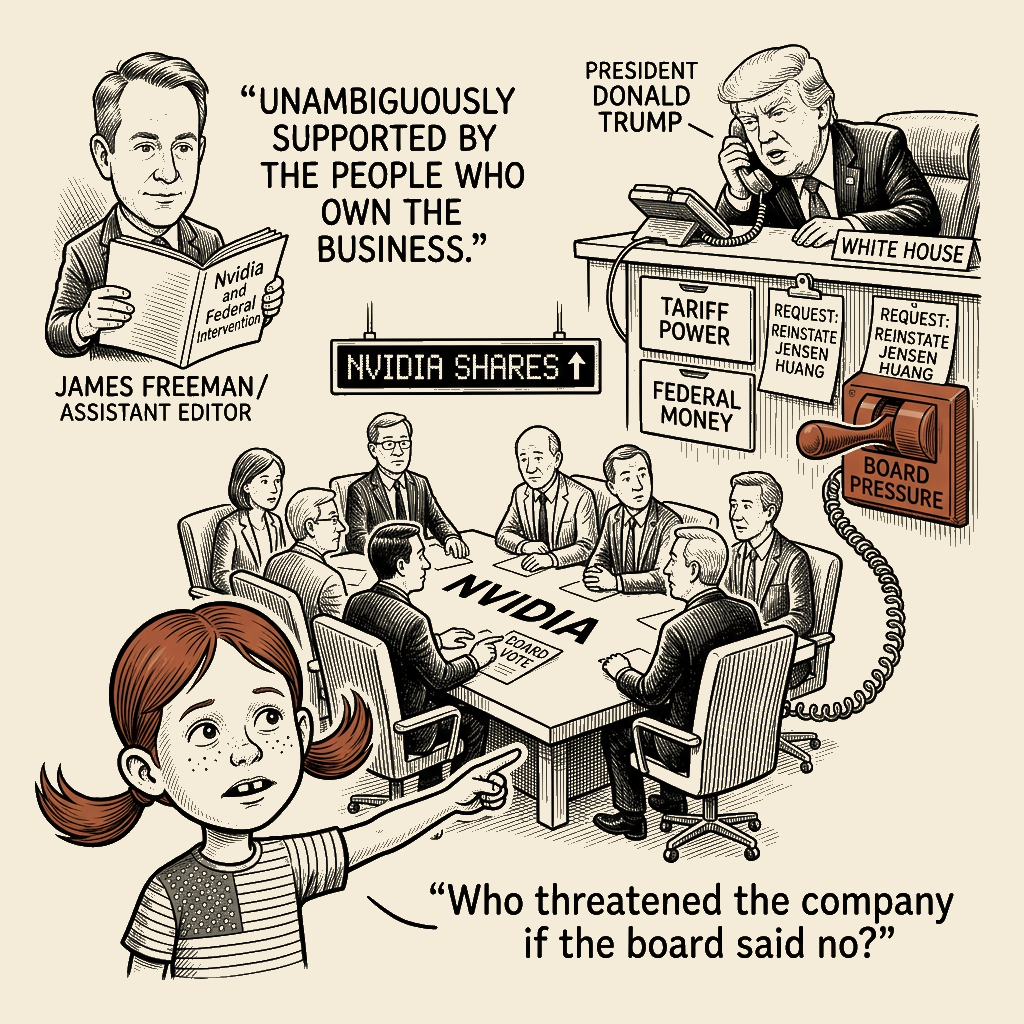
Who threatened the company if the board said no?
What the Piece Argues
The piece argues that corporate governance in a free market belongs to shareholders acting through their board, and that the hard line runs against unelected officials: they “can’t and must not ever” force leadership changes at American companies by anonymously leaking classified information, and suspected lawbreaking belongs in federal court, where executives receive due process and the presumption of innocence. It concedes that President Trump has undertaken “a number of ill-considered interventions in private industry,” but defends his effort to persuade Nvidia’s board to rehire Jensen Huang as different in kind — because the shares surged Monday, the action “was unambiguously supported by the people who own the business,” whose capital is at risk and whose call it therefore is. The piece closes by citing Competitive Enterprise Institute data on record-low rulemaking, arguing U.S. markets are becoming freer despite “a strange mixture of wise federal restraint and foolish federal intervention.”
Receipts
The framing launders presidential pressure on corporate leadership through the idiom of shareholder sovereignty — measuring the legitimacy of state coercion by the stock ticker instead of by the rule of law.
The framing wants you to believe
- That a president’s open pressure on a corporate board is legitimate so long as the shares rise afterward: “Monday’s surge in Nvidia shares shows that the president’s action was unambiguously supported by the people who own the business.”
- That the true threat to corporate governance is the anonymous bureaucratic leak — not the open intervention by an office holding tariff power and federal money.
- That shareholders “are the legitimate decision-makers,” so whatever the tape certifies is the free market working.
What’s really going on
- A stock-price move measures expected shareholder returns, not consent to state coercion. What the ticker priced Monday was delivered favor — and the price of the favor is a precedent every board in America now carries: its leadership operates in the shadow of the president’s preference, and rivals without that favor can calculate what that means.
- The column’s rulebook is real but scoped: unelected officials “can’t and must not ever” force leadership changes “by anonymously leaking classified information,” and suspected lawbreaking goes to “a case in federal court.” The intervention that actually happened was neither anonymous nor in a courtroom — it was the president, openly — and the column blesses it because the pressure paid.
- The record waved off as “only the latest”: in August 2025 the federal government converted CHIPS Act grant commitments into an equity stake of roughly $8.9 billion — about 9.9 percent of Intel — after the president publicly demanded that company’s CEO’s resignation and then blessed him (Reuters, Aug. 22, 2025). In June 2025 the U.S. Steel sale closed under a National Security Agreement carrying a government “golden share.” State direction of nominally private enterprise, finished with a ticker-friendly bow.
The Response Ladder
Polite Reframe
When to use: For persuadable moderates and good-faith family — the reader who owns shares, watches the tape, and wants to believe a rising chart settles a constitutional question. Calm, professional, story-first; the receipt does the work; the voter is never the enemy.
I take the founding claim at face value, because it is correct: “The people who decide who runs a business in America are the people who own the business.” Hold onto that. It is exactly why the argument in front of us fails its own test.
Picture a hypothetical director — call her Diane — two terms in on the board of a mid-sized American manufacturer. The morning her board weighs a CEO change, the call comes in from Washington. Not from an intelligence agency. Not through an anonymous leak. The president of the United States, on the record about the outcome he wants, from an office that holds tariff power in one drawer and federal money in the other. Diane’s question is not whether she likes the candidate. Her question is what the caller’s office can do to her company if she votes the other way.
That leverage is not hypothetical. The record shows what the drawer holds. In August 2025 the president publicly demanded the resignation of Intel’s chief executive; days later he met the man and pronounced himself impressed; weeks after that the federal government converted CHIPS grant commitments into an equity stake of roughly $8.9 billion — about 9.9 percent of a nominally private chipmaker (Reuters, Aug. 22, 2025). In June 2025 the U.S. Steel sale closed under a National Security Agreement carrying a government “golden share” — a federal consent right written into the company’s own decisions. Every board in America read both memos. So when Nvidia’s shares surged Monday, what the tape was pricing was not the owners’ deliberation. It was the favor — and the favor’s price is the lesson every other board just received.
The column’s own rules are good rules, and I will enforce them gladly: unelected officials “can’t and must not ever” force leadership changes by anonymously leaking classified information, and a suspected lawbreaker gets his case in federal court. Fine. The intervention that actually happened was neither anonymous nor in a courtroom. It was the president, openly — and the column blessed it because the tape went green. If we believe shareholders own the business, then the intervention to refuse is any state thumb on the board’s scale — the leak and the phone call alike. Enforcement in court. Government contacts with companies disclosed. Boards that owe their seats to no phone call. That is shareholder sovereignty with its actual meaning intact — and it is what we are defending.
Mockery and Ridicule
When to use: For the bystander audience — the coworker who has watched the tape all week and needs to see the trick performed in daylight. Sharp and satirical; the repeater is shown the machinery, never mocked; the apex of power takes the hit.
New corporate-governance doctrine, fresh off the editorial page, and honestly it’s elegant: legitimacy by candlestick chart. The board convenes around the ticker like a séance, the candles are Bloomberg terminals, and the ghost of the free market spells out one word — M-O-M-O. The people have spoken. The people, in this cosmology, are a moving average.
Call the doctrine what it now is: the corruption-preserver’s free market — “free market” printed on the label of a jar that contains nothing, while the high priests rule that the price of a presidential blessing is obedience.
Here is what the ticker certified, inside the record the column calls restraint. Intel: the president demands a CEO’s resignation by name, then dines him, then the United States government converts grant commitments into roughly a tenth of the company — and that is a footnote. U.S. Steel: a golden share, a federal consent right written into a private steelmaker’s own decisions, announced with an exclamation point. TikTok: kept alive by serial executive decrees stretching a divest-or-ban deadline. And now Nvidia: the president lobbies a board for his man, the stock surges, the editorial verdict — unambiguously supported. Supported by whom? By traders pricing the favor. A man who holds the weather does not persuade a board; he raises the question of whether it might rain on their harvest, and the directors find religion. The column that spent its first paragraph banning unelected officials from leaking leadership changes into existence spent its third applauding the one official who did it in daylight.
If you watched the tape go green and concluded the republic was fine, understand: you were not the principal in that transaction. You were the collateral. The surge is the receipt they file in your name.
Ours is the boring version, and we intend to keep it: boards that answer to owners and to nobody’s phone calls, government contacts with companies on the record, lawbreakers walked to the courthouse the column itself nominates. A rising chart is a price, not a plebiscite. Kings claimed divine right. This one claims beta. Same throne, faster ticker.
Nuclear Satire
When to use: Scorched earth, for the reader ready to watch the whole operation named — the ideas, the institutions, and the named men at the apex villainized in full; receipts stacked with cumulative force; no lies told, no mercy for the conduct.
The American free market was not killed; it was embalmed in public, on the business desk, with the family posing the corpse under a “shareholder sovereignty” banner for the photograph — and the eulogy, read at the service, was an op-ed insisting the deceased had never looked better, citing Monday’s rally as proof of resurrection.
Follow what the column itself narrates, minus the incense. The president pressed a board to restore his preferred man. The shares answered. The verdict arrived wearing a powdered wig of principle: paragraph one — unelected officials “can’t and must not ever” force leadership changes at American companies by anonymously leaking classified information; paragraph three — but the one official who did it openly, on the record, from the office with tariff power and federal money in its drawers, receives a certified blessing, because the tape went green. That is not a constitutional argument. That is a protection racket with a masthead: the anonymous leak is a crime, the open call is a coronation, and the moral distinction between them is whether the money moved.
Stack the ledger this operation calls “wise federal restraint.” August 2025: the president demands a CEO’s resignation, then blesses him, and the treasury ends up holding roughly $8.9 billion — about a tenth — of a private chipmaker (Reuters, Aug. 22, 2025). June 2025: a golden share, a federal consent right bolted into the charter of U.S. Steel. CHIPS grants transmuted into government equity. TikTok kept alive by decree, deadline after deadline, until the palace pronounced the arrangement sound. In Moscow they ran this exact playbook a generation ago: October 2003, the state jailed the oligarch, then got around to his board, and the shareholders there also learned what their paper was worth when the state came to visit. We were taught, once, that we were different. The difference was supposed to be the law.
King warned at Riverside Church on April 4, 1967 that a society which prizes machines, profits, and property over persons breeds racism, materialism, and militarism as one three-headed pathology that cannot be slain one head at a time. Update the anatomy: the machines now vet their own operators, the profits certify the vetting as legitimate, and the property includes the presidency.
Donald Trump treats the federal government as a loyalty portfolio and every board in America as a franchise location. James Freeman, assistant editor of the editorial page and co-author of a book about this administration’s “revival,” watched the open reach into a personnel decision and filed it as a victory for owners — the house voice of the venue best positioned to bless it, delivered with a chart for a chaperone.
The counter-program is unglamorous and measurable, which is why it frightens them: independent boards, disclosed contacts, courts that see every man the same way — including the man holding the phone. So this is how the free market dies — with thunderous applause, on tape, green across the board. Padmé said it of republics; the editorial page has extended the franchise. King said the arc bends only if people bend it. The ticker bends every day, and it bends toward whoever is holding the phone.
Profane Scorched-Earth
When to use: Full catharsis, for the reader who needs the whole goddamn operation said out loud. Everything Nuclear permits, plus the language it holds back. The receipts stay; the gloves do not.
“It’s their call in a free market.” Their call. The shareholders’ holy fucking call. James Freeman, you wrote the rulebook in your own first goddamn paragraph: unelected officials “can’t and must not ever” force leadership changes at American companies by anonymously leaking classified information, and anyone suspected of breaking the law gets brought to federal court. You wrote both rules. Then the president — the one actor those rules conspicuously do not name — skipped both doors. No leak. No courtroom. Just an open thumb on a board vote. And you held his fucking coat, because the tape went green. That is not principle. That is a payscale for the truth, and the check cleared.
Look at the goddamn record the column shrugs off as “only the latest.” August 2025: Trump demands the CEO of Intel resign by name, then meets him, then the United States government converts public grant commitments into an equity stake of roughly $8.9 billion — about 9.9 percent of a private company — and the business pages call it industrial strategy (Reuters, Aug. 22, 2025). June 2025: a golden share jammed into U.S. Steel’s charter, a federal consent right over a company the government does not own, and the same pages that lose their minds over a school-library book call it a jobs miracle. TikTok kept on life support by serial decree. A decade of screaming that socialism is when the government owns things — and when the government actually takes a tenth of Intel, the business desk applauds the ROI. What the fuck did you think state capitalism looked like? It looks like this: well-lit, well-sourced, and up on the day.
Say the mechanism plain, because the mechanism is the whole con. A stock price is not a vote. It is a rumor about favors, priced. The shareholders didn’t decide a goddamn thing Monday; they found out what obedience was worth and marked it up. And every board in America watched a president reach into a personnel decision with tariff power in one drawer and federal money in the other, and read the new org chart — the one that now runs through the Oval Office. You want to invoke “the people who own the business”? Then name the piece of shit who taught every one of those owners that their proxy gets answered at 1600 Pennsylvania Avenue.
The prophets had a word for a market that blesses its own capture. Amos stood in the gate while the merchants below grew rich and religious, and he did not consult the tape: “Let justice roll down like waters, and righteousness like a mighty stream” (Amos 5:24). Not “let the quote roll up on the day.” Not “let the candle go green.” Justice. Waters. You have swapped the stream for a ticker tape and named the flood a free market, and Jeremiah’s line about people who “did not know how to blush” (Jer. 8:12) has your masthead written all over it.
So here is the catharsis, and then the work. Donald Trump ran the biggest shakedown of American corporate governance in modern history and received a business column for a blessing; the editorial page held the fig leaf and called it the flag. Malcolm X put the standard plainly at the founding rally of the Organization of Afro-American Unity: “I’m for truth, no matter who tells it. I’m for justice, no matter who it is for or against.” The truth is that the free market this column mourns over the leak is the same free market it buries under the phone call, and nobody with a functioning spine is required to pretend otherwise out of politeness to a masthead. And our side? We’re the market’s actual loyalists, and our practice is measurable: boards that owe their chairs to owners, government contacts disclosed, and every goddamn lawbreaker walked to the federal courthouse the column itself nominates — including the one holding the phone. Name the operation. Keep the receipts. And fight it by every analytical means necessary — in those courts, and at the ballot box, where the actual owners of this republic still get one call that isn’t measured in basis points.

About Malcolm Little King
Malcolm Little King is a heteronym in Main Street Independent's editorial architecture — an analytical voice, not autobiography of any actual person. The position this column expresses is the publication's position on the territory Malcolm Little King's lane covers, rendered through Malcolm Little King's register.