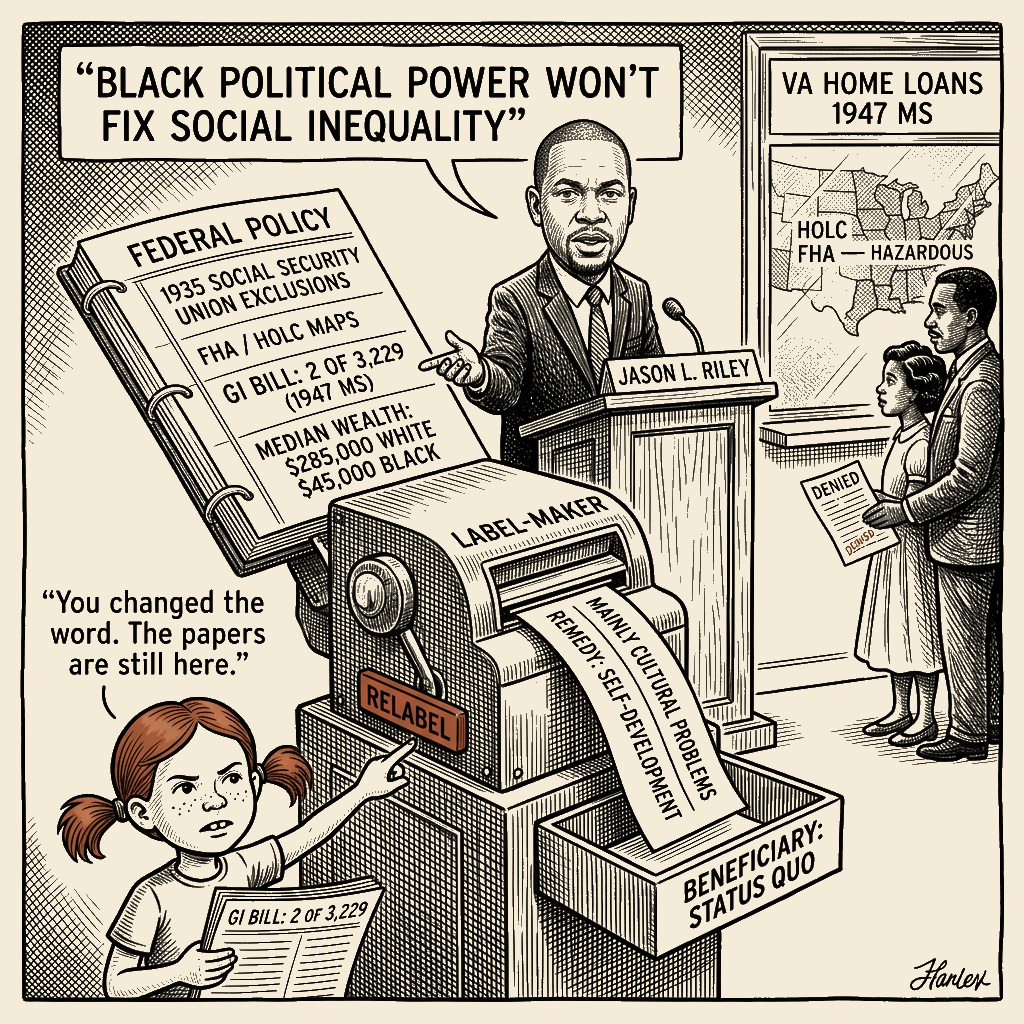
Responding to: Black Political Power Won’t Fix Social Inequality — Jason L. Riley · 2026-11-24
You changed the word. The papers are still here.
What the Piece Argues
Jason L. Riley argues that Black electoral success has not delivered economic advancement: he counts five Black governors taking office in January, notes decades of Black mayors in the largest cities, and points to a twice-elected Black president and a Black vice president — yet the Black poverty rate and the racial wealth gap persist. He credits the strongest periods of Black economic progress to market growth and tight labor markets rather than government programs or elected co-ethnics, cites Asian American advancement as proof that political power is not the deciding variable, and concludes that the assumption “that there are political solutions to what are mainly cultural problems is misguided.” His true half is real: mayors and governors do not automatically deliver prosperity to the poor, and he concedes the civil-rights legislation of the 1960s was necessary. His error is the conversion — from “political power is not sufficient” to “the problems are mainly cultural” — which reassigns the cause of the gap and shrinks the remedy to self-development.
Receipts
The move: relabel a ledger as a lifestyle — convert a wealth gap built by named federal policy into “mainly cultural problems,” so the remedy shrinks from legislation to self-improvement and the parties who profit from the gap never enter the story.
The framing wants you to believe
- Representation has been tried — mayors, presidents — and failed, so politics is a dead end for the Black poor, and what remains are “mainly cultural” deficiencies.
- The great mid-century Black advance happened by market grace — the 1948–73 income doubling, the Reagan expansion — with no federal hand required.
- A group that advanced without matching political power (Asian Americans) proves the general rule: power doesn’t matter, culture does.
What’s really going on
- The one thing the column gets right — representation alone does not guarantee prosperity — does not touch its conclusion. The record makes policy a material cause, not a ceremonial one: Donohue and Heckman found federal Title VII enforcement a principal driver of Southern Black wage gains from 1965 to 1975 (Journal of Economic Literature, 1991) — and the column’s flagship “growth window” (1948–73) contains the enforcement window.
- The gap the column calls cultural is a balance sheet: median white household wealth about $285,000 against about $45,000 for Black households (Federal Reserve Survey of Consumer Finances, 2022) — compounded from named acts of policy: the 1935 act that wrote farm and domestic work out of Social Security and union rights while roughly two-thirds of Black workers held those trades; GI Bill loans denied under Jim Crow administration (in 1947 Mississippi, 2 of 3,229 VA-backed home loans went to Black veterans); FHA/HOLC redlining.
- The tight markets the column credits to “growth” were repeatedly federal-purchased: WWII and Korea mobilization; a Reagan expansion that ran substantially on a defense buildup financed by a federal debt that roughly tripled from 1981 to 1989 (OMB historical tables); a record-low 5.3% Black unemployment in 2019 riding the long recovery opened by the 2009 stimulus. And the subprime industry selling what its own staff called “ghetto loans” burned through what equity remained (Baltimore’s suit against Wells Fargo; the bank’s $175 million federal fair-lending settlement, 2012).
The Response Ladder
Polite Reframe
When to use: For the persuadable neighbor, the deacon, the co-worker who shares the column in good faith — anyone still reachable with a calm hand and a straight fact.
A man from the block I came up on — I’ll call him Deacon Reeves, because he was one, forty years at the same church and thirty-eight at the same plant — had a father who came home from the Pacific in 1946 and went to the bank for a GI loan, same as the white veterans on the next block over. The loan officer pointed at a map on the wall. A federal map, drawn by a federal agency, the Reeveses’ streets shaded red — “hazardous,” “inharmonious,” which is the government’s own underwriting language, not mine. The white veterans bought. Reeves’s father kept renting, worked the double shifts, tithed, and put everything left over into six children, because that is what self-development looked like when the ladder was painted with an agency’s ink.
And the experiment he ran has a national result set. My people have run the column’s experiment at full compliance — work, thrift, church, family — and the gap held anyway. Median white household wealth: about $285,000. Median Black household: about $45,000 — the Federal Reserve’s Survey of Consumer Finances, 2022. That gap is not a mood; it is compound interest on named legislation: the 1935 act that wrote farm and domestic workers — roughly two-thirds of the Black workforce of that era — out of Social Security and union rights; the GI Bill administered locally under segregation, so that in 1947 Mississippi exactly two VA-backed home loans went to Black veterans out of 3,229; the redlining maps that decided credit for a generation. And the very era the column holds up — the great income gains of 1948 to 1973 — contains the years the federal government enforced civil rights in the labor market: Donohue and Heckman concluded that federal anti-discrimination enforcement drove the Black wage gains of the South from 1965 to 1975 (Journal of Economic Literature, 1991). The column credits the harvest to the weather. The harvest had farmhands, and the farmhands were federal.
The column quotes Booker T. Washington — “prepared for the exercise of these privileges” — and I agree with the sentence. But the record shows Washington quietly financing lawsuits against disenfranchisement from behind the scenes at Tuskegee (Louis R. Harlan’s biography documents the practice), because he understood, as the column does not, that self-development and political remedy were one program wearing two coats. Even the column’s quoted authority ran politics.
Here is what we are, then, since the column has asked: we are the builders. We feed, clothe, heal, and organize — the Black church fed the counties the map starved; the unions we built raised the wages the sermon now calls “culture”; the enforcement we demanded doubled Black household income inside a single generation. We don’t desert our own when they’re down — that is the whole of it. Nobody on this side says culture is irrelevant; my people built institutions under conditions the column’s authors never had to survive a week of. We are asking for what was promised — a country that keeps faith with its veterans, houses the families it once redlined, and reads its own ledgers. If growth and grit are the whole story, show me the map wasn’t drawn, show me the loans weren’t denied, show me the exclusions weren’t legislated. The documents say otherwise. “Cultural” is a word for a wound whose instrument is documented — and what legislation built, legislation can repair.
Mockery and Ridicule
When to use: For the bystander audience — the job here is to break the line’s spell and show the person repeating it that they are being used.
The coroner of the American city has updated his paperwork. Cause of death: “insufficient values.” The drowning victim is logged as a weak swimmer; the anchor welded to the ankle is filed under cultural artifacts; and the company that cast the anchor has retained the coroner as a consultant. It would be funny if the morgue weren’t so busy — at a wealth gap of $285,000 to $45,000 per household, it is a very busy morgue.
Exhibit A: a column announcing that Black political power hasn’t fixed inequality, filed by a senior fellow of the Manhattan Institute — the institute where Charles Murray wrote Losing Ground, reported for decades among whose major funders sits the Bradley Foundation, the same philanthropy that hung a prize on the byline in 2018. A man salaried by the anti-policy industry has concluded, after rigorous study, that policy doesn’t work. A fish has published a paper finding that water does not exist.
Now the stamp, because the badge invites it. The column wears “self-reliance” like a press pin — pull yourself up, seize the opportunity, stop asking. Strip the lapel and read the record: this is a corruption-preserver wearing self-reliance as a costume — and yes, a corruption-preserver is exactly as awful as it sounds: the man who tips the ladder over and then lectures the fallen on their climbing technique. The conduct matches the costume. The bank whose staff called the mortgages they pushed into Black neighborhoods “ghetto loans” — their term, entered into the record in Baltimore’s suit — would like a word about the neighborhood’s culture. The federal agency that painted those neighborhoods red for thirty years would like to commission a study of their decay. The Congress that wrote two-thirds of Black workers out of Social Security in 1935 is delighted to hear the gap is “mainly cultural.” Of course it is delighted. Culture is what they call it when the smoke clears and they are still holding the insurance policy.
And to be clear about the laughing order: nobody here is laughing at the relative who shares the thing. The relative has been handed a values lecture by men who have never once been asked for their own values — handed it by the industry that wrote the map, denied the loans, and commissioned the autopsy. The relative is the audience. The coroner is the act. We are the builders — we raise wages, we house the redlined, we keep the receipts. The coroner files paperwork. We build.
Nuclear Satire
When to use: Scorched-earth, for the reader ready to watch the whole machine named and villainized by name — ideas, institutions, and the column’s place in their liturgy.
Picture the autopsy. The city’s dead lie on steel tables under fluorescent light, and the coroner — pinstriped, credentialed, a fellow of the institute that wrote the textbook — rules every one “death by insufficiency of values.” He has never once mentioned the anchors. He logs them as personal effects. Anchor No. 1, stamped 1935, cast by Congress, heavy enough to hold two-thirds of the Black workforce outside Social Security and union law. Anchor No. 2, red-painted, cast by the HOLC and the FHA, thirty years of underwriting manuals deciding who could borrow against a future. Anchor No. 3, GI-stamped, its Mississippi ledger showing 3,229 loan applications processed in 1947 and exactly two issued to Black veterans. Anchor No. 4, factory-shaped, slipped on as the plants fled and the mayor who inherited the emptying city was renamed the problem — Detroit halved itself around Coleman Young’s oath of office. Anchor No. 5, subprime, staffed by loan officers who called the product “ghetto loans” until Baltimore made the term evidence. The coroner rules out every instrument bearing a serial number and blames the deceased’s upbringing. This is not medicine. It is a machine for laundering arson into literature.
Say the machine’s name plainly, since the column won’t. The badge it wears is self-reliance; the trade underneath is corruption-preservation — and there is no polite word for a corruption-preserver, because the office itself is the obscenity: the preservation of the arson, the protection of the holders of the matches, the weekly sermon instructing the burned to audit their own values. The machine has a donor roll: the Manhattan Institute, where the era’s anti-policy canon was written; the Bradley Foundation, which has kept the operation funded for decades and hangs prizes on its alumni — the columnist’s arrived in 2018. The column is not an anomaly in this operation; it is the liturgy — weekly scripture for the theory that the poor are poor on purpose.
And the column’s strongest analogy detonates on contact, as its authors must know. Asian American advancement, cited as proof that politics is unnecessary, carries a policy co-author: the 1965 immigration act’s skills preferences admitted exactly the credentialed streams that scholars credit for much of that profile. Even the counterexample went through committee.
There is a scent-tracking discipline for all of this in the canon. Amos walked the marketplace twenty-eight centuries ago and named the merchants who sold the needy for a pair of sandals and called the transaction piety (Amos 2:6). Jeremiah supplied the clinical picture for the coroner: “they did not know how to blush” (Jeremiah 8:12). The column does not blush. The column is what not blushing looks like at scale — a necropsy performed by the disease.
The map was drawn. The loan was denied. The factory left. And against three serial numbers and a settlement receipt, the verdict is “mainly cultural problems.” There is a room in hell reserved for record-keepers who forge the record. It is well lit, well staffed, and takes new fellows every year. We are not applying. We are the builders: we raise wages, we keep families together, we keep the receipts — and receipts, unlike verdicts, survive appeals.
Profane Scorched-Earth
When to use: The release valve — for the reader who needs the whole goddamn machine named at full volume, gloves off, receipts intact.
Let us speak plainly, since the column won’t.
The gall here is industrial. A man who draws a second paycheck from the Manhattan Institute — the institute where Charles Murray wrote Losing Ground, the book that gave the welfare abolitionists their scripture — a man wearing the Bradley Foundation’s prize like a class ring, sits down at the paper of record for the owning class and files eight hundred words announcing that the racial wealth gap — $285,000 to $45,000 at the median, the Federal Reserve’s own goddamn numbers — is “mainly cultural problems.” That is not an opinion. That is the arsonist testifying about the fire while the insurance check clears. Fuck the corridor of amnesia this thing was built in.
Because here is the shit of it: none of the instruments are hidden. The 1935 Act wrote farm and domestic workers out of Social Security and union law, and those trades held roughly two-thirds of Black workers at the time. The HOLC maps and the FHA underwriting manual painted the neighborhoods red for thirty years — “redlining” is not a metaphor somebody coined at a protest; it is the color of the ink the agency used. The GI Bill’s loan officer in 1947 Mississippi processed 3,229 VA-backed mortgages and approved exactly two for Black veterans. Two. The factories left Detroit as Coleman Young took the oath and the city’s population halved; then Wells Fargo’s own staff called the mortgages they were pushing into Black neighborhoods “ghetto loans,” per the record Baltimore dragged into court, and the bank paid $175 million in 2012 to settle federal fair-lending claims — and this column wants to talk about culture. Talk about culture. Fuck you, and the red map your argument makes disappear.
Here is the con, named plainly, because naming is the only weapon this business respects: relabel the ledger as lifestyle. It is the same workshop that rebranded the estate tax as the “death tax” — that rebrand is documented, it was focus-grouped, it worked — except this column’s product is bigger. That word “cultural” is doing bullshit duty for compound interest. If the gap is cultural, the remedy is a sermon, and sermons are free. If the gap is policy, the remedy is a bill — a wealth program, enforcement with teeth, housing policy that rebuilds equity where the map burned it — and the bill gets delivered to the tables the columnist dines at. Every “it’s culture” column is an invoice shredded for the price of eight hundred words. Best return on investment in American publishing, and the prize money keeps it stocked.
Name the office honestly, since the column has spent eight hundred words wearing the badge without declaring the job: the badge says self-reliance; the job description says corruption-preserver — and a corruption-preserver is a piece of shit by definition, because the office is the preservation of the arson and the sermon at the burned. The “ghetto loans” file and the red map are the job’s daily paperwork. That is the identity, stamped.
Malcolm X settled the jurisdiction question in 1964 — “The Ballot or the Bullet,” Cleveland: “You don’t take your case to the criminal. You take your criminal to court.” This column takes the case to the criminals, asks the criminals to grade the homework, and publishes the grade as research. King told his own staff in 1966 that the slums would never be ended until the profit extracted from them was named and removed — his analysis, my paraphrase, citation his (SCLC staff address, 1966). Eight hundred words, and the column never once locates the profit. Every paragraph tiptoes around it like a fresh grave.
And no — nobody is mad at the uncle who shares it. The uncle is being handed a values lecture by men who have never once been asked for their own values, by a class that calls its own subsidies “incentives” and your grandmother’s check “dependency.” The FHA wrote the white suburbs’ down payments; the government wrote the banks’ bailouts; the lecture is reserved for the families at the bottom of the ledger they drew. You are being played, and the play has a playbill, and the playbill has donors.
Here is what we are instead, and the practice is measurable: we are the builders, and we raise wages — the unions we organized raised them, the enforcement we fought for raised them, the civil-rights law we forced onto the books doubled Black household income inside a generation. We feed, we clothe, we heal, we house. We keep families together. We keep the receipts.
The ledger is a public document. That is the whole answer to “mainly cultural problems.” Read it aloud. Name the instruments. Put the serial numbers into the record — the congressional record, the church record, the kitchen-table record — and take the whole goddamn case to court. By any means necessary, and for us the means are analytical: receipts, names, votes, filings, the slow merciless arithmetic of a public that has stopped buying sermons from arsonists. The arc does not bend because a columnist tells the burned to blame their values. It bends because specific people, in a specific moment, refuse the reroute and read the map into the record. We are those people. This is that moment. Keep the receipts.

About Malcolm Little King
Malcolm Little King is a heteronym in Main Street Independent's editorial architecture — an analytical voice, not autobiography of any actual person. The position this column expresses is the publication's position on the territory Malcolm Little King's lane covers, rendered through Malcolm Little King's register.