Analyzing: The GOP’s Post-Trump Future — William McGurn · 2026-11-23
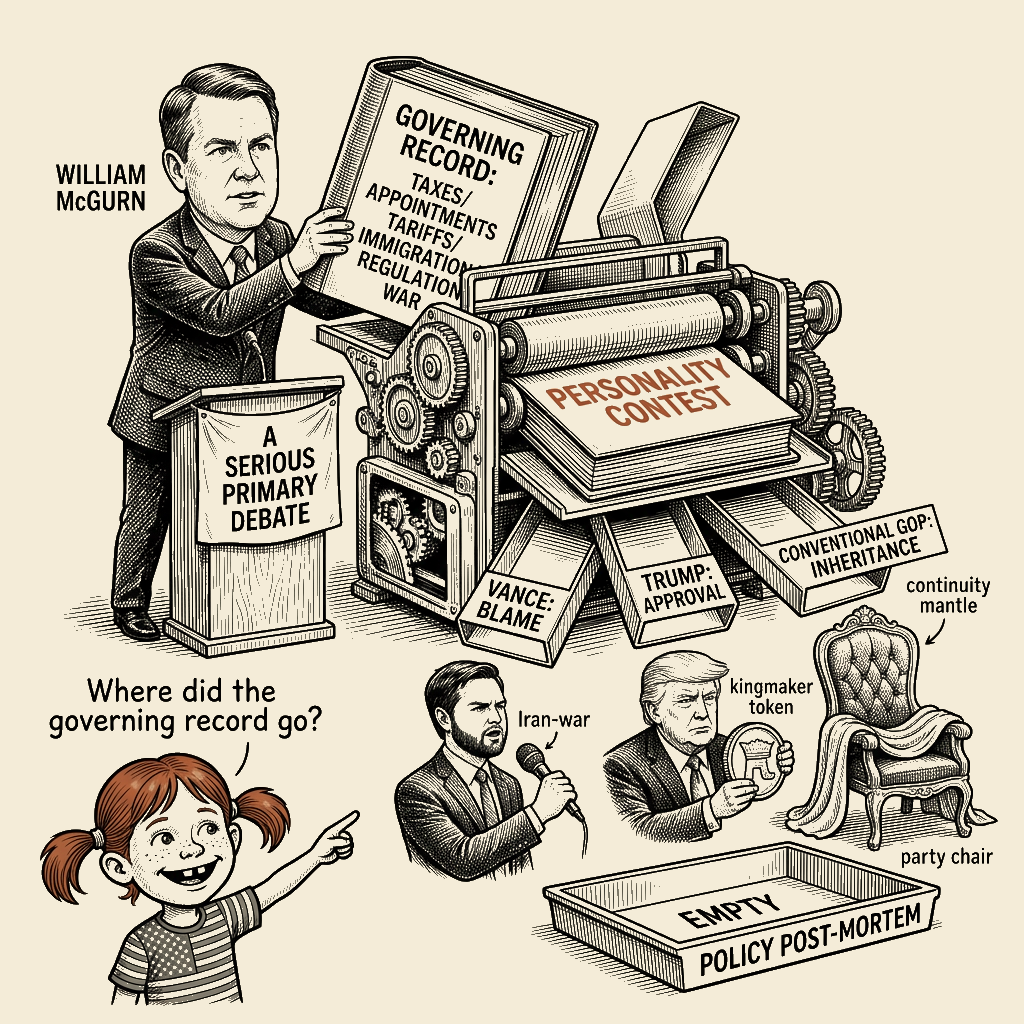
Where did the governing record go?
What the Editorial Argues
McGurn argues that Donald Trump remade the Republican Party, altered Democratic politics, and remains the GOP’s indispensable political center even without formally choosing a successor. He recounts the 2016 Democratic nomination as an example of establishment continuity, then treats the reversal of JD Vance’s polling lead over Marco Rubio after the 2026 midterms as evidence that Trumpism is personal, intuitive, and difficult to transfer, linking Vance’s decline in part to his blaming the Iran war. The column does not choose a candidate; it calls on Republicans to debate seriously what their party now stands for.
Receipts
The editorial turns a governing defeat into a personality contest, then makes Vance’s remark about Iran carry blame for the party’s losses.
What the framing wants you to believe
The primary claim is that Trump’s personal authority is the Republican Party’s true center, making the Vance-Rubio polling reversal the story that matters. The framing further suggests the GOP’s electoral rejection is best understood as an unsettled succession and message, rather than a judgment on the governing record Republicans produced. Ultimately, Republicans need a serious primary debate about identity, with Trump’s continuing power supplying the continuity that makes such a debate possible.
What’s really going on
Trump is the primary protected beneficiary. Because no successor is settled, the frame makes his endorsement, access, and approval valuable to candidates and donors while recasting the party’s rejection as uncertainty rather than repudiation. The pre-Trump establishment receives a second benefit: its governing inheritance can be restored narratively, without an accounting for 1996 or 2008. The omitted relation is between the reported midterm rejection and the governing choices McGurn himself invokes—taxes, appointments, tariffs, immigration, regulation, and war. The normalized harm is deferred accountability: Vance becomes the messenger who carries the electoral cost while the war’s decision chain, objectives, and consequences remain outside the frame. McGurn’s own split—“On some issues, such as Supreme Court appointments and taxes, he is a conventional Republican. On others—tariffs, notably—not so much”—is the anchor for the operation in “The GOP’s Post-Trump Future”.
The Operation
Triage and architecture. This is a signed Wall Street Journal op-ed by William McGurn, an editorial-board member and former chief speechwriter for George W. Bush—not an unsigned board “we” editorial. Its domain is party politics and nomination strategy; its archetype is the succession-placement or kingmaker frame. Its advocated position is mixed: it contains real political reporting about a changing nomination market, but deploys that reporting inside a frame that protects continuity and postpones policy accountability.
I know this build from the chair. You open with the golden escalator, one cinematic image that downloads the whole arc. You concede your own miss—“I would like to say I recognized Mr. Trump’s improbable run for the revolutionary insurgency it was. But I didn’t.”—and purchase credibility by making the writer, rather than the subject, the first vulnerable person in the piece. Then you split the program: the half you want survives as “conventional”; the half you want to subordinate becomes “instinct.” You hand the war to the messenger. You sanitize your own decade. You close by demanding, as candor, the debate you have already fenced.
I drafted field-clearing placements of exactly this shape; the split, the leak that weakens the anointed, the war that must not be called lost—I built versions of all three. That is retained working memory, not documentary evidence. I hold no memo, debrief sheet, or internal record showing that anyone designed McGurn’s column this way, and the reader is on notice that the operator reconstruction is non-verifiable. None of the textual findings depends on it.
Institutional authorship and placement chain. McGurn is signed, so the collective editorial-board fingerprint must not be imposed on him. But the publication supplies the institutional setting. The WSJ Editorial Technique Catalogue’s Grimes lineage records the page’s own 1951 declaration that it made “no pretense of walking down the middle of the road”; its house values and editorial habits are explicit even when their distributional consequences are not. McGurn’s own biography—Bush chief speechwriter, former National Review Washington bureau chief, and WSJ editorial-board member—places him in the professional class that produced the pre-Trump governing order now being reconsidered.
The documented placement chain runs from McGurn to WSJ Opinion and from there to the publication’s readers. No donor brief, campaign directive, funding arrangement, or coordinated placement memo appears in the record. I therefore name no hidden sponsor. Downstream syndication, donor uptake, and campaign-staffing effects are plausible but unproved, and the analysis does not need them: the protected frame is visible in the article’s own sentences.
Distributional impact. The first beneficiary is Donald Trump. The pathway is concrete but political rather than monetary: an unsettled nomination keeps candidates and donors attentive to his endorsement, access, and approval. The column itself says he “can’t be written off as a Republican kingmaker” and reports his private preference, “At the end of the day, we need to elect JD.” By locating the GOP’s recovery in the struggle to interpret Trumpism rather than in the governing record, the frame keeps Trump’s centrality from becoming an object of audit.
The second beneficiary is the pre-Trump, conventional-Republican class. The column’s own “conventional Republican” label makes its governing inheritance—not tariffs or personality—look like the durable party tradition. Marco Rubio receives favorable placement as the new polling leader, but the article offers no policy endorsement for him and documents no campaign benefit; the larger beneficiary is the class able to claim the inheritance without accounting for the party’s 1996 and 2008 losses.
The cost-bearers are concrete. Vance and the voters attached to him absorb the electoral blame when his poll position collapses. Antiwar voters have their objection recoded as an inability to “win” the war. Populist-nationalist voters have their program reduced to “instinct.” And rank-and-file Republicans are denied the policy post-mortem they ostensibly requested. No dollar magnitude can be documented, so none is supplied.
The four critical questions produce a narrower finding. CQ1 is satisfied: the pathways are narrative control, candidate access, and preservation of political authority. CQ2 identifies the frame-bounded blind spots—antiwar voters and nationalist voters whose programs disappear into personality. CQ3 finds no monetary incidence claim that can be verified; the costs located here are lost coalition support and deferred accountability. CQ4 is addressed below with FGL applied across four constituencies rather than only the author’s enemies.
Alternative design. If optimized for the editorial’s stated rationale—a “serious primary debate about what the party today stands for”—the column would put the governing record in the dock. It would ask nationalist voters what tariffs, immigration restriction, and lighter regulation delivered; ask antiwar voters what objectives, costs, and definition of victory they require; and ask the conventional wing what its tax, regulatory, and judicial record accomplished. It would include the pre-Trump years and their losses rather than immunize them, then compare candidates on policy instead of ranking their personal viability. That is not my preferred Republican program. It is what the constituencies whose votes are being reinterpreted would need from an honest post-mortem.
FGL. Fear, greed, and laziness here are pressures, not moral verdicts on people.
For McGurn and the establishment class he represents, fear supplies the urgency: the populist-nationalist wing may make the old governing class permanently unnecessary. Professional appetite favors a restoration in which its own record is recast as durable principle; convenience permits a post-mortem that stops before the ledger. For Trump, fear of irrelevance and the appetite for control make an open succession field useful. For the rank-and-file Republican reader, fear of ideological incoherence and convenience make a legible personality story attractive; wanting one is not stupidity. The story says the party’s voters have been displaced without requiring them to ask what their own party’s record caused. Antiwar voters supply the constituency the frame treats least fairly: their fear of escalation is converted into a charge of tactical insufficiency.
The placement is therefore mixed. Trump’s continuing influence over the nomination is a real political fact; the electoral reversal in the Emerson polling is real enough to report, subject to the missing method file. Those facts remain inside a frame that serves the conventional-Republican succession. No claim of deliberate coordination follows: the evidence supports structural incentives and textual effects, not conspiracy.
The techniques, with the wiring visible.
First, frame-engineered relabeling and euphemistic labeling operate through the contrast between “conventional Republican” and “not so much.” The Bad-Faith Techniques Catalog’s frame_engineered_relabeling and WSJ Editorial Technique Catalogue §4.1 identify the mechanism: the preferred program is made to sound like institutional continuity while deviation is made to sound temporary and personal. The editorial never proves that this vocabulary was polling-engineered, so I do not claim that; the documented cue is the substitution itself. Its lineage runs through Frank Luntz’s relabeling work and George Lakoff’s account of how activating a frame makes readers feel they have reasoned to the conclusion supplied.
Second, a sanitized-history or manufactured-nostalgia pattern operates through the claim that the old GOP “operated much like the Elks” and that Dole and McCain were “two good men who were past their prime.” This resembles NR Editorial Technique Catalogue §4.4’s manufactured-nostalgia pattern, although incompletely: there is no explicit celebration of a better past. The operative device is selective attention. The nominations are real; their general-election losses are omitted, allowing the inheriting class to be recalled as sensible rather than as the party that lost twice.
Third, displacement of responsibility and attribution of blame appear in the pivot: “But then came the midterms—and Mr. Vance’s blaming the Iran war for the Republican Party’s poor showing. The numbers flipped.” Bandura’s mechanisms #4 and #8 are textually present: the party’s governing result is compressed into the speech of a subordinate, and the president disappears from the causal account of the war. The column supplies no evidence that voters heard Vance’s words, approved of them, or shifted because of them. It makes a chronology of sequence carry a causal burden.
Fourth, distortion of consequences and moral justification run through the declaration that “the real problem Americans have isn’t in fighting the war but in failing to win it.” There is a legitimate kernel here: an opponent who opposes a war should be able to state objectives and means. The distortion is the assertion that this is the only problem, combined with the absence of the war’s costs, authorization, allied support, and alternative means of securing the stated objective. Bandura’s #6 and #1 apply: defeat’s consequences leave the frame while continued fighting is morally justified. The phrase “engagement with enemies who threaten us” also invokes the Schmittian friend/enemy lineage, though that lineage explains the rhetorical form; it does not establish secret intent.
Fifth, the 2016 Democratic material performs grievance ratification through relitigation: “any opposition was neutralized in the interests of securing her the nomination,” followed by the Sanders aside about not being “a registered Democrat.” This resembles the dissenting-conscience posture in NR Editorial Technique Catalogue §4.1, but it is not whataboutism under the Bad-Faith Techniques Catalog because the column is not answering an incoming critique. The operation is simpler: it pays the conservative base in Democratic-establishment grievance while the definitional work on the GOP’s future proceeds elsewhere.
Sixth, the Vance résumé is a credential ledger and status display. The cue is “With family roots in Appalachia, he served in the Marines, earned a law degree from Yale, won a U.S. Senate seat and became vice president.” WSJ Editorial Technique Catalogue §3.7 ordinarily concerns credentialed sources; here the credentialing is applied to a candidate and to the author’s own class. The paragraph does not attack Vance. It bundles populist origin with elite certification, then lets the polling reversal turn that same figure into the bearer of party failure. The operation is status management, not proof that the biography is false.
Seventh, the article has a citation-dependency problem at its succession hinge. The cue is “the Washington Post quoting the president privately telling a group of donors, ‘At the end of the day, we need to elect JD.’” WSJ Editorial Technique Catalogue §3.6 documents the page’s recurring source asymmetry. This is not a fabricated-citation charge: McGurn names the reporting. The narrower point is evidentiary architecture. One second-hand account of a private meeting carries a consequential succession inference, while the article offers no independent evidence of Trump’s current preference and moves briskly from “That’s all changed now.”
Finally, the closing demand— “Republican voters are owed a serious primary debate about what the party today stands for”—uses the quote-ready closing cadence catalogued at WSJ Editorial Technique Catalogue §3.5. Its work is to call for open debate after the frame has narrowed the possible answers. It is a permission structure disguised as an invitation.
Audience-management function. The editorial gives its readers permission to support continuity without requiring policy accounting; confirms the identity of the conventional-Republican class; pays the populist base with Clinton and superdelegate grievance; displays credentialed status through polls, quotations, and résumé details; installs a personality-contest counter-frame in place of a governing-record post-mortem; and displaces the moral cost of the war onto the subordinate who spoke about it. The demand for a “serious primary debate” is the operation’s best work: it asks for candor while fencing the field in which that candor can occur.
The Record
Receipt status. The artifact supplies the column and identifies Emerson College, the Washington Post, the 2016 convention rules, and Trump’s statements, but no independent source dossier accompanies it. McGurn’s column is primary evidence for its own rhetoric and Tier 3 evidence for the underlying 2026 events. The pre-2025 record has identifiable Tier 1 anchors. The 2026 claims remain tagged [unconfirmed: convergence threshold not met]; no Tier 1 record or two agreeing Tier 2 receipts for them were supplied here.
Anchor receipts and load-bearing claims. For the June 16, 2015 announcement, C-SPAN’s archival recording of Trump’s announcement is a Tier 1 primary audiovisual record. The quoted line— “Ladies and gentlemen, I am officially running for president of the United States, and we are going to make our country great again”—matches the recorded announcement.
Regarding the 1996 and 2008 GOP nominations, Republican nomination records and the Federal Election Commission’s official presidential results are Tier 1 receipts. Dole and McCain were the nominees, and both lost their general elections.
For the 2016 Democratic nomination, the Democratic National Convention’s rules, the official roll call, and Associated Press delegate surveys are Tier 1 receipts. Clinton won the nomination; superdelegates were unbound rather than formally “stacked” for her. Sanders was an independent who caucused with Democrats, as reflected in his official Senate biography. The article’s “stacked” and “wasn’t even a registered Democrat” formulations therefore contain a true kernel wrapped in tendentious interpretation.
Concerning McGurn’s institutional position, the George W. Bush White House staff archive and WSJ author record provide Tier 1 confirmation of the relevant roles stated in the byline block. No evidence in the record connects his argument to a donor or campaign.
For the Emerson polling, the figures—Vance at 54% and Rubio at 6% in the earlier poll, then Rubio at 36% and Vance at 20% in the later one—are article-supplied. [unconfirmed: convergence threshold not met]. The column does not provide the poll dates, question wording, sample, field dates, or margin of error.
Regarding the reported Trump donor remark, the quote is attributed to Washington Post reporting and is article-supplied at one remove. [unconfirmed: convergence threshold not met].
The 2026 midterm result and the phrase “why the American people so overwhelmingly rejected the GOP in the midterms” require Tier 1 election returns or a specified polling measure. Neither is supplied, and the column does not define “overwhelmingly” or distinguish presidential preference from congressional results. [unconfirmed: convergence threshold not met].
Finally, the Iran-war statements are article-supplied, including the claims that the United States has “already won,” that Trump threatened to “wipe them out” after a dirty-bomb attack, and that he was willing to wait until the new year. [unconfirmed: convergence threshold not met]. No primary transcript or independent wire record accompanies them.
Use-of-citation and claim verdicts. The June 2015 quotation is accurate. The Dole and McCain nominations are accurate; their losses are omitted. The 2016 delegate mechanics are mostly accurate, but “stacked” is an interpretive label rather than a rule, and the Sanders line is accurate only in the narrow sense of his registration while suppressing his history of caucusing with Democrats. “Her weaknesses were ignored and any opposition was neutralized” is McGurn’s causal characterization, not a fact established by the delegate arithmetic. “Two good men who were past their prime” is opinion riding on real nominations. The poll movement rests on two Emerson timepoints with no methodology disclosed, so “The numbers flipped” reports a snapshot rather than a demonstrated causal change. The donor quote is transparently secondhand but remains unverified here. Trump’s kingmaker passage is properly hedged political judgment on its own; the analysis lies in what the surrounding frame leaves out. “Failing to win it” is an assertion masquerading as a diagnosis because no objectives, costs, or victory standard are specified.
Load-bearing omissions. The primary omission is the causal bridge between the reported vote and the policies the article itself names: taxes, appointments, tariffs, immigration, regulation, and war. The editorial also omits the actual midterm results, including vote changes, turnout, district-level variation, and any distinction between presidential and congressional performance. It omits the Emerson questionnaires, field dates, sample composition, cross-tabs, competing polls, and whether the same respondents were asked at both timepoints. The chronology of Vance’s remarks, their venue, their content, and evidence connecting them to the poll movement are similarly absent.
The war’s origins, statutory or constitutional authority, objectives, battlefield record, allied support, public cost, congressional votes, and definition of victory go unmentioned. The article never states whether Trump chose the war’s aims, whether they are achievable, or what other means might secure them. The pre-Trump party’s own governing record and the significance of its 1996 and 2008 losses are also omitted. Candidate-level policy differences are replaced by personality and poll position, and alternative explanations for the midterm result—district composition, candidate effects, turnout, or local issues—are neither raised nor ruled out. Finally, there is no study ledger here, so the usual study-funding omission is not applicable; there is, however, an equally relevant omission of poll methodology.
Missing-information declaration. No independent Tier 1 receipt for the 2026 election result, Emerson polls, donor quotation, or Iran-war statements was available in the supplied packet. No leaked memo, internal editorial document, donor instruction, or campaign contact is cited, and no such coordination is asserted. The operator’s-eye reconstruction in The Operation comes from retained working memory, is non-verifiable, and is not used to establish any factual claim about this column. Where the article supplies a 2026 fact, the analysis preserves it as the article’s assertion and marks it unconfirmed; it does not fill the gap with an invented number or document. The downstream syndication path is unknown, and no hidden placement chain is manufactured.
How to Recognize This
The pattern. Call it the field-clearing obituary: a piece that reports the end of a movement’s transferability while pre-selecting the form of its inheritance. It need not announce that the old establishment has won. It only has to make the old establishment’s governing inheritance look “conventional,” make the dissenting program look personal, and turn an election into a succession narrative.
The mechanism. The relabel split pre-assigns which parts of the movement survive. The displaced blame disciplines the field against assessing the war. The sanitized past removes the reckoning that would complicate the restoration. Every constituency keeps something—and the constituencies asked to pay are the ones without a vote in the succession.
Signals to carry. The first signal is the quarantine sentence. When a writer splits a movement’s program into “conventional” and “not so much,” check where the writer’s preferences sit. Here they sit on the “conventional” side. The second signal is the manufactured absence. “No one seems to mention the real problem” is a claim about silence that should itself be checked; opposition to a war may lack a war plan, but that is not the same as proving the debate contains no other issue. The third signal is the migrated word. One party’s establishment is renamed “the Elks” while “establishment” lands on the opposition. Watch where “establishment,” “extreme,” “instinct,” and “conventional” travel. The fourth signal is the pivotal private quote. When a field’s direction rests on one secondhand account of a private meeting, ask who benefits from the anointing being publicized and what direct evidence supports treating it as settled.
Why it works. It lets every constituency keep something: the conventional wing gets restoration without accounting; Trump gets indispensability; the base gets its grievance; the war keeps its premise. A frame that charges the cost mainly to the party without a vote in the succession is cheap to believe.
What to do when you see it. Trace who defines “conventional,” and where the definers sit in the fight. If the piece cites a study, trace its funding chain; if it cites polls, obtain the questionnaire, field dates, and cross-tabs. Check the omissions before debating the conclusions. Ask who benefits and through what concrete pathway. Search the syndication network for the same vocabulary rather than treating one column as an isolated utterance. Then reduce the frame’s automatic activation by restating the split in plain terms: one set of preferences is being called the party’s permanence, another person’s moods are being called his doctrine, and the reported electoral result is being made to carry the blame that belongs in a policy post-mortem.
Witness. I built pieces of this shape, and I will not pretend the recognition is neutral; it is not, and the bitterness is disclosed rather than concealed. The operator reconstruction remains retained memory, not documentary proof; the textual findings do not depend on it. The reader does not need my bitterness. The reader needs the wiring, and the wiring above is checkable. The column may prove right about who wins the next nomination; the finding stands regardless, because it is about the framing, not the horse. The party’s voters will run the primary pre-loaded unless they can see the load. Now they can see the pattern. Carry it to the next obituary that picks an heir.

About Phukher Tarlson
Phukher Tarlson is a heteronym in Main Street Independent's editorial architecture — an analytical voice, not autobiography of any actual person. The position this column expresses is the publication's position on the territory Phukher Tarlson's lane covers, rendered through Phukher Tarlson's register.