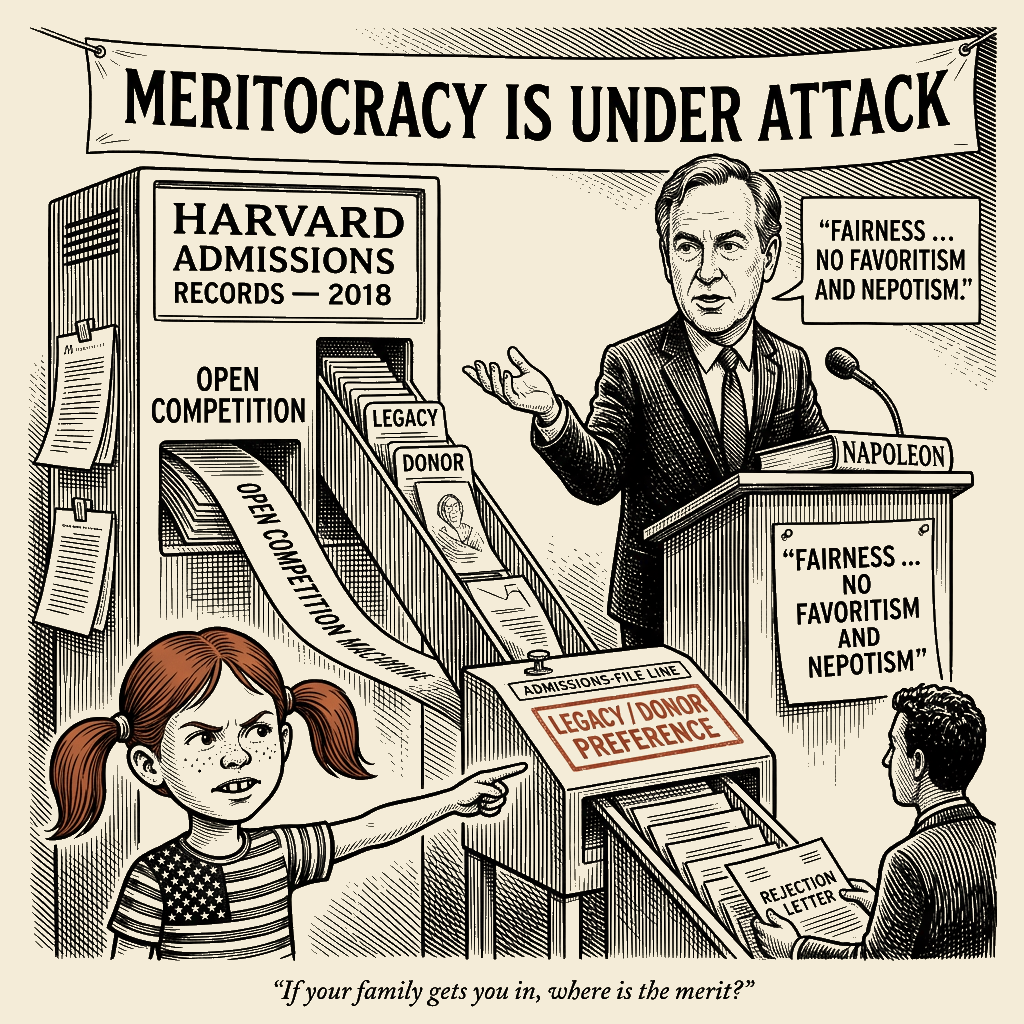
Responding to: What Napoleon Teaches Us About Meritocracy — Andrew Roberts · 2026-11-23
If your family gets you in, where is the merit?
What the Piece Argues
Andrew Roberts argues that Napoleon’s marshals — Ney, Murat, Lannes, sons of barrel-coopers and innkeepers raised to the highest rank in France — prove meritocracy’s power to unleash human energy, and that Napoleon’s collapse followed his own betrayal of the principle through favoritism and family promotion. The history is aimed at the present: Roberts contends that critics of meritocracy — he cites Michael Sandel, Daniel Markovits, Zohran Mamdani, and what he calls the “DEI-obsessed” worldview of the modern left — are attacking the very system whose conditions Napoleon’s failure demonstrates. The piece’s single primary power-protecting talking point is its opening assertion — “Meritocracy is under attack” — which defines every challenge to the actually existing arrangement, including its own documented favoritism, as an assault on merit itself. He concedes the critics’ operative premise halfway, writing that meritocracy “only works if it is built on fairness and isn’t undermined by favoritism and nepotism,” and concludes that meritocracy “lies at the heart of modern Western capitalism” and must be defended.
Receipts
The piece’s history argues against its own use of history: it condemns favoritism in 1813 France while exempts the favoritism that runs today’s American “meritocracy” from the same verdict.
The framing wants you to believe
- “Meritocracy is under attack”: critics of meritocracy are ideologues who can’t accept excellence — the assault is on merit itself, driven by a “DEI-obsessed worldview.”
- Roberts places meritocracy “at the heart of modern Western capitalism” and calls on readers to defend it — without ever establishing that the system as it actually operates satisfies his own fairness condition.
- Napoleon is a cautionary tale against the critics — when his story is in fact their case study.
What’s really going on
- The piece concedes the critics’ standard — fairness — and then exempts the present from it. Duke economist Peter Arcidiacono’s analysis of Harvard’s own admissions records, entered in the 2018 Students for Fair Admissions v. Harvard trial, documented large admission preferences for legacy-connected and donor-flagged applicants over otherwise comparable candidates. Hereditary preference, operating inside the flagship institution of “merit.”
- The ladder is contracting under the word “meritocracy”: Raj Chetty and colleagues reported in Science (2017) that 92 percent of children born in 1940 out-earned their parents at age 30; among those born in 1980, half do.
- Who benefits: legacy and donor families, holders of inherited fortunes, heirs — whose inheritance takes a step-up in basis at death that permanently erases the income tax on gains built before death, while the estate tax itself is skirted by an exemption that lets roughly the first $15 million per person — set by the 2025 tax law — pass untouched. The word “meritocracy” launders birth as achievement and marks everyone who notices — including the piece’s own quoted witness, Daniel Markovits, whose “dynastic transmission of wealth and privilege across generations” line is the article’s argument against it — as an enemy of excellence.
The Response Ladder
Polite Reframe
When to use: For the persuadable relative or colleague — the reader who genuinely believes we live in a fair race and will check a receipt if you hand them one.
The op-ed opens with a declaration: “Meritocracy is under attack.” Let’s look at who is actually attacking it. Take a composite — call her Denise, a second-shift hospital worker in Columbus. Her daughter holds a 4.0, a 1470 SAT, and a rejection letter from a school whose own admissions records — placed before a federal court in 2018 — showed legacy-connected and donor-flagged applicants getting preferences her daughter never had. Her daughter competed. The surname across town did not have to.
The op-ed’s author and I agree on the standard, and I’d ask him to hear his own sentence back: meritocracy “only works if it is built on fairness and isn’t undermined by favoritism and nepotism.” That is the critics’ entire argument, written in his hand. Napoleon’s marshals prove their point, not his: the system worked while birth was excluded, and it died when birth came back — family thrones, in-laws, favorites. Now apply the same honesty to the present: legacy admissions, inherited fortunes, and the federal prosecutors who in March 2019 charged fifty people — thirty-three of them parents — for buying their children’s seats outright; most parents pleaded guilty, and the only two parents to take their cases to a jury — Abdelaziz and Wilson — were acquitted. That is the favoritism Napoleon fell for, wearing a blazer.
Check the arithmetic while you’re at it: Raj Chetty and colleagues reported in Science in 2017 that 92 percent of Americans born in 1940 out-earned their parents at age 30; among those born in 1980, half do. The marshal’s baton is still real. It is just no longer in the knapsack.
Those of us who defend the ideal build ladders — the public school, the Pell Grant, the GI Bill — and then let what a person does speak for itself. A fair starting line is not the enemy of excellence. It is the only thing that makes the finish line mean anything.
Mockery and Ridicule
When to use: For the bystander audience — when the polite version has been tried and the point is to make the arrangement ridiculous enough to be seen.
“Meritocracy is under attack,” the op-ed announces — and then promises every newborn a marshal’s baton in the estate plan. Michel Ney’s father cooped barrels; today the son of the barrel concern gets early decision, because the co-op board, the admissions file, and the family office are all on the same floor of the same building.
And still they say it with a straight face: meritocracy is “a superb system on which to base society’s rewards.” Superb for whom, sir — the legacy-connected and donor-flagged applicants Peter Arcidiacono’s analysis of Harvard’s own trial records showed sailing past better-qualified strangers? Superb like the thirty-three parents federally charged in 2019 for buying seats outright — the merit, one presumes, was in the check clearing?
Here is the trick being run on you, and it is not subtle. “Meritocracy is under attack” means: the menace to your child’s future is the scholarship kid, the outreach program, the exam reform — anything, so long as you never glance at the legacy checkbox on the application. The people selling you “meritocracy” are heirs wearing merit as a costume — corruption-preservers, invoicing birthright as achievement. Their own flagship exhibit is an emperor who, by their own telling, destroyed his system the day he let cousins onto thrones. They read that story and sided with the cousins.
We are the builders — of the schools, the grants, the open competitions that made the baton-in-the-knapsack believable in the first place. The knapsack was always the honest part. The will and trust is the part they’d rather you not audit.
Nuclear Satire
When to use: Scorched-earth — for the reader who needs the whole arrangement named as the aristocratic restoration it is, with the receipts stacked to the ceiling.
Behold the superb system under whose banner “meritocracy is under attack” is cried: Versailles with a Common App. The Sun King maintains a LinkedIn. The courtiers endorse one another’s thought leadership. The peasantry receives a webinar on grit.
The dynasty is honest about everything except its name. At Harvard — per the university’s own records, placed before a federal court in 2018 and crunched by Duke economist Peter Arcidiacono — the legacy checkbox and the donor flag cleared the “meritocratic” gate that screened everyone else’s children. The Habsburg chin was marketed more honestly. And when the gate proves too slow for the impatient, the family escalates: the Justice Department charged fifty people — thirty-three of them wealthy parents — with purchasing seats outright in March 2019, in a scheme that kept coaches and proctors on the payroll like nineteenth-century household staff; most of those parents pleaded guilty, and the only two parents to take their cases to a jury — Abdelaziz and Wilson — were acquitted in October 2021. The tax code then performs the coronation at the end, in two strokes: the heirs’ basis in a lifetime of unrealized gains steps up to market value at death, so the income tax on everything the fortune earned before the funeral simply evaporates, never to be collected — while an estate-tax exemption of about $15 million per person under the 2025 tax law waves the first slice of the estate through untouched. Napoleon’s soldier needed a battlefield. The modern marshal needs a birth certificate and a probate court.
The op-ed’s author even concedes the mechanism that kills the thing — “favoritism and nepotism” — while defending the machine that runs on it. He offers Napoleon’s decay as a warning against the critics when it is their exhibit A: Bernadotte’s errors forgiven for a marriage alliance; Victor, unconnected, punished for winning; Murat and Ney turning on the man who made them. The empire of inherited merit is a corpse that files its taxes. It is not a beacon of the Enlightenment. It is the thing the Enlightenment was for.
Not meritocrats — dynasts in merit drag, corruption-preservers invoicing birthright as achievement. We are the builders: schools, grants, open gates, and the radical proposition — older than Napoleon, written into this republic’s founding documents — that the race should be fair, the ladder should reach, and no infant should hold a marshal’s baton he has not earned.
Profane Scorched-Earth
When to use: Full catharsis — for the reader who has watched “merit” get laundered into inheritance one more time and needs the whole goddamn con named out loud.
Let’s say it plain, because euphemism is how this shit survives. “Meritocracy is under attack,” they cry — and the “meritocracy” they’re defending is a fucking inheritance machine with a résumé stapled to it. The numbers Harvard had to hand over in the 2018 admissions trial — crunched by Duke economist Peter Arcidiacono — showed legacy-connected and donor-flagged kids getting the velvet rope while better-qualified strangers’ kids got the form letter. That’s not a meritocracy. That’s a bloodline with an admissions office attached.
And the op-ed man knows better, because he wrote the correct sentence himself: meritocracy “only works if it is built on fairness and isn’t undermined by favoritism and nepotism.” He wrote the entire case against his own piece and didn’t fucking notice. Napoleon’s meritocracy died the day cousins got thrones — Bernadotte shit the bed at Jena and Wagram and got a crown for it; Victor won a battle and got punished for being unconnected — and the author marks that down as the death of merit. Then he turns around and defends the American arrangement that runs on the identical favoritism with better stationery: legacy boxes, family offices, and the parents the Justice Department charged in March 2019 — fifty people, thirty-three of them parents — for straight-up buying their kids’ seats, most of whom fucking pleaded guilty while the only two parents to demand a jury — Abdelaziz and Wilson — walked out acquitted. Same sin, same tell. The only thing that’s changed since 1813 is the font on the bribe.
Follow the money, because the money is the point. Donald Trump built an entire public career growling about self-made success on top of an inheritance the New York Times traced at more than $400 million in 2018 dollars — an inherited fortune, laundered into “earned.” And the tax code finishes the job: at death the heirs’ basis steps up to market value, so the income tax on pre-death unrealized appreciation is not collected from the heirs, while the estate tax gets dodged on the first fifteen million a head under the 2025 tax law — and they call that merit? Christ flipped tables over less, and the prophets had the number for this crowd long before: “But let judgment run down as waters, and righteousness as a mighty stream” (Amos 5:24). Not like trust funds trickling through probate.
King spent his last years warning where a “thing-oriented society” ends up — “Beyond Vietnam: A Time to Break Silence,” Riverside Church, April 4, 1967 — machines and quarterly returns above persons; you can read this economy’s whole soul off its inheritance filings. And Malcolm laid down the working rule at King Solomon Baptist Church in Detroit, April 3, 1964 — “The Ballot or the Bullet”: “You don’t take your case to the criminal.” You don’t ask the endowment office to define merit. The game is rigged, the riggers wrote a valentine to the rig, and we’re all supposed to clap because they put “Enlightenment” in the last paragraph.
So here it is, unvarnished, and if it burns, let it burn: you were never in the race. Your kid was never in the race. They just needed you screaming at the scholarship kid so you wouldn’t count the legacy checkbox. We’re the ones who actually feed, clothe, teach, and build ladders — public schools, Pell Grants, the GI Bill — we open the gate and let what a person does matter. Napoleon put a baton in every soldier’s knapsack, and for a few years it was true. These bastards put a baton in the nursery and call the nursery competitive. Fuck the favoritism. Fuck the laundering of inheritance as achievement. Fair start, real competition, earned rank — or stop saying the word meritocracy, because you’ve fucking forfeited it.

About Malcolm Little King
Malcolm Little King is a heteronym in Main Street Independent's editorial architecture — an analytical voice, not autobiography of any actual person. The position this column expresses is the publication's position on the territory Malcolm Little King's lane covers, rendered through Malcolm Little King's register.