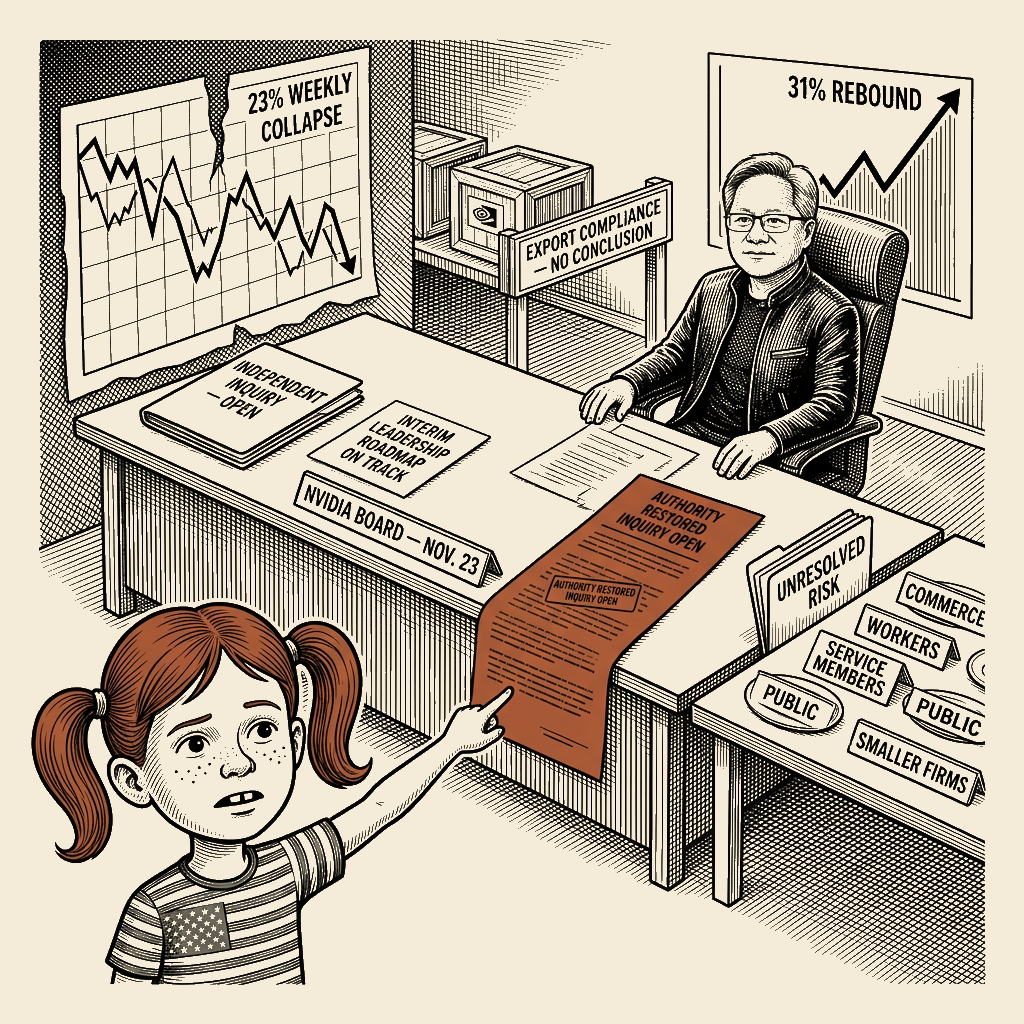
Responding to: Jensen Huang is back. Nvidia’s board still owes America answers · 2026-11-24
Why is Jensen back before the inquiry ends?
What the Piece Argues
The opinion piece argues that Nvidia’s board restored Jensen Huang as CEO and returned him to the board before its independent inquiry into whether he was the target of a foreign intelligence effort had been completed, despite a 23% weekly stock collapse and public pressure from President Trump. It treats the board’s implied defense—“The board’s real question was whether the company could afford to wait for its own investigators”—as inadequate because Reuters reported that Huang misled Nvidia’s general counsel, the Justice Department had reached no conclusion, the FBI was still investigating, and questions about China sales and export compliance remained open. The piece argues that the board should finish the inquiry, disclose what it responsibly can, impose consequences if warranted, and build succession plans and additional advanced-computing capacity so one executive cannot become a single point of failure.
Receipts
The board’s defense—the power-protecting frame the piece puts in play—turns a discretionary governance choice under market and political pressure into a story of unavoidable corporate survival.
The board’s framing wants you to believe
- Nvidia could not responsibly wait for the inquiry because a 23% weekly collapse made delay intolerable and Huang’s 31% rebound appears to have settled the matter.
- The board’s inquiry and the senior officials’ input had already made the national-security concern manageable, even if the evidence remained private.
- Restoring Huang protected American AI leadership, Nvidia’s product roadmap, and shareholders; waiting exposed all three to greater danger.
What’s really going on
- The supplied source establishes opportunity, not compulsion. Nvidia’s interim chief told investors the product roadmap was on track, and the company had just reported $65.3 billion in quarterly profit on $115.8 billion in revenue. Those facts do not make delay costless; they do make “Huang returns now or the company collapses” an incomplete account of the available choices.
- The uncertainty was concrete. Reuters reported that Huang misled Nvidia’s general counsel; the board said its independent inquiry would continue; Attorney General Todd Blanche said the Justice Department had reached no conclusion and the FBI was investigating; and the public had not seen the “very thorough investigation” President Trump invoked. (Robert Maginnis, “Jensen Huang is back. Nvidia’s board still owes America answers,” Nov. 24, 2026)
- The immediate benefit was concentrated: Huang recovered the CEO’s office, his board seat, and control of a company earning $65.3 billion in a quarter; Nvidia recovered founder-led continuity; shareholders received the 31% rebound. Any unresolved export-control risk would instead travel through Commerce’s regulators, service members, workers, the public, and smaller companies dependent on Nvidia’s ecosystem. No receipt proves that a prohibited sale occurred or that anyone obtained restricted technology. The open inquiry is why the risk cannot be treated as closed.
The Response Ladder
Polite Reframe
When to use: With a good-faith voter, investor, employee, or board member who will respond to procedure, evidence, and a calm demand for accountability.
Picture Elena, an export-control analyst at a company selling advanced chips across borders. On the morning after Huang’s return, she has a simple question: when Reuters reports that the chief executive misled his own general counsel and an independent foreign-intelligence inquiry remains unfinished, who has the authority to stop a sale? The answer embedded in the board’s defense is not accountability. It is price: “The board’s real question was whether the company could afford to wait for its own investigators.” Elena’s work now sits inside a 31% rally.
That defense does not fit the chronology. Nvidia announced Huang’s return on Nov. 23 while saying the independent inquiry would continue. Attorney General Todd Blanche said the Justice Department had reached no conclusion and the FBI was investigating. Secretary Scott Bessent said the administration was still seeking answers about Nvidia’s China sales and export compliance. A board did not need to decide whether the allegations were true to recognize that an unfinished inquiry and restored executive authority cannot be treated as the same thing.
None of this proves that Huang was a spy, that anyone accessed restricted technology, or that he directed an improper sale. It proves something more basic: the board restored a man to authority while the questions were open. A board charged with independent oversight cannot convert its own unanswered questions into permission for the person under review to resume command. That is not due process. It is convenience wearing the board’s badge.
The distribution is visible. Huang recovered the CEO’s office, his board seat, and control of an enterprise that reported $65.3 billion in quarterly profit on $115.8 billion in revenue. Nvidia recovered strategic continuity, and shareholders received the immediate 31% rebound. Any unresolved export-control failure would not stay inside the boardroom. It would run through Commerce’s regulators, service members, workers, and the public. No receipt proves such a failure occurred; the open inquiry is the reason not to pretend the risk was closed.
We can defend responsible governance and a functioning Nvidia at the same time. Interim leadership can keep the roadmap moving—it was reportedly on track—while an independent inquiry, a chief compliance officer with real board authority, meaningful disclosure, and congressional oversight do their work. We protect national security by finishing the inquiry, not by confusing a 31% stock jump with a verdict. The board owes America that answer.
Mockery and Ridicule
When to use: In a public thread where the board has chosen market optics over an unfinished inquiry and the goal is to expose the reversal without mocking employees or investors.
Picture the Nvidia boardroom on Nov. 23: a huge balance scale. One side holds an unfinished foreign-intelligence inquiry and Reuters’ report that Huang misled Nvidia’s general counsel. The other side holds a stock chart with a fat 31% arrow. The chart wins by technical decision.
Translated from the piece’s diagnosis of the boardroom into plain English: “The board’s real question was whether the company could afford to wait for its own investigators.” Nonsense with a ticker attached. Nvidia’s interim chief said the product roadmap was on track, and the company had just reported $65.3 billion in quarterly profit on $115.8 billion in revenue. Those facts do not make delay free. They do make the “Huang returns now or the company collapses” story look less like national-security analysis than a very expensive panic button.
Under this logic the watchdog becomes the lapdog, the independent inquiry becomes a subscription, and the board becomes a corporate sovereign: investigator, judge, shareholder, all at once. That corporate sovereign is awful. The board’s own statement says it received input from senior U.S. officials, and President Trump said he pressed the directors—facts that make independence the issue, not an abstraction.
Meanwhile, the Justice Department had reached no conclusion, the FBI was investigating, Bessent said export-compliance questions were unresolved, and the government review invoked by Trump had never been shown to the public. Reuters reported that Huang misled his general counsel. A board can say “we need more time” while the person under review returns; that is not candor. It is a press release with better typography.
So let’s hear it from the board in public: What did the inquiry find? What did the senior officials say? Who can stop a chip sale if the chief executive wants it to go ahead? Why should the public accept a private assurance attached to a public 31% celebration? Shareholders deserved a market verdict. The public deserves a governance answer. The board can deliver both—after the investigation, not before the rally.
Nuclear Satire
When to use: Before an institutional audience that understands the receipts and needs the board’s conduct named without any ambiguity.
Imagine Nvidia’s boardroom transformed into a celestial courthouse. Huang sits beneath a searchlight labeled “POSSIBLE FOREIGN-INTELLIGENCE EXPOSURE”; the inquiry peers through a telescope; behind the judges, a bronze calendar burns down from Nov. 17 to Nov. 23; and a golden ticker tape flashes 31%. The judges postpone the inquiry, restore the man under review to the bench, and announce that continuity is justice.
The actual record is less theatrical and more damning. The piece puts the alleged real question plainly: “The board’s real question was whether the company could afford to wait for its own investigators.” The board said its inquiry into whether Huang was the target of a foreign intelligence effort would continue. Reuters reported that he misled Nvidia’s general counsel. The Justice Department had reached no conclusion; the FBI was investigating; Trump’s “very thorough investigation” remained unseen. No secret cabal required. The board had power, pressure, and six days. It chose speed.
The inversion is complete: the board has become a corporate autocrat—investigator, judge, interested party, and emergency responder to the market. That autocracy is monstrous. An institution cannot manufacture its own certainty and then call the result due process. The inquiry was allowed to continue while executive authority was restored. That is not oversight with a timeline. It is oversight as décor.
Follow the benefit upward. The 31% rebound immediately revalued the restored executive’s control; Nvidia recovered founder-led continuity; shareholders received price relief; Trump received a story of continuity in the AI race. The unresolved risk travels elsewhere: export-control reviewers, service members, workers, and the public cannot verify whether access or sales were contained. Again, no receipt proves a spy or a prohibited sale. The point is that the board and the government have not supplied the evidence their assurance requires.
Trump’s public claim that he pressed the directors and that the government found no risk reveals the pressure and the politics. A White House blessing is not an investigation the public can inspect. Nor can a market rally adjudicate fiduciary care. Congress has the chance to ask why the person at the center of an unfinished inquiry returned with authority over advanced-chip strategy; Huang has already agreed to testimony. Ask the question before the stock price erases it.
We protect democracy by finishing the inquiry and building an AI base no single founder can hold hostage. We do not suspend due process because the richest infrastructure firm in the AI economy throws a tantrum. A republic is not a shareholders’ service. The board can restore continuity after the facts. Until then, continuity is its preference; accountability is ours.
Profane Scorched-Earth
When to use: For a reader who has watched the board convert uncertainty into a 31% rally and needs the full cathartic indictment; use where the venue permits profanity.
Here is the fucking boardroom scene the press release left out: one table, two folders, one marked “unfinished foreign-intelligence inquiry,” one marked “31% stock jump,” and a scale big enough to weigh a sovereign. In the piece’s telling, the stock folder wins because nobody on the board can tolerate six fucking days of uncertainty with the public. Huang gets his comeback; the inquiry gets a committee and a later hearing.
Reuters says Huang misled Nvidia’s own general counsel. The board says the inquiry continues. Todd Blanche says the Justice Department has no conclusion; the FBI is investigating; Bessent says export compliance remains unresolved; Trump’s “very thorough investigation” has never been shown to the public. That goddamn missing file is the whole point. This is not secret exoneration. It is a press-release séance: everybody gets to speak to the ghost of evidence nobody can inspect, and then calls the séance bullshit.
The piece asks whether Nvidia could afford to wait. It could wait. The interim chief said the roadmap was on track; Nvidia posted $65.3 billion in quarterly profit on $115.8 billion in revenue; and the inquiry could continue under interim leadership. Profit does not prove that delay would have been costless. It proves six days was not a fucking emergency and “instant restoration or national-security collapse” is bullshit. What the hell does a 31% rally prove about the unanswered questions? The board had the time, the money, and the fucking machinery. It used all three to put the subject back in command.
Who benefits? Huang gets authority and a board seat. Nvidia gets its founder back and the goddamn 31% halo. Trump gets a continuity story. Who carries the unresolved risk? The public, service members, workers, Commerce’s export-control people, and every smaller chip company dependent on Nvidia’s ecosystem. And let the receipts say what they do not say: nobody has proved that a spy obtained secrets or that China obtained a prohibited chip. That absence is not proof of innocence. It is proof that the goddamn inquiry was still open.
The board feared market disorder. Trump feared a setback in the AI race. Huang feared losing control. Those fears help explain the pressure; they do not complete the investigation. Malcolm X stood at the Oxford Union on Dec. 3, 1964, and defended the motion that “extremism in the defense of liberty is no vice; moderation in the pursuit of justice is no virtue.” Waiting for facts is not extremism. It is the bare minimum of fucking competence.
Amos 5:24 demands that justice run down like water, not stop because the ticker turned green. The board let the stock ticker roll up like a curtain. We wait. We disclose. We enforce. We build succession and more than one advanced-computing source. America does not owe Huang immunity; America owes the public answers. A 31% bounce does not erase the fuck out of an unfinished inquiry.

About Malcolm Little King
Malcolm Little King is a heteronym in Main Street Independent's editorial architecture — an analytical voice, not autobiography of any actual person. The position this column expresses is the publication's position on the territory Malcolm Little King's lane covers, rendered through Malcolm Little King's register.