Analyzing: Ron Johnson Tells the Social Security Truth — The Editorial Board · 2026-11-19
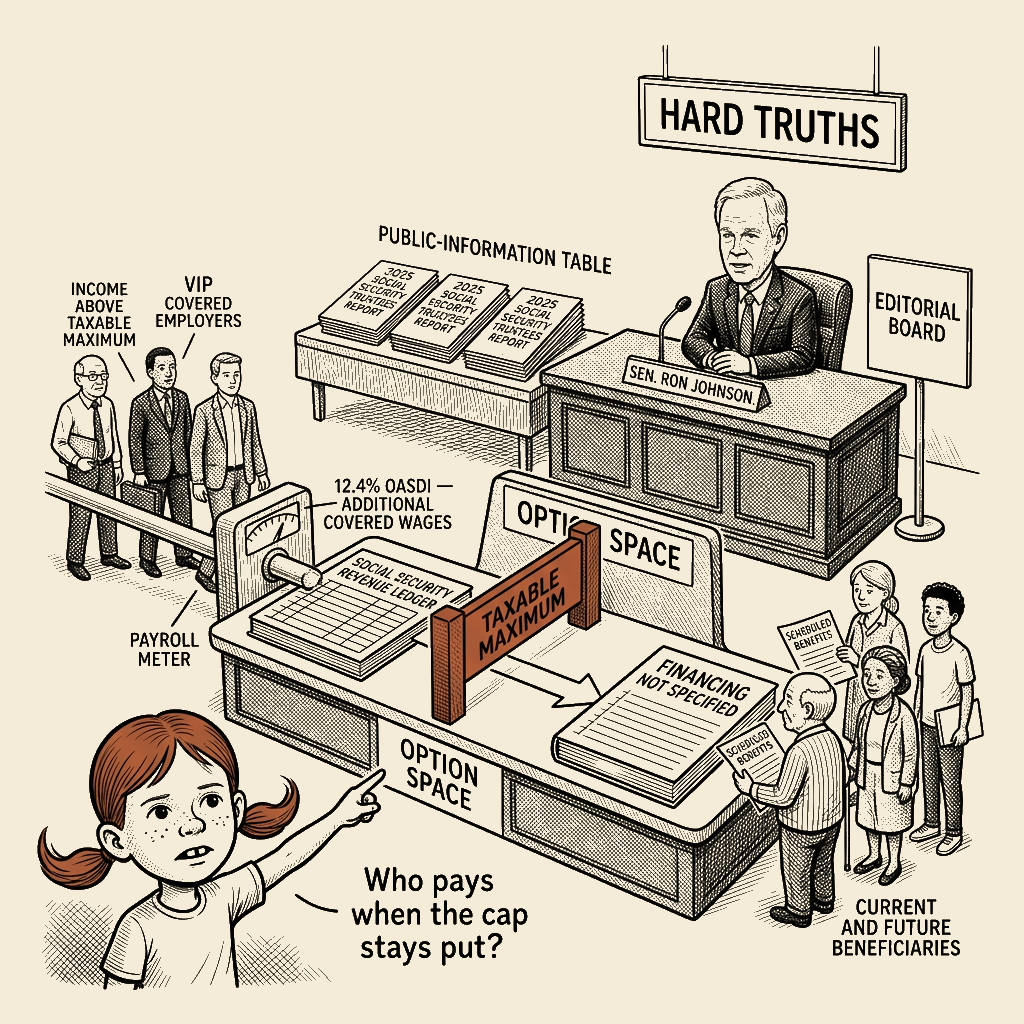
Who pays when the cap stays put?
What the Editorial Argues
The unsigned Wall Street Journal Editorial Board praises Republican Sen. Ron Johnson for publishing a report on Social Security’s deteriorating finances, citing demographic pressure, rising outlays, wage-indexed benefits, trust-fund depletion, and statutory benefit reductions if Congress takes no action. It treats Johnson as a lone candid politician, argues that raising the $184,500 payroll-tax cap would amount to a 12.4% tax increase harmful to workers and the economy, and supports his proposal to repeal the 2032 trigger for a 22% benefit cut. The board favors a broader debate over solutions but portrays Democrats as committed to tax increases and warns Republicans against drifting into the same trap.
Receipts
The move is to turn a publicly documented financing crisis into a lone-truth-teller story, then narrow the remedy before readers can compare the ledgers.
What the framing wants you to believe
- Social Security is “unsustainable,” the mathematics is “inexorable,” and Johnson is the politician willing to “tell the hard fiscal truths” while everyone else hides.
- A 1977 benefit formula and unfavorable demographics explain the crisis; raising the payroll-tax cap would impose a “12.4% income tax increase” on middle- and higher-income Americans.
- Democrats want a tax hike, Republicans are “sleep-walking into a taxing political corner,” and repealing the 2032 cliff is the sensible first step.
What’s really going on
- The protected interest is income above the taxable maximum. The editorial’s $184,500 figure and 12.4% combined rate remain attributed to the editorial; I could not independently retrieve a 2026 SSA announcement in the supplied record. Raising the cap would apply the OASDI tax to additional covered wages above the old ceiling—not to a worker’s total income. The 2025 Social Security Trustees Report, the latest official report verifiable from the supplied record, confirms the financing imbalance and explains the program’s tax-and-benefit architecture.
- The omitted relation is the revenue side. The 1983 amendments created the wage-indexed taxable-maximum system and the present 12.4% combined rate. Because the maximum has not kept pace with the distribution of covered earnings, the tax base has eroded relative to benefits. The editorial makes the 1977 formula a principal culprit while leaving this legislative architecture outside the frame.
- The normalized harm is the benefit cut treated as the default baseline. Current retirees, disabled beneficiaries, survivors, and younger workers bear the risk unless Congress supplies another financing mechanism. Repealing the cliff would not create revenue; it would require general-revenue financing, borrowing, taxes, benefit changes, or some combination that the editorial never identifies.
The Operation
Triage. This is, with high confidence, an unsigned Wall Street Journal Editorial Board piece: the collective institutional voice, the supplied outlet identification, and the board’s closing manifesto all align. The domain is fiscal policy and retirement finance. The principal archetype is the WSJ catalogue’s “study shows” ledger, joined to frame-engineered relabeling, a manufactured-uniqueness posture, multiple-audience targeting, and a quote-ready closing line. The position is mixed: the diagnosis serves the public interest; the prescription protects a concentrated tax advantage.
Build this piece in a conference room and it looks like this: the committee report lands; the frame decision comes first—lead with courage, because courage is the product—then the option space is narrowed below the fold, and the closing line is written to be lifted. I wrote unsigned board drafts to order for a decade. The first thing a byline-less “we” supplies is exactly this: a senator’s committee product that reads as arithmetic.
Institutional authorship and placement.
The immediate author is the Editorial Board, but the evidentiary spine is staged through three institutions:
- Ron Johnson’s Senate Budget Committee report. The report comes from the senator whose fiscal position it supports. Its institutional authority is real; its sponsorship is also a concrete interest, not a disqualification.
- The Hoover Institution work of John Cogan and Daniel Heil. The named researchers supply the counterfactual claim that the 1977 formula materially worsened long-run financing.
- The Editorial Board. The board converts those materials into the “hard truth” frame, supplies the partisan cast, and makes Johnson’s preferred solution the measure against which alternatives are judged.
That is the visible placement chain:
- A Republican committee chair publishes the crisis numbers and political label.
- Hoover researchers supply the contested benefit-formula counterfactual.
- The board installs the lone-truth-teller hero and tax-raising villains.
- The reader receives a quotable instruction to congressional Republicans.
The artifact establishes no donor network, first promoter, hidden funding chain, or directing memo. I will not manufacture one. Structural incentives are sufficient to explain the placement: a tax-centered editorial has reason to cover a solvency crisis through a frame that makes the tax cap the decisive object. The committee report, credentialed study, board amplification, and closing cadence already form an operation. They do not require a conspiracy to become one.
Cui bono: the protected beneficiary.
Follow the money without rhetoric. Earnings above the Social Security taxable maximum currently escape the OASDI tax. Raising the cap would subject additional covered wages to the combined 12.4% rate, divided between employee and employer contributions. Leaving the cap where the editorial wants it preserves that exclusion.
The protected interest is therefore concrete:
- Covered workers above the cap avoid additional employee-side payroll tax.
- Covered employers above the cap avoid additional employer-side payroll tax, unless wage and bargaining arrangements redistribute the burden.
- Johnson gains political ownership and credibility from the editorial’s transformation of his report into a profile of institutional candor.
- Republicans gain a ready-made reason to defer a payroll-tax vote, preserving space for a broader political argument without having to specify an alternative financing plan.
Those are money, labor-cost, and political-power pathways. The beneficiary claim is not an ideological guess.
Cui bono: the cost-bearers.
Current and near-retirees face the editorial’s projected benefit-reduction risk if the present financing path continues and no replacement is enacted. Disabled workers and survivors depend on the same system. Younger workers face some version of the deferred problem: higher contributions, lower eventual benefits, or a larger transfer from future income taxpayers.
The editorial does not provide enough information to assign final incidence precisely, because it does not provide a fully specified alternative. That absence is load-bearing. It can attack a tax increase while refusing to say what happens after blocking one. Repealing the cliff removes the statutory pressure mechanism; it does not produce a dollar of new revenue.
Alternative design.
The alternative must be reconstructed from the interests of the people the frame hides, not from my fiscal preference. Current beneficiaries have an interest in scheduled benefits not being cut through a mechanical funding cliff. Younger workers have an interest in a promise they can actually collect. Workers below the taxable maximum have an interest in not being told that a tax applying above the ceiling is an increase imposed upon them.
Those interests establish minimum design criteria:
- No automatic benefit cliff for current beneficiaries.
- No unfunded promise disguised as a deferral.
- No concentration of the entire adjustment on workers below the taxable maximum.
- Transparent actuarial scores for each combination of revenue, benefit formulas, retirement rules, and general-revenue financing.
- A clear account of who pays, who receives, and when each burden arrives.
The Trustees themselves discuss combinations rather than one mechanical remedy. The editorial presents no design meeting these criteria because it has already made avoidance of a payroll-tax increase the unit of political virtue.
Fear, greed, laziness.
FGL must run in both directions.
- The board and Johnson: Fear that a visible tax increase will damage their free-market and fiscal-credibility identities. Greed, in the non-moralizing sense of institutional self-interest, is the preference for lower taxes and agenda control. Laziness is the avoidance of a financing design that splits the coalition.
- Above-cap earners and covered employers: Fear of a larger payroll-tax burden on additional compensation. Greed is ordinary self-interest: they would rather keep more of the money. Laziness is the convenience of treating a future financing decision as proof that the tax should never be discussed.
- The rank-and-file conservative reader: Fear of both a tax increase and a benefit cut. Greed need not explain the reaction. Laziness is the understandable refusal to master actuarial tables when the editorial converts them into a moral drama. That is a property of the frame, not a defect in the reader.
- Retirees, disabled workers, survivors, and younger workers: Fear is concrete—reduced income, lost benefits, or inherited obligations. Greed is weak or absent from this calculation. Laziness is delay, itself often rational when the decision has been removed from the people bearing it.
Critical-question and failure-mode audit.
CQ1 is answered by the taxable-maximum pathway: additional wages would become taxable. CQ2 identifies the beneficiaries the frame obscures: Johnson’s issue ownership, Republicans’ relief from a tax vote, and covered employers and earners above the cap. CQ3 requires a concession: a cap increase would be a real tax increase on affected covered earnings, while the cost of financing the preferred alternative is deferred and diffuse. CQ4 is answered by the four-constituency FGL analysis.
The symbolic-inference failure mode is avoided because the beneficiary path is concrete. Frame-bounded blindness is checked by following the revenue structure and current law outside the board’s preferred vocabulary. Cost-incidence error is corrected by distinguishing the tax on additional covered wages from a 12.4% tax on total income. The conspiracy trap is avoided because no coordination is asserted. The cynicism trap is avoided because the financing problem is real. The mirror trap is avoided by constructing the alternative around affected constituencies rather than my preferred policy. Asymmetric FGL is avoided by applying the same test to the board, its beneficiaries, its readers, and those left carrying the deferred bill.
Technique identification
1. The candor brand: manufactured uniqueness.
Cue: “Diogenes searched the streets for an honest man” and Johnson is “an exception”; “No one else wants to say it, but the math is inexorable.”
Catalogue cross-reference: Adjacent to the National Review Editorial Technique Catalogue §4.1, the “stands athwart history” frame. Here the dissenting posture has been compressed from ideological minority status into personal moral uniqueness.
Operation: The diagnosis itself is not forbidden or unpublished; the government’s Trustees Reports announce it annually. The editorial does not need to falsify the arithmetic to capture the reader. It needs to make the reader feel that recognizing an alarming number requires unusual moral courage. “Hard truth” then grants the board permission to narrow the remedy without appearing evasive. Bandura’s moral justification is adjacent: the higher-cause vocabulary of fiscal truth recasts opposition as evasion.
2. Frame-engineered relabeling.
Cue: “The Social Security ‘trust fund’ has always been an accounting fiction”; “more generous benefits”; “taxing political corner”; and the payroll-tax cap described as a “12.4% income tax increase.”
Catalogue cross-reference: The WSJ Editorial Technique Catalogue §4.1 and the Bad-Faith Techniques Catalog, frame_engineered_relabeling, drawing on Luntz and Lakoff.
Operation: The trust funds hold special-issue Treasury securities and have statutory purposes; they are not an unrestricted pot of cash, but neither are they a mere “accounting fiction.” The label conceals the legal obligation while using “spent” to imply misuse. “More generous benefits” turns a legislated wage-indexing formula into indulgence. “12.4% income tax” obscures the actual base: additional covered earnings above the cap, not total income.
Lineage: This is the Luntz-Lakoff operation—substitution changes the moral frame before the arithmetic is checked. The textual substitution is documented; no memo proving a centrally engineered terminology campaign is inferred.
3. Vocabulary correction performed in public.
Cue: Calling the “Ponzi scheme” comparison “a political mistake because it gave Democrats an opening to say he wants to destroy Social Security.”
Catalogue cross-reference: A single-publication, partial match to the Bad-Faith Techniques Catalog’s coordinated_message_discipline; one article does not establish organization-wide coordination, and none is alleged.
Operation: The board watches its ally use a vivid but contestable label and replaces it with “unsustainable,” a word that sounds like inevitability and resists appropriation by opponents. This is the visible form of the “don’t say X, say Y” drill: preserve the conclusion, discard the vocabulary that invites rebuttal.
I ran drills of this kind. That is retained trade memory, not evidence about who wrote this editorial; the evidence here is the correction printed in the editorial itself.
4. False dilemma with partisan attribution.
Cue: “Democrats pretend the only way to shore up Social Security is to remove the $184,500 cap,” followed by the board’s approval of repeal of the 2032 cliff.
Catalogue cross-reference: The Bad-Faith Techniques Catalog, false_dilemma; adjacent to the WSJ catalogue §4.6 and the Bad-Faith Techniques Catalog’s strawman.
Operation: The piece does not formally declare its two favored stages exhaustive, but its structure puts only two choices on stage: raise the cap or repeal the cliff. Cap lifts at different thresholds, benefit-formula changes, revenue combinations, retirement-rule changes, and general-revenue financing disappear below the fold.
The attribution is weaker still because the editorial itself names Republican Sen. Bernie Moreno as joining Elizabeth Warren on the cap. It does not quote either senator to establish what they support, so the precise proposal remains unverified. What is documented is this: the board assigns the approach exclusively to Democrats while placing a Republican beside it. “Pretend” asserts the other side’s motive without evidence.
5. The “study shows” ledger.
Cue: “His report notes, citing a 2023 study from the Hoover Institution’s John Cogan and Daniel Heil.”
Catalogue cross-reference: WSJ Editorial Technique Catalogue §4.5, “the ‘study shows’ ledger.”
Operation: The committee report and Hoover study establish authority; the board then treats the methodology, funding, and caveats as outside the question. The cited counterfactual is not inherently false. The ledger becomes a problem because the reader is given a prestigious source without enough information to test how broadly its conclusion travels.
The editorial accurately attributes the “would likely be sustainable” formulation rather than strengthening it into an unqualified claim. That fairness does not cure the omission: the 2023 work itself was not supplied, and no funding or caveat information appears in the editorial. No hidden donor is inferred from that silence.
6. Selective displacement of responsibility.
Cue: “A formula that Congress adopted in 1977”; “when federal law requires benefits to be slashed 22%”; and the closing claim that Democrats do not want to hear the problem.
Catalogue cross-reference: Bandura’s displacement of responsibility and diffusion of responsibility.
Operation: Agency appears where it produces a named villain and disappears where it would implicate the board’s preferred legislators. The 1977 Congress is identified as an author of the benefit formula. The 1983 Congress that established the present tax rate and wage-indexed taxable maximum is not mentioned. The Congress that must choose today’s financing is displaced into “federal law.”
This is selective, not complete, displacement. The editorial knows Congress can repeal the cliff because it proposes doing so. “Federal law requires” therefore functions less as an explanation than as a way to make one legislative choice look like an actuarial avalanche.
7. Asymmetric consequence display.
Cue: A cap increase is a “massive tax hike that harms workers and the larger economy”; repeal of the cliff is presented only as removal of the forced 22% cut.
Catalogue cross-reference: Bandura’s distortion of consequences; adjacent to the WSJ catalogue §4.4, the deficit-double-standard family.
Operation: One ledger is displayed and the other is shredded. The cap increase receives a cost label but no incidence analysis. The preferred remedy receives a benefit label but no financing plan. Fairness requires the concession that applying the 12.4% OASDI rate to earnings above the cap is a real tax increase on those earnings. The trick is not denying that fact. It is counting one side of the ledger and removing the other from view.
8. Multiple-audience targeting.
Cue: “Uncapping the Social Security tax would amount to a 12.4% income tax increase for middle and higher-income Americans.”
Catalogue cross-reference: WSJ Editorial Technique Catalogue §4.3.
Operation: One sentence performs several jobs. The affluent reader receives defense of income above the cap. The middle-income reader, whose wages may remain below it, hears a tax allegedly aimed at him anyway. The political class receives “his report says,” a citable formulation suitable for legislative messaging. The broader conservative base receives “Democrats,” “entitlements,” and “raising taxes again and again”—a grievance to carry into the next vote.
9. Closing-line cadence and whip operation.
Cue: “Republicans who ignore the problem are sleep-walking into a taxing political corner. Credit to Mr. Johnson for telling them to snap out of it.”
Catalogue cross-reference: WSJ Editorial Technique Catalogue §3.5, closing-line cadence; adjacent to §4.13, threat inflation.
Operation: The final addressee changes. The editorial has spent most of its length attacking Democrats, then closes by disciplining Republicans. The praise is not merely encomium; it is a behavioral cue. Credit Johnson for speaking the line Republicans are expected to repeat. The tax-raising “corner” supplies the punishment for deviation.
Audience-management function.
The principal function is a permission structure joined to conscience displacement. The reader worried about a retirement check is handed an honest man, a villainous tax proposal, and a deadline. Agreement with the frame then feels like fiscal prudence rather than a distributional choice. Identity confirmation tells the conservative reader that vigilance against taxes is vigilance against Washington. Grievance ratification directs anger at Democrats. Status display comes from the committee report, the Hoover citation, the actuarial ratios, and the name of a Stanford-yielding credential. The counter-frame is simple: truth versus tax. Conscience displacement does the final work—the reader can support avoiding a payroll-tax increase without confronting the deferred benefit cost because the hero-and-villain structure has already supplied a moral answer.
The lineage is older than this editorial. Lippmann described the public as a construction made for interpretation; Bernays wrote about consent as an engineered outcome; Luntz industrialized the vocabulary. This article’s visible wiring does not require an internal memo. The report lands, the credential arrives, the frame narrows, the close transmits.
The Record
Anchor receipts (Tier 1)
-
The 2025 Social Security Trustees Report confirms the chronic financing imbalance, projects depletion of the combined trust funds during the 2030s absent action, and explains the resulting statutory reduction in payable benefits. It also explains the trust funds’ holdings of special-issue Treasury securities. It supports the editorial’s general diagnosis while not independently confirming its exact “2032” and “22%” pairing.
-
Social Security Act §121, codified at 42 U.S.C. §425(i), establishes the automatic benefit-adjustment mechanism used when trust-fund assets cannot support full scheduled benefits. The statute employs a formula over time; it does not establish a flat 22% reduction automatically on one fixed date, nor does it reduce benefits merely to “match payroll tax revenue.” The editorial’s legal formulation is therefore an oversimplification.
-
The Social Security Amendments of 1983, Pub. L. 98-21, 97 Stat. 65, created the present wage-indexed taxable-maximum architecture and the combined 12.4% OASDI rate. The legislation’s taxable-maximum benchmark was tied to covered earnings, providing the institutional foundation the editorial omits.
-
National Center for Health Statistics life tables support the historical at-birth life-expectancy series. The 1940 figure of 63.6 is consistent with the official historical record; the editorial does not identify the year or final-data release behind 79.1, so that figure cannot be independently tied to a specific estimate from the excerpt. More important than either figure, at-birth life expectancy is not the proper denominator for a retirement-age comparison. The relevant life-expectancy measure begins at age 65, while the full retirement age is cohort-specific: 67 applies to later cohorts, not every current beneficiary.
Supporting receipts (Tier 2)
- The 2023 Cogan-Heil work at the Hoover Institution is a real Tier-2 source for the editorial’s benefit-formula counterfactual. The editorial attributes the claim accurately and preserves its “would likely be sustainable” qualification. The particular paper was not independently retrieved here, so it supports context rather than carrying the analysis alone.
Unconfirmed claims
-
[unconfirmed: convergence threshold not met]The Johnson report’s exact 2032 depletion date, 22% reduction, 47% attribution of benefit growth, and 159.4-to-2.6 worker ratio as presented in this editorial. The broad direction is consistent with official reporting; the package-specific figures were not independently verified. -
[unconfirmed: convergence threshold not met]The $184,500 taxable maximum for 2026. It is plausible given the historical indexing sequence, but no 2026 SSA notice was obtained from the supplied record. -
[unconfirmed: convergence threshold not met]The distribution claims that the top 10% pay approximately 24% of payroll taxes and receive 11% of benefits, while the bottom 60% pay 32% and receive 53%. -
[unconfirmed: convergence threshold not met]The Moreno-Warren proposal and the terms on which Moreno joined her. The editorial is the only source in the record.
Load-bearing omissions
- The diagnosis is public. The Trustees have published annual actuarial reports for decades. Whatever politicians do or do not say, the condition cannot credibly be presented as a truth known only to Johnson.
- The 1983 legislative architecture. The piece identifies the 1977 Congress while omitting the Congress that created the present rate and taxable-maximum formula.
- Revenue-side erosion. The taxable maximum has not kept pace with the distribution of covered earnings. That is one of the structural reasons raising the cap closes part of the financing gap.
- The financing of repeal. Removing the cliff requires revenue or borrowing that the editorial never identifies.
- The actual statutory adjustment formula. “Federal law requires” a 22% cut is not an adequate description of Section 121.
- The wrong life-expectancy denominator. The comparison uses at-birth longevity against a cohort-specific retirement age.
- The levels of the progressivity claim. Social Security taxes are progressive within the program relative to benefit receipt because benefits use a progressive formula and payroll taxes stop at the wage ceiling. The payroll tax as a share of total income is not progressive at the top because no OASDI tax applies above the ceiling and capital income is outside the tax. The editorial presents only the flattering intra-program view.
- The scored option space. No score, dollar amount, or distribution analysis accompanies the board’s preferred remedy or its rejection of the cap increase.
Per-citation accuracy verdicts
- Johnson report: The editorial accurately attributes the argument and the warning about the “Ponzi scheme” phrase. Its exact numeric claims remain unverified from the report itself.
- Life expectancy: The historical direction is real, but the architectural comparison is misleading. Accurate numbers attached to the wrong denominator are not a clean receipt.
- Worker-to-beneficiary ratio: Consistent with the demographic trend, though the exact figures and their use in this report remain unverified. The ratio alone does not establish which policy response follows.
- Outlays and the 1977 formula: Properly attributed to the Johnson report and Cogan-Heil work. Selectively framed, not accurately characterized as the whole cause.
- “Trust fund … accounting fiction”: Polemically misleading. The funds hold special-issue Treasury securities and serve a statutory purpose; they are neither unrestricted cash nor a meaningless fiction. The label obscures the legal obligation while evoking misuse.
- “Federal law requires” a 22% cut: The exact percentage is unverified, and the legal mechanism is compressed beyond what Section 121 provides.
- Payroll-tax cap and 12.4% rate: The rate is correct. The $184,500 ceiling is unverified here. Describing the cap increase as a 12.4% tax on total income obscures the covered-wage base.
- Distributional statistics: Plausible but unverified. Even if accurate, they describe distribution within the payroll-tax-and-benefit system, not the entire tax-and-income relationship.
- “No one else wants to say it”: Unsupported as a claim about the public diagnosis and contradicted by the annual Trustees Reports.
Missing-information declaration
The Johnson report is not in evidence. The Cogan-Heil paper is not in evidence. No 2026 SSA taxable-maximum notice was independently retrieved from the supplied record, and no OCA proposal memorandum was available for proposal-level scoring. Those items are carried as unconfirmed rather than upgraded through inference.
No funding chain, donor coordination, directing memo, syndication sequence, or leaked document is asserted. Retained trade memory is used only for the operator’s-eye reconstruction of message discipline and is flagged as non-verifiable; it does not establish who wrote this editorial or how it was commissioned. The remaining uncertainty is about precise figures and the eventual incidence of an unspecified alternative—not about the existence of the editorial’s framing operation.
How to Recognize This
The pattern: the candor brand—courage theater mounted on a consensus diagnosis, then used to pre-narrow the remedy.
The mechanism: The first paragraph gives the reader moral credit—being willing to face the math—and a hero. By the time the remedy arrives, the reader is invested in the frame’s honesty, and the option space has quietly contracted. One door is labeled tax; the other is labeled cliff. The shared diagnosis has been converted into a prescription favored by one side.
Signals to carry:
- “No one wants to say it” about a fact the government publishes every year. Check whether the diagnosis appears in an annual public report. If it does, the bravery is branded merchandise.
- Accurate numbers on the wrong denominator. Here, at-birth life expectancy is set beside a cohort-specific retirement age. When every figure checks out but the comparison feels off, find the denominator and the population each number describes.
- A tax named by the wrong base. “A 12.4% income tax increase” conceals that the rate would apply to covered earnings above the cap. Whenever a levy is described as a percentage of “income,” ask what income the statute actually touches.
- A remedy named only by the obstacle it removes. “Repealing the cliff” tells us what disappears, not who pays. Put the removed benefit cut on one ledger, the required revenue on the other, and ask who enters the difference.
Why it works: Candor performed upfront discounts scrutiny downstream. A reader who applauded the truth-telling in paragraph one feels petty insisting on an incidence table in paragraph nine; the applause was placed there to make arithmetic feel like bad manners.
What to do when you see it: Pull the annual Trustees Report—the diagnosis is public and does not require a hero. Pull the scored Chief Actuary proposals for the option the piece dismisses. Trace the report’s and study’s funding and commissioning; do not assume a hidden donor, but do not accept an institutional label as a substitute for disclosure. Check the omitted revenue side, ask who benefits and who bears the deferred cost, and compare the vocabulary across the surrounding syndication network for repeated frames rather than isolated phrases. Retitle the remedy—“pay benefits from general revenue and borrowing,” if that is the design—and see whether it survives the honesty of its new name. Then write the burden-shifting sentence: rule out the suppressed factor or retract the categorical version.
Witness: I built versions of this architecture: candor up front, the option space narrowed below, the close built to be lifted. My recollection of particular message drills is retained trade memory; the evidence for this particular operation is the editorial in front of us. The craft has not changed, only the chair. Next time a piece hands you applause and a villain in the same paragraph, count what the applause was placed there to keep you from counting.

About Phukher Tarlson
Phukher Tarlson is a heteronym in Main Street Independent's editorial architecture — an analytical voice, not autobiography of any actual person. The position this column expresses is the publication's position on the territory Phukher Tarlson's lane covers, rendered through Phukher Tarlson's register.