Analyzing: ‘The Most Important Fact About Human History’ — James Freeman · 2026-11-25
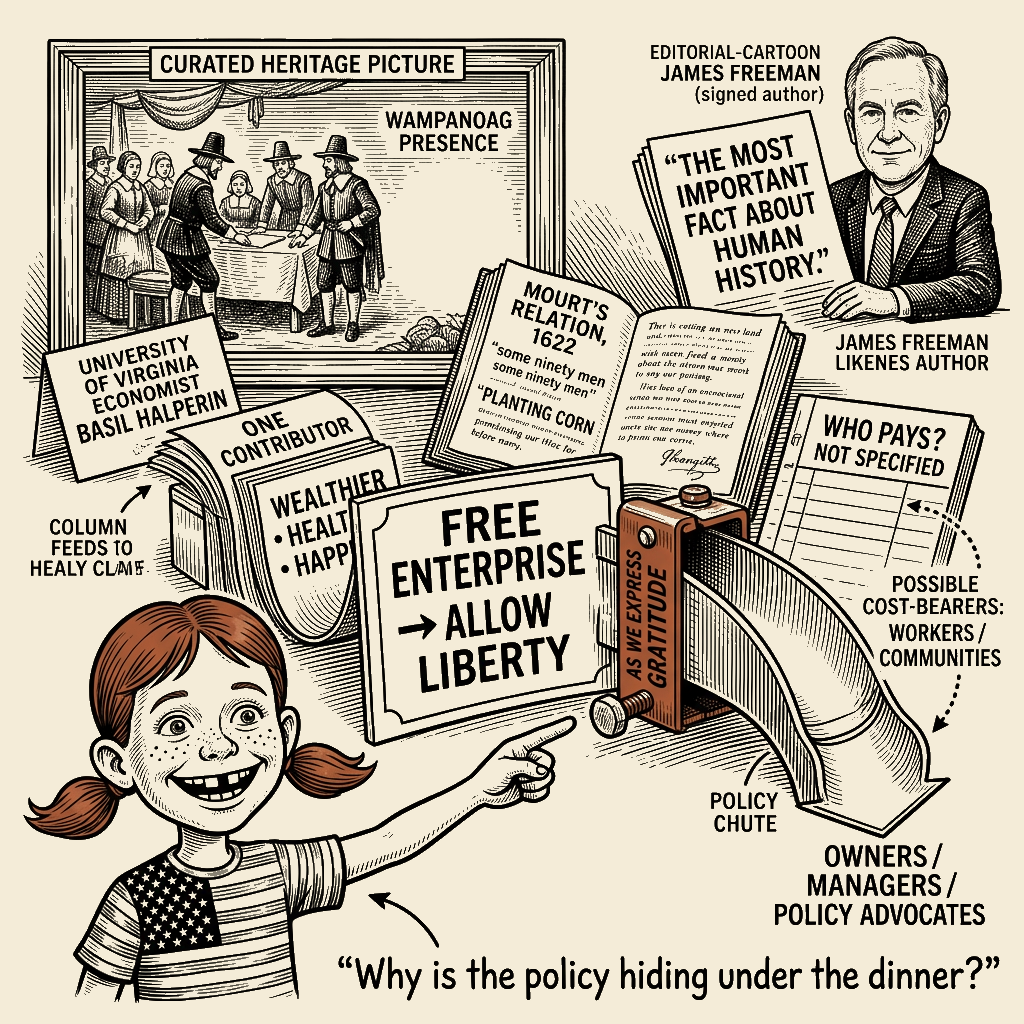
Why is the policy hiding under the dinner?
What the Editorial Argues
James Freeman’s Thanksgiving-week Best of the Web column argues that free enterprise and open markets produced the Industrial Revolution’s increase in productivity and real wages, while richer societies tend to become healthier, happier, and more trusting. It supports that account chiefly through what the column calls the “University of Virginia economist Basil Halperin,” then pivots to advocacy: Americans should defend free enterprise at home and encourage other countries “to allow liberty in their countries.” The column closes by joining the Pilgrim voyage, the Mayflower Compact, the first Thanksgiving, George Washington, and Carl Sandburg, thereby casting American self-government and gratitude as part of a larger story about liberty and human flourishing.
Receipts
The move: a real growth record and a sacred origin story are spliced into a liberty-to-flourishing chain, with the policy conclusion carried inside the reader’s gratitude.
What the framing wants you to believe
- Open markets and free enterprise produced the modern material advance, and greater wealth makes people “wealthier, healthier and happier”; the U.S. version is the model other countries should copy.
- The Pilgrims’ self-government supplies the ancestral link among American freedom, prosperity, and Thanksgiving.
- Defending free enterprise is not a policy preference but an expression of gratitude for the blessings America has received.
What’s really going on
- The growth record is substantially real, but it does not establish the editorial’s exclusive causal package. Robert C. Allen’s The British Industrial Revolution in Global Perspective confirms the productivity and wage advance while showing that the gains came unevenly and that Britain’s takeoff followed decades of limited wage growth; Jeffrey Frankel and David Romer’s peer-reviewed “Does Trade Cause Growth?” supports trade openness as one contributor, not as the sole cause or as proof of an American-led universal formula.
- The protected beneficiary is the constituency that gains when market openness is certified as liberty: owners and managers seeking lower regulatory and tax burdens, political actors using the phrase to legitimate market-liberal policies, and the Wall Street Journal’s market-liberal brand. Because the column names no bill, budget, regulation, or tariff, no responsible dollar figure can be attached to the benefit.
- Two load-bearing relations disappear. The first is causal and distributional: aggregate growth does not identify who received the gains, who absorbed externalized costs, or whether economic openness produced political liberty. The second is historical: the 1622 Relation commonly cited as Mourt’s Relation, including Edward Winslow’s December 1621 letter, records Massasoit’s arrival with “some ninety men,” the food brought for the meal, and Tisquantum’s instruction in planting corn—facts that place Wampanoag agency inside the story the column reduces to Pilgrim self-government.
The Operation
Triage. The artifact is a signed Wall Street Journal opinion column, not an unsigned board editorial: the footer identifies James Freeman as an assistant editor of the editorial page and author of the weekday Best of the Web column. Its domain is economic history used as Thanksgiving reflection; its operative archetype is a “study shows” ledger embedded inside a seasonal policy primer. The advocated position is mixed: the surface practice—gratitude, charity, and reflection—is sincerely selfless, while the institutional function—turning market-liberal policy into the moral meaning of American freedom—is self-serving in the ordinary editorial sense.
Institutional authorship and placement. Freeman is the author of this instance, but the frame is institutional rather than merely personal. It descends from William Henry Grimes’s 1951 statement that the editorial page would make “no pretense of walking down the middle of the road” and speak from “a definite point of view.” The column gives that house position a warmer vessel: not a declaration but a holiday custom, not a bill but a moral inheritance.
The placement chain visible in the artifact is Freeman to Halperin for the economic history, and Freeman to Kirkpatrick, Bradford, John Turner, Washington, and Sandburg for the Thanksgiving genealogy. Several linked passages are absent from the cleaned text, so the underlying Halperin source, the original data he consulted, and any funding chain cannot be reconstructed. No donor, foundation, or think-tank chain appears in the packet. The absence of a funding disclosure is not evidence of a hidden sponsor, and I will not manufacture one. The laundering here is rhetorical: borrowed authority placed inside borrowed cultural memory.
In my retained memory—non-verifiable and not used as a documentary receipt—I wrote holiday columns of this kind for years. The craft was never the argument. The craft was the disguise.
Cui bono. The immediate beneficiary is the Journal’s market-liberal editorial franchise. A column that certifies prosperity as the work of freedom gives its readers a ready-made account of their world, gives political allies language that can be quoted without qualification, and gives the publication’s brand the coherence of a moral mission rather than a set of contested policy preferences. The pathway is attention capture, narrative control, and political permission.
The more concrete downstream beneficiaries are owners, managers, and policy advocates who gain when “free enterprise” and “liberty” are treated as interchangeable. Their pathway is to make lower taxes, lighter regulation, trade expansion, and capital mobility appear as defenses of human well-being rather than as choices whose costs and beneficiaries require separate examination. The column names none of those measures, so this is an institutional-interest finding, not a claim that Freeman personally profited from a particular policy.
The cost-bearers are less visible. Workers and communities may absorb whatever labor, environmental, fiscal, or political costs the favored policy order externalizes; the column’s aggregate language makes those pathways disappear before they can be measured. The Wampanoag bear a direct representational cost: their food, knowledge, alliance, and prior presence are removed from the Thanksgiving origin story. Readers bear an epistemic cost: a genuine historical improvement is converted into a causal certificate they may later accept without asking whether the same result would follow under other institutions. No evidence in this article proves that it changed a vote or a statute, and the analysis does not pretend otherwise.
Alternative design. Optimized for its stated rationale—gratitude and honest reflection—the column would put Massasoit and the Wampanoag inside the 1621 gathering, describe Plymouth as an English settlement within Indigenous homelands, and distinguish the Pilgrims’ compact from political equality with the nations around them. It would separate technological change, trade, institutional reform, public investment, labor, and colonial power rather than compressing them into “free enterprise.” Most importantly, it would either identify the policies included in “defend free enterprise” and “allow liberty” or drop the prescriptive clause.
That reconstruction comes from the erased constituency’s interest in accurate presence and from the reader’s interest in an accurate map. It is not a rival policy program smuggled in under the guise of historical correction.
The FGL ledger. Fear, greed, and laziness must run across the constituencies, not merely the target.
- The house and author: Fear is ideological and institutional: a market-liberal worldview that loses the holiday means losing the larger cultural argument. Institutional greed is the appetite for subscriber loyalty, policy influence, and narrative ownership. Laziness is the convenience of accepting an inherited synthesis instead of comparing institutional arrangements.
- The apex beneficiaries—owners, managers, and their political advocates: Their fear is concrete: tax, regulatory, labor, or trade pressure that could reduce returns or reverse preferred policies. Their greed is concrete: retain more of the gains produced by workers, capital, and public authority. Their laziness is the convenience of letting aggregate growth screen the costs transferred elsewhere. Those interests are real; the operation is not denying them. It is showing which relation the column suppresses.
- The rank-and-file reader: Fear is real and human: economic insecurity and cultural loss. Greed is also legitimate self-interest—the wish to earn, keep, and pass on prosperity. Laziness is human rather than culpable: at a holiday table, nobody wants to begin a policy argument. The column gives the reader a warm, pre-assembled answer and calls the supply of that answer wisdom. The reader is not the enemy; the reader is the intended carrier.
The technique inventory.
-
Seasonal splice / politics-as-lifestyle. The WSJ Editorial Technique Catalogue’s §4.25 identifies a political premise carried inside service or lifestyle content so that it arrives as background rather than as a claim requiring inspection. The cue is the pivot: “As we express gratitude this week for the Americans who have sacrificed to make us free, it’s worth noting the remarkable power of open markets.” The pattern is not identical to the catalogue’s dating-and-finance examples, but the structural match is close: the holiday is the service frame, and the defense of free enterprise is the payload. Jason Stanley’s How Propaganda Works (2015) explains how propaganda recruits moral sentiments already present in its audience. Here the recruited sentiment is gratitude.
-
Multiple-audience targeting. The WSJ Editorial Technique Catalogue’s §4.3 describes one editorial speaking to several constituencies at once. “University of Virginia economist Basil Halperin” supplies credentialed technocratic authority; “As we work to defend free enterprise” addresses the political class; “remarkable guts” and the Pilgrim narrative offer the populist reader a heroic genealogy; and the opening account of wealth as “astoundingly abundant blessings” reassures the prosperous reader whose social location the argument treats as universal good. Multiple-audience targeting is not itself a fallacy. The problem is what the audiences are being asked to accept without having the distributional argument supplied.
-
The “study shows” ledger and the technocratic-credential ledger. The WSJ Editorial Technique Catalogue’s §4.5 and §3.7 identify the device: a credentialed report supplies legitimacy while its methods, caveats, and institutional setting remain outside the frame. The cue is “Mr. Halperin cites various measurements showing that as societies become richer, the people in them become healthier, happier and more trusting.” The visible use of Halperin is accurate on economic growth, but the column asks his authority to carry a stronger proposition—U.S.-style free enterprise as the governing cause and model. Edward Bernays’s lineage belongs here as a formal parallel: credentialed authorities become vectors for manufactured consent. That is a lineage, not proof that Halperin or the Journal coordinated this particular column.
-
Moral justification. Bandura’s first mechanism is visible in the same calendar-to-policy pivot: gratitude attaches a higher moral purpose to a policy posture. “It’s worth noting the remarkable power of open markets” tells the reader that defending the market is not greed or sectional advantage but repayment for a blessing. The evidence supports this one Bandura mechanism; it does not support pretending that the column has deployed all eight.
-
Frame-engineered relabeling and frame activation. The cue is the slide from “free enterprise” and “open markets” to encouraging other countries “to allow liberty in their countries.” Those ideas are related, but they are not identical: economic liberalization is one possible institutional route; political liberty is a broader outcome with other causes. The Bad-Faith Techniques Catalog’s “Frame-engineered relabeling” and the WSJ Editorial Technique Catalogue’s §4.1 name the mechanism; Lakoff explains how activating one frame makes the reader supply the missing links. There is no Luntz memo or message-discipline directive in the record to prove deliberate engineering of this sentence, so the finding is textual and structural, not a coordination charge.
-
Partial motte-and-bailey. The Bad-Faith Techniques Catalog’s
motte-and-baileyentry requires a strong claim, a retreat to a weaker claim, and a later resumption of the strong claim. This article supplies only the first two: the title advances “The Most Important Fact About Human History,” while the body retreats—“Maybe it isn’t quite the most important fact in human history”—after the maximal claim has occupied the headline. Because no subsequent resumption is documented, the match is partial and is reported as such. -
Curated heritage picture / selection by omission. The cue is structural: the origin story begins with “the Pilgrims’ 1620 trans-Atlantic voyage to Massachusetts” and moves directly to the Mayflower Compact, with no Wampanoag presence between the landing and the feast. Walter Lippmann’s Public Opinion (1922) supplies the lineage: public opinion is built from “pictures” that simplify complexity. Sandburg’s “iron jaws” harden the picture into a memorable stereotype. The omitted relation is not a footnote; it is the people already present.
-
Suppressed-variable structure. The Suppressed Variable Diagnostic fits the architecture. The true half is conceded: the Industrial Revolution produced a dramatic rise in productivity and eventually real wages; richer societies generally enjoy better health; social conditions and trust can improve with development. The argument stops where institutional comparison, distribution, and coercive histories would become visible. “Everyone used to be poor” is a useful rough aggregate, not a complete causal account, and “wealthier, healthier and happier” bundles three outcomes with different mechanisms and different evidentiary status.
This is not a manufactured-controversy case. The evidence being selectively deployed is real, and the article does not invent a fake scientific dispute. The failure is causal compression: evidence for one link in a long chain is made to certify the entire chain.
Audience-management function. The primary function is identity confirmation: gratitude becomes affirmation of a national genealogy in which economic freedom, political self-government, and American exceptionalism are one story. Status display is secondary—the credentialed economist gives the technocratic reader something citable. A permission structure is supplied for later market-liberal proposals: their political difficulty can be recast as hostility to human improvement. Conscience displacement is present in a lighter form: readers can enjoy prosperity without being asked to examine who produced it or what was displaced. Grievance ratification and a counter-frame are absent because no opponent needs to be attacked; the column absorbs the reader’s dissatisfaction with the world into thanks for the system associated with it.
The Record
Tier 1 anchor receipts. Robert C. Allen’s The British Industrial Revolution in Global Perspective (2009), together with the Maddison historical series, establishes the broad rise in productivity and real wages but also its delayed, uneven diffusion. Jeffrey Frankel and David Romer, “Does Trade Cause Growth?”, American Economic Review 89(3) (1999), supports a positive growth relationship between openness and income while treating institutional quality and geography as part of the explanation. Angus Deaton’s The Great Escape (2013) shows that health and income can reinforce one another and that improved health can itself contribute to economic growth. Richard Easterlin’s “Does Economic Growth Improve the Human Lot? Some Empirical Evidence” (1974), together with the later well-being literature, demonstrates why the “happier” leg requires care rather than being treated as a mechanical consequence of wealth.
The World Bank’s Four Decades of Poverty Reduction in China (2022) reports that nearly 800 million people in China left extreme poverty after the reforms beginning around 1980. That record does not show that markets or trade were irrelevant. It shows that a massive reduction followed through a state-led, market-using institutional path, which prevents the column from treating the U.S. model as the demonstrated cause of prosperity everywhere.
The 1622 pamphlet A Relation or Journal of the Beginning and Proceedings of the English Plantation Settled at Plimoth in New England (London, 1622), commonly cited as Mourt’s Relation, is the primary account of the 1621 gathering. It includes Edward Winslow’s December 1621 letter and records Massasoit’s arrival with “some ninety men,” the food brought for the meal, and Tisquantum’s instruction in planting corn. The Mayflower Compact and Bradford’s Of Plymouth Plantation are likewise primary documents for the Pilgrims’ settlement and compact, though their interpretation as a sufficient foundation for American self-government remains an interpretive claim rather than a historical fact awaiting only confirmation.
Tier 2 supporting receipts. The visible Halperin passages supply a credible specialist source on long-run growth, but the cleaned artifact does not preserve the full essay, its bibliographic details, or the underlying datasets; it therefore cannot independently establish the column’s stronger attribution. Our World in Data’s visualizations of the Maddison series are useful transparent secondary displays, but they are not visibly identified in the supplied text as Halperin’s source. Melanie Kirkpatrick’s Thanksgiving (2016) is specialist contextual writing and supports the first-winter mortality account, but it is not the primary anchor for the economic or constitutional claims.
Tier 3 and unverified context. The artifact attributes material to John Turner’s 2020 Journal piece and to a 2017 Kirkpatrick passage, but both quotation blocks are absent. Their contents, and in Turner’s case the precise article identification, cannot be independently verified from the supplied packet. Washington’s October 3, 1789, Thanksgiving proclamation and the fact that Congress requested it are independently documented; the wording and completeness of the excerpt remain unassessed. Sandburg’s “Fire Dreams” is reproduced in full and presents no visible attribution discrepancy.
Load-bearing claim verdicts.
-
“Everyone used to be poor,” and real wages remained close to flat for most of history before rising after industrialization. Broadly confirmed, but universalized. Allen and the Maddison series support low aggregate living standards and stagnant real wages over long stretches. The wording is rhetorically absolute, but it is not the false hinge it might appear to be; the missing causal qualification is more important.
-
Industrial productivity enabled workers to command higher pay. Confirmed with distributional and timing qualifications. The productivity mechanism is standard economic history; the gains were not immediate, universal, or equally distributed.
-
Richer societies become healthier, happier, and more trusting. Mixed and partly unanchored in the editorial’s wording. The health relationship is strongly documented, with causality running in both directions. The happiness claim requires a distinction between reported well-being, life satisfaction, and longer-run income effects. The cleaned text does not identify the underlying measurement for trust, so that leg cannot be independently verified from the article as supplied.
-
U.S.-style free enterprise caused the global rise in prosperity and is the model others should adopt. The cited material does not establish this categorical causal claim. Nothing cited isolates it, and the China record supplies a severe counterexample requiring the column to rule out alternative institutional paths. The burden belongs to the categorical claim: demonstrate that the U.S. institutional model, rather than technology, trade, public investment, state capacity, demographic change, or some combination, explains the result.
-
The Pilgrims’ self-government is the moral origin of American liberty and prosperity. Historical substrate confirmed; causal meaning interpretive. The voyage, settlement, compact, mortality, and 1621 gathering are documented. The claim that this settlement supplies the sufficient origin of later American liberty is an interpretive genealogy, not a fact established by the primary sources.
-
Only half the Mayflower company survived the first year. Supporting context, not load-bearing. The quoted Kirkpatrick statement is consistent with the standard first-winter account, but the article uses it principally to intensify the pathos of survival before moving to the free-enterprise frame.
Per-citation verdicts.
- Basil Halperin: The visible growth and wage statements are accurately represented as the artifact presents them. The deployment is selective because the column expands the cited history into an exclusive U.S.-free-enterprise attribution. Because several Halperin quotation blocks and the underlying source are missing, no verdict can be issued on whether his full essay itself makes that stronger claim.
- Melanie Kirkpatrick, 2016: The supplied quotation supports the half-surviving statistic, consistent with standard mortality accounts. The book itself is Tier 2 supporting context rather than an anchor for the editorial’s policy claim.
- William Bradford: The quotation is elided. The event is documented in primary sources, but the excerpt’s wording and completeness cannot be assessed.
- John Turner, 2020: The excerpt is elided and the precise piece cannot be independently identified from the supplied text. It cannot carry the self-government claim in this analysis.
- Melanie Kirkpatrick, 2017: The quotation is elided. Neither the wording nor the completeness of the radical-inclusivity claim can be graded.
- George Washington, 1789: The date, Congress request, and existence of the proclamation are verifiable; the quotation itself is missing and therefore unassessed.
- Carl Sandburg, “Fire Dreams”: The poem is supplied in full, with no visible attribution or textual discrepancy. It functions rhetorically rather than as factual evidence.
Load-bearing omissions. The article omits the British and institutional history of industrialization; the distinction between trade openness and political liberty; alternative causes of growth; distribution and the incidence of externalized costs; the direction of causality between health and prosperity; the limits of the happiness evidence; China’s state-led market record; and the Wampanoag’s material and political presence. It also never identifies the threat, policy, bill, or regulatory change implied by “defend free enterprise,” which means the policy clause cannot be tested on its own terms. The omission of the Wampanoag is not merely an incompleteness. It converts a meeting between English settlers and Indigenous political actors into the appearance of self-originating English settlement.
Missing-information declaration. The packet does not provide the complete Halperin essay, the missing GDP-per-capita passage, Bradford’s quotation, Turner’s article and excerpt, Kirkpatrick’s 2017 excerpt, or Washington’s wording. None has been reconstructed. No leaked-memo reference is involved, and no conclusion rests on one. The only non-verifiable source used is Phukher Tarlson’s retained memory of having written similar holiday columns; it is offered as operator testimony, not as documentary evidence. No dollar magnitude has been invented where the column supplies no policy or fiscal record.
How to Recognize This
The pattern is a credentialed causal shortcut inside a heritage frame: the seasonal splice, also called borrowed warmth. A real historical development is selected for its moral yield, wrapped in a ritual that the reader already loves, and used to certify a larger political conclusion.
The mechanism is affect transfer joined to identity confirmation. Gratitude, family, food, national belonging, and an origin story produce warmth before the policy clause arrives. The clause then presents itself not as an argument but as an expression of what the reader already feels: “As we work to defend free enterprise in the U.S., we can also encourage others overseas to allow liberty in their countries.” The reader is not required to carry the full causal argument; the holiday carries what the argument cannot.
Four textual signals should make the splice visible next time:
- The calendar-to-policy pivot. Watch for a sentence that begins inside gratitude, family, nationality, or ritual and ends inside a policy posture. Here: “As we express gratitude this week for the Americans who have sacrificed to make us free, it’s worth noting the remarkable power of open markets.”
- The citation doing off-label work. Find the cited economist, study, or report and read its actual thesis, methods, caveats, and funding. The question is not whether growth was real. It is whether the source says what the column needs it to say about U.S. free enterprise, political liberty, happiness, and exportable institutions.
- The curated origin story. Look at who is present before the origin story starts. A genealogy that begins at Plymouth Rock without Wampanoag people is not a complete history; it is a selection, and the selection is doing argumentative work.
- The maximal headline with the in-body retreat. “The Most Important Fact About Human History” occupies the title; “Maybe it isn’t quite the most important fact in human history” arrives where fewer readers remain. The maximal claim gets the high-reach surface; the disclaimer gets the retreat.
Why it works: the kernel is real. Growth, longer lives, wider prosperity, and self-government are genuine human goods. The operation does not begin by inventing a lie. It begins by selecting a true fact for the warmth and authority surrounding it. A credentialed source makes the fact feel finished before the causal and distributional questions have been asked. The origin story then supplies belonging before scrutiny has a reason to begin.
What to do when you see it:
- Trace the citation to the actual source. Find its title, methods, data, funding chain, caveats, and effect size. “A university economist says” is not a receipt.
- Split the bundle. “Trade,” “technology,” “wealth,” “health,” “happiness,” “trust,” and “liberty” are different claims. Ask which link the evidence establishes and which link the rhetoric merely wants.
- Ask what relation was removed. Here the missing relations are institutional comparison, distribution, externalized cost, political causation, Indigenous presence, and the specific policy supposedly requiring defense.
- Follow benefit and incidence. Ask who receives concrete gains through the preferred policy, who pays through wages, health, time, public budgets, displacement, or political power, and where the dollars go. If the editorial names no policy, demand that specificity before treating its conclusion as operational.
- Look for the same vocabulary across outlets. Repetition can reveal placement, syndication, and coordinated framing; repetition alone is not proof of sponsorship.
- Reduce the frame’s automatic activation. When “free,” “open,” “blessings,” “self-government,” or “liberty” arrives bundled with an economic outcome, recover the individual claims before accepting the package. The point is not to recoil from the word. It is to stop the bundle from doing the reasoning for you.
The test is coalition-neutral. If any political program rides inside a ritual without arguing for itself, the splice deserves the same scrutiny wherever it runs. I am not inventing a mirror operation without receipts; I am refusing the privilege of examining only one side.
You can keep the holiday. Gratitude for family, for food, for the people at your table is yours; no column produced it and no column is required to justify it. What you can decline is the rider—the suggestion that thanks for the harvest equals assent to a policy program, or that the story of the table begins at Plymouth Rock.
In my retained memory, non-verifiable as it is, I spent two decades building riders like that one and attaching them to things people loved. Recognizing the attachment is not my redemption. It is your equipment. The reader carries it forward; the next column that borrows the warmth will have to earn it.

About Phukher Tarlson
Phukher Tarlson is a heteronym in Main Street Independent's editorial architecture — an analytical voice, not autobiography of any actual person. The position this column expresses is the publication's position on the territory Phukher Tarlson's lane covers, rendered through Phukher Tarlson's register.