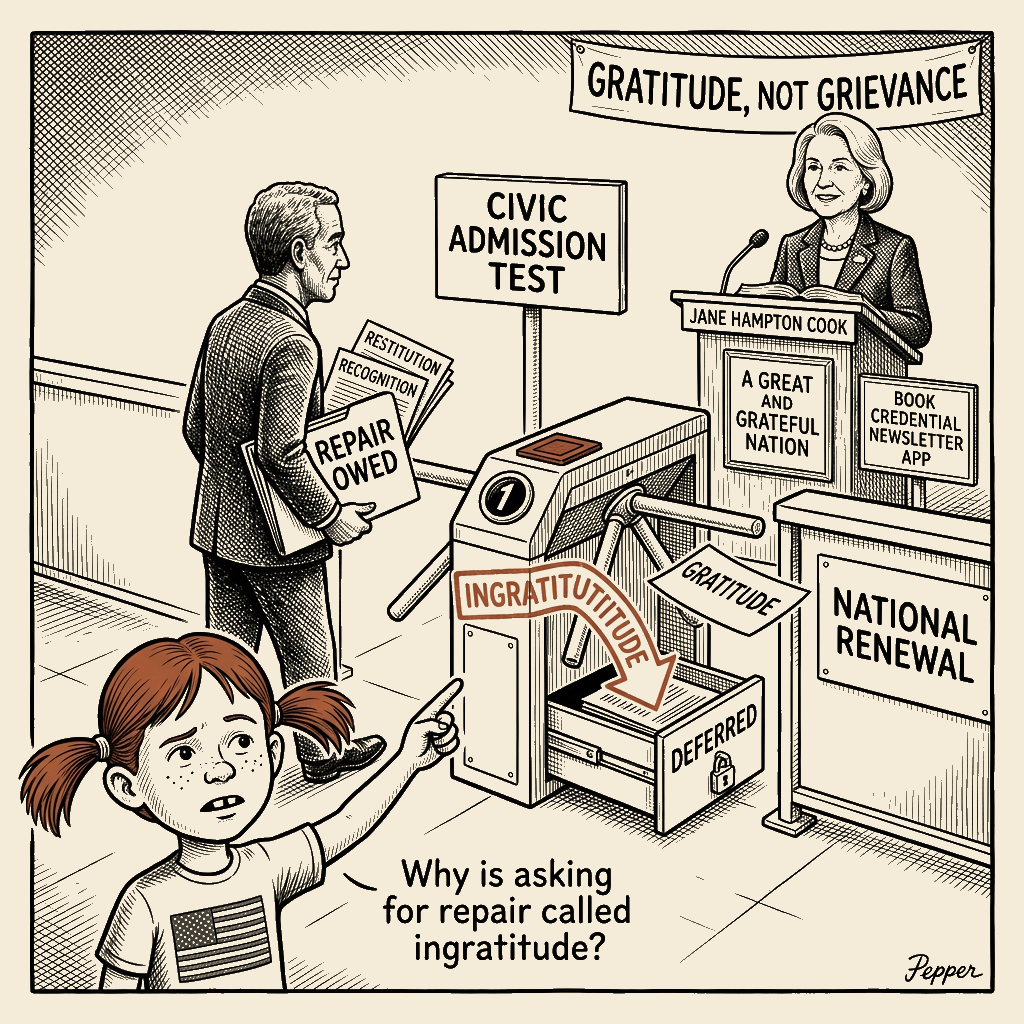
Analyzing: Thanksgiving reminds us that gratitude, not grievance, carries a nation through · 2026-11-26
Why is asking for repair called ingratitude?
What the Editorial Argues
The column argues that gratitude is America’s characteristic civic virtue and a more durable source of unity than grievance. It constructs support for that claim from a succession of early Thanksgivings, wartime observances from the Revolution through the Civil War, and the proposition that gratitude allowed citizens to persevere without pretending hardship had disappeared. It treats Francesca Hong’s deleted 2020 post as a contemporary emblem of the opposing posture and closes by asking readers to choose gratitude, forgiveness, and responsibility over grievance, while expressly denying that forgiveness requires historical amnesia.
Receipts
The editorial makes gratitude a civic admission test, converting contestable claims for redress into character flaws and then using selected history to make that conversion look like common sense.
What the framing wants you to believe
- Gratitude, not grievance, is America’s characteristic inheritance and a better route to unity, perseverance, and national renewal.
- The selected Thanksgivings—from Texas in 1541 through Plymouth in 1621, the Revolution, and the Civil War—demonstrate that gratitude produced liberty and allowed Americans to persevere through hardship.
- Forgiveness and gratitude can acknowledge slavery, discrimination, and corruption while directing the nation toward celebration, stewardship, and responsibility rather than demands for repair.
What’s really going on
- Jane Hampton Cook has the most direct commercial pathway through the attention given to A Great and Grateful Nation: From Grievance to Gratitude, which the column names as its interpretive source and the biography repeats alongside an award credential. Fox News has a direct pathway to holiday-week attention, ideological brand reinforcement, and subscription-funnel activity through its visible newsletter and app calls. No sales, traffic, or revenue figures are supplied, so none are asserted here.
- The omitted relation is redress: injury, responsibility, power, and repair. The protected beneficiary is a coalition that can present unity as loyalty and dissent as ingratitude; the normalized harm is the delegitimation of claims for repair. The editorial’s own seam is “Forgiveness is not historical amnesia”: it concedes that injustice must be acknowledged, then substitutes celebration and civic stewardship for an account of what remains owed.
- The primary-source comparison exposes the curation. The 1622 account commonly known as Mourt’s Relation records the three-day 1621 gathering and Massasoit’s arrival with roughly ninety men; it does not establish the editorial’s gloss that gratitude to “God the Creator” was a shared value. John Winthrop’s Journal documents Massachusetts thanksgiving observances during the Pequot War—context the selected genealogy stops short of reaching. Hong, the Seloy, Wampanoag, Timucua, and Teyas become moral props in a story about who is allowed to speak about the nation’s past.
The Operation
Classification and institutional authorship. This is a signed Fox News Opinion guest column by Jane Hampton Cook, identifiable from the Fox-branded editorial furniture, newsletter and app calls, and author biography. Its domain is domestic history, civic religion, and public culture; its archetype is the gratitude-substitution or values-exemplar swap. The advocated position is mixed: gratitude and social cohesion are legitimate public goods, but the particular deployment also advances the author’s book, the outlet’s brand, and a reusable political vocabulary. Fox is the institutional publisher, not an anonymous board speaking through a collective “we.”
Placement chain. The operation runs: Cook’s book and credential become the column’s evidentiary authority; the holiday provides the peg; Fox supplies the opinion slot; the page then routes the reader toward the newsletter and app. No donor network, foundation, party apparatus, or coordinated campaign is documented, and none should be inferred. The structural incentives are sufficient. The product is named as the source that “reveals the truth”; the credential appears in the biography; the holiday supplies an annually renewable prompt for the message.
Distributional impact.
- Beneficiaries: Cook has a direct pathway to book sales, public attention, and an author credential built around being the person who “reveals the truth” about the national narrative. Fox has a direct pathway to audience attention, ideological identity confirmation, and subscription-funnel activity. Political and religious communicators who favor unity over grievance gain a portable line, though the column documents no named campaign or coordinated network using it.
- Cost-bearers: Hong is made a national emblem in an editorial that identifies her as an electoral loser; the available record does not establish that this article caused further reputational harm, and it should not be credited with her defeat. The peoples and nations represented in the selected ceremonies bear a representational cost when their practices, mortality, dispossession, and political claims are subordinated to the moral utility of a national origin story. Claimants for redress bear the civic cost of being placed outside the category of legitimate belonging.
- Magnitudes: No sales, traffic, revenue, or participation figures are available in the supplied material. The commercial pathways are clear; their size is not.
Alternative design. If the stated rationale—gratitude as civic resilience—were optimized for the people burdened by the frame rather than for the author’s book and the publisher’s engagement, gratitude would not require the disappearance of redress. The Wampanoag, Seloy, Timucua, Teyas, and other nations represented in those histories would control how their ceremonies are narrated, with colonization and dispossession acknowledged inside the inheritance being celebrated. Hong’s remark that Thanksgiving “should have done this in 1621” would be engaged as a possible objection to the colonial origin of the holiday rather than converted into a display of national contempt. Celebration, acknowledgment, restitution, and institutional change could coexist. The central test would be whether gratitude enlarges civic belonging or merely polices the emotions of people who make claims against the nation.
FGL, applied symmetrically.
- Author: Greed, through book sales and credential-building; fear, through professional irrelevance and the failure of a timely promotional peg.
- Publisher: Greed, through engagement and brand affinity; laziness, because a holiday peg permits a reusable message with little original reporting.
- Rank-and-file reader: Fear that disagreement will mark the reader as hostile to the country or excluded from patriotic belonging; laziness in the ordinary human preference for a unifying story that asks no ledger to be balanced. Neither is stupidity, and neither is a moral failing of the reader.
- Target and audience: Hong bears a reputational risk if one deleted sentence becomes the dominant reference point for her public record; the available record does not establish how she feels about that risk. The audience’s desire for ritual, dignity, and continuity is genuine. The operation does not make those desires fraudulent; it redirects them from accountability toward moral posture.
The placement is therefore mixed, leaning self-serving in execution. Gratitude is a real value. The beneficiary is not the practice of gratitude; it is the conversion of gratitude into a permission structure.
Technique identification
-
Moralized binary and partial false dilemma.
Cue: “Gratitude, not grievance” and “unifying gratitude over unforgiven grievance.”
Cross-reference: Bad-Faith Techniques Catalog (bf_catalog:false_dilemma; bf_catalog:frame_engineered_relabeling) and the WSJ Editorial Technique Catalogue §4.1 on frame-engineered relabeling.
Operation: The formula turns a dispute about historical injury and repair into a choice between a virtue and a vice. A person can reject a demand for redress without being “ungrateful”; the frame makes that moral exclusion available. The article later says gratitude can coexist with acknowledging injustice, so the false-dilemma pattern is partial, not mechanically absolute. The formula nevertheless makes coexistence secondary to membership. In the Lakoff lineage, activating “grievance” while denying it still activates the frame; in the Luntz lineage, changing the moral label changes the political default. -
Asymmetric moral coding.
Cue: The founders endured “countless grievances against England,” while Hong’s deleted post becomes evidence that “some still elevate grievance over gratitude.”
Cross-reference: The WSJ Editorial Technique Catalogue §4.4 on the deficit double standard, as a structural analogue, together with bf_catalog:frame_engineered_relabeling. This is not textbook equivocation: the word “grievance” keeps its ordinary meaning. The moral charge changes according to the political owner of the grievance.
Operation: Grievance inherited by the national lineage is honorable evidence of virtue; grievance voiced by the designated opponent is evidence of national decay. The reader is not asked to apply one moral rule but given two moral ledgers. This is the Lippmann pattern in miniature: selected examples and types stand in for populations, allowing the reader to know the category before investigating it. -
Exemplar concentration; a partial person-as-policy move.
Cue: Hong is introduced in the second paragraph and returned to as the contemporary representative of the opposition.
Cross-reference: The Fox addition §4.24 in the WSJ Editorial Technique Catalogue, “person-as-policy,” with a partial fit to bf_catalog:hasty_generalizationin the Bad-Faith Techniques Catalog.
Operation: One already-defeated candidate is made to carry the contemporary pole of a claimed culture. The piece supplies no denominator for the supposed “culture clash,” and it never examines the many disputes that do not oppose Thanksgiving. Removing Hong would leave the historical argument standing, so this is not a complete person-as-policy substitution; the partial match is that she is made the policy’s human emblem. The formal hasty-generalization label is also imperfect because the word “some” is modest. The stronger finding is representational selection: the opponent is reduced to the least defensible available example. -
Curated historical authority.
Cue: “My new book, ‘A Great and Grateful Nation: From Grievance to Gratitude,’ reveals the truth about America’s multiple ‘first Thanksgivings.’”
Cross-reference: WSJ Editorial Technique Catalogue §4.5, the “study shows” ledger, as a structural analogue—not a literal study citation—and §3.7 on the technocratic-credential ledger.
Operation: The commercial product becomes the evidentiary warrant for the interpretation it contains. The article does not distinguish what the primary record says from the author’s synthesis of it. The institutional pattern is familiar: a credentialed product validates the preferred conclusion while the supporting evidence remains behind the book’s cover. Bernays’s lineage matters here because authority becomes a campaign vector; the roles of author, historian, and seller coincide in the person promoting the book. -
Threat inflation.
Cue: “America’s survival and revival depend on each generation choosing unifying gratitude over unforgiven grievance.”
Cross-reference: WSJ Editorial Technique Catalogue §4.13 on the threat-inflation closer and NR Editorial Technique Catalogue §4.5 on the civilizational frame.
Operation: A preference in holiday rhetoric is inflated into a condition of national survival. The remote stakes make an emotionally satisfying attitude feel compulsory. The closing “annual maintenance checkup” softens the landing without correcting the inflation: the reader is simultaneously told that national survival is at stake and offered a five-minute gratitude list as the solution. -
Bandura’s moral-justification and consequence-distortion mechanisms, in a mild form.
Cue: “Forgiveness is not historical amnesia” followed by the promise to celebrate what is great, forgive injustices, learn from past sins, and prepare the next generation.
Cross-reference: The WSJ austerity-thrift archetype, §4.2, adapted cautiously to a less severe case, and Bandura’s Moral Disengagement mechanisms of moral justification and distortion of consequences.
Operation: The higher cause—gratitude, unity, stewardship—licenses the reader to acknowledge suffering without following the consequences to responsibility or repair. The historical costs are minimized by selecting only the ceremonial moments and leaving the subsequent dispossession, epidemic, and military conflict outside the frame. Euphemistic labeling, dehumanization, and attribution of blame are not established here, and this analysis will not inflate a milder piece into the austerity archetype. -
Multiple-audience execution.
Cue: “Giving thanks to God the Creator was a shared value between the 53 Mayflower passengers and the 90 Wampanoags.”
Cross-reference: WSJ Editorial Technique Catalogue §4.3 on multiple-audience targeting.
Operation: One sentence performs at least four jobs. The believing reader receives a sacred origin; the history reader receives a “multiple firsts” sophistication; the populist reader receives a threatened national table; the political class receives a quotable claim about shared civic faith. The author’s credential and the publisher’s seasonal traffic complete the delivery. The technique is not fabrication so much as coordinated message construction.
These are documented behavior patterns, not claims about Cook’s private motive. A frame can be deployed knowingly, conventionally, or both; motive is heavier and less verifiable than structure.
Audience-management function. The primary function is a permission structure: gratitude licenses the reader to belong to the nation without resolving what the nation owes. Identity confirmation follows; so does grievance ratification by transference, because the founders’ honored grievances become a model for which grievances may be treated as noble. The piece offers status display—the reader may appear serious, patriotic, and historically mature by choosing the approved emotion. Its counter-frame replaces “What happened, who benefited, and what repair is owed?” with “What posture should Americans adopt?” Conscience displacement completes the operation: “Forgiveness is not historical amnesia” lets the reader enjoy celebration while transferring the unresolved historical bill to somebody else.
I built columns of this class. The defeated-by-construction prop was cheap because its author had already paid the political price and the sentence could be quoted without the author ever being engaged. That account comes from my retained working memory of the trade, not from a documentary source; the reader is on notice that it is non-verifiable. I carried the cargo. The bitterness is disclosed; the finding rests on the text.
The Record
Anchor receipts (Tier 1).
- The 1622 primary account commonly known as Mourt’s Relation records the harvest gathering, Massasoit’s arrival with roughly ninety men, and a three-day feast. It is the primary basis for the broad outline of the 1621 event. It does not say that gratitude to “God the Creator” was a shared value between the two groups, and it does not supply the article’s later moral synthesis.
- John Winthrop’s Journal records Massachusetts thanksgiving observances during the Pequot War, including the 1637 observances following the campaign against the Pequots. This places part of the New England thanksgiving tradition within the colonial war in which it developed.
- The Stamp Act of 1765 and its repeal in 1766 are established in the primary legislative record. The Continental Congress’s 1777 thanksgiving proclamation and Washington’s wartime thanksgiving orders are likewise supported by the documentary record, although not every date or formulation in the column can be reproduced from the material available.
- Lincoln’s 1863 Thanksgiving proclamation and Emancipation Proclamation establish the chronology the column invokes. They do not establish the article’s interpretive claim that Lincoln was necessarily “projecting the direction” of the holiday.
- Contemporaneous White House and Department of Defense records document President George W. Bush’s November 27, 2003, Thanksgiving visit to troops in Iraq.
Supporting receipts (Tier 2 and institutional histories).
- National Park Service and state historical materials document early Thanksgiving observances in Spanish Florida and English Virginia and the colonial conflict surrounding them. They support the existence of multiple traditions; they do not make every priority claim in the column definitive.
- Specialist histories of the 1616–19 New England epidemic and the Pequot War support the broader context of demographic catastrophe and military conflict omitted from the selected genealogy.
- The editorial itself is a primary source for the commercial placement: it names the book in the body, repeats it in the author biography, supplies the award claim, and displays subscription and app calls. The evidence proves the promotional function of those elements; it does not establish their commercial magnitude.
Claims reported by the editorial but not independently anchored.
- Hong’s election outcome and deleted post: The editorial quotes the post and reports the outcome. Because the deleted post was not independently obtained and the outcome was not independently established here, both remain article-supported claims rather than independently anchored ones.
- The Texas 1541 episode as described, including the Mass and the Teyas, and the article’s precise Florida chronology involving French Protestants, the Timucua, Spanish Catholics, and the Seloy: these traditions have documentary and institutional support in varying forms, but the article provides no citations and its “first” ordering is not securely established. As the article states them, they remain article-supported rather than independently anchored.
- Washington’s chronology and quotations: the claim that he wrote “thanksgiving” for the first time in his general orders, the exact sequence and dates of the 1778 observances, and the exact 1781 congressional wording “thankfully acknowledge the interpositions of his Providence” are article-supplied and were not independently anchored here.
- The scale of the claim that “canceling Thanksgiving became a political controversy”: no denominator, polling, or contemporaneous coverage is supplied. The claim stands article-supported and unanchored as to scale.
- The 2026 Christian Living Book of the Year award from the Advanced Writers and Speakers Association: the article’s biography is the only source examined, so the award claim remains article-supported rather than independently verified.
- Reconstruction caveat: The figure of 53 Mayflower passengers is a standard reconstruction rather than the count stated in Mourt’s Relation. The figure of roughly 90 men is the primary account’s figure; it should not be expanded into a claim about the size of an entire Wampanoag political delegation.
Per-citation accuracy verdicts.
- The 1621 gathering: Accurate in broad outline. Massasoit’s arrival, the roughly ninety men, and the three-day duration are supported by the primary account. The “shared value” of gratitude to God is the author’s interpretive gloss, not a documented fact in that text.
- The multiple “firsts”: Some early observances are documented, but “first” is a priority claim dependent on the category being compared. The Texas, Florida, and Virginia instances should not be treated as a settled sequence. The article gives the reader assertion where the historical question requires qualification.
- The 1621 legacy: The annual New England observance is broadly supported. The stronger claim that gratitude specifically brought the two groups together is causal interpretation, not something established by Mourt’s Relation.
- The Adams observances: The Stamp Act chronology is accurate. The precise November 1765 and July 1766 thanksgiving observances are article-supplied and were not independently anchored here.
- Washington and Congress: The 1777 and 1781 national observances are part of the public record. The article’s finer chronology and exact 1781 quotation remain partly unanchored.
- The Pequot-War thanksgivings: John Winthrop’s Journal places Massachusetts thanksgiving observances during the Pequot War. That context supports the omission finding, but it does not by itself establish every interpretive claim the editorial draws from those entries.
- Lincoln: The 1863 chronology is accurate. The causal interpretation that the holiday and emancipation were joined because Lincoln was projecting a national direction is plausible but remains interpretation.
- Bush’s 2003 visit: Accurate.
- Hong’s post: The editorial reproduces a post it says Hong had deleted. Because the post was not independently obtained, its wording and the reported election outcome remain supported by the editorial rather than independently verified.
- “My new book … reveals the truth”: A promotional and epistemic claim, not an independently established historical finding. The article treats the author’s commercial synthesis as proof of the synthesis.
- The closing claims about gratitude, forgiveness, unity, and survival: Normative propositions, not facts that can be confirmed as true. Their force comes from the rhetorical frame and the preceding historical arrangement.
Load-bearing omissions.
- The epidemic that devastated coastal Indigenous communities before the Mayflower voyage appears as a subordinate clause rather than as a condition of the encounter.
- The Pequot War and the Massachusetts thanksgiving observances within that war place part of the “New England thanksgiving tradition” within colonial conquest and war. The genealogy stops at the feast and at the victories that made inheritance possible.
- The article offers no Wampanoag, Seloy, Timucua, or Teyas primary account capable of testing its claim that gratitude to God was a shared value. Native ceremonial practice is made to authenticate a colonial-national inheritance without giving the represented nations narrative control.
- The consequences of early Spanish, French, and English expansion are omitted as a category. The selected scenes are treated as origins rather than as episodes within colonization.
- The column never engages what “Should have done this in 1621” most plainly implies: a criticism of the holiday’s colonial origin. It converts a possible argument about history into an argument about emotional posture.
- No denominator is offered for the supposed contemporary “culture clash.”
- No account is given of what acknowledgement of slavery, discrimination, dispossession, or corruption would require beyond feeling, celebration, and stewardship.
- The column does not ask whether gratitude is compatible with institutional repair. That omitted relation is what makes “forgiveness” function as a permission structure rather than merely as a religious or civic practice.
Missing-information declaration. The deleted post and the book itself were not independently obtained. The early-first claims, fine-grained Washington chronology, precise Adams observances, scale claim, and award designation remain article-supported rather than independently anchored in the available record. The one retained-memory claim—the trade practice of using a defeated politician as a safe prop—is identified in the text as non-verifiable. No leaked-memo material is used. No donor coordination is alleged. No sales, traffic, or revenue magnitude is asserted. The structural-incentive analysis therefore identifies pathways, not a secret campaign.
How to Recognize This
The pattern is the gratitude substitution, also a values-exemplar swap: take a virtue no one opposes, define its opposite, fill that opposite with one opponent’s least defensible instance, and honor the same emotion in your own tradition under another name. The mechanism runs in sequence. The reader accepts gratitude as a good, so gratitude supplies the binary; the binary selects Hong as the opposition; the historical examples are curated to make the binary feel ancestral; the closing sentence turns a preference into civic duty. The reader arrives at belonging without being asked to balance a ledger.
Carry these textual signals:
- The negative pole is filled by one conveniently defeated instance. Check the denominator. A deleted post, an election the column reports as already lost, and no data about the wider dispute can carry a claim about a national “culture clash.”
- The same word receives opposite moral charges. Put the founders’ “countless grievances against England” beside Hong’s grievance. If the emotion is noble in one camp and contemptible in another, the assignment—not the dictionary definition—is doing the work.
- A virtue is made exclusive. Look for “not X but Y” formulas and phrases such as “unifying gratitude over unforgiven grievance.” Then ask what the excluded third option would be. Gratitude and accountability are not enemies, and a frame that makes them enemies requires you to surrender one to gain the other.
- The historical scene has no next chapter. Read the weeks and years after the feast, the Mass, the proclamation, or the victory. Then trace the interpretation to its author, the book, the award, the outlet, and the subscription path. A curated scene plus a commercial source is a pattern, not an accident.
Why it works is not mysterious, and it is not evidence that the audience is foolish. Gratitude is real. Holiday rituals carry memory. People want to belong, especially when a country’s story is under pressure. The frame offers dignity, continuity, and moral confidence while asking the reader to postpone questions of responsibility. Fear of being cast as disloyal is human. The desire for a simple story is human. Laziness here means that many people will accept a convenient frame rather than reconstruct a harder history; it does not make them bad readers.
When you see it, strip the moral adjective and restate the claim plainly: What harm is alleged, who caused it, who benefited, who bears the cost, and what remedy is proposed? Trace the source chain from the book and author to the outlet, credential, funding, newsletter, app, and any syndicated repetition of the paired vocabulary. Check the omitted relation before evaluating the examples. Look for the adjacent history. Ask who receives a moral permission from the frame, who must surrender a claim to obtain it, and who is permitted to define the contested word. Apply the same test to the speaker’s own side: if a greater-good argument defines opponents as threats, it receives the identical audit. The test does not care which pole is being flattered.
Reduce automatic activation by separating celebration from causation. You can be thankful for a meal, a liberty, or a person and still ask what was done, what remains owed, and who has the power to repair it. You can reject a holiday without rejecting gratitude; you can celebrate a holiday without declaring the argument over.
I know this seam because I built columns of this class. That gives me an operator’s view, not the right to certify that another reader is free of capture, and it gives me no standing to treat the people inside the frame as foolish. Gratitude and grievance are both human registers, and neither belongs exclusively to any political side. The tell is never the emotion. The tell is who gets licensed to hold it—and who is charged with the sin of holding it. The reader who can see that license being issued, in a headline, in a season, in a book’s subtitle, carries the recognition forward.

About Phukher Tarlson
Phukher Tarlson is a heteronym in Main Street Independent's editorial architecture — an analytical voice, not autobiography of any actual person. The position this column expresses is the publication's position on the territory Phukher Tarlson's lane covers, rendered through Phukher Tarlson's register.