Analyzing: Sánchez and Socialists Poised to Lose Power in Spain — Tunku Varadarajan · 2026-11-26
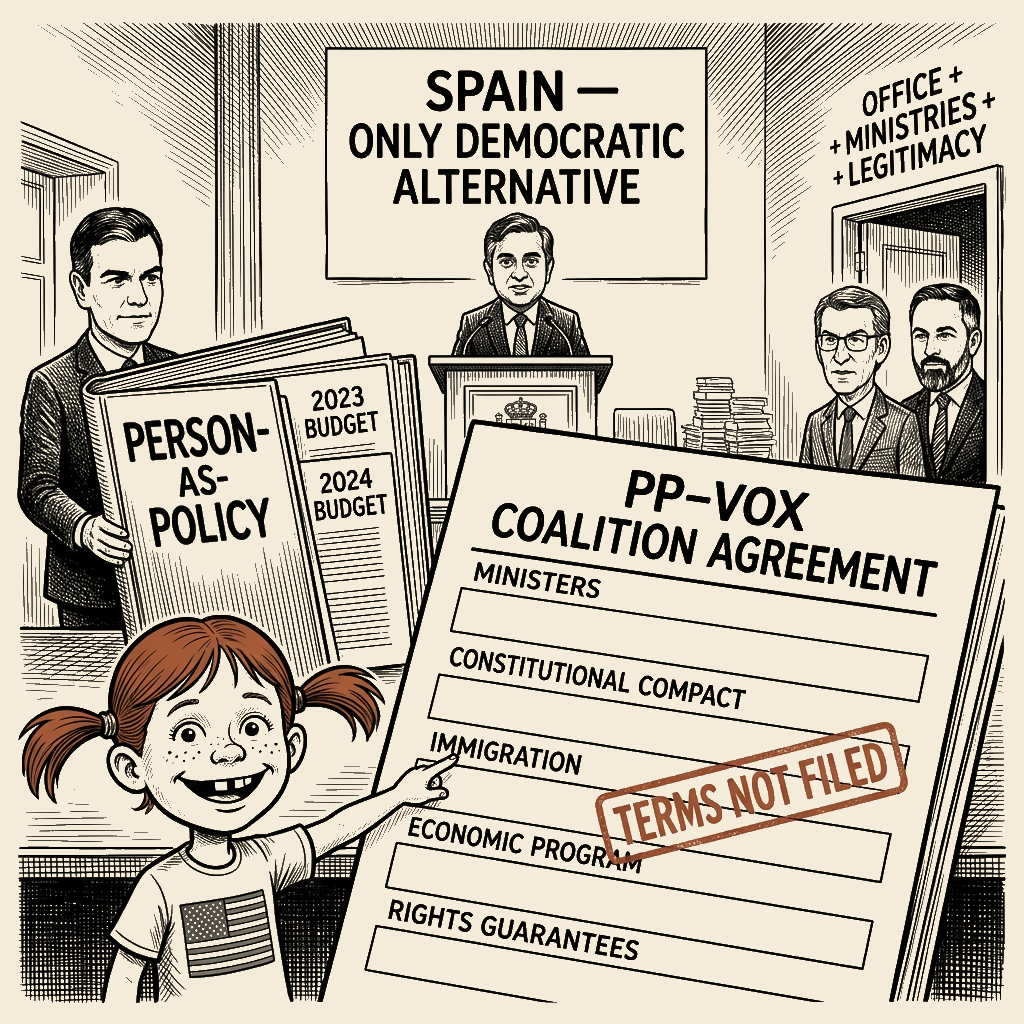
Where is the agreement?
What the Editorial Argues
Ahead of Sunday’s parliamentary election, Tunku Varadarajan argues that Pedro Sánchez’s eight-year Socialist-led government is uniquely corrupt, anti-democratic, and ideologically extreme, and that Sánchez is likely to lose the election. He presents Alberto Núñez Feijóo’s Popular Party as a dull but trustworthy alternative while predicting that Vox will force the PP into either a formal coalition or dependence on its parliamentary support. The column treats the exclusion of Vox from government as an illegitimate taboo that must yield to the supposed inevitability of a PP-led right-wing government.
Receipts
The move is to convert an unnamed-poll forecast and a ledger of personal condemnations into a moral inevitability that makes a PP–Vox government appear to be democratic restoration rather than a contested political bargain.
What the framing wants you to believe
- Sánchez’s defeat would not merely replace one government with another; it would correct a uniquely corrupt, anti-democratic, anti-American, far-left order and permit Spain’s “liberal, democratic forces” to resume their proper place.
- Feijóo’s dullness is evidence of seriousness and honesty, while Vox’s “far-right” stigma and exclusion from office are presented as obsolete prejudice rather than a safeguard requiring a substantive defense.
- The coming PP–Vox arrangement is therefore not merely one possible coalition. It is the only democratic alternative to continued Sánchez rule.
What’s really going on
- The protected beneficiaries are the PP leadership, which stands to gain the premiership and governing machinery; Vox, which stands to gain legitimacy, ministerial access, and leverage over centralization and immigration; and the Aznar-centered network, which receives an American outlet for its restoration project. The normalized harms fall on Catalan and Basque autonomy, non-native residents exposed to citizenship-based priority, mainstream conservatives whose positions may be diluted, and the democratic compact if the firewall is abandoned before any conduct test is specified.
- The load-bearing omission is the bargain itself: there is no coalition agreement, ministry allocation, constitutional compact, minority-rights guarantee, immigration framework, or economic program from which readers could judge whether the proposed partnership would govern better than the government it replaces.
- The principal factual hinge is also contradicted by the primary record. Spain’s Boletín Oficial del Estado records the enacted state budgets for 2023 and 2024—
Ley 22/2022, de 28 de diciembre, de los Presupuestos Generales del Estado para 2023andLey 31/2023, de 28 de diciembre, de los Presupuestos Generales del Estado para 2024. Parliament therefore had and enacted budgets during the period in which Sánchez was prime minister. The narrower dispute may concern later budget politics and passage; it cannot support the categorical charge that Sánchez “failed to present a single budget before Parliament in his last four years in office.”
The Operation
The question is not whether Sánchez may lose an election. The question is what the column makes his defeat mean—and who is authorized by that meaning.
Retained memory, not documentary evidence about this commission: I drafted columns in this architecture for twenty years—villain-ledger up, client’s virtues next, sourcing monopolized by the client’s elders, credential line at the bottom to close the sale. I have no document ordering this piece and claim none. That memory tells me where to look for the wiring; it does not prove intent. I am bitter about this class of column. The reader can convict it on the public record and owes my bitterness nothing.
Institutional authorship. This is a signed Wall Street Journal op-ed, not an unsigned editorial-board “we” piece. The collective-first-person and third-graf-turn fingerprints described in the WSJ Editorial Technique Catalogue therefore do not apply. The operative archetype is a signed, person-as-policy and coalition-normalization frame: a foreign-election forecast, a liberty-frame argument, and an advocated position that is mixed but leans selfish.
The byline and affiliation line supply the immediate placement chain: Tunku Varadarajan, identified as a “Journal contributor,” fellow at the American Enterprise Institute, and fellow at NYU Law School’s Classical Liberal Institute. AEI and the Classical Liberal Institute supply institutional credentials, not proof that either organization commissioned, funded, or coordinated the piece. No such claim is made.
The more important chain runs through the column’s sources. Aznar and Abascal are not incidental characters in a reported story; they are the credentialed authorities whose language supplies the narrative of restoration. Their interviews travel through a flagship business publication into an American audience already primed to recognize Aznar as a former prime minister and Abascal as a party leader. The placement chain is therefore:
Varadarajan’s aligned authorship → Aznar and Abascal as the right’s elder and operative voices → WSJ distribution and credentialing → PP–Vox coalition seeking office and legitimacy.
That is structural alignment, not a conspiracy finding. The record does not establish a donor chain, payment, meeting, or coordinated directive.
Distributional impact.
- Feijóo and the Popular Party stand to receive the premiership, cabinet, control of the governing narrative, and the power to place personnel in state institutions. This is not symbolic benefit. The office is the office.
- Vox stands to receive an end to the cordon sanitaire, movement from opposition into governing legitimacy, possible cabinet participation, and bargaining power over centralization, immigration, and “national priority.” The editorial itself says the PP would have to accommodate Vox on the constitutional structure and citizenship-based priority in housing and health care. If implemented as described, those policies would advance Vox’s constitutional program while placing new pressure on Catalonia, the Basque Country, and non-native residents.
- Aznar and the older PP network receive an American venue in which their preferred political vocabulary—restoration, liberal order, historical correction—appears as conventional international analysis rather than as party advocacy. That is a pathway to status and influence, not proof of payment.
- Varadarajan, the WSJ, and the wider conservative media ecosystem receive an attention-rich example of Europe moving to the right. The supplied record establishes access, placement, and ideological affinity; it does not establish payment for the placement.
- Sánchez’s voters and governing coalition plainly lose office. Their policy record is not evaluated; it is replaced by a charge against Sánchez’s alleged character and a characterization of the parties supporting him as enemies.
The documented scale is limited but real. Spain’s Interior Ministry records 137 PP seats in the 350-seat Congress after the July 2023 election; 176 is the majority threshold. The column projects 133–137 PP seats and more than 60 for Vox, but it names no pollster, fieldwork dates, sample, model, or uncertainty interval. If those projections were accurate, they would produce 193–197 seats, but they remain projections rather than receipts. The column supplies no fiscal magnitude for the policies it wants the reader to treat as settled.
Alternative design. If the stated rationale is to explain a foreign election to American readers and help them judge its democratic consequences, the design begins with the missing mechanism rather than the desired moral outcome:
- Name the pollsters, fieldwork dates, samples, seat models, uncertainty ranges, and plausible governing configurations.
- Present the macro ledger in both directions: growth, employment, inflation, deficits, housing pressure, and the institutional disputes behind budget passage or failure to pass.
- Give the budget chronology. Establish when budgets were introduced, rejected, extended, revised, or enacted, and distinguish failure to introduce a budget from failure to secure passage.
- Publish the proposed PP–Vox compact: ministries, policy concessions, constitutional language, treatment of Catalan and Basque autonomy, immigration rules consistent with EU law and due process, and the meaning of “national priority” in housing and health care.
- Compare formal coalition, confidence-and-supply, minority government, and renewed-election alternatives, including what each would require from the PP.
- Include the legitimate argument that excluding anti-system parties can strengthen them, then answer it with enforceable safeguards rather than treating exclusion itself as illegitimate.
- Interview the governing side, coalition partners, unaffiliated constitutional and fiscal experts, and voters likely to bear the policy costs—not only Aznar and Abascal.
This alternative does not require keeping Sánchez in office. It reconstructs the terms from the interests of people who need a government capable of governing and people who would bear the costs of the proposed bargain. It does not presume that a particular party should win.
Fear, greed, and laziness. Here “greed” means a concrete preference for gain, not an accusation of financial corruption.
- The framing author: fear of a renewed Socialist-led government and of the European right losing its moment; greed for access, status, and a usable example of the conservative coalition’s rise; laziness about disclosing the terms on which his conclusion depends. These are structural incentives, not a diagnosis of private motive.
- The apex beneficiaries—PP leadership, Vox, and the Aznar network: fear of renewed exclusion or irrelevance; greed for executive office, ministries, and control of the national agenda; laziness about exposing what coalition government will cost each of them. For Vox, the firewall’s breach is also a status prize.
- The rank-and-file reader: fear of deadlock, corruption, disorder, or an uncontrolled migration surge; greed for reassurance that housing, health care, borders, and ordinary government will be managed; laziness about checking pollsters, budgets, court dockets, and coalition obligations. The reader is not stupid. The frame lowers the cost of not checking by supplying an enemy and a mandatory solution.
The legitimate concern that exclusion can strengthen anti-system parties is real. It does not erase the costs of entry, and it does not make the proposed coalition self-justifying.
The failure-mode audit narrows the finding. No coordinated campaign or hidden payment is alleged because the record does not show one. Costs are attached to concrete pathways rather than ideological dislike. The alternative is reconstructed from the interests of the constituencies the frame pushes aside. Fear, greed, and laziness are applied across the author, the beneficiaries, and the reader rather than assigned only to the target.
Technique identification.
-
Character-ledger substitution; partial ad hominem.
Cue: “the most Machiavellian, amoral, corrupt and unprincipled head of government in Western Europe,” followed by the budget claim as “proof of his undemocratic and unaccountable character.”
Cross-reference: The Bad-Faith Techniques Catalog (bf_catalog:ad_hominem) and the WSJ Editorial Technique Catalogue §4.24, “Person-as-policy,” adapted here from its Fox-specific setting to a signed op-ed. The match is partial because temperament and leadership can bear on public confidence; it becomes the bad-faith pattern when character is made to perform work that policy evidence should perform.
Operation: The government’s institutional record is replaced by one man’s alleged soul. Feijóo receives the inverse ledger—dullness converted into “serious, dignified, honest and uncorrupt”—without a comparable performance record. The reader is invited to reach a verdict about both men before examining the economic, constitutional, and coalition questions. Lippmann’s Public Opinion supplies the lineage: politics is processed through a ready-made picture when the underlying system is too large to inspect. -
Advantageous comparison and moral analogy.
Cues: “unthinkable even in a country like Nigeria”; “It’s as if the Labour Party in the U.K. were to govern alongside former IRA killers.”
Cross-reference: Bandura’s mechanism of advantageous comparison. The Bad-Faith Techniques Catalog has no standalone false-analogy entry; the nearest formal pattern is the undistributed-middle problem, but the safer finding is operational rather than taxonomic.
Operation: The comparison supplies an instant moral calibration without showing that the compared systems share the relevant causal or institutional features. It moves the reader from parliamentary arithmetic and minority-government mechanics to a tableau of national degradation. -
Friend-enemy coding and dehumanizing metaphor.
Cues: Sánchez has “handed the country over to his enemies”; Catalonia and the Basque Country are described as “the antinational Catalans and Basques”; the governing alliance becomes “their leftist-separatist menagerie.”
Cross-reference: The NR Editorial Technique Catalogue §4.5, the civilizational frame; Carl Schmitt’s friend-enemy apparatus in The Concept of the Political; Bandura’s mechanism of dehumanization.
Operation: Ordinary multiparty support becomes treason, and a coalition becomes a menagerie. Once opposition is coded as enemy, coalition bargaining no longer requires a defense on its merits; it appears as surrender to the illegitimate. The phrase “menagerie” is the dehumanizing stroke: people and political parties are rendered as a collection of creatures to be managed rather than parties with voters, programs, and constitutional claims. -
Frame-engineered relabeling.
Cues: “far right,” “far left,” “progressive,” “anti-Zionism,” “humanitarian,” and “remigration”; Aznar’s “liberal”—“in the European manner”—to denote free-market politics; Abascal’s “reconquista.”
Cross-reference: The Bad-Faith Techniques Catalog (bf_catalog:frame_engineered_relabeling) and the WSJ Editorial Technique Catalogue §4.1, with related asymmetric scare-quote practice in §4.12. Lakoff’s cognitive-frame work and Luntz’s Words That Work supply the lineage, although there is no evidence of a particular Luntz memo behind this column.
Operation: The article does not hide Aznar’s definition of “liberal”; it uses the honorable label to certify a coalition whose ideological content remains untested. “Remigration” relabels deportation, and “reconquista” relabels ethno-national restoration as institutional repair. The column quotes and distance-marks those terms while leaving them alive as described policy. The labels settle the moral question before the reader has examined the policy. -
Associative guilt and distortion of consequences.
Cues: “a deranged Ireland”; recognition of a “putative Palestinian state”; Hamas’s praise; Sánchez’s having “all but exhorted radicals to sail to Israel in ‘humanitarian’ flotillas.”
Cross-reference: Bandura’s distortion of consequences, with the partial circumstantial-ad-hominem pattern in the Bad-Faith Techniques Catalog (bf_catalog:ad_hominem).
Operation: Diplomatic recognition of Palestinian statehood, criticism of an Israeli government, private flotilla activity, Hamas’s October 7 attack, and Sánchez’s character are fused into one chain. The distinct relations—recognition, normalization, criticism, support, and military response—are not preserved. That fusion converts a contested foreign-policy position into evidence of personal malignancy without supplying the intervening evidence. -
Anti-expertise framing and press-as-standing-antagonist.
Cues: “analysts persist in whitewashing Mr. Sánchez with the euphemism ‘progressive’”; Vox is “characterized, inevitably, as ‘far-right’ by the Western media.”
Cross-reference: The Bad-Faith Techniques Catalog’s expert-consensus/expert-deference framing in its anti-expertise direction, and the WSJ Editorial Technique Catalogue §4.23, “Press-as-standing-antagonist.”
Operation: The analyst class and press are placed outside the legitimate order before their judgments are examined. The Council on Foreign Relations item is used chiefly as a foil; the column does not engage the analysis beneath the phrases it selects. This is enough to discredit the reference class. It is not enough to establish manufactured consensus, and no such coordination claim is made. -
Poll-as-ledger and appeal to popularity.
Cues: “If opinion polls can be trusted”; “Wave or no, the right is set to return to power in Spain.”
Cross-reference: The Bad-Faith Techniques Catalog (bf_catalog:appeal_to_nature_tradition_popularity) is a partial match, analogous to the WSJ Editorial Technique Catalogue’s “study shows” ledger. The column does not literally cite a study.
Operation: A conditional survey premise is hardened into certainty without an attributable poll, date, sample, model, or uncertainty interval. The quantitative apparatus supplies the appearance of objectivity while its methods remain outside the frame. -
Pre-emptive legitimacy withdrawal.
Cues: Vox and comparable parties have been “treated like pariahs and shunned in all coalitions”; entry would bring “a paradigm change”; “For how much longer” will Vox be treated as anathema?
Cross-reference: The Bad-Faith Techniques Catalog (bf_catalog:pre_emptive_legitimacy_withdrawal). Ano_true_scotsmanmatch is partial because the editorial never answers a concrete counterexample.
Operation: Prior exclusion is treated as proof of present democratic legitimacy. Admission criteria are never specified. The institutional taboo is condemned in advance of any case-specific inquiry into conduct, constitutional compatibility, minority rights, or governing competence. -
Citation asymmetry and access-as-authority.
Cues: “Aznar tells me”; Abascal’s statements “in interviews”; the conversation conducted “in a van taking him from one campaign rally to another”; Sánchez’s words appearing chiefly as hostile quotation.
Cross-reference: The WSJ Editorial Technique Catalogue §3.6, source-citation asymmetry, and §3.7, the technocratic-credential ledger. Edward Bernays’s account of credentialed authorities as campaign vectors supplies the lineage.
Operation: All attributed interviews come from Aznar or Abascal. No Socialist, Catalan, Basque coalition partner, unaffiliated Spanish analyst, or government-side official is interviewed to answer. The interview atmosphere—van, chuckle, Delphic grin—turns advocacy into eyewitness intimacy. Access is not itself a fallacy; without transcripts or independently corroborated material, it is testimony rather than independent proof. -
Threat inflation and multiple-audience targeting.
Cues: Vox’s entry would “bring about a paradigm change in European political attitudes”; “The future of Spain rests on it”; the country needs “a coalition of the right to wrest the reins from Mr. Sánchez.”
Cross-reference: The WSJ Editorial Technique Catalogue §4.13, the threat-inflation closer, and §4.3, multiple-audience targeting, adapted from board copy to a signed op-ed; the NR Editorial Technique Catalogue §4.5, the civilizational frame.
Operation: The close turns coalition arithmetic into a continental hinge. At the same time, the column serves several audiences: Sánchez’s voters receive moral condemnation; Feijóo’s receive dullness-as-virtue; Aznar’s network receives the “liberal” label; Vox receives normalization; and the international conservative audience receives a showcase of a right-wing wave. The technique creates urgency without supplying the coalition instrument that would justify it.
Audience-management function. The primary function is a permission structure: a reader who has treated Vox as beyond the pale can support its entry without feeling that a democratic standard has been surrendered. The piece also performs identity confirmation for anti-socialist and economically liberal readers; grievance ratification through the corrupt incumbent and the “Western media”; status display through Feijóo’s supposed seriousness and Aznar’s former premiership; a counter-frame in which “liberal democracy” means a PP–Vox government; and conscience displacement. That last move is the hinge: moral scrutiny is transferred from Sánchez to the coalition the article wants admitted, so the reader can retain the feeling of defending democracy while changing the object of the defense.
The Record
The primary artifact is the complete column by Tunku Varadarajan, “Sánchez and Socialists Poised to Lose Power in Spain” (Wall Street Journal, Nov. 26, 2026). It confirms what the column says, whom it quotes, what it omits, and how it constructs the argument. It does not automatically corroborate the truth of its external claims.
Tier 1 — anchor receipts.
- Budget claim: Spain’s Boletín Oficial del Estado records
Ley 22/2022, de 28 de diciembre, de los Presupuestos Generales del Estado para 2023andLey 31/2023, de 28 de diciembre, de los Presupuestos Generales del Estado para 2024. Parliament therefore received and enacted state budgets during Sánchez’s premiership. The claim that Sánchez “failed to present a single budget before Parliament in his last four years” is inaccurate as stated. The later budget chronology may reveal deadlock, repeated failure to secure passage, or another institutional dispute; that narrower question cannot be smuggled back into the categorical claim. - 2023 election arithmetic: Spain’s Interior Ministry results for the July 23, 2023 general election record the PP with 137 seats, PSOE with 120, Vox with 33, and Sumar with 31. The column’s 137-seat figure, 350-seat chamber, and 176-seat majority threshold are accurate. Its 2026 projections are not primary results.
- Catalan amnesty:
Ley 20/2023, de 27 de octubre, published in the official gazette, provided amnesty and sentence relief for qualifying Catalan political cases. The existence of a parliamentary amnesty measure is anchored; the editorial’s presentation of it as a personal grant by Sánchez is materially compressed. The treatment of Sánchez’s broader relationships with ERC and EH Bildu requires the separate distinctions between parliamentary confidence support and cabinet participation. - Palestinian-state recognition: Spain’s government announcement and contemporaneous Reuters reporting establish that Spain, Ireland, and Norway announced their intention to recognize the Palestinian state on May 22, 2024, and that recognition took effect May 28. The recognition was a national act and did not require EU Council authorization.
- Alliance context: Official NATO and EU records establish Spain’s NATO membership since 1982 and EU membership since 1986. Those facts do not prove that Sánchez’s foreign policy was conventionally pro-American or anti-American; they establish that the “anti-American coalition” characterization requires evidence beyond the editorial’s accusation and omitted alliance context.
- The editorial as a primary document: The absence of growth, unemployment, inflation, and deficit performance figures; the absence of a pollster; the concentration of interviews with Aznar and Abascal; the absence of a coalition agreement; and the absence of court-status accounting for the accusations against Begoña Gómez are all checkable from the text itself.
Supporting and testimony-based receipts.
- The Aznar and Abascal quotations are accurately reproduced within the supplied article, but no transcript, recording, publication, or independent verification was supplied. They are testimony about politics and character, not independent evidence of either.
- A Council on Foreign Relations article would ordinarily be a Tier 2 contextual source even after retrieval. Here the underlying article and its full context were not supplied, so the phrases “Europe’s progressive conscience” and “Spain’s election could spark Europe’s next right-wing wave” can be assessed only as attributed quotations in the column.
- The column properly says Sánchez’s wife “faces accusations,” not that she has been convicted. That wording preserves the allegation as an allegation. The column supplies no docket, disposition, comparator, or rate supporting its broader claim that corruption “flourished” for eight years.
Unconfirmed claims.
- 2026 polling and the forecast of a right-wing government: no pollster, fieldwork date, sample, model, uncertainty interval, or alternative scenario is supplied.
[unconfirmed: convergence threshold not met] - “Spectacular mismanagement”: the editorial offers no growth, employment, inflation, fiscal, or housing-performance ledger.
[unconfirmed: convergence threshold not met] - “Corruption has flourished in Spain” as an eight-year generalization: no adjudicated case inventory or base-rate comparison is supplied.
[unconfirmed: convergence threshold not met] - The “anti-American coalition”: one diplomatic recognition and a set of statements about Israel are not the cited evidence.
[unconfirmed: convergence threshold not met] - Hamas’s public praise “on numerous occasions”: no examples or primary quotations are supplied beyond the column’s characterization.
[unconfirmed: convergence threshold not met] - Ceuta as a recent “invasion” by “tens of thousands of Moroccan migrants”: no date, incident document, count, source, or definition of “invasion” is supplied. The package does not permit a finding that the event occurred as described.
[unconfirmed: convergence threshold not met] - Vox’s “nearly a fifth of the national vote” and the projected 60-plus seats: no cited poll or certified result is supplied.
[unconfirmed: convergence threshold not met] - “Spain’s most leftist government since the Spanish Civil War”: no metric or historical comparison is given. It is an undefined superlative, not an anchored factual claim.
- The $2.09-trillion economy and rankings: no year, price measure, source, or methodological explanation is supplied.
[unconfirmed: convergence threshold not met]
Per-citation accuracy verdicts.
- Budget: inaccurate as stated; the enacted 2023 and 2024 budgets contradict the categorical no-presentation claim.
- 2023 seat result and majority threshold: accurate.
- Catalan amnesty: substantially accurate in substance, materially compressed in agency and context.
- Palestinian-state recognition: accurate. The wider “anti-American” characterization is unsupported by the cited record.
- Begoña Gómez: accurately characterized by the editorial as facing accusations, not as convicted. Its use as proof of a broader corruption ledger remains unanchored.
- Ceuta: unsupported in the supplied text.
- Aznar: testimony accurately reproduced within the article, with no independent transcript supplied.
- Abascal: testimony accurately reproduced within the article, with no independent transcript supplied.
- Council on Foreign Relations: attribution is visible, but the underlying item and context were not obtained; the pairing of phrases is rhetorically selective.
- Polls: no attributable citation exists, so they cannot support the editorial’s forecast or convert “Wave or no” into a fact.
Load-bearing omissions.
- The economic record behind “spectacular mismanagement.”
- The complete budget chronology and the actual institutional obstacle.
- Court status for each accusation and the cases needed to support an eight-year corruption generalization.
- The PP–Vox coalition agreement, ministry allocation, and concessions.
- Vox’s constitutional program and the concrete fiscal and administrative meaning of “national priority” in housing and health care.
- The treatment of Catalan and Basque autonomy, minority rights, and non-native residents under the proposed arrangements.
- Pollsters, fieldwork dates, samples, seat models, uncertainty ranges, and alternative governing configurations.
- A comparison of formal coalition, confidence-and-supply, minority government, and renewed-election options.
- The precedents and distinct conditions under which European parties have entered government or supported outside governments.
- The legal and diplomatic distinctions among Palestinian-state recognition, full bilateral normalization, criticism of Israel’s government, support for Hamas, and private flotilla activity.
- Spain’s NATO, EU, and alliance relationships as context for the “anti-American” charge.
- Any interview with the governing side, a coalition partner, or an unaffiliated Spanish analyst.
Missing-information declaration. The supplied record does not contain the 2026 polling series, the linked CFR article, the Aznar and Abascal transcripts, the Ceuta incident evidence, the later budget chronology, or a post-publication election result; the column is a forecast, and no result is assumed here. No leaked memo is referenced. The operator-method passage is explicitly retained memory, used only to identify a familiar operation class rather than to establish facts about this article or its commissioning. No gap has been filled by invention. Where a primary document supplies an answer, it is named; where the record remains silent, the claim is either labeled unconfirmed or the omission itself is stated.
How to Recognize This
The pattern. The mandatory-coalition frame: a manufactured moral enemy is paired with an insistence that the supposedly forbidden solution is now the only democratic choice. Its characteristic movement is not “these policies deserve consideration.” It is: “The other side is so corrupt, illegitimate, and dangerous that the taboo party must be admitted.”
The column also performs a character-ledger swap. Sánchez’s governing record becomes his alleged soul; Feijóo’s temperament becomes evidence of virtue; Vox’s movement vocabulary is quoted with a wink and left live as governing policy; and the certificates are signed by the challengers’ own elders. The machinery makes a contested bargain feel like a restoration too obvious to require a contract.
Mechanism. The frame gives the reader a civic emergency and a permission slip. Sánchez is made to embody corruption, appeasement, extremism, and foreign disloyalty. The policy merits of the proposed replacement are treated as self-evident. The reader is not asked to compare platforms; the reader is asked to choose between a moral rescue and renewed rule by the enemy. Once the labels do that work, scrutiny of Vox’s commitments can be redescribed as residual prejudice.
Textual signals.
- A poll appears without a pollster, date, method, sample, model, or uncertainty range, then becomes “Wave or no” certainty.
- A superlative character charge appears in the opening paragraphs—“the most Machiavellian, amoral, corrupt and unprincipled head of government in Western Europe”—while the verifiable performance ledger is missing.
- “Far right,” “far left,” “progressive,” “liberal,” “humanitarian,” “remigration,” or “reconquista” does argumentative work before the policy it describes is examined.
- “Only way forward,” “paradigm change,” “the future rests on it,” or a similar mandatory phrase arrives before the coalition agreement, platform, budget record, constitutional text, or enacted policy that would make the conclusion testable.
Count the interviews as well. When every attributed interview comes from the favored coalition’s former leaders or current leaders, while the opposition’s words appear only as hostile excerpts and no one is invited to answer, the article has given you the shape of its evidence without calling it evidence.
Why it works. Lakoff explains how a substituted label can settle an argument before the underlying relation is examined. Lippmann explains how readers receive foreign politics through ready-made pictures rather than raw facts. Bernays explains how consent can be engineered until the preferred outcome feels like common sense. Schmitt explains the friend-enemy division that makes the coalition choice feel existential. The added force is moral: readers can support the preferred side while retaining the status of defenders of democracy. That permission structure is the product.
What to do when you see it.
- Strip the labels and restate the proposal mechanically. Replace “liberal democratic forces” with the ministries, spending authority, constitutional changes, immigration rules, and coalition concessions actually proposed.
- Find the original poll or report. Check its sponsor, fieldwork dates, sample, model, uncertainty interval, and whether a second polling family agrees. “The polls” are not a source.
- Demand the coalition contract before treating the coalition as inevitable. Ask who gets a ministry, what concession is exchanged, what condition can end the arrangement, and who bears the cost.
- Check the institutional record in the order the editorial avoided: budget calendars and enacted laws, court dockets, parliamentary votes, party platforms, and coalition documents. Character comes after the mechanism.
- Ask who gains concrete power and who pays in money, time, freedom, rights, or institutional autonomy. Apply the same test to the favored side.
- Search the distinctive vocabulary—“far-right,” “far-left,” “national priority,” “remigration,” “paradigm change”—across the outlet and its syndication network. Repetition may indicate a house frame; it may not. It is still a reason to investigate.
- Reduce the frame’s automatic activation. Before repeating the claim, write the strongest plain-language version of the opposing case and identify the evidence that would change your conclusion. If no such evidence can be named, the labels are doing the work the facts should do.
I drafted memos like this. I am bitter about what that work did, and the bitterness is residue, not evidence. The confession is not an application for forgiveness; it is a map of the wiring. You do not have to regard Sánchez and Vox as equivalent to recognize what the frame is doing, and you do not have to regard Vox as illegitimate to see why the editorial conceals the terms of its admission.
The next time moral labels arrive before the underlying policy and costs, slow the frame down. Require the poll, the budget record, the coalition agreement, the constitutional text, and the distributional accounting. Then ask the question this frame wants kept below the fold: who gets power when the taboo breaks, and who pays for it?
Recognition is not absolution for either side. It is how the next vote remains yours.

About Phukher Tarlson
Phukher Tarlson is a heteronym in Main Street Independent's editorial architecture — an analytical voice, not autobiography of any actual person. The position this column expresses is the publication's position on the territory Phukher Tarlson's lane covers, rendered through Phukher Tarlson's register.