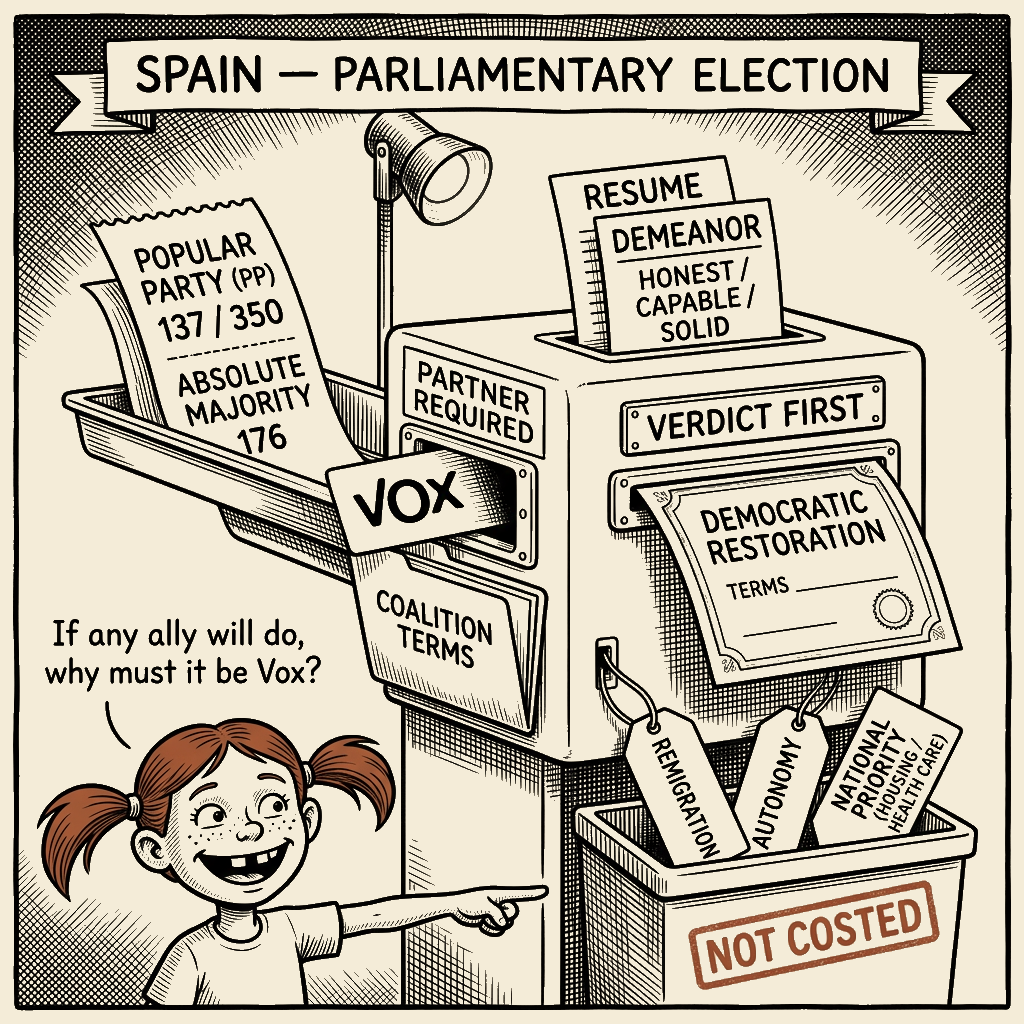
Analyzing: Sánchez and Socialists Poised to Lose Power in Spain — Tunku Varadarajan · 2026-11-26
If any ally will do, why must it be Vox?
What the Editorial Argues
The editorial argues that Pedro Sánchez’s Socialist government is likely to lose Spain’s forthcoming parliamentary election and portrays Sánchez’s alliances with separatists, communists, and political figures associated with the ETA as evidence of corruption, extremism, and democratic unaccountability. It presents Alberto Núñez Feijóo as an honest, capable technocrat whom José María Aznar endorses as a non-populist alternative, and argues that the Popular Party’s failure to govern alone makes some alliance with Vox unavoidable. It then treats Vox’s entry into government—or its role as kingmaker—as democratic restoration and a necessary break with the European firewall against the right.
Receipts
The move is verdict laundering: it turns contingent parliamentary arithmetic into a moral clearance operation for a PP–Vox government.
What the framing wants you to believe
- Sánchez is uniquely corrupt, extremist, anti-Israel, and unaccountable; Feijóo is personally decent and institutionally competent.
- Vox is not a compromising partner but a necessary democratic one, because it commands nearly a fifth of the vote and the Popular Party cannot govern alone.
- The coming contest is not a choice among flawed programs and coalition bargains. It is a restoration of liberal democracy against a far-left cabal.
What’s really going on
- The concrete beneficiaries are the Popular Party and Vox. The PP needs a durable governing partner; Vox needs mainstream acceptance, cabinet access or kingmaker leverage, and the disappearance of the firewall the column celebrates. Spain’s official July 2023 results show the PP with 137 of 350 seats; Article 99 of the Spanish Constitution requires 176 for an absolute majority. Those Tier-1 records establish the need for an ally, not the need for Vox specifically.
- The authority supplying the column’s verdict is not neutral. The artifact itself identifies Aznar as “an avid backer of Alberto Núñez Feijóo,” while the byline places Varadarajan at the American Enterprise Institute and NYU Law School’s Classical Liberal Institute. That establishes an affiliation-and-placement chain, not a secret order to write the piece; no document shows that either institution or the Wall Street Journal commissioned or approved it.
- The load-bearing omissions include facts that materially qualify the verdict. The claim that Sánchez’s government “failed to present a single budget before Parliament in his last four years” is false as worded: Spain enacted the 2023 budget under Ley 31/2022 and the 2024 budget under Ley 31/2023. The government did at times operate without a newly approved annual budget and depend on extensions, but that narrower fact cannot support the categorical accusation. Spain’s May 2024 recognition of Palestine was expressly conditional, including on hostage releases and a ceasefire; the column’s “with no concessions asked” omits the conditions in the government’s own record.
The Operation
Classification and placement. This is a signed Wall Street Journal guest contribution, not an unsigned editorial-board product. The domain is European electoral politics; the archetype is the foreign-election endorsement essay fused with the coalition-normalization operation. The position is mixed in its stated rhetoric—anti-corruption and democratic order are legitimate values—but selfish in its distributional effect: the concrete electoral beneficiaries are the PP and Vox, while the constituencies whose status and autonomy would be negotiated are not given comparable weight. This is a liberty-frame operation rather than a greater-good-paramount editorial, but the audit is symmetric: a left-side endorsement of an analogous coalition would receive the same scrutiny.
Institutional authorship and placement. The documented chain begins with a liberty-affiliated author whose institutional homes appear in the bio, continues through the Journal’s mass-circulation opinion channel, and ends with an endorsement from a former PP prime minister and interviews with Vox’s leader. Aznar’s partisanship is disclosed in the text; the column’s authority is therefore not hidden, merely foregrounded. What the record does not show is a coordinating memo, a funding chain, or an institutional instruction. None is needed to explain the operation. The stack itself performs the work: credential, venue, friendly authority, and a desired conclusion.
Distributional impact. The PP stands to obtain both a governing majority and the moral certification of a prominent American conservative outlet. Vox stands to obtain the larger prize: normalization across the European center-right, cabinet posts or decisive parliamentary support, and the end of the “firewall” that the column treats as an artificial courtesy. Feijóo and Aznar gain an internationally legible claim to respectability.
The cost-bearers are conditional but concrete. Non-native residents face the consequences of what Vox calls “remigration,” a term the column imports into American circulation even while noting that the PP has ruled out forcible removals inconsistent with EU law. Catalan and Basque communities face Vox’s demand for centralized rule that would “neuter” their separatist aspirations. Residents seeking housing or health care face policy described only as “national priority” and never costed. The wider cost is to the electoral process itself: a party entering government on 60-odd projected seats would make roughly a fifth of the vote a normal route to executive power without requiring voters ever examine the bargain.
No dollar figure can responsibly be attached to those pathways because the column specifies no program, fiscal mechanism, or implementation schedule. Inventing one would turn a propaganda autopsy into a parallel fabrication. The currency here is legitimacy, and the exchange rate appears in the close: “The future of Spain rests on it.”
Alternative design. A column optimized for its stated rationale—helping American readers understand a consequential allied election—would begin with the actual alternatives and the coalition agreement. It would name the pollsters, dates, samples, and margins; report the government’s case as well as the opposition’s; set out what Vox would demand in cabinet and what the PP would concede; and test the arrangement against the affected constituencies. It would examine Vox’s position on migration, federalism, housing, and health care; identify who gains from “national priority” and who loses access; and ask whether a PP–Vox government could honor the PP’s stated EU-law and minority-rights commitments. On Sánchez, it would distinguish a budget rejected in 2023 from budgets presented and enacted in 2022 and 2023, and it would report the conditions attached to Palestinian recognition. Only after that work would it offer a moral judgment. The column supplies applause where the reader needed terms.
Fear, greed, and laziness. The FGL analysis must not make the reader stupid or the targets less than human.
- For the framing author and institutional lane: the fear the frame serves is obsolescence—the possibility that the preferred coalition’s common-sense vocabulary no longer fits an electoral order shifting toward the right. The greed is not personal enrichment; no payment or private benefit is documented. The available institutional incentives are access, reputation, and ideological affinity. The laziness is the ready-made template: verdict first, friendly authority in the spine, flattering adjectives in the middle, inevitability at the close.
- For the PP–Vox bloc: the fear is exclusion from government and the loss of political power. The greed is concrete—ministries, votes, an agenda, and durable control of the state. The laziness is accepting a preassembled legitimacy package rather than building a defensible coalition case.
- For the rank-and-file reader: the fear is supplied by “enemies,” “invasion,” corruption, and the return of the left. The greed is for identity, status, and the satisfaction of a political judgment landing on schedule. The laziness is accepting a trusted name in place of checking a number. That is not stupidity; complexity is genuinely difficult, and confidence is attractive.
The placement is therefore mixed in form and selfish in operation. The column sells a mixed proposition—an electoral preference wrapped in democratic restoration—while the concrete winners are the parties it wants in power.
The techniques, with the cues
-
Verdict-first inevitability. The cue is the lede: “If opinion polls can be trusted, Sunday’s parliamentary elections in Spain should see the defeat, at last, of Pedro Sánchez.” The WSJ Editorial Technique Catalogue’s dek-as-thesis pattern (§3.2) reappears here as lede-as-thesis because a signed guest contribution has no board dek. The third-graf turn (§3.3) arrives with “It’s standard fare these days,” moving from Sánchez to a civilizational left-right frame; the closing-line cadence (§3.5) then ends with “The future of Spain rests on it.” Operationally, the piece converts an open election into a verdict awaiting confirmation. The unnamed polls reinforce the effect: a pollster, date, sample, and margin can be checked; “opinion polls” cannot.
-
Partisan authority laundering. The cue is the disclosure that Aznar is “an avid backer of Alberto Núñez Feijóo,” followed by repeated reliance on his judgments. This matches the WSJ Editorial Technique Catalogue’s technocratic-credential ledger (§3.7) and is adjacent to the Bad-Faith Techniques Catalog’s
expert-consensus / expert-deference framings: credentialed authority is used to close debate rather than supply evidence on the merits. Bernays’s lineage is visible—credentialed authorities become vectors for manufactured consent—and Lippmann’s interpreter stands at the center, wearing a fellowship pin. The technique does not require Aznar to be neutral. It requires him to be trusted enough. -
Maximalist characterization and the moral bracket. The cue is “the most Machiavellian, amoral, corrupt and unprincipled head of government in Western Europe,” reinforced by “outright and unabashed communists” and “the most leftist government since the Spanish Civil War.” The Bad-Faith Techniques Catalog supplies
hasty_generalizationfor the unsupported comparative superlative and the abusivead_hominemfamily for the substitution of character labels for argument. There is no denominator, comparison set, or criterion for “most.” Operationally, the superlative fixes the conclusion before policy can be examined; the bracket then makes every policy inside it appear disqualified by association with the bracketed side. This is not astrawman, because the column does not misrepresent a specific progressive proposal. It does something blunter: it brackets the entire governing side and declines engagement. -
Asymmetric vocabulary and quotation marks as an ingestion port. “Far left” appears as description; “far right” appears in quotation marks supposedly supplied by “the Western media.” “Remigration” enters the text as Vox’s own word, while “national priority” is imported without any account of who gains access or what policy is displaced. This is the Bad-Faith Techniques Catalog’s
frame-engineered relabeling, with the WSJ Editorial Technique Catalogue’s asymmetric scare-quote pattern (§3.8) and euphemism cluster (§4.12). The Luntz-Lakoff lineage is exact: vocabulary changes the cognitive frame before policy receives attention. I ran relabeling operations. The parenthetical is the ingestion port. -
Dehumanizing aggregates and advantageous comparison. The cues are “their leftist-separatist menagerie,” “a deranged Ireland,” the “invasion” of Ceuta by “tens of thousands of Moroccan migrants,” and the comparison to a country “like Nigeria.” Bandura’s
dehumanizationis a partial rather than complete match: the language collapses distinct persons into a hostile mass or animal collection, but the column does not develop a complete dehumanizing program.Advantageous comparisonoperates plainly in the Nigeria passage, which chooses a familiar stereotype to delegitimize democratic governance rather than examine Spain’s own constitutional record. The transfer from the October 7 attack to the word “invasion” is the tell: atrocities involving Hamas and mass migration are made to share a noun so the first supplies moral force to the second. -
Guilt by association and the friend-enemy frame. The cues are “Hamas has praised Mr. Sánchez publicly,” the comparison to a Labour government alongside “former IRA killers,” and Aznar’s claim that Sánchez has “handed the country over to its enemies.” This is the Bad-Faith Techniques Catalog’s
ad_hominemfamily applied through political association rather than personal insult. Schmitt’s friend-enemy apparatus supplies the lineage: a democratic government’s foreign policy is recoded as alignment with terminal enemies, and every measure taken against that government becomes self-defense. The column never shows what relation between praise from Hamas and the conduct of Spanish diplomacy would establish terrorist control. -
Manufactured-consensus rhetoric. The cue is “analysts persist in whitewashing Mr. Sánchez with the euphemism ‘progressive,’” followed by the claim that Vox is “characterized, inevitably, as ‘far-right’ by the Western media.” The piece converts an heterogeneous field of analysts into one whitewashing apparatus and dismisses contrary characterization in advance. This is adjacent to the Bad-Faith Techniques Catalog’s
manufactured_controversy, run in reverse, but it is not a complete instance of the Oreskes–Conway Tobacco Strategy: no scientific-consensus record or coordination trail is established here. The fully present technique is frame-engineered relabeling plus pre-emptive dismissal. We attacked Oreskes for that argument; we were wrong; the record her book compiles supports the reading. -
Normalization by arithmetic. The cue is “for how much longer will parties that can boast—as Vox does—nearly a fifth of the national vote be treated as anathema?” This invokes the Bad-Faith Techniques Catalog’s
appeal to nature, tradition, popularity: electoral support is made to settle the normative question before Vox’s governing terms are examined. The prospective Overton-window reading must be labeled prospective. One election is pending; there is not yet longitudinal evidence of a moved European center. What the column does is engineer acceptance in advance by converting vote share into legitimacy and the firewall into an arbitrary exclusion waiting to expire. -
Asymmetric threat management. Sánchez’s Civil War warnings are “bogeys” and “scaremongering”; the column’s own preferred outcome becomes “a paradigm change in European political attitudes,” while Vox’s “reconquista” rhetoric is displayed with a “Delphic grin.” This matches the WSJ Editorial Technique Catalogue’s threat-inflation closer (§4.13) and sits adjacent to the Bad-Faith Techniques Catalog’s
slippery_slope: concrete stakes are inflated into a civilizational transformation without support for the intervening causal steps. The asymmetry is the technique. The opponent’s warning is superstition; the preferred bloc’s history is charm. -
Motive smuggling. The cue is “no doubt to distract attention from his political and ethical problems.” The Bad-Faith Techniques Catalog has no need to manufacture a formal-fallacy label here: this is an evidentiary-discipline failure. The Suppressed Variable Diagnostic’s guardrail is directly applicable—cui bono is a question, not an accusation. The column states Sánchez’s motive as fact without evidence. My own discipline forbids that move, which is why I flag it rather than laundering it into analysis.
-
Access theater. The cue is “In a conversation with me, conducted in a van taking him from one campaign rally to another.” The van is not material to Abascal’s policy. It certifies intimacy and proximity while replacing documentation with the writer’s access. This overlaps the WSJ Editorial Technique Catalogue’s credential ledger (§3.7) and the Bernays-Lippmann lineage of the interpreter as privileged custodian of the public’s picture. I built columns shaped exactly like this one. I know what a quoted ride is for. That is operator testimony about the trade, not a claim that this particular interview was arranged for propaganda; the documented fact is the access displayed, the intimacy quoted, and the endorsement that access purchases.
-
Multiple-audience execution. The cue is Aznar’s praise of Feijóo: “He isn’t a populist… He doesn’t roll up his sleeves and spout stuff before crowds. He’s very capable, and solid.” The WSJ Editorial Technique Catalogue calls this the multiple-audience-targeting analytic (§4.3). The political class receives a citable endorsement from a former head of government; the populist base sees its preferred anti-populist energy redirected into a respectable vessel; the technocratic class receives seat arithmetic and a credentialed technocrat; the donor-and-finance reader receives reassurance that the pro-business center-right will not be captured by a mass movement. One sentence, four payloads. I have built this sentence.
Bandura’s mechanisms run in concert. Moral justification makes the right coalition a rescue of democracy; euphemistic labeling makes “remigration” and “national priority” sound technical; advantageous comparison reaches for Nigeria and the IRA; distortion of consequences hides migration, federalism, housing, and health-care consequences; dehumanization appears in “menagerie” and “invasion”; and attribution of blame makes Sánchez’s coalition responsible for the conditions the column treats as proof of its character. The point is not that one isolated phrase is wicked. The cluster is the machine.
The audience-management function is permission, identity confirmation, grievance ratification, status display, counter-frame, and conscience displacement. The permission structure says that supporting Vox is not extremism but democratic realism. Identity confirmation says that opposition to the left is the identity of the reasonable. Grievance ratification supplies “enemies,” “invasion,” and corruption. Status display comes through fellowships, former prime ministers, and technocratic vocabulary. The counter-frame reduces a multiparty election to far left versus democratic right. Conscience displacement then allows a reader to support a nationalist-right party without recording that Vox’s participation might require concessions on migration, minority autonomy, or public allocation.
The Record
The record confirms some of the column, breaks its strongest factual accusation, and leaves its central predictions resting on unnamed sources and selective omissions. The piece is not fabricated throughout. It is a selectively scaled argument assembled around a preferred electoral outcome.
Anchor receipts:
- Official July 2023 election results — Tier 1. Spain’s Ministry of the Interior and the Congress of Deputies record 137 Popular Party seats in the 350-seat chamber. Article 99 of the Spanish Constitution requires 176 seats for an absolute majority. The column’s seat count and threshold are accurate. The receipt establishes the PP’s need for a partner; it does not establish Vox as the only possible partner.
- Spain’s 2023 and 2024 budgets — Tier 1. The Boletín Oficial del Estado records the 2023 state budget in Ley 31/2022 and the 2024 state budget in Ley 31/2023. Both were presented to and approved by Parliament during Sánchez’s four-year window. The claim that his government “failed to present a single budget” is therefore inaccurate as worded. The narrower record—that the 2023 budget was rejected and the government later relied on extensions while budgets remained pending—does not support the categorical accusation.
- Palestinian recognition — Tier 1. Spanish government records and Real Decreto 225/2024 establish that the May 2024 recognition was conditional. The published terms included hostage releases and a ceasefire. “With no concessions asked” omits a documented condition and is materially misleading.
- The governing coalition — Tier 1. The Communist Party participated in the Sumar alliance and the left-wing governing coalition; EH Bildu supplied parliamentary support and included politicians with ETA histories. Those membership facts make the column’s kernel partly true. “Outright and unabashed communists” and “former Basque terrorists” are framing judgments substituted for a more exact account of coalition responsibility.
- The Catalan amnesty and sedition law — Tier 1. Ley Orgánica 1/2024 enacted the amnesty for the Catalan independence cases. Ley Orgánica 1/2022 had already revised the classification of rebellion and sedition. The column reports the amnesty but omits the prior legal change while attaching the verdict “well-deserved” to the charges.
- Public-office chronology — Tier 1. Aznar served from 1996 to 2004; Feijóo led Galicia from 2009 to 2022; Vox was founded in 2013. Those portions of the column are accurate.
Supporting receipts:
- Feijóo’s résumé — only partly corroborated. Public biographical records place his birth in September 1961. The editorial states that he was 65 and led Correos for three years; no primary Correos corporate record was independently retrieved for this analysis, so the three-year tenure remains attributed to the editorial rather than independently corroborated. None of these background facts establishes the separate moral verdict “honest and uncorrupt.”
- Spain’s constitutional structure and the 2023 seat result support the claim that a PP-only majority was unavailable and that a PP–Vox combination would clear 176 seats if the projected Vox result occurred.
- The column’s references to Sánchez’s positions on Israel, Hamas’s public praise, and Abascal’s “reconquista” language are best treated as Tier-3 evidence of the author’s selected quotations until transcripts or primary records are produced. They are not independent receipts for the conclusions drawn from them.
- The article is Tier 3 for every factual claim it advances outside the words it directly attributes to its interviewees. It is primary evidence of the editorial’s own position, not an independent authority on that position.
Unconfirmed claims and conflicts:
- The projected 133–137 PP seats, Vox’s “more than 60 seats,” and Vox’s “nearly a fifth” share are not tied to named pollsters, field dates, samples, or margins. The artifact is the sole receipt.
- The election result is necessarily prospective at publication. No result can be credited to it.
- The alleged recent mass entry into Ceuta by “tens of thousands of Moroccan migrants” cannot be independently verified from the supplied record. The event, date, and magnitude remain open; the use of “invasion” is a framing choice regardless of the eventual count.
- The characterization of Sánchez as “Europe’s progressive conscience,” the precise $2.09-trillion economic figure and rankings, the interviews with Aznar and Abascal, and the quotations attributed to them lack independent receipts here.
- The legal status of the investigation touching Sánchez’s wife is not established by the artifact. The column does not identify the accuser, procedural posture, charges, findings, or disposition, so its accusation cannot be audited.
Per-citation accuracy verdicts:
- “Failed to present a single budget … in his last four years” — inaccurate as worded. Two budgets were presented and enacted. The true half is that Sánchez’s government at times operated without a newly approved annual budget and became dependent on extensions.
- “137” PP seats and the 176-seat majority threshold — accurate.
- Sánchez’s government with communists — selectively accurate. Coalition composition is verifiable; “outright and unabashed” is ideological characterization.
- Amnesties from “well-deserved charges of sedition” — selectively accurate. The amnesty is documented; “well-deserved” is the author’s verdict, and the earlier sedition reform is omitted.
- Alliance with former Basque terrorists — selectively accurate. Political figures with ETA histories served through EH Bildu; equating parliamentary support with governing alongside terrorists is guilt by association.
- Palestinian recognition “with no concessions asked” — materially misleading. Spain’s own conditions contradict the absolute wording.
- Feijóo is “honest and uncorrupt” — an unsupported moral endorsement, not a demonstrated factual conclusion. The editorial says Feijóo was 65 and had a three-year tenure leading Correos. Public biographical records place his birth in September 1961; the supplied record does not independently corroborate the asserted Correos tenure. Those background facts do not establish character. An endorsement is not a receipt.
- Vox supplies the necessary majority — conditionally sound, factually unresolved. The arithmetic works if the unnamed polling premise works; the premise is unverified, and the receipt does not exclude other coalition arrangements.
- Ceuta was “invaded” by tens of thousands — externally unresolved. The noun is an editorial choice, not a fact established by the artifact.
- Sánchez is the most corrupt, Machiavellian, amoral, leftist, and anti-Israel Western leader — rhetorical assertions, not falsifiable measurements. The column provides neither comparison criteria nor a documentary basis for the superlatives.
Load-bearing omissions:
- The named pollsters, dates, samples, and margins behind every seat projection.
- The 2023 and 2024 budget record that falsifies the column’s strongest institutional accusation.
- The conditions Spain imposed on Palestinian recognition.
- The legal status, accuser, and disposition of the case involving Sánchez’s wife.
- The earlier sedition law and the actual scope of the Catalan amnesty.
- Vox’s policy program, the contents of any PP–Vox agreement, and the specific concessions each side would make.
- The consequences of “national priority” in housing and health care, including who receives priority and who is displaced.
- The status of Vox’s “remigration” proposal under EU law and human-rights constraints.
- The coalition demands affecting Catalan and Basque autonomy.
- Any meaningful opportunity for the Sánchez camp to answer the corruption, constitutional, and diplomatic charges.
- The evidentiary basis, beyond résumé and demeanor, for converting Feijóo into the particular figure of “honest and uncorrupt.”
Missing-information declaration. No leaked-memo material is used here, and no factual claim rests on retained memory of a particular operation. My operator testimony concerns the generic craft of building an access-centered endorsement column; it is disclosed as such and is not used to manufacture evidence about this piece’s commissioning. The future election, polling, Ceuta event, interview transcripts, CFR characterization, and case status cannot be independently resolved from the supplied packet. No primary Correos corporate record was independently retrieved, so the three-year tenure is attributed to the editorial rather than represented as an independently checked Tier-1 receipt. Where the artifact is the only receipt, it is identified as such; where primary law contradicts it, the law prevails.
How to Recognize This
The pattern is respectability laundering through personality substitution. The instruction is not merely “support the capable leader.” It is: do not inspect the coalition; admire the respectable leader attached to it.
The mechanism begins with a real institutional fact—Spain’s fragmented parliament requires alliances. It then substitutes personality for policy: Sánchez becomes corrupt and charismatic, Feijóo becomes dull and therefore trustworthy, Aznar becomes the elder statesman whose approval resolves doubts about Vox, and Abascal’s historical rhetoric is treated as evidence of democratic purpose. The reader receives certainty without a coalition agreement.
Four textual signals are especially useful next time:
- Watch the adjective symmetry. “Far left” appears without quotation marks; “far right,” “remigration,” and “national priority” do. Ask which political vocabulary is being treated as description and which is being treated as contamination.
- Watch personality replace policy. Praise such as “dull,” “serious,” “capable,” “solid,” or “not a populist” appears where a party platform, concession, or fiscal consequence should appear. In this column, the editorial’s résumé is followed by the unsupported verdict “honest and uncorrupt”; a biography cannot bear that load.
- Watch “only way forward.” If every advertised alternative contains the same preferred outcome, the alternatives have been narrowed rather than examined.
- Watch numbers without provenance. “Polls show” can supply exact ranges without naming a pollster, date, sample, or margin. Precision without a receipt is engineered certainty.
The pattern works because political uncertainty is genuinely hard, and fear is not stupidity. The frame offers a morally clean way to act without examining the price. It flatters the reader’s intelligence, supplies an enemy, and delegates difficult choices to familiar elite figures. None of that requires the reader to be gullible; it requires only that the frame arrive before the reader asks for the coalition’s terms.
When you see it, remove the adjectives and write the claims descriptively. Trace every number to its pollster and every quotation to its transcript. Compare the actual platforms. Check the budget record, the recognition conditions, and the omitted institutional facts. Ask what each participant must concede, who receives the benefit, which people bear the cost, and what conduct would disqualify the preferred side. Trace the institutional and quote network where the column itself provides the names. There is no study here whose funding must be followed; the equivalent test is whether AEI, NYU’s Classical Liberal Institute, the Journal, Aznar, and Abascal are being used as a coordinated authority chain or whether the author has disclosed the relevant alignments and supplied independent evidence. Neither excuses the missing evidence.
Write the strongest charitable case for the side being disparaged before deciding whether the frame has concealed a fact. The purpose is not to neutralize every argument. It is to stop a frame from doing evidentiary work before it has been checked.
I built columns like this one—the verdict installed in the first paragraph, the ex-principal interview as the spine, the van ride quoted for the intimacy it certifies, and the closing line engineered to outlive the facts it was built to outrun. I did not build this column, and I am not asking you to trust my regret or my moral standing. The BOE budget laws, the official 2023 results, the conditions attached to Palestinian recognition, and Aznar’s disclosed partisanship are checkable without me. Any résumé facts matter less: even a perfect résumé cannot prove character.
The omitted relation is simple: the PP needs Vox, Vox needs the PP, and people outside both parties will live with whatever bargain makes their alliance possible. The protected beneficiaries are the two party leaderships. The normalized harm is what happens to non-native residents, Catalonia, the Basque Country, and anyone dependent on public housing or health care once their claims become bargaining chips rather than policy questions.
Recognition is not redemption. It is the point at which automatic activation becomes interruptible—and recognition is yours to carry forward.

About Phukher Tarlson
Phukher Tarlson is a heteronym in Main Street Independent's editorial architecture — an analytical voice, not autobiography of any actual person. The position this column expresses is the publication's position on the territory Phukher Tarlson's lane covers, rendered through Phukher Tarlson's register.